Philippines Cybersecurity Market Snapshot
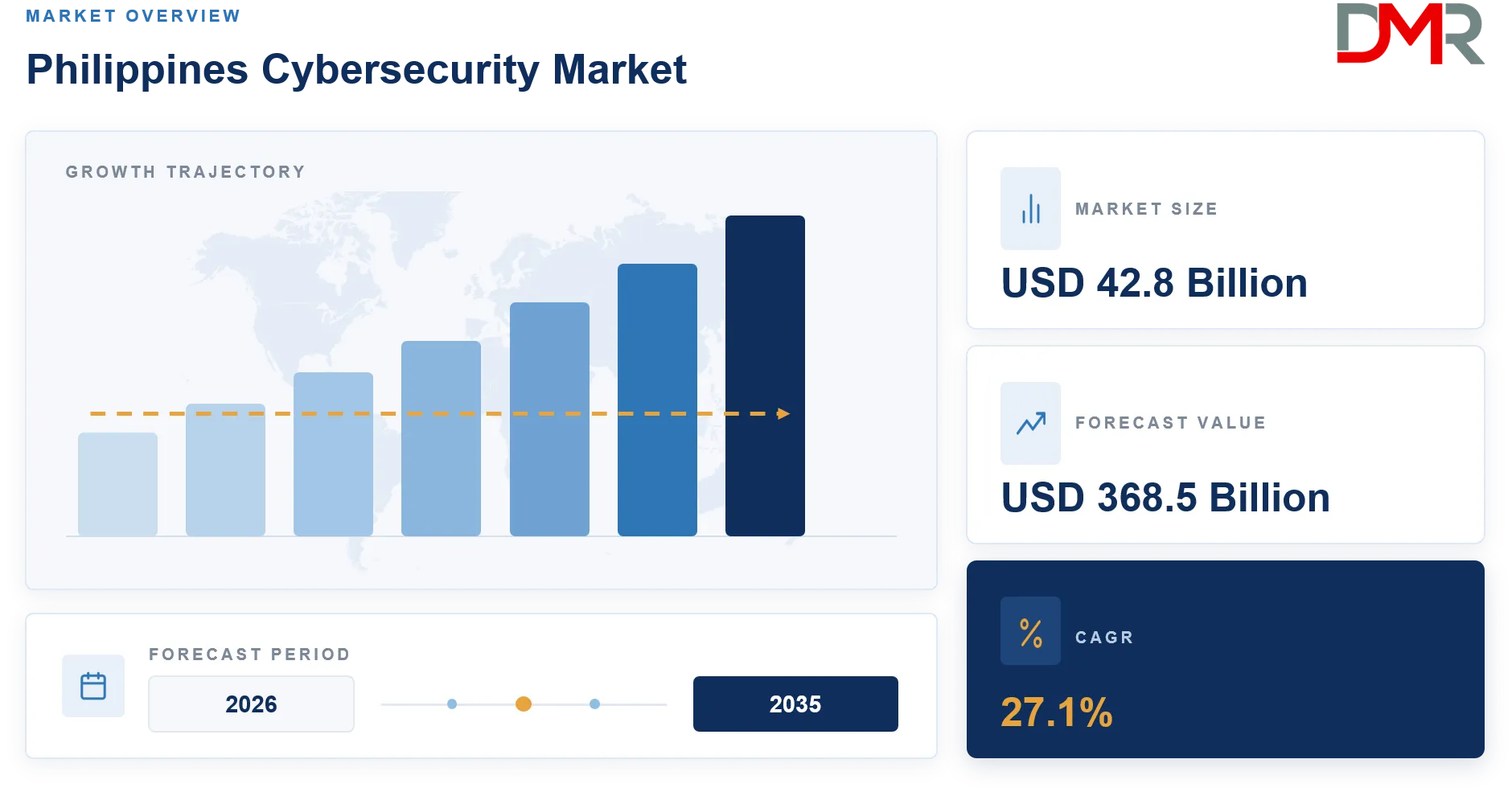
- Market Value: Philippines cybersecurity market is valued at USD 1.52 billion in 2026 and is expected to reach USD 3.35 billion by 2035.
- CAGR: Philippines cybersecurity market is expected to grow at a CAGR of 9.2% from 2026 to 2035.
- By Component Segment Analysis: Solutions segment dominated with 62.0% share in 2026.
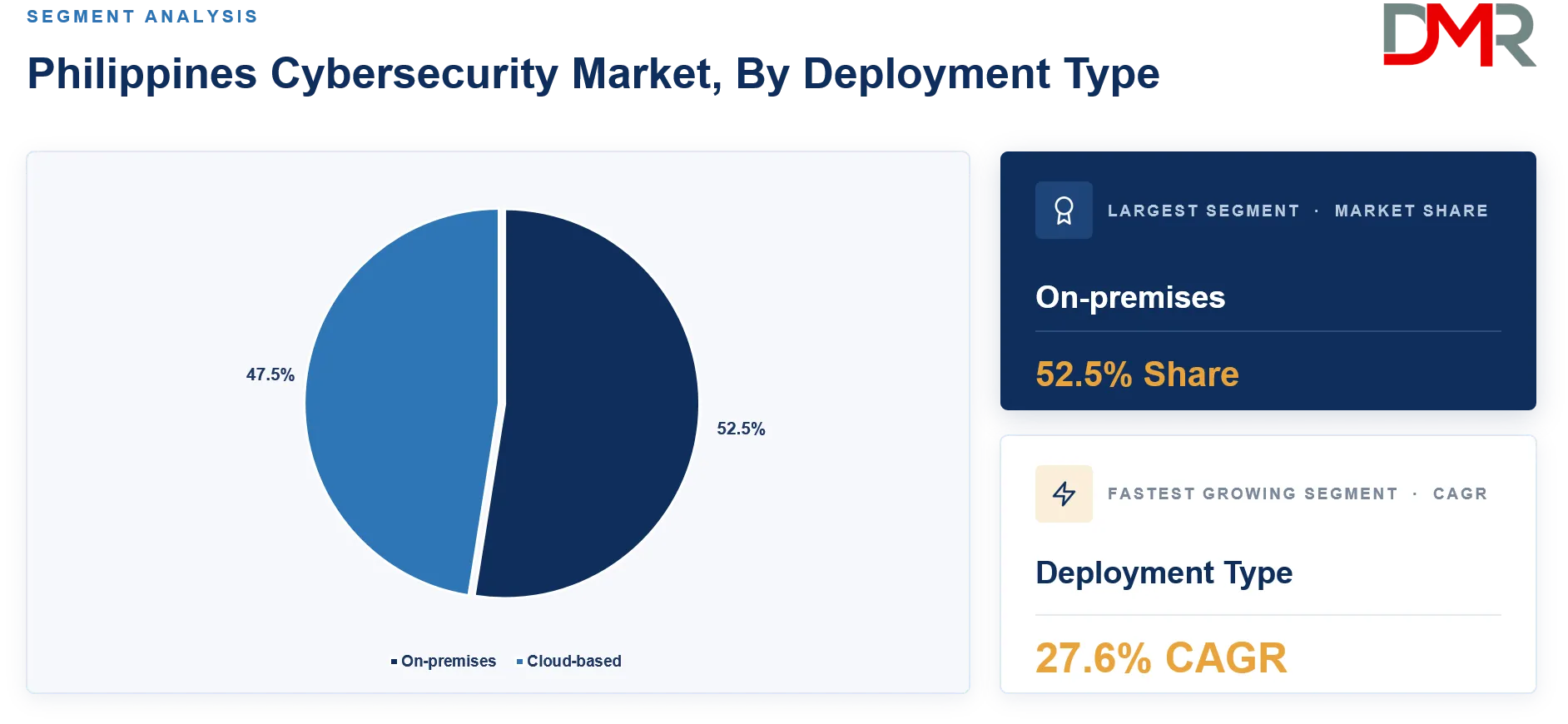
- By Deployment Type Segment Analysis: On-premises deployment led with 52.5% share in 2026.
- By Industry Vertical Segment Analysis: BFSI sector led with 29.5% share in 2026.
- Major Players: Blackpanda, Cisco Systems Philippines, Trend Micro Philippines, Palo Alto Networks, and Globe Telecom.
What is the Philippines Cybersecurity Market and its Market Size?
The Philippines cybersecurity market size is projected to be valued at USD 1.52 billion in 2026 and is forecast to reach USD 3.35 billion by 2035, expanding at a CAGR of 9.2% during the forecast period. Rising digital banking activity, cloud migration, connected enterprise infrastructure, online government services, data protection requirements, and increasingly sophisticated cyber threats are widening cybersecurity demand across the country. Based on the 2026 market structure, solutions account for about USD 0.94 billion, while large enterprises represent approximately USD 0.93 billion in cybersecurity spending.
ℹ
To learn more about this report –
Download Your Free Sample Report Here
Cybersecurity in the Philippines covers technologies and services used to protect networks, applications, identities, endpoints, cloud workloads, digital transactions, operational systems, and sensitive business data. Enterprise buyers are increasingly moving beyond perimeter protection toward identity and access management, continuous vulnerability management, security operations, governance, risk and compliance, threat detection, and incident response. The government's National Cybersecurity Plan 2023 to 2028 also provides a national framework for strengthening cyber resilience, protecting critical information infrastructure, improving coordination, and building cybersecurity capabilities.
Use Cases
- Financial Transaction Security: Banks, digital banks, insurers, payment providers, and fintech companies deploy IAM, fraud monitoring, endpoint security, SIEM, vulnerability management, encryption, and incident response tools to protect customer accounts, payment infrastructure, mobile banking applications, and confidential financial information.
- Enterprise Network Protection: Large Philippine businesses use network security, endpoint detection, secure access, vulnerability assessment, and managed SOC services to monitor distributed offices, data centers, remote employees, applications, and internet-facing infrastructure while limiting downtime caused by malware or unauthorized access.
- Cloud and Data Protection: Businesses migrating workloads to public, private, and hybrid cloud environments use cloud security assessment, access controls, data protection, workload monitoring, and security posture management to identify misconfigurations and protect business information across increasingly distributed technology environments.
- Government and Critical Infrastructure: Government agencies, energy operators, telecom companies, transportation networks, and other critical organizations require threat monitoring, infrastructure security, incident response, access management, and resilience planning as more public services and essential infrastructure depend on connected digital systems.
- Compliance and Risk Management: Organizations use governance, risk and compliance platforms, security audits, data privacy controls, breach management processes, and policy monitoring to meet regulatory requirements. Philippine privacy rules require qualifying personal data breaches to be notified within prescribed timelines, increasing demand for structured incident management.
How AI/Gen AI is Transforming the Philippines Cybersecurity Market?
Artificial intelligence is changing how Philippine enterprises detect threats, analyze security alerts, prioritize vulnerabilities, and investigate incidents. Security operations teams can use machine learning and automated analytics to correlate endpoint, network, identity, cloud, and application events that would be difficult to review manually at enterprise scale. This supports faster anomaly detection and allows analysts to concentrate on incidents with greater business impact. AI-supported security is particularly relevant to large banks, telecom providers, technology companies, and organizations operating 24-hour digital services. Security vendors are also adding automation to exposure management, threat intelligence, malware analysis, phishing detection, identity monitoring, and incident response workflows.
Generative AI also expands the threat surface. Attackers can use automated tools to produce convincing phishing messages, adapt social engineering campaigns, accelerate reconnaissance, and increase the volume of malicious activity. Enterprises adopting Gen AI applications must also address sensitive-data leakage, shadow AI, insecure integrations, model access, identity permissions, and third-party application risk. Trend Micro's recent threat research highlights the growing interaction between AI adoption and cyber risk, while Microsoft has noted that AI is being used by both defenders and threat actors. This dynamic is expected to increase demand for identity-first security, data controls, proactive exposure management, and security monitoring around AI workloads.
Key Drivers in the Philippines Cybersecurity Market
Expansion of Digital Banking and Connected Business Operations
The rapid shift toward digital payments, mobile banking, cloud applications, e-commerce, connected workplaces, and online customer services is increasing the number of systems that Philippine organizations must secure. Financial institutions face additional pressure because service interruptions, account compromise, and data theft can directly affect customers and regulatory compliance. The Bangko Sentral ng Pilipinas continues to strengthen operational resilience expectations for supervised financial institutions, supporting investment in monitoring, access control, recovery planning, threat detection, and cyber risk governance.
National Cybersecurity and Data Protection Requirements
Government policy is making cyber resilience a strategic issue rather than only an IT responsibility. The National Cybersecurity Plan 2023 to 2028 establishes a framework for protecting critical information infrastructure and improving national cybersecurity capabilities. At the enterprise level, the Data Privacy Act and National Privacy Commission breach requirements increase accountability for organizations holding personal information. These obligations support demand for GRC platforms, data security, security assessments, breach monitoring, incident response, IAM, and managed cybersecurity services.
Restraints in the Philippines Cybersecurity Market
Cybersecurity Skills and Specialist Capacity Gap
Demand for security architects, SOC analysts, cloud security specialists, penetration testers, incident responders, and governance professionals is increasing as enterprise environments become more complex. Limited specialist capacity can make it difficult for smaller organizations to establish round-the-clock internal security operations. The issue is encouraging managed security adoption but can also raise implementation costs. Skills initiatives involving Microsoft, TESDA, educational institutions, and other technology organizations show that workforce development remains an important part of strengthening the country's cybersecurity ecosystem.
Budget and Implementation Complexity for SMEs
Small and medium enterprises often operate with smaller technology teams and must balance cybersecurity spending against cloud migration, software modernization, connectivity, and other business priorities. Enterprise security platforms may involve licensing, integration, monitoring, training, and specialist staffing costs that are difficult for smaller companies to absorb. Fragmented legacy systems also complicate deployment. This creates a gap between risk exposure and security maturity, increasing demand for subscription-based security, managed services, bundled telecom security offerings, and scalable cloud-based protection.
Growth Opportunities in the Philippines Cybersecurity Market
Managed Security and SOC-as-a-Service Expansion
Managed cybersecurity presents a major opportunity as organizations seek continuous monitoring without building a full security operations center internally. Philippine providers are already developing SOC-based services that combine security platforms, threat intelligence, specialist personnel, incident detection, and response. PLDT Enterprise offers SOC-as-a-Service, while Globe Business provides local SOC-supported security services. Greater adoption among mid-sized firms, financial services, healthcare, retail, energy, and distributed businesses can widen the addressable managed security market through 2035.
Cloud Security, Identity Security and Zero Trust Adoption
Cloud migration creates new opportunities for cloud security posture management, identity protection, privileged access controls, secure access, workload protection, and data security. Philippine businesses increasingly operate applications across corporate data centers, SaaS platforms, public clouds, remote endpoints, and partner networks. This reduces the effectiveness of security models based only on network boundaries. Demand is therefore shifting toward identity-aware controls and continuous verification. Globe Business, Microsoft, Palo Alto Networks, Cisco, Fortinet, IBM, and other providers are positioned to address this transition through integrated security portfolios.
Trends in the Philippines Cybersecurity Market
Shift from Prevention to Cyber Resilience
Philippine enterprises are increasingly treating cybersecurity as a resilience requirement covering prevention, detection, containment, recovery, and business continuity. This change is visible in financial-sector operational resilience requirements and commercial security offerings built around continuous monitoring and incident response. Businesses are evaluating security investments based not only on whether attacks can be blocked but also on how quickly operations can identify, isolate, recover from, and learn from an incident. This trend supports spending on SOC, SIEM, EDR, threat intelligence, backup security, and response services.
Convergence of Cloud, Identity, Endpoint and Security Operations
Security programs are becoming more integrated as users, workloads, applications, data, and devices move beyond traditional corporate networks. Enterprises increasingly want centralized visibility across identity, endpoint, network, and cloud environments rather than separate tools generating disconnected alerts. Providers are responding with consolidated security platforms, SIEM, security automation, cloud protection, IAM, exposure management, and managed monitoring. The trend favors vendors that can reduce tool fragmentation while providing local expertise, compliance support, threat intelligence, and rapid incident response.
Research Scope and Analysis
The Philippines cybersecurity market is segmented based on Component, Deployment Type, User Type, Industry Vertical, and other relevant categories. The analysis covers applications, enterprise adoption, demand patterns, security architecture, technology modernization, compliance requirements, and the contribution of key segments to overall market growth.
By Component
The Solutions segment dominated the component category with 62.0% share in 2026, equivalent to approximately USD 0.94 billion based on the total market estimate. Its leadership reflects sustained demand for infrastructure security, IAM, data protection, vulnerability management, governance, risk and compliance, endpoint controls, and integrated security platforms. Large enterprises increasingly operate complex hybrid environments where thousands of identities, endpoints, workloads, applications, and network connections require continuous protection. Solutions also remain central to regulatory compliance and security architecture modernization. Services are expected to gain importance as companies seek specialist implementation, assessment, monitoring, incident response, and managed security capabilities.
ℹ
To learn more about this report –
Download Your Free Sample Report Here
By Deployment Type
On-premises deployment held 52.5% share in 2026, representing approximately USD 0.80 billion of market revenue. The segment remains important among banks, government organizations, telecom operators, large corporations, and organizations managing sensitive or regulated workloads. These users often require direct control over security infrastructure, access policies, data location, and integration with existing enterprise systems. Cloud-based cybersecurity is expected to narrow the gap as businesses expand SaaS adoption and migrate workloads to cloud platforms. Hybrid environments will support demand for security tools capable of providing consistent visibility and policy enforcement across on-premises data centers, public clouds, remote users, and third-party applications.
By User Type
Large enterprises captured 61.5% of the Philippines cybersecurity market in 2026, equal to about USD 0.93 billion. Their dominant position is supported by large digital footprints, higher numbers of employees and customer accounts, complex supply chains, strict compliance requirements, and greater exposure to financially motivated and targeted attacks. Large banks, telecom operators, retailers, technology companies, manufacturers, utilities, and business service organizations typically invest across multiple layers of cybersecurity. SME demand is also developing as cloud applications, digital payments, e-commerce, and remote access expose smaller companies to many of the same threats, creating opportunities for managed and subscription-based security services.
By Industry Vertical
BFSI led the industry vertical segment with 29.5% share in 2026, representing about USD 0.45 billion. Banks, insurers, payment companies, fintech providers, and other financial institutions manage valuable financial assets, personal data, digital identities, and high transaction volumes, making them prominent targets for phishing, account takeover, ransomware, credential theft, fraud, and service disruption. BSP oversight and operational resilience requirements further raise the importance of security governance, monitoring, incident response, access controls, vulnerability management, and business continuity. Healthcare, government, telecom, energy, manufacturing, and retail also provide significant growth potential as their operations become more digitally connected.
The Philippines Cybersecurity Market Report is segmented on the basis of the following:
By Component
- Solutions
- Unified Vulnerability Management Service Offering
- Data Security and Privacy Service Offering
- Governance, Risk and Compliance
- Infrastructure Security
- Identity and Access Management (IAM)
- Others
- Services
- Managed Services
- Professional Services
By Deployment Type
By User Type
- Small and Medium Enterprises
- Large Enterprises
By Industry Vertical
- Energy
- Manufacturing
- Defense/Government
- Healthcare
- BFSI
- Retail
- IT and Telecom
- Others
Competitive Landscape
The Philippines cybersecurity market has a competitive mix of global security vendors, technology companies, telecom operators, managed security specialists, and local service providers. Blackpanda competes in incident response and cyber resilience, while Cisco Systems Philippines, Palo Alto Networks, Fortinet Philippines, IBM Philippines, Microsoft Philippines, and Trend Micro Philippines provide security technologies spanning networks, endpoints, identities, cloud environments, threat intelligence, analytics, and enterprise platforms. Globe Telecom and PLDT Enterprise strengthen competition through telecommunications relationships, connectivity infrastructure, managed cybersecurity, and local SOC capabilities. PLDT Enterprise markets SOC-as-a-Service that combines platforms, skilled personnel and a local facility, while Globe Business offers SOC-supported monitoring and security services across cloud, identity, data, applications, and enterprise infrastructure. Competition is moving toward integrated platforms, managed detection and response, cloud security, exposure management, IAM, automation, and continuous monitoring. Vendors that combine technology with local implementation, regulatory knowledge, incident response expertise, and 24-hour security operations are well placed to capture growing enterprise demand.
Some of the prominent players in the Philippines cybersecurity industry are:
- Blackpanda
- Cisco Systems Philippines
- Lumen Technologies Philippines
- Trend Micro Philippines
- Palo Alto Networks
- Globe Telecom
- IBM Philippines
- Fortinet Philippines
- PLDT Enterprise
- Microsoft Philippines
- Others
Regulatory Landscape
The Philippines cybersecurity market operates under a strengthening regulatory framework shaped by the Data Privacy Act of 2012, the National Cybersecurity Plan 2023-2028, sector-specific rules, and requirements for critical digital infrastructure. The National Privacy Commission requires organizations processing personal information to maintain appropriate organizational, physical, and technical safeguards, including network protection, vulnerability monitoring, access controls, encryption, resilience, and regular security assessments. The Bangko Sentral ng Pilipinas further raises cybersecurity requirements in BFSI through its Financial Services Cyber Resilience Plan 2024-2029 and technology risk framework. Newer connectivity rules also reinforce CERT, zero-trust, secure development, risk assessment, VAPT, continuity, and incident-reporting practices. These requirements are expanding enterprise demand for GRC, IAM, data security, vulnerability management, SOC services, compliance assessment, and incident response solutions.
Investment and White Space Analysis
Investment opportunities in the Philippines cybersecurity market are widening as cloud adoption, data-center expansion, digital banking, AI workloads, e-government, and enterprise modernization increase the volume of critical infrastructure requiring protection. The 50 MW VITRO Sta. Rosa hyperscale facility and the A-FLOW ML1 data center, designed to scale from 6 MW to 36 MW of IT load, illustrate continued investment in digital capacity. Government investment policy also identifies cybersecurity, AI, and data centers among priority technology activities, improving the environment for specialized security businesses. White space remains particularly attractive in managed detection and response, SME-focused managed security, cloud posture management, IAM, OT and critical-infrastructure security, vulnerability management, and compliance automation. Vendors that combine subscription pricing, local SOC capacity, Filipino cybersecurity talent, regulatory expertise, and rapid incident response can address customers underserved by costly enterprise platforms and limited internal security teams.
Recent Developments
- July 2026: Lumen Technologies launched Lumen Defender Advanced MDR for Palo Alto Networks Cortex XSIAM, bringing managed detection and response capabilities with network-embedded threat intelligence to strengthen cyber defense operations.
- April 2026: Palo Alto Networks rolled out AI-focused cybersecurity solutions across ASEAN including the Philippines, addressing rising cloud and artificial intelligence-related security risks for regional enterprises.
- January 2026: Cisco Systems Philippines partnered with Entropy Technology to deploy the Cisco Secure AI Factory locally, marking the first Philippine deployment to develop AI solutions for telecom firms, ISPs, and enterprises with cybersecurity applications.
Report Details
| Report Characteristics |
| Market Size (2026) |
USD 1.52 Bn |
| Forecast Value (2035) |
USD 3.35 Bn |
| CAGR (2026–2035) |
9.2% |
| Historical Data |
2021 – 2025 |
| Forecast Data |
2027 – 2035 |
| Base Year |
2025 |
| Estimate Year |
2026 |
| Segments Covered |
By Component (Solutions {Unified Vulnerability Management Service Offering, Data Security and Privacy Service Offering, Governance, Risk and Compliance, Infrastructure Security, Identity and Access Management (IAM), and Others}, Services {Managed Services and Professional Services}), By Deployment Type (On-premises and Cloud-based), By User Type (Small and Medium Enterprises and Large Enterprises), By Industry Vertical (Energy, Manufacturing, Defense/Government, Healthcare, BFSI, Retail, IT and Telecom, and Others) |
| Regional Coverage |
Philippines |
Frequently Asked Questions
What is the current size of the Philippines Cybersecurity Market?
▾ Philippines cybersecurity market is USD 1.52 billion in 2026 and is forecast to reach USD 3.35 billion by 2035.
What is the growth rate of the Philippines Cybersecurity Market during?
▾ The Philippines cybersecurity market is expected to grow at a CAGR of 9.2% during the forecast period from 2026 to 2035.
What factors are driving the growth of the Philippines Cybersecurity Market?
▾ Digital banking, cloud adoption, cyber threats, and data rules are key drivers of the Philippines cybersecurity market.
What are the major challenges restraining the Philippines Cybersecurity Market?
▾ Skills shortages, security costs, legacy systems, and SME budget limits restrain the Philippines cybersecurity market.
Which segment holds the largest share of the Philippines Cybersecurity Market?
▾ Solutions hold the largest Philippines cybersecurity market component share, accounting for 62.0% of revenue in 2026.
Who are the leading companies in the Philippines Cybersecurity Market?
▾ Blackpanda, Cisco Systems Philippines, Lumen Technologies Philippines, Trend Micro Philippines, Palo Alto Networks, Globe Telecom, IBM Philippines, Fortinet Philippines, PLDT Enterprise, and Microsoft Philippines are leading companies in the Philippines cybersecurity market.
How is AI influencing the Philippines Cybersecurity Market?
▾ AI improves threat detection and security automation while adding new cyber risks to the Philippines cybersecurity market.
What are the future opportunities and trends in the Philippines Cybersecurity Market?
▾ Managed security, cloud protection, IAM, and zero trust offer strong future growth in the Philippines cybersecurity market.