The market is gaining momentum due to rising investments in transmission infrastructure, increasing electricity demand, and the rapid integration of renewable energy sources. The expansion of solar and wind power projects is driving the need for advanced transformer systems capable of managing fluctuating power generation and maintaining grid reliability. Additionally, the growing adoption of smart grids, digital monitoring solutions, and energy storage systems is improving grid flexibility while supporting efficient power management. The shift toward sustainable energy infrastructure is also accelerating the replacement of aging transformer systems with more efficient and environmentally friendly alternatives. Developed economies are investing in high-voltage transmission networks, renewable energy corridors, and cross-border electricity connections to strengthen grid resilience and support decarbonization goals. The increasing need to upgrade aging infrastructure and reduce power losses is creating new opportunities for advanced transformer technologies.
However, the industry continues to face challenges, including limited availability of high-quality electrical steel, supply chain disruptions, extended production cycles, and high capital requirements. To address these constraints, manufacturers are focusing on improved manufacturing processes, advanced monitoring technologies, and alternative materials to enhance efficiency and reduce lifecycle costs.
Use Cases
- Voltage Step-Up for Transmission: One of the main functions of power transformers is to step up the voltage of electricity generated at power plants for effective transmission over long distances. Higher voltages minimize transmission losses, as they enable lower currents to carry the same amount of power, which is important for transmitting electricity over long distances from power generation centers to distribution centers or substations.
- Voltage Step-Down for Distribution: Power transformers also play an important role in stepping down high transmission voltages to lower distribution voltages suitable for use in homes, businesses, & industries. Distribution transformers deployed at substations or pole-mounted units minimize voltage levels to safer & more usable levels for consumers, which allows the safe & efficient delivery of electricity to end-users.
- Grid Interconnection and Power Exchange: Power transformers support the interconnection of different electrical grids, allowing the exchange & sharing of electricity between regions or countries. Interconnected grids can support balance supply & demand, improve grid stability, and provide backup power during emergencies. Transformers at grid interconnection points may need to adapt voltage levels between different grid systems to allow smooth power exchange.
- Industrial Applications and Voltage Regulation: In industrial settings, power transformers are used for many applications, like voltage regulation & power quality improvement. Industries often need stable & reliable power supply to operate machinery & equipment efficiently. Voltage-regulating transformers help maintain constant voltage levels even after fluctuations in the input supply. In addition, transformers equipped with filtering & conditioning features can reduce power quality issues such as harmonics & voltage sags, ensuring uninterrupted operation of industrial processes.
Market Dynamic
Key Drivers: Rising Investments in Grid Modernization
Governments and utility companies are significantly increasing investments in modernizing aging transmission and distribution infrastructure to improve grid reliability and efficiency. Many existing transformers have exceeded their intended service life, creating the need for advanced, energy-efficient replacements. Large-scale smart grid initiatives, high-voltage transmission projects, and rural electrification programs are further driving transformer demand. As electricity consumption continues to rise across residential, commercial, and industrial sectors, utilities are prioritizing grid upgrades, making power transformers a critical component of long-term energy infrastructure development.
Growing Integration of Renewable Energy
The rapid expansion of renewable energy generation is creating substantial demand for high-capacity power transformers. Wind farms, solar parks, and hydroelectric facilities require reliable voltage transformation for efficient transmission of electricity over long distances. Increasing investments in renewable energy projects and cross-border transmission networks are encouraging utilities to install advanced transformers capable of handling fluctuating power generation. As countries pursue decarbonization targets and expand clean energy capacity, demand for technologically advanced power transformers continues to accelerate.
Restraints: High Capital and Installation Costs
Power transformers require substantial investment in manufacturing, transportation, installation, and commissioning, making them one of the most expensive assets within electrical infrastructure. Large-capacity transformers also involve specialized logistics, extensive civil works, and skilled technical personnel, increasing overall project costs. Budget constraints faced by utilities and industrial operators may delay procurement decisions, particularly in developing economies where infrastructure financing remains limited, restricting faster market expansion.
Supply Chain and Raw Material Price Volatility
The market remains vulnerable to fluctuations in the prices of key raw materials such as electrical steel, copper, aluminum, and transformer oil. Global supply chain disruptions, transportation bottlenecks, and geopolitical uncertainties can increase manufacturing costs and extend delivery timelines. Long production cycles for customized transformers further amplify project delays. These factors challenge manufacturers in maintaining competitive pricing while meeting increasing customer demand and project schedules.
Growth Opportunities: Expansion of Smart Grid Infrastructure
The global transition toward digital electricity networks presents significant opportunities for power transformer manufacturers. Smart grids require intelligent transformers equipped with real-time monitoring, remote diagnostics, and predictive maintenance capabilities. Utilities are investing in digital substations and automated transmission systems to improve operational efficiency and reduce outages. The growing adoption of IoT-enabled transformer technologies is expected to create new revenue opportunities for manufacturers offering advanced monitoring and asset management solutions.
Electrification and Infrastructure Development in Emerging Economies
Rapid industrialization, urbanization, and increasing access to electricity across emerging economies continue to generate strong demand for new transmission infrastructure. Governments are investing heavily in power generation facilities, transmission corridors, industrial parks, and rural electrification projects to support economic development. These initiatives are driving large-scale deployment of medium- and high-capacity power transformers, creating long-term growth opportunities for both global and regional manufacturers.
Market Trends
Adoption of Digital and Smart Power Transformers
Utilities are increasingly deploying digitally enabled power transformers featuring intelligent sensors, cloud connectivity, and advanced analytics for continuous asset monitoring. These systems provide real-time information on transformer health, loading conditions, and insulation performance, allowing predictive maintenance and reducing unplanned downtime. The growing focus on asset optimization and operational efficiency is accelerating adoption of smart transformer technologies across modern transmission networks.
Rising Demand for Eco-Friendly Transformer Technologies
Environmental sustainability is becoming a major focus across the power sector, encouraging manufacturers to develop transformers with biodegradable insulating fluids, reduced energy losses, and environmentally friendly materials. Utilities are also replacing aging equipment with energy-efficient transformers that comply with stringent environmental and efficiency standards. Continuous innovation in insulation systems, cooling technologies, and recyclable materials is supporting the transition toward more sustainable and reliable power transmission infrastructure.
Research Scope and Analysis
By Core
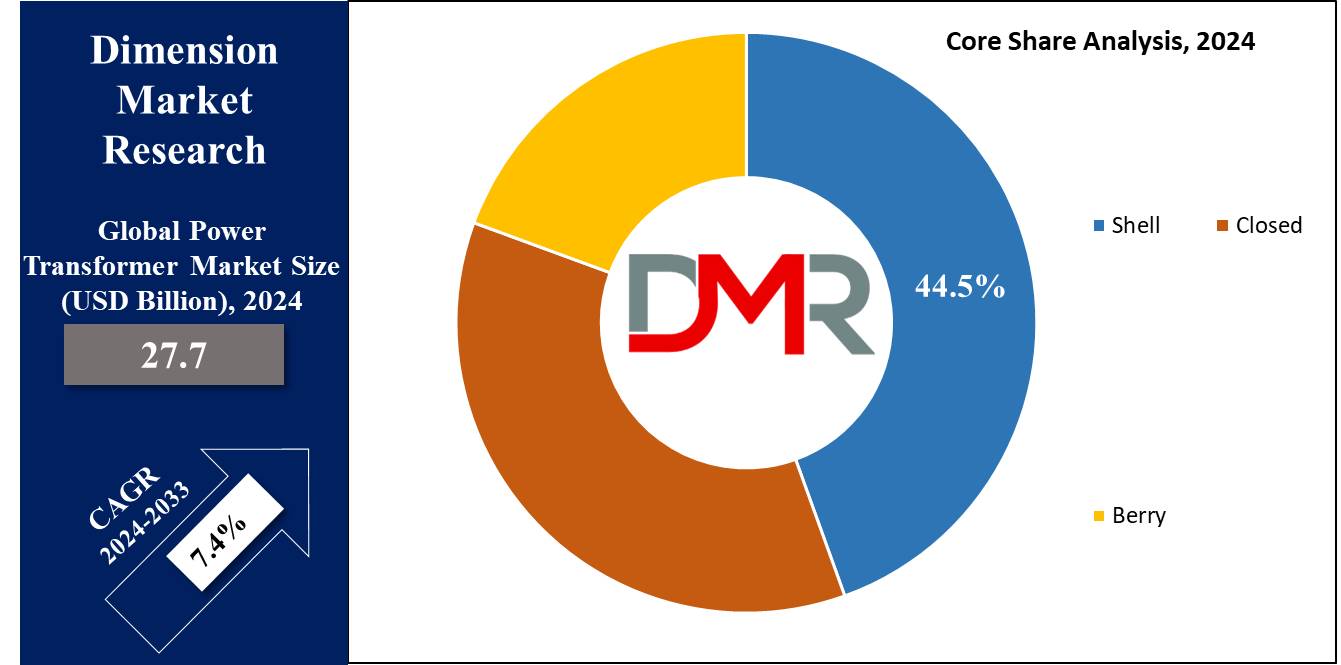
Based on core type, power transformers include closed, shell, and berry cores, with the shell core expected to dominate in 2024, highlighting the fastest expansion. Shell cores are favored for low-voltage & high-output applications, providing versatility across industries like Power Sports and Outdoor Power Equipment.
Having a square or rectangular cross-sectional core, shell core transformers are preferred for their affordability, allowing the optimization of circuit expenses. Moreover, the shell core design provides many advantages, like an efficient cooling system, providing better heat dissipation, design flexibility to accommodate numerous application demands, high resilience against seismic activity, effective control of leakage magnetic flux, and better resistance to short circuits.
ℹ
To learn more about this report –
Download Your Free Sample Report Here
Also, such characteristics make shell core transformers highly desirable for industries looking for reliable and low-cost power distribution solutions. In addition, the versatility and adaptability of shell core transformers make them suitable for various applications, from electronic devices to industrial machinery. As industries constantly evolve and demand for efficient power solutions increases, the market for shell-core transformers is expected to show sustained growth. Moreover, current developments in technology & design innovations are likely to further improve the capabilities and applications of shell core transformers, supporting their position as a foundation in modern electrical systems.
By Phase
The power transformer market segment categorized by phase type includes single and three phases, with the three-phase segment expected to dominate the market share by 2024 and experience high growth in the coming years. Three-phase transformers are largely used across many sectors, like precision machine tools, mining, manufacturing, automation, petrochemicals, and telecommunications, mainly for power generation & distribution purposes.
Further known for their affordability, lightweight construction, and compact design, three-phase transformers are the main choice for industrial equipment due to their low cost and space efficiency, mainly in applications with higher power ratings. In addition, in three-phase configurations, the incorporation of multiple single-phase toroid or ferroresonant devices can provide further advantages.
These transformers expand in low voltage distribution environments characterized by high fluctuations & low voltage scenarios, due to their superior isolation properties, strong common-mode interference suppression, & customizable designs customized to meet the specific parameters of end-users.
Further, the wide-ranging applications & inherent benefits of three-phase transformers are expected to drive their constant growth over the forecast period, highlighting a promising trajectory for market expansion. As industries constantly evolve & demand for efficient power distribution solutions grows, the adoption of three-phase transformers is expected to grow steadily, bonding their position as an important component in modern electrical systems.
By Insulation
In terms of insulation type, the power transformer market is segmented into categories like gas, oil, solid, air, and other insulation types, where oil insulation is predicted to hold the largest market share in 2024, and is expected to exhibit high growth throughout the forecast period. Majorly used across industries for its capacity to resist high temperatures, oil serves as a vital insulation medium. Its electrical insulation properties, mainly its dielectric ability, effectively reduce high voltage, making oil insulators the preferred choice among manufacturers. In addition, oil acts as a protective barrier, avoiding damage like burning components like copper coils.
It finds high usage in many applications, like fluorescent lamp ballasts, high-voltage capacitors, oil-filled transformers, switches, & circuit breakers. While transformers mainly use mineral oil, majorly naphthenic, along with silicone and bio-based oils for insulation, a main industry trend reflects a switch towards eco-friendly alternatives like ester oil, which is driven by the growth in prominence of environmental concerns among transformer manufacturers globally. By using more sustainable options, like ester oil, the industry focuses on addressing environmental challenges while maintaining performance & reliability standards, which not only highlights a commitment to sustainability but also supports innovation towards greener transformer technologies to meet evolving market demands.
By Rating
The market is segmented into 100 MVA to 500 MVA, 501 MVA to 800 MVA, and 801 MVA to 1200 MVA transformers. The 100 MVA to 500 MVA transformers are expected to hold the major market share in 2024 and experience the most rapid growth. These transformers are used in various industrial applications, including power tools and vehicle motors.
Further, the rising electricity demand, driven by global industrialization & urbanization trends, is driving the demand for transformers within the 100 MVA to 500 MVA range. Furthermore, current technological development and design refinements are contributing to the growing usage of these transformers. As industries change & need more efficient power distribution solutions, the need for transformers in this rating range is expected to rise steadily, which also highlights the importance these transformers play in helping various sectors & facilitating the reliable supply of electricity to meet the changing needs of modern infrastructure & industrial operations.
By End User
The power transformer market is segmented by end user into residential & commercial, utilities, and industrial sectors, where the industrial sub-segment commands the highest market share in 2024, with further anticipates to show the fastest growth rate throughout the forecast period, as power transformers used in industrial settings play a major role in providing the safe, reliable, and accurate usage of electricity within industries, which is closely linked to the inception of smart transformers, providing market players with a competitive edge.
In addition, higher global investments directed toward energy generation, industrial expansion, and urban development are making market players allocate resources toward research and development efforts focused on producing eco-friendly transformers, which also highlights the industry's commitment to sustainability and aligns with the growing demand for environmentally conscious solutions in industrial applications.
The Power Transformer Market Report is segmented on the basis of the following
By Core
By Phase
By Insulation
By Rating
- 100 MVA to 500 MVA
- 501 MVA to 800 MVA
- 801 MVA to 1200 MVA
By End User
- Industrial
- Residential & Commercial
- Utilities
Regional Analysis
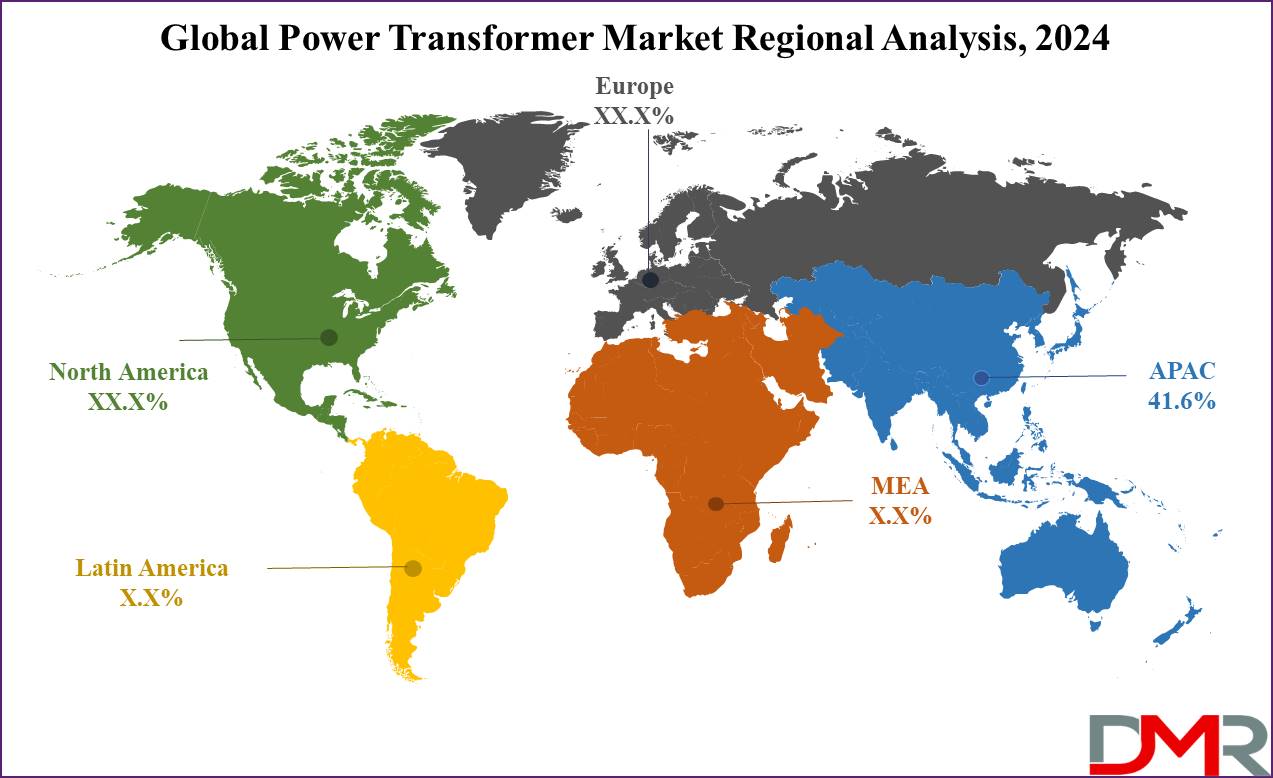
Asia Pacific's power transformer industry is set to capture over 41.6% of the global revenue share and is also projected to experience significant growth, which is fueled by rapid economic development & the growing need for consistent & dependable power supply, driven by the region's growing population. China, in particular, is leading this growth with investments focused on supporting its electrical transmission and distribution infrastructure to meet the growing electricity demand resulting from its rapid industrialization & urbanization.
The industry in China is expected to exceed further through the growth of new transmission lines & substations, addressing the increasing gap between energy supply & demand. Also, the rising concerns regarding greenhouse gas emissions & environmental risks are increasing the growth prospects across the Asia Pacific. The region's growing industrialization, infrastructure development, & construction activities have highly supported the demand for power transformers. Notably, the market expansion in China is driven by growing energy needs and a focus on renewable energy production.
ℹ
To learn more about this report –
Download Your Free Sample Report Here
By Region
North America
Europe
- Germany
- The U.K.
- France
- Italy
- Russia
- Spain
- Benelux
- Nordic
- Rest of Europe
Asia-Pacific
- China
- Japan
- South Korea
- India
- ANZ
- ASEAN
- Rest of Asia-Pacific
Latin America
- Brazil
- Mexico
- Argentina
- Colombia
- Rest of Latin America
Middle East & Africa
- Saudi Arabia
- UAE
- South Africa
- Israel
- Egypt
- Rest of MEA
Competitive Landscape
The global power transformer market experiences a competitive landscape characterized by strong rivalry among key players looking to innovate & expand their market presence. These companies engage in strategic initiatives like mergers & acquisitions, partnerships, and product developments to gain a competitive edge. In addition, the market is witnessing growth towards the development of eco-friendly transformers in response to growing environmental concerns.
Key factors influencing competition like technological development, pricing strategies, and geographical expansion efforts. Moreover, strict government regulations focused on reducing greenhouse gas emissions are reshaping the competitive dynamics of the market, making manufacturers invest in sustainable solutions to meet changing consumer demands while maintaining profitability.
Some of the prominent players in the global Power Transformer Market are:
- ABB Ltd
- GE Company
- Toshiba Corporation
- Crompton Greaves Ltd
- SPX Transformer Solutions
- Siemens AG
- Bharat Heavy Electricals Ltd
- Hitachi Ltd
- WEG SA
- Schneider Electric SE
- Other Key Players
Recent Developments
- February 2026: Hammond Power Solutions signed a deal to acquire AEG Power Solutions, expanding its capabilities in transformers and power electronics while strengthening its international presence through a broader electrical solutions portfolio.
- February 2026: ASTA Energy Solutions AG secured long-term partnerships with Prolec GE Vernova and TSEA, improving component availability and reinforcing its supply network for high-voltage transformer projects across Latin America.
- January 2026: RESA Power completed the acquisition of 3MD Power Services LLC, enhancing its expertise in transformer testing, maintenance, installation, and field services to support growing utility and industrial demand in the U.S.
- October 2025: Premier Energies expanded its power equipment business by investing in transformer and inverter manufacturing through strategic acquisitions, strengthening its position within the rapidly evolving clean energy value chain.