What is the Privacy-Enhancing Technology Market Size?
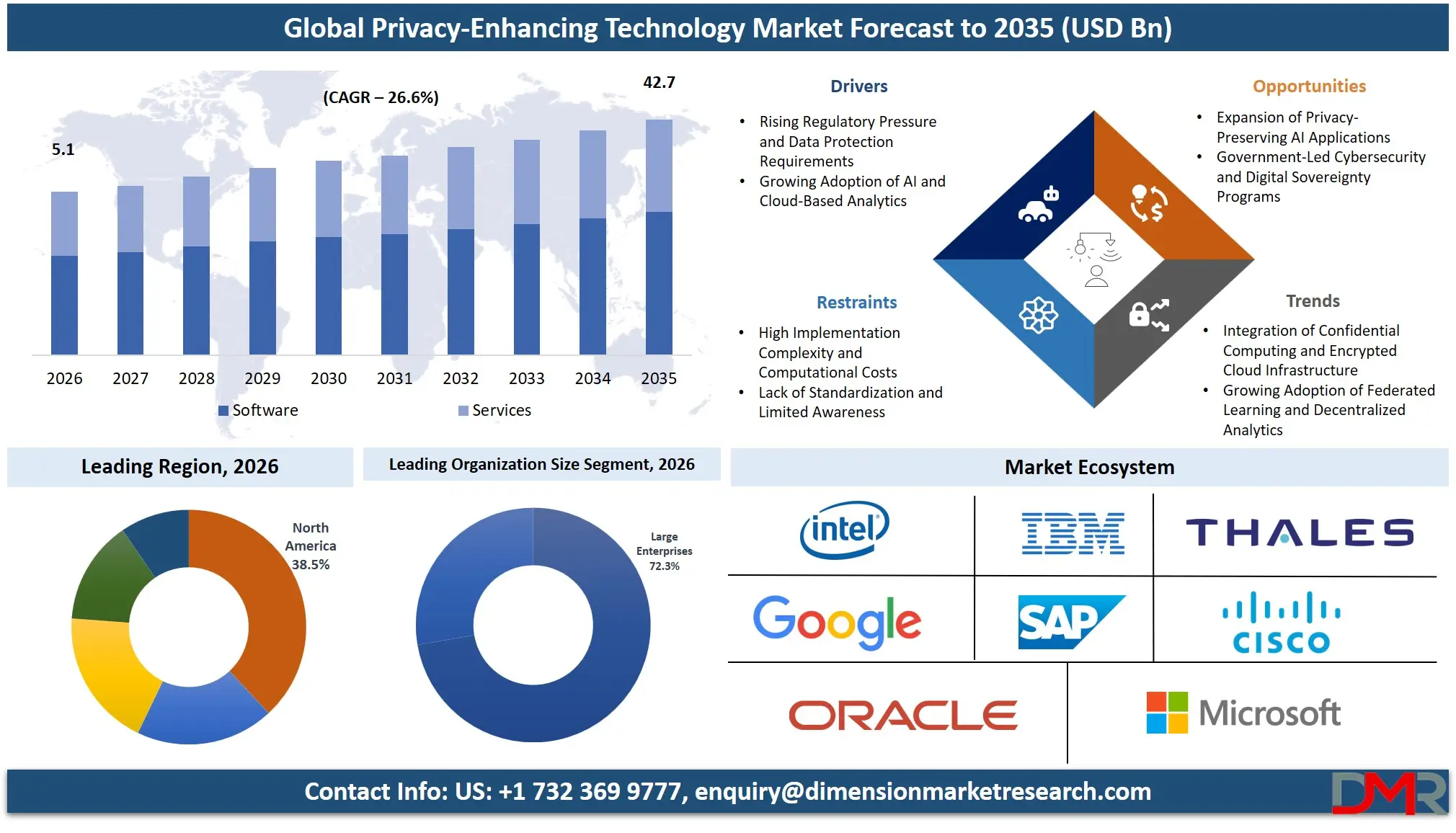
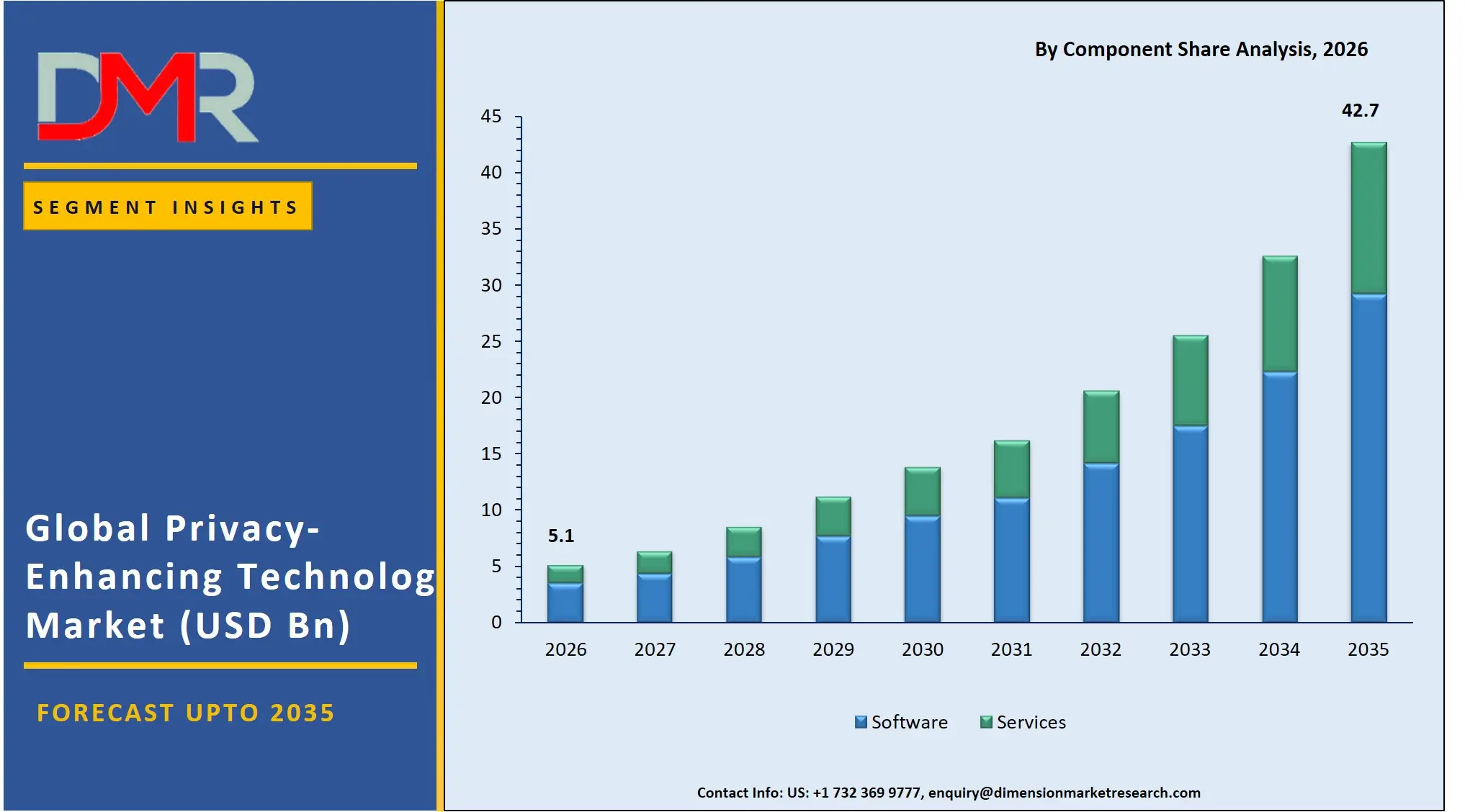
The Privacy-Enhancing Technology Market size is expected to reach USD 5.1 billion in 2026 and expand at a compound annual growth rate of 26.6% to reach USD 42.7 billion by 2035, driven by stricter data privacy regulations, increasing cybersecurity threats, growing adoption of AI using sensitive datasets, and rising demand for secure cloud-based data processing.
ℹ
To learn more about this report –
Download Your Free Sample Report Here
Privacy-Enhancing Technology market offers highly sophisticated technology-based tools that aim at ensuring that personal and confidential data remain protected throughout collection, storage, analysis, and transfer processes. Some of the prominent tools used for securing data privacy include homomorphic encryption, federated learning, differential privacy, multi-party computing, confidential computing platform, and zero-knowledge proofs.
The growing use of privacy-ensuring technologies is due to the increasing cybersecurity risks, stringent government regulations, and growth in AI-powered analytics solutions. Recent developments like encrypted AI inference, decentralized digital identification system, confidential cloud computing, and global cross-border data collaboration have further propelled market growth.
ℹ
To learn more about this report –
Download Your Free Sample Report Here
The US Privacy-Enhancing Technology Market
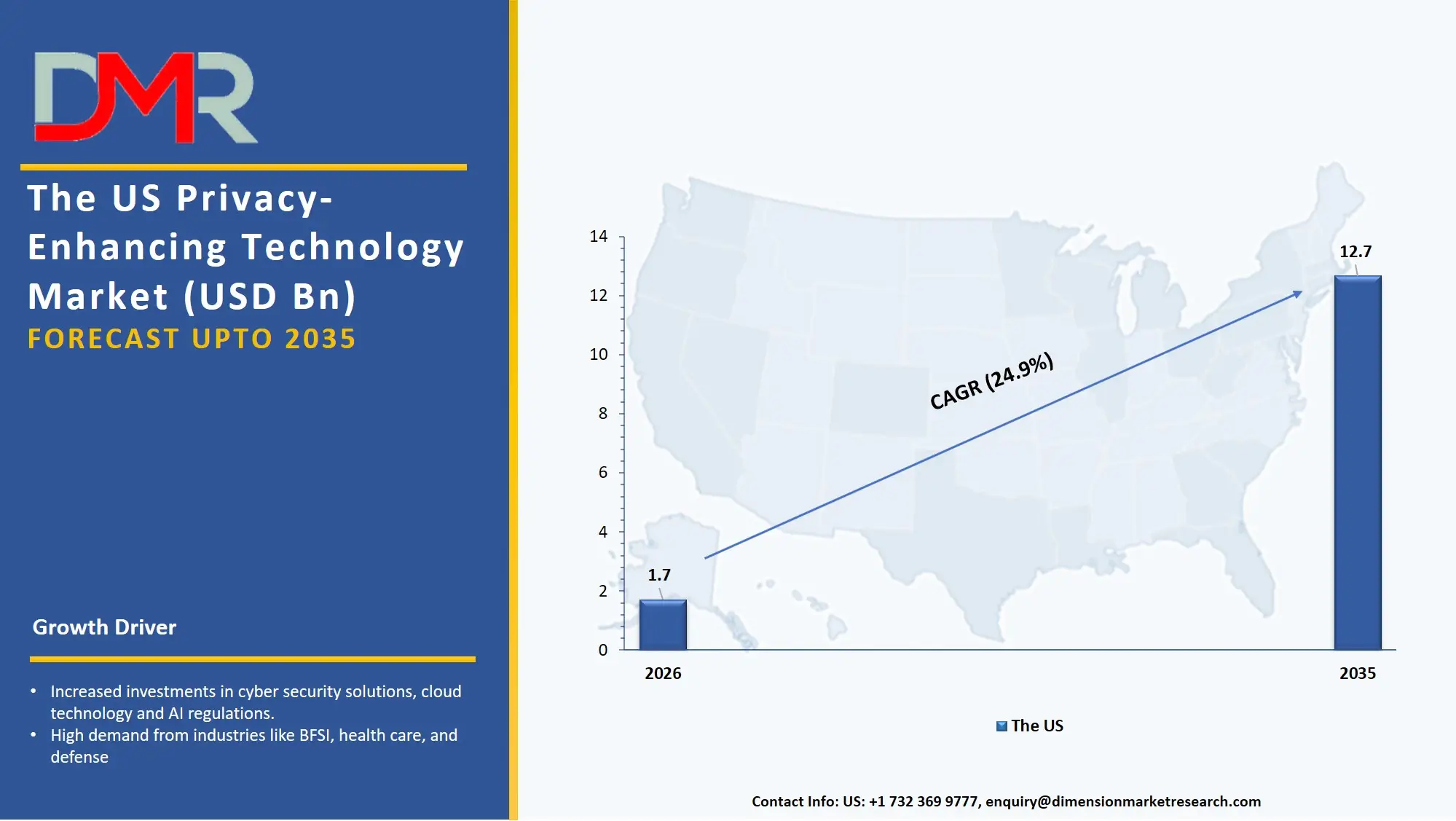
The US Privacy-Enhancing Technology Market size is estimated to be USD 1.7 billion in 2026 and is expected to increase at a CAGR of 24.9% over the forecast period.
ℹ
To learn more about this report –
Download Your Free Sample Report Here
Rapid growth in the US market for Privacy-Enhancing Technologies (PETs) can be attributed to increased investments in cyber security solutions, cloud technology and AI regulations. The high demand from industries like BFSI, health care, and defense is driving the adoption of advanced solutions like confidential computing, federated learning and encrypted analytics platforms. The impact of regulatory measures like the California Consumer Privacy Act and federal cyber security requirements will help organizations adopt PET solutions. Cloud and technology companies have accelerated innovations in the space by making partnerships, acquisitions and research initiatives related to AI training in secure cloud infrastructures.
Europe Privacy-Enhancing Technology Market
The Europe Privacy-Enhancing Technology Market size is estimated at USD 1.3 billion in 2026 and is expected to expand at a CAGR of 24.1% over the forecast period.
Europe represents an advanced and highly regulated market for Privacy-Enhancing Technologies, supported by stringent GDPR compliance requirements and evolving regulatory frameworks such as the EU AI Act and Data Act. These regulations are increasing enterprise focus on data minimization, secure processing, controlled data sharing, and privacy-preserving AI applications. Companies located in Germany, France, and Scandinavia embrace innovative technologies such as secure data collaboration and differential privacy tools in order to be compliant with tough cross-border data governance norms. Europe is experiencing significant investments in AI-powered privacy technologies, digital identity platforms, and sovereign clouds. Digital transformation projects in the spheres of healthcare, finance, and government can become additional accelerators for adoption.
Japan Privacy-Enhancing Technology Market
The Japan Privacy-Enhancing Technology Market size is estimated at USD 255 million in 2026 and is expected to expand at a CAGR of 26.8% over the forecast period.
The market for Privacy-Enhancing Technologies in Japan is expected to experience strong growth due to digitalization, smart manufacturing development, and significant government support for cybersecurity innovation. Financial companies, car makers, and telecommunication companies in Japan are now using data sharing platforms and confidential computing solutions to ensure protection of their business and consumer data. Japan's Society 5.0 initiatives and the increasing adoption of AI-driven industrial digitalization have fueled interest in investments in federated learning and security analytics. Legacy infrastructure modernizations may be problematic at times, but increasing cloud services, connected car security, and research activities pose many opportunities.
Key Takeaways
- Market Size & Forecast: The Privacy-Enhancing Technology Market size is projected to reach USD 5.1 billion in 2026 and is anticipated to have a value of USD 42.7 billion in 2035.
- Growth Rate & Outlook: The Privacy-Enhancing Technology Market size is set to grow at a compound annual growth rate of 26.6% during the forecast period of 2026 to 2035.
- Primary Growth Drivers: Some of the major growth drivers in the market include Growing Regulatory Scrutiny and Need for Data Security Compliance, and more.
- Key Market Trends: Some of the major trends in the market are Growth in Federated Learning & Decentralized Analytics, and more.
- By Organization Size: The large enterprise segment is anticipated to get the majority share of the Privacy-Enhancing Technology market in 2026.
- By End Use Industry: BFSI segment is expected to get the largest revenue share in 2026 in the Privacy-Enhancing Technology market.
- By Component: Software segment is expected to get the largest revenue share in 2026 in the Privacy-Enhancing Technology market.
- Regional Leadership: North America is set to lead the Privacy-Enhancing Technology market with an estimated 38.5% share in 2026.
What is the Privacy-Enhancing Technology?
Privacy-enhancing technology (PET) is the term that is used to refer to a set of software, encryption mechanisms, and data protection tools used for protecting sensitive data while still facilitating the use, analysis, and exchange of data without exposing sensitive information. Some of the examples of PETs include encrypted messaging applications, anonymity tools, federated learning systems, confidential computing systems, and artificial intelligence algorithms. The use of such tools is becoming more relevant in industries dealing with regulated and sensitive information, such as finance, health care, defense, telecommunication, and e-commerce.
Use Cases
- Secure Healthcare Data Collaboration: Healthcare organizations utilize privacy-enhancing techniques for transferring patient health data in a safe manner among hospitals, pharma firms, and research agencies without exposing any patient identifiers. Federated learning and differential privacy are used for developing AI algorithms for clinical collaboration under stringent healthcare privacy regulations.
- Fraud Detection in Financial Services: Financial service organizations employ secure multiparty computing technologies and encrypted data analysis systems for spotting patterns of fraudulent transactions across many databases without disclosing customer data. Secure analytics techniques can significantly help banks in conducting effective anti-money laundering programs.
- Confidential AI Model Training: Companies are increasingly turning to privacy-preserving AI platforms for training AI models in an encrypted environment using datasets. Confidential computing and homomorphic encryption technologies enable corporations to handle data of their customers and enterprises in a secure environment without compromising security.
- Cross-Border Regulatory Compliance: International companies use PET solutions for performing cross-border regulatory compliance when transmitting data internationally under GDPR and other AI laws. Secure data transfer platforms and anonymization technologies allow corporations to collaborate effectively across geographies despite stringent privacy policies.
How AI Is Transforming the Privacy-Enhancing Technology Market
Artificial Intelligence is revolutionizing the Privacy-Enhancing Technologies Market through better threat detection, secure analytics, and compliance monitoring. AI-enabled solutions can detect suspicious access patterns, anomalies in encrypted data environments, and automate secure sharing of data in enterprise networks. The use of machine learning is also aiding in adaptive encryption and privacy risks assessment.
The adoption of artificial intelligence will fast-track the growth of privacy-preserving analytics, federated learning platforms, and confidential computing solutions. AI will allow enterprises to build cyber-resilient strategies without making their operations complex. Moreover, advanced AI algorithms will improve secure identity management, fraud prevention, and encrypted analytics of customers for the enterprise.
Market Dynamics
Driving Factors in the Privacy-Enhancing Technology Market
Growing Regulatory Scrutiny and Need for Data Security Compliance
Strict regulatory compliance on matters concerning data privacy and protection remains one of the most compelling factors that drive the growth of the Privacy-Enhancing Technology market. The enforcement of increasingly strict regulations and policies around data privacy, artificial intelligence governance, and international data transfer is becoming more pronounced. Businesses are using PET solutions not only to meet regulatory requirements but also to avoid potential threats and costs. Through the use of technologies like differential privacy, confidential computing, and secure multi-party computation, firms can safely process their data without revealing any sensitive details.
Rising Adoption of Privacy-Preserving AI
The rapid adoption of artificial intelligence is creating substantial demand for technologies that allow organizations to analyze and train models on sensitive datasets without directly exposing underlying information. Enterprises in healthcare, finance, telecommunications, and government increasingly require secure methods for combining proprietary, customer, and regulated datasets. Federated learning, confidential computing, secure multi-party computation, differential privacy, and encrypted inference are consequently becoming important components of enterprise AI architectures. Growth in generative AI is further increasing concerns surrounding training-data confidentiality, intellectual property protection, model security, and regulatory compliance. Privacy-enhancing technologies allow businesses to obtain analytical value from sensitive information while reducing unnecessary data movement and exposure. As organizations expand AI deployments across hybrid-cloud environments and multiple jurisdictions, demand for privacy-preserving machine learning and secure collaborative analytics is expected to strengthen.
Restraints in the Privacy-Enhancing Technology Market
Implementation Challenges and Computation Costs
Despite its substantial growth potential, implementation complexity and high computational requirements remain important restraints on the Privacy-Enhancing Technology market. Highly sophisticated cryptography techniques like fully homomorphic encryption and zero knowledge proof consume high computing power, which creates latency and performance issues within real-time processing by firms managing extensive data sets. Firms also encounter significant challenges integrating these technologies within legacy IT systems and current cloud infrastructure setups. Significant implementation costs, lack of expertise in cybersecurity personnel, and low interconnectivity among different privacy systems further exacerbate these challenges. Small companies are often financially constrained to adopt advanced privacy systems.
Limited Standardization and Interoperability
Limited interoperability among privacy-enhancing technologies, cloud infrastructure, enterprise applications, and existing security frameworks can restrain broader adoption. Organizations frequently deploy different encryption standards, identity systems, data-governance platforms, and analytical environments, making implementation of advanced PET solutions technically complex. Integrating federated learning, secure multi-party computation, trusted execution environments, or homomorphic encryption into existing workflows often requires specialized expertise and customized system architecture. A lack of common implementation frameworks can also make it difficult for enterprises to evaluate performance, security, and regulatory suitability across competing solutions. These challenges are particularly relevant to organizations operating across multiple countries and cloud environments. Greater standardization, common APIs, cloud-native integration, and improved orchestration tools will therefore be important for reducing implementation complexity and supporting wider commercial deployment.
Opportunities in the Privacy-Enhancing Technology Market
Expanding AI Privacy Use Cases
The growth in AI generation, prediction, and autonomous applications will create numerous possibilities for privacy solution providers. Companies will require safe methods to train AI algorithms with private data while minimizing their risks of security breaches and legal violations. Advancements in federated learning, encrypted AI model inference, and machine learning with privacy will enable businesses to benefit from their AI technology investments while avoiding any potential cybersecurity risks. There will be a greater need for privacy technologies in the areas of healthcare diagnostics, financial fraud detection, connected vehicles, and government intelligence. The business interest in AI ethics and explainability will fuel the use of privacy technologies in AI solutions and platforms.
Growing Demand for Secure Cross-Organization Data Collaboration
Increasing demand for data collaboration among banks, healthcare providers, pharmaceutical companies, governments, telecommunications operators, and research organizations is creating a major opportunity for privacy-enhancing technologies. Many organizations possess valuable datasets that could generate stronger analytical insights when combined, but legal, competitive, and cybersecurity concerns frequently prevent raw information from being shared. Secure multi-party computation, federated analytics, clean rooms, confidential computing, and privacy-preserving data platforms allow organizations to perform collaborative analysis without directly exposing sensitive records. These capabilities can support applications including fraud detection, medical research, drug discovery, credit analysis, advertising measurement, and public-sector intelligence. As enterprises increasingly participate in data ecosystems and cross-border partnerships, PET providers capable of delivering scalable and interoperable collaboration environments are expected to gain significant commercial opportunities.
Trends in the Privacy-Enhancing Technology Market
Growth in Federated Learning & Decentralized Analytics
Federated learning and decentralized analytics have become increasingly significant in the context of organizations' efforts towards finding privacy-enhancing approaches for joint model creation for AI. Rather than uploading raw data into the central server, federated technologies allow local training of the models by sharing only their encrypted outputs or parameters. Such an approach allows organizations to minimize compliance issues and increase their data sovereignty. Healthcare, telecoms, automotive and banking industries are actively embracing federated learning as a way of conducting secure analytics and developing predictive models.
Increasing Integration of PETs into Cloud and AI Infrastructure
Privacy-enhancing technologies are increasingly being embedded directly into cloud computing and artificial intelligence infrastructure instead of being deployed as standalone privacy solutions. Major cloud and technology providers are expanding confidential virtual machines, secure enclaves, encrypted computing environments, privacy-preserving machine learning tools, and automated data-governance capabilities. This integration allows enterprises to adopt privacy features within existing cloud workloads without building entirely separate security architectures. The trend is also encouraging PET vendors to provide APIs, developer tools, and cloud-native platforms that simplify encrypted analytics and secure AI development. As businesses expand generative AI, multi-cloud environments, and collaborative analytics, privacy capabilities are increasingly expected to become embedded within standard data and AI infrastructure rather than treated only as regulatory compliance tools.
Research Scope and Analysis
The research analyzes the global Privacy-Enhancing Technology Market across technology type, component, deployment mode, application, organization size, end-user industry, and region. The study evaluates market size, segment shares, adoption patterns, regulatory developments, competitive strategies, technological innovation, and regional growth opportunities from the historical period through 2035.
ℹ
To learn more about this report –
Download Your Free Sample Report Here
By Technology Type Analysis
Homomorphic Encryption is expected to lead the Privacy-Enhancing Technology Market, accounting for approximately 31.0% of total market revenue in 2026. Its dominance is supported by increasing demand for secure computation on encrypted data across banking, healthcare, government, cloud computing, and artificial intelligence applications. Homomorphic encryption enables organizations to process and analyze sensitive information without exposing the underlying data, supporting secure analytics and regulatory compliance. Growing investment in cryptographic acceleration and privacy-preserving AI is also improving its commercial viability. However, computational complexity and processing overhead remain important adoption challenges, particularly for fully homomorphic encryption. Zero-knowledge proofs and confidential computing are also expected to record strong growth as enterprises expand privacy-preserving digital infrastructure.
By Component Analysis
The software segment is expected to dominate the market with approximately 68.4% share in 2026, due to increasing use of encryption technologies, privacy-preserving artificial intelligence software, and secure data collaboration solutions. There is an increasing demand from businesses for scalable software-based PET offerings that are compatible with the cloud computing environment and advanced analytics platforms based on artificial intelligence. Privacy management software and machine learning systems using encryption technologies have seen increased interest among businesses due to escalating compliance needs and concerns about cybersecurity. However, managed privacy services are projected to register the highest CAGR owing to the need for outside help in deploying, managing compliance, and monitoring privacy-enhancing infrastructure.
By Deployment Mode Analysis
The cloud deployment model is expected to hold about 57.6% of market share in 2026 owing to the growing adoption of scalable and cost-efficient cloud infrastructure among enterprises. Public and hybrid clouds are now vital for the processing of AI securely, collaborative activities that are encrypted, and the analysis of confidential datasets. The cloud service providers have been offering confidential computing features and enhanced encryption services to help process enterprise datasets securely. Yet, edge deployment is set to experience the highest growth rate owing to the need for low latency and secure processing among IoT devices, autonomous vehicles, and industrial automation systems.
By Application Analysis
It is anticipated that secure data sharing and collaboration will continue to be the dominant application category and hold a share of 21.9% in 2026. The organizations in various industries such as healthcare, BFSI, and governments are embracing secure collaboration solutions to enable the flow of compliant information among internal units and their partners. Confidential computing, encrypted analytics, and secure multi-party computations are enabling secure collaboration practices as well as safeguarding sensitive data. In addition, encrypted AI training models are forecasted to become the fastest-growing application category owing to rising implementation of generative AI models in enterprises. This is primarily due to the need for secure training of AI models and increasing compliance issues.
By Organization Size Analysis
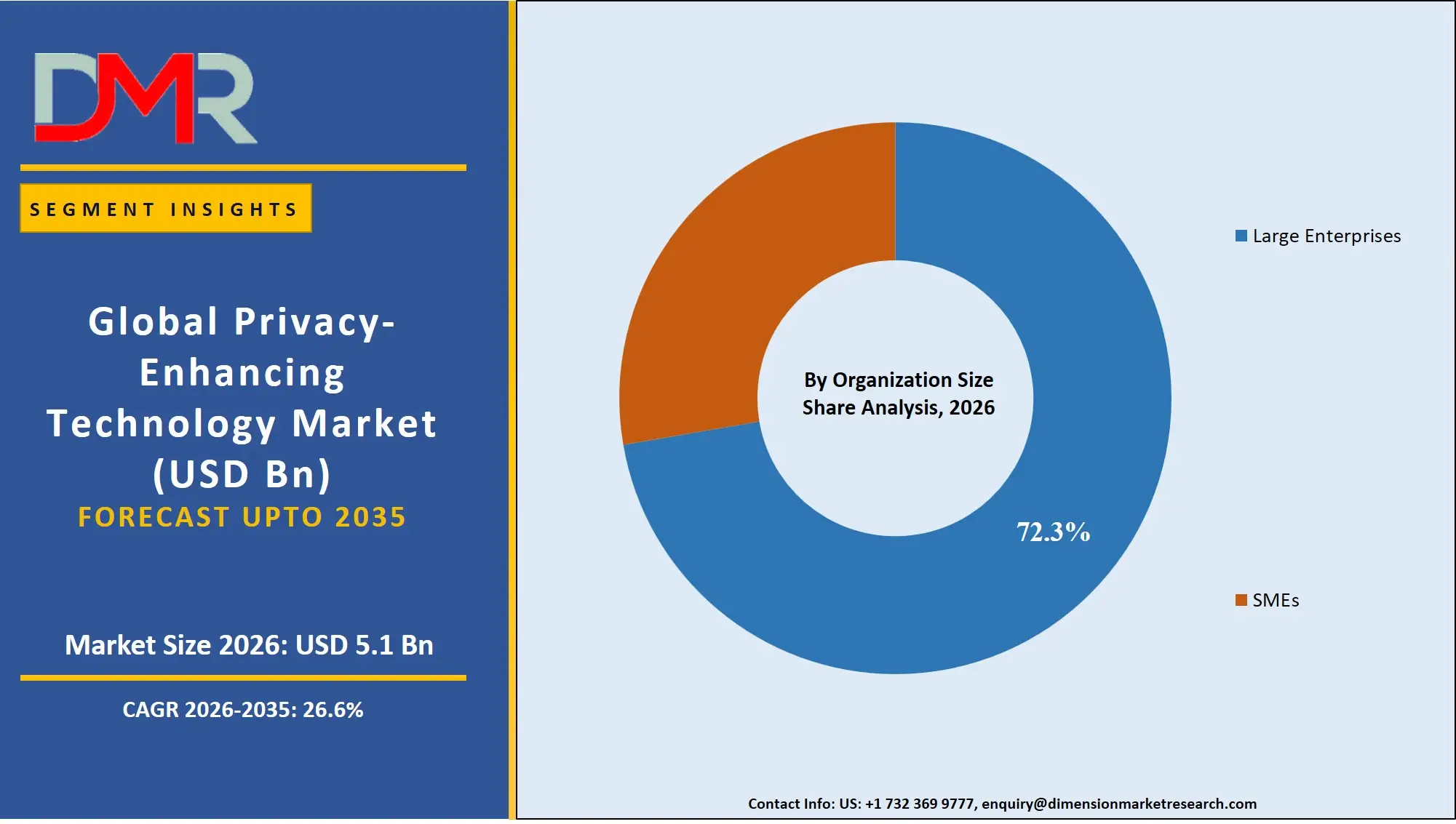
Large enterprises are expected to have a majority of 72.3% market share in 2026 owing to their heavy investment in cybersecurity upgrades, AI policy, and regulatory compliance infrastructure. This is because large companies handle large amounts of financial, medical, and consumer information, which requires privacy-enhancing technologies to be implemented. Large enterprises generally possess greater financial and technical resources to deploy computationally intensive encryption, confidential computing, secure analytics, and privacy-governance infrastructure at scale. Nonetheless, small and medium-sized companies will grow at the fastest rate since the deployment process of PET via cloud services has become more straightforward and financially feasible.
By End User Industry Analysis
In the BFSI industry, an estimated market share of around 26.7% will be attained by 2026 owing to the rising demand for fraud protection, security in transaction monitoring, and privacy in customer data management. Various financial institutions such as banks, insurance companies, and Fintech organizations are increasingly adopting techniques like encrypted analytics, federated learning, and secure multiparty computation to enhance their cybersecurity and regulatory compliance frameworks. As a result of growing incidences of financial crimes as well as expansion of digital banking services, the BFSI industry remains a leader in implementing PETs. Furthermore, the healthcare and life science sector will witness the fastest growth rate due to adoption of privacy-preserving AI technologies and collaboration platforms.
The Privacy-Enhancing Technology Market Report is segmented on the basis of the following:
By Technology Type
- Homomorphic Encryption
- Fully Homomorphic Encryption (FHE)
- Partially Homomorphic Encryption (PHE)
- Somewhat Homomorphic Encryption (SHE)
- Secure Multi-Party Computation (SMPC)
- Secret Sharing
- Distributed Secure Computation
- Threshold Cryptography
- Differential Privacy
- Local Differential Privacy
- Global Differential Privacy
- Statistical Noise Injection
- Federated Learning
- Cross-Device Federated Learning
- Cross-Silo Federated Learning
- Federated Analytics
- Zero-Knowledge Proofs (ZKP)
- zk-SNARKs
- zk-STARKs
- Identity Verification Proofs
- Trusted Execution Environment (TEE) & Confidential Computing
- Secure Enclaves
- Confidential Virtual Machines
- Encrypted Memory Computing
- Data Anonymization & Tokenization
- Data Masking
- Pseudonymization
- Tokenization
- Privacy-Preserving AI & Analytics
- Encrypted AI Inference
- Secure Machine Learning
- Privacy Analytics Platforms
By Component
- Software
- Encryption & Privacy Platforms
- Secure Data Collaboration Platforms
- Privacy Management Tools
- Privacy-Preserving AI Software
- Services
- Consulting & Advisory
- System Integration & Deployment
- Managed Privacy Services
- Compliance & Risk Management
By Deployment Mode
- Cloud-Based
- Public Cloud
- Private Cloud
- Hybrid Cloud
- On-Premises
- Edge Deployment
By Application
- Secure Data Sharing & Collaboration
- Identity & Access Management
- Fraud Detection, AML & Financial Crime Analytics
- Regulatory Compliance
- Secure AI Model Training
- Privacy-Preserving Data Analytics
- Privacy-Preserving Advertising
- Cross-Border Data Transfer
By Organization Size
- Large Enterprises
- Small & Medium-Sized Enterprises (SMEs)
By End-User Industry
- BFSI
- Banking
- Insurance
- FinTech
- Healthcare & Life Sciences
- Hospitals
- Pharmaceutical Companies
- Clinical Research Organizations
- Government & Defense
- Intelligence Agencies
- Public Sector Departments
- IT & Telecommunications
- Cloud Providers
- Telecom Operators
- Data Center Operators
- Retail & E-Commerce
- Digital Commerce Platforms
- Payment Platforms
- Customer Analytics
- Manufacturing & Industrial
- Industrial IoT
- Supply Chain Security
- Automotive
- Connected Vehicles
- Autonomous Vehicle Data Platforms
Regional Analysis
Leading Region in the Privacy-Enhancing Technology Market
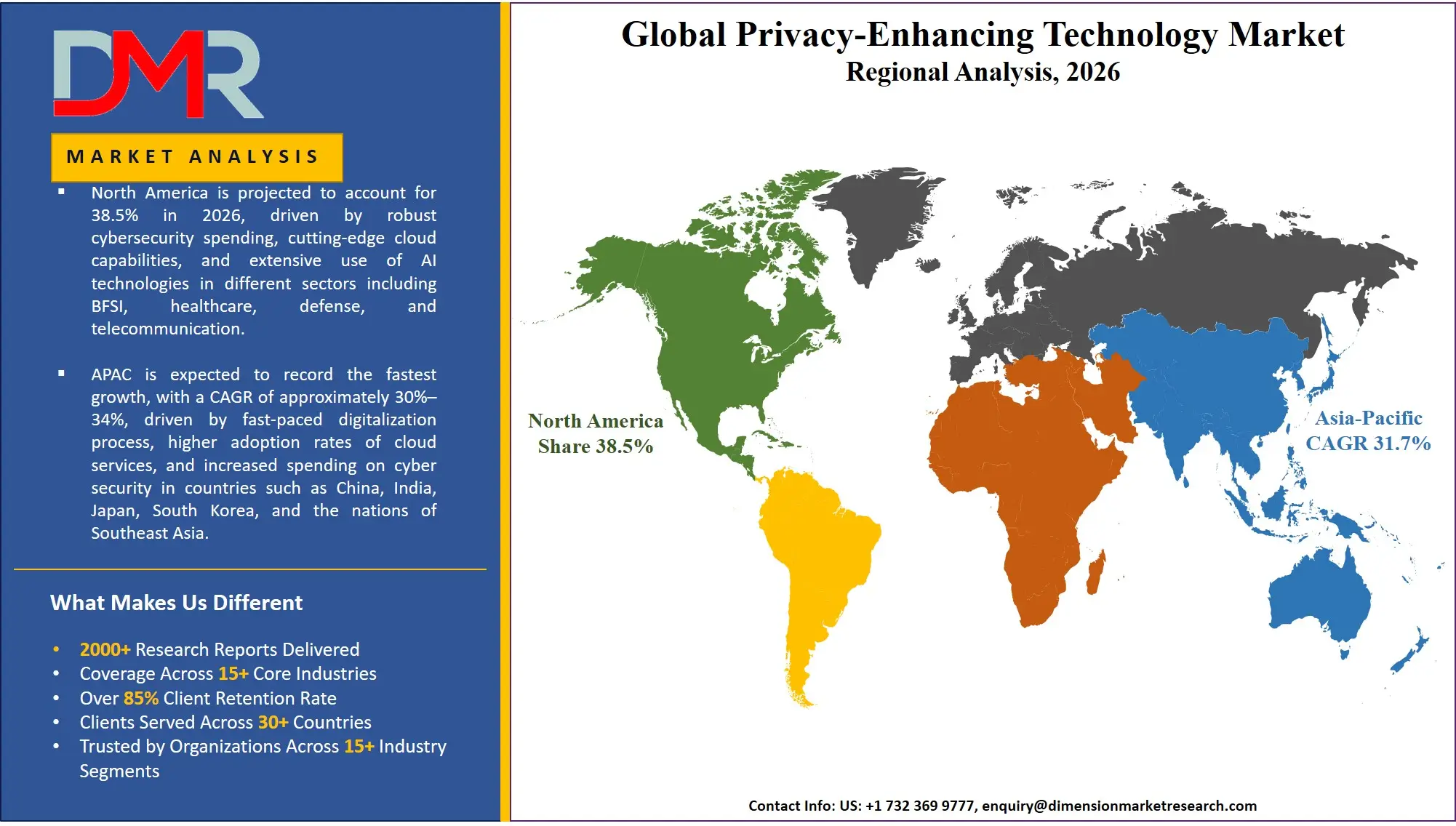
North America is expected to retain its stronghold in the market for Privacy-Enhancing Technologies with an estimated market share of 38.5% by 2026. This region will remain dominant due to high cybersecurity spending, cutting-edge cloud capabilities, and extensive use of AI technologies in different sectors including BFSI, healthcare, defense, and telecommunication. The need for more advanced encryption technologies and confidential computing systems owing to stringent regulatory environment surrounding privacy and security is expected to drive the uptake of these technologies in the region.
ℹ
To learn more about this report –
Download Your Free Sample Report Here
Fastest Growing Region in the Privacy-Enhancing Technology Market
Asia-Pacific is expected to emerge as the fastest-growing regional market for Privacy-Enhancing Technology during the forecast period, supported by rapid digitalization, growing cloud adoption, and increasing cybersecurity investment across China, India, Japan, South Korea, and Southeast Asia. Countries have developed robust data protection regulations along with cybersecurity policies at the national level to ensure the safety of their digital economy and industries relying on AI technology. The advancements in smart manufacturing, connected automobiles, digital banking, and digitalization of the healthcare sector are fueling the adoption of privacy technologies.
By Region
North America
Europe
- Germany
- The U.K.
- France
- Italy
- Russia
- Spain
- Benelux
- Nordic
- Rest of Europe
Asia-Pacific
- China
- Japan
- South Korea
- India
- ANZ
- ASEAN
- Rest of Asia-Pacific
Latin America
- Brazil
- Mexico
- Argentina
- Colombia
- Rest of Latin America
Middle East & Africa
- Saudi Arabia
- UAE
- South Africa
- Israel
- Egypt
- Rest of MEA
Competitive Landscape
In the Privacy-Enhancing Technology market, there is a high degree of innovation, fast technology progression, and an increase in strategic partnerships between solution providers in the fields of cybersecurity, cloud computing, and artificial intelligence. A lot of effort is being invested in research and development of cryptography technologies that are scalable, computationally efficient, and interoperable. Partnerships with cloud computing companies, governments, and AI vendors are becoming common practices to enhance market positioning and improve deployment. The high barrier of entry in terms of technology, regulations, and infrastructure benefits existing players with strong cybersecurity offerings.
Some of the prominent players in the global Privacy-Enhancing Technology are:
- Microsoft
- IBM
- Google Cloud
- Oracle
- Cisco Systems
- SAP
- Intel Corporation
- Thales Group
- SAS Institute
- Duality Technologies
- TrustArc
- OneTrust
- BigID
- Informatica
- Transcend
- Enveil
- Zama
- Fortanix
- Anjuna Security
- Decentriq
- Partisia
- Skyflow
- Vaultree
- Proton AG
- Other Key Players
Recent Developments
- In May 2026, JISA Softech Pvt. Ltd, an independent provider of data security, encryption, tokenization, data masking, and privacy services, has partnered with Seqrite, the enterprise segment of Quick Heal Technologies Limited. This partnership will provide a combination of data security and privacy services to enterprises, government organizations, and BFSI institutions around the world, thereby expediting their compliance with global data protection laws and strengthening their defenses against cyber-attacks.
- In November 2025, Google introduced Private AI Compute, a secure cloud-based AI processing platform designed to provide Gemini-powered capabilities while keeping sensitive user data protected. The technology is supported by the capabilities of Gemini cloud models, which have great security measures that ensure users' personal data cannot be accessed by anyone, including Google. The technology is supported by Trillium Tensor Processing Units and Titanium Intelligence Enclaves.
- In September 2025, Informatica announced its Cloud Data Access Management solution, integrating AI-powered governance with policy-based data security and privacy controls. The solution builds on capabilities acquired through Privitar and enables organizations to automate data-access policies across enterprise data environments, supporting secure analytics and AI applications.
Report Details
| Report Characteristics |
| Market Size (2026) |
USD 5.1 Bn |
| Forecast Value (2035) |
USD 42.7 Bn |
| CAGR (2026–2035) |
26.6% |
| Historical Period |
2021 – 2025 |
| Forecast Period |
2027 – 2035 |
| Base Year |
2025 |
| Estimate Year |
2026 |
| Segments Covered |
By Technology Type, By Component, By Deployment Mode, By Application, By Organization Size, By End-User Industry |
| Regional Coverage |
North America – The US and Canada; Europe – Germany, The UK, France, Russia, Spain, Italy, Benelux, Nordic, & Rest of Europe; Asia-Pacific – China, Japan, South Korea, India, ANZ, ASEAN, Rest of APAC; Latin America – Brazil, Mexico, Argentina, Colombia, Rest of Latin America; Middle East & Africa – Saudi Arabia, UAE, South Africa, Turkey, Egypt, Israel, & Rest of MEA |
Frequently Asked Questions
How big is the Privacy-Enhancing Technology Market?
▾ The Privacy-Enhancing Technology Market size is expected to reach USD 5.1 billion by 2026 and is projected to reach USD 42.7 billion by the end of 2035.
What is the CAGR of the Privacy-Enhancing Technology Market from 2026 to 2035?
▾ The market is growing at a CAGR of 26.6 percent over the forecasted period.
What factors are driving the growth of the Privacy-Enhancing Technology Market?
▾ Growing Regulatory Scrutiny and Need for Data Security Compliance, and more are the factors driving the growth of the Privacy-Enhancing Technology Market.
What are the major trends in the Privacy-Enhancing Technology Market?
▾ Growth in Federated Learning & Decentralized Analytics, and more are some of the major trends in the market.
Who are the key players in the Privacy-Enhancing Technology Market?
▾ Some of the key players in the Privacy-Enhancing Technology Market include IBM, SAP, Oracle, and more.
How is the Privacy-Enhancing Technology Market segmented?
▾ The Privacy-Enhancing Technology Market is segmented by technology type, component, deployment mode, application, organization size, end-user industry.
Which region held the largest share of the Privacy-Enhancing Technology Market in 2026?
▾ North America is set to lead the Privacy-Enhancing Technology market with an estimated 38.5% share in 2026.
Which region is expected to grow the fastest in the Privacy-Enhancing Technology Market?
▾ Asia Pacific is the fastest-growing region in the Privacy-Enhancing Technology market during the forecast period.