Market Snapshot
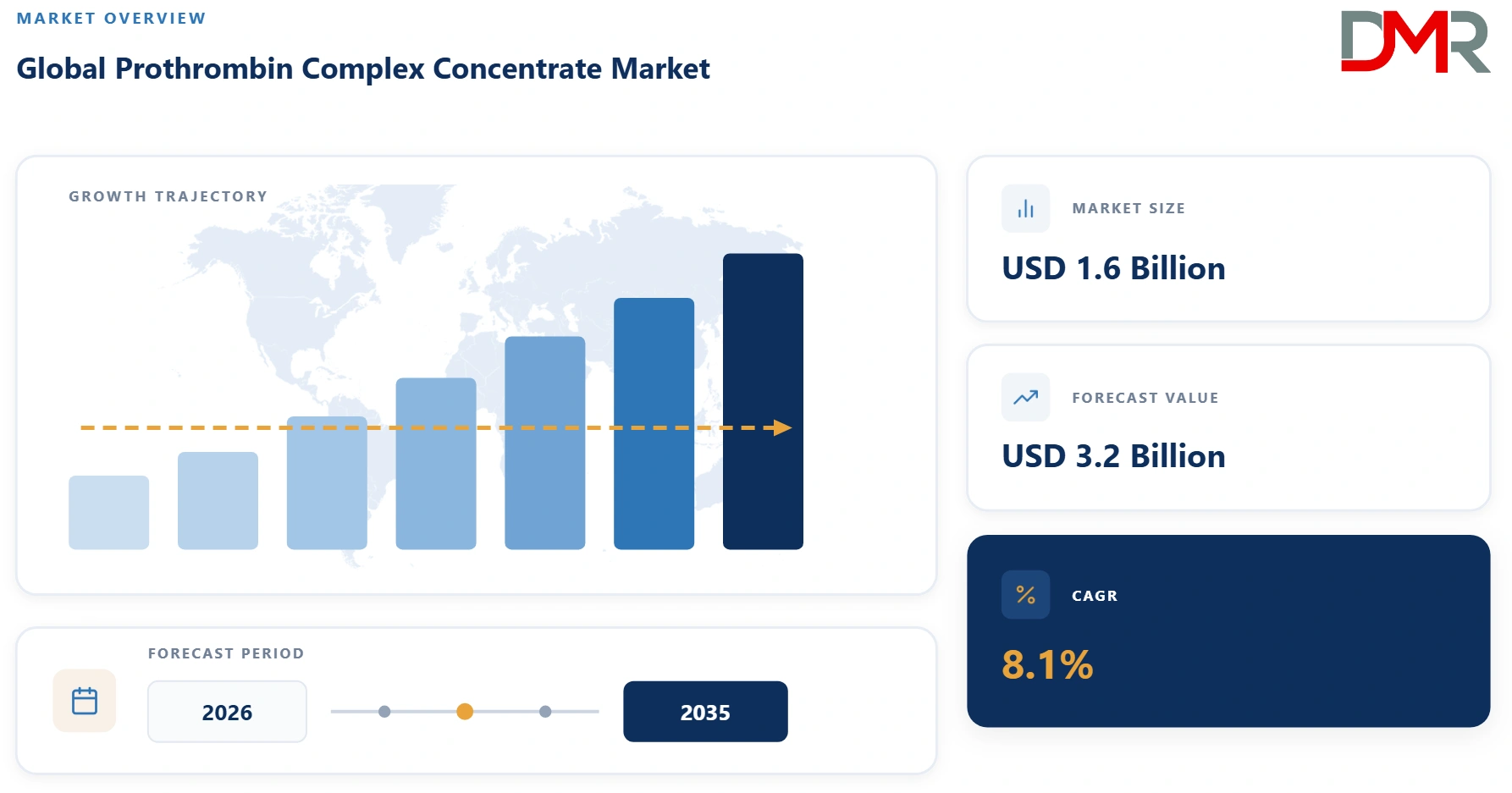
- Market Size (2026): USD 1.6 Bn
- Forecast Value (2035): USD 3.2 Bn
- CAGR (2026-2035): 8.1%
- Largest Region (2026): North America, approximately 42%
- Fastest-Growing Region: Asia-Pacific
- Leading Product Type (2026): Four-Factor PCC, around 64%
- Leading Application (2026): Vitamin K Antagonist Reversal, close to 44%
- Key Players: CSL Behring, Octapharma AG, Takeda Pharmaceutical Company Limited and others
What is Prothrombin Complex Concentrate Market and its Market Size?
Global Prothrombin Complex Concentrate Market size is estimated to reach USD 1.6 Bn in 2026 and is further anticipated to reach USD 3.2 Bn by 2035, at a CAGR of 8.1%.
ℹ
To learn more about this report –
Download Your Free Sample Report Here
Prothrombin complex concentrates are plasma-derived coagulation products formulated to rapidly restore vitamin K dependent clotting factors when immediate hemostatic correction is required. Commercial products include non-activated three-factor and four-factor concentrates as well as activated complexes used principally as bypassing agents. The market boundary includes finished PCC medicines, institutional supply and associated channel revenue, while excluding recombinant single-factor therapies, fresh frozen plasma, fibrinogen concentrate, standalone vitamin K and specific antidotes that are not PCC products.
Hospitals are the central buyers because demand is concentrated in emergency departments, operating rooms, trauma services, intensive care units and anticoagulation reversal protocols. Four-factor products carry the largest revenue contribution because they replace factors II, VII, IX and X in a low-volume infusion and can be stocked for urgent use. Clinical procurement decisions balance speed of reversal, factor composition, thromboembolic risk, dosing simplicity, product availability, storage characteristics and total episode-of-care cost.
Structural change is widening the category beyond its traditional association with warfarin reversal. Evidence generation in cardiac surgery and other major bleeding settings is increasing physician familiarity with factor-concentrate strategies, while hospitals are standardizing massive bleeding and perioperative algorithms. At the same time, activated PCC remains important for selected inhibitor-associated bleeding but faces pressure from newer prophylactic and bypassing approaches, making the overall revenue mix progressively more weighted toward non-activated four-factor products and acute hospital use.
Use Cases
- Emergency Warfarin Reversal: Emergency physicians and hospital pharmacists deploy four-factor PCC when a patient receiving a vitamin K antagonist presents with life-threatening bleeding or requires an urgent procedure. Rapid factor replacement reduces dependence on high-volume plasma and supports faster correction within time-critical treatment pathways.
- Cardiac Surgery Coagulopathy: Cardiac anesthesiology and perfusion teams use PCC in selected patients with diffuse coagulopathic bleeding after cardiopulmonary bypass, particularly when conventional factor replacement would require substantial plasma volume. Concentrated dosing can simplify transfusion support and help operating teams regain hemostatic control during complex procedures.
- Hemophilia with Inhibitors: Hemophilia treatment centers administer activated PCC to patients whose factor VIII or IX inhibitors make conventional replacement ineffective. The product bypasses the inhibited step in the coagulation cascade, giving clinicians an established option for acute bleeding, surgery and selected prophylactic management.
- Trauma and Critical Bleeding Protocols: Trauma centers may incorporate PCC into narrowly defined reversal or coagulopathy pathways when rapid restoration of vitamin K dependent factors is clinically justified. Use is coordinated with laboratory testing, transfusion medicine and thrombotic-risk assessment so that concentrate therapy complements, rather than replaces, broader hemorrhage control.
Key Takeaways
- Market Size & Share: Europe is expected to represent approximately 31% of 2026 revenue, supported by long-standing plasma-product use and mature hospital blood-management systems.
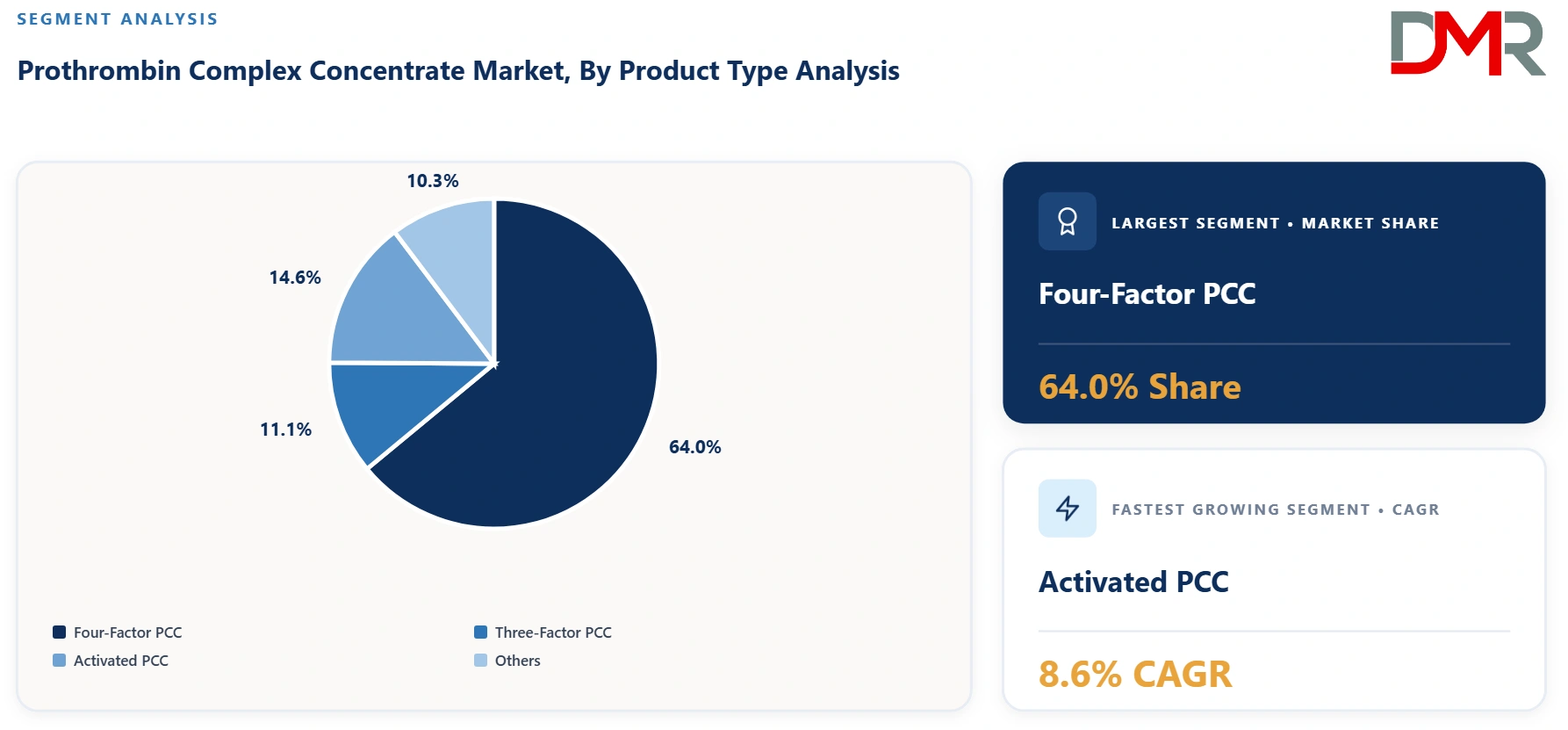
- Product Type Analysis: Activated PCC is modeled to expand at a CAGR of 8.6% through 2035, while four-factor PCC remains the larger commercial base.
- Regional Analysis: Asia-Pacific is projected to register the highest regional CAGR at 9.7% as hospital access, anticoagulation management and plasma-product availability broaden.
- Application Analysis: Perioperative Major Bleeding is forecast to grow at 10.4% CAGR, supported by expanding evidence and protocol adoption in surgical settings.
- End Use Analysis: Hospitals are set to hold nearly 68% of 2026 revenue because most PCC dosing occurs in high-acuity, monitored environments.
- Channel Shift: Direct Institutional Procurement is expected to grow at 9.0% CAGR as large health systems consolidate blood-management purchasing and contract directly for critical-care inventory.
How AI/Gen AI is Transforming the Prothrombin Complex Concentrate Market?
AI influence is operational rather than therapeutic. Hospitals are using predictive analytics and rules-based decision support to identify anticoagulated patients, reconcile medication histories, flag elevated bleeding risk and route urgent reversal orders through standardized pathways. Machine learning can combine laboratory data, anticoagulant exposure, renal function and procedure urgency to support triage, while computer vision and transfusion analytics help quantify surgical blood loss and correlate it with hemostatic interventions. These systems can improve consistency, but they do not replace clinician judgment for PCC dosing or thrombotic-risk assessment.
Generative AI is becoming more relevant in documentation and pharmacovigilance. LLM-based tools can summarize medication records, draft protocol notes, extract adverse-event narratives and organize evidence for formulary committees. Manufacturers and hospital systems also use analytics for inventory forecasting because PCC is a high-value, low-volume emergency medicine with variable demand.
- Clinical Decision Support: Combines medication, INR and procedure data to surface eligible reversal pathways for clinician review.
- Pharmacovigilance Processing: LLM document processing can structure safety narratives and speed case triage while preserving human medical review.
- Inventory Forecasting: Predictive models estimate emergency consumption and expiry risk across hospital networks.
- Surgical Bleeding Analytics: Computer vision and perioperative data models can support earlier recognition of abnormal bleeding patterns.
Key Drivers in the Global Prothrombin Complex Concentrate Market
Demand is anchored in the need for rapid correction of acquired coagulation-factor deficiency and is strengthened as more institutions formalize reversal and perioperative blood-management protocols.
- Standardization of Rapid Anticoagulation Reversal: Vitamin K Antagonist Reversal is expected to account for approximately 44% of application revenue in 2026, giving PCC a durable base in emergency medicine. Four-factor concentrates replace multiple vitamin K dependent factors in a relatively small infusion volume, which fits protocols where delays associated with plasma thawing, blood-group matching or large-volume administration are undesirable. As hospitals formalize anticoagulation stewardship and emergency reversal pathways, pharmacy stocking becomes less discretionary and more protocol driven. The mechanism is important commercially: each additional hospital adopting a standardized pathway creates recurring demand for inventory, replacement stock and dosing education, supporting utilization even as the overall anticoagulant mix continues shifting toward direct oral agents.
- Expansion of Concentrate-Based Perioperative Hemostasis: Perioperative Major Bleeding is projected to grow at a CAGR of 10.4% from 2026 to 2035, faster than the overall category. Cardiac surgery, complex vascular procedures and other high-risk operations can produce broad coagulation-factor depletion that is traditionally managed with plasma and component therapy. Clinical evidence supporting four-factor PCC in selected surgical bleeding scenarios encourages hospitals to evaluate factor-concentrate algorithms that reduce infusion volume and accelerate factor replacement. Commercial adoption is gradual because dosing and patient selection remain protocol dependent, but the addressable population is much larger than classic warfarin reversal alone. This creates an important route for manufacturers to expand usage through evidence generation, institutional education and patient blood management integration.
Restraints in the Global Prothrombin Complex Concentrate Market
Growth is constrained by clinical risk management, plasma-supply economics and strong competition from alternative reversal and hemostatic strategies.
- Thromboembolic Risk and Conservative Protocoling: Hospitals are expected to generate nearly 68% of 2026 market revenue, but that concentration also exposes the category to strict institutional controls. PCC delivers several procoagulant factors rapidly, so clinicians must weigh hemostatic benefit against arterial and venous thromboembolic complications, particularly in patients whose underlying condition already carries thrombosis risk. Pharmacy and therapeutics committees therefore limit indications, require hematology or transfusion oversight, and monitor dosing closely. These safeguards are clinically appropriate but slow unrestricted utilization and can prevent evidence from one bleeding setting from translating immediately into broad label or protocol expansion. The restraint is especially visible in off-label factor Xa inhibitor reversal and non-specific surgical bleeding, where hospitals may prefer approved antidotes, plasma, fibrinogen or algorithm-specific alternatives.
- Plasma Supply, Manufacturing Complexity and High Unit Cost: Three-Factor PCC is expected to represent about 21% of product-type revenue in 2026, while the wider category remains dependent on specialized plasma fractionation capacity and validated pathogen-reduction processes. Production requires donor plasma collection, fractionation, purification, viral inactivation or removal, potency testing and batch release under biologics regulation. Capacity cannot be added as quickly as small-molecule manufacturing, while donor economics and competing demand for immunoglobulin, albumin and other plasma-derived therapies influence the cost structure. High acquisition cost also makes hospitals sensitive to wastage and vial-size efficiency. In lower-resource settings, limited reimbursement and constrained plasma-product budgets can favor fresh frozen plasma even when concentrate administration is operationally simpler.
Growth Opportunities in the Global Prothrombin Complex Concentrate Market
White space is concentrated in evidence-backed perioperative use, broader access in emerging hospital systems and more efficient institutional supply models.
- Cardiac Surgery and Patient Blood Management Integration: North America provides a large installed base from which manufacturers can extend PCC into structured patient blood management programs, while Europe is expected to account for around 31% of 2026 revenue. Cardiac surgery is particularly attractive because complex procedures can create factor depletion, high transfusion exposure and a strong need for rapid hemostatic correction. Randomized evidence comparing four-factor PCC with frozen plasma is improving the quality of the clinical discussion and can support more specific treatment algorithms. The opportunity is not simply higher dose volume; it includes formulary expansion, protocol education, perioperative decision support and bundled hospital contracting. Suppliers that pair reliable product availability with evidence generation can capture incremental demand without relying solely on growth in warfarin-treated populations.
- Emerging-Market Access and Institutional Procurement: Asia-Pacific is forecast to grow at a CAGR of 9.7% through 2035 as tertiary hospitals expand critical-care capacity and standardize anticoagulation management. Many markets still use plasma more heavily because PCC access is uneven, reimbursement is limited or hospital inventories are small. Manufacturers can address this gap through local distribution, physician training, optimized pack sizes and partnerships with plasma-product channels. Direct Institutional Procurement, itself modeled at a 9.0% CAGR, offers an additional commercial lever because large hospital networks can aggregate demand and improve stock rotation. Better forecasting and pooled purchasing can lower expiry risk, making routine stocking more feasible in centers that previously treated PCC as an exceptional purchase.
Trends in the Global Prothrombin Complex Concentrate Market
Current shifts concern the product mix, hospital protocols and the role of concentrated factor replacement within broader bleeding-management pathways.
- Four-Factor PCC Becoming the Reference Non-Activated Format: Activated PCC is projected to account for roughly 15% of 2026 product revenue, while the commercial center of gravity has moved toward products containing factors II, VII, IX and X because they align with comprehensive vitamin K antagonist reversal and offer a more complete factor profile than three-factor formulations. Three-factor products retain use in selected markets and legacy protocols, but procurement increasingly favors four-factor concentrates where available. The trend is reinforced by formulary standardization and new market entrants that create direct competition within four-factor supply. As more hospitals maintain standing inventory, competition shifts from category education toward evidence, contracting, vial efficiency, supply reliability and institutional protocol support.
- Broader Use of Data-Guided Hemostatic Algorithms: Ambulatory Surgical Centers are expected to grow at a CAGR of 9.3% through 2035, while hospital systems are also pushing more procedures into distributed surgical networks. This raises demand for clearer escalation rules governing when concentrated factors should be stocked or rapidly sourced. Viscoelastic testing, anticoagulant-specific assays, electronic order sets and patient blood management programs are making factor replacement more data guided. PCC is therefore increasingly positioned as one component within a coordinated algorithm rather than a standalone rescue product. The shift favors suppliers that can support protocol implementation, education and logistics across multi-site systems, but it also disciplines use by tying dosing to specific clinical triggers.
Research Scope and Analysis
Segment performance is assessed across product type, application, end use and distribution channel. Each axis identifies where 2026 revenue is concentrated and which sub-segment is moving fastest through 2035, linking the figures to clinical adoption, procurement structure and supply economics.
ℹ
To learn more about this report –
Download Your Free Sample Report Here
By Product Type
Four-Factor PCC is projected to hold the largest product share in 2026, accounting for approximately 64% of revenue because it replaces factors II, VII, IX and X and has become the preferred non-activated format for rapid vitamin K antagonist reversal in many hospital protocols. Its broad institutional adoption, low infusion volume and established branded supply create a durable installed base. Growth, however, is slightly stronger in Activated PCC, which is forecast to expand at a CAGR of 8.6% between 2026 and 2035. Activated formulations retain a specialized role in inhibitor-associated hemophilia and selected complex bleeding settings. Their trajectory is supported by persistent need for bypassing activity in difficult cases, although newer prophylactic therapies limit the segment from accelerating as quickly as perioperative four-factor applications.
By Application
Vitamin K Antagonist Reversal is expected to remain the largest application in 2026, representing around 44% of revenue due to established emergency protocols for major bleeding and urgent procedures in warfarin-treated patients. Hospitals maintain PCC inventory specifically because this indication can require treatment within minutes, creating recurring demand even as anticoagulant prescribing patterns evolve. Growth, however, is concentrated in Perioperative Major Bleeding, which is projected to expand at a CAGR of 10.4% through 2035. Randomized evidence in cardiac surgery and wider patient blood management adoption are encouraging clinicians to compare concentrated factor replacement with plasma-based strategies. The segment benefits from a large surgical addressable population, but adoption remains governed by local algorithms, licensing scope and thrombotic-risk management.
By End Use
Hospitals are projected to account for nearly 68% of 2026 revenue, reflecting the concentration of PCC use in emergency departments, trauma centers, operating rooms, intensive care units and monitored hematology services. High-acuity infrastructure allows rapid laboratory assessment, pharmacy verification and management of thromboembolic complications, which keeps complex reversal therapy centered in hospital settings. The steeper trajectory sits with Ambulatory Surgical Centers, expanding at a CAGR of 9.3% from 2026 to 2035. Procedure migration to outpatient settings and consolidation of surgical networks are increasing demand for emergency reversal planning outside tertiary hospitals. Most centers will not hold the same inventory depth as large hospitals, so growth depends on selective stocking, rapid distributor access and standardized escalation pathways with nearby acute-care facilities.
By Distribution Channel
Hospital Pharmacy is anticipated to lead distribution in 2026 with a share of roughly 73%, since PCC is typically ordered, stored and dispensed through institutional pharmacy systems under emergency-use protocols. Centralized formulary control also allows hospitals to manage expensive inventory, vial rotation and indication restrictions while coordinating with transfusion medicine. Growth, however, is strongest in Direct Institutional Procurement, which is expected to post a CAGR of 9.0% through 2035. Large integrated delivery networks are consolidating purchasing across multiple hospitals and surgical facilities, allowing them to negotiate supply agreements directly and pool inventory planning. This model improves forecasting and can reduce expiry losses, while manufacturers gain clearer demand visibility and stronger system-level relationships than transaction-by-transaction distribution alone provides.
The Global Prothrombin Complex Concentrate Market Report is Segmented Based on the Following
By Product Type
- Four-Factor PCC
- Three-Factor PCC
- Activated PCC
- Others
By Application
- Vitamin K Antagonist Reversal
- Perioperative Major Bleeding
- Hemophilia with Inhibitors
- Trauma and Critical Bleeding
- Others
By End Use
- Hospitals
- Ambulatory Surgical Centers
- Specialty Clinics
- Blood Centers
- Others
By Distribution Channel
- Hospital Pharmacy
- Specialty Distributors
- Direct Institutional Procurement
- Others
Regulatory Landscape
Covers product approvals, plasma-derived medicinal product requirements, coagulation factor safety standards, pharmacovigilance, viral inactivation requirements, labeling, hospital-use restrictions, and regulatory differences affecting PCC commercialization.
Epidemiology Analysis
Assesses the patient populations driving PCC demand, including vitamin K antagonist-associated major bleeding, urgent anticoagulation reversal, hemophilia with inhibitors, perioperative bleeding, trauma-related coagulopathy, and other high-risk bleeding conditions.
Regional Analysis
Region with the Largest Revenue Share
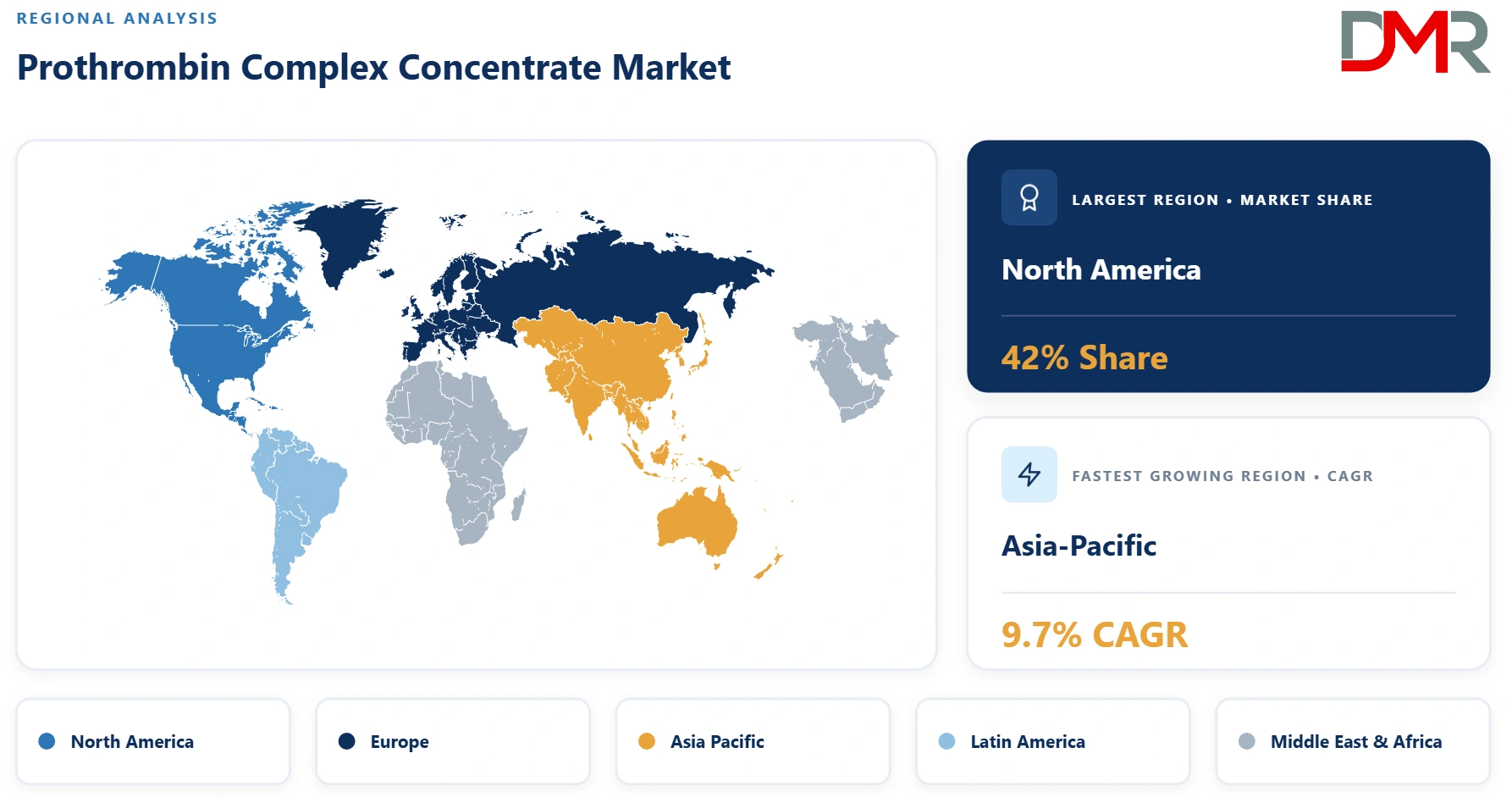
North America is expected to remain the largest region in 2026, accounting for approximately 42% of revenue. The United States drives the regional position through broad use of four-factor PCC in hospital anticoagulation reversal, mature emergency medicine infrastructure and system-level formulary protocols. Commercial competition between established and newer four-factor products also supports category visibility and hospital contracting. Canada contributes through organized blood management and concentrated tertiary-care demand. The region's advantage is less about population than treatment intensity: emergency departments and surgical services have the laboratory support, pharmacy budgets and governance needed to stock a high-value biologic for time-critical use. Expansion into perioperative algorithms provides further upside within an already developed customer base.
ℹ
To learn more about this report –
Download Your Free Sample Report Here
Region with the Highest CAGR
Asia-Pacific is projected to record the highest regional CAGR at 9.7% from 2026 to 2035. Demand is rising as China, Japan, India, South Korea and other markets expand tertiary hospital capacity, anticoagulation management and access to plasma-derived therapies. Aging populations and growing procedural volumes increase the number of patients exposed to anticoagulants and complex surgery, while local plasma fractionation capacity is improving in several countries. Adoption remains uneven because reimbursement and product availability differ sharply by market, creating white space for regional manufacturers and multinational suppliers. The strongest gains are expected where hospitals move from plasma-heavy reversal pathways toward stocked factor concentrates supported by clearer protocols and specialist training.
By Region
North America
Europe
- Germany
- France
- The UK
- Italy
- Spain
- Rest of Europe
Asia-Pacific
- China
- Japan
- India
- Australia
- South Korea
- Rest of APAC
Latin America
- Mexico
- Brazil
- Colombia
- Argentina
- Rest of LATAM
Middle East & Africa
- Saudi Arabia
- The UAE
- South Africa
- Rest of MEA
Competitive Landscape
Competition is concentrated at the finished-PCC level because plasma fractionation, biologics regulation and hospital contracting create high barriers to entry, while the broader supply chain includes plasma processors, distributors and blood-management technology vendors. CSL Behring and Octapharma anchor the non-activated four-factor segment in major markets, while Takeda remains important in activated PCC. Regional plasma manufacturers expand access in Asia and other markets. Competitive strategy centers on clinical evidence, dependable plasma supply, pathogen safety, product availability, dosing and vial efficiency, and inclusion in institutional bleeding protocols. Companies are also investing in fractionation capacity and hospital education as utilization moves beyond conventional warfarin reversal. Distribution scale matters because emergency products must be available rapidly despite irregular patient-level demand.
Some of the Prominent Players in the Global Prothrombin Complex Concentrate Market Are
- CSL Behring
- Octapharma AG
- Takeda Pharmaceutical Company Limited
- Grifols, S.A.
- Kedrion Biopharma
- PlasmaGen Biosciences Pvt. Ltd.
- LFB
- Prothya Biosolutions B.V.
- GC Biopharma
- SK Plasma Co., Ltd.
- Hualan Biological Engineering Inc.
- Shanghai RAAS Blood Products Co., Ltd.
- Uniphar plc
- Boya Bio-Pharmaceutical Group Co., Ltd.
- Sichuan Yuanda Shuyang Pharmaceutical Co., Ltd.
- Beijing Tiantan Biological Products Co., Ltd.
- Reliance Life Sciences
- Bharat Serums and Vaccines Limited
- Kamada Ltd.
- ADMA Biologics, Inc.
- Mediq B.V.
- China Resources Pharmaceutical Group Limited
- Zuellig Pharma
- DKSH Holding Ltd.
- McKesson Corporation
- Cencora, Inc.
- Cardinal Health, Inc.
- FFF Enterprises, Inc.
- PHOENIX Pharmahandel GmbH & Co KG
- Medipal Holdings Corporation
- Alfresa Holdings Corporation
- Suzuken Co., Ltd.
- Toho Holdings Co., Ltd.
- Terumo Blood and Cell Technologies
- Haemonetics Corporation
- Fresenius Kabi
- Cytiva
- Sartorius AG
- Pall Corporation
- Charles River Laboratories International, Inc.
- Other Key Players
Recent Developments
- In March 2026, Octapharma updated its US Balfaxar formulary support materials, reinforcing hospital adoption of its four-factor PCC as an alternative for urgent vitamin K antagonist reversal and emphasizing institutional protocol integration.
- In October 2025, additional reporting from the FARES-II program highlighted reduced transfusion requirements with four-factor PCC in cardiac surgery, strengthening the evidence base for concentrated factor replacement in perioperative bleeding management.
- In March 2025, Octapharma reported Phase 3 FARES-II results showing stronger hemostatic efficacy for its four-factor PCC than frozen plasma in bleeding cardiac-surgery patients, expanding the commercial discussion beyond routine anticoagulant reversal.
- In August 2024, Octapharma highlighted peer-reviewed comparative data for Balfaxar in urgent warfarin reversal, supporting hospital formulary evaluation after the product entered the United States market and increasing direct competition in four-factor PCC.
| Report Characteristics |
| Market Size (2026) |
USD 1.6 Bn |
| Forecast Value (2035) |
USD 3.2 Bn |
| CAGR (2026-2035) |
8.1% |
| The US Market Size (2026) |
USD 0.5 Bn |
| Historical Data |
2021 - 2025 |
| Forecast Data |
2026 - 2035 |
| Base Year |
2025 |
| Segments Covered |
By Product Type, By Application, By End Use and By Distribution Channel |
| Regional Coverage |
North America - The US and Canada; Europe - Germany, France, The UK, Italy, Spain, Rest of Europe; Asia-Pacific - China, Japan, India, Australia, South Korea, Rest of APAC; Latin America - Mexico, Brazil, Colombia, Argentina, Rest of LATAM; Middle East & Africa - Saudi Arabia, The UAE, South Africa, Rest of MEA |
Frequently Asked Questions
How big is the Global Prothrombin Complex Concentrate Market?
▾ The global industry is estimated at USD 1.6 Bn in 2026 and is forecast to reach USD 3.2 Bn by 2035. Demand is concentrated in hospital emergency reversal, surgery and specialist bleeding care, with four-factor products generating the majority of finished-product revenue.
What is the growth rate of the Global Prothrombin Complex Concentrate Market?
▾ Revenue is expected to expand at a CAGR of 8.1% from 2026 to 2035. Growth reflects wider institutional stocking, stronger patient blood management protocols, expansion of perioperative use and improving access to plasma-derived coagulation concentrates in developing hospital systems.
Which region holds the largest share in the Global Prothrombin Complex Concentrate Market?
▾ North America is projected to hold the largest regional position in 2026, representing around 42% of market revenue. The region benefits from mature hospital reversal protocols, high critical-care spending, established four-factor PCC availability and strong formulary adoption across emergency and surgical services.
Who are the key players in the Global Prothrombin Complex Concentrate Market?
▾ Key participants include CSL Behring, Octapharma AG, Takeda Pharmaceutical Company Limited, Grifols, Kedrion Biopharma, Prothya Biosolutions B.V. and LFB. Competition is based on plasma supply security, clinical evidence, regulatory reach, hospital contracting, product availability and integration into institutional bleeding-management pathways.
Which product type leads the Global Prothrombin Complex Concentrate Market?
▾ Four-Factor PCC is expected to lead product revenue in 2026 with approximately 64% share. Its position reflects broad adoption for rapid replacement of factors II, VII, IX and X, established hospital protocols and preference for comprehensive non-activated factor replacement where the product is available.
What is driving demand in the Global Prothrombin Complex Concentrate Market?
▾ Demand is driven by the need for rapid anticoagulation reversal, protocolized emergency bleeding management, increased procedural complexity and broader evaluation of concentrated factor replacement in cardiac and other major surgery. Hospitals also favor products that can be stored for immediate use and administered in lower volume than plasma.
How is the Prothrombin Complex Concentrate Market segmented?
▾ The Prothrombin Complex Concentrate Market is segmented by product type, application, end use and distribution channel. The analysis covers four-factor, three-factor and activated PCC products, major reversal and bleeding applications, institutional care settings, hospital pharmacy, specialty distribution and direct procurement across five regions.