Refinery & Petrochemical Equipment Market Snapshot
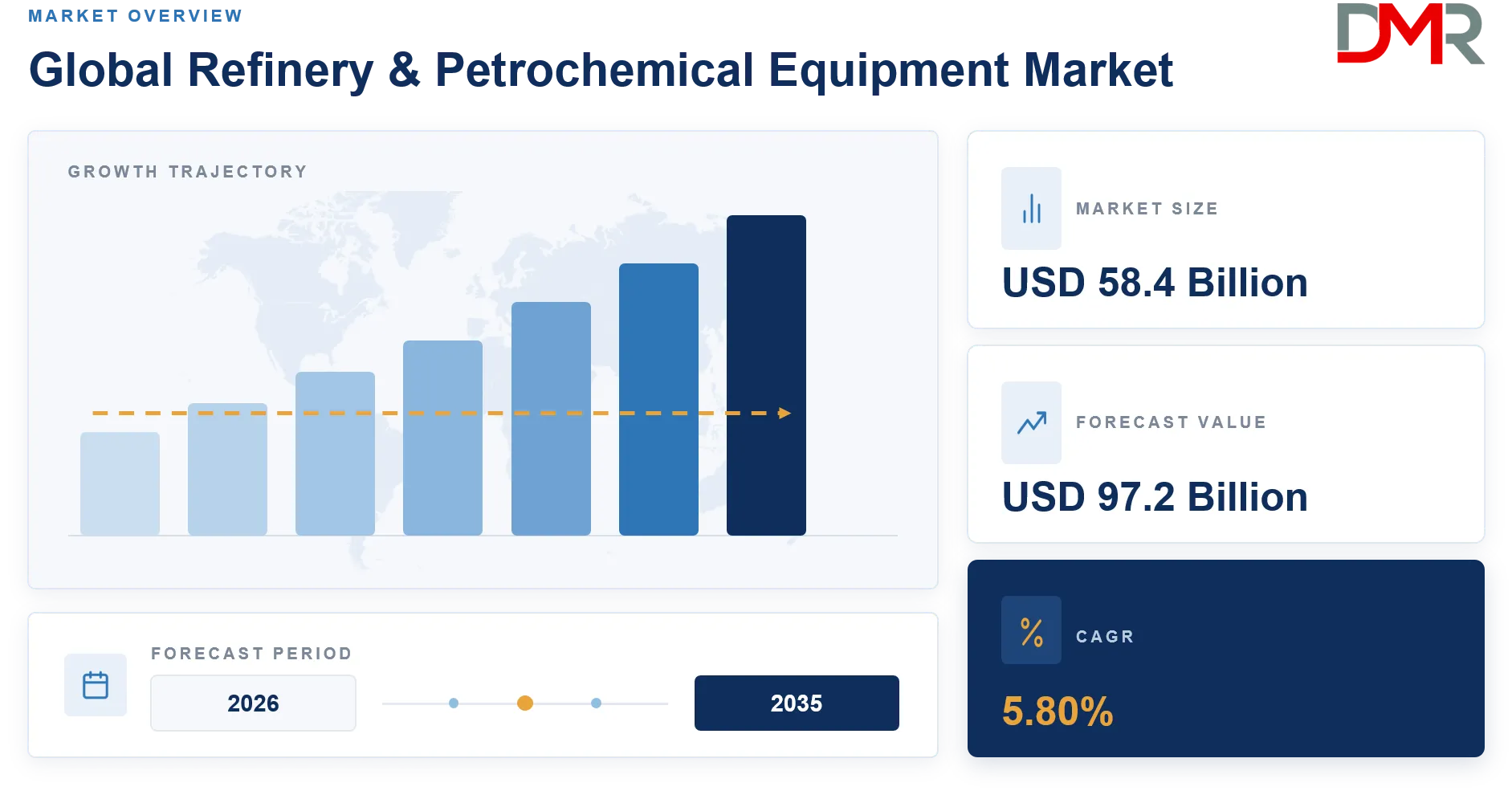
- Market Value: Refinery & Petrochemical Equipment Market is valued at USD 58.4 billion in 2026 and is projected to reach USD 97.2 billion by 2035.
- CAGR: Refinery & Petrochemical Equipment Market is expected to grow at a CAGR of 5.8% from 2026 to 2035.
- By Equipment Type Analysis: Distillation Equipment led the equipment type segment with a 14.2% share in 2026.
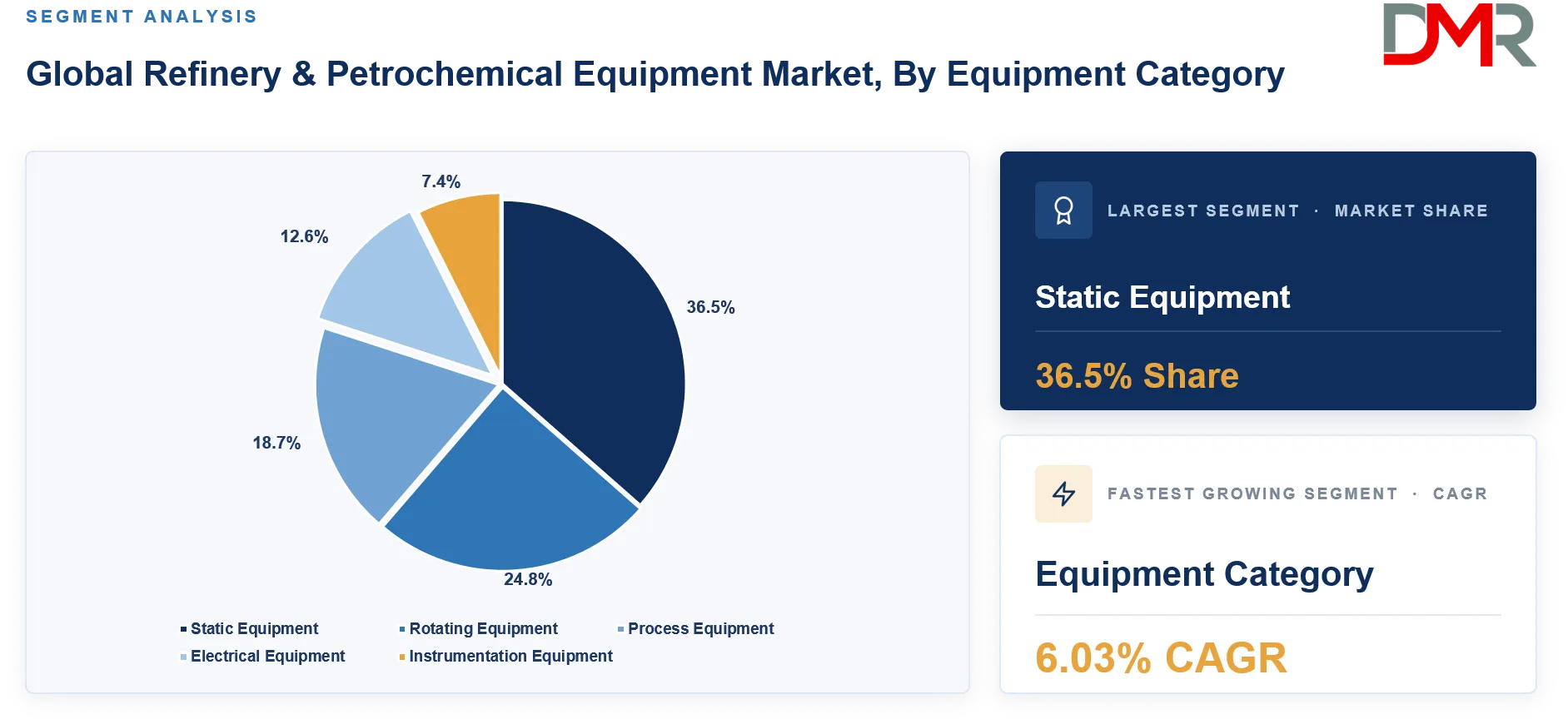
- By Equipment Category Segment Analysis: Static Equipment led equipment categories with a 36.5% share in 2026.
- By Refinery Process Industry Segment Analysis: Crude Distillation held a 22.4% share in 2026.
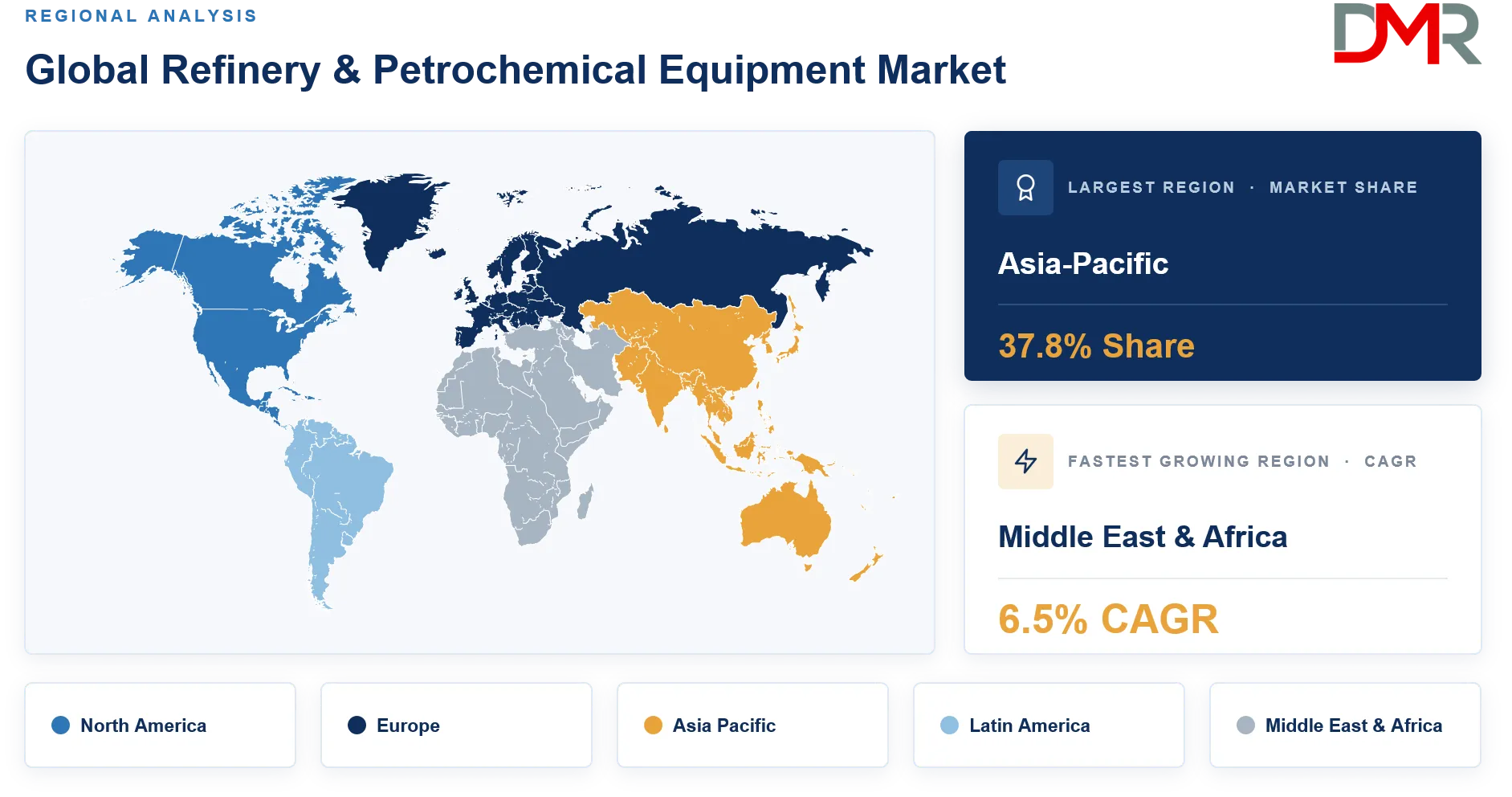
- Regional Analysis: Asia Pacific led the Refinery & Petrochemical Equipment Market with a 37.8% revenue share in 2026.
- US Market Size: The United States size is expected to reach USD 11.8 billion by 2035 from USD 7.6 billion in 2026, at a CAGR of 5.0%.
- Saudi Arabia Market Size: The Saudi Arabia size is expected to reach USD 9.4 billion by 2035 from USD 5.9 billion in 2026, at a CAGR of 6.1%.
- China Market Size: The China size is expected to reach USD 18.7 billion by 2035 from USD 11.2 billion in 2026, at a CAGR of 6.6%.
- Major Players: Sulzer Chemtech, Alfa Laval, Honeywell UOP, Emerson Electric Co., and Others.
What is the Refinery & Petrochemical Equipment Market and its Market Size?
The Global Refinery & Petrochemical Equipment Market size is projected to be valued at USD 58.4 billion in 2026 and is projected to reach USD 97.2 billion by 2035, expanding at a steady CAGR of 5.8% during the forecast period. Market demand covers distillation columns, heat exchangers, reactors, pumps, compressors, furnaces, pressure vessels, storage systems, separation equipment, valves, instrumentation, and associated process systems installed across petroleum refineries, petrochemical plants, integrated complexes, chemical processing facilities, and gas processing plants.
ℹ
To learn more about this report –
Download Your Free Sample Report Here
Equipment spending is moving toward integrated refining and petrochemical complexes, plant debottlenecking, higher-value chemical conversion, energy efficiency, emissions reduction, and replacement of aging assets. The IEA expects 4.2 million barrels per day of new global refining capacity to be added by 2030, partly offset by around 1.6 million barrels per day of closures. Much of the net capacity expansion is concentrated in Asia and the Middle East, creating direct demand for process equipment, rotating machinery, heat-transfer systems, reactors, columns, control systems, and refinery modernization services.
Use Cases
- Crude Oil Separation: Atmospheric and vacuum distillation systems separate crude streams into naphtha, kerosene, diesel, gas oil, and heavier fractions. Columns, reboilers, condensers, heat exchangers, pumps, and instrumentation form a major equipment demand base because every conventional refinery requires primary crude fractionation before downstream conversion.
- Petrochemical Conversion: Reactors, cracking furnaces, compressors, quench systems, fractionation columns, heat exchangers, and separation units support production of ethylene, propylene, aromatics, methanol, ammonia, and polymer intermediates. Integrated complexes increasingly combine refining and chemical conversion to improve feedstock flexibility and product value.
- Energy Recovery: Refineries use heat exchangers, waste heat recovery systems, furnace optimization, and process integration to reduce fuel consumption. Crude distillation can account for a major portion of refinery energy use, which makes thermal efficiency a direct operating-cost issue and supports investment in higher-performance heat-transfer equipment.
- Plant Modernization: Operators replace pumps, valves, vessels, exchangers, compressors, burners, analyzers, and controls to extend asset life, improve reliability, reduce shutdown frequency, and accommodate new feedstocks. Modernization is particularly important in mature refinery systems where full greenfield construction offers less attractive economics than targeted upgrades.
- Emissions and Product Compliance: Hydrotreating, desulfurization, hydrogen management, flare control, emissions monitoring, and heat integration require specialized process equipment. Refiners are investing in equipment capable of producing cleaner fuels while improving energy use and operational efficiency across existing process units.
How AI/Gen AI is Transforming the Global Refinery & Petrochemical Equipment Market?
Artificial intelligence is changing how refinery operators monitor pumps, compressors, furnaces, columns, exchangers, valves, and rotating assets. Machine-learning models can combine vibration, pressure, temperature, flow, corrosion, and maintenance records to identify abnormal operating patterns before equipment failure affects throughput. Predictive maintenance is especially valuable for high-cost compressors, critical pumps, fired heaters, and heat exchangers where unplanned downtime can interrupt an entire process train. Digital monitoring also helps operators prioritize inspections and schedule maintenance around planned turnarounds.
Generative systems are expanding the value of plant data by helping engineering and maintenance teams search technical manuals, compare operating histories, summarize alarm patterns, review work orders, and retrieve equipment specifications faster. Combined with process simulators and digital twins, these tools can support troubleshooting and operating-envelope analysis. Adoption is likely to favor equipment designed with connected sensors, interoperable control architecture, remote diagnostics, and lifecycle service capabilities, strengthening demand for instrumentation, automation platforms, intelligent valves, and condition-monitoring systems.
Key Drivers in the Refinery & Petrochemical Equipment Market
Expansion of Integrated Refining and Petrochemical Capacity
Large downstream projects are increasingly designed around refinery and chemical integration rather than standalone fuel production. This shift creates equipment demand across crude distillation, steam cracking, aromatics, polymerization, separation, compression, storage, and utility systems. China is a major example. Its refining capacity was estimated at about 18.5 million barrels per day and is projected by the IEA to approach 19.5 million barrels per day by 2030, with future expansion increasingly concentrated in complex integrated facilities.
Modernization, Reliability and Energy Efficiency Spending
Equipment replacement is becoming a larger procurement priority as operators seek higher uptime, lower energy intensity, longer maintenance intervals, and reduced emissions. Heat-transfer performance is particularly important because crude distillation is highly energy intensive. Fouling lowers heat recovery and raises fuel requirements, increasing the business case for exchanger upgrades, cleaning systems, process optimization, advanced monitoring, and improved materials. This supports recurring demand beyond greenfield refinery construction.
Restraints in the Refinery & Petrochemical Equipment Market
High Capital Cost and Long Project Development Cycles
Large refinery and petrochemical projects require substantial spending on process design, licensed technology, pressure equipment, metallurgy, construction, utilities, environmental systems, and commissioning. Procurement decisions can span several years and are sensitive to margins, interest rates, feedstock economics, permitting, and product-demand assumptions. This limits greenfield investment in mature markets and encourages owners to favor debottlenecking, selective equipment replacement, and brownfield modernization where returns can be achieved with lower execution risk.
Refinery Rationalization in Mature Fuel Markets
Slower gasoline and diesel demand growth can constrain investment in conventional refining assets. The IEA expects global refined-product demand to peak around 2027 while capacity additions remain significant. In the United States, operable atmospheric distillation capacity stood at about 18.2 million barrels per calendar day on January 1, 2026, down more than 250,000 barrels per day from January 2025. These conditions can limit new refinery construction while redirecting spending toward efficiency, chemicals integration, reliability, and higher-value conversion.
Growth Opportunities in the Global Refinery & Petrochemical Equipment Market
Crude-to-Chemicals and Refinery-Petrochemical Integration
Crude-to-chemicals strategies create a major opportunity for equipment suppliers because integrated sites require additional cracking, fractionation, reaction, compression, heat-transfer, and product-separation capacity. The planned Yasref expansion in Saudi Arabia includes a 1.8 million-ton-per-year mixed-feed steam cracker and a 1.5 million-ton-per-year aromatics complex. Projects of this scale generate demand across static equipment, compressors, pumps, furnaces, instrumentation, storage, and specialized process technology.
Brownfield Upgrades and Equipment Replacement
Aging refinery infrastructure creates a recurring market for replacement heat exchangers, valves, pumps, compressors, pressure vessels, burners, instrumentation, and corrosion-resistant components. Brownfield spending can improve capacity, energy efficiency, feed flexibility, and reliability without constructing an entirely new refinery. Vendors with retrofit engineering, lifecycle service, local maintenance networks, and equipment capable of fitting existing plant layouts can capture higher-value opportunities as operators extend the productive life of installed assets.
Trends in the Global Refinery & Petrochemical Equipment Market
Shift Toward High-Efficiency Heat and Mass Transfer Systems
Refiners are giving greater priority to equipment that can recover more process heat, reduce furnace duty, manage fouling, and improve throughput within existing plant footprints. Compact welded heat exchangers, advanced column internals, high-performance trays, improved burners, and enhanced separation systems are gaining relevance. Alfa Laval and Sulzer are among suppliers positioning heat-transfer and mass-transfer technologies for refinery and petrochemical applications where energy efficiency and operating reliability directly influence plant economics.
Greater Equipment Demand from Integrated Asian Complexes
Asia continues to attract large integrated downstream projects that combine crude processing with olefins, aromatics, and derivative production. In China, the Fujian Sinopec Aramco project is planned around a 320,000-barrel-per-day refinery, a 1.5 million-ton-per-year ethylene unit, and 2 million tons per year of paraxylene and downstream derivative capacity. Shell and CNOOC have also approved a Daya Bay expansion featuring a 1.6 million-ton-per-year ethylene cracker, reinforcing equipment demand for large chemical conversion complexes.
Research Scope and Analysis
The Global Refinery & Petrochemical Equipment Market is segmented based on Equipment Type, Equipment Category, Refinery Process, Petrochemical Process, Application, Material Type, Operation, End-User, and Region. The study evaluates equipment demand, installed-base replacement, project development, modernization activity, process requirements, material selection, technology adoption, and regional investment patterns that influence market growth.
ℹ
To learn more about this report –
Download Your Free Sample Report Here
By Equipment Type
Distillation Equipment dominated the equipment type segment with a 14.2% share in 2026. Distillation remains fundamental to atmospheric and vacuum crude processing, petrochemical fractionation, aromatics recovery, and product purification. Large columns require trays or packing, reboilers, condensers, heat integration, instrumentation, pumps, and pressure-control systems, creating a broad equipment value chain. Demand is supported by new crude distillation capacity in Asia and the Middle East, refinery expansions, column revamps, throughput debottlenecking, and efficiency upgrades. Technip Energies reported installation activity involving a vacuum distillation column for the Numaligarh refinery expansion in India, illustrating continued investment in large separation systems.
By Equipment Category
Static Equipment accounted for 36.5% of the Refinery & Petrochemical Equipment Market in 2026. The segment includes pressure vessels, columns, storage tanks, reactors, heat exchangers, separators, and other fixed process assets. Its leading position reflects the large number and high engineered value of static components required throughout refinery and petrochemical process trains. Material selection is critical because equipment must withstand high temperature, pressure, corrosive streams, hydrogen service, sulfur compounds, and continuous operating cycles. Growth is supported by integrated complexes, replacement of aging vessels and exchangers, and investments in more energy-efficient processing.
By Refinery Process
Crude Distillation held a 22.4% share in 2026, making it the leading refinery process segment. Atmospheric crude distillation is the entry point for most refinery configurations and determines feed distribution to hydrotreating, catalytic cracking, hydrocracking, coking, and reforming units. Capacity additions therefore create demand for columns, desalters, heaters, pumps, heat exchangers, condensers, separators, valves, and controls. Refinery operators are also upgrading crude preheat trains and column internals to improve heat recovery, handle changing crude slates, reduce fouling, and raise throughput without proportionate increases in fuel use.
The Refinery & Petrochemical Equipment Market Report is segmented on the basis of the following:
By Equipment Type
- Distillation Equipment
- Heat Exchangers
- Reactors
- Separation Equipment
- Pumps
- Compressors
- Storage Tanks
- Valves
- Pressure Vessels
- Furnaces
By Equipment Category
- Static Equipment
- Rotating Equipment
- Process Equipment
- Electrical Equipment
- Instrumentation Equipment
By Refinery Process
- Crude Distillation
- Catalytic Cracking
- Hydrocracking
- Hydrotreating
- Reforming
- Alkylation
- Coking
- Desulfurization
By Petrochemical Process
- Steam Cracking
- Polymerization
- Aromatics Production
- Olefins Production
- Methanol Production
- Ammonia Production
By Application
- Crude Oil Refining
- Petrochemical Manufacturing
- Natural Gas Processing
- Product Separation
- Product Storage
- Process Heat Management
By Material Type
- Carbon Steel
- Stainless Steel
- Alloy Steel
- Duplex Stainless Steel
- Nonferrous Metals
By Operation
- New Plant Construction
- Plant Expansion
- Equipment Replacement
- Plant Modernization
- Maintenance Operations
By End-User
- Petroleum Refineries
- Petrochemical Plants
- Integrated Complexes
- Chemical Processing Plants
- Gas Processing Plants
Regional Analysis
Asia Pacific is the Leading Region in the Refinery & Petrochemical Equipment Market
Asia Pacific captured 37.8% of Global Refinery & Petrochemical Equipment Market revenue in 2026. China, India, South Korea, Singapore, and Southeast Asian economies support equipment demand through refining capacity, petrochemical integration, plant expansion, and chemicals manufacturing. China remains central to the regional outlook as large integrated projects shift investment toward steam crackers, aromatics, advanced separation, large reactors, compressors, heat exchangers, and digital control systems. India also supports demand through refinery expansion and new polypropylene, cracking, and conversion projects.
Middle East & Africa is the Fastest-Growing Region in the Refinery & Petrochemical Equipment Market
Middle East & Africa is positioned for rapid equipment demand in the Global Refinery & Petrochemical Equipment Market as producers move further downstream into chemicals and higher-value refined products. Saudi Arabia is advancing refinery-petrochemical integration at Yasref and evaluating a major Samref upgrade in Yanbu. Africa is also developing larger refining assets, including expansion ambitions around the Dangote refinery. These projects support demand for crackers, reactors, distillation systems, rotating equipment, storage, utilities, and emissions-control systems.
By Region
North America
Europe
- Germany
- France
- The UK
- Italy
- Spain
- Rest of Europe
Asia-Pacific
- China
- Japan
- India
- Australia
- South Korea
- Rest of APAC
Latin America
- Mexico
- Brazil
- Colombia
- Argentina
- Rest of LATAM
Middle East & Africa
- Saudi Arabia
- The UAE
- South Africa
- Rest of MEA
ℹ
To learn more about this report –
Download Your Free Sample Report Here
Major Countries Analysis
United States Refinery & Petrochemical Equipment Market
The United States market is expected to reach USD 11.8 billion by 2035 from USD 7.6 billion in 2026, growing at a CAGR of 5.0%. With atmospheric distillation capacity of approximately 18.2 million barrels per calendar day at the start of 2026, the country maintains one of the world's largest installed refinery equipment bases. Investment is increasingly tied to modernization, reliability, petrochemical integration, emissions compliance, heat recovery, equipment replacement, and debottlenecking rather than large conventional greenfield refineries.
Saudi Arabia Refinery & Petrochemical Equipment Market
The Saudi Arabia market is expected to expand from USD 5.9 billion in 2026 to USD 9.4 billion by 2035 at a CAGR of 6.1%. Growth is supported by downstream diversification and conversion of more hydrocarbon streams into chemicals. Yasref's planned expansion includes a 1.8 million-ton-per-year steam cracker and a 1.5 million-ton-per-year aromatics complex, while Aramco and ExxonMobil are evaluating upgrades at Samref. These investments create opportunities across process equipment, furnaces, compression, separation, storage, and instrumentation.
China Refinery & Petrochemical Equipment Market
The China market is projected to reach USD 18.7 billion by 2035 from USD 11.2 billion in 2026, advancing at a CAGR of 6.6%. Growth is shifting from basic refining additions toward large integrated refinery-petrochemical hubs, efficiency improvements, high-value chemicals, and replacement of smaller inefficient facilities. The Fujian Sinopec Aramco complex is planned with 320,000 barrels per day of refining capacity, a 1.5 million-ton-per-year ethylene unit, and substantial paraxylene capacity, strengthening demand for high-value process and rotating equipment.
Competitive Landscape
The Refinery & Petrochemical Equipment Market is fragmented across specialized equipment manufacturers, automation suppliers, process technology licensors, engineering contractors, and integrated project companies. Competition depends on equipment reliability, API and process-standard compliance, metallurgy expertise, efficiency, lifecycle cost, installed-base support, localization, aftermarket service, and ability to participate in large EPC packages. Sulzer Chemtech competes through mass-transfer, separation, mixing, and refinery process technologies, while Alfa Laval has a strong position in high-efficiency heat-transfer systems. Flowserve participates across pumps, valves, seals, and flow-control applications.
Honeywell UOP, KBR, Technip Energies, JGC, Toyo Engineering, Chiyoda, Fluor, and other engineering and technology companies influence equipment specifications through licensed processes and major project execution. Technip Energies' recent refinery and petrochemical work in India and Vietnam illustrates continued demand for proprietary furnaces, process equipment, engineering, and procurement capabilities. Suppliers able to combine equipment, digital monitoring, retrofit engineering, energy-efficiency improvement, and long-term service are positioned to capture a larger share of modernization and integrated-complex spending.
Some of the prominent players in the Refinery & Petrochemical Equipment Industry are:
- Sulzer Chemtech
- Alfa Laval
- Honeywell UOP
- Emerson Electric Co.
- Flowserve Corporation
- JGC Corporation
- Technip Energies
- KBR Inc.
- Mitsubishi Heavy Industries (MHI)
- Siemens Energy
- Yokogawa Electric
- Larsen & Toubro (L&T)
- Toyo Engineering
- Chiyoda Corporation
- Fluor Corporation
- Anup Engineering Ltd
- Brembana & Rolle S.p.A. (B&R)
- Weihai Shidao Heavy Industry
- Yantai Sanmen Machinery
- Roben Manufacturing
- Others
Investment and White Space Analysis
Investment activity in the Refinery & Petrochemical Equipment Market is shifting toward integrated refining and chemicals complexes, brownfield modernization, energy-efficiency upgrades, and high-value equipment replacement. Attractive white spaces are emerging in Asia Pacific and the Middle East, where operators are adding steam crackers, aromatics units, advanced separation systems, hydrogen processing, and higher-conversion facilities.
Saudi Arabia's planned Yasref expansion includes a 1.8 million-ton-per-year mixed-feed steam cracker and a 1.5 million-ton-per-year aromatics complex, while the Fujian integrated project in China includes 320,000 barrels per day of refining capacity and a 1.5 million-ton-per-year ethylene unit. These projects create opportunities for heat exchangers, reactors, columns, compressors, pumps, furnaces, valves, and instrumentation suppliers. Additional white space exists in retrofit engineering, corrosion-resistant materials, localized fabrication, predictive maintenance, aftermarket services, and equipment designed to reduce energy use and extend turnaround intervals.
Technology Analysis
Technology development in the Refinery & Petrochemical Equipment Market is focused on higher thermal efficiency, process intensification, connected equipment, predictive maintenance, advanced process control, and digital twins. Modern refineries increasingly deploy wireless condition monitoring and analytics across compressors, pumps, control valves, heat exchangers, fired heaters, and storage assets to identify degradation before unplanned shutdowns occur. Digital twins allow operators to test operating scenarios, optimize crude distillation and petrochemical processes, and evaluate energy or throughput changes without disrupting production.
Heat-transfer technology is also advancing as fouling remains a major source of lost energy recovery and higher furnace duty. Compact welded and plate-type exchangers can improve heat recovery while reducing equipment footprint. Smart sensors, real-time diagnostics, automated cleaning, intelligent valves, and integrated control platforms are therefore becoming important equipment differentiators, shifting competition from standalone hardware toward connected lifecycle performance and measurable operating-cost reduction.
Recent Developments
- August 2026: Honeywell UOP awarded major contract by Kuwait Integrated Petroleum Industries Company (KPIC) to reconfigure refining and petrochemical sections at Al Zour refinery, supplying technology licenses, design services, key equipment, catalysts and adsorbents for clean fuels, paraxylene and propylene production.
- July 2026: Larsen & Toubro (L&T) Heavy Engineering secured large international orders across Asia, Africa, North America, South America and Europe for critical process plant equipment, including the world's largest Fluid Catalytic Cracking Reactor Regenerator Package and urea/ammonia equipment for refinery and petrochemical complexes.
- June 2026: Technip Energies, in partnership with JGC and Samsung Heavy Industries, awarded €1bn+ EPCIC contract by Mozambique Rovuma Venture (Eni JV) for the Coral Norte floating LNG project offshore Mozambique, classified as a major award advancing integrated gas-to-liquids infrastructure.
Report Details
| Report Characteristics |
| Market Size (2026) |
USD 58.4 Bn |
| Forecast Value (2035) |
USD 97.2 Bn |
| CAGR (2026–2035) |
5.8% |
| The Country Market Size (2026) |
United States: USD 7.6 Bn; Saudi Arabia: USD 5.9 Bn; China: USD 11.2 Bn |
| Historical Data |
2021 – 2025 |
| Forecast Data |
2026 – 2035 |
| Base Year |
2025 |
| Segments Covered |
By Equipment Type, By Equipment Category, By Refinery Process, By Petrochemical Process, By Application, By Material Type, By Operation, and By End-User |
| Regional Coverage |
North America – The US and Canada; Europe – Germany, France, The UK, Italy, Spain, Rest of Europe; Asia-Pacific – China, Japan, India, Australia, South Korea, Rest of APAC; Latin America – Mexico, Brazil, Colombia, Argentina, Rest of LATAM; Middle East & Africa – Saudi Arabia, The UAE, South Africa, Rest of MEA |
Frequently Asked Questions
What is the current size of the Refinery & Petrochemical Equipment Market?
▾ The Refinery & Petrochemical Equipment Market size is valued at USD 58.4 billion in 2026 and is forecast to reach USD 97.2 billion by 2035.
What is the growth rate of the Refinery & Petrochemical Equipment Market during?
▾ The Refinery & Petrochemical Equipment Market is expected to grow at a CAGR of 5.8% during the forecast period from 2026 to 2035.
Which region dominates the global Refinery & Petrochemical Equipment Market?
▾ Asia Pacific leads the global Refinery & Petrochemical Equipment Market, accounting for a 37.8% revenue share in 2026.
What factors are driving the growth of the Refinery & Petrochemical Equipment Market?
▾ Refinery expansion, petrochemical integration, plant modernization, capacity additions, and equipment replacement are driving market growth.
What are the major challenges restraining the Refinery & Petrochemical Equipment Market?
▾ High capital costs, long project cycles, refinery closures, volatile margins, and complex plant upgrades restrain market expansion.
Which segment holds the largest share of the Refinery & Petrochemical Equipment Market?
▾ Static Equipment leads the Refinery & Petrochemical Equipment Market by equipment category, accounting for a 36.5% share in 2026.
Who are the leading companies in the global Refinery & Petrochemical Equipment Market?
▾ Sulzer Chemtech, Alfa Laval, Honeywell UOP, Emerson Electric Co., Flowserve Corporation, JGC Corporation, Technip Energies, KBR Inc., Mitsubishi Heavy Industries (MHI), Siemens Energy, Yokogawa Electric, Larsen & Toubro (L&T), Toyo Engineering, Chiyoda Corporation, Fluor Corporation, Anup Engineering Ltd, Brembana & Rolle S.p.A. (B&R), Weihai Shidao Heavy Industry, Yantai Sanmen Machinery, and Roben Manufacturing are prominent companies in the Refinery & Petrochemical Equipment Market.
How is AI influencing the Refinery & Petrochemical Equipment Market?
▾ AI supports predictive maintenance, process optimization, equipment monitoring, fault detection, and plant efficiency across refinery operations.
What are the future opportunities and trends in the Refinery & Petrochemical Equipment Market?
▾ Integrated complexes, smart equipment, plant retrofits, energy efficiency, digitalization, and advanced materials offer future market opportunities.