Global Refining Industry Automation Software Market Snapshot
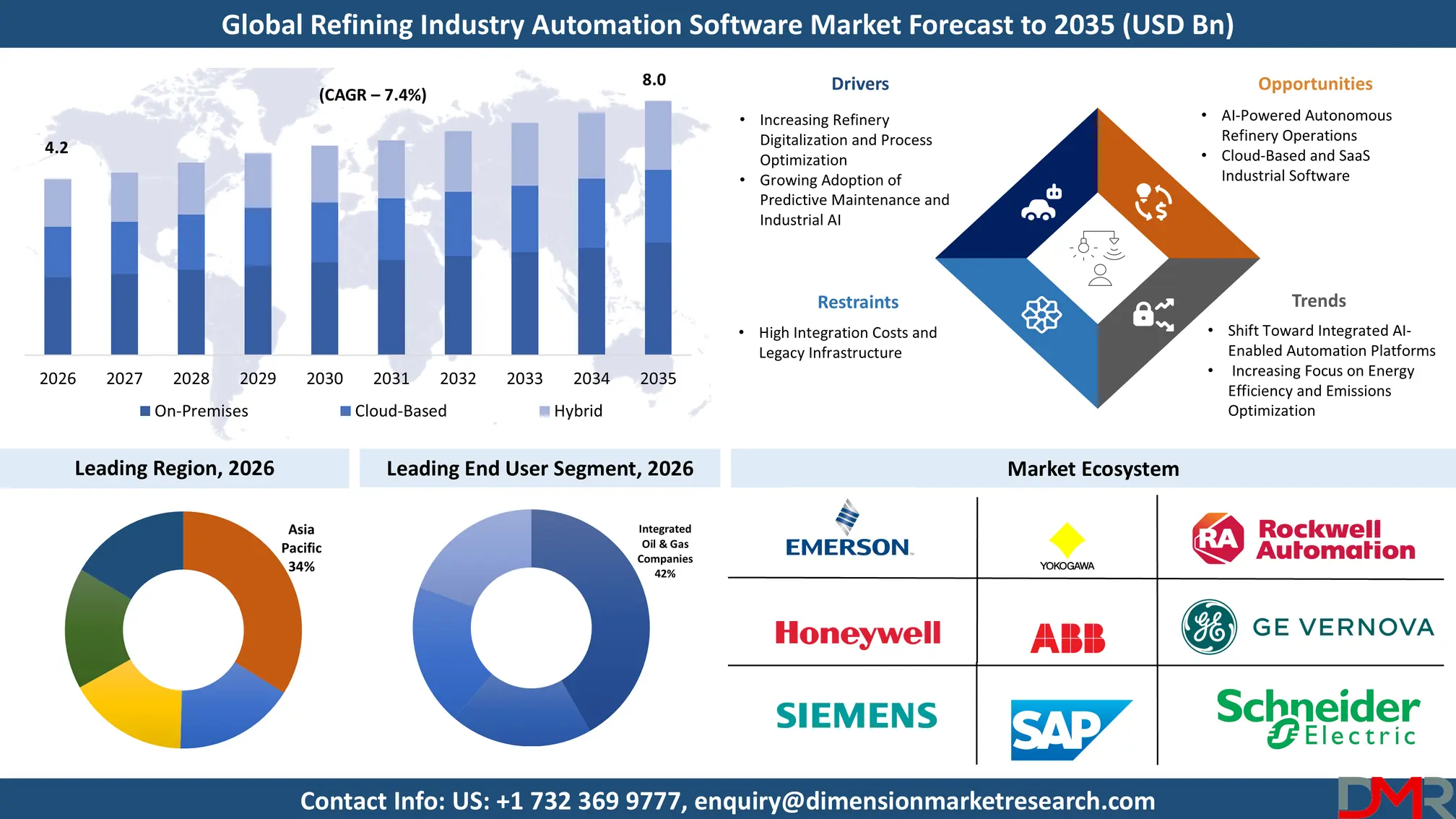
- Global Refining Industry Automation Software Market Size in 2026: USD 4.2 Billion
- Global Refining Industry Automation Software Market Size in 2035: USD 8.0 Billion
- Global CAGR from 2026 to 2035: 7.4%
- Leading Software Type in 2026: Advanced Process Control (APC) Software, 24.0%
- Leading Application in 2026: Process Optimization & Control, 27.0%
- Leading Deployment Model in 2026: On-Premise, 56.0%
- Fastest-Growing Segment: Digital Twin Software, 14.0% CAGR
- Leading Region in 2026: Asia-Pacific, 34.0%
- Fastest-Growing Region: Middle East & Africa, 9.1% CAGR
What is the Global Refining Industry Automation Software and its Market Size?
The global Refining Industry Automation Software Market is estimated at approximately USD 4.20 billion in 2026 and is projected to reach USD 8.00 billion by 2035, representing a 7.4% CAGR.
The market encompasses software platforms that automate, optimize, monitor, simulate, analyze, and digitally manage refinery processes. Core solutions include advanced process control, distributed control system software, manufacturing execution systems, production planning, asset-performance management, predictive maintenance, energy-management software, digital twins, and industrial analytics.
ℹ
To learn more about this report –
Download Your Free Sample Report Here
Growth is being supported by the need to extract higher utilization and margins from increasingly complex refinery assets. Although global refined-product demand growth is expected to be relatively modest, the IEA expects additional refining capacity to come online through 2030, particularly in Asia and the Middle East. This creates pressure on individual facilities to operate more efficiently, optimize feedstocks and product yields, reduce energy intensity, and minimize unplanned downtime.
The market is also transitioning from conventional automation toward software-defined, connected and AI-enabled operations. Vendors are increasingly embedding machine learning, digital twins, industrial data platforms, predictive analytics, and AI assistants into established automation environments. Honeywell, for example, commercially launched its Experion Operations Assistant in 2026, combining real-time and historical information to provide operators with predictive decision support.
Use Cases
- Process Optimization & Control: Continuously adjusts operating parameters to maximize throughput, yield, stability, and product quality.
- Predictive Maintenance: Uses equipment data and machine learning to identify developing failures before they cause costly shutdowns.
- Production Planning & Scheduling: Optimizes crude selection, unit utilization, blending, inventories, and production schedules according to market conditions.
- Asset Performance Management: Provides centralized monitoring of equipment health, reliability, maintenance requirements, and asset lifecycle performance.
- Energy Management: Optimizes steam, electricity, fuel gas, heat integration, and utilities to reduce refinery energy intensity.
- Digital Twin & Simulation: Creates virtual representations of refinery processes for optimization, training, scenario analysis, and operational decision-making.
Key Takeaways
- The global market is estimated at USD 4.20 billion in 2026 and is forecast to reach USD 8.00 billion by 2035.
- Market growth is driven by refinery digitalization, operational-efficiency requirements, predictive maintenance, AI adoption, and modernization of legacy automation.
- Advanced Process Control is estimated to remain the largest software category in 2026.
- Digital twin software is projected to be the fastest-growing major software category at approximately 14.0% CAGR.
- Asia-Pacific is expected to hold the largest regional share, supported by refinery capacity and modernization activity.
- Middle East & Africa is expected to record the fastest regional growth as large-scale refinery and integrated refining-petrochemical projects adopt advanced digital systems.
- AI is shifting competition from conventional automation functionality toward intelligent optimization, predictive decision support, and increasingly autonomous operations.
How AI, IoT, Cloud, Edge Computing and Digital Twins are Transforming the Market
AI and machine learning are increasingly being integrated into refinery automation software to identify process anomalies, predict equipment failures, optimize operating parameters, forecast yields, and support operator decisions. Digital twins combine process models with real-time plant information, while industrial IoT connects sensors, equipment, control systems, and enterprise applications. Cloud and edge architectures provide scalable analytics while retaining low-latency processing near critical equipment.
The result is a shift from reactive automation toward predictive and prescriptive operations. Software can identify deviations before they become failures, recommend corrective actions, optimize energy flows, and compare current plant performance against modeled operating conditions. Siemens, for example, markets AI-enabled predictive analytics for process plants, while ABB's OPTIMAX platform applies AI-enhanced forecasting and optimization to refining and petrochemical energy systems.
Competition is consequently moving toward integrated platforms that combine control, industrial data, AI, engineering, asset management, and cybersecurity rather than isolated point solutions.
Key Drivers in the Global Refining Industry Automation Software Market
Increasing Refinery Digitalization and Process Optimization
Refineries operate with narrow margins in which small improvements in yield, throughput, energy consumption, and reliability can translate into significant economic value. This makes advanced software attractive even when overall refined-product demand is growing slowly. Operators increasingly deploy APC, real-time optimization, production-planning, historian, MES, analytics, and asset-management applications to extract more value from existing equipment. The need is particularly strong at mature brownfield facilities, where replacing physical equipment may be considerably more expensive than improving control and optimization capabilities.
Growing Adoption of Predictive Maintenance and Industrial AI
Unplanned refinery outages can create substantial production losses, while maintenance activities can require significant labor, equipment, and turnaround expenditure. Predictive analytics therefore represents an increasingly important software opportunity. AI models can combine historical process data, equipment measurements, maintenance records, and operating conditions to detect abnormal behavior and identify likely failure modes.
Restraints in the Global Refining Industry Automation Software Market
High Integration Costs and Legacy Infrastructure
Many refineries operate automation systems that have been deployed and upgraded over several decades. DCS, PLC, SCADA, historians, laboratory systems, MES, ERP, maintenance platforms, and engineering applications may originate from different vendors and generations. Connecting these systems can require extensive engineering, data mapping, validation, cybersecurity assessment, and operational testing. The economic case for software can therefore be weakened by integration costs even when the software itself has an attractive return on investment.
Growth Opportunities in the Global Refining Industry Automation Software Market
AI-Powered Autonomous Refinery Operations
The most significant long-term opportunity is the development of AI systems capable of moving beyond monitoring and recommendations toward semi-autonomous optimization. AI can evaluate thousands of operating variables simultaneously and recommend or execute actions subject to defined safety and process constraints. Honeywell's 2026 launch of Experion Operations Assistant illustrates the movement toward AI-powered decision support embedded within industrial control environments.
Cloud-Based and SaaS Industrial Software
Cloud-based platforms offer refiners greater scalability, centralized data management, remote access, faster software updates, and the ability to standardize analytics across multiple sites. SaaS models may also reduce the initial capital barrier associated with software deployment.
Trends in the Global Refining Industry Automation Software Market
Shift Toward Integrated AI-Enabled Automation Platforms
The market is moving away from isolated applications toward interconnected platforms that combine engineering, operations, asset performance, analytics, AI, and enterprise information. Siemens' 2026 Eigen Engineering Agent demonstrates the industry's movement toward AI capable of executing automation-engineering tasks rather than merely generating recommendations.
Increasing Focus on Energy Efficiency and Emissions Optimization
Energy represents one of the largest operating-cost categories for many refineries. Software is therefore being deployed to optimize steam networks, furnaces, electricity consumption, fuel gas, heat integration, and utilities while supporting emissions-management objectives. ABB specifically positions OPTIMAX for refining and petrochemical operations around energy optimization, lower emissions, and improved operational reliability.
Research Scope and Analysis
The market is segmented by software type, deployment model, refinery process and end user. The analysis distinguishes software directly used for refinery automation and optimization from general-purpose enterprise software, hardware, engineering services, and unrelated industrial IT.
ℹ
To learn more about this report –
Download Your Free Sample Report Here
By Software Type Analysis
Advanced Process Control (APC) software is estimated to be the dominant software category in 2026, accounting for approximately 24.0% of market revenue. APC maintains leadership because it directly influences refinery throughput, yield, process stability, quality, and profitability and can be integrated with existing DCS environments. Asset Performance Management software is estimated to be the second-largest category at approximately 18.0%, reflecting increasing attention to equipment reliability and maintenance optimization. Digital Twin software is projected to be the fastest-growing category, with an estimated 14.0% CAGR, as refiners increasingly use virtual process models for optimization, training, engineering, scenario analysis, and predictive operations. DCS and SCADA software remain foundational categories because they provide the operational control layer, while MES, production planning, energy management, and predictive analytics continue gaining importance as refineries build integrated digital architectures.
By Refining Process Analysis
By refining process, Conversion Processes are estimated to dominate the market in 2026 with approximately 40.0% share, driven by the high software intensity of Fluid Catalytic Cracking (FCC), Hydrocracking, and Coking for process optimization, yield improvement, predictive maintenance, and operational efficiency. Treating & Upgrading represents the second-largest segment at approximately 25.0%, comprising Hydrotreating and Hydrogen Production, supported by stringent fuel-quality requirements and growing demand for hydrogen and energy optimization. Crude Distillation accounts for approximately 24.0%, driven by automation, process control, throughput optimization, and energy management across primary refining operations. Blending & Product Optimization represents approximately 11.0% and is expected to be the fastest-growing segment at around 10.2% CAGR, supported by AI, real-time optimization, product-quality management, and the increasing need to maximize refinery-wide product value.
By Deployment Analysis
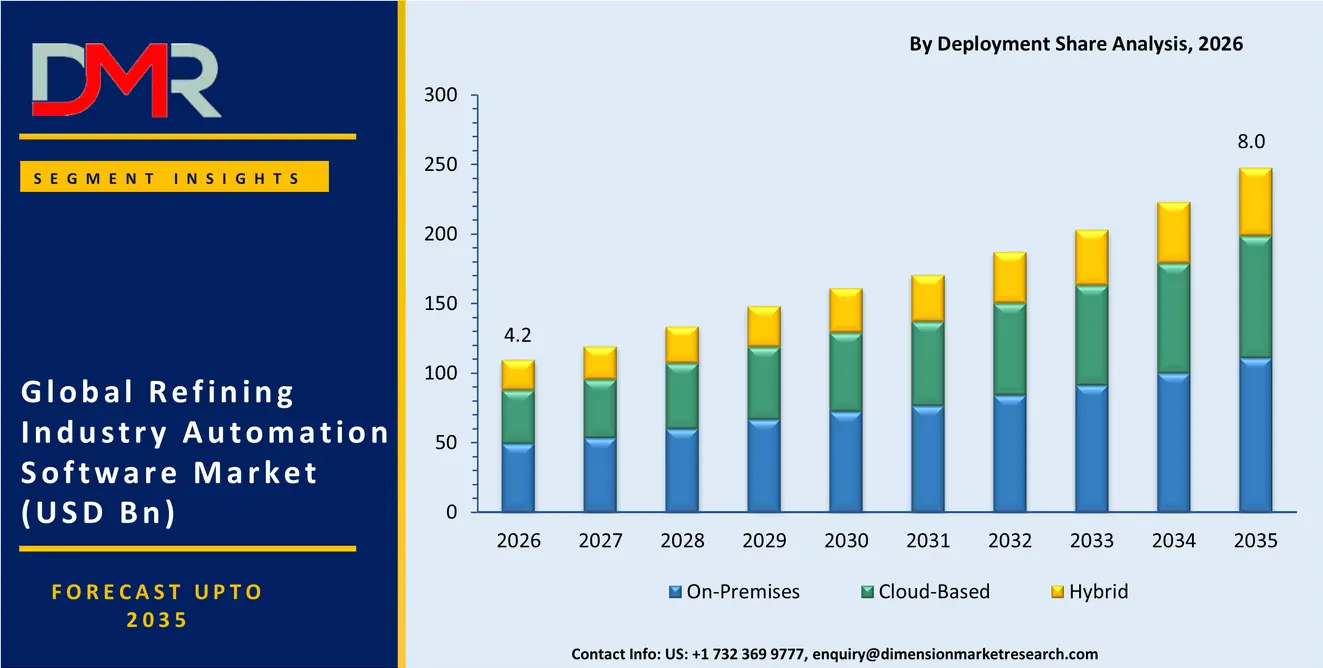
On-premise deployment is estimated to account for approximately 56.0% of the market in 2026, reflecting the safety, cybersecurity, latency, reliability, and legacy-infrastructure requirements of refinery operations. Hybrid deployment represents approximately 28.0%, benefiting from the ability to maintain mission-critical control locally while using cloud or enterprise environments for analytics and optimization. Cloud deployment is expected to be the fastest-growing model, at approximately 13.8% CAGR, as industrial cloud platforms mature and operators become more comfortable with remote analytics, centralized data environments, and SaaS applications. However, cloud adoption will remain slower for core control functions than for analytics, planning, asset management, and enterprise-level applications because of operational and cybersecurity requirements.
ℹ
To learn more about this report –
Download Your Free Sample Report Here
By End User Analysis
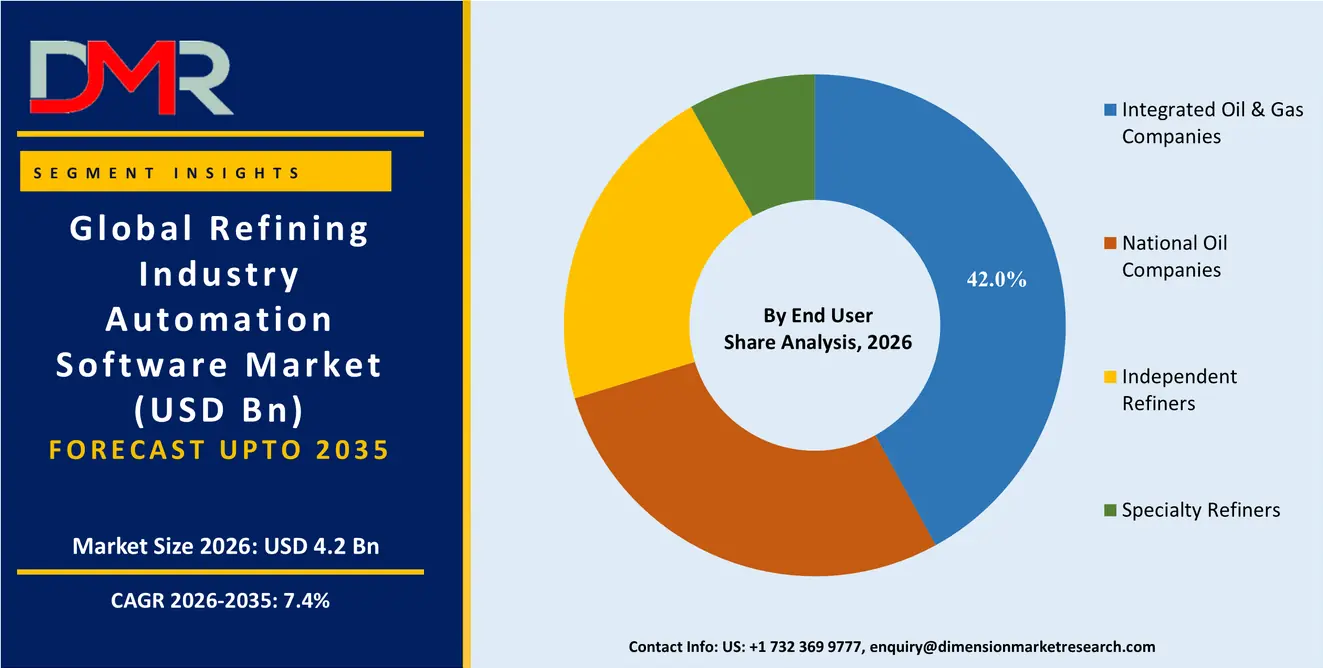
By end user, Integrated Oil & Gas Companies are estimated to dominate the market in 2026 with approximately 42.0% share, supported by their large refinery portfolios and strong investments in automation, process optimization, asset management, AI, and digital transformation. National Oil Companies represent the second-largest segment at approximately 30.0% share and are expected to be the fastest-growing segment at around 8.5% CAGR, driven by major refinery modernization and integrated refining-petrochemical investments, particularly across Asia and the Middle East. Independent Refiners account for approximately 21.0%, with demand focused on improving throughput, yields, energy efficiency, maintenance, and refinery margins. Specialty Refiners represent the remaining 7.0%, with adoption increasingly supported by modular, cloud-based, and analytics-driven automation solutions that provide cost-effective optimization for smaller or specialized facilities.
The Global Refining Industry Automation Software Market Report is segmented on the basis of the following:
By Software Type
- Distributed Control System (DCS) Software
- Supervisory Control and Data Acquisition (SCADA) Software
- Manufacturing Execution System (MES)
- Advanced Process Control (APC) Software
- Asset Performance Management (APM) Software
- Process Simulation & Digital Twin Software
- Laboratory Information Management System (LIMS)
- Industrial Cybersecurity Software
By Refining Process
- Crude Distillation
- Conversion Processes
- Fluid Catalytic Cracking (FCC)
- Hydrocracking
- Coking
- Treating & Upgrading
- Hydrotreating
- Hydrogen Production
- Blending & Product Optimization
By Deployment
- On-Premises
- Cloud-Based
- Hybrid
By End User
- Integrated Oil & Gas Companies
- National Oil Companies
- Independent Refiners
- Specialty Refiners
Regional Analysis
Asia Pacific is the Leading Region in the Global Refining Industry Automation Software Market
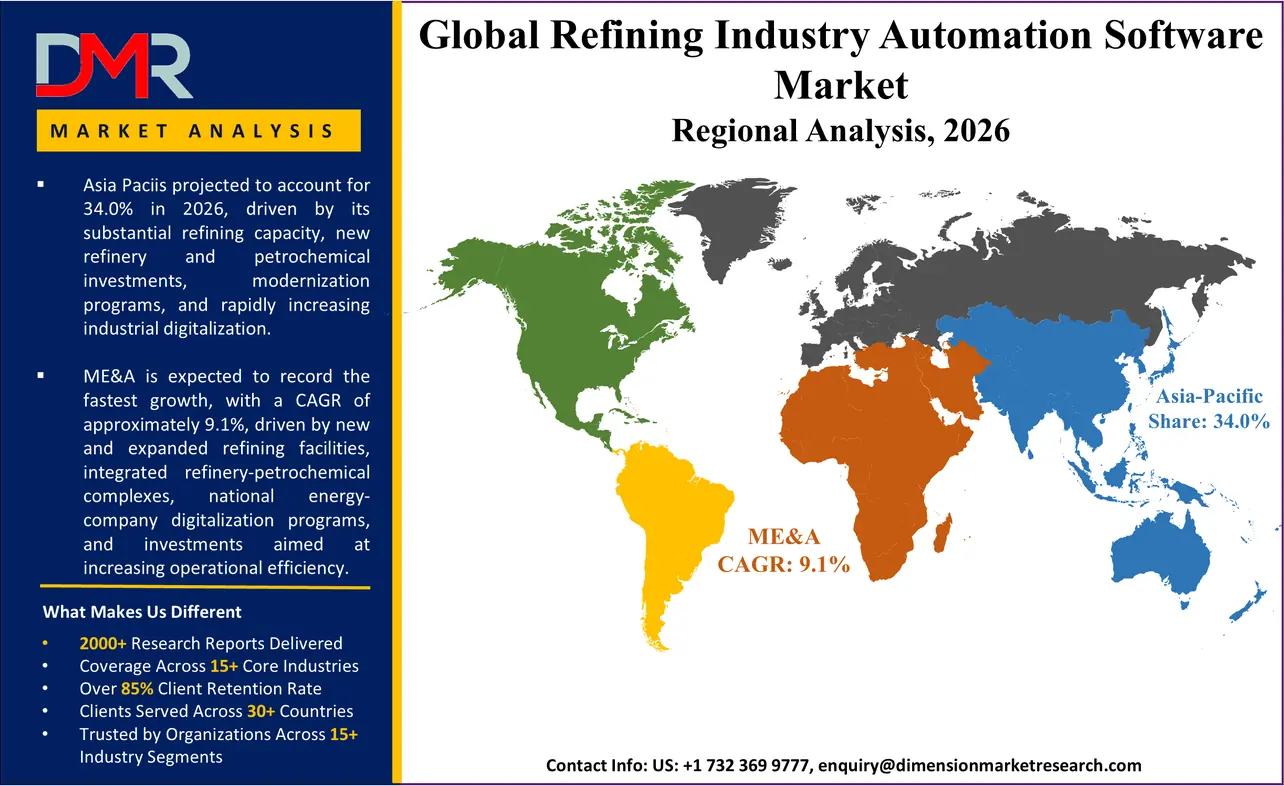
Asia-Pacific is expected to maintain its position as the largest regional market, representing approximately 34.0% of global revenue in 2026, equivalent to roughly USD 1.43 billion. The region benefits from substantial refining capacity, new refinery and petrochemical investments, modernization programs, and rapidly increasing industrial digitalization. China and India are particularly important, while Southeast Asian refining hubs provide additional demand. The IEA expects refining capacity additions through 2030 to be concentrated heavily in Asia, with China and India outpacing refinery closures in Europe and the United States. Software demand is consequently supported by both greenfield deployment and brownfield modernization, creating opportunities across APC, MES, digital twins, predictive maintenance, energy optimization, and industrial cybersecurity.
ℹ
To learn more about this report –
Download Your Free Sample Report Here
ME&A is the Fastest-Growing Region in the Global Refining Industry Automation Software Market
Middle East & Africa is projected to be the fastest-growing regional market, with an estimated 9.1% CAGR between 2026 and 2035. Growth is supported by new and expanded refining facilities, integrated refinery-petrochemical complexes, national energy-company digitalization programs, and investments aimed at increasing operational efficiency. Saudi Arabia, the UAE, and other Gulf markets represent high-value opportunities because of their large, technically sophisticated refining assets. Africa is also emerging as a longer-term opportunity as new facilities and modernization programs increase demand for advanced automation. The Dangote refinery in Nigeria, for example, has a capacity of 650,000 barrels per day and is undergoing expansion-oriented development, illustrating the scale of emerging African refining infrastructure.
The Europe Refining Industry Automation Software Market
The European market is estimated at USD 0.92 billion in 2026 and is projected to reach approximately USD 1.54 billion by 2035, representing a 5.9% CAGR. Growth is constrained by refinery closures, mature infrastructure, and relatively weak long-term transport-fuel demand. However, energy-efficiency requirements, emissions reduction, asset modernization, cybersecurity, predictive maintenance, and optimization of remaining high-value facilities support continued software investment. The IEA expects European and U.S. refining activity to slow while higher-cost facilities facing increasing competitive pressure.
North America Refining Industry Automation Software Market
North America is estimated to hold 27.1% of the global market in 2026, valued at approximately USD 1.14 billion, and is projected to reach USD 1.99 billion by 2035, at a 6.4% CAGR. The U.S. dominates regional demand, supported by its large refinery base, while Canada contributes through modernization and efficiency investments. Growth is primarily driven by brownfield automation upgrades, advanced process control, predictive maintenance, asset performance management, AI, digital twins, energy optimization, and OT cybersecurity. Rather than major refinery-capacity expansion, the region's opportunity is centered on improving utilization, yield, reliability, and profitability across existing facilities.
Latin America Refining Industry Automation Software Market
Latin America is estimated at approximately USD 0.25 billion in 2026 and is projected to reach USD 0.49 billion by 2035, representing a 7.7% CAGR. Demand is supported by refinery modernization, improved utilization, operational-efficiency programs, and upgrades at major facilities. Brazil and Mexico represent the principal markets, while Argentina and Colombia provide additional opportunities. Brownfield automation modernization is expected to account for a significant portion of spending as operators seek to improve reliability without replacing complete physical systems.
Major Countries Analysis
United States Refining Industry Automation Software Market
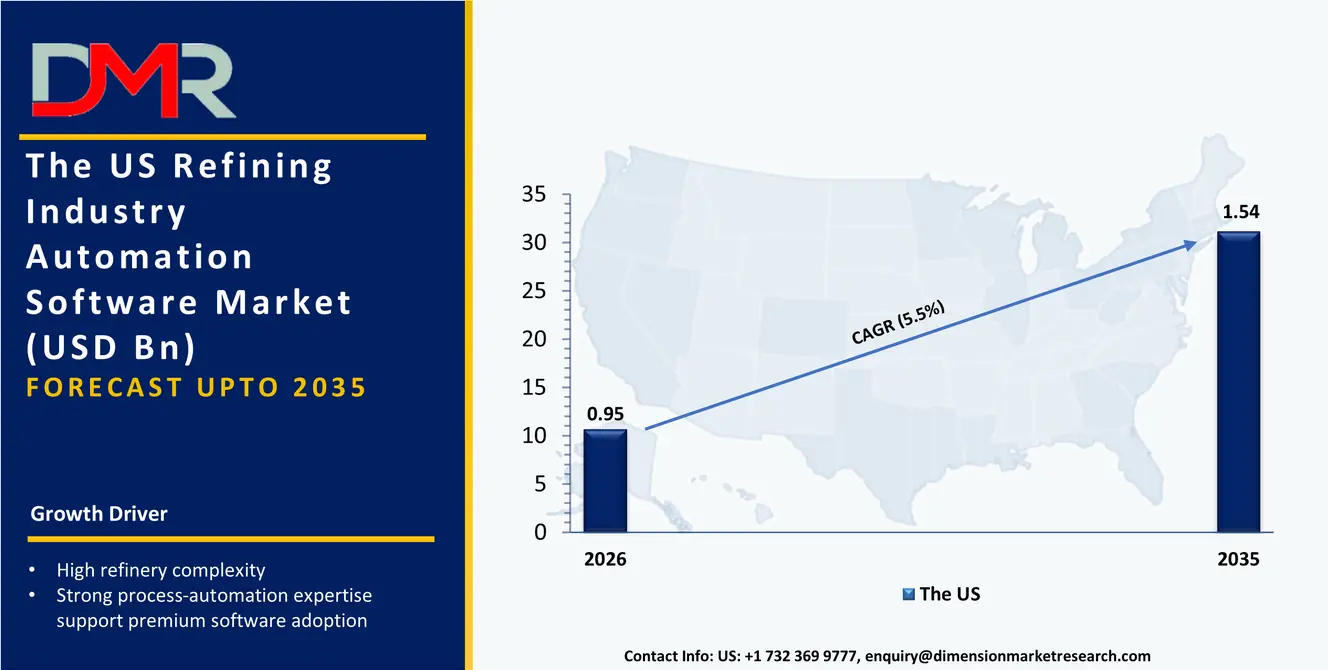
The U.S. Refining Industry Automation Software Market is estimated at USD 0.95 billion in 2026, rising to approximately USD 1.54 billion by 2035, representing a 5.5% CAGR. The market is mature but technologically advanced, with demand centered on APC, predictive analytics, asset performance, cybersecurity, energy optimization, and modernization of legacy systems. High refinery complexity and strong process-automation expertise support premium software adoption.
ℹ
To learn more about this report –
Download Your Free Sample Report Here
Japan Refining Industry Automation Software Market
Japan is estimated at USD 0.27 billion in 2026, reaching approximately USD 0.45 billion by 2035, representing a 5.9% CAGR. Aging refinery assets, workforce constraints, energy efficiency, predictive maintenance, and high automation maturity are major demand drivers. Digital twins and AI-supported maintenance are particularly relevant where operators seek to extend the economic life of existing facilities.
Saudi Arabia Refining Industry Automation Software Market
Saudi Arabia's market is estimated at USD 0.18 billion in 2026 and projected to reach approximately USD 0.42 billion by 2035, representing a 9.8% CAGR. Large-scale refining and petrochemical complexes, digital-transformation programs, AI adoption, energy optimization, and investments by major national energy companies create strong demand. Emerson's 2026 deployment of AI-driven Aspen Hybrid Models with Aramco illustrates the increasing use of industrial AI for refinery yield and quality optimization.
Regulatory Landscape
The Refining Industry Automation Software Market is influenced by process-safety, functional-safety, cybersecurity, environmental, emissions, and critical-infrastructure requirements. IEC 61508 and IEC 61511 are important frameworks for functional safety and safety-instrumented systems, while IEC 62443 is increasingly relevant to industrial automation and control-system cybersecurity.
ISO 27001 can influence information-security governance around connected software environments. Environmental requirements related to emissions, energy efficiency, flaring, fuel specifications, and carbon management increasingly affect software purchasing decisions. Regulation differs substantially by country, but the overall direction favors better monitoring, traceability, cybersecurity, process safety, and emissions visibility.
Investment and White Space Analysis
The largest white spaces are likely to occur in AI-powered predictive maintenance, digital twins, refinery energy optimization, OT cybersecurity, cloud analytics, brownfield modernization, and software designed for small and mid-sized refineries. Middle Eastern projects offer high-value opportunities because of their scale and integration of refining with petrochemicals.
India and Southeast Asia provide strong volume opportunities as refinery capacity and digitalization increase. Africa represents a longer-term opportunity because new refineries can adopt modern software architectures without being constrained by decades-old installed systems. AI-enabled optimization is particularly attractive because it can be deployed as a software layer over existing control infrastructure rather than requiring complete physical automation replacement.
By Region
North America
Europe
- Germany
- France
- The U.K.
- Italy
- Spain
- Rest of Europe
Asia-Pacific
- China
- Japan
- India
- Australia
- South Korea
- Rest of APAC
Latin America
- Mexico
- Brazil
- Rest of LATAM
Middle East & Africa
- Saudi Arabia
- The UAE
- South Africa
- Rest of MEA
Competitive Landscape
The Refining Industry Automation Software Market is moderately concentrated, with established process-automation vendors holding significant installed bases while specialized industrial-software providers compete in optimization, asset performance, analytics, digital twins, and planning. Key participants include Honeywell, Siemens, Emerson, ABB, Schneider Electric, Yokogawa Electric, Rockwell Automation, and AVEVA, alongside specialized optimization and industrial-software businesses. Competitive differentiation increasingly depends on installed-base access, process-domain expertise, AI capabilities, interoperability, cybersecurity, implementation expertise, and measurable operational outcomes.
Some of the prominent players in the Global Refining Industry Automation Software Market are:
- Honeywell
- Emerson Electric
- ABB
- Siemens
- Schneider Electric
- Yokogawa Electric
- Rockwell Automation
- Aspen Technology
- AVEVA
- Honeywell Connected Enterprise
- Siemens Digital Industries
- GE Vernova
- Kongsberg Gruppen
- Valmet
- Mitsubishi Electric
- Endress+Hauser
- Baker Hughes
- SLB
- Halliburton
- Yokogawa Solutions
- Hexagon
- Dassault Systèmes
- Bentley Systems
- SAP
- IBM
- Oracle
- Microsoft
- Cisco Systems
- Johnson Controls
- Inductive Automation
- Seeq Corporation
- Cognite
- AspenTech
- Honeywell UOP
- Process Systems Enterprise (PSE)
- KBC Advanced Technologies
- Yokogawa Electric Middle East & Africa
- Petro-SIM
- Invensys
- Siemens Energy
- Other Key Players
Recent Developments
- In June 2026, ABB introduced Automation Extended, designed to modernize existing DCS environments and add digital capabilities such as AI and advanced analytics without requiring complete system replacement.
- In June 2026, AVEVA expanded CONNECT in India with new AI capabilities, including an industrial knowledge graph and agentic-AI-based twin-builder capabilities planned for 2027, highlighting the industry's movement toward contextual industrial intelligence.
- In May 2026, AVEVA announced new AI capabilities across its industrial software portfolio, including enhancements to Unified Engineering, Operations Control, PI Data Infrastructure, and CONNECT for AI-enabled industrial operations.
- In April 2026, Siemens launched the Eigen Engineering Agent, an AI system capable of performing automation-engineering tasks end-to-end, representing a shift from AI recommendations toward autonomous engineering workflows.
- In April 2026, Emerson announced deployment of Aspen Hybrid Models with Aramco, combining first-principles models, industrial AI, and domain expertise to improve refinery yield and quality prediction and optimization.
- In March 2026, Honeywell commercially launched Experion Operations Assistant, an AI-powered control-room solution designed to provide real-time decision support and predictive intelligence within industrial process environments.
Report Details
| Report Characteristics |
| Market Size (2026) |
USD 4.2 Bn |
| Forecast Value (2035) |
USD 8.0 Bn |
| CAGR (2026–2035) |
7.4% |
| Historical Period |
2021 – 2025 |
| Forecast Period |
2027 – 2035 |
| Base Year |
2025 |
| Estimate Year |
2026 |
| Segments Covered |
By Software Type, By Refining Process, By Deployment, By End User |
| Regional Coverage |
North America – The US and Canada; Europe – Germany, The UK, France, Spain, Italy, & Rest of Europe; Asia-Pacific – China, Japan, South Korea, India, Australia, Rest of APAC; Latin America – Brazil, Mexico, Argentina, Colombia, Rest of Latin America; Middle East & Africa – Saudi Arabia, The UAE, South Africa, & Rest of MEA |
Frequently Asked Questions
What is the Refining Industry Automation Software Market size in 2026?
▾ The market is estimated at USD 4.20 billion in 2026, based on a modeled assessment of refinery-focused automation and operational software revenue.
What will the market size be in 2035?
▾ The market is projected to reach approximately USD 8.00 billion by 2035, representing sustained digitalization across global refining assets.
What is the expected CAGR in Refining Industry Automation Software Market ?
▾ The market is estimated to grow at approximately 7.4% CAGR between 2026 and 2035, supported by AI, optimization, predictive maintenance, and modernization.
What are the major growth drivers in Refining Industry Automation Software Market ?
▾ Major drivers include refinery digitalization, process optimization, predictive maintenance, energy efficiency, AI adoption, cybersecurity, and modernization of aging automation infrastructure.
Which software segment dominates in Refining Industry Automation Software Market ?
▾ Advanced Process Control is estimated to lead in 2026 with approximately 24.0% market share, reflecting its direct impact on refinery optimization and profitability.
Which segment is growing fastest in Refining Industry Automation Software Market?
▾ Digital Twin Software is projected to be among the fastest-growing categories, with an estimated 14.0% CAGR through 2035.
Which region leads the Refining Industry Automation Software Market ?
▾ Asia-Pacific is estimated to lead with approximately 34.0% share in 2026, while Middle East & Africa is projected to grow fastest.
Who are the major players in Refining Industry Automation Software Market ?
▾ Major participants include Honeywell, Siemens, Emerson, ABB, Schneider Electric, Yokogawa, Rockwell Automation, and AVEVA, alongside specialized industrial-software providers.