Residential Battery Energy Storage Systems Market Snapshot
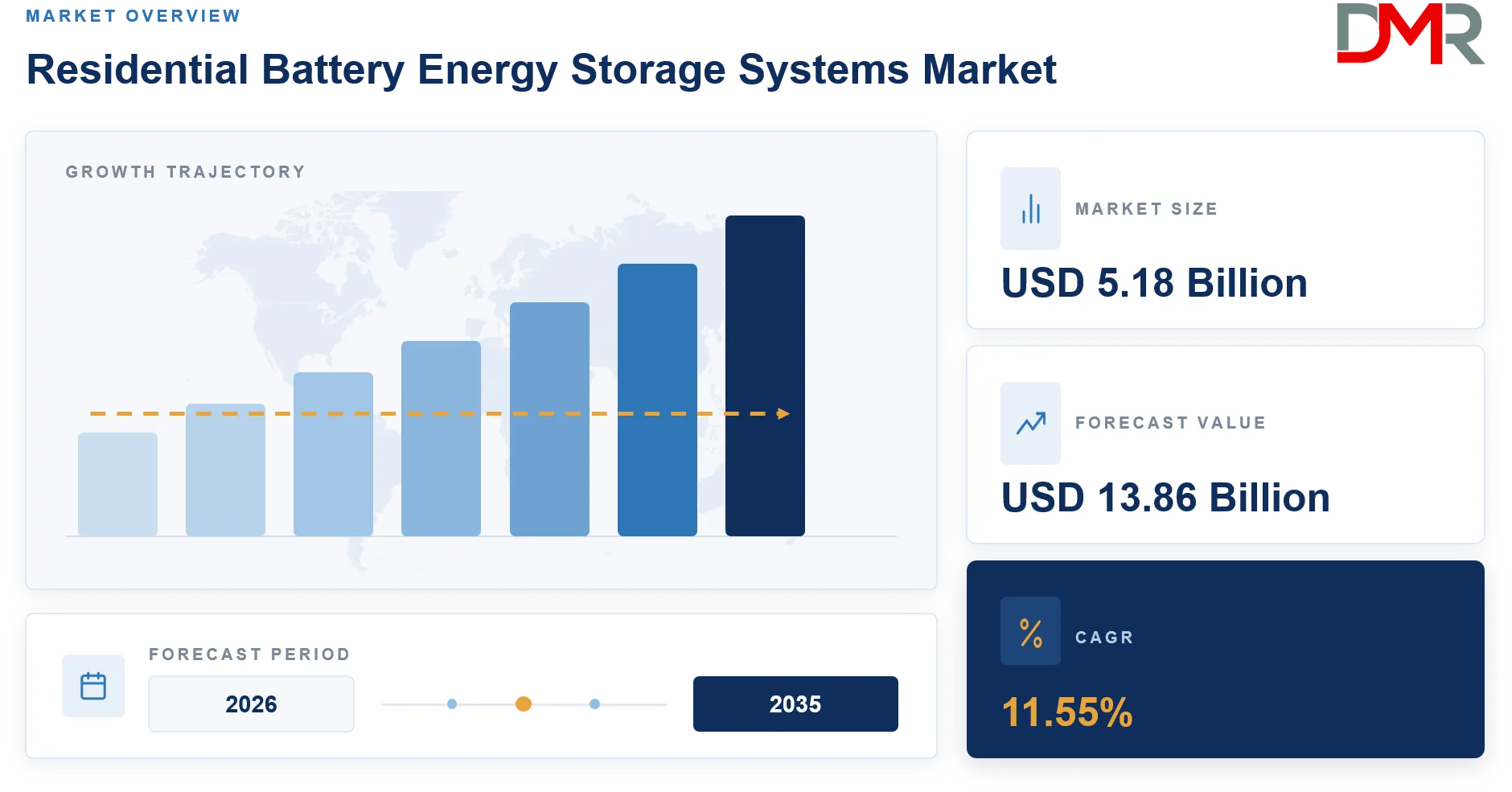
- Market Value: The Residential Battery Energy Storage Systems Market is valued at USD 5.18 billion in 2026 and is projected to reach USD 13.86 billion by 2035.
- CAGR: The Residential Battery Energy Storage Systems Market is expected to grow at a CAGR of 11.55% from 2026 to 2035.
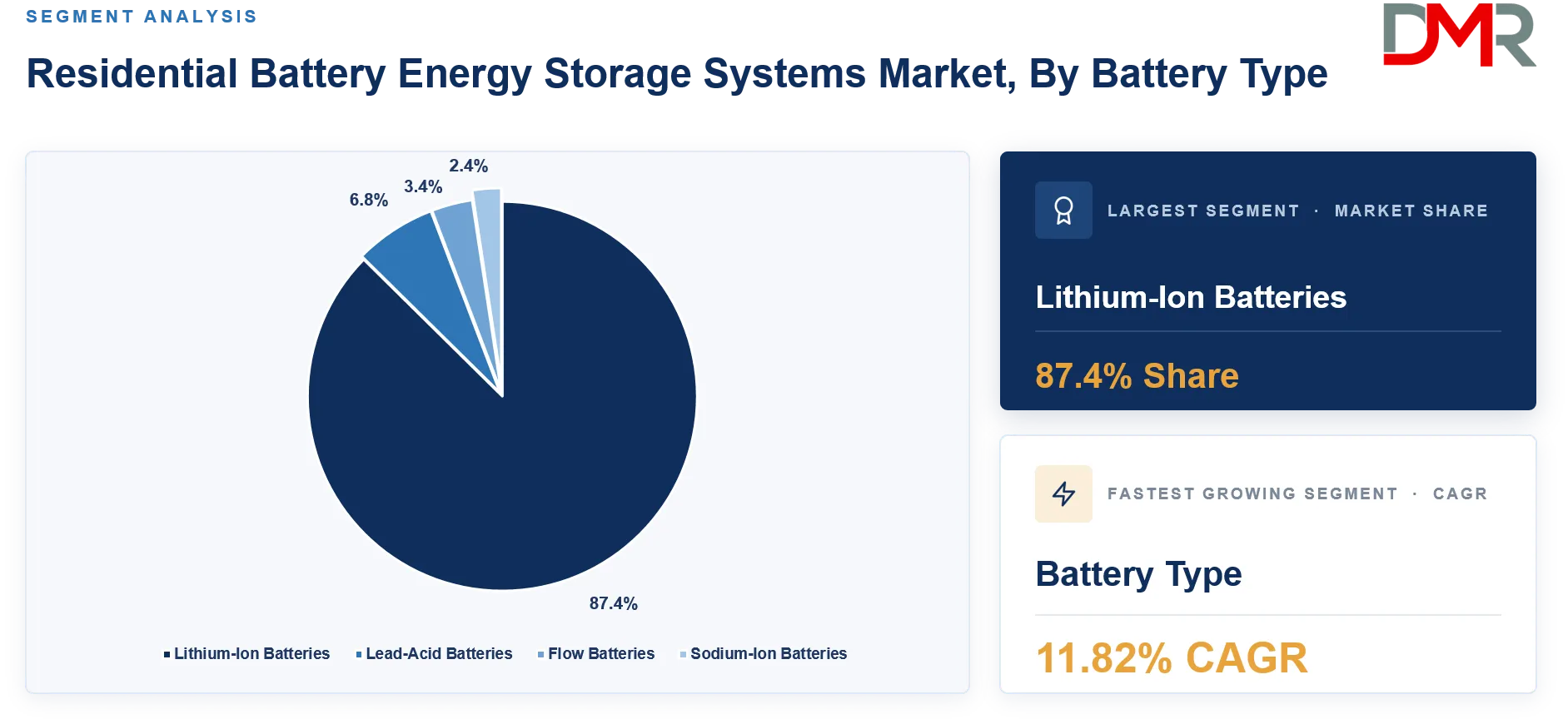
- By Battery Type Analysis: Lithium-Ion Batteries led the battery type segment with an 87.4% share in 2026.
- By System Type Analysis: AC-Coupled Systems led system types with a 42.6% share in 2026.
- By Capacity Analysis: 10-20 kWh systems held a 44.3% share in 2026.
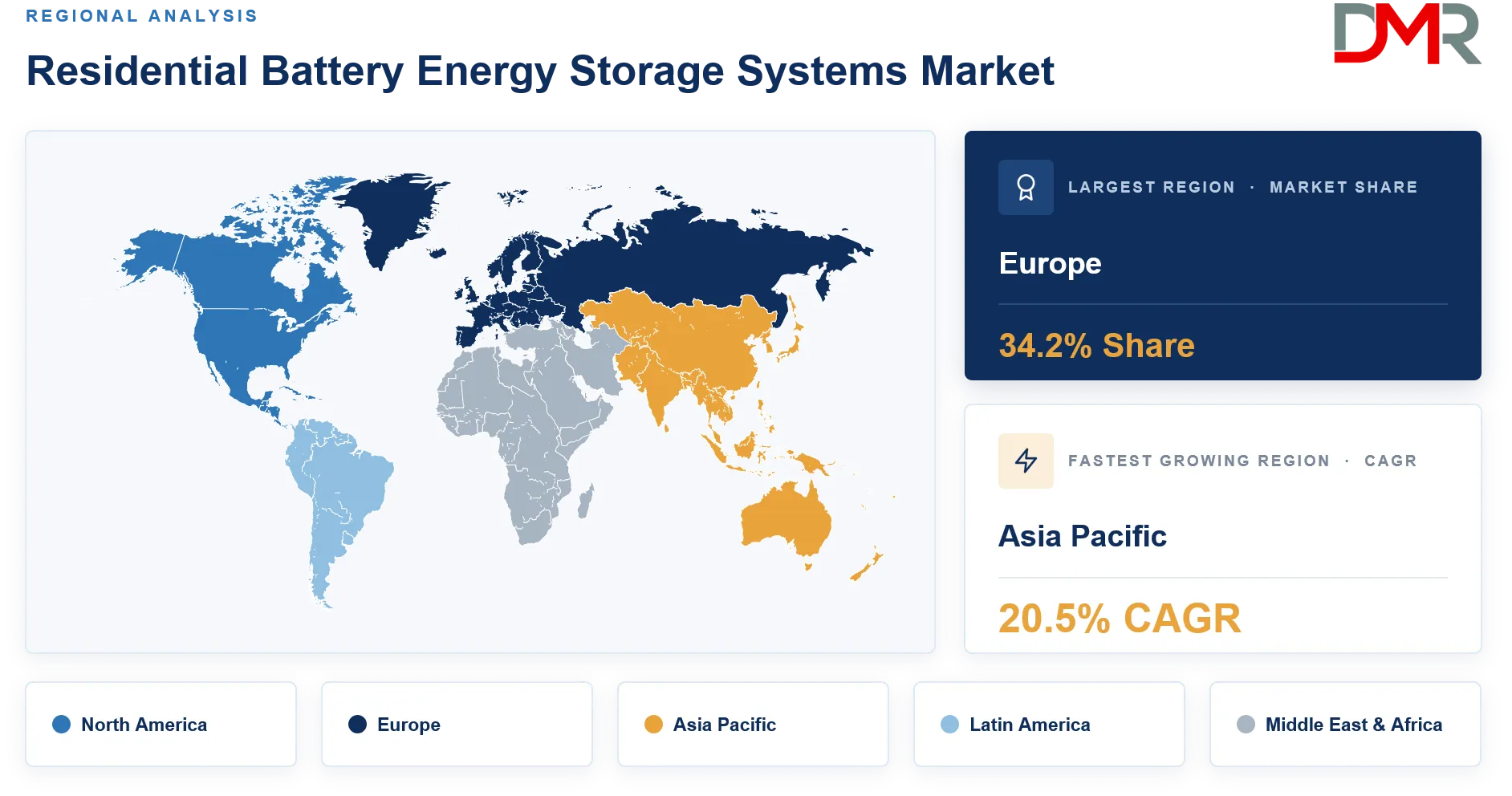
- Regional Analysis: Europe led the Global Residential Battery Energy Storage Systems Market with a 34.2% revenue share in 2026.
- Major Players: Sungrow Power Supply Co., Ltd., FENECON GmbH, Tesla Inc., Amara Raja Energy and Mobility Limited, and SolarEdge Technologies, Inc.
What is the Residential Battery Energy Storage Systems Market and its Market Size?
The Global Residential Battery Energy Storage Systems Market size is projected to be valued at USD 5.18 billion in 2026 and is projected to reach USD 13.86 billion by 2035, expanding at a CAGR of 11.55% during the forecast period. Residential BESS combines batteries, power conversion equipment, controls, safety hardware, and energy management software to store electricity at homes for solar self-consumption, backup power, tariff optimization, peak reduction, grid services, and electric vehicle charging. Demand is moving beyond basic backup applications as households increasingly use batteries as controllable energy assets linked with rooftop solar, smart meters, dynamic tariffs, heat pumps, and electric vehicles.
ℹ
To learn more about this report –
Download Your Free Sample Report Here
The commercial case is becoming more measurable across major markets. Europe had more than 100 GWh of operational battery capacity by the end of 2025, while residential systems still represented just under half of the installed European fleet. SolarPower Europe projects European residential battery additions to reach 13.2 GWh in 2026. In the United States, residential energy storage capacity increased 51% during 2025, and cumulative residential battery capacity reached about 9 GWh. These developments create opportunities for battery manufacturers, inverter suppliers, installers, aggregators, utilities, software providers, and energy service companies.
Use Cases
- Solar Energy Storage: Residential BESS captures electricity produced by rooftop photovoltaic systems during high-generation hours and makes it available in the evening. This improves household solar self-consumption, reduces exports at low feed-in rates, and strengthens the economic value of rooftop PV in markets with time-sensitive electricity pricing.
- Backup Power: Home batteries maintain power for selected or whole-home loads when the grid fails. Systems can support lighting, refrigeration, communications, medical devices, pumps, and selected heating or cooling loads. Backup capability has become a stronger purchase factor in regions exposed to storms, wildfires, grid congestion, and planned outages.
- Energy Bill Optimization: Smart residential batteries can charge when electricity prices are low and discharge when tariffs rise. The opportunity becomes stronger as utilities adopt time-of-use and dynamic pricing. Energy management platforms can combine load forecasts, solar output, battery state of charge, and tariff signals to reduce household electricity costs.
- Virtual Power Plants: Utilities and aggregators can coordinate thousands of household batteries as distributed flexible capacity. Participating homes may supply stored electricity during periods of high grid demand while retaining predefined backup reserves. This creates recurring grid-service revenue opportunities beyond the original hardware sale.
- EV and Home Energy Integration: Residential storage increasingly operates alongside electric vehicle chargers, rooftop solar, smart panels, and home energy management systems. Coordinated charging can reduce peak household demand and improve the use of locally generated electricity, creating a broader home electrification platform for energy technology vendors.
How AI/Gen AI is Transforming the Residential Battery Energy Storage Systems Market?
AI-based energy management is shifting residential batteries from passive storage devices toward automatically optimized home energy resources. Machine learning models can combine household consumption patterns, weather forecasts, expected solar generation, electricity tariffs, battery state of charge, and grid signals to determine when a system should charge, discharge, preserve backup capacity, or export electricity. This capability is especially important as dynamic electricity pricing and virtual power plant programs expand. For manufacturers, smarter controls can increase usable customer value without proportionally increasing battery capacity, while remote diagnostics can identify abnormal temperature, inverter behavior, cell imbalance, or performance degradation before a service visit is required.
Generative AI adds value around system design, installation, customer service, and fleet management. Installers can use software tools to interpret household load profiles, tariff structures, solar capacity, and backup requirements when recommending battery sizes. Customer interfaces can translate complex energy data into understandable explanations of savings, stored energy, outage readiness, and operating modes. At portfolio level, companies managing thousands of distributed systems can use automated analytics to prioritize service cases and identify underperforming assets. The competitive advantage will increasingly come from combining reliable battery hardware with software that improves economics, availability, and customer engagement.
Key Drivers in the Residential Battery Energy Storage Systems Market
Expansion of Rooftop Solar and Self-Consumption Economics
Rooftop solar remains one of the strongest demand foundations for residential battery storage because batteries allow households to shift excess daytime generation into evening consumption. This becomes commercially important where exported solar electricity receives less compensation than electricity purchased from the grid. Europe has already connected millions of residential batteries alongside distributed solar, while Australia has more than 4 million rooftop PV systems. As solar penetration rises, battery storage becomes a practical tool for increasing self-consumption and managing household energy costs.
Energy Resilience and Electricity Cost Management
Households are evaluating batteries not only on energy savings but also on resilience and control. Extreme weather, grid outages, rising peak tariffs, and electrification of heating and transportation increase the economic cost of losing electricity. Modern residential systems can automatically transition into backup operation and preserve energy for critical loads. Tesla Powerwall 3, for example, provides 13.5 kWh of energy capacity and configurable power capabilities, showing how manufacturers are designing products for both energy optimization and high-load backup applications.
Restraints in the Residential Battery Energy Storage Systems Market
High Upfront Installed Cost and Payback Sensitivity
Initial system cost remains a major barrier because residential battery economics depend on hardware prices, installation labor, inverter configuration, local electricity tariffs, solar export rates, incentives, financing costs, and household consumption. Payback periods can therefore vary widely between customers in the same country. Australia's policy experience illustrates the issue: the federal government introduced a battery discount of around 30% to reduce upfront costs, while government analysis indicated support could lower typical household payback periods to about 7.3 years.
Installation Complexity, Safety, and Grid Connection Requirements
Residential BESS requires qualified electrical installation, appropriate siting, protection equipment, compliant wiring, inverter coordination, and increasingly complex grid interconnection procedures. Safety rules relating to battery chemistry, thermal behavior, enclosure standards, and emergency access can influence installation design and cost. Product certification and installer capability therefore remain important market-entry factors. Vendors that simplify commissioning, integrate inverters and controls, and provide strong installer training can reduce this friction and improve channel scalability.
Growth Opportunities in the Global Residential Battery Energy Storage Systems Market
Virtual Power Plants and Distributed Grid Services
Virtual power plants create a significant opportunity to transform household batteries into recurring-service assets. Aggregators can coordinate distributed systems to respond to peak demand, wholesale prices, renewable generation fluctuations, and utility capacity requirements. Participating homeowners can potentially earn incentives while maintaining a backup reserve. For suppliers, the model expands competition from battery hardware into fleet software, forecasting, interoperability, cybersecurity, grid integration, and energy trading, creating new revenue pools for platforms with large installed bases.
Government Incentives and Underserved Solar Markets
Policy support can rapidly change residential storage economics. Australia introduced its Cheaper Home Batteries Program in July 2025 with an upfront discount of around 30%. Within its first six months, the program had supported more than 160,000 battery installations and added over 3.6 GWh of storage capacity. The government subsequently expanded estimated program funding to USD-equivalent multi-billion-dollar scale, with an objective of helping more than 2 million Australians install batteries by 2030. This demonstrates the deployment potential created by targeted incentives.
Trends in the Residential Battery Energy Storage Systems Market
Shift Toward Modular 10-20 kWh Home Storage
The 10-20 kWh category accounted for 44.3% of the market in 2026 as consumers increasingly seek enough capacity to cover evening consumption, essential backup loads, and higher household electricity demand from electrification. Product design reflects this requirement. Tesla Powerwall 3 provides 13.5 kWh of nominal energy, while modular architectures from several competitors allow homeowners to expand storage as loads change. The trend supports higher-value installations while giving installers flexibility to match battery capacity with solar generation and household demand.
LFP Chemistry and Integrated Energy Platforms
Lithium-ion batteries held 87.4% of the residential BESS market in 2026, with lithium iron phosphate increasingly important in stationary applications because of its cycle life, thermal characteristics, and cobalt-free chemistry. Enphase's IQ Battery 5P, for example, uses LFP chemistry and provides 5.0 kWh of usable capacity in an AC-coupled architecture. Competition is also shifting toward complete platforms that combine batteries, inverters, transfer equipment, applications, solar controls, EV charging, and remote energy management rather than selling battery modules alone.
Research Scope and Analysis
The Global Residential Battery Energy Storage Systems Market is segmented based on Battery Type, System Type, Capacity, Application, Connection Type, Ownership Model, End User, and Region. The study evaluates product adoption, technology development, household energy economics, installation models, competitive positioning, policy incentives, distribution channels, and emerging grid-service opportunities. It also considers how solar penetration, electricity tariffs, household electrification, battery pricing, safety standards, and software capabilities influence demand across developed and emerging markets.
ℹ
To learn more about this report –
Download Your Free Sample Report Here
By Battery Type
Lithium-Ion Batteries dominated the battery type segment with an 87.4% market share in 2026. Their leadership is supported by high energy density, established manufacturing supply chains, falling cell costs, modular product architectures, and broad compatibility with residential inverters and solar systems. LFP variants are gaining particular importance in stationary home storage because vendors can combine long cycle life with reduced dependence on nickel and cobalt. Lead-acid systems retain a role in cost-sensitive and legacy backup applications, while sodium-ion batteries represent an emerging option as manufacturers seek alternative materials and supply chains. Flow batteries remain less suited to mainstream homes because their physical footprint and balance-of-system requirements favor larger applications.
By System Type
AC-Coupled Systems led system types with a 42.6% share in 2026. Their position is supported by retrofit demand because an AC-coupled battery can often be added to a property that already has rooftop solar without replacing the existing solar inverter. This makes the architecture attractive across mature rooftop PV markets such as Germany, the United Kingdom, Australia, and the United States. AC coupling also supports modular system expansion and independent battery operation. DC-coupled systems can provide conversion-efficiency and equipment-integration advantages for new solar-plus-storage installations, while hybrid coupled systems are gaining attention where homeowners seek flexible energy routing between PV, batteries, loads, electric vehicles, and the grid.
The Global Residential Battery Energy Storage Systems Market Report is segmented on the basis of the following:
By Battery Type
- Lithium-Ion Batteries
- Lead-Acid Batteries
- Flow Batteries
- Sodium-Ion Batteries
By System Type
- AC-Coupled Systems
- DC-Coupled Systems
- Hybrid Coupled Systems
By Capacity
- Below 10 kWh
- 10-20 kWh
- 20-50 kWh
- Above 50 kWh
By Application
- Solar Energy Storage
- Backup Power
- Peak Load Shifting
- Energy Bill Optimization
- Grid Services
- Electric Vehicle Charging
By Connection Type
- On-Grid Systems
- Off-Grid Systems
- Hybrid Grid Systems
By Ownership Model
- Direct Ownership
- Third-Party Ownership
- Energy Storage Leasing
By End User
- Single-Family Homes
- Multi-Family Residences
- Residential Communities
Regional Analysis
Europe is the Leading Region in the Residential Battery Energy Storage Systems Market
Europe accounted for 34.2% of Global Residential Battery Energy Storage Systems Market revenue in 2026. The region benefits from a large rooftop solar base, high retail electricity costs, established installer networks, energy-security priorities, and growing use of dynamic tariffs. Europe surpassed 100 GWh of operational battery capacity in 2025, while residential storage still represented just under half of the cumulative fleet. Germany remains a central home-storage market, supported by extensive solar adoption and a mature battery supplier ecosystem.
Asia Pacific is the Fastest-Growing Region in the Residential Battery Energy Storage Systems Market
Asia Pacific is positioned for rapid residential BESS growth as Australia, China, Japan, India, and other markets expand distributed solar and household electrification. Australia provides a clear demand catalyst through its Cheaper Home Batteries Program, while Asian battery manufacturing ecosystems support technology availability and competitive pricing. Opportunities are also growing around smart homes, EV charging, microgrids, and residential solar self-consumption, creating favorable conditions for battery suppliers, inverter manufacturers, installers, and energy-management platforms.
By Region
North America
Europe
- Germany
- France
- The UK
- Italy
- Spain
- Rest of Europe
Asia-Pacific
- China
- Japan
- India
- Australia
- South Korea
- Rest of APAC
Latin America
- Mexico
- Brazil
- Colombia
- Argentina
- Rest of LATAM
Middle East & Africa
- Saudi Arabia
- The UAE
- South Africa
- Rest of MEA
ℹ
To learn more about this report –
Download Your Free Sample Report Here
Major Countries Analysis
Germany Residential Battery Energy Storage Systems Market
The Germany Residential Battery Energy Storage Systems Market size is projected to be valued at USD 1.27 billion in 2026 and is expected to reach USD 3.40 billion by 2035, expanding at a CAGR of 11.56% during the forecast period.
Germany remains a strategic residential battery market because of its large rooftop solar sector, high household electricity prices, mature installer base, and strong consumer focus on energy independence. German Solar Association estimates indicate cumulative battery storage capacity in the country reached approximately 25 GWh in 2025. Germany also remained Europe's leading overall battery market during 2025. Growing adoption of smart tariffs and self-consumption models provides further opportunities for integrated battery, inverter, home energy management, EV charging, and virtual power plant offerings.
Australia Residential Battery Energy Storage Systems Market
The Australia Residential Battery Energy Storage Systems Market size is projected to be valued at USD 0.76 billion in 2026 and is expected to reach USD 2.05 billion by 2035, expanding at a CAGR of 11.66% during the forecast period.
Australia has become one of the most attractive household battery growth markets due to its exceptional rooftop solar penetration and direct policy support. More than 4 million rooftop solar systems were installed nationally by mid-2025, yet battery penetration remained far lower, leaving a large conversion opportunity. The federal Cheaper Home Batteries Program introduced an approximately 30% upfront discount from July 2025. Within six months, more than 160,000 supported batteries had been installed, representing over 3.6 GWh of additional capacity and creating rapid channel expansion opportunities.
Competitive Landscape
The Global Residential Battery Energy Storage Systems Market has a competitive structure that combines battery cell manufacturers, power electronics specialists, solar inverter companies, integrated home-energy vendors, and distributed energy software providers. Tesla competes through its Powerwall ecosystem and vertically integrated consumer energy proposition, while Enphase and SolarEdge benefit from established residential solar channels. Sungrow, Huawei, Growatt, GoodWe, and BYD bring large-scale manufacturing and power electronics capabilities, while Sonnen and FENECON have strong exposure to European smart-energy and aggregation models.
LG Energy Solution, Samsung SDI, Panasonic, and VARTA contribute battery manufacturing expertise. Competition is increasingly based on usable capacity, power output, LFP adoption, safety, warranty, installation time, inverter integration, backup functionality, software quality, virtual power plant compatibility, installer relationships, pricing, and geographic service coverage. As hardware becomes more standardized, recurring software and grid-service revenue will become more important differentiators.
Some of the prominent players in the Global Residential Battery Energy Storage Systems Industry are:
- Sungrow Power Supply Co., Ltd.
- FENECON GmbH
- Tesla Inc.
- Amara Raja Energy and Mobility Limited
- SolarEdge Technologies, Inc.
- Panasonic Holdings Corporation
- FranklinWH Energy Storage Inc.
- BYD Company Ltd.
- VARTA AG
- Growatt New Energy Technology Co., Ltd.
- Schneider Electric SE
- Alpha ESS Co., Ltd.
- LG Energy Solution Ltd.
- GoodWe Technologies Co., Ltd.
- Samsung SDI Co., Ltd.
- Generac Power Systems, Inc.
- Huawei Technologies Co., Ltd.
- Sonnen GmbH
- Delta Electronics, Inc.
- SMA Solar Technology AG
- Enphase Energy, Inc.
- Others
Regulatory Landscape
The regulatory landscape for the Global Residential Battery Energy Storage Systems Market is increasingly shaped by safety standards, grid interconnection rules, battery traceability requirements, and household incentive programs. In Europe, battery regulation is moving toward stronger lifecycle transparency, including digital product passport requirements for relevant battery categories from February 2027. Australia has expanded residential storage adoption through its Cheaper Home Batteries Program, which provides an upfront discount of around 30% for eligible solar-connected systems under the Small-scale Renewable Energy Scheme. In the United States, federal residential battery incentives changed after 2025, increasing the importance of state-level rebates, utility programs, and virtual power plant compensation. These policies influence system economics, product certification, installer requirements, supply-chain compliance, and market entry strategies for manufacturers and energy service providers.
Investment and White Space Analysis
Investment opportunities in the Global Residential Battery Energy Storage Systems Market are shifting from standalone battery hardware toward integrated energy platforms, software-led services, financing, and distributed grid participation. Significant white space exists in virtual power plant aggregation, battery leasing, retrofit AC-coupled systems, intelligent energy management, EV-to-home integration, and solutions for multi-family housing. Australia demonstrates the scale of policy-driven opportunity, with its battery support program expected to help more than 2 million Australians install storage by 2030 and add around 40 GWh of capacity. Emerging opportunities are also visible in markets where rooftop solar penetration is high but battery attachment rates remain low. Investors and strategic buyers can target installer networks, energy management software, flexible financing models, certified LFP-based systems, and aggregation platforms that generate recurring revenue beyond the initial equipment sale.
Recent Developments
- September 2026: Sungrow Power Supply Co., Ltd. Introduced its MGTL Series, a next-generation three-phase hybrid inverter for residential customers across Southeast Asia, Africa, and Latin America, enhancing backup power reliability in grid-unstable regions.
- July 2026: Sungrow Power Supply Co., Ltd. Unveiled a new low-voltage residential solar and storage solution for Thailand featuring MG5/10RL hybrid inverters and stackable MBL battery modules to meet rapidly growing residential energy demand.
- March 2026: Enphase Energy, Inc. Partnered with French residential solar provider Ensol to launch a home battery subscription program in France, expanding IQ Battery 5P deployments with monthly plans starting at €30 including installation and 15-year warranty.
| Report Characteristics |
| Market Size (2026) |
USD 5.18 Bn |
| Forecast Value (2035) |
USD 13.86 Bn |
| CAGR (2026-2035) |
11.55% |
| The US Market Size (2026) |
USD 1.16 Bn |
| Historical Data |
2021 - 2025 |
| Forecast Data |
2026 - 2035 |
| Base Year |
2025 |
| Segments Covered |
By Battery Type, By System Type, By Capacity, By Application, By Connection Type, By Ownership Model and By End User |
| Regional Coverage |
North America - The US and Canada; Europe - Germany, France, The UK, Italy, Spain, Rest of Europe; Asia-Pacific - China, Japan, India, Australia, South Korea, Rest of APAC; Latin America - Mexico, Brazil, Colombia, Argentina, Rest of LATAM; Middle East & Africa - Saudi Arabia, The UAE, South Africa, Rest of MEA |
Frequently Asked Questions
What is the current size of the Residential Battery Energy Storage Systems Market?
▾ The Residential Battery Energy Storage Systems Market is valued at USD 5.18 billion in 2026 and is forecast to reach USD 13.86 billion by 2035.
What is the growth rate of the Residential Battery Energy Storage Systems Market during?
▾ The Residential Battery Energy Storage Systems Market is expected to grow at a CAGR of 11.55% during the forecast period 2026-2035.
Which region dominates the Global Residential Battery Energy Storage Systems Market?
▾ Europe leads the Global Residential Battery Energy Storage Systems Market with a 34.2% revenue share in 2026, supported by strong residential solar and storage adoption.
What factors are driving the growth of the Residential Battery Energy Storage Systems Market?
▾ Rooftop solar adoption, electricity cost optimization, backup power demand, home electrification, and grid flexibility are driving the Residential Battery Energy Storage Systems Market.
What are the major challenges restraining the Residential Battery Energy Storage Systems Market?
▾ High upfront costs, installation complexity, grid connection rules, safety requirements, and uncertain payback periods restrain the Residential Battery Energy Storage Systems Market.
Which segment holds the largest share of the Residential Battery Energy Storage Systems Market?
▾ Lithium-Ion Batteries hold an 87.4% share of the Residential Battery Energy Storage Systems Market in 2026, supported by energy density and long cycle life.
Who are the leading companies in the Residential Battery Energy Storage Systems Market?
▾ Sungrow Power Supply Co., Ltd., FENECON GmbH, Tesla Inc., Amara Raja Energy and Mobility Limited, SolarEdge Technologies, Inc., Panasonic Holdings Corporation, FranklinWH Energy Storage Inc., BYD Company Ltd., VARTA AG, Growatt New Energy Technology Co., Ltd., Schneider Electric SE, Alpha ESS Co., Ltd., LG Energy Solution Ltd., GoodWe Technologies Co., Ltd., Samsung SDI Co., Ltd., Generac Power Systems, Inc., Huawei Technologies Co., Ltd., Sonnen GmbH, Delta Electronics, Inc., SMA Solar Technology AG, and Enphase Energy, Inc. are leading companies in the Residential Battery Energy Storage Systems Market.
How is AI influencing the Residential Battery Energy Storage Systems Market?
▾ AI is advancing the Residential Battery Energy Storage Systems Market through predictive energy management, smart charging, tariff optimization, demand forecasting, and battery diagnostics.
What are the future opportunities and trends in the Residential Battery Energy Storage Systems Market?
▾ Virtual power plants, LFP batteries, dynamic tariffs, solar-plus-storage, EV integration, modular systems, and smart energy management offer opportunities in the Residential Battery Energy Storage Systems Market.