Market Snapshot
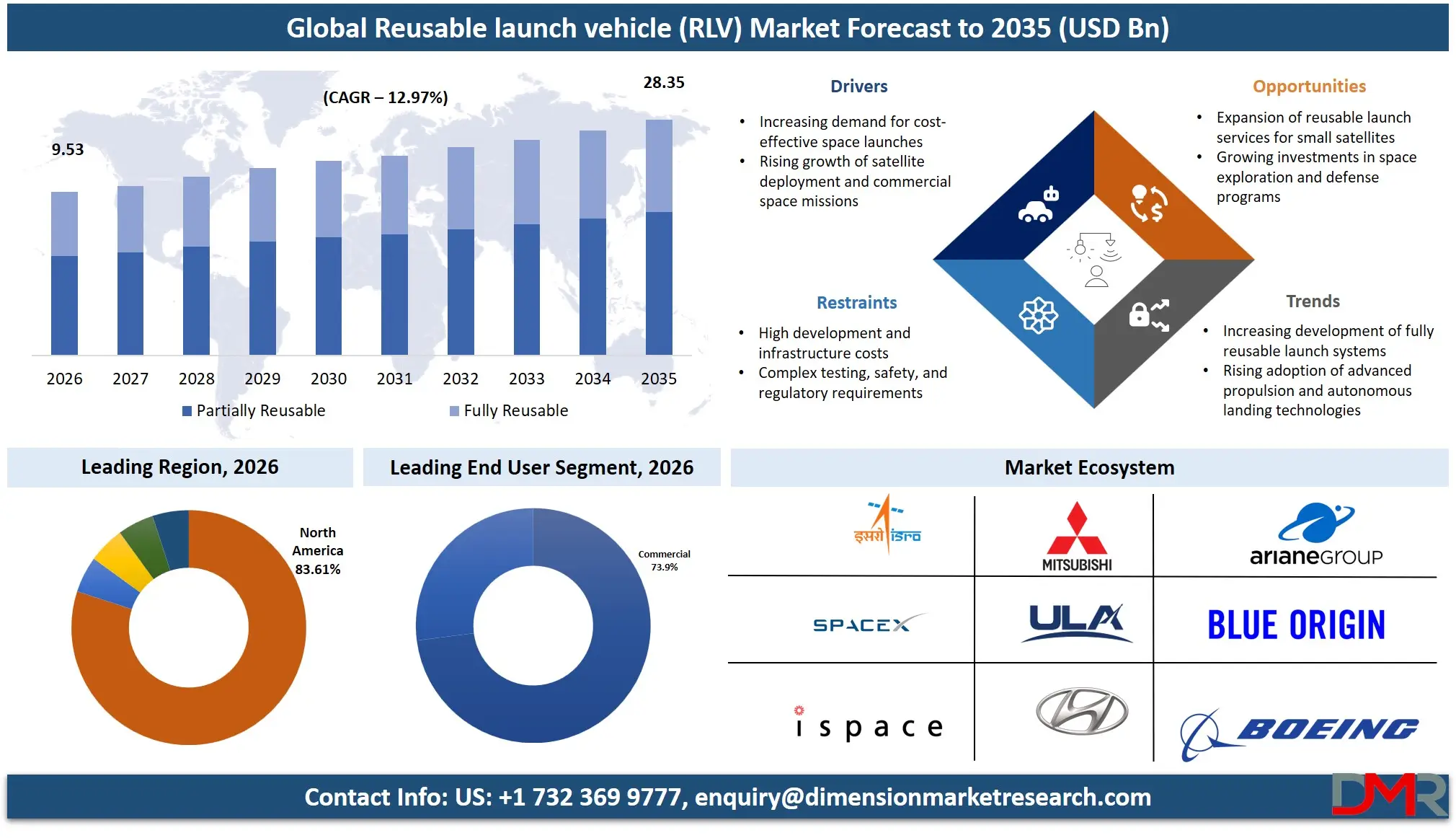
- The Reusable launch vehicle (RLV) market size is USD 8.44 billion in 2025, reached USD 9.53 billion in 2026, and is projected to hit USD 28.35 billion by 2035 at a CAGR of 12.97%.
- By Type: Partially Reusable led with a 93.80% share in 2026.
- By Configuration: Two-Stage-to-Orbit (TSTO) led with a 88.90% share in 2026.
- By Payload Class: Medium (2,000 kg to 20,000 kg) led with a 61.10% share in 2026.
- By End User: Commercial led with a 73.90% share in 2026.
- By Mission: Satellite Deployment led with a 72.05% share in 2026.
- By Orbit Type: Low Earth Orbit (LEO) led with a 78.22% share in 2026.
- By Region: North America led with a 83.61% share, valued at USD 7.06 Billion, in 2026.
Market Overview
The reusable launch vehicle (RLV) market covers orbital and suborbital rocket systems engineered for post-mission recovery and re-flight, spanning fully and partially reusable architectures. The market excludes expendable launch vehicles, satellite hardware, and ground-segment infrastructure. RLVs sit at the intersection of aerospace manufacturing, propulsion engineering, and commercial space services, feeding demand from satellite operators, government agencies, and an emerging human spaceflight sector.
Booster reusability has restructured launch economics in ways that expendable rockets never could. Per-launch cost compression has pulled commercial satellite deployment budgets downward, expanding the total addressable market for orbital access and attracting a new class of buyers. The market now serves constellations requiring dozens of launches annually, not one-off government payloads.
Autonomous landing guidance, regeneratively cooled engine architectures, and composite fairing recovery have advanced from experimental programs to standard operating procedures for leading providers. Providers that cannot match sub-30-day booster turnarounds will find themselves priced out of constellation contracts regardless of rocket performance. Operational tempo, not raw lift capacity, is the new competitive currency.
Market Size and Forecast
The Global Reusable Launch Vehicles Market size is estimated at USD 9.53 Billion in 2026 from USD 8.44 Billion in 2025, and is projected to reach USD 28.35 Billion by 2035, exhibiting a CAGR of 12.97% during the forecast period.
ℹ
To learn more about this report –
Download Your Free Sample Report Here
Underlying the forecast is a sustained pipeline of mega-constellation satellites requiring high-cadence orbital access. As reported by the FAA, licensed commercial space operations reached a record 148 in FY2024, up more than 30% over the prior year. That operational acceleration confirms that demand is not a projection artifact. Buyers are already contracting launches at volumes that validate the CAGR trajectory.
Forecast assumptions hinge on continued booster refurbishment cycle compression, stable regulatory throughput from the FAA's Part 450 framework, and sovereign launch programs in India, Japan, and Europe maintaining public expenditure commitments. A downside scenario exists if upper-stage reusability stalls at current engineering barriers, capping achievable cost reductions and slowing the rate at which new buyers enter the market.
Type Analysis
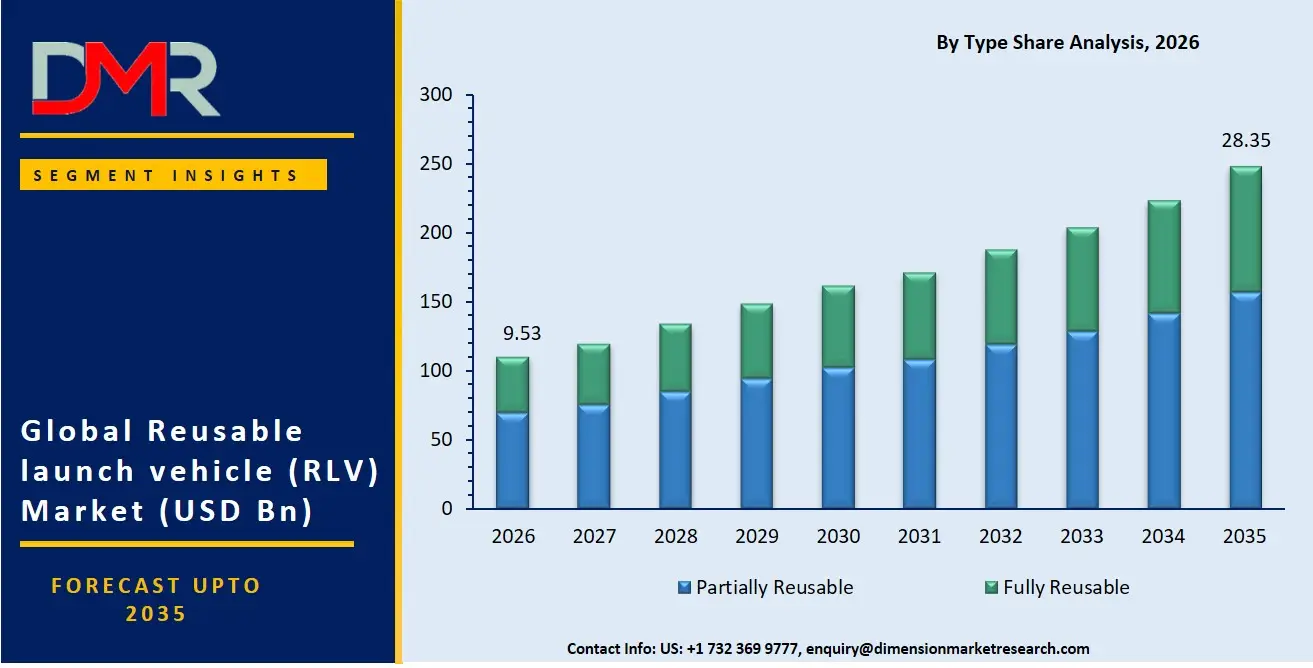
Partially Reusable accounted for 93.80% of Type demand in 2026, the highest of any category.
ℹ
To learn more about this report –
Download Your Free Sample Report Here
Partially reusable systems dominate because the engineering and certification pathway for first-stage booster recovery is proven at commercial scale. SpaceX's Falcon 9 established the template: recover and re-fly the booster while accepting an expendable upper stage. That trade-off delivers meaningful cost reduction without requiring solutions to the far harder problem of reentry-capable second stages.
Fully reusable configurations remain the market's long-run destination but carry unresolved technical risk today. Starship's second-stage failures have illustrated precisely why full-stack reuse cannot yet be priced into commercial contracts. Vendors building fully reusable vehicles are positioning for post-2028 demand, not immediate revenue. Buyers with near-term constellation timelines will continue signing partially reusable contracts as the default.
Configuration Analysis
With an 88.90% share in 2026, Two-Stage-to-Orbit (TSTO) outpaced all other Configuration categories.
TSTO architecture dominates because the two-stage separation event cleanly partitions the reusable booster from the expendable upper stage. That partition is commercially workable today. Operators accept the loss of the upper stage in exchange for a proven, bankable cost model on the first stage. No SSTO vehicle has reached orbital commercial operation, and the physics of single-stage ascent leave little margin for payload fraction growth.
Multi-stage booster-only reuse occupies a narrow but functional share, used when heavy-lift missions demand more than two stages for trajectory shaping. SSTO remains a long-horizon engineering target with no near-term commercial entry point. TSTO's share will compress only after a fully reusable second stage completes operational certification, an event no credible roadmap places before the early 2030s.
Payload Class Analysis
Medium (2,000 kg to 20,000 kg) led the Payload Class segment with a 61.10% share in 2026.
Medium-class payloads align precisely with the mass range of current-generation constellation satellites. Falcon 9's 22,800 kg capacity to LEO means a single medium-class vehicle can deploy multiple Starlink or Kuiper units per mission, making medium lift the most economical match for constellation operators. As reported by SpaceX, Falcon 9 delivers 22,800 kg to LEO, 8,300 kg to GTO, and 4,020 kg to Mars, a performance profile that covers the majority of commercial satellite contracts in the current pipeline.
Small-payload vehicles serve the dedicated small-satellite market, where customers pay a premium for schedule certainty over cost per kilogram. Heavy-lift systems, defined as payloads exceeding 20,000 kg, are gaining strategic importance as lunar and deep-space programs scale. Starship's commercial certification, once achieved, will create a heavy-lift demand corridor that medium-class vehicles cannot serve. Vendors positioned in heavy lift today are building for government and exploration customers first, with commercial overflow following.
End User Analysis
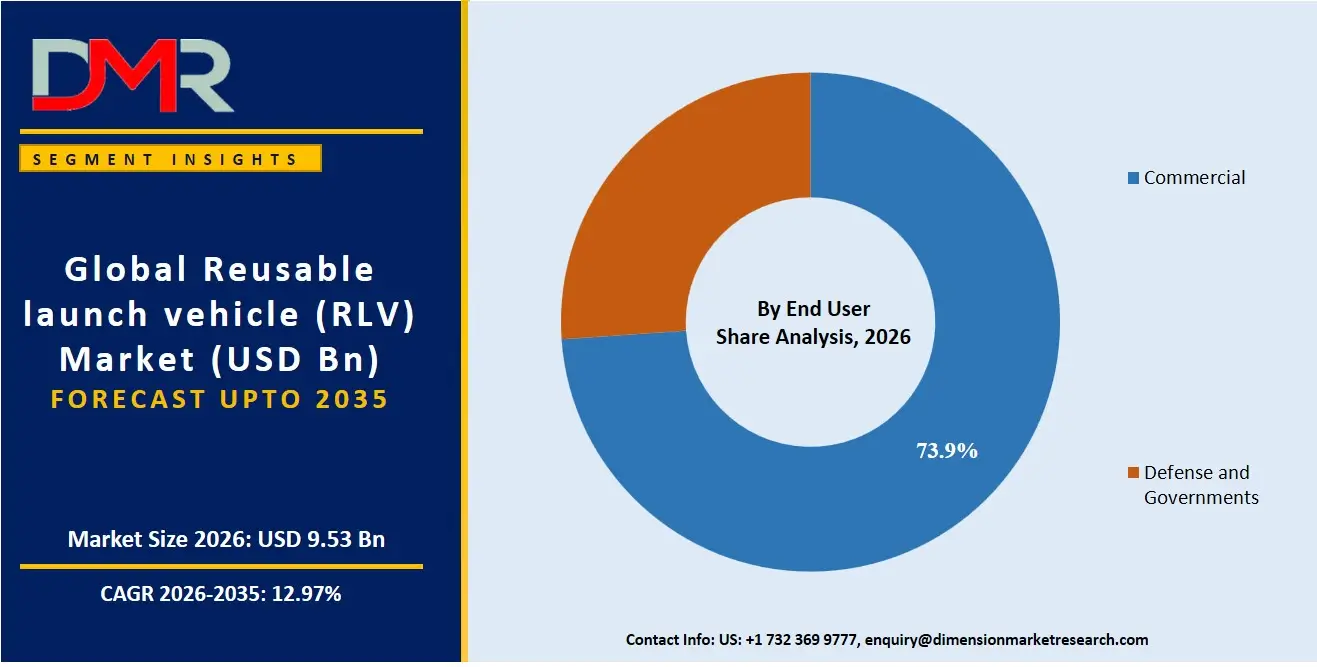
Commercial captured 73.90% of the End User segment in 2026, ahead of all rivals.
Commercial operators, primarily satellite constellation managers and remote-sensing companies, drive purchase decisions on cost per kilogram and launch frequency. Reusability directly addresses both variables. A single Falcon 9 booster completing 20 or more flights distributes refurbishment costs across enough missions to undercut any expendable alternative on per-kilogram economics.
ℹ
To learn more about this report –
Download Your Free Sample Report Here
Defense and government customers retain a structural share rooted in mission requirements that commercial providers cannot always meet: classified payloads, non-standard orbits, and security-cleared launch crews. National security space programs in the United States, France, Japan, and India all fund domestic RLV development precisely to avoid dependence on foreign commercial providers. Government demand stabilizes revenue for providers even when commercial constellation build-outs pause between deployment phases.
Mission Analysis
Satellite Deployment led the Mission segment with a 72.05% share in 2026.
Satellite deployment dominates mission demand because constellation operators require dozens to hundreds of launches on predictable cadences. A single Starlink phase expansion can require more than 50 Falcon 9 missions. No other mission category generates that launch frequency, making satellite deployment the structural anchor of every major RLV provider's manifest.
Cargo resupply and in-space logistics serve the International Space Station and, increasingly, commercial orbital platforms. Human spaceflight remains a small but high-margin mission type. Both categories will expand as orbital infrastructure density increases. The strategic importance of cargo and human missions exceeds their current revenue share because they demonstrate vehicle safety margins that attract insurance underwriters and government certification bodies.
Orbit Type Analysis
A 78.22% share made Low Earth Orbit (LEO) the clear leader across Orbit Type categories in 2026.
LEO's dominance reflects the constellation buildout economics underpinning this entire market. Satellites operating at 400 km to 1,200 km altitude require less launch energy, shorter mission durations, and faster re-flight cycles than GTO or deep-space trajectories. That operational profile matches the reusable booster's core advantage: rapid ground turnaround and high annual launch frequency.
GTO missions command higher per-launch revenue because payload mass fractions are smaller and mission risk is greater. Providers price GTO launches at a premium, meaning GTO's lower volume share does not translate proportionally to lower revenue contribution. Orbit type diversification across a provider's manifest reduces the financial risk of any single constellation customer reducing its launch cadence.
Key Market Segments
By Type
- Partially Reusable
- Fully Reusable
By Configuration
- Two-Stage-to-Orbit (TSTO)
- Single-Stage-to-Orbit (SSTO)
- Multi-Stage (Booster-only reuse)
By Payload Class
- Medium (2,000 kg to 20,000 kg)
- Small (Less than 2,000 kg)
- Heavy (More than 20,000 kg)
By End User
- Commercial
- Defense and Governments
By Mission
- Satellite Deployment
- Cargo Resupply and In-Space Logistics
- Human Spaceflight
By Orbit Type
- Low Earth Orbit (LEO)
- Geosynchronous Transfer Orbit (GTO)
Regional Analysis
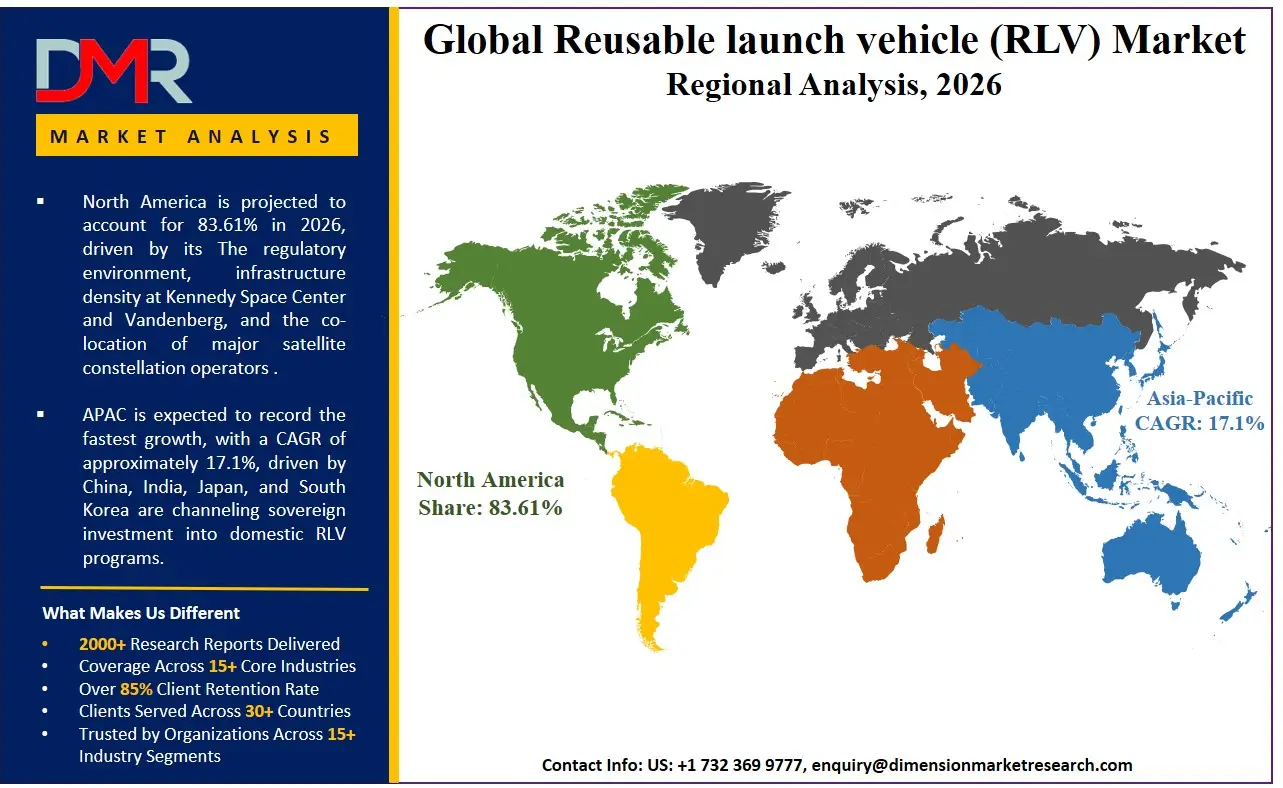
North America led the Regional segment with an 83.61% share, valued at USD 7.06 Billion, in 2026.
North America's structural dominance reflects one underlying fact: SpaceX operates from U.S. soil and holds a commanding share of global commercial launch manifest. The regulatory environment, infrastructure density at Kennedy Space Center and Vandenberg, and the co-location of major satellite constellation operators give North American providers a home-field advantage that no other region has replicated at scale.
ℹ
To learn more about this report –
Download Your Free Sample Report Here
Asia Pacific is the fastest-growing region, where China, India, Japan, and South Korea are channeling sovereign investment into domestic RLV programs. Unlike North America, Asia Pacific's growth is driven by government mandates for launch autonomy, not commercial constellation demand alone. Europe, anchored by ArianeGroup's Ariane 6 program and new entrants building small-sat launchers, holds a strategic but contracting share as the region works through the transition from Ariane 5 to next-generation vehicles. Latin America and the Middle East and Africa remain nascent launch markets, with activity concentrated in ground-station infrastructure rather than vehicle development.
Key Regions and Countries
North America
Europe
- Germany
- France
- The UK
- Spain
- Italy
- Rest of Europe
Asia Pacific
- China
- Japan
- South Korea
- India
- Australia
- Rest of APAC
Latin America
- Brazil
- Mexico
- Rest of Latin America
Middle East & Africa
- GCC
- South Africa
- Rest of MEA
Market Dynamics
Driver: Constellation Demand and Reusability Economics Compressing Launch Costs
Mega-constellation programs from Starlink, Kuiper, and OneWeb have transformed launch demand from episodic government contracts into high-volume, recurring commercial procurement. A single Starlink deployment phase can exceed 50 missions. That volume only pencils out economically when providers can re-fly boosters across dozens of missions and distribute refurbishment costs accordingly.
FAA-licensed commercial operations grew more than 900% in a decade, from 14 in FY2015 to 148 in FY2024, as reported by the FAA. That trajectory confirms the constellation buildout is pulling forward launch demand, not simply growing alongside it. Relativity Space's March 2025 recapitalization under Eric Schmidt's controlling stake signals that private capital has concluded reusable vehicle development will capture a significant share of that demand pipeline.
Restraint: Upper-Stage Reusability and Capital Barriers Limit New Entrants
Full-stack vehicle reuse remains an unsolved engineering problem at operational scale. Starship's second-stage failures have exposed the thermal, structural, and guidance challenges of recovering an upper stage from orbital velocities. Providers advertising full reusability today are selling a roadmap, not a certified product. Buyers running constellation deployment timelines cannot absorb that execution risk.
Capital intensity compounds the technical barrier. Booster refurbishment hangars, offshore recovery vessels, engine test stands, and re-flight certification programs require sustained investment before the first re-flown booster generates revenue. New entrants face an asymmetry: incumbents have already paid for that infrastructure across hundreds of missions while new providers must fund it from scratch on pre-revenue balance sheets.
Opportunity: Refurbishment Services, Heavy Lift, and Asia Pacific Demand
Rapid booster turnaround creates a standalone commercial service layer. Inspection, cleaning, engine swap, and re-flight certification can be sold as managed services to providers that lack in-house refurbishment infrastructure. In FY2024 alone, the FAA conducted 810 inspections and 23 environmental reviews, as reported by the FAA, illustrating the regulatory throughput that refurbishment service vendors must align with. SpaceX's planned Starship Block 3 upgrade targets an additional 40 tons of payload capacity and incorporates an on-orbit refueling docking system, per Universe Today, opening deep-space and lunar corridors that today's medium-lift market cannot serve.
Asia Pacific's sovereign investment programs have created commercial opportunities for Western technology partners supplying propulsion components, avionics, and ground systems to regional launch providers. Providers that enter those supply relationships now gain design-in positions that competitors cannot easily displace once programs reach operational status.
Market Trends
Full-Stack Reusability Milestones Reshaping Competitive Expectations
Starship's tenth flight test on August 26, 2025, achieved the first successful payload deployment demonstration from the vehicle, as reported by SpaceX, marking a transition from propulsion testing to mission-capability validation. Blue Origin's New Glenn successfully recovered its first-stage booster in November 2025, establishing the vehicle as an operational competitor to Falcon 9 rather than a developmental program. Autonomous landing systems and advanced propulsion modules are no longer differentiators on a roadmap. Providers that cannot demonstrate booster recovery within two years will find themselves locked out of constellation contracts that assume re-flight economics.
Market Competition Overview
The RLV market is highly consolidated at the top but fragmented across the challenger tier. One provider controls a share of global commercial launch manifest that no rival can match on cost, cadence, or operational record. That concentration compresses margins for all competitors and forces differentiation on reliability guarantees, orbit-type specialization, or government mission clearances rather than price.
New entrants are multiplying, particularly in the small-lift fully reusable segment, but face a capital-access problem that incumbents do not. The FAA met its 180-day licensing deadline 98% of the time in FY2024, with Office of Commercial Space Transportation staffing at a historic high of 165, up from 118 at the end of FY2022, as reported by the FAA. That regulatory throughput removes one historical friction point for new providers. The real competitive barrier is booster re-flight heritage: constellation operators now require demonstrated re-flight records before signing multi-launch contracts, an advantage that only providers with operational vehicles can accumulate.
Company Profiles
Space Exploration Technologies Corp. (SpaceX) operates the world's only orbital-class reusable rocket at commercial scale. Falcon 9 stands 70 m tall with a liftoff mass of 549,054 kg and generates more than 1.7 million pounds of thrust at sea level through its nine Merlin engines, as reported by SpaceX. That performance baseline, combined with a booster re-flight program now exceeding 20 missions per vehicle, gives SpaceX a per-launch cost floor that competitors cannot reach without equivalent launch volume. SpaceX's strategic advantage is circular: volume lowers cost, low cost wins contracts, contracts generate volume.
Stoke Space Technologies, Inc. is building a fully reusable two-stage vehicle targeting the post-Falcon 9 cost curve. A Series D funding round in October 2025 delivered USD 510 million to accelerate Nova rocket manufacturing, testing, and commercialization. That capital infusion positions Stoke as the best-funded pure-play fully reusable entrant in the U.S. market. The strategic risk is timing: Nova must reach commercial certification before constellation operators lock multi-year contracts with incumbent providers on re-negotiated terms.
Key Players
- Space Exploration Technologies Corp. (SpaceX)
- Blue Origin Enterprises, L.P.
- ArianeGroup SAS
- United Launch Alliance, LLC
- Rocket Lab USA, Inc.
- Indian Space Research Organisation (ISRO)
- Mitsubishi Heavy Industries, Ltd.
- Hyundai Rotem Company
- Shanghai Academy of Spaceflight Technology
- Korea Aerospace Research Institute
- ispace, inc.
- LandSpace Technology Co., Ltd.
- Stoke Space Technologies, Inc.
- China Aerospace Science and Technology Corporation (CASC)
- Innovative Rocket Technologies Inc. (iRocket)
- Lockheed Martin Corporation
- The Boeing Company
- Orbex
Supply Chain and Value Chain Analysis
SpaceX recovers and reuses the carbon-composite payload fairing, jettisoned approximately 3 minutes into flight, as reported by SpaceX. That fairing recovery extends the value chain upstream into composite manufacturing and downstream into post-flight inspection and refurbishment. Maximum value concentration sits at the booster and fairing recovery stage, where reuse converts a single manufacturing cost into a recurring revenue-generating asset across multiple missions.
Raw material supply chains for high-grade aluminum alloys, carbon fiber composites, and specialty propellants are the primary bottleneck risk. Engine production, specifically Merlin and Raptor manufacturing at scale, determines how quickly providers can build new vehicles to meet manifest growth. Providers that vertically integrate propulsion production, as SpaceX has done, eliminate a critical dependency that exposes competitors relying on third-party engine suppliers.
Regulatory Landscape
By the FAA's March 9, 2026 deadline, all major U.S. launch operators including Blue Origin, Firefly Aerospace, SpaceX, Rocket Lab, and United Launch Alliance transitioned to the single Part 450 licensing framework, which consolidates four prior rules into one, as reported by the FAA. The FAA has issued 14 Part 450 licenses since the rule took effect in March 2021. Consolidation removes procedural redundancy that previously added months to certification timelines, a direct cost reduction for providers filing frequent re-flight applications.
Outside the United States, regulatory fragmentation remains a commercial barrier. European providers operate under national licensing regimes coordinated through the European Space Agency but without equivalent procedural standardization. India's IN-SPACe regulatory body is maturing but has not yet published a full reusable vehicle re-flight framework. Providers targeting multi-region launch operations must maintain compliance with multiple national frameworks simultaneously, adding legal overhead that favors incumbents with established government relationships.
Investment and White Space Analysis
Investment is concentrating in fully reusable small-to-medium lift vehicles where the cost-reduction thesis remains unproven but the addressable market is well-defined. Stoke Space's back-to-back funding rounds in 2025 illustrate that capital allocators are placing early bets on the post-Falcon 9 generation before incumbents reach that market.
White space exists in rapid turnaround refurbishment services, where no standalone commercial operator has scaled a provider-agnostic booster inspection and re-flight certification business. Asia Pacific presents a regional white space: commercial satellite operators in Southeast Asia, Australia, and South Asia require orbital access but lack proximate domestic providers. Western vendors offering payload integration and launch brokerage services into Asian sovereign launch programs can capture margin without building a rocket.
Recent Developments
- In January 2025, Stoke Space raised USD 260 million in a Series C funding round to complete development of its fully reusable Nova launch vehicle and associated launch infrastructure.
- In November 2025, Blue Origin unveiled the New Glenn 9x4, an expanded reusable launch vehicle variant engineered to increase payload capacity for commercial and government missions.
Report Details
| Report Characteristics |
| Market Value (2025) |
USD 8.44 Billion |
| Market Value (2026) |
USD 9.53 Billion |
| Forecast Revenue (2035) |
USD 28.35 Billion |
| CAGR (2026–2035) |
12.97% |
| Base Year for Estimation |
2025 |
| Historic Period |
2020 – 2024 |
| Forecast Period |
2026 – 2035 |
| Report Coverage |
Revenue Forecast, Market Dynamics, Competitive Landscape, Recent Developments |
| Segments Covered |
By Type (Partially Reusable, Fully Reusable), By Configuration (TSTO, SSTO, Multi-Stage), By Payload Class (Small, Medium, Heavy), By End User (Commercial, Defense and Governments), By Mission (Satellite Deployment, Cargo Resupply and In-Space Logistics, Human Spaceflight), By Orbit Type (LEO, GTO) |
| Regional Analysis |
North America – US and Canada; Europe – Germany, France, The UK, Spain, Italy, and Rest of Europe; Asia Pacific – China, Japan, South Korea, India, Australia, and Rest of APAC; Latin America – Brazil, Mexico, and Rest of Latin America; Middle East & Africa – GCC, South Africa, and Rest of MEA |
| Competitive Landscape |
Space Exploration Technologies Corp. (SpaceX), Blue Origin Enterprises L.P., ArianeGroup SAS, United Launch Alliance LLC, Rocket Lab USA Inc., Indian Space Research Organisation (ISRO), Mitsubishi Heavy Industries Ltd., Hyundai Rotem Company, Shanghai Academy of Spaceflight Technology, Korea Aerospace Research Institute, ispace inc., LandSpace Technology Co. Ltd., Stoke Space Technologies Inc., China Aerospace Science and Technology Corporation (CASC), Innovative Rocket Technologies Inc. (iRocket), Lockheed Martin Corporation, The Boeing Company, Orbex |
| Customization Scope |
Customization for segments and region or country level will be provided. Additional customization can be done based on requirements. |
| Purchase Options |
Three license options: Single User License, Multi-User License (Up to 5 Users), and Corporate Use License (Unlimited Users and Printable PDF). |
Frequently Asked Questions
What is the biggest investment opportunity in Reusable launch vehicle (RLV) Market?
▾ Rapid turnaround refurbishment services represent the clearest white space in the current market. No provider-agnostic booster inspection and re-flight certification business operates at commercial scale. Asia Pacific launch brokerage, connecting commercial satellite operators in Southeast Asia and South Asia to sovereign launch programs, offers a second high-margin entry point without requiring vehicle development capital.
Who are the top companies in Reusable launch vehicle (RLV) Market?
▾ Space Exploration Technologies Corp. (SpaceX) holds the dominant commercial launch position. Blue Origin, Rocket Lab, ArianeGroup, United Launch Alliance, and Stoke Space Technologies represent the primary challenger tier across heavy-lift, small-lift, and fully reusable vehicle categories.
Which segment is growing fastest in Reusable launch vehicle (RLV) Market and why?
▾ Fully reusable vehicle configurations are growing fastest within the Type segment as providers race to eliminate upper-stage expendability. Starship's Flight 10 payload demonstration and Blue Origin's booster recovery in late 2025 signal that full-stack reuse is transitioning from engineering ambition to near-term commercial product. Buyers that lock contracts with fully reusable providers now will capture the next generation of per-kilogram cost reductions ahead of competitors.
Which region is growing fastest in Reusable launch vehicle (RLV) Market and why?
▾ Asia Pacific is the fastest-growing region, driven by sovereign launch autonomy programs in China, India, Japan, and South Korea channeling sustained public expenditure into domestic RLV capability. Commercial satellite demand across Southeast Asia and South Asia is outpacing available regional launch supply, creating a structural demand pull that Western providers have not yet fully addressed.
What is the biggest challenge holding Reusable launch vehicle (RLV) Market back?
▾ Upper-stage reusability engineering remains the market's primary technical barrier. Starship's unresolved second-stage failures have delayed full-stack reuse and prevented providers from advertising the next step-change in per-launch cost reduction. Until a fully reusable vehicle completes operational certification, constellation operators must budget for upper-stage expendability, limiting how far launch costs can fall and slowing the expansion of the addressable buyer base.