Global Rice Milk Market Snapshot
- Global Rice Milk Market Size in 2026: USD 923.8 million
- Global Rice Milk Market Size in 2035: USD 1,991.3 million
- Global CAGR from 2027 to 2035: 9.6%
- Liquid is the leading form segment in 2026: 61.2%
- Powder is the fastest-growing form segment: 11.2% CAGR
- Conventional is the leading Nature segment in 2026: 66.8%
- Organic is the fastest-growing Nature segment: 11.4% CAGR
- Supermarkets and Hypermarkets are the leading Distribution Channel segment in 2026: 37.4%
- Online Retail is the fastest-growing Distribution Channel segment: 10.4% CAGR
- North America is the leading Region in 2026: 35.5%
- Asia Pacific is the fastest-growing Region: 10.1%CAGR
What is the Global Rice Milk and its Market Size?
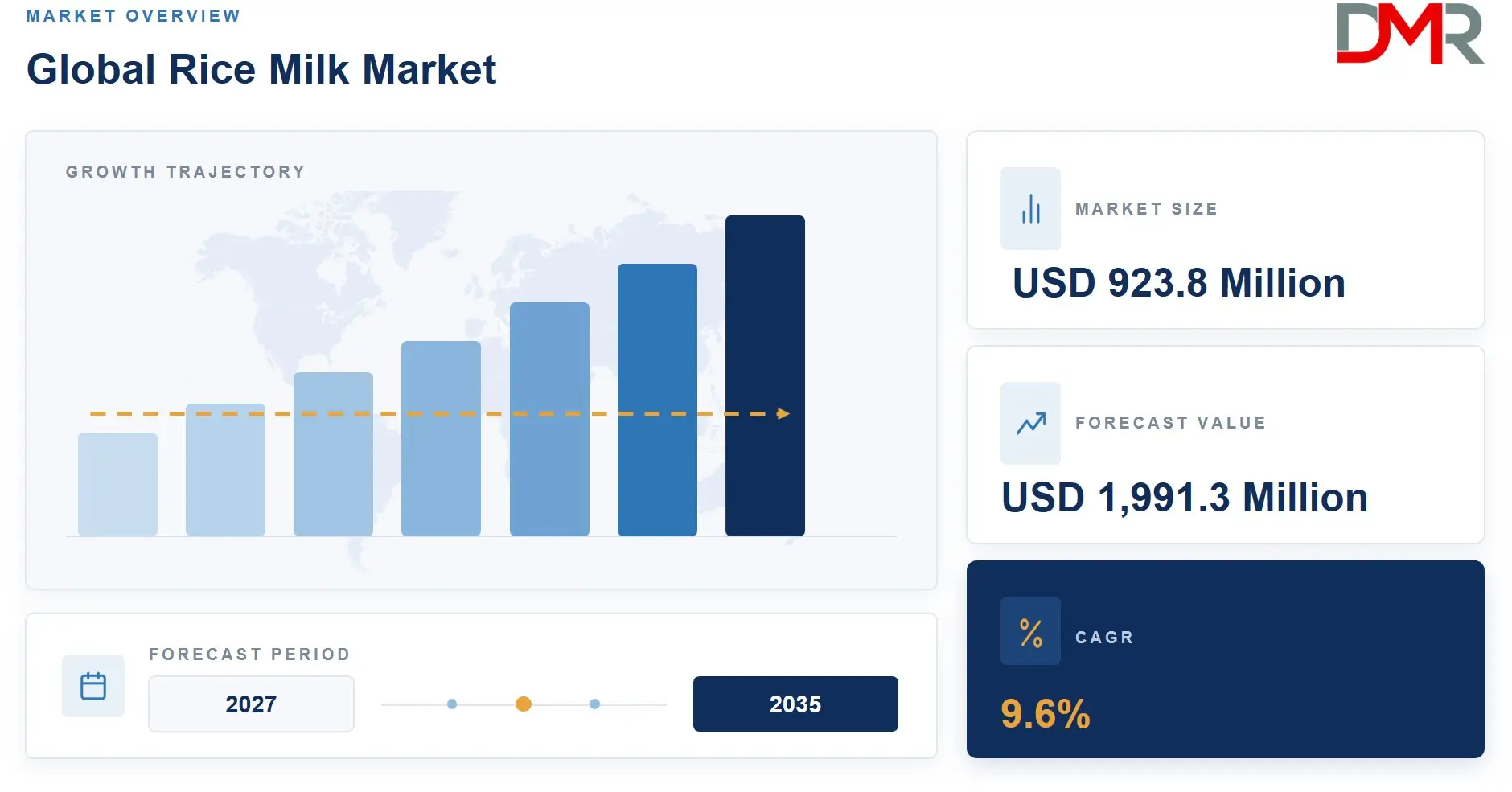
The Global Rice Milk Market size is projected to be valued at USD 923.8 million in 2026, and it is further anticipated to reach a market value of USD 1,991.3 million by 2035 at a CAGR of 9.6%.
ℹ
To learn more about this report –
Download Your Free Sample Report Here
The Global Rice Milk Market covers beverages and ingredients made by processing rice with water to create a non-dairy alternative to animal milk. Products are sold as ready-to-drink liquids or powders for reconstitution and may be offered in plain, flavored, organic, conventional, unsweetened, or fortified varieties. Rice milk has a light texture and generally mild taste, helping it serves consumers looking for dairy-free or soy-free beverage choices. Producers sell through supermarkets, specialty food outlets, online channels, and foodservice partners. Growth reflects the wider availability of plant-based foods, interest in lactose-free choices, development of fortified products, and expanding retail distribution. Product positioning must nevertheless consider relatively low protein content and the need for careful rice sourcing and contaminant controls.
Use Cases
- Everyday Dairy Alternative: Rice milk can be consumed as a standalone beverage and used with breakfast cereals, oatmeal, and smoothies. Buyers often select it for its neutral flavor and dairy-free formulation. Fortified variants may provide added calcium or vitamins, but consumers should compare nutrition panels because protein levels vary and are commonly lower than dairy or soy milk.
- Coffee and Foodservice Applications: Cafes, bakeries, and restaurants can use rice beverages in selected hot drinks, sauces, and dessert recipes. Texture, foaming performance, sweetness, and stability differ by formulation. Operators may test commercial products before introducing them into menus to ensure consistent taste and performance.
- Cooking and Baking: Liquid rice milk can replace dairy milk in pancakes, muffins, puddings, sauces, and other preparations where a light beverage is suitable. Naturally occurring carbohydrates may contribute mild sweetness. Recipe developers must adjust for the lower protein and different fat composition compared with conventional milk.
- Packaged Food Ingredients and Household Convenience: Powdered rice milk and shelf-stable liquid cartons provide options for beverage mixing, home storage, and food manufacturing. Ingredient suppliers can serve bakery, confectionery, prepared foods, and specialty nutrition applications where a rice-based profile is desired. Brands may develop unsweetened or fortified versions and offer smaller pack sizes for trial purchases. Manufacturers must validate shelf life, ingredient declarations, allergen cross-contact controls, and nutritional suitability. Rice beverages should not be assumed to be nutritionally equivalent to infant formula or conventional milk, and official age-specific guidance is especially important.
Key Takeaways
- Global Market Value: The Global Rice Milk Market is generating revenue of USD 923.8 million in 2026 and is further anticipated to reach USD 1,991.3 million by 2035.
- Global Growth Rate: The Global Rice Milk Market is expected to have a CAGR of 9.6% during the forecast period from 2027 to 2035.
- Technology Trends: Commercial development focuses on improved rice extraction and hydrolysis, formulation consistency, ambient-stable packaging, sugar management, vitamin and mineral fortification, and plant-based beverage processing. These capabilities can improve taste, texture, nutritional positioning, product stability, and distribution flexibility while supporting new beverage and ingredient applications.
- Market Drivers: Growing awareness of dairy alternatives, interest in lactose-free and plant-based consumption, an expanding range of packaged rice drinks, retailer assortment strategies, and convenient online shopping support demand. Consumer purchase decisions also reflect flavor, pricing, ingredient transparency, nutrition, and product availability across channels.
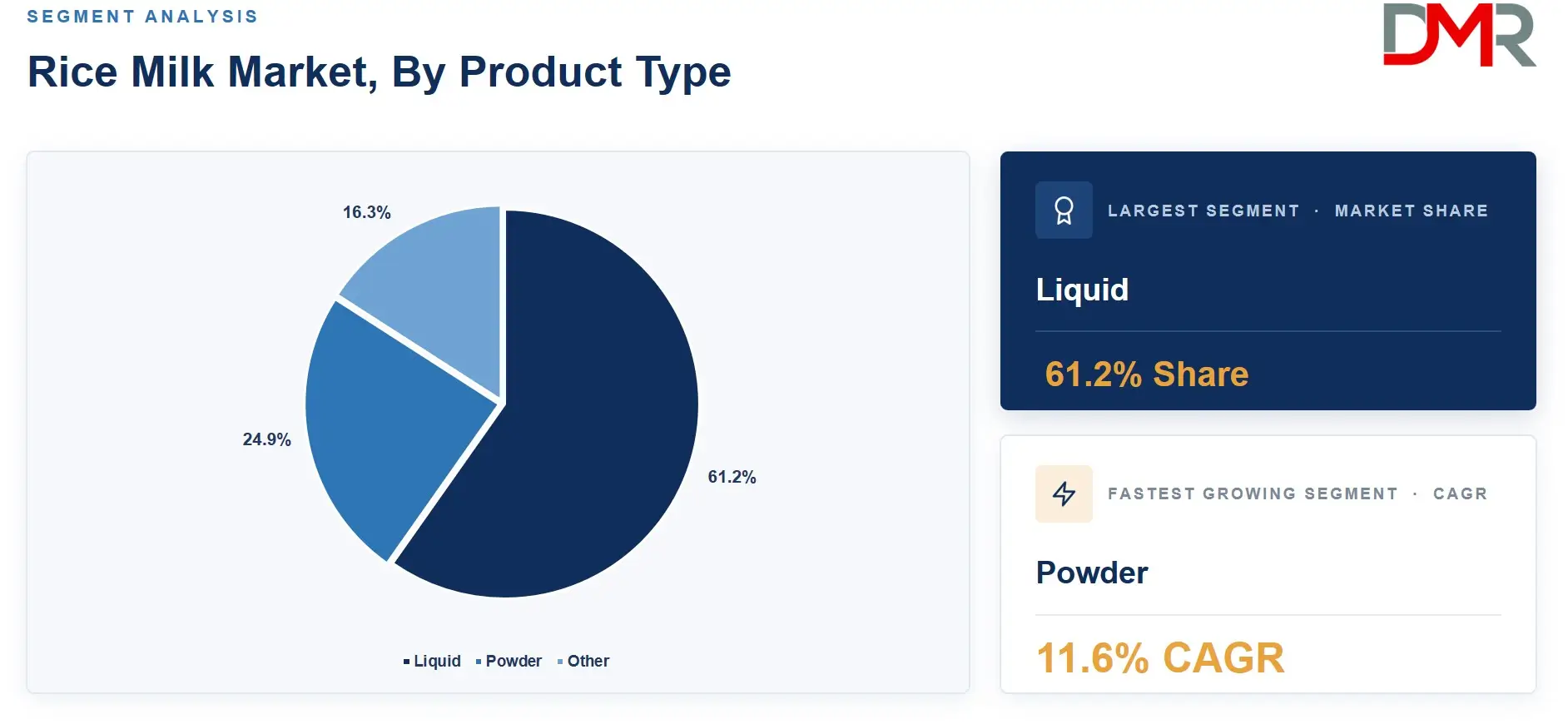
- Form Segment Analysis: The Liquid segment is anticipated to be the largest form segment, having a market share of 61.2% by the end of 2026. The Powder segment is expected to be the fastest-growing segment with a CAGR of 11.2% from 2027 to 2035.
- Nature Segment Analysis: Conventional is the major nature segment, representing the highest market share of 66.8% in 2026, while the organic segment is projected to have the highest growth rate with a CAGR of 11.4% during the forecast period.
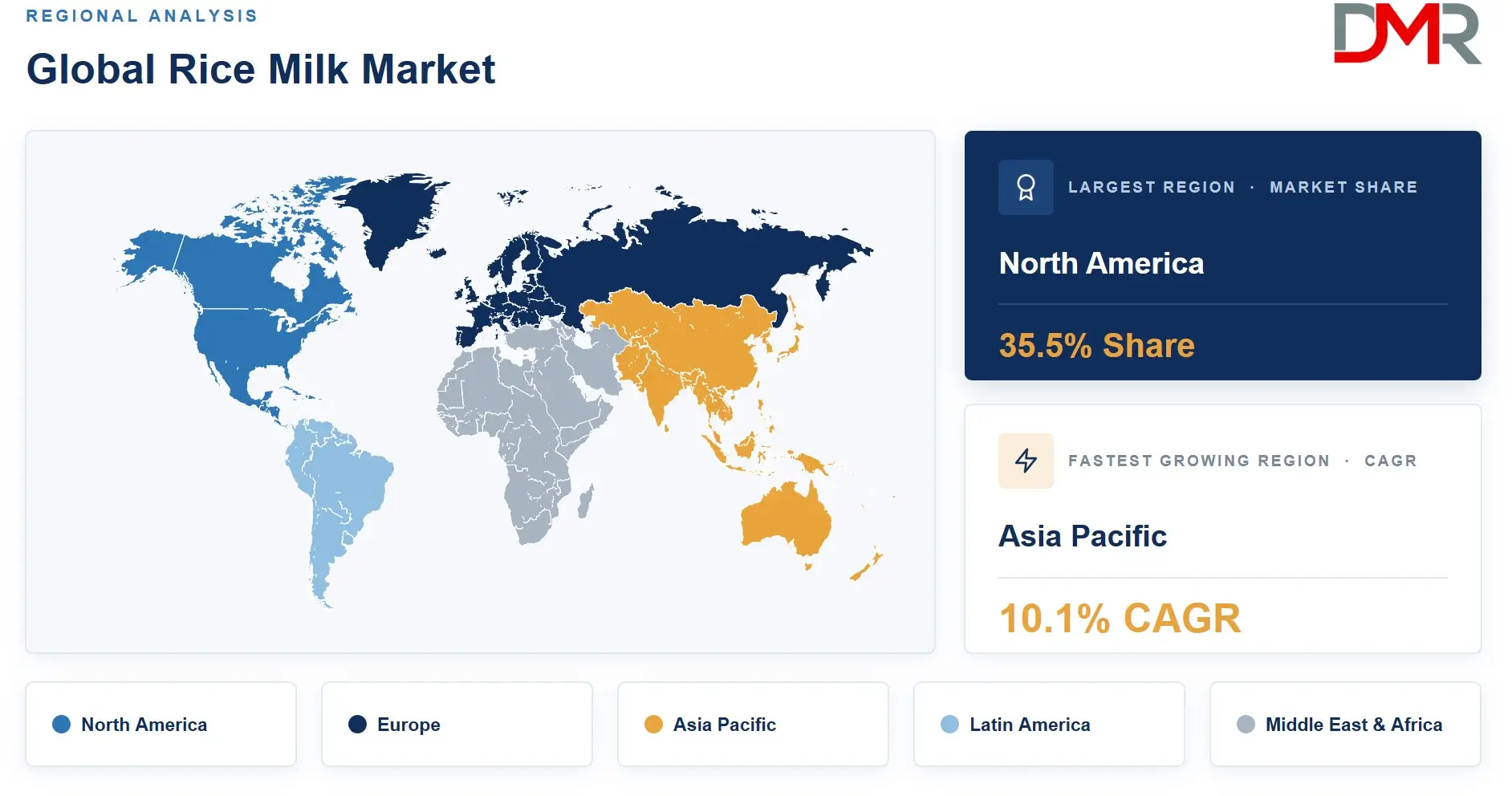
- Regional Analysis: The North America region is poised to hold the largest market share of 35.5% in the global market in 2026. The Asia Pacific region is expected to be the fastest-growing region with a CAGR of 10.1% during the forecast period.
How AI/Gen AI is Transforming the Rice Milk Market?
Artificial intelligence can assist participants in the rice milk market with demand forecasting, quality control, recipe development, and supply chain planning. Manufacturers may analyze sales data, consumer reviews, and seasonal trends to guide production and retail inventory decisions. Machine learning can help evaluate process variables such as rice-to-water ratios, enzyme treatment, heat stability, sweetness, and viscosity, provided trials confirm actual performance. Computer vision may help inspect packaging or detect defects during production. Generative AI can summarize product feedback and support early formulation research, but its suggestions require human review, laboratory testing, and compliance checks. The practical value of these tools depends on the quality of production data, available budgets, and food safety requirements. AI should be treated as an operational support technology rather than evidence of an established, market-wide rice milk adoption rate.
Market Drivers
Increasing Preference for Dairy-Free and Plant-Based Beverages
Demand for rice milk is supported by consumers exploring dairy-free beverage options for personal preferences, food sensitivities, or plant-focused eating habits. Rice beverages have a mild taste that may suit cereal, smoothies, and routine consumption. Retailers are introducing broader non-dairy assortments and placing alternatives alongside conventional milk, increasing consumer visibility. Product innovation gives shoppers a choice of plain, unsweetened, organic, flavored, and fortified products. Brands benefit when products combine acceptable taste with convenient packaging, clear labels, and accessible prices. Adoption is not uniform: competing oat, almond, and soy drinks often have stronger brand recognition, while nutritional differences shape purchasing decisions. These factors make product differentiation, education, and repeat-use occasions particularly important for suppliers targeting mainstream beverage consumers.
Growing Availability of Convenient Retail and Foodservice Options
Supermarket shelf space, e-commerce listings, and foodservice distribution channels are improving the visibility and accessibility of rice milk, allowing consumers to compare it with other plant-based milk alternatives. Shelf-stable cartons offer convenient storage options for households, while powdered formats cater to specific ingredient applications and longer-term storage requirements. Manufacturers are focusing on improving taste, texture, and product consistency to encourage the use of rice milk in beverages and food preparation. Wider product availability may encourage first-time purchases, although retailers must carefully manage product assortments due to relatively modest consumer demand compared with more established plant-based milk alternatives. Consistent product availability, competitive pricing, and suitable packaging sizes remain important factors in encouraging repeat purchases and supporting market growth.
Market Restraints
Nutritional Differences and Consumer Comparisons
Rice milk typically contains less protein than dairy milk and several alternative beverages, which can limit its appeal among consumers prioritizing protein intake. Many formulations rely on added calcium and vitamins to improve nutritional positioning. Natural carbohydrate content, added sugar, and ingredient choices can also influence purchasing decisions. Brands therefore face the challenge of communicating product benefits without implying nutritional equivalence across all milk types. Retail shoppers increasingly compare nutrition labels, taste, price, and fortification levels. Producers must also consider different dietary requirements and avoid marketing rice beverages as substitutes for medically appropriate infant feeding products.
Arsenic Controls and Competition from Alternative Beverages
Rice can absorb inorganic arsenic from its growing environment, making raw-material controls, testing, and regulatory compliance important considerations for rice beverage companies. The United Kingdom advises that children younger than five should not consume rice drinks as milk substitutes because of arsenic exposure concerns. These restrictions affect product positioning and require careful labeling. At the same time, established soy, almond, and oat drinks compete for limited retail space. Pricing pressure and the need to demonstrate distinctive functional benefits can make expansion challenging for smaller rice milk producers.
Market Opportunities
Expansion of Fortified and Unsweetened Rice Beverages
Product development in calcium-enriched, vitamin-fortified, and unsweetened rice beverages presents an opportunity for manufacturers seeking better alignment with label-conscious shoppers. Brands may position formulations around specific adult consumption occasions such as breakfast, home cooking, and convenient daily beverages. Improved ingredient clarity and taste consistency can increase confidence among first-time customers. Opportunities also exist in packaging that communicates serving size, nutritional content, and appropriate use clearly. Suppliers that validate ingredient safety, follow contaminant limits, and offer competitive prices may be better placed to reach mainstream distribution. The potential remains conditional on retail acceptance and nutritional substantiation.
New Foodservice and Shelf-Stable Product Applications
Rice milk producers may expand through cafes, bakery ingredient suppliers, and shelf-stable grocery channels. Convenient cartons and powders allow participation in different storage and preparation settings. Formulations designed for cooking, desserts, or beverage mixing could create additional commercial uses beyond conventional drinking occasions. Manufacturers need to demonstrate reliable performance, transparent ingredient sourcing, competitive economics, and suitable labeling to convert these possibilities into sustained demand.
Market Trends
Growing Interest in Fortified and Reduced-Sugar Products
Manufacturers are responding to consumer scrutiny of sugar, protein, and vitamin content by developing fortified and lower-sugar rice beverages. Calcium, vitamin D, or vitamin B12 may be added depending on local requirements and product positioning. Clear front-of-pack communication can help shoppers distinguish unsweetened and flavored products. Such innovation supports broader product choice but should not obscure rice milk generally limited natural protein content or override official guidance for younger children.
Increasing Focus on Convenient Shelf-Stable Formats
Ambient-stable cartons remain an important packaging option for rice beverages because they can simplify distribution and household storage before opening. Manufacturers are also exploring powders and ingredient-oriented formats that allow flexible preparation. Convenience-oriented product design can support online sales and smaller retail locations, but texture after reconstitution and product safety must remain consistent. Packaging sustainability claims require evidence, and manufacturers must consider the environmental footprint of rice production, processing, and transport. These factors influence how brands communicate value across different markets and consumer groups.
Research Scope and Analysis
The Global Rice Milk Market is segmented based on Form, Nature, Product Type, and Distribution Channel. On the basis of Form, the market includes Liquid, Powder, and Others. By Nature, the market is categorized into Organic and Conventional rice milk. On the basis of Product Type, the market includes Unflavored and Flavored. By Distribution Channel, the market includes Supermarkets and Hypermarkets, Convenience Stores, Specialty & Health Food Stores, Online Retail, Foodservice, and Others. The market analysis examines changing consumer preferences, increasing demand for plant-based milk alternatives, product availability, and distribution trends. Geographically, the market covers North America, Europe, Asia Pacific, Latin America, and the Middle East and Africa.
ℹ
To learn more about this report –
Download Your Free Sample Report Here
By Form
Liquid is projected to dominate the Form segment in the Rice Milk Market as it is expected to hold 61.2% of the total market share in 2026. The dominance is caused by the increasing demand for plant-based dairy alternatives, rising awareness of lactose intolerance, growing preference for convenient and ready-to-consume beverages, expanding availability across retail channels, and widespread use of Liquid in smoothies, cereals, coffee, desserts, and everyday household consumption. Powder is poised to have the highest CAGR of 11.2% during the forecast period (2027–2035) in the Form segment, driven by increasing consumer demand for convenient plant-based beverages, expanding retail availability, innovative packaging solutions, and healthier lifestyles.
By Nature
The conventional segment is dominating the nature segment in the rice milk market, accounting for 66.8% of the total market share in 2026. The dominance is due to lower production costs, affordable pricing, widespread product availability, established manufacturing processes, expanding retail distribution networks, growing consumer demand for economical plant-based beverages, and increasing adoption across households and foodservice applications. Organic is poised to have the highest CAGR of 11.4% during the forecast period (2027–2035) in the Nature segment, driven by increasing consumer preference for chemical-free products, rising health consciousness, growing demand for organic plant-based beverages, expanding organic retail networks, higher disposable incomes, and increasing awareness of sustainable farming practices.
By Product Type
Unflavored is projected to dominate the Product Type segment in the Global Rice Milk Market as it is expected to hold 59.4% of the total market share in 2026. This dominance is attributed to increasing consumer preference for natural and minimally processed plant-based beverages, growing demand for dairy-free milk alternatives, rising health consciousness, expanding applications in cooking and baking, increasing adoption among lactose-intolerant consumers, and growing availability of unsweetened rice milk products. Flavoured is poised to have the highest CAGR of 12.2% during the forecast period (2027–2035) in the Product Type segment, driven by increasing demand for innovative beverage flavours, growing consumer preference for convenient and ready-to-drink plant-based beverages, rising popularity of chocolate and vanilla variants, expanding product innovation, increasing demand among younger consumers, and growing availability of flavoured rice milk products through retail and online distribution channels.
By Distribution Channel
Supermarkets and Hypermarkets is projected to dominate the distribution channel segment in the Rice Milk Market as it is expected to hold 37.4% of the total market share in 2026. This dominance is attributed to the consumer preference for convenient shopping experiences, increasing availability of plant-based dairy alternatives, expanding dedicated health food sections, attractive promotional offers, competitive pricing, and growing consumer awareness of rice milk products, supported by established retail networks and diverse product selections. Online Retail is poised to have the highest CAGR of 10.4% during the forecast period (2027–2035) in the Distribution Channel segment, driven by increasing consumer preference for convenient shopping, expanding e-commerce platforms, rising smartphone penetration, growing availability of plant-based beverages online, attractive discounts, doorstep delivery services, and increasing adoption of digital purchasing channels.
The Global Rice Milk Market Report is segmented based on the following:
By Form
By Nature
By Product Type
By Distribution Channel
- Supermarkets and Hypermarkets
- Convenience Stores
- Specialty & Health Food Stores
- Online Retail
- Foodservice
- Others
Regional Analysis
North America is the Leading Region in the Global Rice Milk Market
North America is expected to dominate the Global Rice Milk Market, accounting for a market share of 35.5% in 2026. The region's leading position is supported by the widespread availability of dairy alternatives through supermarkets, growing consumer familiarity with plant-based beverages, and the presence of specialized natural food retail chains. Rice milk brands compete with oat, soy, almond, and other non-dairy alternatives based on pricing, ingredient composition, nutritional fortification, and taste. In the United States, retail distribution channels offer both national brands and private-label products, while Canada is witnessing increasing availability of specialty plant-based beverages. These factors are expected to strengthen North America's position in the global rice milk market.
ℹ
To learn more about this report –
Download Your Free Sample Report Here
Asia Pacific is the Fastest-Growing Region in the Global Rice Milk Market
Asia Pacific is expected to emerge as the fastest-growing regional market for rice milk, registering a compound annual growth rate (CAGR) of 10.1% during the forecast period from 2027 to 2035. The region's growth is supported by widespread rice consumption, established rice-processing capabilities, and growing interest in plant-based beverages. Countries such as Japan, China, India, and Australia, along with Southeast Asian markets, have diverse consumer preferences and retail environments that influence product demand. Growing interest in dairy-free alternatives and convenient beverage options is expected to create opportunities for rice milk manufacturers, particularly those adapting product sweetness, packaging sizes, and nutritional formulations to meet local consumer preferences.
Europe Rice Milk Market
Europe has a well-established plant-based beverage market shaped by organic retail, grocery private labels, and consumer attention to ingredient transparency. Rice drinks are distributed in countries including Germany, France, the United Kingdom, Italy, and Spain, where they compete with oat, soy, and almond beverages. Organic formulations and ambient-stable cartons can appeal to shoppers seeking convenient, dairy-free alternatives. Manufacturers must consider EU food information requirements, nutrition and health-claim rules, contaminant limits, and country-specific retail conditions. In the United Kingdom, official guidance advises against using rice drinks as milk substitutes for children under five because of potential inorganic arsenic exposure. These considerations make accurate labeling, responsible age-related communication, and supplier quality assurance central to European commercialization. Retailers are likely to favor products that combine good taste with transparent sourcing, dependable stock availability, and clear positioning among existing dairy alternatives.
Latin America Rice Milk Market
Latin America is an emerging opportunity for rice milk producers as major metropolitan retailers expand their ranges of dairy-free beverages. Brazil and Mexico have sizeable food and beverage industries and growing access to packaged plant-based alternatives, although rice drinks must compete with several familiar local beverage choices. Distribution costs, import dependence, and household purchasing power affect pricing and adoption. Brands can explore smaller carton sizes, locally appropriate flavors, and partnerships with supermarkets or specialty stores. Food manufacturers may also evaluate rice ingredients for selected bakery and dessert applications. Growth will depend on reliable supply chains, nutritional communication, product safety, and consumer willingness to purchase rice-based beverages relative to competing alternatives.
Middle East and Africa (MEA) Rice Milk Market
The Middle East and Africa Rice Milk Market is at an earlier stage of development in many countries, with demand concentrated in modern grocery stores, imported specialty foods, and selected hospitality outlets. Saudi Arabia and the United Arab Emirates offer opportunities for shelf-stable plant-based beverages that fit regional distribution and storage requirements. South Africa also has natural-food retailers and wider beverage categories through which rice drinks may be introduced. However, consumer awareness, price sensitivity, import costs, and the limited protein content of rice beverages can constrain adoption. Brands entering these markets need compliant Arabic or local-language labeling where applicable, evidence of ingredient safety, and appropriate shelf-life validation. Further development may come from private-label products and partnerships with large food distributors, subject to local demand and competitive pricing.
Major Countries Analysis
United States Rice Milk Market
The US Rice Milk Market is projected to be valued at USD 242.5 million in 2026. It is expected to witness subsequent growth in the upcoming period, reaching USD 522.7 million in 2035. The United States is an important national market for rice milk, with plant-based beverages sold through supermarkets, natural-food specialists, and e-commerce platforms. Products range from traditional plain rice drinks to flavored or vitamin-fortified versions designed for adult household use. Shoppers commonly compare rice milk with oat, almond, soy, coconut, and pea-based alternatives, so suppliers must clarify differences in taste, protein, sugar, and pricing. Shelf-stable packaging and established grocery logistics support availability across different states. Commercial opportunities include household breakfasts, recipe applications, specialty diets, and selected foodservice accounts. Brands should maintain controls over rice sourcing, potential inorganic arsenic exposure, and ingredient declarations.
Japan Rice Milk Market
Japan has potential for rice-based beverages because rice is a familiar food ingredient and producers have substantial expertise in grain processing and packaged drink manufacturing. Consumer interest in convenient nutritional products and non-dairy choices may support products that offer a pleasant mouthfeel and controlled sweetness. Companies can explore applications in breakfast drinks, cafes, desserts, and packaged foods. However, dairy and soy beverages are established alternatives, and shoppers may place strong emphasis on taste, quality, and product reliability. Local food labeling, product testing, and appropriate positioning are necessary for successful commercialization. Developments in rice hydrolysis and processing could help suppliers optimize texture and sweetness. Commercial adoption remains dependent on brand visibility, pricing, and distribution rather than rice consumption alone.
Saudi Arabia Rice Milk Market
Saudi Arabia offers a developing opportunity for packaged rice milk through modern retail chains, health-oriented grocery outlets, and foodservice channels that already sell dairy alternatives. Consumers considering plant-based beverages may be motivated by dietary preference, lactose avoidance, or interest in new product formats. Shelf-stable cartons can suit the distribution environment and reduce dependence on chilled merchandising before opening. Suppliers can explore plain, unsweetened, and fortified variants while maintaining competitive retail prices. Saudi Food and Drug Authority requirements, compliant product labels, ingredient declarations, and food safety documentation must be addressed before market entry. Imported brands may face logistics costs, retailer listing requirements, and competition from familiar oat, almond, and soy beverages. Product education should communicate both the benefits and nutritional limitations of rice drinks, particularly their relatively modest protein content. Local partnerships with importers, distributors, and organized retailers could strengthen availability.
Regulatory Landscape
The Global Rice Milk Market operates under national and regional food safety, labeling, contaminant, and nutrition-related regulations. In the United States, packaged rice beverages must meet applicable FDA food labeling and safety requirements, including truthful ingredient and nutrient information. In the European Union, food information and contaminant standards are particularly relevant, while organic claims require applicable certification. The UK Food Standards Agency notes that rice may contain inorganic arsenic and that manufacturers must keep contamination as low as reasonably achievable within regulatory limits. UK health guidance advises against rice drinks as milk substitutes for children younger than five. Regulators in Japan, India, Saudi Arabia, and other markets also maintain food safety and labeling frameworks that require country-specific review. Manufacturers must check rules for fortification, product names, health claims, allergen declarations, and shelf-life claims rather than assuming one global labeling approach is sufficient.
Investment and White Space Analysis
Investment opportunities in the Global Rice Milk Market include improved processing efficiency, fortified formulations, premium unsweetened products, private-label development, and distribution into underserved retail channels. Manufacturers can investigate ways to optimize viscosity and flavor while reducing the need for unnecessary sweeteners. Powder formats may provide opportunities for ingredient suppliers and certain foodservice applications where storage efficiency matters. Regional expansion requires realistic assessments of purchasing power, competition from other plant-based milks, and the cost of retailer access. Quality investments are especially important for raw-rice sourcing and inorganic arsenic monitoring. Producers may also evaluate packaging improvements and clearer nutritional education. White-space potential is strongest where products solve identifiable consumer or commercial needs, rather than relying solely on broad trends in plant-based consumption.
By Region
North America
Europe
- Germany
- France
- The U.K.
- Italy
- Spain
- Rest of Europe
Asia Pacific
- China
- Japan
- India
- Australia
- South Korea
- Rest of APAC
Latin America
- Mexico
- Brazil
- Rest of LATAM
Middle East & Africa
- Saudi Arabia
- The UAE
- South Africa
- Rest of MEA
Competitive Landscape
The competitive landscape of the Global Rice Milk Market includes dedicated rice beverage brands, diversified plant-based milk companies, organic packaged-food suppliers, and retailers offering private-label alternatives. Competition centers on taste, price, ingredient simplicity, organic credentials, fortification, and distribution reach. Established beverage portfolios can benefit from existing supermarket relationships and marketing capabilities, while niche suppliers may differentiate through specialized formulations or sourcing standards. Rice milk competes directly with other plant-based beverages that may offer higher protein, different textures, or stronger consumer recognition. Product development priorities include lower-sugar options, improved stability, convenient packaging, and dependable quality controls. Manufacturers must also address inorganic arsenic monitoring and responsible nutritional communication. Brand-specific rice milk availability differs between countries and can change over time, so market participants should be verified by product and geography before inclusion in a quantitative competitive ranking.
Some of the prominent players in the Global Rice Milk Market are:
- Danone S.A.
- SunOpta Inc.
- Vitasoy International Holdings Limited
- Campbell Soup Company
- Ebro Foods S.A.
- Pureharvest Pty Ltd.
- The Bridge S.r.l.
- Riso Scotti S.p.A.
- Rude Health Foods Ltd.
- Natumi GmbH
- ABAFOODS S.r.l. (Isola Bio)
- Alinor S.p.A.
- Frías Nutrición S.A.
- Grupo Leche Pascual S.A.
- Nutriops S.L.
- Amandin (Costa Concentrados Levantinos S.A.)
- Liquats Vegetals S.A.
- Stremicks Heritage Foods LLC
- Essona Organics Inc.
- PANOS Brands LLC
- Eden Foods Inc.
- Pacific Foods of Oregon LLC
- Earth's Own Food Company Inc.
- Sanitarium Health & Wellbeing Company
- Noumi Limited
- Kikkoman Corporation
- Fine Japan Co., Ltd.
- Gan Teck Kar Foods
- Nature's Choice
- Nutra Organics
- Axiom Foods Inc.
- Rita Food and Drink Co., Ltd.
- BioAsia Ltd.
- Natura Nuova S.r.l.
- Kallo Foods Ltd.
- Fauser Vitaquellwerk KG
- La Compagnie du Riz
- Spiral Foods Pty Ltd.
- Refresco Group B.V.
- The Hain Celestial Group, Inc.
Recent Developments
- In July 2026, Axiom Foods Inc. partnered with NNB Nutrition to develop protein-enriched beverage formulations using plant-based ingredients, including rice proteins and rice milk bases. The collaboration focuses on combining plant proteins with functional ingredients to support product innovation, nutritional enhancement, and the development of next-generation plant-based beverages, creating opportunities for rice milk applications in functional drinks.
- In May 2026, Riso Scotti S.p.A. showcased its plant-based rice drinks alongside its traditional rice products at TuttoFood 2026 in Milan, Italy. The company highlighted its expanding international presence and rice-based beverage portfolio, supporting its positioning in the global plant-based milk alternatives market.
- In April 2025, Pureharvest Pty Ltd.'s Organic Rice Milk received food product registration in the Philippines through its local distributor, Nextrade Philippines, Inc. The registration supports the availability of the company's rice-based dairy alternative in the Philippine market and reflects its international market presence.
Report Details
| Report Characteristics |
| Market Size (2026) |
USD 923.8 Mn |
| Forecast Value (2035) |
USD 1991.3 Mn |
| CAGR (2027–2035) |
9.6% |
| The US Market Size (2026) |
USD 242.5 Mn |
| Historical Data |
2021 – 2025 |
| Forecast Data |
2027 – 2035 |
| Base Year |
2026 |
| Segments Covered |
By Form, By Nature, By Product Type, By Distribution Channel |
| Regional Coverage |
North America – The US and Canada; Europe – Germany, France, The UK, Italy, Spain, Rest of Europe; Asia-Pacific – China, Japan, India, Australia, South Korea, Rest of APAC; Latin America – Mexico, Brazil, Colombia, Argentina, Rest of LATAM; Middle East & Africa – Saudi Arabia, The UAE, South Africa, Rest of MEA |
Frequently Asked Questions
How big is the Rice Milk Market?
▾ The Global Rice Milk Market is projected to be valued at USD 923.8 million in 2026 and is expected to reach USD 1,991.3 million by 2035.
What is the CAGR of the Rice Milk Market from 2027 to 2035?
▾ The Global Rice Milk Market is anticipated to grow at a compound annual growth rate (CAGR) of 9.6% during the forecast period from 2027 to 2035.
What factors are driving the growth of the Rice Milk Market?
▾ Market development is supported by consumer demand for plant-based and dairy-free drinks, supermarket availability, foodservice experimentation, and product innovation. Plain, unsweetened, flavored, and fortified offerings help manufacturers reach different preferences, although nutrition, taste, price, and competition shape purchasing decisions.
What are the major trends in the Rice Milk Market?
▾ Major trends include greater interest in fortified and reduced-sugar beverages, convenient shelf-stable cartons, emerging powder applications, product quality improvements, and expanded online availability. Brands are also emphasizing ingredient transparency and product safety to maintain consumer confidence.
Which region held the largest share of the Rice Milk Market in 2026?
▾ North America is poised to hold the largest share of the Global Rice Milk Market in 2026, accounting for 35.5% of the total market.
Which region is expected to grow the fastest in the Rice Milk Market?
▾ Asia Pacific is projected to be the fastest-growing regional market during the forecast period, registering a CAGR of 10.1%.
Who are the key players in the Rice Milk Market?
▾ Companies relevant to the Global Rice Milk Market include Danone S.A., The Hain Celestial Group, SunOpta Inc., Vitasoy International Holdings Limited, Pureharvest Pty Ltd., The Bridge S.r.l., Riso Scotti S.p.A., Rude Health Foods Ltd., Natumi GmbH, ABAFOODS S.r.l. (Isola Bio), and other plant-based beverage manufacturers. These companies offer rice milk, organic rice drinks, fortified rice beverages, and related dairy-free alternatives, focusing on product innovation, nutritional enrichment, sustainable packaging, and expanding distribution across global markets.
How is the Rice Milk Market segmented?
▾ The Global Rice Milk Market is segmented by Form into Liquid, Powder, and Others; by Nature into Organic and Conventional; and by Product Type into Unflavored and Flavored. By Distribution Channel, the market includes Supermarkets and Hypermarkets, Convenience Stores, Specialty & Health Food Stores, Online Retail, Foodservice, and Others. Geographically, the market covers North America, Europe, Asia Pacific, Latin America, and the Middle East and Africa.