Market Overview
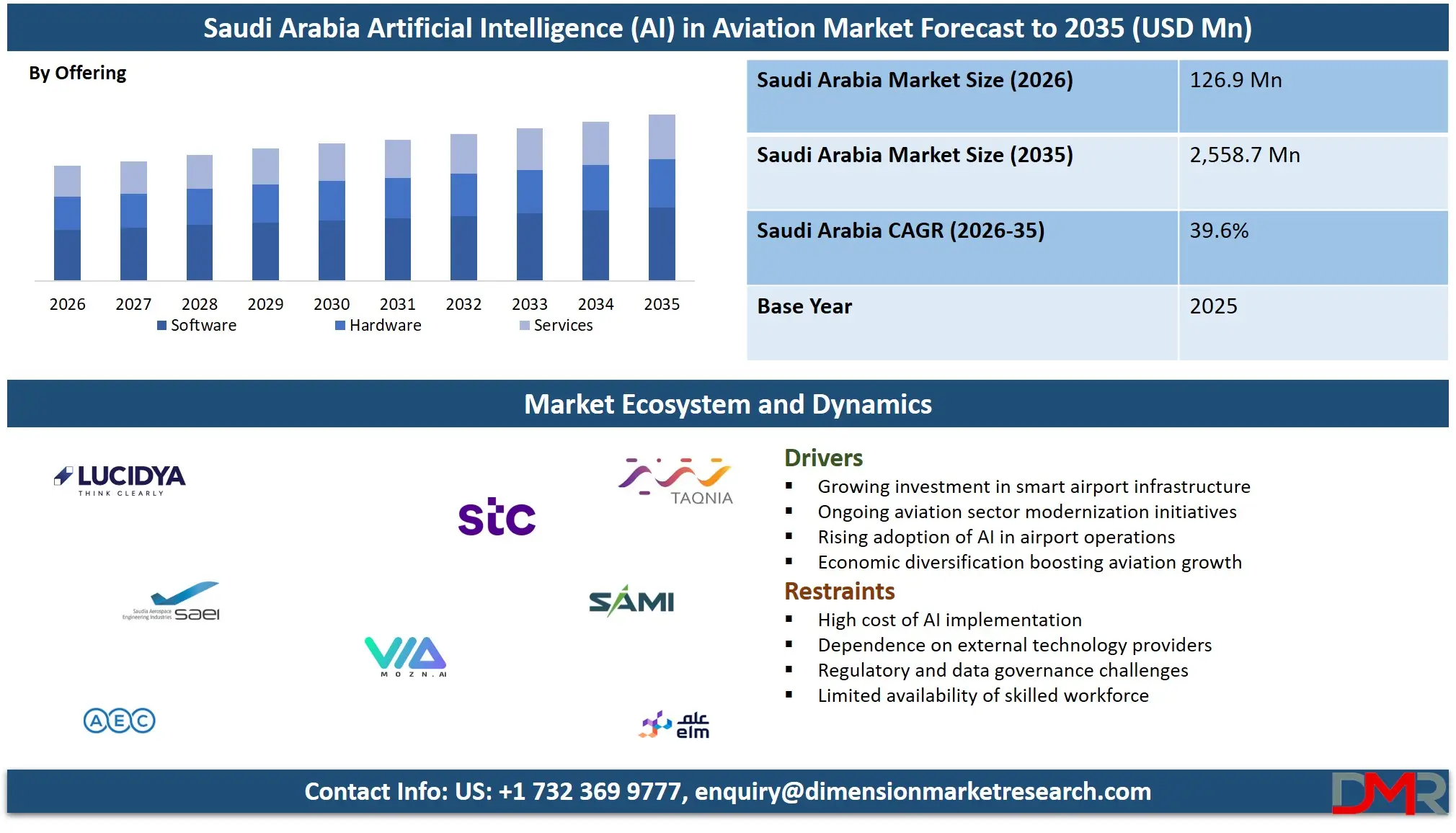
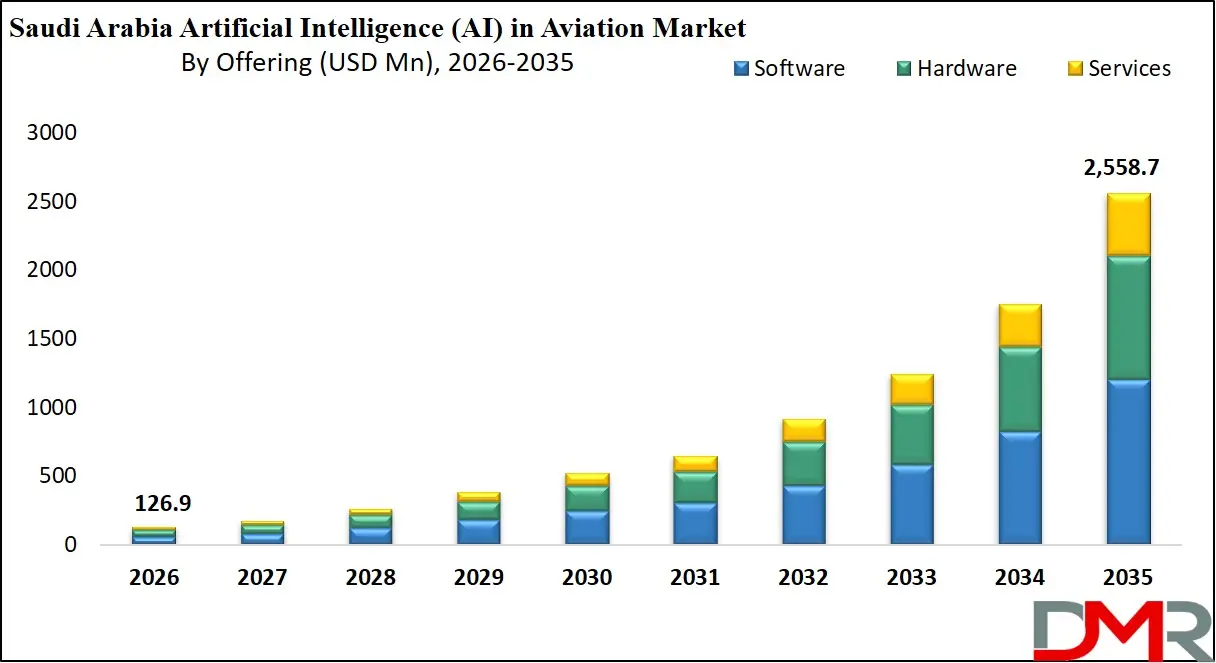
The Saudi Arabia Artificial Intelligence (AI) in Aviation Market size is projected to reach USD 126.9 million in 2026 and grow at a compound annual growth rate of 39.6 to reach a value of USD 2,558.7million in 2035.
ℹ
To learn more about this report –
Download Your Free Sample Report Here
Saudi Arabia Artificial Intelligence (AI) in Aviation refers to the integration of advanced algorithms, machine learning models, and data-driven systems into aviation operations, infrastructure, and services. It encompasses applications such as predictive maintenance, air traffic optimization, passenger experience enhancement, and autonomous systems.
The market is gaining strategic importance as the aviation sector modernizes under digital transformation initiatives and national diversification goals. Emerging trends include the adoption of AI-powered analytics, real-time decision-making tools, and smart airport ecosystems. Increasing investments in aviation infrastructure and smart technologies are accelerating AI adoption, reshaping operational efficiency, safety standards, and customer engagement across the sector.
ℹ
To learn more about this report –
Download Your Free Sample Report Here
Saudi Arabia Artificial Intelligence (AI) in Aviation Market: Key Takeaways & Influencing Factors
- Market Growth: The Saudi Arabia Artificial Intelligence (AI) in Aviation Market size is expected to grow by USD 2,386.6 million, at a CAGR of 39.6%, during the forecasted period of 2027 to 2035.
- By Offering: The software segment is anticipated to get the majority share of the Saudi Arabia Artificial Intelligence (AI) in Aviation market in 2026.
- By Application: The manufacturing segment is expected to get the largest revenue share in 2026 in the Saudi Arabia Artificial Intelligence (AI) in Aviation market.
- Use Cases: Some of the use cases of Artificial Intelligence (AI) in Aviation include predictive maintenance, passenger experience enhancement, and more.
- General Authority of Civil Aviation (Saudi Arabia): The authority reported in 2025 that passenger traffic exceeded 128 million, reflecting strong aviation growth driven by digital transformation initiatives.
- International Air Transport Association: The association stated in 2024 that AI adoption in global aviation operations improved operational efficiency by over 25% in digitally advanced airports.
- Saudi Data and Artificial Intelligence Authority: The authority indicated in 2026 that over 40% of aviation entities in the Kingdom are integrating AI-based solutions into operational workflows.
- World Bank: The bank reported in 2025 that smart infrastructure investments in Saudi Arabia’s transport sector grew by more than 18% annually, supporting AI deployment.
Saudi Arabia Artificial Intelligence (AI) in Aviation Market: Use Cases
- Predictive Maintenance: AI-driven systems analyze aircraft sensor data to forecast component failures, reducing downtime and maintenance costs. Airlines leverage these insights to enhance fleet reliability, improve safety compliance, and optimize maintenance schedules, ensuring uninterrupted operations and extended aircraft lifecycle performance.
- Air Traffic Management Optimization: AI enables real-time analysis of flight patterns, weather data, and airspace congestion to improve traffic flow. This reduces delays, enhances fuel efficiency, and ensures better coordination between control towers and aircraft, supporting safer and more efficient aviation operations.
- Passenger Experience Enhancement: AI-powered chatbots, facial recognition, and personalized recommendation systems streamline passenger journeys. From automated check-ins to baggage tracking, these solutions enhance convenience, reduce wait times, and improve overall satisfaction across airports and airlines.
- Autonomous Ground Operations: AI supports automation in ground handling activities such as baggage sorting, aircraft refueling coordination, and runway inspections. This improves operational speed, reduces human error, and enhances safety standards in airport environments.
Market Dynamic
Driving Factors in the Saudi Arabia Artificial Intelligence (AI) in Aviation Market
Government-led Digital Transformation Initiatives
Saudi Arabia’s Vision-driven transformation is a major growth driver for AI in aviation. Strong government backing through funding programs, regulatory support, and smart airport initiatives is accelerating adoption. Investments in digital infrastructure and innovation hubs are encouraging airlines and airport operators to integrate AI technologies, improving operational efficiency, safety, and passenger services while positioning the country as a regional aviation leader.
Rising Demand for Operational Efficiency and Cost Reduction
Airlines and airports are increasingly adopting AI to minimize operational costs and enhance efficiency. AI enables predictive analytics, automated processes, and optimized resource utilization, reducing fuel consumption, maintenance expenses, and delays. As competition intensifies and passenger volumes grow, stakeholders are leveraging AI to streamline workflows, improve turnaround times, and maintain profitability in a rapidly evolving aviation ecosystem.
Restraints in the Saudi Arabia Artificial Intelligence (AI) in Aviation Market
High Implementation and Integration Costs
The deployment of AI systems requires significant capital investment in infrastructure, software, and skilled workforce. Integration with legacy aviation systems further increases complexity and costs. Smaller operators may face financial constraints, limiting widespread adoption. These high upfront expenses can delay implementation timelines and restrict market growth, particularly among mid-sized aviation service providers.
Data Privacy and Cybersecurity Concerns
AI systems rely heavily on large datasets, including sensitive passenger and operational information. This raises concerns around data protection and cybersecurity risks. Regulatory compliance requirements and potential vulnerabilities to cyberattacks can hinder adoption. Aviation stakeholders must invest in robust security frameworks, which adds to operational complexity and may slow down AI deployment across the sector.
Opportunities in the Saudi Arabia Artificial Intelligence (AI) in Aviation Market
Expansion of Smart Airports and Infrastructure Projects
Ongoing development of smart airports presents a significant opportunity for AI integration. These projects incorporate advanced technologies such as biometrics, automation, and real-time analytics. AI solutions can enhance airport operations, improve passenger flow, and support seamless travel experiences, creating a strong growth avenue for technology providers and aviation stakeholders.
Growing Investment in AI Research and Talent Development
Saudi Arabia is investing heavily in AI education, research centers, and workforce development. This fosters innovation and supports the creation of advanced aviation-specific AI solutions. The availability of skilled professionals and increased collaboration between academia and industry are expected to accelerate adoption and drive long-term market growth.
Trends in the Saudi Arabia Artificial Intelligence (AI) in Aviation Market
Integration of AI with IoT and Big Data Analytics
The convergence of AI with IoT and big data is transforming aviation operations. Connected devices generate vast amounts of data, which AI systems analyze for actionable insights. This trend enhances predictive maintenance, real-time monitoring, and operational optimization, enabling smarter and more efficient aviation ecosystems.
Adoption of Autonomous and Semi-Autonomous Systems
Airports and airlines are increasingly exploring autonomous technologies such as self-driving ground vehicles and AI-assisted flight systems. These innovations improve safety, reduce human dependency, and enhance operational efficiency. The trend toward automation is reshaping traditional aviation processes and driving technological advancement in the sector.
Impact of Iran War on Saudi Arabia Artificial Intelligence (AI) in Aviation Market
The geopolitical issue like that of the Iran War has caused disruptions in flights owing to issues like lack of airspace and rising prices of fuel. In this regard, there is a need for the development of AI in the aviation sector that ensures the optimization of flight path and effective use of fuel. The airlines would need to utilize predictive analytics due to uncertainties.
Research Scope and Analysis
By Offering Analysis
The software category is forecasted to lead the market and capture around 46.8% of market share by 2026 owing to the rise in demand for artificial intelligence-based platforms and tailor-made aviation solutions. Software-based solutions offer capabilities such as analytics, automation, and real-time decision making. The services segment is the most rapidly growing segment due to increasing demand for integration services, consulting, and maintenance services. There is an immense need for skilled professionals who can help organizations implement AI solutions efficiently.
By Technology Analysis
Machine learning holds the top position in terms of market share with an estimated value of 44.2% in 2026, mainly because of its wide usage in predictive maintenance, forecast operations, and customer analysis. Deep learning becomes very important within machine learning because of its capability to analyze and interpret aviation data. NLP is expected to be the fastest growing market segment because of the rising popularity of virtual assistants and automated customer services.
By Equipment Analysis
Vision Measuring Machine (VMM) will emerge as a market leader with 29.6% of the market share because of the ability of the machine to take exact measurements of the components of the aircraft. The reason why such equipment is extremely vital in aviation is that of their precision in measuring parts. The fastest growing group within aviation metrology solutions are Optical Digitizers & Scanners.
By Application Analysis
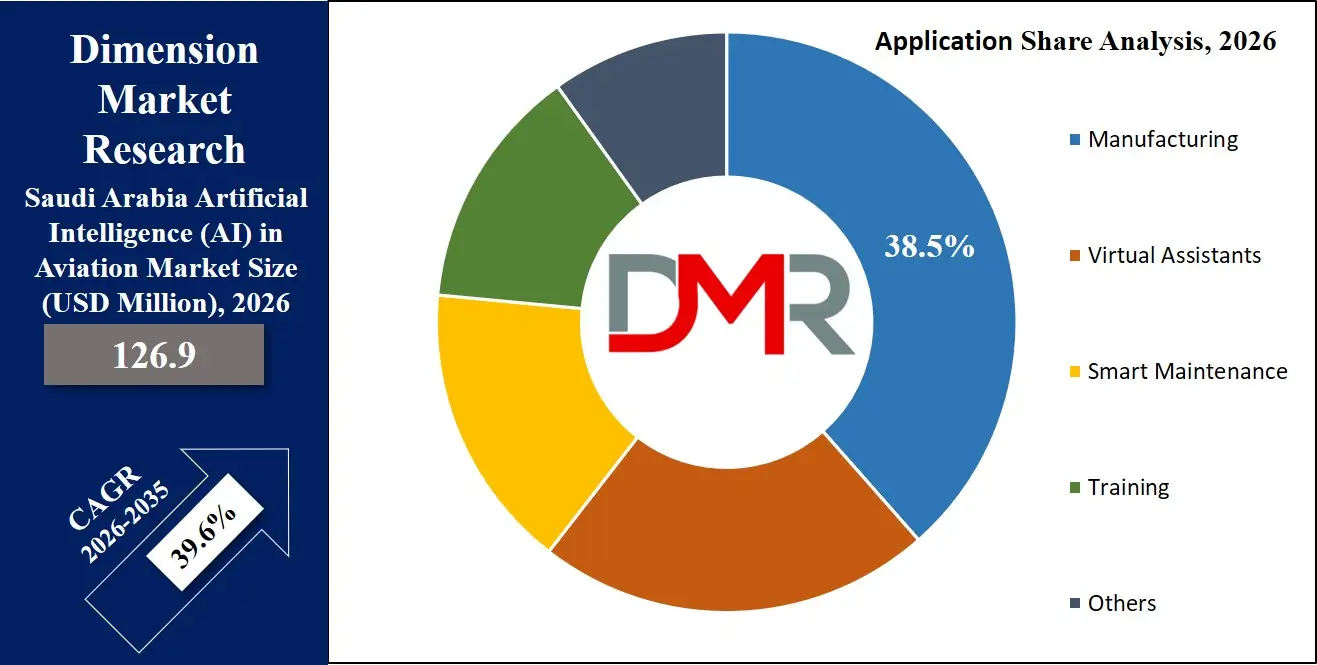
The manufacturing segment is estimated to hold the largest market share of 38.5% by 2026, owing to the vital role played by artificial intelligence in manufacturing processes in the aircraft manufacturing industry.
ℹ
To learn more about this report –
Download Your Free Sample Report Here
Artificial intelligence improves production efficiency while at the same time minimizing errors. The virtual assistant sub-segment is expected to be the fastest-growing sub-segment due to growing demand for automated customer service applications.
The Saudi Arabia Artificial Intelligence (AI) in Aviation Market Report is segmented on the basis of the following:
By Offering
- Hardware
- Software
- Services
- Integration & Development
- Support & Maintenance
By Technology
- Machine Learning
- Deep Learning
- Supervised Learning
- Semi-supervised Learning
- Unsupervised Learning
- Reinforcement Learning
- Natural Language Processing
- Context Awareness Computing
- Computer Vision
By Equipment
- Autocollimator
- Profile Projector
- Measuring Microscope
- Optical Digitizers & Scanners (ODS)
- Co-ordinate Measuring Machine (CMM)
- Vision Measuring Machine (VMM)
By Application
- Virtual Assistants
- Smart Maintenance
- Manufacturing
- Training
- Others
Competitive Landscape
The Saudi Arabia AI in Aviation Market is characterized by high levels of competition due to innovation, technological expertise, and collaboration. Companies dedicate a significant amount of effort toward R&D and develop advanced AI systems for aviation purposes.
ℹ
To learn more about this report –
Download Your Free Sample Report Here
The entry level in this market is also high because of financial limitations and the need for competent individuals. Market participants leverage the benefits of collaborating with aviation regulation agencies and tech companies to enhance their capabilities.
Some of the prominent players in the Saudi Arabia Artificial Intelligence (AI) in Aviation are:
- Saudi Arabian Military Industries (SAMI)
- Saudia Aerospace Engineering Industries (SAEI)
- STC Solutions
- Aramco Digital
- Saudi Data and AI Authority (SDAIA)
- TAQNIA (TAQNIA Space & Defense)
- Advanced Electronics Company (AEC)
- Elm Company
- SITE (Saudi Information Technology Company)
- Mozn
- Lucidya
- Quant Data & Analytics
- Lean Business Services
- Ejada Systems
- Taqnia Cyber
- Halian Middle East
- Proven Arabia
- Hyperthink Systems
- Smart Vision
- Quickworks
- Other Key Players
Recent Developments
- In April 2026, WINGIE introduced an AI-powered system to automate airline refunds, enabling travelers to manage requests digitally without call centers. The platform integrates with airline systems to calculate refunds and provide clear options. Users can review and modify requests, improving efficiency, reducing delays, and enhancing overall control over the refund process.
- In December 2025, Riyadh Air and IBM introduced Riyadh Air as the world’s first fully AI-native airline. Built without legacy systems, its AI-driven operations enhance passenger and employee experiences. Led by IBM Consulting, the initiative integrates multiple partners and technologies, marking a key milestone as the airline prepares for full commercial operations.
- In November 2025, FLYR announced the opening of its regional headquarters in Riyadh, strengthening its presence in the Kingdom. Following collaboration with Riyadh Air, the move supports Vision 2030 goals. FLYR aims to expand its Offer & Order technology, enabling advanced retailing, cross-selling, and integrated travel services across the region.
Report Details
| Report Characteristics |
| Market Size (2026) |
USD 126.9 Mn |
| Forecast Value (2035) |
USD 2,558.7 Mn |
| CAGR (2026–2035) |
39.6% |
| Historical Data |
2021 – 2025 |
| Forecast Data |
2027 – 2035 |
| Base Year |
2025 |
| Estimate Year |
2026 |
| Report Coverage |
Market Revenue Estimation, Market Dynamics, Competitive Landscape, Growth Factors and etc. |
| Segments Covered |
By Offering (Hardware, Software, Services), By Technology (Machine Learning, Natural Language Processing, Context Awareness Computing, Computer Vision), By Equipment (Autocollimator, Profile Projector, Measuring Microscope, Optical Digitizers & Scanners (ODS), Co-ordinate Measuring Machine (CMM), Vision Measuring Machine (VMM)), By Application (Virtual Assistants, Smart Maintenance, Manufacturing, Training, Others) |
| Country Coverage |
Saudi Arabia |
| Prominent Players |
Saudi Arabian Military Industries (SAMI), Saudia Aerospace Engineering Industries (SAEI), STC Solutions, Aramco Digital, Saudi Data and AI Authority (SDAIA), TAQNIA (TAQNIA Space & Defense), Advanced Electronics Company (AEC), Elm Company, SITE (Saudi Information Technology Company), Mozn, Lucidya, Quant Data & Analytics, Lean Business Services, Ejada Systems, Taqnia Cyber, Halian Middle East, Proven Arabia, Hyperthink Systems, Smart Vision, Quickworks, and Other Key Players |
| Purchase Options |
We have three licenses to opt for: Single User License (Limited to 1 user), Multi-User License (Up to 5 Users) and Corporate Use License (Unlimited User) along with free report customization equivalent to 0 analyst working days, 3 analysts working days and 5 analysts working days respectively. |
Frequently Asked Questions
How big is the Saudi Arabia Artificial Intelligence (AI) in Aviation Market?
▾ The Saudi Arabia Artificial Intelligence (AI) in Aviation Market size is expected to reach USD 126.9 million by 2026 and is projected to reach USD 2,558.7 million by the end of 2035.
Who are the key players in the Saudi Arabia Artificial Intelligence (AI) in Aviation Market?
▾ Some of the major key players in the Saudi Arabia Artificial Intelligence (AI) in Aviation Market include SAMI, STC, SAEI, and others
What is the growth rate in the Saudi Arabia Artificial Intelligence (AI) in Aviation Market?
▾ The market is growing at a CAGR of 39.6 percent over the forecasted period.