Saudi Arabia Carboxymethyl Cellulose Market Snapshot
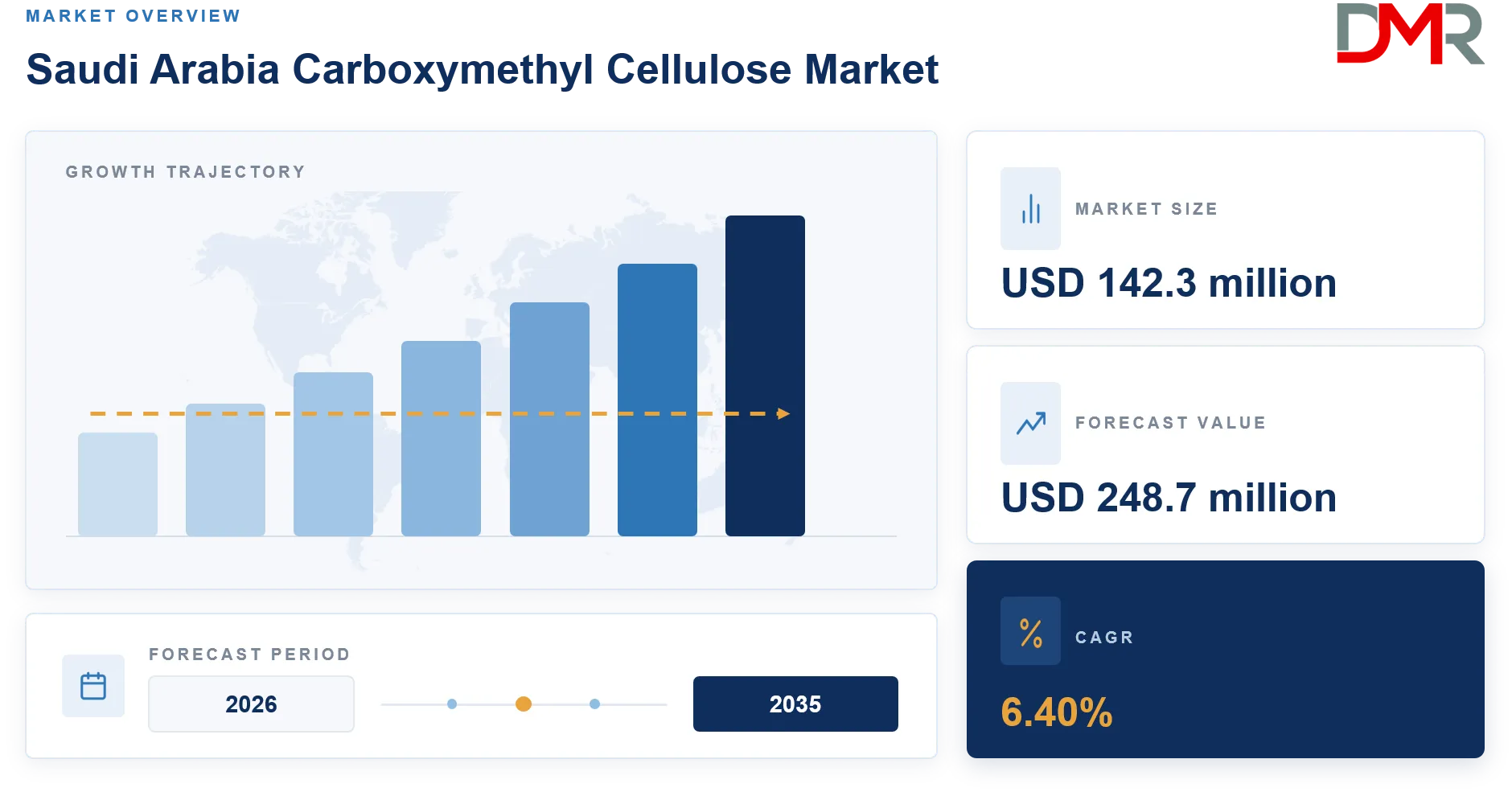
- Market Value: Saudi Arabia carboxymethyl cellulose market is valued at USD 142.3 million in 2026 and is expected to reach USD 248.7 million by 2035.
- CAGR: Saudi Arabia carboxymethyl cellulose market is expected to grow at a CAGR of 6.4% from 2026 to 2035.
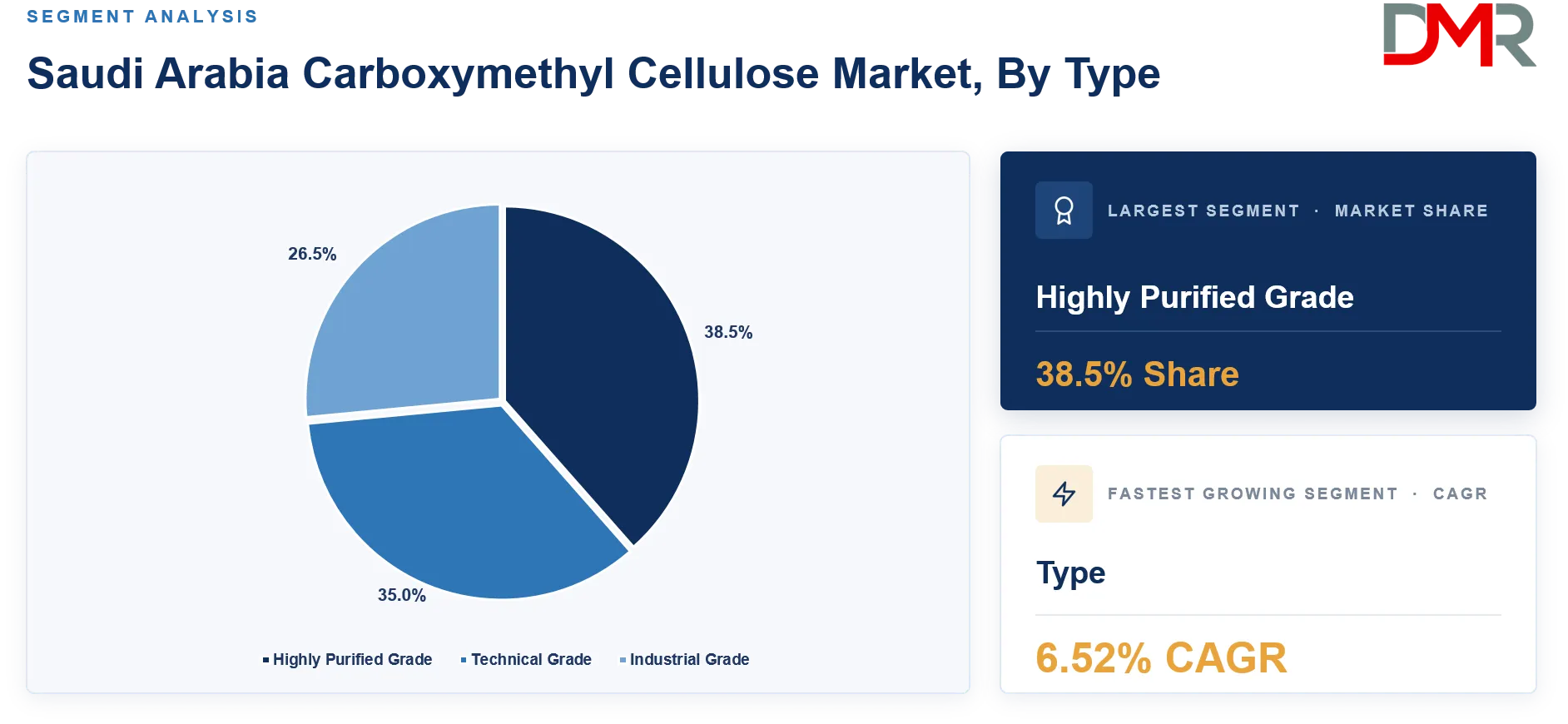
- By Type Segment Analysis: Highly purified grade led the type segment with a 38.5% share in 2026, equivalent to approximately USD 54.8 million.
- By Application Segment Analysis: Oil-field drilling fluids led applications with a 29.0% share in 2026, representing approximately USD 41.3 million.
- Regional Analysis: Saudi Arabia accounts for approximately 55 to 60% of GCC carboxymethyl cellulose demand in 2026.
- Major Players: Al Battal Factory for Chemical Industries, Univar Solutions, Palmart Co., Industrochem, and Ashland Global Holdings Inc.
What is the Saudi Arabia Carboxymethyl Cellulose Market and its Market Size?
The Saudi Arabia Carboxymethyl Cellulose Market size is projected to be valued at USD 142.3 million in 2026 and is expected to reach USD 248.7 million by 2035, expanding at a CAGR of 6.4% during the forecast period. Carboxymethyl cellulose, commonly known as CMC or cellulose gum, is a water-soluble cellulose derivative used as a thickener, stabilizer, binder, viscosity modifier, suspending agent, and water-retention additive. Its functional versatility supports demand across Saudi oil-field drilling fluids, food and beverages, pharmaceuticals, detergents, paper and pulp, paints, coatings, cosmetics, and other industrial formulations.
ℹ
To learn more about this report –
Download Your Free Sample Report Here
Saudi Arabia represents a strategically important CMC market within the GCC because its demand structure combines a large hydrocarbon sector with expanding downstream manufacturing. Oil-field drilling remains the largest single application, while food processing, pharmaceutical manufacturing, detergents, personal care, and coatings broaden the demand base. Buyers increasingly evaluate viscosity consistency, purity, degree of substitution, salt tolerance, dissolution performance, microbiological quality, and compatibility with production processes. These requirements create distinct opportunities for technical, industrial, and highly purified CMC grades.
Use Cases
- Oil-Field Drilling Fluids: CMC is used in water-based drilling fluids to regulate viscosity, reduce filtration loss, improve suspension stability, and help maintain suitable rheology during drilling. Saudi Arabia's extensive upstream oil and gas activity makes drilling-fluid formulations one of the most commercially important consumption areas for technical and performance-focused CMC grades.
- Food and Beverages: Food-grade CMC functions as a stabilizer, thickener, moisture-retention agent, and texture modifier in dairy products, sauces, bakery formulations, beverages, frozen foods, and processed products. Growth in Saudi food manufacturing creates demand for highly purified grades offering controlled viscosity, reliable hydration, and consistent formulation performance.
- Cosmetics and Pharmaceuticals: Highly purified CMC is used as a binder, suspending agent, rheology modifier, and formulation aid in pharmaceutical and personal-care products. Expansion of domestic pharmaceutical manufacturing and increasing focus on controlled product quality support demand for grades with tighter purity, microbiological, and performance specifications.
- Detergents and Cleaning Products: CMC is incorporated into detergent formulations to support soil suspension, anti-redeposition performance, viscosity management, and product stability. Demand is linked to household cleaning, institutional products, industrial detergents, and local formulation activity, creating opportunities for suppliers able to offer cost-effective industrial and technical grades.
- Paints, Paper and Industrial Processing: CMC helps control rheology, binding, water retention, coating behavior, and suspension characteristics in paints, coatings, paper, pulp, adhesives, and industrial formulations. Growth of Saudi manufacturing and construction-related supply chains increases opportunities for CMC grades customized around viscosity, solids compatibility, and process efficiency.
How AI/Gen AI is Transforming the Saudi Arabia Carboxymethyl Cellulose Market?
Artificial intelligence is beginning to influence the Saudi Arabia carboxymethyl cellulose industry through formulation optimization, quality control, procurement planning, and process monitoring. Producers and industrial users can analyze viscosity, moisture, purity, temperature, mixing time, dosage, and batch-performance data to identify deviations earlier and reduce formulation variability. In drilling-fluid applications, analytical models can combine fluid properties and operating conditions to support faster adjustment of CMC concentration. Food, pharmaceutical, detergent, and coating manufacturers can use similar systems to optimize recipes while maintaining required texture, stability, flow behavior, or suspension performance.
Digital procurement and predictive planning can also improve CMC supply decisions in a market that relies on both domestic distribution and international supply chains. Forecasting systems can connect inventory levels with production schedules, application demand, supplier lead times, and historical consumption patterns. For management teams, this improves visibility into procurement risk and working-capital requirements. Over the forecast period, suppliers with strong product data, traceability, technical documentation, and application-support capabilities are likely to be better positioned as Saudi industrial customers adopt more data-driven purchasing and quality-management processes.
Key Drivers in the Saudi Arabia Carboxymethyl Cellulose Market
Oil and Gas Drilling Activity Sustains High-Volume CMC Demand
Oil-field drilling fluids are the largest CMC application in Saudi Arabia, accounting for 29.0% of market demand in 2026. This equals approximately USD 41.3 million based on the total market value. CMC is valued in water-based drilling systems for filtration control, viscosity adjustment, suspension stability, and fluid-loss reduction. Continued requirements for drilling, well development, maintenance, and field-service chemicals create recurring demand for technical grades that deliver predictable rheological performance under demanding operating conditions.
Expansion of Local Processing Industries Broadens CMC Consumption
Saudi industrial diversification is widening CMC demand beyond petroleum applications. Food processors, pharmaceutical manufacturers, detergent formulators, cosmetics producers, paint companies, and other industrial users require cellulose-based additives for stabilization, thickening, binding, and water retention. This creates a broader customer base and reduces reliance on one end-use sector. Suppliers offering application-specific viscosity ranges and consistent technical documentation can address higher-value requirements across several Saudi manufacturing value chains.
Restraints in the Saudi Arabia Carboxymethyl Cellulose Market
Dependence on Imported Raw Materials and Global Supply Chains
A significant portion of Saudi CMC supply is connected to international cellulose derivatives producers, distributors, and imported raw materials. Freight costs, currency movements, shipping schedules, cellulose feedstock prices, and international chemical availability can therefore affect landed costs and delivery reliability. These factors are especially important for manufacturers that require tightly specified food or pharmaceutical grades and cannot easily switch suppliers without qualification, testing, or changes to product documentation.
Application-Specific Qualification Limits Easy Supplier Substitution
CMC is not a uniform commodity across all end uses. Drilling fluids may require particular fluid-loss and viscosity characteristics, while food and pharmaceutical applications demand higher purity and stricter quality control. Changes in molecular weight, degree of substitution, particle size, moisture, or dissolution characteristics can alter finished-product performance. Buyers consequently conduct technical qualification before approving new material, which can lengthen sales cycles and raise market-entry costs for suppliers without local technical support or consistent batches.
Growth Opportunities in the Saudi Arabia Carboxymethyl Cellulose Market
Localization of Specialty Chemical Supply
Saudi Arabia's focus on strengthening domestic industrial supply chains creates an opportunity for local CMC formulation, distribution, warehousing, repacking, technical service, and eventually deeper manufacturing activity. Oil-field chemical buyers particularly value dependable in-country availability because drilling programs require predictable supply. Companies that combine local inventory with technical support and shorter delivery times can compete on service rather than price alone while reducing procurement exposure to long international lead times.
Higher-Purity CMC for Food, Pharmaceutical and Personal Care Applications
The highly purified grade segment holds the largest type share at 38.5% in 2026, representing nearly USD 54.8 million. Its position creates an attractive opportunity as Saudi Arabia expands food processing, pharmaceutical production, and higher-value consumer manufacturing. These industries require additives with tighter impurity control, reliable viscosity, batch consistency, and suitable documentation. Suppliers able to provide specialized grades and formulation assistance can target higher-margin applications where performance and compliance carry more weight than unit price.
Trends in the Saudi Arabia Carboxymethyl Cellulose Market
Shift Toward Application-Specific CMC Grades
Saudi buyers are increasingly evaluating CMC according to end-use performance rather than treating cellulose gum as a single standardized material. Oil-field customers prioritize filtration and rheological behavior, food companies focus on texture and stabilization, while pharmaceutical customers require purity and reproducibility. This encourages suppliers to differentiate products through viscosity range, substitution level, particle characteristics, dissolution profile, salt tolerance, purity, and technical service instead of competing mainly through commodity pricing.
Greater Emphasis on Local Inventory and Supply Reliability
Supply security is becoming an important procurement consideration for Saudi industrial customers. Long international supply chains can expose manufacturers to shipping delays and changes in landed cost. Distributors and producers are therefore strengthening local stocking, demand planning, customer-specific inventory programs, and technical support. For CMC suppliers, an in-country commercial presence can improve response times and increase account retention, particularly in drilling chemicals and continuously operating manufacturing facilities.
Research Scope and Analysis
The Saudi Arabia Carboxymethyl Cellulose Market is segmented based on type and application. The study provides an in-depth analysis of key segments and sub-segments, covering their applications, industry adoption, demand patterns, technical requirements, and contribution to overall market growth.
ℹ
To learn more about this report –
Download Your Free Sample Report Here
By Type
Highly purified grade dominated the Saudi Arabia CMC market with a 38.5% share in 2026, corresponding to approximately USD 54.8 million. Demand is supported by applications where purity, controlled viscosity, reproducible performance, and product consistency are commercially important. Food and beverage manufacturers use purified CMC for stabilization, thickening, moisture control, and texture management, while pharmaceutical and cosmetics formulations require tightly controlled material characteristics. Growth in local processing and increasing attention to standardized production are likely to support this segment through 2035. Technical and industrial grades remain important in drilling fluids, detergents, paper, coatings, and general industrial formulations where performance-to-cost balance is a major purchasing criterion.
By Application
Oil-field drilling fluids accounted for the largest application share at 29.0% in 2026, generating an estimated USD 41.3 million in market value. CMC performs multiple functions in water-based drilling systems, including fluid-loss control, viscosity modification, suspension support, and stabilization. Saudi Arabia's established oil and gas value chain gives this application a structural advantage over many other GCC markets. Food and beverages form another important demand pool, followed by detergents, cosmetics and pharmaceuticals, paper and pulp, and paints and coatings. Over the forecast period, industrial diversification is expected to increase the contribution of non-oil applications while drilling fluids remain a central source of volume demand.
The Saudi Arabia Carboxymethyl Cellulose Market Report is segmented on the basis of the following:
By Type
- Highly Purified Grade
- Technical Grade
- Industrial Grade
By Application
- Food and Beverages
- Detergents
- Paper and Pulp
- Oil-Field Drilling Fluids
- Cosmetics and Pharmaceuticals
- Paints and Coatings
- Others
Competitive Landscape
The Saudi Arabia carboxymethyl cellulose market combines local chemical companies, regional distributors, international cellulose-derivative producers, and Asian manufacturers. Competition is shaped by product grade, viscosity consistency, purity, pricing, inventory availability, technical support, documentation, and delivery time. Oil-field customers tend to prioritize reliable performance and supply continuity, while food and pharmaceutical buyers place greater emphasis on highly purified material, quality assurance, and batch reproducibility. International producers benefit from established production technology and broad grade portfolios, while Saudi and regional distributors compete through customer access, local stocks, faster delivery, and knowledge of procurement requirements. Chinese, Japanese, European, Indian, and regional suppliers also increase price and specification competition. As the market grows from USD 142.3 million in 2026 to USD 248.7 million by 2035, suppliers that combine application-specific grades with local inventory, technical service, regulatory documentation, and stable supply relationships are positioned to capture a larger share of incremental demand.
Some of the prominent players in the Saudi Arabia Carboxymethyl Cellulose Industry are:
- Al Battal Factory for Chemical Industries
- Saudi Arabian Amiantit Company
- Univar Solutions
- Palmart Co.
- Industrochem
- Achilles Chemical Co., Ltd.
- Hebei InnoNew Material Technology
- Jining Fortune Biotech Co., Ltd.
- SA Materials
- Al-Futtaim Auto & Machinery
- Ashland Global Holdings Inc.
- Nouryon Chemicals Holding B.V.
- Daicel Corporation
- Nippon Paper Industries Co., Ltd.
- DKS Co., Ltd.
- Tate & Lyle PLC
- Lamberti S.p.A.
- Shandong Head Co., Ltd.
- Hebei Jiahua Cellulose Co., Ltd.
- Ugur Seluloz Kimya AS
- Others
Export-Import Analysis
Saudi Arabia's carboxymethyl cellulose trade structure is influenced by domestic demand for specialized cellulose derivatives and the presence of international suppliers serving oil-field, food, pharmaceutical, detergent, and industrial customers. Imports remain important for highly purified and application-specific CMC grades because buyers require defined viscosity, purity, substitution level, and performance characteristics. China, Europe, Japan, India, and other Asian manufacturing centers form important sourcing channels for cellulose derivatives entering Saudi supply chains. Jeddah Islamic Port and King Abdulaziz Port in Dammam provide major gateways for chemicals and industrial materials, while distributors maintain local inventories to shorten customer lead times. Saudi demand from drilling-fluid formulators creates substantial requirements for technical grades, while food and pharmaceutical production supports higher-value purified products. Import substitution presents a longer-term opportunity as Saudi Arabia expands specialty chemical localization under its industrial development programs.
Investment and White Space Analysis
Investment opportunities in the Saudi Arabia carboxymethyl cellulose market are expanding as demand rises from USD 142.3 million in 2026 to USD 248.7 million by 2035. A major white space exists in localized production, finishing, blending, warehousing, and application-specific CMC development, particularly where customers currently depend on imported material. Highly purified grade represents an attractive investment area because it accounts for 38.5% of the market in 2026 and serves food, pharmaceutical, cosmetics, and other quality-sensitive applications. Oil-field drilling fluids offer another sizeable opportunity, holding 29.0% of application demand, where local technical support and rapid product availability can strengthen supplier positioning. Investors can also target customized viscosity grades, food-grade cellulose gum, pharmaceutical-quality material, and industrial formulations. Partnerships with Saudi distributors and end users could reduce market-entry barriers and support localization, supply security, and customer-specific product development.
Recent Developments
- February 2026: Nouryon Chemicals Holding B.V. launched FinnFix® PB MAX, described as the first 100% biobased, biodegradable CMC for laundry detergents, supporting lower-carbon products in Saudi Arabia’s detergent market.
- January 2026: Univar Solutions and Ashland Global Holdings Inc. formed an exclusive EMEA distribution partnership for cellulose ethers including CMC, with coverage extended to Saudi Arabia from March 2026 through Univar’s Foodology network.
- September 2025: Al Battal Factory for Chemical Industries signed an exclusive agency agreement with Alphion International to market its CMC and PAC products in North America, expanding export opportunities for its Saudi-made portfolio.
Report Details
| Report Characteristics |
| Market Size (2026) |
USD 142.3 Million |
| Forecast Value (2035) |
USD 248.7 Million |
| CAGR (2026–2035) |
6.4% |
| Historical Data |
2021 – 2025 |
| Forecast Data |
2027 – 2035 |
| Base Year |
2025 |
| Estimate Year |
2026 |
| Segments Covered |
By Type (Highly Purified Grade, Technical Grade, and Industrial Grade), By Application (Food and Beverages, Detergents, Paper and Pulp, Oil-Field Drilling Fluids, Cosmetics and Pharmaceuticals, Paints and Coatings, and Others) |
| Regional Coverage |
Saudi Arabia |
Frequently Asked Questions
What is the current size of the Saudi Arabia Carboxymethyl Cellulose Market?
▾ The Saudi Arabia Carboxymethyl Cellulose Market size is valued at USD 142.3 million in 2026 and may reach USD 248.7 million by 2035.
What is the growth rate of the Saudi Arabia Carboxymethyl Cellulose Market during?
▾ The Saudi Arabia Carboxymethyl Cellulose Market is expected to grow at a CAGR of 6.4% during the forecast period 2026-2035.
What factors are driving the growth of the Saudi Arabia Carboxymethyl Cellulose Market?
▾ Oil-field drilling, food processing, pharmaceuticals and industrial localization are driving Saudi Arabia Carboxymethyl Cellulose Market growth.
What are the major challenges restraining the Saudi Arabia Carboxymethyl Cellulose Market?
▾ Import dependence, supply volatility and strict grade qualification restrain Saudi Arabia Carboxymethyl Cellulose Market growth.
Which segment holds the largest share of the Saudi Arabia Carboxymethyl Cellulose Market?
▾ Highly purified grade holds a 38.5% share, making it the leading type in the Saudi Arabia Carboxymethyl Cellulose Market in 2026.
Who are the leading companies in the Saudi Arabia Carboxymethyl Cellulose Market?
▾ Key companies include Al Battal Factory for Chemical Industries, Saudi Arabian Amiantit Company, Univar Solutions, Palmart Co., Industrochem, Achilles Chemical Co., Ltd., Hebei InnoNew Material Technology, Jining Fortune Biotech Co., Ltd., SA Materials, Al-Futtaim Auto & Machinery, Ashland Global Holdings Inc., Nouryon Chemicals Holding B.V., Daicel Corporation, Nippon Paper Industries Co., Ltd., DKS Co., Ltd., Tate & Lyle PLC, Lamberti S.p.A., Shandong Head Co., Ltd., Hebei Jiahua Cellulose Co., Ltd., and Ugur Seluloz Kimya AS.
How is AI influencing the Saudi Arabia Carboxymethyl Cellulose Market?
▾ AI supports Saudi Arabia Carboxymethyl Cellulose Market growth through quality control, demand forecasting and formulation optimization.
What are the future opportunities and trends in the Saudi Arabia Carboxymethyl Cellulose Market?
▾ Local production, purified grades and specialty applications offer new Saudi Arabia Carboxymethyl Cellulose Market opportunities.