What is the DeepFake AI Market Size?
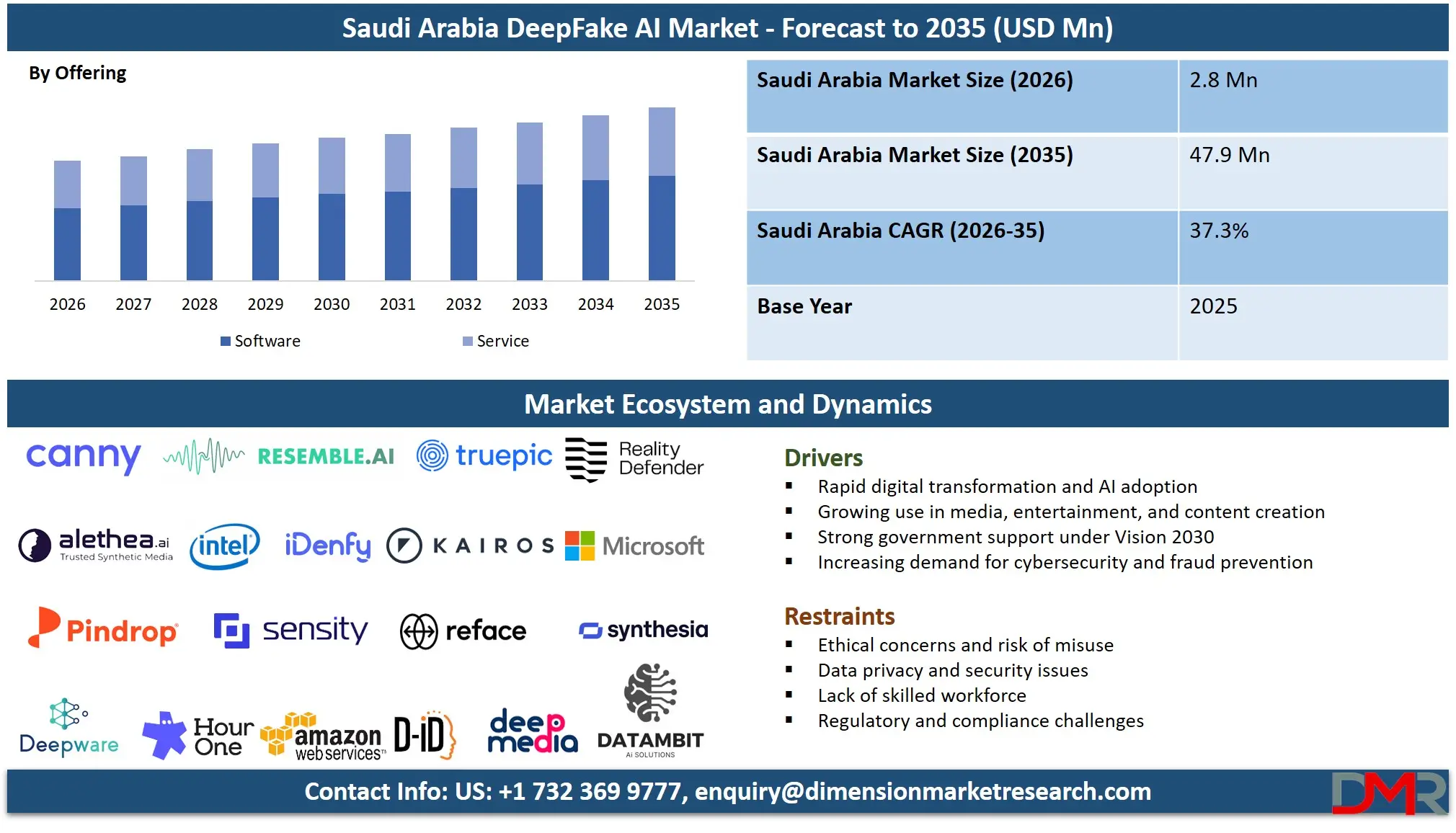
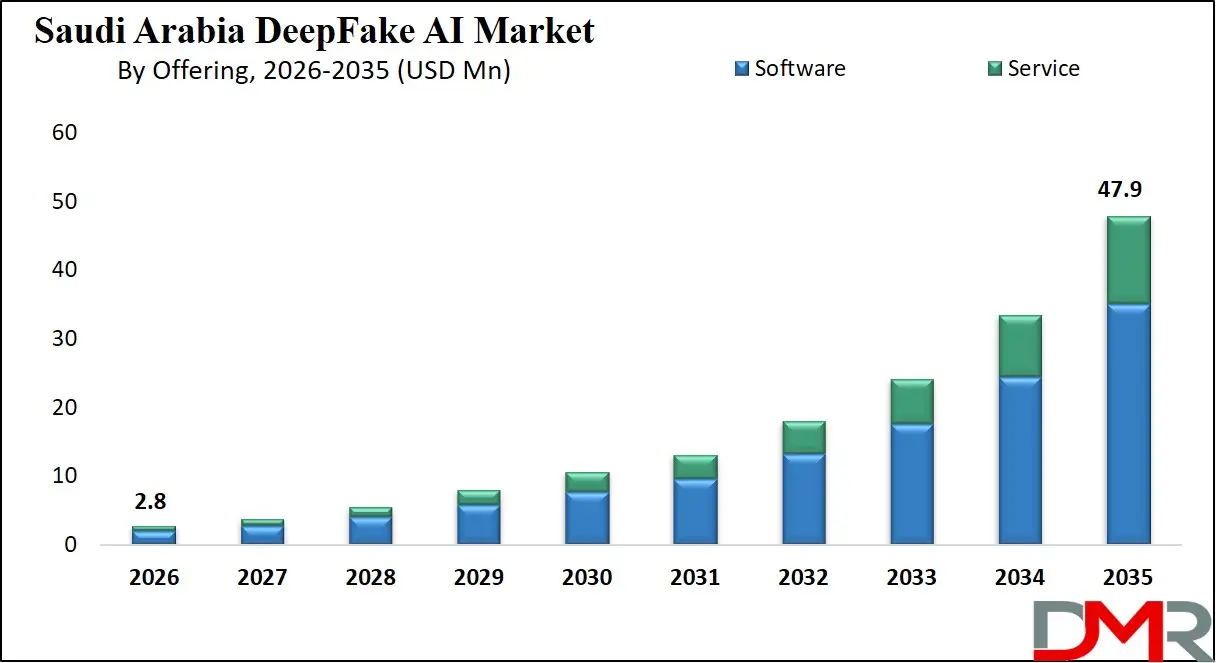
Saudi Arabia DeepFake AI market is expected to reach a value of USD 2.8 million in 2026, and it is further anticipated to reach USD 47.9 million by 2035, growing at a CAGR of 37.3% during the forecast period. The Saudi Arabia DeepFake AI market has been revealed to be an important part of Saudi Arabia's extensive digital transformation and cybersecurity market infrastructure.
ℹ
To learn more about this report –
Download Your Free Sample Report Here
This dramatic rise in instances of fraud has prompted a prompt response from Saudi Arabia's official authorities, namely, the Saudi Data & Artificial Intelligence Authority (SDAIA) and the National Cybersecurity Authority (NCA). Apart from being influenced by commercial competition among vendors, the market will also witness heavy involvement from sovereign investments and strict AI ethics compliance rules.
The Saudi Arabia DeepFake AI market consists of government regulatory agencies, telecom service providers embedding deepfake detection features in national infrastructure, banking and financial institutions protecting their onboarding processes, and other international as well as local technology companies aligned with the Vision 2030 strategy.
ℹ
To learn more about this report –
Download Your Free Sample Report Here
Key Takeaways
- Market Size & Forecast: Saudi Arabia DeepFake AI market is projected to reach USD 2.8 million by 2026 and expand dramatically to USD 47.9 million by 2035, due to the increase in deepfake incidents in the region, compelling both public and private sectors to urgently adopt advanced detection and authentication solutions.
- Growth Rate & Outlook: The market is forecasted to grow at a CAGR of 37.3% from 2026 to 2035. This strong forecast is attributable to the growing threat of cyber fraud in the BFSI industry, the weaponizing of deepfakes for disinformation campaigns, and the urgent necessity to safeguard the security of biometrics-based ID verification systems employed in business and governmental digital services.
- Primary Growth Drivers: Growth is fueled by the fast dissemination of AI-powered disinformation on social media sites, increased regulatory scrutiny of disinformation by agencies like SDAIA and GAMA, and the rising need for the authentication of video and audio content in court proceedings in Saudi Arabia.
- Key Market Trends: The key trends shaping the market include the integration of real-time detectors of deepfakes in video conferences and live streaming applications, leveraging blockchain technology for immutable media provenance and content authentication, developing forensic software suitable for courtroom presentation, and implementing managed detection and response (MDR) solutions for deepfake attacks.
- By Offering Type Analysis: The Software segment is estimated to dominate the market in this segment. This is mainly attributed to the increasing demand for automated and scalable systems that can analyze large amounts of media content for news agencies, monitoring social media platforms by government agencies, and KYC processes within banks to automate their fraud prevention system.
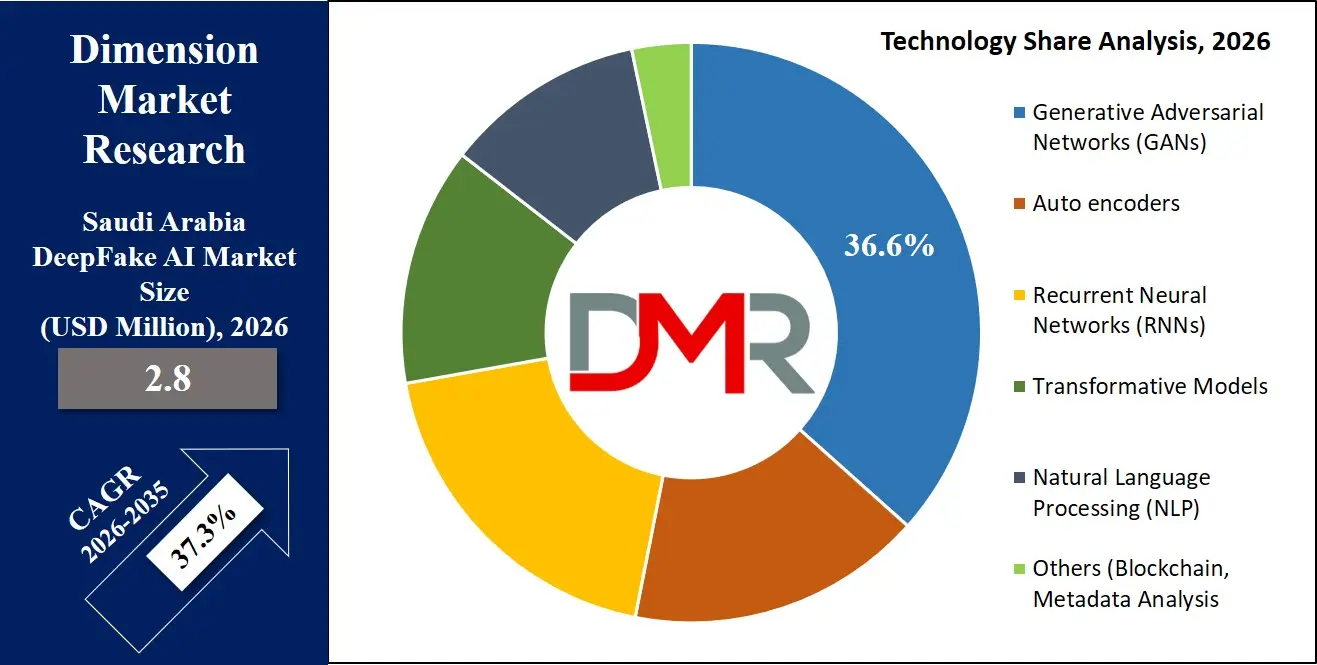
- By Technology Analysis: Generative Adversarial Networks (GANs) are poised to dominate this market as it acts as a key technologies involved in the development of deepfake technologies and in detecting these deepfakes are generative adversarial networks (GANs). Besides, there is an increased use of natural language processing (NLP) and forensic audio technologies to detect the use of synthetic voice cloning in vishing and corporate scams.
- By End User Analysis: Despite BFSI having the largest end user share owing to the high incidence of wire fraud and identity theft cases, the Media & Entertainment industry is not far behind. This industry is characterized by the need to verify celebrities' endorsement and fake news clips that could create reputation problems and cause misdirection.
What is the DeepFake AI?
Deepfake AI is the implementation of sophisticated algorithms of artificial intelligence and deep learning methods, including GANs and Autoencoders, which facilitate the creation of videos, audio recordings, and images that possess extremely realistic features, despite being computer-generated. Deepfake AI functions by training neural networks using enormous databases of authentic human faces and voices, allowing for the substitution of people's identities and the construction of completely fabricated speech and actions.
Although there exist valid purposes for employing this technology in the movie industry, localization services, and the arts, the technology has been widely utilized for nefarious activities such as producing nonconsensual pornography, conducting fraudulent transactions involving financial gain via impersonation, and disseminating political misinformation.
Use Cases
- National Digital Identity Protection (Nafath/Absher): The Absher portal for unified access to services in Saudi Arabia and the Nafath verification tool employ advanced facial biometric technology. Financial organizations and government agencies are adopting cutting-edge liveness and deepfake detection solutions to thwart the threat of artificial identity creation while originating an account and performing important transactions.
- Financial Sector Fraud Mitigation: As part of their compliance with SAMA's mandate to provide cybersecurity and anti-fraud protection within the financial sector, Saudi banks are adopting voice analysis technologies at their contact centers to detect AI-powered voice impersonators who use "vishing" scams to steal money from victims via fake wire transfers.
- Media Integrity and Public Information Defense: The Saudi Ministry of Media and the Government Communication Center use detection and provenance systems to monitor social media platforms for AI-created misinformation. It applies to the need to protect the image of megaprojects and ensure accuracy when reporting on Hajj and Umrah pilgrimages.
- Legal and Forensic Admissibility: The Saudi Public Prosecution and special criminal courts are now facing cases of digital evidence contested through allegations of deepfake tampering. Expert witnesses are compelled to make use of high-level spectral analysis and AI detection programs to authenticate such evidence submitted as proof in fraud, blackmail, and defamation cases.
Market Dynamics
Key Drivers of the Saudi Arabia DeepFake AI Market
Sovereign Mandate and SDAIA Regulatory Enforcement
In fact, the Saudi Data and Artificial Intelligence Authority (SDAIA) has managed to establish a market for detection solutions where no negotiation is possible. Indeed, the introduction of such things as the AI Ethics Principles, along with specific guidance on the use of deepfakes, is a clear indication of what happens to those who do not take steps to protect themselves from these types of threats. All government agencies, as well as semi-government agencies and the private companies working for them, have to act accordingly.
Vision 2030 and the Trust Imperative
In this case, the implementation of Saudi Vision 2030 will greatly rely on foreign investments, tourism, and the flawless performance of smart cities such as NEOM. It is crucial to note that trust in digital interactions is essential for success. Notably, instances of deepfake manipulation where speeches or business messages have been created to appear authentic may cause reputational harm, negatively affecting the country's image as an investment destination. Consequently, investing in technologies that combat deepfake threats has been deemed necessary for national branding.
Restraints in the Saudi Arabia DeepFake AI Market
Data Sovereignty and On-Premise Deployment Requirements
The entry into the market of international providers offering deepfake detection services is subject to certain obstacles due to the highly restrictive data sovereignty regulations existing in Saudi Arabia and PDPL. Deepfake detection systems may utilize sensitive biometric information and video feeds from users. In order to be deployed within the kingdom, such applications should be deployable within its geographic boundaries, either locally in data centers owned by firms or in the local cloud zones of certified service providers.
Adversarial AI and the Arabic Language Gap
Most deepfake detection tools in the commercial market train their AI models using a vast majority of data from English and East Asian languages. Such a gap in the efficacy of deepfake detection technology arises when applying it to Arabic materials. For instance, some phonetical traits of Gulf Arabic and unique visual cues within the Gulf region may be ignored by globally developed models, thereby producing more false negatives. Moreover, as generative AI models develop further, the telltale marks that deepfake detection software can detect will continue to be increasingly hard to detect.
Growth Opportunities in the Saudi Arabia DeepFake AI Market
Strategic Investment in Localized AI Defense Champions
Saudi Arabia's sovereign funds, including the Public Investment Fund (PIF) and corporate venture arms like Wa'ed Ventures, are actively seeking to invest in and incubate local deepfake detection and cybersecurity startups. There is a clear opportunity for joint ventures between international technology leaders and Saudi-based entities to develop detection models specifically optimized for the Arabic language and the regional threat landscape. This "onshoring" of defense technology aligns with Vision 2030 goals of increasing local content and creating high-value technical jobs.
Integration with the National Enterprise Architecture
The launch of deepfake detection is not occurring in a vacuum but rather as part of the larger stack of digitization efforts within the country. There are many opportunities for providers to incorporate their APIs and SDKs as part of the SOP of big companies such as Absher, the national health app known as Tawakkalna, and the banking interoperability initiatives spearheaded by Saudi Payments. This creates a huge level of scale and vendor lock-in potential.
Trends in the Saudi Arabia DeepFake AI Market
Regulatory-Driven Compliance as a Service
The SDAIA guidelines encourage the adoption of a continual compliance approach. There is an industry trend that can be identified in the managed detection and response services to synthetic media. Banks and government agencies in Saudi Arabia are not merely purchasing software but are acquiring "authenticity assurance" services, which are a combination of technical solutions and human experts' reviews to ensure compliance with the SDAIA guidelines.
Integration with NEOM and Cognitive City Infrastructure
The flagship mega-project is NEOM, which is planned to be a cognitive city where data is the basis of all interactions. In this framework, confidence in visual and audio data streams of innumerable sensors and drones is essential. Deepfake detection is under consideration as a fundamental security and data governance architecture of NEOM. This includes verifying drone surveillance feeds and authenticating holographic communications. This is a greenfield of creating detection protocols as if they were being created new and not as an addition to older systems.
Research Scope and Analysis
By Offering
Software is poised to lead the Saudi market in this segment with the highest market share. This consists of real-time detection engines that run on video conferencing streams and API-based solutions that search uploaded files to verify an identity. The software dominance is influenced by the necessity of automation of high-volume government service portals and banking apps, in which the manual review is not possible. Professional and Managed Services will however grow at a fast rate. Saudi institutions need specialized help in setting up detection tools to detect local network settings, deciphering forensic reports and educating internal teams about new trends of deepfake developers. There is a demand in consultancy services based on alignment with SDAIA compliance.
By Technology
Generative Adversarial Networks form the base technologies that the industry functions on, yet their application is strictly binary, as far as creation and defense are concerned. Defense is such a market thus is centred around the sophisticated Deep Neural Networks that have been trained to recognize the minute physiological and statistical fingerprints left behind by these generative models.
ℹ
To learn more about this report –
Download Your Free Sample Report Here
The NLP that is specific to the Arabic language is an important distinguishing factor in the Saudi market. Any solution capable of identifying audio deepfakes in different Gulf dialects and recognizing AI-created text propaganda will be in high demand. Moreover, Cryptographic Provenance and Blockchain technologies are gaining some traction as an additional layer, offering an unalterable audit trail on media files utilized in official and legal purposes.
By End User
The Banking, Financial Services, and Insurance (BFSI) sector is poised to dominate this segment deepfake AI market in Saudi Arabia. This is motivated by direct regulatory pressure on loss prevention in fraud and the necessity to protect the fast-growing open banking ecosystem by SAMA. The quickest growing industry is the Government and Public Sector. This comprises of the Ministry of Interior (cybercrime investigation), the Ministry of Defense (counter-disinformation) and the Ministry of Media (content verification). Telecommunications industry is a major player and organizations such as stc are users as well as possible resellers of detection technology. Media and Entertainment industry, which is driven by investment in film creation and game playing, is a new user of both creation (to create special effects) and detection (to protect copyrights and brands) solutions.
Saudi Arabia DeepFake AI Market Report is segmented based on the following:
By Offering
- Software
- DeepFake Detection Algorithms
- Media Authentication Tools
- Forensic Analysis Software
- Service
- Professional Services
- Managed Services
By Technology
- Generative Adversarial Networks (GANs)
- Autoencoders
- Recurrent Neural Networks (RNNs)
- Transformative Models
- Natural Language Processing (NLP)
- Others (Blockchain, Metadata Analysis)
By End User
- BFSI
- Customer Verification & Authentication
- Anti-Money Laundering & Fraud Detection
- Telecom
- Call Center Security
- Fraud Detection
- Government
- Election Campaigns
- National Security
- Government Communications
- Content Verification & Moderation
- Ethical Hacking & Digital Security
- Enforcement Agencies
- Healthcare
- Medical Training & Simulation
- Patient Case Simulations
- Telemedicine & Virtual Healthcare
- Legal
- Digital Evidence Authentication
- Intellectual Property Protection
- Legal & Ethical Consultation
- Media & Entertainment
- CGI Character Creation
- De-aging Actors
- Special Effects & Visual Enhancements
- Digital Content Creation
- Celebrity & Influencer Marketing
- News Agencies
- Social Media
- Retail & E-commerce
- Customer Service & Personalization
- Visual Merchandising
- Security & Fraud Prevention
- Others
Competitive Landscape
The Saudi Arabia market of deepfakes AI is rather medium in terms of competition with both global and regional technological giants and newcomers. Synthesia, D-ID, Sensity AI, Hour One and Truepic are the international corporations that dominate the market with the sophisticated AI functions, significant investments in research and development, and a wide range of offers in the areas of media, security, and enterprise solutions.
ℹ
To learn more about this report –
Download Your Free Sample Report Here
Simultaneously, cybersecurity and deep fake detection companies become more significant as the issues of misinformation, fraud, and protection of digital identities start to become more prominent. The market is slowly being filled with local startups with the help of government programs such as Vision 2030, with their emphasis on partnerships and niche innovations. In general, competition is growing with more focus on compliance, accuracy, and ethical AI usage.
Some of the prominent players in the DeepFake AI Market are:
- Synthesia
- Reface
- D-ID
- Sensity AI
- Hour One
- Canny AI
- Alethea AI
- Pindrop
- Datambit
- Deepware
- Truepic
- DeepMedia
- Resemble AI
- Amazon.com Inc.
- Alphabet Inc.
- Microsoft Corporation
- Intel Corporation
- Kairos AR
- Reality Defender
- IDenfy
- Other Key Players
Recent Developments
- March 2026: Wa'ed Ventures, the venture branch of Saudi Aramco invested in Resemble AI to enhance deepfake detection and voice synthesis technologies. The investment will help in advancing digital trust, cyber resilience, and fraud prevention in Saudi Arabia and the Middle East region at large.
- February 2025: LEAP Tech Conference 2025 (Riyadh) featured improvements in generative AI and synthetic media, such as deepfake technologies. The event brought together international technology leaders and investors, leading to major funding announcements and collaborations that catalyzed the use and adoption of artificial intelligence and innovation in the fast-paced digital ecosystem in Saudi Arabia.
- February 2025: DeepFest 2025, held alongside LEAP, focused on artificial intelligence applications in media, cybersecurity, and creative industries. It included talks on deepfake creation and detection, with the involvement of international AI firms and supporting the image of Saudi Arabia as an emerging center of high-end AI-based technologies.
Report Details
| Report Characteristics |
| Market Size (2026) |
USD 2.8 Mn |
| Forecast Value (2035) |
USD 47.9 Mn |
| CAGR (2026–2035) |
37.3% |
| Historical Period |
2021 – 2025 |
| Forecast Period |
2027 – 2035 |
| Base Year |
2025 |
| Estimate Year |
2026 |
| Segments Covered |
By Offering (Software and Service), By Technology (Generative Adversarial Networks (GANs), Auto encoders, Recurrent Neural Networks (RNNs), Transformative Models, Natural Language Processing (NLP), and Others (Blockchain, Metadata Analysis)), By End User (BFSI, Telecom, Government, Healthcare, Legal, Media & Entertainment, Retail & E-commerce, and Others) |
| Country Coverage |
Saudi Arabia |
Frequently Asked Questions
How big is Saudi Arabia DeepFake AI Market?
▾ The Saudi Arabia DeepFake AI market is poised to be valued at USD 2.8 million in 2026 and is projected to reach USD 47.9 million by 2035, reflecting sustained and exponential expansion driven by escalating synthetic media threats and corporate fraud concerns within the Kingdom's rapidly digitizing economy.
What is the CAGR of Saudi Arabia DeepFake AI Market from 2026 to 2035?
▾ The Saudi Arabia DeepFake AI market is expected to grow at a CAGR of 37.3% from 2026 to 2035, indicating robust long-term growth fueled by accelerating adoption of detection software and authentication tools across Saudi enterprises, government ministries, and financial institutions implementing Vision 2030 digital mandates.
What factors are driving the growth of Saudi Arabia DeepFake AI Market?
▾ Escalating deepfake-enabled financial fraud targeting Saudi banks and fintech platforms, national security and public trust imperatives identified by the Saudi Data and AI Authority and the National Cybersecurity Authority, proliferation of AI-generated disinformation on major social platforms popular in this region.
What are the major trends in Saudi Arabia DeepFake AI Market?
▾ Adoption of content authenticity initiative standards within Saudi media organizations, integration of real-time audio deepfake detection in corporate call center security for Saudi telecom providers, legislative activity addressing non-consensual deepfakes under Saudi cybercrime and anti-harassment laws, and emergence of specialized managed detection services for government entities.
Who are the key players in Saudi Arabia DeepFake AI Market?
▾ Global leaders such as Microsoft and Google alongside regional cybersecurity integrators, SITE (Saudi Information Technology Company), specialized local forensic software vendors, and managed security service providers licensed by the National Cybersecurity Authority are prominent participants in the Saudi Arabia DeepFake AI market ecosystem.
How is Saudi Arabia DeepFake AI Market segmented?
▾ This market is segmented by offering (software and services), technology (GANs, autoencoders, RNNs, transformative models, NLP, and blockchain), and end user (BFSI, telecom, government, healthcare, legal, media and entertainment, and retail and e-commerce).