Saudi Arabia Enterprise Resource Planning (ERP) Software Market Snapshot
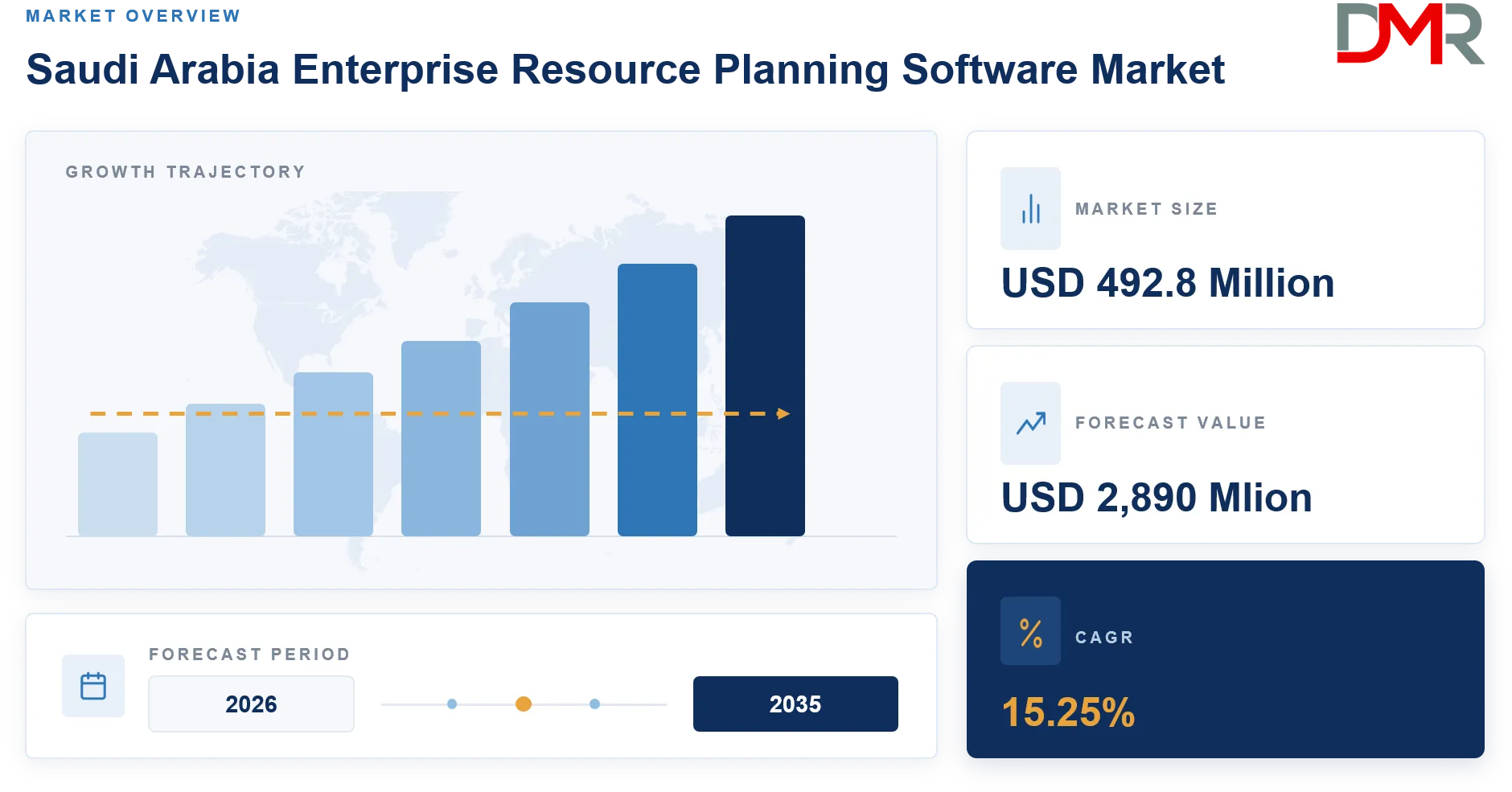
- Market Value: The Saudi Arabia enterprise resource planning software market size is valued at USD 492.8 million in 2026 and is projected to reach USD 1,771.6 million by 2035.
- CAGR: The market is expected to expand at a CAGR of 15.25% from 2026 to 2035.
- By Function Segment Analysis: Finance led the function segment with a 34.6% share in 2026.
- By Deployment Segment Analysis: Cloud led the deployment segment with a 61.8% share in 2026.
- By Enterprise Size Segment Analysis: Large enterprises accounted for 48.7% of the market in 2026.
- Major Players: SAP SE, Oracle, Microsoft, IFS AB, and Focus Softnet Pvt Ltd.
What is the Saudi Arabia Enterprise Resource Planning Software Market and its Market Size?
The Saudi Arabia Enterprise Resource Planning (ERP) Software Market size is projected to be valued at USD 492.8 million in 2026 and is forecast to reach USD 1,771.6 million by 2035, expanding at a CAGR of 15.25% during the forecast period. ERP software connects finance, procurement, human resources, supply chain, inventory, projects, sales, and operational data within a common enterprise platform. Demand in Saudi Arabia is becoming closely linked with cloud migration, digital government programs, large-scale construction, manufacturing expansion, financial modernization, and the need for auditable financial processes. The Kingdom's Cloud First policy is intended to accelerate cloud adoption across government entities, strengthening the operating environment for cloud-based enterprise applications.
ℹ
To learn more about this report –
Download Your Free Sample Report Here
The market is also shaped by regulatory and operational requirements that make integrated business systems increasingly important. ZATCA's electronic invoicing framework requires invoices and related documents to be created and processed in structured electronic formats through compliant electronic solutions. This increases the value of ERP platforms that can connect accounting, invoicing, tax data, customer records, and transaction workflows without relying on disconnected systems.
Use Cases
- Financial Management: Saudi enterprises use ERP platforms to combine general ledger, accounts payable, receivables, budgeting, consolidation, tax workflows, and management reporting. Integrated finance systems help large groups control multiple entities while creating a consistent financial data structure for audits and executive reporting.
- Supply Chain Management: Manufacturing, retail, construction, and distribution companies apply ERP software to procurement, inventory planning, supplier management, warehousing, order processing, and logistics. Real-time information helps managers coordinate purchasing decisions with production schedules and customer demand.
- Human Resource Management: ERP-based HR modules centralize employee records, payroll, workforce planning, attendance, recruitment, benefits, and performance processes. They are particularly relevant to organizations operating large or distributed workforces that need consistent policies and consolidated workforce information.
- Project and Asset Management: Construction, infrastructure, real estate, aerospace, utilities, and industrial organizations use ERP systems to monitor project budgets, contractors, materials, equipment, assets, milestones, and operating costs. This creates clearer links between project execution and corporate financial performance.
- Compliance and E-Invoicing: ERP platforms can support structured invoicing and transaction workflows required by Saudi tax administration. ZATCA identifies e-invoicing as an integrated electronic process for exchanging and processing invoices, credit notes, and debit notes, increasing demand for connected financial systems.
How AI/Gen AI is Transforming the Saudi Arabia Enterprise Resource Planning Software Market?
AI-enabled ERP is changing how Saudi organizations interact with operational and financial data. Instead of relying only on fixed dashboards, enterprise applications are adding predictive functions for cash forecasting, inventory planning, procurement, anomaly detection, workforce analysis, and maintenance. Generative interfaces can also allow managers to retrieve information through natural-language questions, summarize business performance, prepare draft reports, and identify unusual transactions. The value is highest when these functions operate on governed ERP data because finance, procurement, HR, and supply-chain records already contain the structured information required for business analysis.
Saudi Arabia's wider investment in cloud and intelligent digital infrastructure supports this shift. SAP has expanded locally available cloud technology in the Kingdom, including SAP Business Technology Platform availability on Google Cloud for regulated customers, while Oracle has continued investment in Saudi cloud infrastructure. For ERP buyers, the key issue is moving from isolated automation toward embedded intelligence that works inside approval, planning, accounting, purchasing, and service workflows. This trend is likely to increase demand for modern ERP architectures with secure APIs, governed enterprise data, local hosting options, Arabic-language capabilities, and integration with analytics platforms.
Key Drivers in the Saudi Arabia Enterprise Resource Planning Software Market
Cloud-Led Enterprise Modernization
Cloud modernization is one of the strongest growth drivers for the Saudi Arabia ERP software market. Cloud represented 61.8% of the market in 2026 as organizations sought scalable applications without maintaining extensive on-site infrastructure. Subscription models also allow businesses to add modules and users as operations expand. Saudi Arabia's Cloud First policy and government cloud adoption programs reinforce this direction by encouraging cloud use, improving institutional familiarity with hosted applications, and supporting a larger domestic ecosystem of cloud providers and implementation partners.
Financial Digitization and Regulatory Integration
Finance functions are becoming central to ERP investment because Saudi businesses need stronger control over accounting, tax, invoicing, budgeting, consolidation, and audit workflows. Finance accounted for 34.6% of the market in 2026. ZATCA's e-invoicing program has increased the importance of systems capable of handling structured invoice data and connecting transaction records with accounting processes. This encourages enterprises to replace fragmented accounting environments with integrated platforms that can improve traceability, reporting consistency, and financial governance across operating units.
Restraints in the Saudi Arabia Enterprise Resource Planning Software Market
Implementation Complexity and Integration Risk
ERP transformation can involve substantial process redesign, data migration, customization, testing, employee training, and integration with legacy platforms. These requirements are especially demanding for large Saudi enterprises operating multiple subsidiaries, business units, sites, or industry-specific systems. Poor data quality or unclear process ownership can extend implementation schedules and reduce expected returns. Businesses must also connect ERP platforms with banking, tax, payroll, customer, procurement, manufacturing, and industry applications, making implementation capability a major factor in software selection.
Data Governance and Localization Requirements
Organizations in regulated sectors must evaluate hosting, access control, cybersecurity, business continuity, privacy, and data residency before moving sensitive ERP workloads to the cloud. These requirements can slow procurement and increase the need for local infrastructure, approved configurations, and specialized implementation expertise. Saudi cloud policy and government guidelines provide clearer adoption frameworks, yet enterprises still need detailed governance models for financial, employee, customer, and operational data. Vendors that can demonstrate local compliance and secure cloud delivery are therefore better positioned.
Growth Opportunities in the Saudi Arabia Enterprise Resource Planning Software Market
Industry-Specific Cloud ERP
A major opportunity lies in ERP products designed around Saudi industry workflows rather than generic enterprise processes. Construction firms require project controls and subcontractor management, manufacturers need planning and plant integration, healthcare organizations require procurement and workforce coordination, while retailers need inventory and multi-channel order visibility. Cloud platforms allow vendors to package these industry functions into configurable offerings. This creates opportunities for SAP, Oracle, Microsoft, IFS, Odoo, Zoho, Focus Softnet, Frappe, Seidor, and local implementation specialists to address sector-specific modernization programs.
Mid-Market ERP Adoption
Large enterprises generated the highest share in 2026, but medium and smaller organizations represent an important expansion opportunity as cloud deployment lowers infrastructure requirements and reduces the need for large internal IT teams. Modular ERP suites can allow businesses to begin with finance, sales, inventory, or HR and add capabilities as their operations mature. Subscription pricing, standardized implementation templates, mobile access, Arabic localization, and integrated e-invoicing can make ERP platforms more practical for growing Saudi companies that have outgrown standalone accounting and spreadsheet-based processes.
Trends in the Saudi Arabia Enterprise Resource Planning Software Market
Shift Toward Composable and Integrated ERP
Saudi enterprises are increasingly evaluating ERP as part of a wider digital architecture rather than as a single isolated application. Modern platforms connect core financial and operational records with analytics, customer applications, procurement networks, project tools, data platforms, and external services through APIs. This favors ERP vendors with broad partner ecosystems and extensible platforms. The trend is particularly relevant for organizations that need to modernize selected functions while keeping specialized applications already embedded in their operations.
Growing Focus on Local Cloud Availability
Local cloud availability is becoming an important factor in enterprise software purchasing because it can support latency, resilience, governance, and data residency objectives. Technology vendors are expanding infrastructure and services in Saudi Arabia. SAP announced local availability of SAP BTP on Google Cloud for regulated customers, while Oracle has expanded its Saudi cloud infrastructure. These investments strengthen the technical foundation for cloud ERP, integration platforms, analytics, and intelligent enterprise applications used by government and private-sector organizations.
Research Scope and Analysis
The Saudi Arabia Enterprise Resource Planning Software Market is segmented based on Function, Deployment, Enterprise Size, Vertical, and relevant industry categories. The study provides an in-depth analysis of key segments and sub-segments, covering their applications, industry adoption, demand patterns, and contribution to overall market growth.
By Function
Finance dominated the function segment with a 34.6% market share in 2026. Its leadership reflects the central role of accounting data in enterprise planning and the growing need to connect budgeting, general ledger, receivables, payables, consolidation, tax, invoicing, and management reporting. Saudi organizations with multiple business units require common financial controls and faster visibility into cash flow, profitability, and expenditure. ZATCA's structured e-invoicing framework further raises the importance of connected financial systems. Finance modules also provide the foundation for analytics because procurement, payroll, project, inventory, and sales transactions ultimately flow into financial reporting.
By Deployment
Cloud deployment accounted for 61.8% of the Saudi Arabia ERP software market in 2026. The segment benefits from subscription pricing, faster provisioning, scalability, remote access, centralized updates, and lower dependence on customer-owned data-center infrastructure. Cloud-based delivery is particularly relevant to companies expanding locations, subsidiaries, users, or digital services because computing capacity can be adjusted without a full hardware refresh. Saudi government policy has also promoted cloud adoption as part of national digital transformation. On-premise deployment remains relevant for organizations with legacy environments, specialized integrations, or internal requirements that favor direct infrastructure control.
By Enterprise Size
Large enterprises represented 48.7% of market revenue in 2026. These organizations typically manage more complex structures, including multiple legal entities, extensive workforces, cross-functional supply chains, major capital projects, and large volumes of financial transactions. ERP systems help consolidate these activities into standardized workflows and a shared information model. Large companies are also more likely to invest in advanced analytics, planning, automation, industry modules, and system integration. Medium and small enterprises remain important growth targets as cloud ERP reduces infrastructure requirements and offers more modular deployment options.
By Vertical
Vertical demand spans healthcare, telecom, manufacturing, government, BFSI, construction and real estate, aerospace and defense, retail, and other sectors. Requirements vary significantly by industry. Construction businesses need project costing and procurement control, manufacturers emphasize production and inventory planning, banks require strong financial governance, retailers prioritize stock and order visibility, and government entities require secure enterprise platforms aligned with digital transformation programs. This diversity supports demand for both broad ERP suites and industry-specific platforms that can address sector workflows without extensive customization.
The Saudi Arabia Enterprise Resource Planning Software Market Report is segmented on the basis of the following:
By Function
- Supply Chain
- Human Resource (HR)
- Finance
- Others
By Deployment
By Enterprise Size
- Small Enterprises
- Large Enterprises
- Medium Enterprises
By Vertical
- Healthcare
- Telecom
- Manufacturing
- Government
- BFSI
- Construction & Real Estate
- Aerospace & Defense
- Retail
- Others
Competitive Landscape
The Saudi Arabia enterprise resource planning software market combines global enterprise software companies, regional implementation partners, mid-market ERP providers, open-source platforms, and locally focused technology firms. SAP SE, Oracle, and Microsoft compete strongly for complex enterprise transformations through broad application portfolios, cloud platforms, analytics, integration capabilities, and established partner networks. IFS has relevance in asset-intensive and project-oriented industries, while Odoo, Zoho, Frappe, Focus Softnet, and other providers address businesses seeking modularity, lower implementation complexity, or more flexible economics. Seidor and implementation specialists add consulting, localization, integration, and managed-service capabilities that can influence platform selection. Competitive advantage increasingly depends on Saudi localization, cloud availability, data governance, Arabic support, ZATCA-compatible financial processes, industry templates, implementation capacity, and the ability to connect ERP with analytics and intelligent automation. Vendor competition is therefore shifting from basic feature comparison toward measurable business outcomes, migration speed, ecosystem strength, regulatory readiness, and lifecycle support.
Some of the prominent players in the Saudi Arabia Enterprise Resource Planning Software Industry are:
- Tawatur IT
- SAP SE
- Focus Softnet Pvt Ltd
- Zoho Corporation Pvt. Ltd.
- IFS AB
- Odoo
- Seidor
- Oracle
- Frappe
- Microsoft
- Others
Regulatory Landscape
The regulatory landscape for the Saudi Arabia enterprise resource planning software market is increasingly shaped by digital tax compliance, data governance, cybersecurity, and cloud adoption requirements. ZATCA's e-invoicing framework has made structured electronic invoicing an important consideration for ERP finance modules, encouraging businesses to integrate invoicing, accounting, tax records, and transaction reporting within compliant systems. Saudi Arabia's Personal Data Protection Law also raises requirements around the collection, processing, storage, access, and transfer of personal information managed through HR, CRM, payroll, and finance modules. Cloud ERP adoption is further influenced by national cloud policies and cybersecurity controls, particularly for government entities and regulated industries. These requirements are increasing demand for ERP vendors that offer strong access controls, audit trails, data protection, local hosting options, Arabic capabilities, and configurable compliance workflows. As a result, regulatory readiness is becoming a significant software procurement criterion alongside functionality, scalability, implementation cost, and industry specialization.
Investment and White Space Analysis
The Saudi Arabia enterprise resource planning software market presents investment white space in localized cloud ERP, vertical-specific applications, mid-market deployment, integration services, and intelligent process automation. Cloud already represented 61.8% of the market in 2026, yet opportunities remain for providers that combine scalable SaaS delivery with Saudi tax workflows, Arabic interfaces, local implementation capacity, and industry-specific functionality. Medium and small enterprises form another addressable area as modular subscriptions reduce infrastructure and upfront implementation requirements. White space is particularly visible in construction and real estate, manufacturing, healthcare, retail, logistics, and project-intensive businesses where generic ERP configurations may not fully address operational workflows. Investors and software providers can also target migration, data integration, managed services, analytics, and ERP modernization around established platforms. Vendors able to combine local regulatory knowledge with rapid deployment and sector-specific templates can differentiate themselves from broad global suites while capturing demand generated by enterprise modernization and expanding digital operations.
Recent Developments
- February 2026: Microsoft advanced its Saudi data-center region and sovereign-cloud cooperation with PIF and SITE, strengthening local hosting options for regulated ERP workloads and supporting enterprise cloud adoption.
Report Details
| Report Characteristics |
| Market Size (2026) |
USD 492.8 Million |
| Forecast Value (2035) |
USD 1,771.6 Million |
| CAGR (2026–2035) |
15.25% |
| Historical Data |
2021 – 2025 |
| Forecast Data |
2027 – 2035 |
| Base Year |
2025 |
| Estimate Year |
2026 |
| Segments Covered |
By Function (Supply Chain, Human Resource {HR}, Finance, and Others), By Deployment (On-premise and Cloud), By Enterprise Size (Small Enterprises, Large Enterprises, and Medium Enterprises), and By Vertical (Healthcare, Telecom, Manufacturing, Government, BFSI, Construction & Real Estate, Aerospace & Defense, Retail, and Others) |
| Regional Coverage |
Saudi Arabia |
Frequently Asked Questions
What is the current size of the Saudi Arabia Enterprise Resource Planning Software Market?
▾ The Saudi Arabia Enterprise Resource Planning Software Market is valued at USD 492.8 million in 2026 and is forecast to reach USD 1,771.6 million by 2035.
What is the growth rate of the Saudi Arabia Enterprise Resource Planning Software Market?
▾ The Saudi Arabia Enterprise Resource Planning Software Market is expected to grow at a CAGR of 15.25% during the forecast period from 2026 to 2035.
What factors are driving the growth of the Saudi Arabia Enterprise Resource Planning Software Market?
▾ Cloud migration, financial digitization, e-invoicing compliance, enterprise automation, and Vision 2030 initiatives are driving Saudi Arabia Enterprise Resource Planning Software Market growth.
What are the major challenges restraining the Saudi Arabia Enterprise Resource Planning Software Market?
▾ Implementation costs, legacy system integration, data migration, cybersecurity requirements, and regulatory compliance restrain Saudi Arabia Enterprise Resource Planning Software Market growth.
Which segment holds the largest share of the Saudi Arabia Enterprise Resource Planning Software Market?
▾ Cloud deployment holds a 61.8% share of the Saudi Arabia Enterprise Resource Planning Software Market in 2026.
Who are the leading companies in the Saudi Arabia Enterprise Resource Planning Software Market?
▾ Tawatur IT, SAP SE, Focus Softnet Pvt Ltd, Zoho Corporation Pvt. Ltd., IFS AB, Odoo, Seidor, Oracle, Frappe, Microsoft, and others are prominent companies in the Saudi Arabia Enterprise Resource Planning Software Market.
How is AI influencing the Saudi Arabia Enterprise Resource Planning Software Market?
▾ AI is influencing the Saudi Arabia Enterprise Resource Planning Software Market through predictive planning, financial automation, anomaly detection, intelligent reporting, and workflow optimization.
What are the future opportunities and trends in the Saudi Arabia Enterprise Resource Planning Software Market?
▾ Cloud ERP, industry-specific platforms, mid-market adoption, intelligent automation, local hosting, and integrated analytics offer opportunities in the Saudi Arabia Enterprise Resource Planning Software Market.