What is the Saudi Arabia HR and Payroll Management Software Market Size in 2026?
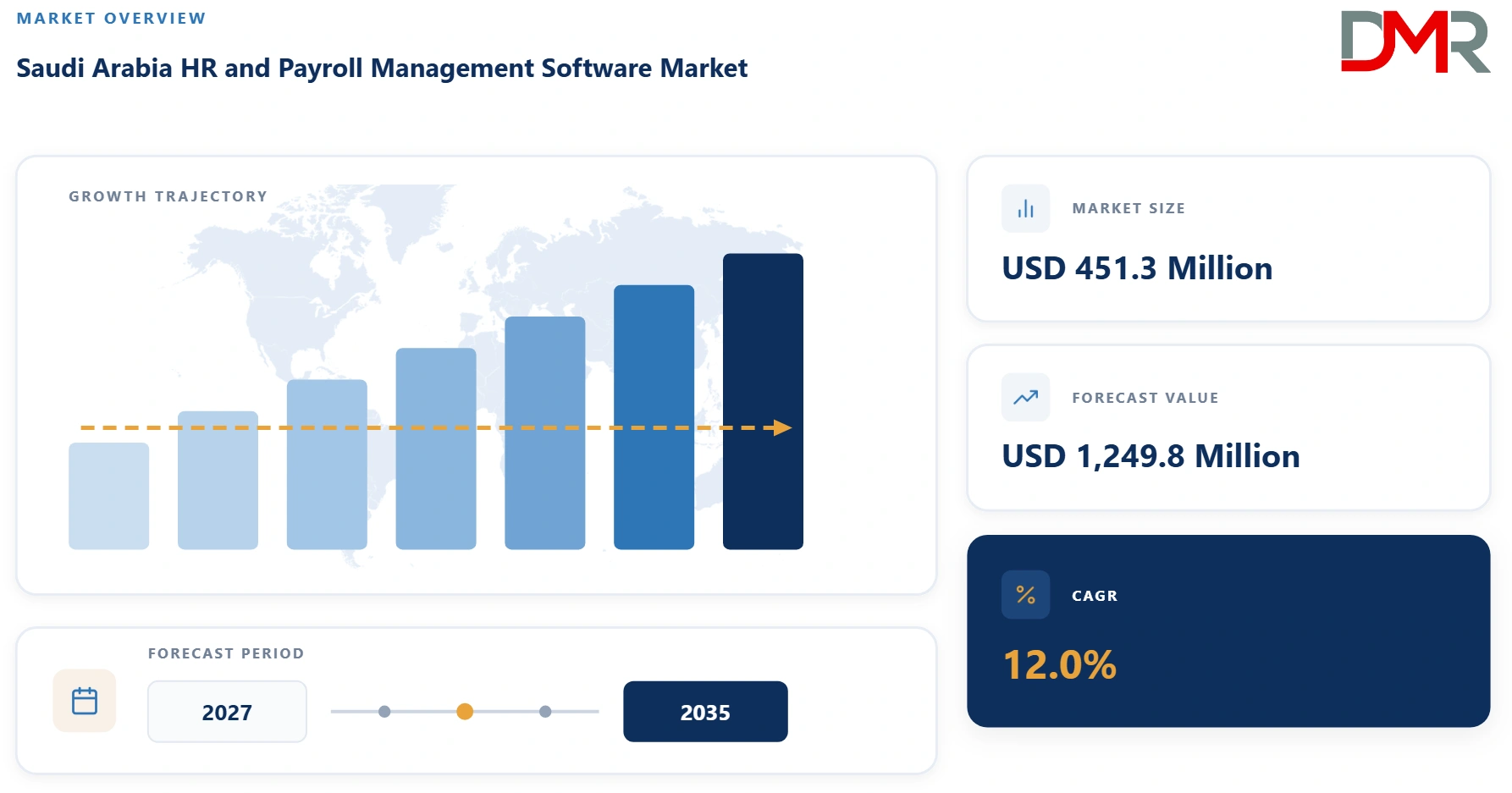
The Saudi Arabia HR and Payroll Management Software Market size is USD 451.3 Million in 2026, and it is further anticipated to reach a market value of USD 1,249.8 Million by 2035 at a CAGR of 12.0%. Growth is driven by increasing digitalization of human resource functions, growing demand for automated payroll processing, expanding compliance requirements related to Saudi labor regulations and social insurance, rising adoption of cloud-based HR platforms, and increasing workforce management needs across enterprises.
ℹ
To learn more about this report –
Download Your Free Sample Report Here
HR and payroll management software helps organizations manage employee information, attendance, leave, recruitment, performance, benefits, payroll calculations, and compliance-related activities through a centralized digital platform. These solutions reduce manual administrative work, improve payroll accuracy, and provide HR teams with better visibility into workforce costs and productivity.
The market includes standalone HR software, standalone payroll software, and integrated HR and payroll platforms. It also covers software subscriptions, licenses, implementation and integration services, training, upgrades, and ongoing support services. Organizations across Saudi Arabia are increasingly adopting these solutions to manage growing workforces, improve operational efficiency, and meet local labor and payroll requirements.
Saudi Arabia HR and Payroll Management Software Market Snapshot
Saudi Arabia HR and Payroll Management Software Market Snapshot, 2027-2035
| Metric |
Value |
| Market Size (2026) |
USD 451.3 Million |
| Forecast Value (2035) |
USD 1,249.8 Million |
| CAGR (2027-2035) |
12.0% |
| Leading Component (2026) |
Software, 68.8% share |
| Leading Deployment (2026) |
Cloud, 64.2% share |
| Leading Organization Size (2026) |
SMEs, 51.9% share |
| Leading End-Use Industry (2026) |
Government, 32.7% share |
| Key Players |
Jisr, Bayzat, Palm HR, ZenHR, Menaitech, Zimyo, Zoho Corporation, SAP SE |
Saudi Arabia HR and Payroll Management Software Market: Key Takeaways
- Market Growth: The market is projected to grow from USD 451.3 million in 2026 to USD 1,249.8 million by 2035, at a CAGR of 12.0%.
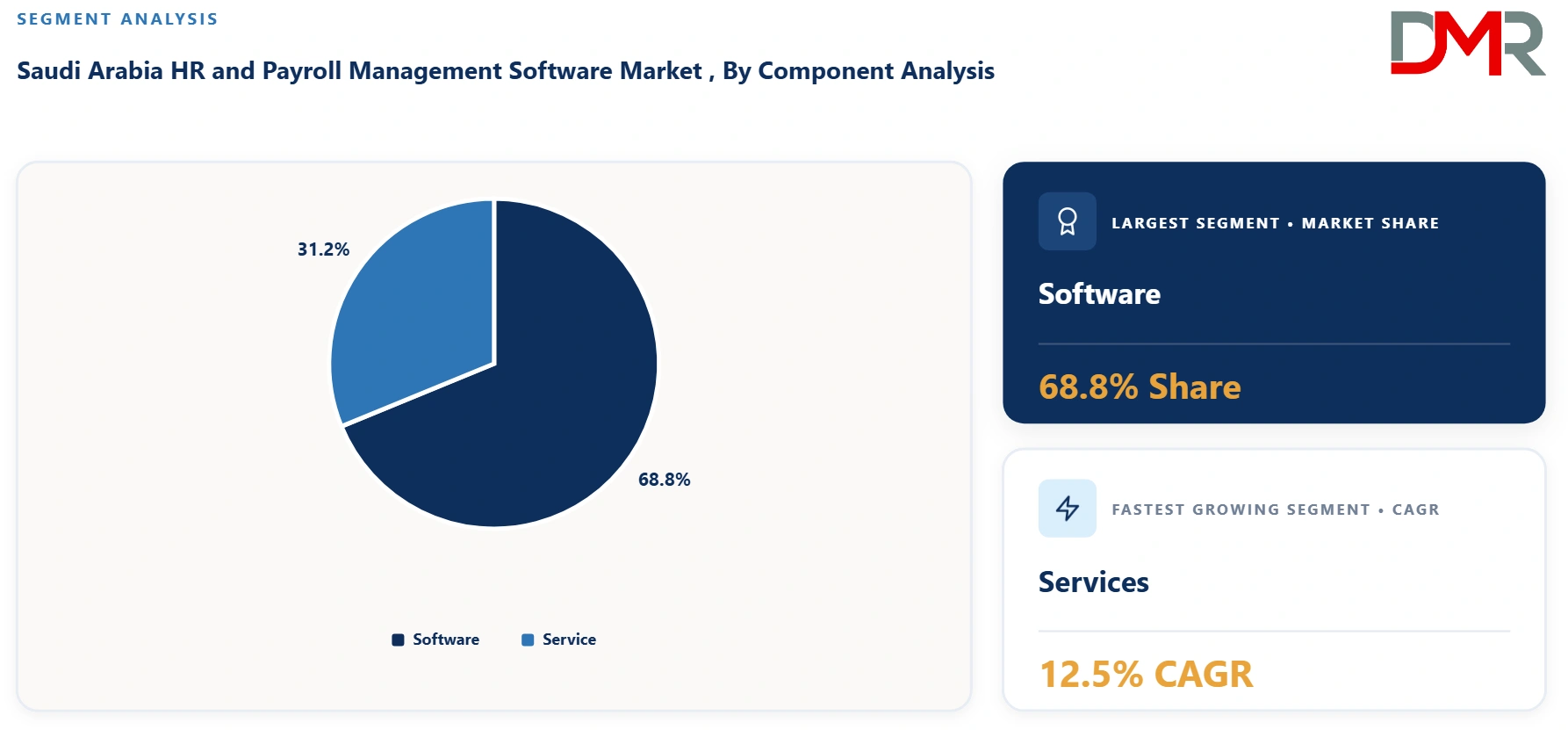
- Component Leader: Software holds a 68.8% market share in 2026, supported by increasing demand for integrated HR management, payroll automation, and regulatory compliance solutions.
- Fastest-Growing Component: Services are expected to grow at a CAGR of 12.5% through 2035, driven by increasing demand for software implementation, customization, integration, and technical support services.
- Deployment Leader: On-premises accounts for 64.2% of market revenue in 2026, supported by increasing demand for scalability, cost efficiency, remote accessibility, and seamless software integration.
- Fastest-Growing Deployment: Cloud is projected to grow at a CAGR of 12.6%, driven by increasing enterprise digitalization, flexible subscription models, remote accessibility, and scalable workforce management solutions.
- Organization Size Leader: SMEs account for 51.9% of market revenue in 2026, supported by their expanding presence and increasing adoption of automated HR and payroll management solutions.
- Fastest-Growing Organization Size: SMEs are expected to grow at a CAGR of 13.4%, supported by government initiatives promoting SME development, affordable software subscriptions, and increasing workforce management requirements.
What are the Key Use Cases of Saudi Arabia HR and Payroll Management Software Market?
- Employee Records and Core HR Administration: Helps organizations maintain employee profiles, employment contracts, organizational structures, job details, and personnel records in one centralized system.
- Payroll Processing and Compensation Management: Automates salary calculations, allowances, deductions, overtime, bonuses, end-of-service benefits, payslips, and payroll approval workflows.
- Statutory Compliance and Reporting: Supports organizations in meeting labor regulations, social insurance requirements, wage protection requirements, and other workforce-related reporting obligations.
- Time, Attendance, and Leave Management: Tracks employee working hours, shifts, attendance, overtime, leave balances, and absences, helping ensure accurate payroll processing.
How are Foundation Models and Generative AI Transforming the Saudi Arabia HR and Payroll Management Software Market?
Foundation models and generative AI are changing the way organizations manage HR and payroll functions in Saudi Arabia. These technologies can help HR teams analyze workforce trends, identify unusual payroll entries, forecast staffing needs, and improve decisions related to compensation, productivity, and talent management.
Generative AI can also assist HR professionals by drafting employee communications, answering routine employee queries, summarizing workforce reports, and supporting compliance documentation. Software providers are increasingly exploring AI capabilities that understand HR policies, payroll rules, and local labor requirements. While AI can improve efficiency and reduce repetitive work, organizations must ensure that payroll calculations remain accurate and employee data remains secure. Human oversight, strong data privacy controls, and reliable system validation will remain important as AI-enabled HR and payroll platforms become more widely adopted.
Saudi Arabia HR and Payroll Management Software Market Dynamics at a Glance
Drivers, Restraints, Opportunities and Trends in the Saudi Arabia HR and Payroll Management Software Market
| Type |
Factor |
Impact |
| Driver |
Increasing Digitalization of HR and Payroll Functions |
High |
| Driver |
Growing Demand for Automated and Compliant Payroll Processing |
High |
| Restraint |
High Implementation and Legacy System Migration Costs |
Medium |
| Restraint |
Data Security and Employee Privacy Concerns |
High |
| Opportunity |
Development of Arabic-Language and Industry-Specific HR Solutions |
High |
| Opportunity |
Growing Demand for HR Analytics and Workforce Planning |
Medium |
| Trend |
Increasing Integration of Artificial Intelligence in HR and Payroll |
Medium |
| Trend |
Adoption of Employee Self-Service and Mobile HR Applications |
High |
What is Driving the Growth of the Saudi Arabia HR and Payroll Management Software Market?
Increasing Digitalization of HR and Payroll Functions
Saudi organizations are rapidly replacing manual HR and payroll processes with digital platforms that centralize employee records, attendance, leave, benefits, and salary processing. Digitalization reduces administrative workload, minimizes calculation errors, and improves visibility across HR operations. Government digital-transformation initiatives, Vision 2030 goals, and rising expectations for real-time workforce information are encouraging businesses to modernize. Cloud-based systems also enable HR teams to manage dispersed workforces efficiently. As companies scale, integrated HR and payroll software becomes essential for maintaining accuracy, auditability, and timely salary disbursement.
Growing Demand for Automated and Compliant Payroll Processing
Saudi employers face complex payroll requirements, including GOSI contributions, Wage Protection System compliance, end-of-service benefits, overtime, allowances, deductions, and Saudization-related reporting. Automated payroll software reduces manual errors, ensures timely payments, and maintains audit-ready records. It also helps organizations respond quickly to regulatory updates and employee changes. Businesses increasingly prefer systems that can validate payroll data, generate statutory reports, and integrate with banking and government platforms. Automated processing is particularly valuable for SMEs and enterprises managing large, diverse workforces.
What are the Key Restraints in the Saudi Arabia HR and Payroll Management Software Market?
High Implementation and Legacy System Migration Costs
Although cloud HR software reduces long-term infrastructure costs, initial implementation can be expensive. Organizations must budget for software licensing, data migration, system integration, employee training, workflow redesign, and ongoing support. Companies using older on-premises systems may face difficulties transferring historical employee, payroll, attendance, and benefits data into modern platforms. Integration with ERP, banking, time-and-attendance, and government systems can further increase complexity. These costs can delay adoption, particularly among smaller businesses with limited IT budgets.
Data Security and Employee Privacy Concerns
HR and payroll systems hold highly sensitive information, including national identification data, salary details, bank accounts, attendance records, performance data, and family information. Any data breach can expose organizations to financial losses, reputational damage, regulatory penalties, and loss of employee trust. Saudi organizations therefore require strong encryption, access controls, audit trails, backup systems, and compliance with local data-protection requirements. Cloud adoption can raise concerns about where data is stored and who can access it.
What are the Key Opportunities in the Saudi Arabia HR and Payroll Management Software Market?
Development of Arabic-Language and Industry-Specific HR Solutions
Many Saudi organizations need HR software that supports Arabic interfaces, local payroll rules, Hijri calendars, Saudization reporting, and sector-specific workflows. Generic global platforms may not fully address these requirements without costly customization. Vendors that offer Arabic-language support, localized compliance features, and tailored modules for sectors such as healthcare, construction, retail, government, and logistics can differentiate themselves. Industry-specific solutions can also address unique needs such as shift scheduling, site-based attendance, project labor costing, and multi-entity payroll.
Growing Demand for HR Analytics and Workforce Planning
Organizations increasingly want HR software that provides actionable insights beyond payroll administration. Analytics can reveal attrition patterns, absenteeism, overtime costs, recruitment effectiveness, workforce productivity, compensation trends, and future staffing needs. Workforce-planning tools help employers align hiring, training, and succession plans with business growth and Saudization objectives. Real-time dashboards enable leaders to make faster, evidence-based decisions.
What are the Latest Trends in the Saudi Arabia HR and Payroll Management Software Market?
Increasing Integration of Artificial Intelligence in HR and Payroll
Artificial intelligence is increasingly being used to automate repetitive HR tasks, detect payroll anomalies, predict attrition, improve recruitment screening, and personalize employee support. AI-powered chatbots can answer common employee questions, while machine-learning tools can identify unusual expense claims, attendance patterns, or payroll exceptions. In payroll, AI can improve error detection and compliance monitoring. However, adoption is still developing because organizations need reliable data, clear governance, and trust in automated decisions.
Adoption of Employee Self-Service and Mobile HR Applications
Employee self-service portals and mobile applications allow staff to view payslips, request leave, update personal details, submit expenses, access policies, and track approvals without contacting HR. This reduces administrative workload and improves transparency and employee experience. Mobile access is especially important for field-based employees in construction, logistics, retail, healthcare, and hospitality. Self-service tools also support faster approvals and more accurate record-keeping.
Research Scope and Analysis
Saudi Arabia HR and Payroll Management Software Market is segmented based on Component into Software, Services, Deployment into Cloud, On-premises, Hybrid, Organization Size into SMEs, Large Enterprises, Others, End-Use Industry into BFSI, Government, Healthcare, IT and Telecom, Retail, Manufacturing, Construction, Transportation and Logistics, Hospitality, Education, Others.
ℹ
To learn more about this report –
Download Your Free Sample Report Here
By Component Analysis
The Software segment dominates the market with a share of 68.8% in 2026, supported by increasing demand for integrated HR management, payroll automation, and regulatory compliance solutions. The Services segment is expected to grow at the fastest CAGR of 12.5% through 2035, driven by rising demand for implementation, customization, integration, and technical support services.
By Deployment Analysis
The Cloud segment leads the market with a share of 64.2% in 2026, supported by increasing demand for scalability, cost efficiency, remote accessibility, and seamless integration with enterprise applications.
The Cloud segment is expected to grow at the fastest CAGR of 12.6% through 2035, driven by increasing enterprise digitalization, flexible subscription models, remote accessibility, and scalable workforce-management solutions.
By Organization Size Analysis
The SMEs segment accounts for the largest market share of 51.9% in 2026, supported by expanding business operations and increasing adoption of automated HR and payroll management solutions. The segment is also expected to register the highest CAGR of 13.4% through 2035, driven by government initiatives promoting SME development, affordable software subscriptions, and growing workforce-management requirements.
By End-Use Industry Analysis
The Government segment accounts for the largest market share of 32.7% in 2026, supported by large public-sector workforces, strict payroll governance requirements, and increasing investment in digital HR and payroll systems. The IT and Telecom segment is expected to register the fastest CAGR of 13.1% through 2035, driven by rapid workforce digitalization, expanding technology-sector employment, and increasing adoption of cloud-based HR and payroll platforms.
How is the Saudi Arabia HR and Payroll Management Software Market Segmented?
By Component
By Deployment
By Organization Size
- SMEs
- Large Enterprises
- Others
By End-Use Industry
- BFSI
- Government
- Healthcare
- IT and Telecom
- Retail
- Manufacturing
- Construction
- Transportation and Logistics
- Hospitality
- Education
- Others
Regulatory Landscape
Labor regulations, social insurance requirements, wage protection requirements, and data protection rules have a significant influence on the Saudi Arabia HR and Payroll Management Software Market. Organizations need software solutions that can support accurate payroll calculations, employee record management, statutory reporting, and compliance documentation. The need for automated compliance management, secure employee data handling, and localized payroll rules is creating opportunities for software providers. However, frequent regulatory updates and evolving technology requirements may increase software development, integration, and compliance costs.
Investment and White Space Analysis
The Saudi Arabia HR and Payroll Management Software Market offers investment opportunities supported by increasing workforce digitalization, growing demand for payroll automation, and rising adoption of cloud-based HR platforms. Significant potential remains among SMEs, organizations operating outside major commercial centers, and industries with complex workforce management needs. Investments in Arabic-language platforms, mobile employee self-service applications, AI-enabled HR analytics, and localized payroll compliance solutions can help providers attract new customers. Partnerships with HR consultancies, system integrators, and technology providers can also strengthen distribution networks and improve market penetration. However, competitive pricing pressure, customer acquisition costs, and ongoing software development expenses may affect profitability. Providers that offer affordable subscription plans, customized functionality, reliable customer support, and strong local compliance capabilities are likely to be better positioned to capture emerging opportunities.
Who are the Leading Companies in the Saudi Arabia HR and Payroll Management Software Market?
The Saudi Arabia HR and payroll management software market is moderately concentrated, with local cloud-HR specialists competing alongside global enterprise vendors. Leading players differentiate through Arabic-language support, GOSI, WPS, Qiwa, and end-of-service compliance, as well as mobile self-service and AI-enabled capabilities. Strategic developments focus on cloud expansion, payroll automation, integrations, and industry-specific solutions.
- Jisr (Saudi Arabia): Leading local cloud HR and payroll platform with strong Saudi compliance and SME–enterprise coverage.
- Bayzat (United Arab Emirates): Offers integrated HR, payroll, benefits, and finance tools for Saudi businesses.
- Palm HR (Saudi Arabia): Provides cloud HRMS and payroll automation for growing regional organizations.
- ZenHR (Jordan): Delivers localized cloud HR and payroll solutions with regional compliance capabilities.
- Menaitech (Saudi Arabia): Offers MenaPAY, an established HR and payroll platform for Saudi enterprises.
- Zimyo (India): Provides GCC-focused cloud HRMS, payroll, and workforce-management solutions.
- Zoho Corporation (India): Offers affordable cloud payroll and HR software for SMEs.
- SAP SE (Germany): Serves large enterprises through integrated ERP, HCM, and payroll capabilities.
Some of the prominent players in the Saudi Arabia HR and Payroll Management Software Market are:
- Oracle Corporation
- ADP, LLC
- Workday, Inc.
- UKG Inc.
- Jisr
- ZenHR
- Sage Group plc
- BambooHR
- Retain
- PeopleHum
- greytHR
- Keka HR
- Darwinbox
- HiBob
- Factorial
- Others
Recent Developments
- In October 2026, SAP hosted HR Connect KSA 2026 in Riyadh and recognized 13 Saudi organizations for HR transformation. SAP also highlighted SuccessFactors innovations, including connected AI agents for recruiting, workforce administration, payroll, learning, performance, and talent development.
- In September 2026, Jisr unveiled new HR and financial-operations technologies at LEAP 2026, supporting its strategy to expand beyond payroll into integrated workforce and financial management.
- In January 2026, Jisr crossed 700,000 users, reflecting growing adoption of its Saudi-focused HR, payroll, compliance, and operational-management platform as companies accelerate HR digitization.
Report Scope and Research Methodology
Definition: The Saudi Arabia HR and Payroll Management Software Market includes digital solutions that help organizations manage employee information, recruitment, attendance, leave, performance, benefits, payroll processing, statutory deductions, workforce compliance, and HR analytics through standalone and integrated software platforms.
Methodology: Dimension Market Research’s market estimation methodology combines bottom-up analysis of HR and payroll software-related company revenues, software subscriptions, enterprise adoption, and pricing information with top-down benchmarking against HR technology, payroll software, workforce management, and human capital management expenditure. Primary interviews with software providers, HR professionals, payroll consultants, system integrators, and enterprise end users were conducted to validate pricing and adoption assumptions. Forecasts incorporate segment-level growth expectations for 2027–2035 and periodic assessment of regulatory developments, technological advancements, and market conditions.
Report Details
| Report Characteristics |
Details |
| Market Size (2026) |
USD 451.3 Million |
| Forecast Value (2035) |
USD 1,249.8 Million |
| CAGR (2027-2035) |
12.0% |
| Historical Data |
2021–2026 |
| Forecast Data |
2027–2035 |
| Base Year |
2026 |
| Estimate Year |
2027 |
| Segments Covered |
By Component, By Deployment, By Organization Size, By End-Use Industry |
Frequently Asked Questions
How big is the Saudi Arabia HR and Payroll Management Software Market in 2026?
▾ The Saudi Arabia HR and Payroll Management Software Market is valued at USD 451.3 million in 2026 and is projected to reach USD 1,249.8 million by 2035.
What is the growth rate of the Saudi Arabia HR and Payroll Management Software Market?
▾ The Saudi Arabia HR and Payroll Management Software Market is projected to grow at a CAGR of 12.0% from 2027 to 2035.
Which Component segment dominates the Saudi Arabia HR and Payroll Management Software Market?
▾ Software dominates the Component segment, accounting for 68.8% of the total market share in 2026.
Which Deployment segment dominates the Saudi Arabia HR and Payroll Management Software Market?
▾ Cloud dominates the Deployment segment, accounting for 64.2% of the total market share in 2026.
Which Organization Size segment dominates the Saudi Arabia HR and Payroll Management Software Market?
▾ SMEs dominate the Organization Size segment, accounting for 51.9% of the total market share in 2026.
Who are the key players in the Saudi Arabia HR and Payroll Management Software Market?
▾ The key players in the Saudi Arabia HR and Payroll Management Software Market are Oracle Corporation, ADP, LLC, Workday, Inc., UKG Inc., Jisr, ZenHR, Sage Group plc, BambooHR, Pittant, peopleHum, greytHR, Keka HR, Darwinbox, HiBob, Factorial, among others.
What are the main challenges facing the Saudi Arabia HR and Payroll Management Software Market?
▾ The main challenges in the Saudi Arabia HR and Payroll Management Software Market include high implementation and legacy-system migration costs, as organizations must invest in licensing, data migration, integration, training, and support. Data security and employee privacy concerns also remain significant, since HR and payroll platforms handle sensitive salary, banking, identification, attendance, and performance data. Strong encryption, access controls, and compliance with local data-protection requirements are essential.