What is the Security and Vulnerability Management Market Size in 2026?
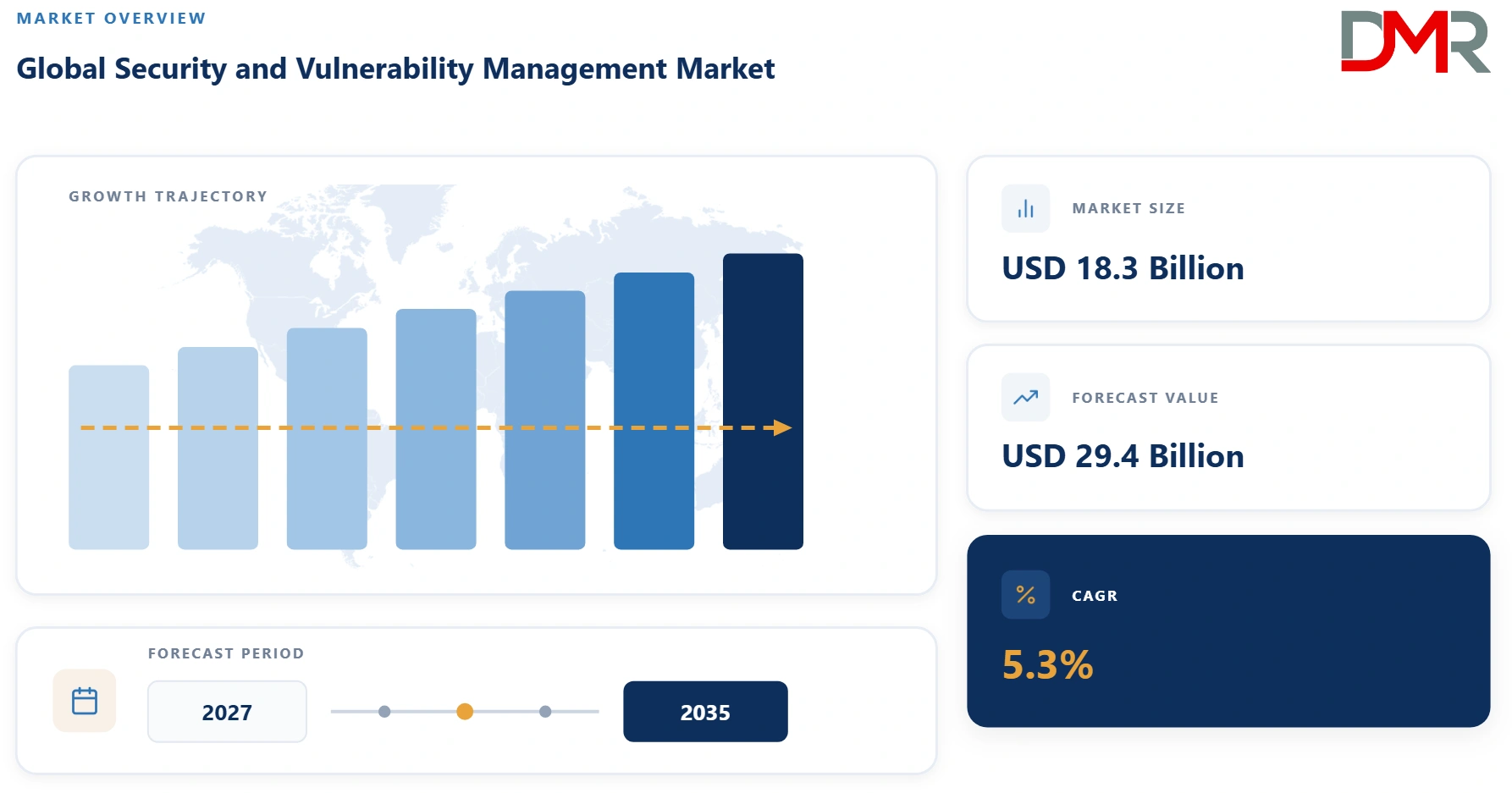
The Global Security and Vulnerability Management Market is valued at USD 18.3 billion in 2026 and is projected to reach USD 29.4 billion by 2035, growing at a CAGR of 5.3% from 2027 to 2035. Growth is driven by increasing cybersecurity threats, expanding enterprise digital infrastructure, rising regulatory compliance requirements, growing cloud adoption, and increasing investments in continuous vulnerability assessment and remediation solutions.
ℹ
To learn more about this report –
Download Your Free Sample Report Here
Security and Vulnerability Management refers to software and services designed to identify, assess, prioritize, monitor, and remediate security weaknesses across enterprise information technology environments. These solutions help organizations detect vulnerabilities within networks, applications, endpoints, cloud infrastructure, and databases. Vulnerability management platforms provide continuous security assessments, risk classification, remediation tracking, and compliance reporting. Organizations utilize these solutions to reduce cybersecurity exposure, protect sensitive business information, and maintain operational continuity.
The Global Security and Vulnerability Management Market covers software and services supporting vulnerability identification, security assessment, risk prioritization, and remediation management across enterprise environments. Market coverage encompasses cloud-based and on-premises deployment models addressing network, application, endpoint, cloud, and database vulnerabilities. The analysis includes IT & telecom, BFSI, government & defense, healthcare, retail & e-commerce, manufacturing, and energy & utilities. Revenue assessment considers software subscriptions, licensing, implementation, integration, consulting, managed vulnerability assessment, and technical support services.
Security and Vulnerability Management Market Snapshot
Security and Vulnerability Management Market Snapshot, 2027-2035
| Metric |
Value |
| Market Size (2026) |
USD 18.3 Billion |
| Forecast Value (2035) |
USD 29.4 Billion |
| CAGR (2027–2035) |
5.3% |
| Largest Region (2026) |
North America, 46.2% share |
| Fastest-Growing Region (2027–2035) |
Asia Pacific, 6.2% CAGR |
| Leading Offering (2026) |
Software, 71.6% share |
| Leading Deployment (2026) |
Cloud-Based, 64.7% share |
| Key Players |
Tenable Holdings, Inc.; Qualys, Inc.; Rapid7, Inc.; Microsoft Corporation; Cisco Systems, Inc.; CrowdStrike Holdings, Inc.; Palo Alto Networks, Inc.; Ivanti |
Security and Vulnerability Management Market: Key Takeaways
- Market Growth: The market is valued at USD 18.3 billion in 2026 and is projected to reach USD 29.4 billion by 2035, registering a CAGR of 5.3%.
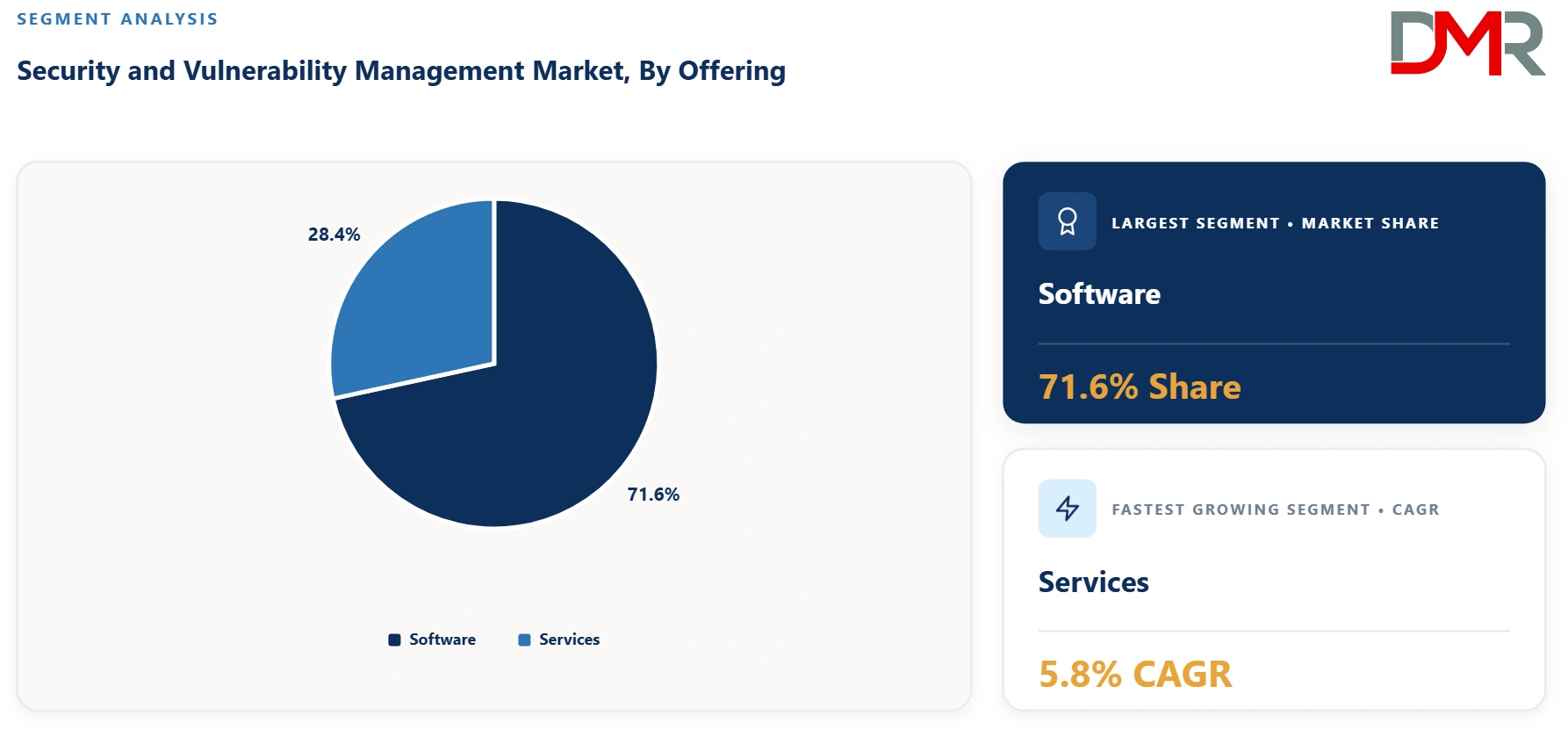
- Offering Leader: Software accounts for 71.6% of market revenue in 2026, supported by widespread adoption of automated vulnerability scanning and security assessment platforms.
- Fastest-Growing Offering: Services is projected to register a CAGR of 5.8%, driven by increasing demand for managed vulnerability assessment, security consulting, and remediation support.
- Deployment Leader: Cloud-Based deployment accounts for 64.7% of market revenue in 2026, supported by scalability, remote accessibility, and centralized vulnerability monitoring capabilities.
- Fastest-Growing Deployment: Cloud-Based deployment is projected to register a CAGR of 5.4%, driven by expanding cloud infrastructure and distributed enterprise environments.
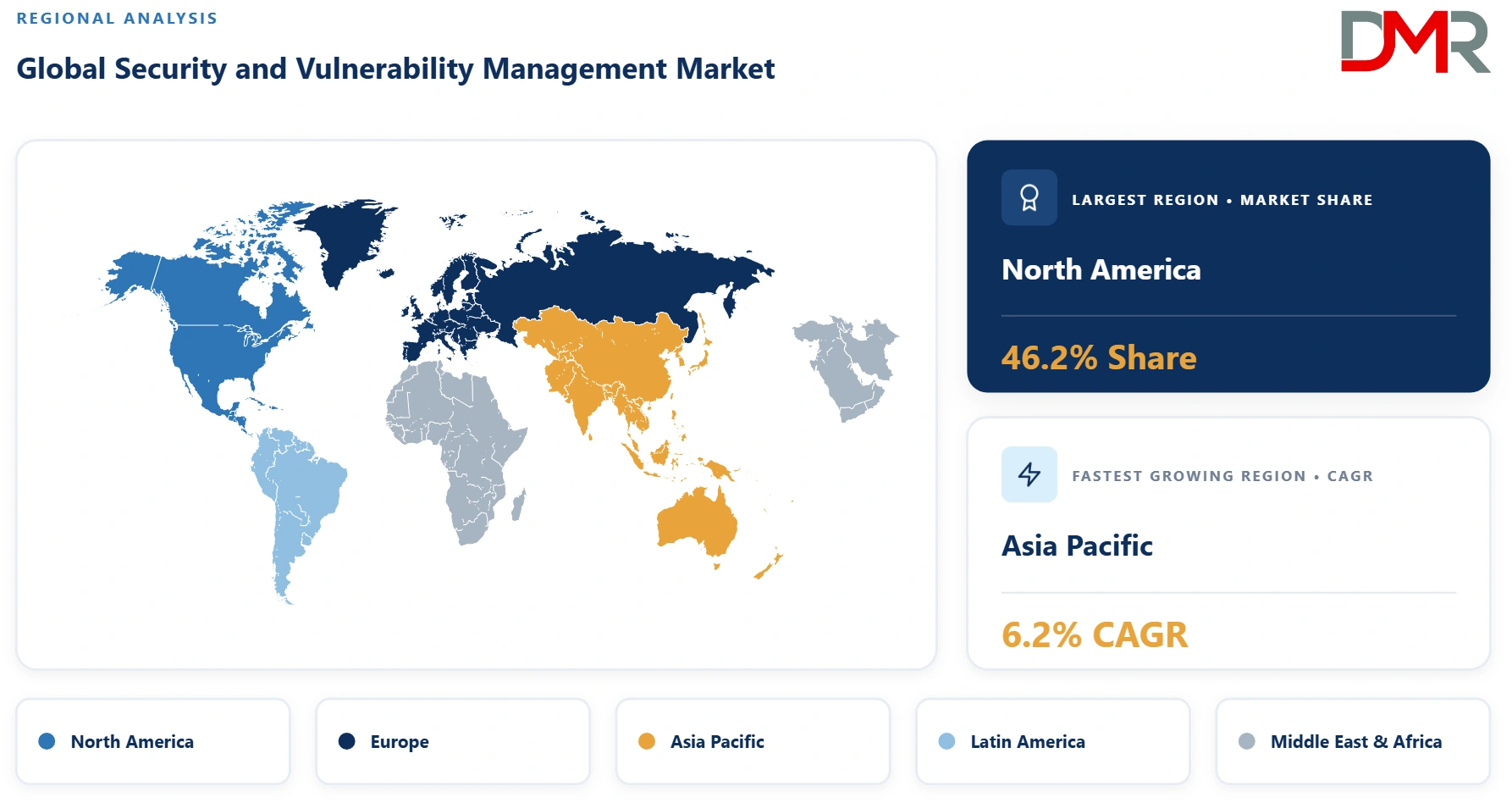
- Regional Picture: North America leads with a 46.2% market share in 2026, while Asia Pacific is projected to grow at a CAGR of 6.2%.
What are the Key Use Cases of Security and Vulnerability Management?
- Enterprise Network Security Assessment: Identifies security weaknesses across enterprise networks, servers, routers, and connected infrastructure to reduce exposure to unauthorized access.
- Application Vulnerability Management: Detects security weaknesses within business applications, web platforms, and software components, supporting secure development and remediation practices.
- Cloud Infrastructure Security: Monitors cloud workloads, virtual environments, and infrastructure configurations to identify security gaps and reduce exposure to cyber threats.
- Regulatory Compliance Management: Supports security audits, vulnerability assessments, remediation documentation, and compliance reporting across industries subject to cybersecurity and data protection requirements.
How are Foundation Models and Generative AI Transforming the Security and Vulnerability Management Market
Foundation models and generative AI are transforming the Security and Vulnerability Management Market through advancements in automated vulnerability identification, contextual risk assessment, threat intelligence analysis, and remediation planning. Large language models enable security platforms to analyze complex vulnerability reports, interpret security configurations, and generate actionable remediation recommendations. These capabilities improve vulnerability assessment efficiency, reduce manual workloads, and support faster identification of security weaknesses across enterprise networks, applications, endpoints, and cloud infrastructure.
Generative AI advancements simultaneously increase requirements for sophisticated cybersecurity assessment and exposure management technologies. AI-enabled vulnerability management platforms analyze security patterns, exploit intelligence, asset criticality, and configuration weaknesses to prioritize emerging threats. Foundation models improve analytical capabilities across diverse enterprise environments while supporting automated security reporting and remediation guidance. Increasing adoption of generative AI encourages investment in continuous vulnerability monitoring, predictive risk assessment, automated patch management, and integrated security operations, strengthening enterprise cybersecurity resilience and operational efficiency.
Security and Vulnerability Management Market Dynamics at a Glance
Drivers, Restraints, Opportunities and Trends in the Security and Vulnerability Management Market
| Type |
Factor |
Impact |
| Driver |
Increasing Frequency and Complexity of Cybersecurity Threats |
High |
| Driver |
Growing Regulatory Compliance and Data Protection Requirements |
High |
| Restraint |
High Implementation and Maintenance Costs |
Medium |
| Restraint |
Shortage of Skilled Cybersecurity Professionals |
High |
| Opportunity |
Expanding Demand for Cloud Security and Vulnerability Management |
High |
| Opportunity |
Growing Adoption of Managed Vulnerability Management Services |
High |
| Trend |
Increasing Adoption of Risk-Based Vulnerability Prioritization |
High |
| Trend |
Growing Integration of Continuous Exposure Monitoring |
High |
What is Driving the Growth of the Security and Vulnerability Management Market?
Increasing Frequency and Complexity of Cybersecurity Threats
The increasing frequency and complexity of cybersecurity threats are driving demand for Security and Vulnerability Management solutions across enterprise environments. Expanding digital infrastructure, interconnected business applications, and remote working arrangements create additional opportunities for cybercriminals to exploit security weaknesses. Organizations require continuous vulnerability assessment capabilities to identify outdated software, insecure configurations, and unpatched systems before exploitation occurs. Vulnerability management platforms support security teams through centralized monitoring, risk classification, and remediation tracking. Growing concerns regarding ransomware, data breaches, and operational disruptions encourage enterprises to strengthen preventive cybersecurity measures. These requirements support sustained investments in vulnerability management software and associated services.
Growing Regulatory Compliance and Data Protection Requirements
Growing regulatory compliance and data protection requirements encourage organizations to implement comprehensive vulnerability management practices. Financial institutions, healthcare providers, government organizations, and other regulated industries must maintain appropriate security controls to protect confidential information and critical infrastructure. Regular vulnerability assessments, security documentation, and remediation procedures support compliance with applicable cybersecurity standards. Organizations increasingly adopt centralized security platforms to simplify audit preparation and maintain visibility across distributed technology environments. Failure to address security weaknesses can result in financial penalties, reputational damage, and operational disruptions. Increasing regulatory scrutiny supports demand for reliable vulnerability management software, professional assessment services, and continuous compliance monitoring capabilities.
What are the Key Restraints in the Security and Vulnerability Management Market?
High Implementation and Maintenance Costs
High implementation and maintenance costs restrict the adoption of comprehensive Security and Vulnerability Management solutions, particularly among organizations operating with limited cybersecurity budgets. Enterprise-grade platforms require investment in software licensing, infrastructure integration, system configuration, and ongoing technical support. Additional expenses arise from security assessments, employee training, and remediation activities. Organizations maintaining complex legacy systems frequently encounter higher deployment costs due to compatibility requirements and customization needs. Smaller businesses may rely on basic vulnerability scanning tools with limited monitoring capabilities to control expenditure. These financial considerations create challenges for advanced vulnerability management providers seeking wider adoption across cost-sensitive enterprise environments.
Shortage of Skilled Cybersecurity Professionals
The shortage of skilled cybersecurity professionals presents a significant challenge for effective vulnerability management across organizations. Identifying security weaknesses represents only one component of the vulnerability management process, while successful remediation requires technical expertise, risk evaluation, and coordination between security and information technology teams. Organizations frequently encounter difficulties recruiting professionals capable of interpreting vulnerability assessments and managing complex security environments. Large volumes of vulnerability notifications can increase workloads and delay remediation activities. Limited technical resources particularly affect small and medium-sized businesses. These workforce constraints reduce the effectiveness of vulnerability management programs and create challenges for organizations implementing comprehensive cybersecurity strategies.
What are the Key Opportunities in the Security and Vulnerability Management Market?
Expanding Demand for Cloud Security and Vulnerability Management
Expanding enterprise adoption of cloud computing creates significant opportunities for Security and Vulnerability Management solution providers. Organizations increasingly operate applications, databases, and business workloads across public, private, and hybrid cloud environments. Distributed infrastructure introduces security challenges associated with configuration errors, outdated software components, and inadequate access controls. Conventional vulnerability assessment tools may provide limited visibility across rapidly changing cloud environments. Specialized cloud vulnerability management platforms support continuous workload assessment, configuration monitoring, and centralized security reporting. Growing demand for secure cloud migration and infrastructure modernization encourages providers to develop scalable solutions compatible with multiple cloud platforms and enterprise security ecosystems.
Growing Adoption of Managed Vulnerability Management Services
Growing adoption of managed vulnerability management services creates opportunities for cybersecurity service providers supporting organizations with limited internal security resources. Businesses increasingly require continuous security assessments, vulnerability prioritization, remediation guidance, and compliance reporting without expanding dedicated cybersecurity teams. Managed service providers offer specialized expertise, centralized monitoring, and recurring vulnerability assessments through flexible service arrangements. These services enable organizations to address security weaknesses while managing operational expenditure. Increasing demand from small and medium-sized enterprises, healthcare organizations, and regulated industries supports commercial opportunities for outsourced vulnerability management. Expanding cybersecurity requirements across emerging markets further encourage adoption of professional and managed security services.
What are the Latest Trends in the Security and Vulnerability Management Market?
Increasing Adoption of Risk-Based Vulnerability Prioritization
Increasing adoption of risk-based vulnerability prioritization reflects changing enterprise approaches to cybersecurity management. Traditional vulnerability assessment platforms frequently generate extensive lists of security weaknesses without sufficient information regarding business impact or exploitation potential. Organizations increasingly prioritize vulnerabilities according to asset criticality, exploit availability, threat intelligence, and operational exposure. Risk-based approaches enable security teams to allocate resources toward weaknesses presenting the greatest potential consequences. Integration with existing security operations and information technology management platforms supports coordinated remediation activities. Growing demand for efficient cybersecurity resource allocation encourages solution providers to enhance vulnerability scoring, contextual risk assessment, and remediation tracking capabilities.
Growing Integration of Continuous Exposure Monitoring
Growing integration of continuous exposure monitoring reflects increasing organizational requirements for real-time visibility across expanding digital environments. Periodic vulnerability assessments may fail to identify security weaknesses introduced between scheduled scanning activities. Organizations increasingly adopt platforms supporting continuous asset discovery, configuration assessment, vulnerability monitoring, and remediation verification. Integration with cloud infrastructure, endpoint management, and security operations platforms provides broader visibility across enterprise systems. Continuous monitoring enables security teams to identify emerging weaknesses and address changing exposure levels more efficiently. Increasing dependence on distributed business applications and interconnected infrastructure supports demand for comprehensive vulnerability management platforms offering ongoing security assessment capabilities.
Research Scope and Analysis
The research covers the Global Security and Vulnerability Management Market across offering, deployment, vulnerability type, end-use industry, and region. The analysis evaluates revenue generated through vulnerability assessment software, subscriptions, licensing, managed security services, and associated professional services. Market assessment incorporates enterprise adoption, technological developments, competitive positioning, regulatory requirements, and commercial growth opportunities across diverse industries and geographic markets.
ℹ
To learn more about this report –
Download Your Free Sample Report Here
By Offering Analysis
Software is projected to dominate the offering segment in the Global Security and Vulnerability Management Market, accounting for 71.6% of the total market share in 2026. Dominance is supported by extensive enterprise adoption of vulnerability scanning, security assessment, and remediation management platforms. Services are projected to be the fastest-growing segment, registering a CAGR of 5.8% from 2027 to 2035, driven by increasing demand for managed vulnerability assessments, security consulting, implementation assistance, and specialized remediation support.
By Deployment Analysis
Cloud-Based deployment is projected to dominate the deployment segment in the Global Security and Vulnerability Management Market, accounting for 64.7% of the total market share in 2026. Dominance is supported by scalability, centralized security administration, remote accessibility, and reduced infrastructure requirements. Cloud-Based deployment is also projected to be the fastest-growing segment, registering a CAGR of 5.4% from 2027 to 2035, driven by increasing cloud migration, distributed enterprise operations, and growing adoption of subscription-based cybersecurity platforms.
By Vulnerability Type Analysis
Network is projected to dominate the vulnerability type segment in the Global Security and Vulnerability Management Market, accounting for 28.6% of the total market share in 2026. Dominance is supported by widespread enterprise networking infrastructure and established requirements for identifying security weaknesses across connected systems. Cloud is projected to be the fastest-growing segment, registering a CAGR of 5.9% from 2027 to 2035, driven by expanding cloud infrastructure, increasing cloud-based application deployment, and growing concerns regarding cloud configuration vulnerabilities.
By End-Use Industry Analysis
IT & Telecom is projected to dominate the end-use industry segment in the Global Security and Vulnerability Management Market, accounting for 26.8% of the total market share in 2026. Dominance is supported by extensive digital infrastructure, interconnected communication networks, and continuous cybersecurity monitoring requirements. BFSI is projected to be the fastest-growing segment, registering a CAGR of 5.6% from 2027 to 2035, driven by expanding digital banking services, increasing financial cybersecurity threats, and strengthening regulatory compliance requirements.
How is the Security and Vulnerability Management Market Segmented?
By Offering
By Deployment
By Vulnerability Type
- Network
- Application
- Endpoint
- Cloud
- Database
- Others
By End-Use Industry
- IT & Telecom
- BFSI
- Government & Defense
- Healthcare
- Retail & E-Commerce
- Manufacturing
- Energy & Utilities
- Others
Which Region Leads the Security and Vulnerability Management Market?
North America leads the Global Security and Vulnerability Management Market, while Asia Pacific is projected to register the highest CAGR of 6.2% from 2027 to 2035.
ℹ
To learn more about this report –
Download Your Free Sample Report Here
Region with the Largest Revenue Share
North America dominates the Global Security and Vulnerability Management Market, accounting for a market share of 46.2% in 2026. Regional dominance is supported by advanced enterprise technology infrastructure, substantial cybersecurity expenditure, and established regulatory compliance requirements. The U.S. and Canada contribute to market demand through investments in enterprise security assessment and continuous vulnerability monitoring. The presence of established cybersecurity solution providers supports technological development, while increasing concerns regarding ransomware, data breaches, and critical infrastructure security encourage adoption of comprehensive vulnerability management platforms.
Region with the Highest CAGR
Asia Pacific is projected to register the highest CAGR of 6.2% in the Global Security and Vulnerability Management Market from 2027 to 2035. Regional growth is supported by expanding digital infrastructure, increasing cloud adoption, and growing cybersecurity investments across enterprises. China, Japan, India, Australia, and South Korea contribute through digital transformation initiatives and strengthening information security requirements. Growing demand for affordable cloud-based vulnerability assessment, managed security services, and regulatory compliance solutions supports market expansion across established and emerging regional economies.
Regional Analysis
Europe Security and Vulnerability Management Market
The Europe Security and Vulnerability Management Market is supported by established cybersecurity regulations, expanding enterprise digital infrastructure, and increasing investments in information security technologies. Germany, France, the U.K., Italy, and Spain contribute to regional demand through enterprise modernization and regulatory compliance initiatives. Organizations increasingly prioritize vulnerability management solutions offering continuous security monitoring, centralized reporting, and efficient remediation management. Growing requirements for data protection, operational resilience, and critical infrastructure security encourage the adoption of comprehensive vulnerability assessment platforms and associated professional services.
Latin America Security and Vulnerability Management Market
The Latin America Security and Vulnerability Management Market is supported by expanding digital infrastructure, increasing cloud adoption, and growing awareness of enterprise cybersecurity requirements. Mexico and Brazil contribute to regional demand through financial technology development, enterprise modernization, and expanding digital commerce activities. Organizations increasingly adopt cloud-based vulnerability management platforms to improve security visibility and reduce infrastructure expenditure. Growing demand for affordable security assessment solutions, managed cybersecurity services, and regulatory compliance support creates commercial opportunities across regional industries and emerging enterprise technology environments.
Middle East & Africa Security and Vulnerability Management Market
The Middle East & Africa Security and Vulnerability Management Market is supported by national digital transformation initiatives, expanding enterprise technology infrastructure, and increasing cybersecurity investments. Saudi Arabia, the UAE, and South Africa contribute through government modernization, financial sector development, and critical infrastructure protection initiatives. Organizations increasingly prioritize continuous vulnerability assessment to strengthen cybersecurity resilience and protect sensitive business information. Growing demand for cloud-based security platforms, localized cybersecurity services, and regulatory compliance management creates opportunities for vulnerability management solution providers across established and emerging regional markets.
By Region
North America
Europe
- Germany
- France
- The U.K.
- Italy
- Spain
- Rest of Europe
Asia-Pacific
- China
- Japan
- India
- Australia
- South Korea
- Rest of APAC
Latin America
- Mexico
- Brazil
- Rest of LATAM
Middle East & Africa
- Saudi Arabia
- The UAE
- South Africa
- Rest of MEA
Regulatory Landscape
The regulatory landscape of the Global Security and Vulnerability Management Market is influenced by cybersecurity regulations, data protection requirements, information security standards, and industry-specific compliance frameworks. The General Data Protection Regulation, NIS2 Directive, Digital Operational Resilience Act, and Payment Card Industry Data Security Standard influence enterprise cybersecurity practices across relevant jurisdictions. The Cybersecurity and Infrastructure Security Agency maintains a catalog of known exploited vulnerabilities to support remediation prioritization. Increasing requirements for security assessments, documented remediation procedures, and operational resilience encourage organizations to strengthen vulnerability management programs. These requirements create opportunities for providers offering continuous security assessment, risk prioritization, compliance reporting, and centralized vulnerability monitoring capabilities.
Technology Analysis
Technological advancements in the Global Security and Vulnerability Management Market focus on automated vulnerability scanning, continuous asset discovery, risk-based prioritization, and integrated remediation management. Advanced assessment technologies identify security weaknesses across enterprise networks, applications, endpoints, cloud infrastructure, and databases. Threat intelligence integration supports vulnerability classification according to exploitation potential and business impact. Cloud-based infrastructure enables scalable security assessments and centralized monitoring across geographically distributed enterprise environments. Application programming interfaces facilitate integration with endpoint management, security operations, and information technology service management platforms. Growing demand for comprehensive security visibility encourages investment in agent-based scanning, agentless assessment, configuration monitoring, and automated remediation verification capabilities.
Who are the Leading Companies in the Security and Vulnerability Management Market?
- The Global Security and Vulnerability Management Market is characterized by competition among established cybersecurity providers, specialized vulnerability assessment companies, and enterprise technology solution developers. Major participants include Tenable Holdings, Inc., Qualys, Inc., Rapid7, Inc., Microsoft Corporation, and Cisco Systems, Inc. Competitive differentiation focuses on vulnerability detection capabilities, asset coverage, risk prioritization, remediation efficiency, and enterprise integration. Companies strengthen market positioning through product innovation, strategic partnerships, expanded cloud security capabilities, and comprehensive vulnerability management services.
- Tenable Holdings, Inc. (Maryland, U.S.): Provides vulnerability assessment and exposure management solutions through Tenable Vulnerability Management, Nessus, and Tenable Security Center, supporting continuous security monitoring and risk-based vulnerability prioritization.
- Qualys, Inc. (California, U.S.): Offers cloud-based vulnerability management, detection, and response solutions through the Qualys Enterprise TruRisk Platform, supporting asset discovery, vulnerability assessment, risk prioritization, and patch management.
- Rapid7, Inc. (Massachusetts, U.S.): Provides vulnerability assessment and exposure management solutions through InsightVM and Exposure Command, supporting enterprise security monitoring, vulnerability prioritization, and coordinated remediation workflows.
- Microsoft Corporation (Washington, U.S.): Offers Microsoft Defender Vulnerability Management, supporting continuous asset discovery, security configuration assessment, vulnerability identification, risk prioritization, and remediation recommendations across enterprise environments.
- Cisco Systems, Inc. (California, U.S.): Provides enterprise cybersecurity solutions supporting network security assessment, vulnerability risk management, threat intelligence integration, and exposure reduction across distributed information technology infrastructure.
Some of the prominent players in the Global Security and Vulnerability Management are:
- Tenable Holdings, Inc.
- Qualys, Inc.
- Rapid7, Inc.
- Microsoft Corporation
- Cisco Systems, Inc.
- CrowdStrike Holdings, Inc.
- Palo Alto Networks, Inc.
- Ivanti
- Forescout Technologies, Inc.
- BeyondTrust Corporation
- Fortra, LLC
- Greenbone AG
- Vicarius Ltd.
- Action1 Corporation
- Automox, Inc.
- Nucleus Security, Inc.
- Brinqa, Inc.
- Balbix, Inc.
- Recorded Future, Inc.
- Arctic Wolf Networks, Inc.
- XM Cyber Ltd.
- Wiz, Inc.
- Orca Security Ltd.
- Aqua Security Software Ltd.
- Sysdig, Inc.
- Check Point Software Technologies Ltd.
- Fortinet, Inc.
- Trend Micro Incorporated
- Sophos Ltd.
- HCLSoftware
- OpenText Corporation
- International Business Machines Corporation
- ServiceNow, Inc.
- BMC Software, Inc.
- Flexera Software LLC
- Tanium Inc.
- ManageEngine (Zoho Corporation)
- Invicti Security
- PortSwigger Ltd.
- Other Key Players
Recent Developments
- In November 2026, Qualys, Inc. expanded its managed Risk Operations Center alliance through a partnership with Cognizant. The development strengthens managed cybersecurity capabilities, supporting enterprise vulnerability assessment, security risk prioritization, and coordinated remediation management across distributed technology environments.
- In October 2026, Tenable Holdings, Inc. announced that Atos selected its technology to support a continuous threat exposure management program. The development strengthens enterprise security assessment capabilities, supporting continuous vulnerability identification, exposure monitoring, and risk management across complex digital environments.
- In August 2026, Qualys, Inc. introduced InstaScan, a vulnerability detection capability within its Enterprise TruRisk Management platform. The development reduces the interval between vulnerability disclosure and identification, supporting faster security assessments and more efficient remediation activities across enterprise infrastructure.
- In July 2026, Tenable Holdings, Inc. joined Cisco's SolutionsPlus program as an exposure management partner. The development expands access to vulnerability management capabilities and supports closer integration of enterprise security assessment solutions across network infrastructure and cybersecurity environments.
- In July 2026, Qualys, Inc. introduced direct integration between Enterprise TruRisk Management and TruRisk Eliminate. The development connects vulnerability risk assessment with remediation workflows, supporting centralized security management and more efficient resolution of identified weaknesses across enterprise technology environments.
Security and Vulnerability Management Market Report Scope and Research Methodology
Definition: The Security and Vulnerability Management Market encompasses software and services supporting security weakness identification, vulnerability assessment, risk prioritization, remediation management, and continuous security monitoring across enterprise networks, applications, endpoints, cloud infrastructure, and databases globally.
Methodology: Dimension Market Research's proposed market estimation methodology combines bottom-up analysis of vulnerability management solution provider revenues, software subscriptions, enterprise licensing, adoption rates, and associated service expenditure with top-down validation against enterprise cybersecurity and information security spending. Primary interviews with technology providers, cybersecurity professionals, enterprise security administrators, and institutional end users support validation of pricing and adoption assumptions. Forecasts incorporate segment-level growth expectations for 2027–2035 and periodic assessment of technological advancements, cybersecurity requirements, regulatory developments, and market conditions.
Report Details
| Report Characteristics |
Details |
| Market Size (2026) |
USD 18.3 Billion |
| Market Size (2027) |
USD 8.1 Billion |
| Forecast Value (2035) |
USD 29.4 Billion |
| CAGR (2027–2035) |
5.3% |
| Historical Data |
2021–2026 |
| Forecast Data |
2027–2035 |
| Base Year |
2026 |
| Estimate Year |
2027 |
| Regional Coverage |
North America (The US, Canada); Europe (Germany, France, The UK, Italy, Spain, Rest of Europe); Asia Pacific (China, Japan, India, Australia, South Korea, Rest of APAC); Latin America (Mexico, Brazil, Rest of LATAM); Middle East & Africa (Saudi Arabia, The UAE, South Africa, Rest of MEA) |
Frequently Asked Questions
How big is the Security and Vulnerability Management Market in 2026?
▾ The Global Security and Vulnerability Management Market is valued at USD 18.3 billion in 2026 and is projected to reach USD 29.4 billion by 2035.
What is the growth rate of the Security and Vulnerability Management Market?
▾ The Global Security and Vulnerability Management Market is projected to grow at a CAGR of 5.3% from 2027 to 2035.
Which region leads the Security and Vulnerability Management Market?
▾ North America dominates the Global Security and Vulnerability Management Market, accounting for a market share of 46.2% in 2026.
Which offering segment dominates the Security and Vulnerability Management Market?
▾ Software dominates the offering segment, accounting for 71.6% of the total market share in 2026.
Which end-use industry is growing fastest in the Security and Vulnerability Management Market?
▾ BFSI is projected to be the fastest-growing end-use industry segment, registering a CAGR of 5.6% from 2027 to 2035.
Who are the key players in the Security and Vulnerability Management Market?
▾ Key players include Tenable Holdings, Inc., Qualys, Inc., Rapid7, Inc., Microsoft Corporation, Cisco Systems, Inc., CrowdStrike Holdings, Inc., Palo Alto Networks, Inc., and Ivanti.
What are the main challenges facing the Security and Vulnerability Management Market?
▾ High implementation costs, shortages of skilled cybersecurity professionals, and complex enterprise infrastructure represent significant challenges restricting vulnerability management solution adoption.