Singapore Medical Tourism Market Snapshot
- Singapore Medical Tourism Market Size in 2026: USD 2.8 Billion
- Singapore Medical Tourism Market Size in 2035: USD 6.5 Billion
- Singapore CAGR from 2026 to 2035: 9.8%
- Cancer and Oncology Treatments is the leading treatment type segment in 2026: 27.4%
- Medical and Surgical Treatment is the leading service nature segment in 2026: 72.5%
- Private Hospitals and Clinics is the leading service provider segment in 2026: 88.6%
What is the Singapore Medical Tourism Market and its Market Size?
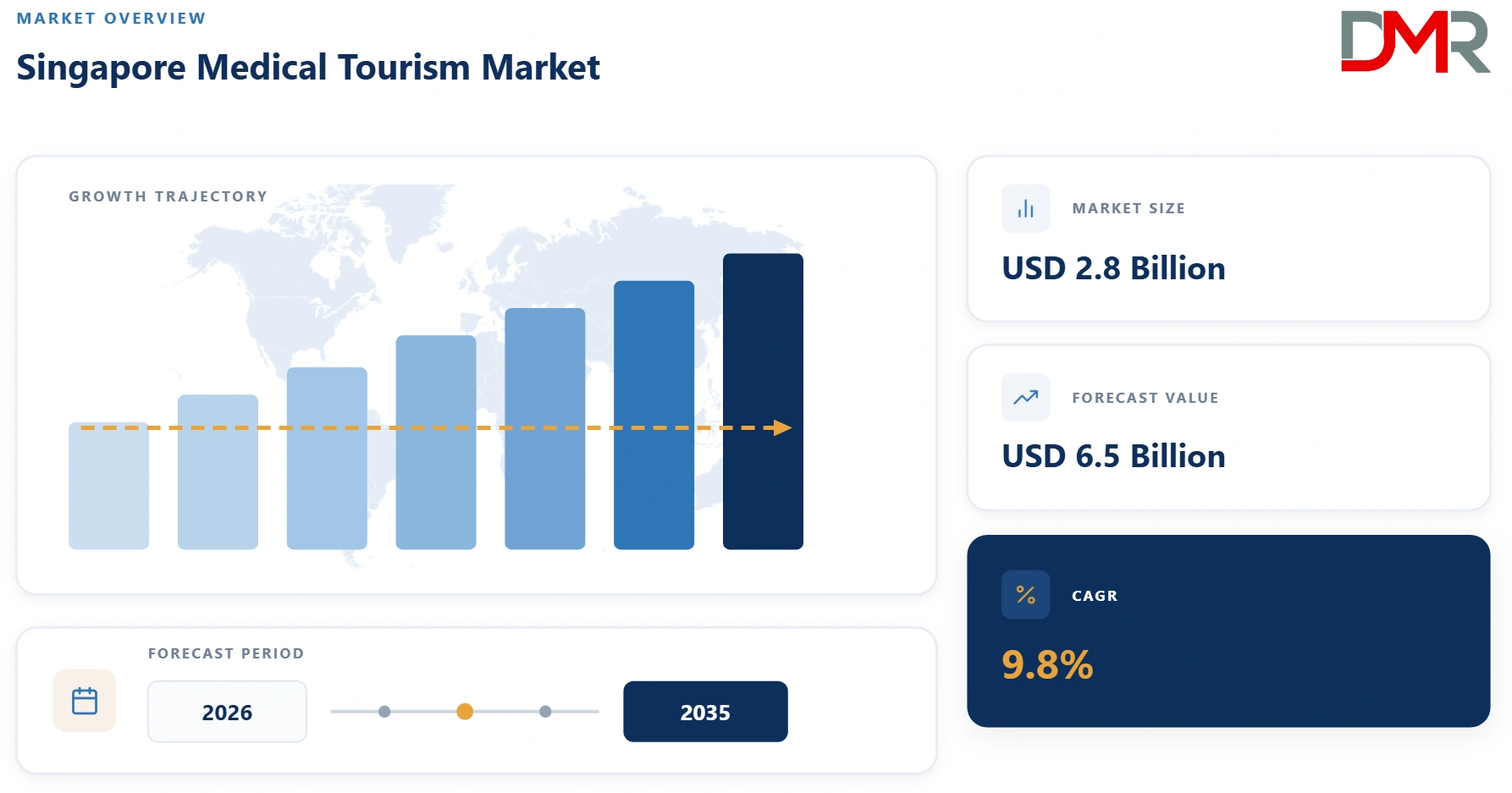
The Singapore Medical Tourism Market is projected to be valued at USD 2.8 Billion in 2026 and is projected to reach USD 6.5 Billion by 2035, expanding at a CAGR of 9.8% during the forecast period.
ℹ
To learn more about this report –
Download Your Free Sample Report Here
Growth is being propelled by Singapore’s sustained reputation as a premier global healthcare destination, offering world-class medical infrastructure, internationally accredited hospitals, and a highly skilled, English-speaking medical workforce. The city-state’s strategic position as a regional hub, combined with its political stability, superior quality of care, and robust intellectual property protection, continues to attract high-value international patients, particularly from Southeast Asia, South Asia, and the Middle East. Investment is accelerating as Singapore’s healthcare providers expand their specialized oncology, cardiology, and fertility treatment capabilities, while also integrating wellness and preventive services to capture a broader spectrum of health-seeking travelers.
Use Cases
- Complex Cancer and Oncology Care for Regional Patients: International patients from across the Asia Pacific region engage Singapore’s private hospitals for comprehensive cancer care, leveraging the nation's advanced diagnostic imaging, proton therapy systems, and multi-disciplinary oncology teams to access cutting-edge treatment regimens that may be unavailable in their home countries.
- Fertility and Reproductive Treatments for International Couples: Couples, particularly from neighboring countries, choose Singapore for in-vitro fertilization (IVF) and other reproductive treatments, attracted by the city-state's high success rates, advanced reproductive technologies, and a clear, supportive legal and regulatory environment.
- Executive Health Screening and Wellness Retreats: High-net-worth individuals and corporate clients from the region utilize Singapore’s premium wellness and preventive treatment packages, combining comprehensive medical screening with luxury hospitality services and personalized wellness plans.
- Cardiovascular and Orthopedic Surgeries for Medical Travelers: Patients from the region seek elective and complex procedures such as coronary bypass, joint replacements, and spinal surgeries in Singapore, drawn by the high success rates, use of advanced surgical techniques, and shorter waiting times compared to their domestic public healthcare systems.
Key Takeaways
- Market Size: The Singapore Medical Tourism Market is anticipated to be valued at USD 2.8 Billion in 2026 and is forecast to reach USD 6.5 Billion by 2035, expanding at a CAGR of 9.8%.
- Growth Outlook: Market expansion is sustained by Singapore’s brand equity as a leading medical hub, an increasing regional demand for advanced medical and wellness services, and strategic investments in premium healthcare infrastructure and digital health integration.
- Primary Growth Drivers: Rising regional affluence, a growing preference for premium healthcare services, Singapore’s strong regulatory framework, and the expansion of specialized and complex treatment centers are accelerating market growth.
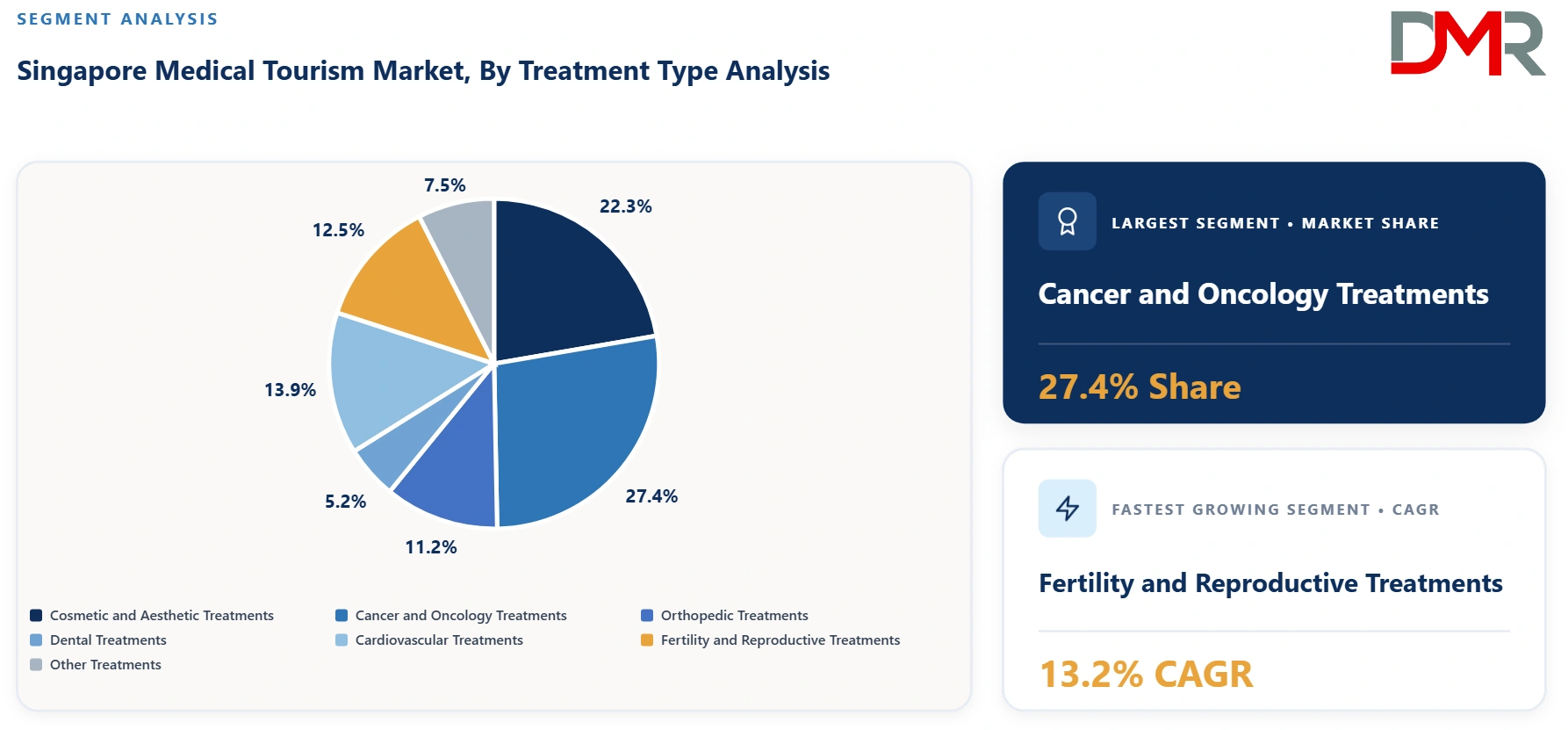
- By Treatment Type Analysis: Cancer and Oncology Treatments is projected to lead the treatment type segment with a 27.4% share in 2026, reflecting the substantial demand for advanced oncological care. Fertility and Reproductive Treatments is the fastest-growing segment at 13.2% CAGR, driven by rising rates of infertility and Singapore's reputation for high success rates.
- By Service Nature Analysis: Medical and Surgical Treatment is projected to dominate with a 72.5% share in 2026, reflecting the core focus on tertiary and quaternary care for international patients. Wellness and Preventive Treatments is the fastest-growing service nature segment at 12.5% CAGR, driven by a global shift toward proactive health management and Singapore’s integration of wellness with medical tourism.
- By Service Provider Analysis: Private Hospitals and Clinics are projected to dominate with an 88.6% share in 2026, reflecting their primary role in serving the high-value international patient market. Public Healthcare Institutions cater predominantly to the domestic population and a small segment of international patients seeking subsidized care.
Key Drivers in the Singapore Medical Tourism Market
Singapore’s Brand Equity as a Premier Global Healthcare Destination
Singapore has cultivated a powerful global brand associated with safety, quality, and excellence, making it a top-of-mind destination for medical travelers seeking premium healthcare. This brand is reinforced by the nation’s reputation for political stability, cleanliness, a robust legal system, and a highly efficient government. For international patients, particularly those from developing nations, Singapore represents a guarantee of world-class care, offering a level of trust and confidence that is often a primary decision-making factor.
Rising Regional Affluence and Demand for Advanced Healthcare
The rapid economic growth of Southeast Asia and South Asia has produced a burgeoning middle and upper class with the financial means to seek premium medical services abroad. These patients are increasingly crossing borders for advanced oncology treatments, complex cardiac surgeries, and elective procedures that may not be available or of the same quality in their home nations. Singapore’s proximity and connectivity to these growing markets position it to capture a substantial share of this outbound medical travel demand.
Restraints in the Singapore Medical Tourism Market
High Cost of Medical and Living Expenses
Singapore is renowned for its high cost of living and premium healthcare services, which represent a significant barrier for a large portion of potential medical travelers. While the nation competes on quality rather than cost, this high price point makes it less accessible to price-sensitive segments of the market. This positions Singapore in a more niche, premium segment of the global medical tourism market, competing with high-quality destinations like the US and UK, rather than cost-competitive ones like Thailand and India.
Growth Opportunities in the Singapore Medical Tourism Market
Integration of Wellness and Preventive Medicine
Singapore possesses a significant opportunity to expand its medical tourism ecosystem by seamlessly integrating wellness and preventive treatments into its existing portfolio. By creating comprehensive packages that combine medical procedures with wellness retreats, executive health screenings, and lifestyle management programs, providers can attract a broader range of health-conscious travelers. This move will not only extend the patient journey but also strengthen Singapore's position as a holistic health destination, moving beyond a purely reactive, treatment-focused model.
Digital Health and Telemedicine for Pre- and Post-Treatment Care
Investment in digital health platforms presents a major opportunity to enhance patient experience and expand the market's reach. By offering telemedicine consultations for initial patient triage and robust post-treatment follow-up, Singaporean providers can build stronger patient relationships, improve continuity of care, and extend their service footprint beyond physical borders. This digital infrastructure can streamline the patient journey, reduce on-site stay duration, and make the overall experience more convenient and efficient.
Trends in the Singapore Medical Tourism Market
Shift from Cost-Arbitrage to Quality and Outcomes-Driven Care
The Singapore market is moving away from the traditional cost-arbitrage model of medical tourism and increasingly competing on the basis of superior clinical outcomes, advanced technology, and patient safety. This trend is driven by sophisticated international patients who prioritize success rates and the expertise of medical teams over cost savings. As a result, Singapore is attracting a higher-value patient demographic, which in turn justifies its premium pricing and reinforces its position as a leader in complex and critical care.
Increased Focus on Patient Experience and Concierge Services
A key trend is the elevation of the patient experience, where private hospitals are investing heavily in concierge services, bilingual patient coordinators, and seamless travel and accommodation integration. This focus on a "medical concierge" approach is moving beyond just treating a condition to managing a patient's entire stay, significantly enhancing the value proposition and generating positive word-of-mouth referrals.
Research Scope and Analysis
The Singapore Medical Tourism Market is segmented by treatment type, service nature, patient origin, and service provider, covering a range of specialties from cancer and cardiovascular care to fertility and wellness treatments.
ℹ
To learn more about this report –
Download Your Free Sample Report Here
By Treatment Type Analysis
Cancer and Oncology Treatments is projected to dominate the Singapore Medical Tourism Market with 27.4% share in 2026, reflecting substantial demand for advanced oncological care from international patients seeking cutting-edge proton therapy, precision medicine, and multi-disciplinary oncology expertise unavailable in their home countries. Fertility and Reproductive Treatments is expected to register the highest CAGR of 13.2% during 2026-2035, driven by rising infertility rates globally, delayed childbearing trends, and Singapore's high success rates, advanced reproductive technologies, and favorable regulatory framework. Cosmetic, cardiovascular, and orthopedic treatments also represent significant segments, attracting patients seeking premium outcomes in Singapore's world-class private healthcare ecosystem.
By Service Nature Analysis
Medical and Surgical Treatment is anticipated to dominate, accounting for 72.5% share in 2026, reflecting its role as the core offering for international patients seeking acute interventions, elective procedures, and complex surgeries ranging from cardiac bypass to joint replacements. Wellness and Preventive Treatments is projected to be the fastest-growing service nature at 12.5% CAGR, reflecting the global shift towards proactive health management and Singapore's strategic positioning of integrated wellness alongside medical care. Alternative Treatments and Therapies represents a smaller, niche segment, catering to patients seeking complementary approaches alongside conventional medical interventions in Singapore's premium healthcare environment.
By Patient Origin Analysis
International Patients are projected to dominate the Singapore Medical Tourism Market, accounting for a substantial majority share in 2026, reflecting Singapore's established reputation as a premier global healthcare destination attracting medical travelers primarily from Indonesia, Malaysia, Vietnam, China, India, and the Middle East. These patients seek advanced oncology treatments, complex cardiovascular surgeries, fertility care, and executive health screenings unavailable or of lower quality in their home countries. Domestic Patients represent a smaller but significant and stable segment, comprising Singaporean residents and permanent residents utilizing both public and private healthcare services. While domestic patients form the operational foundation of Singapore's healthcare system, the market's growth trajectory and premium positioning are increasingly driven by the higher-margin international patient segment seeking world-class medical outcomes.
By Service Provider Analysis
Private Hospitals and Clinics are projected to dominate with 88.6% share in 2026, reflecting their aggressive international marketing, premium infrastructure, dedicated medical concierge services, and strategic positioning to attract high-value international patients seeking world-class care. These providers invest heavily in accreditations, luxury patient experiences, and specialized centers of excellence. Public Healthcare Institutions represent a niche and smaller segment, primarily serving domestic patients and a limited number of international patients seeking less costly care or specific public-sector expertise. The dominance of private providers underscores Singapore's medical tourism model competing on quality, outcomes, and service excellence rather than cost competitiveness.
The Singapore Medical Tourism Market Report is segmented based on the following:
By Treatment Type
- Cosmetic and Aesthetic Treatments
- Cancer and Oncology Treatments
- Orthopedic Treatments
- Dental Treatments
- Cardiovascular Treatments
- Fertility and Reproductive Treatments
- Other Treatments
By Service Nature
- Medical and Surgical Treatment
- Wellness and Preventive Treatments
- Alternative Treatments and Therapies
By Patient Origin
- International Patients
- Domestic Patients
By Service Provider
- Private Hospitals and Clinics
- Public Healthcare Institutions
Technology Analysis
Technology development is increasingly shaping competitiveness in the Singapore Medical Tourism Market as providers invest in advanced diagnostic imaging, robotic surgical systems (e.g., the da Vinci system), and proton therapy for cancer treatment. The use of telemedicine platforms and integrated electronic medical records (EMR) for international patients is enhancing the seamless coordination of care. Opportunities are expanding for providers who can incorporate artificial intelligence for personalized treatment planning and use blockchain for secure and efficient cross-border medical records transfer. However, ensuring interoperability between national healthcare systems and maintaining data privacy in a cross-border context remains a key technical and regulatory challenge.
Competitive Landscape
The Singapore Medical Tourism Market is highly consolidated and competitive, dominated by a few major private healthcare groups. Competition centers on clinical excellence, brand reputation, sophisticated medical technology, and the integration of luxury patient services. Key players differentiate themselves through specialized centers of excellence (e.g., for oncology or cardiology), affiliation with international medical institutions, and strategic partnerships with travel and hospitality companies. The market's focus on premium care means competition is more about attracting a higher-value, quality-conscious patient than competing on price.
Some of the prominent players in the Singapore Medical Tourism Market are:
- IHH Healthcare Singapore
- Raffles Medical Group
- Parkway Pantai
- Mount Elizabeth Hospital
- Gleneagles Hospital Singapore
- Mount Elizabeth Novena Hospital
- Parkway East Hospital
- Raffles Hospital
- Thomson Medical Group
- Thomson Specialists
- Farrer Park Hospital
- Mount Alvernia Hospital
- Parkway Cancer Centre
- National University Health System (NUHS)
- Singapore General Hospital (SGH)
- National University Hospital (NUH)
- Tan Tock Seng Hospital
- National Heart Centre Singapore
- National Cancer Centre Singapore
- Singapore National Eye Centre
- KK Women's and Children's Hospital
- Changi General Hospital
- Khoo Teck Puat Hospital
- Ng Teng Fong General Hospital
- Sengkang General Hospital
- Alexandra Hospital
- Mount Alvernia Medical Centre
- Camden Medical Centre
- Nobel Medical Group
- Parkway Shenton
- Fullerton Health
- Healthway Medical Group
- Minmed Group
- Singapore Medical Specialists Centre
- The Orthopaedic Centre
- Nobel Eye & Skin Centre
- Singapore Brain & Spine Centre
- Singapore Sports & Orthopaedic Clinic
- Gleneagles Medical Centre
- Novena Specialist Center
- Other Key Players
Recent Development
- September 2026: Global asset manager TPG submitted a confidential IPO application for its Southeast Asian medical assets, A1Health (formerly Columbia Asia), seeking a valuation of approximately US$8 billion to leverage high patient volumes and expand its footprint across 22 Malaysian hospitals.
- September 2026: The Malaysian Ministry of Health boosted digital health funding to USD 250 million to fast-track its cloud-based clinical management system across public facilities and the national Electronic Medical Records project, driving efficiency that will structurally alleviate public hospital congestion and spill over into private care demand.
- May 2026: Supported by rising global care costs and an influx of patients from the Middle East and South Asia, Malaysia's healthcare travel revenue spiked to RM3.35 billion, with patient arrivals jumping to 1.85 million to consolidate the nation's regional price competitiveness against Singapore and Thailand.
- February 2026: Following the 2025 opening of its 224-bed specialist hospital in Rawang, Selgate Healthcare advanced its roll-out strategy by breaking ground on two new private hospitals to build a comprehensive care network utilizing its integrated digital platform.
Report Details
| Report Characteristics |
| Market Size (2026) |
USD 2.8 Bn |
| Forecast Value (2035) |
USD 6.5 Bn |
| CAGR (2026–2035) |
9.8% |
| Historical Data |
2021 – 2025 |
| Forecast Data |
2026 – 2035 |
| Base Year |
2025 |
| Segments Covered |
By Treatment Type, By Service Nature, By Patient Origin, and By Service Provider |
| Country Coverage |
Singapore |
Frequently Asked Questions
How big is the Singapore Medical Tourism Market?
▾ The Singapore Medical Tourism Market is poised to be valued at USD 2.8 Billion in 2026 and is projected to reach USD 6.5 Billion by 2035, reflecting sustained demand for advanced and premium healthcare services from international patients.
What is the CAGR of the Singapore Medical Tourism Market from 2026 to 2035?
▾ The market is projected to expand at a compound annual growth rate (CAGR) of 9.8% between 2026 and 2035, supported by rising regional affluence, brand equity, and infrastructure investment.
What factors are driving the growth of the Singapore Medical Tourism Market?
▾ Growth is driven by Singapore’s brand equity as a premier healthcare hub, rising regional affluence and demand for advanced care, and investment in specialized medical technologies and patient experience.
What are the major trends in the Singapore Medical Tourism Market?
▾ Major trends include a shift from cost-arbitrage to outcomes-driven care, increased focus on patient experience and concierge services, and the integration of wellness and preventive medicine.
Who are the key players in the Singapore Medical Tourism Market?
▾ Key market participants include Raffles Medical Group, Parkway Pantai (IHH Healthcare), Thomson Medical Group, and other leading private hospital groups.
How is the Singapore Medical Tourism Market segmented?
▾ The market is segmented by treatment type, service nature, patient origin, and service provider, with demand concentrated on oncology, cardiology, and fertility treatments delivered by private hospitals.