Market Snapshot
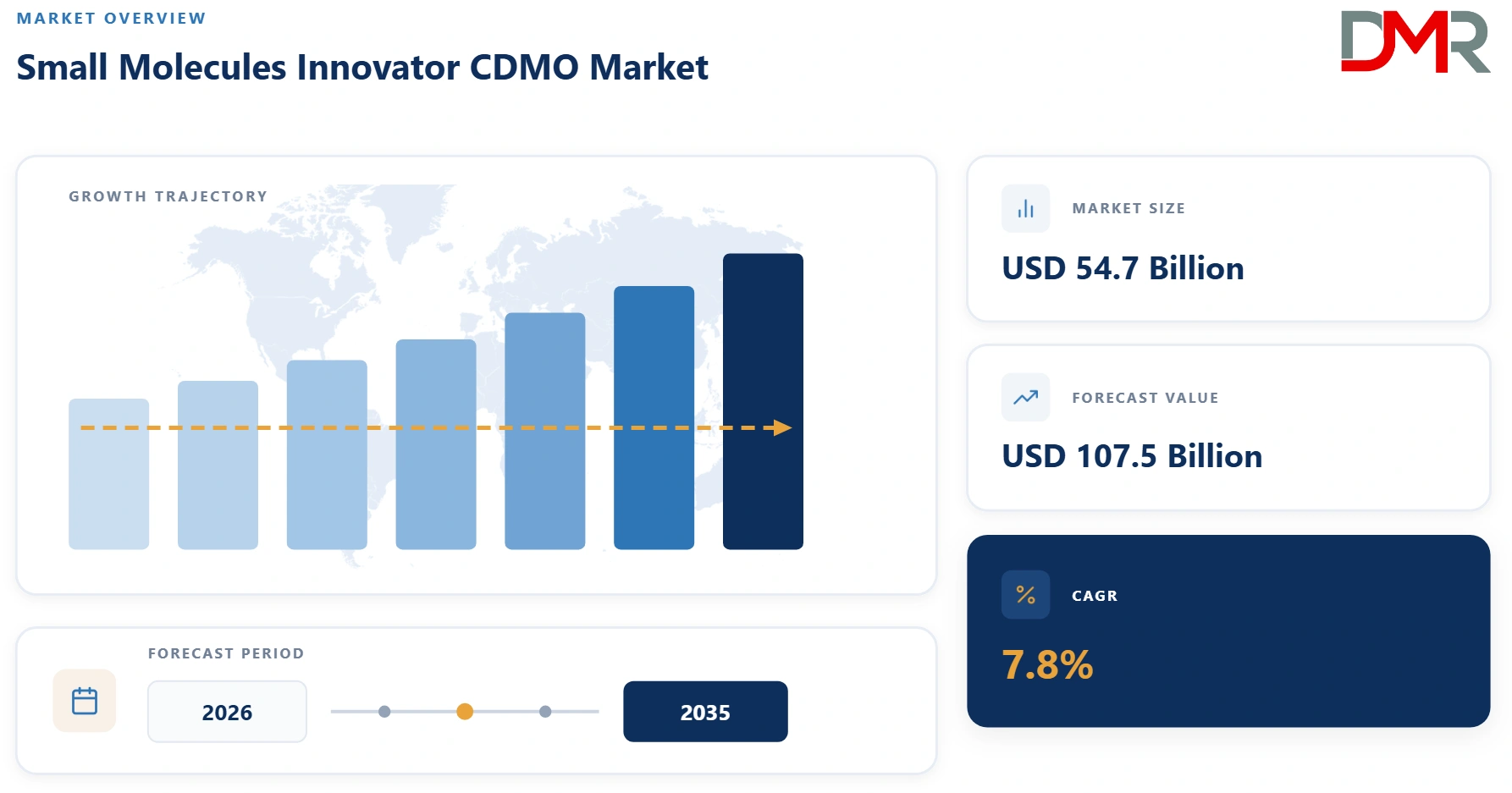
- Market Size (2026): USD 54.7 Bn
- Forecast Value (2035): USD 107.5 Bn
- CAGR (2026-2035): 7.8%
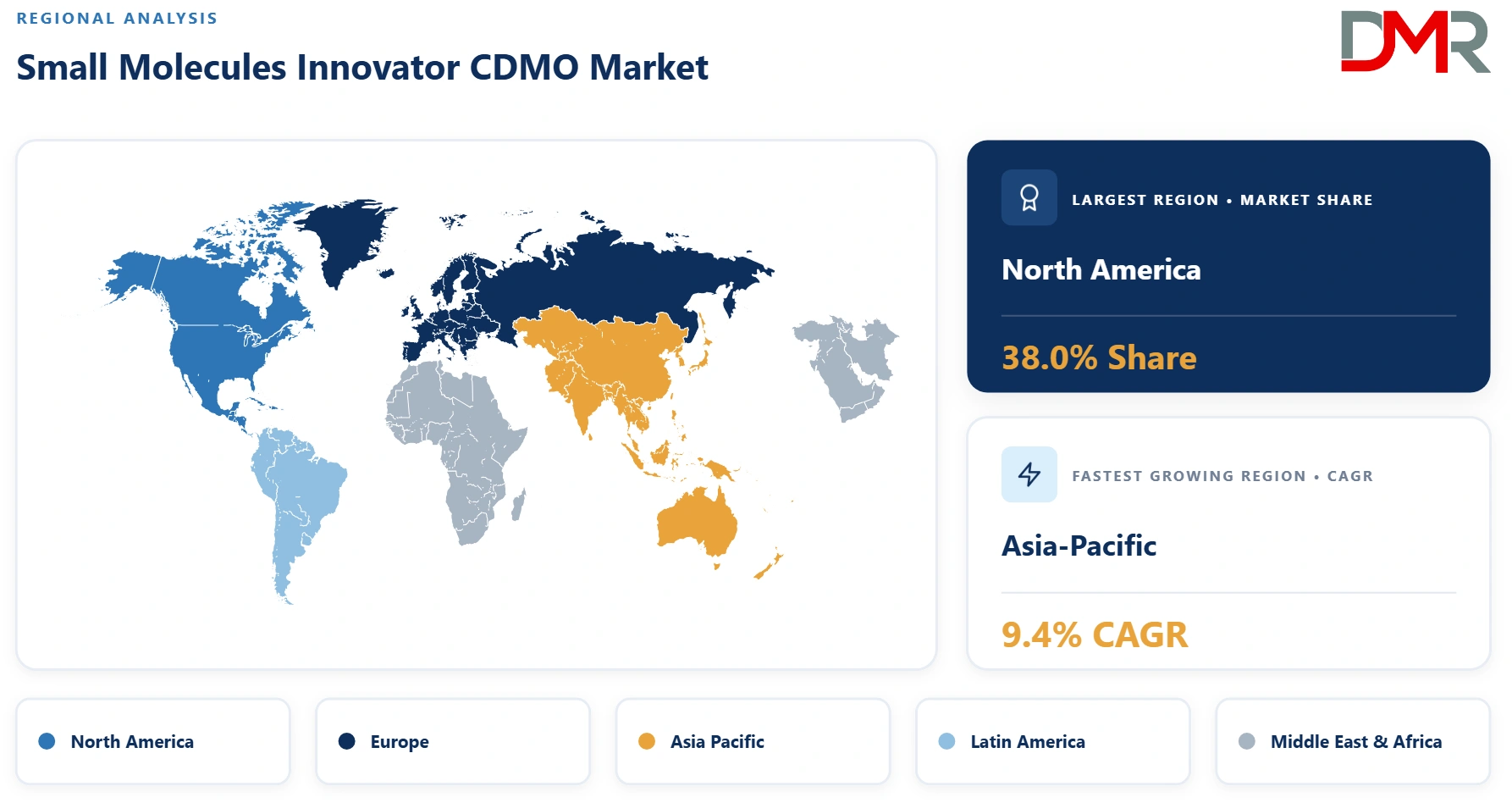
- Largest Region (2026): North America, approximately 38%
- Fastest-Growing Region: Asia-Pacific
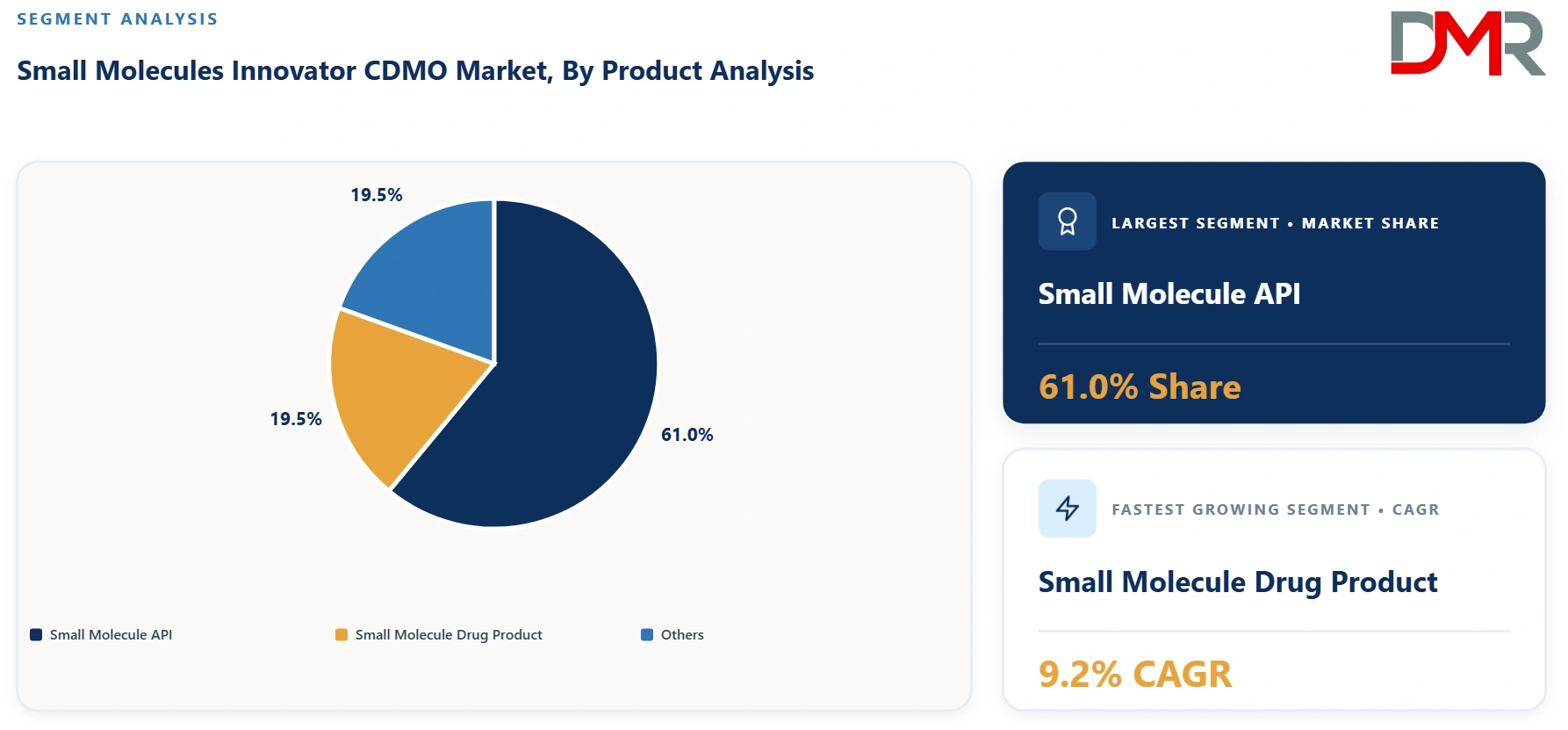
- Leading Product (2026): Small Molecule API, around 61%
- Leading Stage Type (2026): Commercial, close to 47%
- Key Players: Lonza, Thermo Fisher Scientific, CordenPharma and others
What is Small Molecules Innovator CDMO Market and its Market Size?
Global Small Molecules Innovator CDMO Market size is estimated to reach USD 54.7 Bn in 2026 and is further anticipated to reach USD 107.5 Bn by 2035, at a CAGR of 7.8%.
ℹ
To learn more about this report –
Download Your Free Sample Report Here
Small molecule innovator contract development and manufacturing organizations provide outsourced chemistry, process development, analytical, formulation, clinical supply and commercial manufacturing services for patented or pipeline drug candidates. The scope covers custom active pharmaceutical ingredients and finished drug products developed for innovator pharmaceutical and biotechnology sponsors, rather than commodity generic API supply. Revenue is generated through fee-for-service development work, dedicated capacity, technology transfer, clinical manufacturing and recurring commercial supply agreements.
Demand is shaped by a widening gap between the number of development programs entering the clinic and the internal manufacturing capacity that emerging sponsors can economically maintain. Small and mid-sized biotechnology companies often need route scouting, process safety, solid-state characterization, scale-up and GMP production before they have the capital or utilization required for owned plants. Large pharmaceutical companies also outsource selected molecules to diversify supply, gain access to specialized chemistry and move variable manufacturing costs outside the core network.
The industry is structurally moving toward integrated development-to-commercial models. Buyers increasingly evaluate a CDMO on its ability to retain process knowledge across drug substance and drug product, handle potent compounds, manage regulatory documentation and transfer a program between scales without repeated requalification. That favors providers with broad chemistry toolkits and multi-site quality systems, while leaving room for specialist firms that can solve difficult synthesis, particle engineering, containment or formulation problems faster than a diversified incumbent.
Use Cases
- Early Clinical Candidate Scale-Up: Emerging biotechnology sponsors use innovator CDMOs to convert medicinal chemistry routes into reproducible GMP processes for first-in-human supply. The partner establishes impurity controls, process safety limits and analytical methods, reducing the operational burden of building an internal pilot plant before clinical proof of concept.
- High-Potency Oncology Manufacturing: Oncology developers place cytotoxic and highly potent small molecules with facilities designed for contained synthesis, isolation and dosage-form production. Specialized engineering controls let sponsors progress compounds with low occupational exposure limits while avoiding the capital and validation burden associated with dedicated high-containment infrastructure.
- Late-Stage Technology Transfer: Pharmaceutical companies transfer Phase III programs from development laboratories into larger reactors and commercial lines when demand visibility improves. CDMOs redesign unit operations for scale, qualify raw-material sources and prepare process validation packages, helping the sponsor preserve critical quality attributes during the transition to launch volumes.
- Lifecycle and Supply Continuity Programs: Commercial brand owners use secondary CDMO sites to add geographic redundancy, debottleneck established products and support line extensions. A qualified external source can absorb demand peaks, enable new strengths or dosage forms and reduce dependence on a single internal manufacturing location.
Key Takeaways
- Market Size & Share: North America is expected to account for roughly 38% of global revenue in 2026, supported by dense innovator pipelines and high outsourcing intensity.
- Product Analysis: Small Molecule Drug Product is projected to expand at a CAGR of 9.2% from 2026 to 2035 as sponsors seek integrated API-to-dose delivery.
- Regional Analysis: Asia-Pacific is forecast to grow at a CAGR of 9.4% through 2035 as quality-compliant capacity expands across India, China and other manufacturing hubs.
- Customer Mix: Pharmaceutical Companies are set to represent approximately 52% of 2026 revenue because commercial programs carry larger and more durable manufacturing contracts.
- Clinical Pipeline: Clinical manufacturing is forecast to grow at 9.1% as emerging sponsors externalize GMP batches and scale-up work before commercialization.
- Service Evolution: Process Development and Scale-Up is expected to hold close to 27% of 2026 service revenue, reflecting the technical intensity of converting discovery chemistry into manufacturable processes.
How AI/Gen AI is Transforming the Small Molecules Innovator CDMO Market?
AI adoption is concentrated in development productivity rather than autonomous manufacturing. Machine learning can rank reaction conditions, identify correlations in impurity formation and support multivariate process understanding using experimental and manufacturing data. Generative models also assist chemists in exploring synthetic route alternatives, while document-focused systems accelerate the preparation and review of controlled technical records. The value is highest when models are constrained by validated data and embedded within established quality workflows.
For CDMOs, the commercial effect is shorter iteration cycles and better use of scarce scientific capacity. Sponsors still require experimentally demonstrated chemistry, qualified methods and human quality oversight, so AI changes the economics of development more than the regulatory responsibility.
- Route and Condition Screening: Predictive models prioritize reaction pathways, solvents, catalysts and operating windows before laboratory confirmation.
- Deviation and Trend Detection: Statistical learning flags unusual process signals and recurring quality patterns across batches for expert investigation.
- Regulatory Document Processing: LLM-based tools organize development histories, specifications and change records while controlled review preserves data integrity.
- Digital Process Models: Hybrid digital twins combine mechanistic understanding with plant data to support scale-up decisions and reduce unnecessary experimentation.
Key Drivers in the Global Small Molecules Innovator CDMO Market
Outsourcing rises when pipeline breadth grows faster than sponsors can justify fixed manufacturing assets. Two forces are particularly important.
- Asset-Light Development by Emerging Biopharma: Virtual and Emerging Biopharma is expected to account for around 17% of customer revenue in 2026, but its influence on new project starts is larger because these sponsors typically own little manufacturing infrastructure. Funding is therefore directed toward clinical evidence and intellectual property while chemistry, analytical development and GMP production are purchased externally. The mechanism creates repeat work as a molecule advances from gram-scale route development to clinical batches and then larger validation campaigns. CDMOs that can preserve teams and process knowledge across those transitions reduce transfer risk and become harder to replace as the program matures.
- Complexity of Modern Small Molecule Pipelines: Oncology is projected to hold approximately 34% of therapeutic-area revenue in 2026, reflecting the high concentration of potent and structurally demanding compounds in outsourced pipelines. These programs can require specialized containment, cryogenic reactions, asymmetric synthesis, controlled substances handling, challenging crystallization or low-dose formulation. Sponsors rarely need every capability at the same utilization level, making external access more economical than duplicating specialized suites internally. Complexity therefore shifts CDMO selection away from simple reactor volume and toward problem-solving depth, process safety, analytical capability and a credible path from development scale to commercial supply.
Restraints in the Global Small Molecules Innovator CDMO Market
Growth is constrained by the cost of qualified capacity and by the friction created when a sponsor moves a regulated process between organizations. These brakes can delay outsourcing decisions even when external manufacturing is strategically attractive.
- Technology Transfer and Quality-System Friction: Commercial is expected to represent close to 47% of stage revenue in 2026, which means a large share of market value sits in programs where process changes carry substantial validation and filing consequences. Moving a mature molecule requires method transfer, equipment fit assessment, raw-material qualification, comparability work and careful change control. A failed transfer can threaten launch or continuity of supply, so sponsors may keep established products in an incumbent network despite lower-cost alternatives. This creates long sales cycles for challengers and raises the importance of regulatory inspection history, project governance and disciplined documentation alongside chemistry capability.
- Scarcity and Cost of Specialized Capacity: Highly potent, cryogenic, hydrogenation and complex purification assets cannot be added quickly because engineering, containment verification and GMP qualification are capital intensive. Small Molecule API is projected to account for around 61% of product revenue in 2026, concentrating demand on drug-substance plants where complex chemistry can create bottlenecks. When specialized suites are full, sponsors face longer scheduling windows or must redesign a route for another asset base. CDMOs also need experienced process chemists, engineers and quality staff, so labor availability can constrain effective capacity even when physical equipment exists. These factors can increase project cost and limit rapid response to pipeline volatility.
Growth Opportunities in the Global Small Molecules Innovator CDMO Market
White space is strongest where sponsors need both technical specialization and continuity across development stages. Integrated platforms and high-growth Asian capacity offer distinct routes to expansion.
- Integrated API-to-Drug-Product Programs: Small Molecule Drug Product is forecast to expand at 9.2% from 2026 to 2035, faster than the overall industry, as sponsors try to reduce handoffs between drug-substance and formulation partners. A provider that controls solid-state selection, particle engineering, formulation, clinical packaging and commercial scale-up can identify manufacturability problems earlier and keep accountability within one quality network. The opportunity is particularly attractive for poorly soluble molecules and potent oral products where API form, particle properties and dosage-form performance are tightly linked. CDMOs can capture more wallet share per molecule while sponsors gain a simpler governance model and fewer cross-company technology transfers.
- Quality-Compliant Capacity Expansion in Asia-Pacific: Asia-Pacific is forecast to grow at 9.4% through 2035, supported by a deeper base of process chemistry talent, improving regulatory track records and investment in high-value rather than commodity manufacturing. The commercial opening is not simply lower cost. Regional providers are adding containment, flow chemistry, analytical development and integrated clinical-to-commercial services that let them compete for innovator programs earlier in the lifecycle. Sponsors seeking geographic diversification can qualify Asian sites alongside North American or European capacity. Providers that combine responsive project execution with inspection-ready systems can move from intermediate supply into higher-value API and drug-product relationships.
Trends in the Global Small Molecules Innovator CDMO Market
Buyer behavior is shifting toward fewer strategic suppliers while technical investment is moving into platforms that handle difficult chemistry and formulation. This changes both contract structure and the basis of competition.
- From Transactional Projects to Preferred-Network Relationships: Pharmaceutical Companies are projected to represent approximately 52% of 2026 customer revenue, giving large sponsors significant influence over contracting models. Procurement teams increasingly rationalize vendor lists around CDMOs that can support multiple molecules, geographies and lifecycle stages under common quality agreements. That can improve capacity visibility for the manufacturer and reduce repeated audits for the sponsor, but it also raises the performance threshold because delivery, data integrity and change control are evaluated across a broader portfolio. Winning one project therefore matters less than demonstrating repeatable execution across development and commercial programs, which favors providers with standardized governance and flexible multi-site networks.
- Investment in Enabling Chemistry and Particle Engineering: Process Development and Scale-Up is expected to account for nearly 27% of service revenue in 2026 as sponsors confront solubility, potency and synthetic complexity earlier in development. CDMOs are responding with flow chemistry, continuous processing, advanced crystallization, spray drying, milling and solid-form screening capabilities that can solve constraints before commercial scale. These tools are not interchangeable commodities because their value depends on scientific integration with analytical and formulation teams. The trend supports premium pricing for difficult programs and encourages acquisitions of specialist sites that add a missing technology rather than simply increasing generic reactor capacity.
Research Scope and Analysis
Segment performance is assessed across product, stage type, customer type, therapeutic area and service type. Each axis identifies where 2026 revenue is concentrated and where demand is moving through 2035, linking the positions to capacity requirements, sponsor behavior and technical complexity.
ℹ
To learn more about this report –
Download Your Free Sample Report Here
By Product
Small Molecule API is projected to hold the largest product share in 2026, accounting for approximately 61% of revenue because nearly every innovator program requires route development, process optimization, analytical control and GMP drug-substance supply before dosage-form production can begin. API projects also extend across multiple scales, creating recurring work as a molecule moves from clinical to commercial demand. Growth, however, is concentrated in Small Molecule Drug Product, expanding at a CAGR of 9.2% between 2026 and 2035 as sponsors consolidate formulation, clinical supply and commercial dose manufacturing with fewer partners. Poor solubility, potent compounds and accelerated development timelines increase the value of linking solid-state and API decisions directly with formulation and finished-dose process development.
By Stage Type
Commercial is expected to hold the largest stage share in 2026 at around 47%, supported by larger batch sizes, validated recurring campaigns and long supply relationships once a product reaches the market. Commercial programs generate durable revenue but demand high service levels, regulatory consistency and reliable capacity planning. The steeper trajectory sits with Clinical manufacturing, which is forecast to grow at a CAGR of 9.1% from 2026 to 2035 as biotech sponsors outsource GMP production rather than build underutilized internal plants. Clinical work also creates a strategic entry point for CDMOs because successful execution can lead to scale-up, validation and commercial awards, making early engagement valuable beyond the immediate batch revenue.
By Customer Type
Pharmaceutical Companies are projected to lead customer revenue in 2026 with a share of roughly 52%, reflecting their larger commercial portfolios, global supply requirements and willingness to use external manufacturers for specialized chemistry or network flexibility. Their contracts often carry higher volumes and longer durations than early-stage development projects. Growth, however, is concentrated in Virtual and Emerging Biopharma, expanding at a CAGR of 10.3% through 2035 because these sponsors commonly operate with lean technical operations and little owned manufacturing capacity. As financing becomes more milestone driven, external development and GMP manufacturing allow them to preserve capital while still accessing process chemistry, analytical, quality and regulatory capabilities needed to advance assets.
By Therapeutic Area
Oncology is expected to account for close to 34% of therapeutic-area revenue in 2026, driven by a broad small molecule pipeline and frequent need for potent-compound handling, complex synthesis and specialized formulation. These requirements increase outsourced value per program and favor CDMOs with containment and high-potency expertise. The faster growth is expected in Central Nervous System Disorders at a CAGR of 9.0% from 2026 to 2035 as renewed investment in neuropsychiatric and neurodegenerative pipelines increases demand for flexible development capacity. CNS candidates can present challenging solid-state, bioavailability and dose-form requirements, creating opportunities for providers that connect medicinal chemistry transition, API process development and formulation under one technical program.
By Service Type
Process Development and Scale-Up is set to represent approximately 27% of service revenue in 2026 because route selection, impurity control, process safety and scale translation determine whether a discovery synthesis can become a reliable GMP process. Sponsors pay for this expertise early because poor process choices become expensive to correct later. The fastest expansion is projected in Commercial Manufacturing at a CAGR of 8.8% between 2026 and 2035 as more externally developed programs remain with the originating CDMO after approval and as large pharmaceutical companies add qualified secondary sources. Commercial awards favor providers that can demonstrate inspection readiness, consistent yields, secure raw-material strategies and the ability to reserve capacity over multi-year demand horizons.
The Global Small Molecules Innovator CDMO Market Report is Segmented Based on the Following
By Product
- Small Molecule API
- Small Molecule Drug Product
- Others
By Stage Type
- Preclinical
- Clinical
- Commercial
- Others
By Customer Type
- Pharmaceutical Companies
- Biotechnology Companies
- Virtual and Emerging Biopharma
- Others
By Therapeutic Area
- Oncology
- Cardiovascular and Metabolic Disorders
- Central Nervous System Disorders
- Infectious Diseases
- Immunology and Inflammation
- Other Therapeutic Areas
By Service Type
- Process Development and Scale-Up
- Analytical Development and Testing
- Clinical Manufacturing
- Commercial Manufacturing
- Packaging and Supply Services
- Others
Regional Analysis
Region with the Largest Revenue Share
North America is expected to remain the largest regional market in 2026, accounting for approximately 38% of global revenue. The region combines a dense concentration of biotechnology sponsors, large pharmaceutical procurement budgets and a substantial installed base of clinical and commercial manufacturing sites. US innovators frequently externalize process development and clinical supply while retaining strategic oversight of CMC programs, which creates a large addressable pool for specialized CDMOs. The region also benefits from demand for domestic or near-market capacity in controlled substances, potent compounds and commercial APIs. High labor and operating costs encourage providers to compete on speed, technical depth and regulatory execution rather than on unit manufacturing cost alone.
ℹ
To learn more about this report –
Download Your Free Sample Report Here
Region with the Highest CAGR
Asia-Pacific is forecast to record the highest regional CAGR of 9.4% from 2026 to 2035. India and China are moving beyond cost-led intermediate production toward complex chemistry, high-potency handling, analytical development and integrated clinical-to-commercial services, while other Asian locations are attracting new capacity intended for global customers. A large scientific workforce and expanding GMP infrastructure improve the region's ability to win innovator programs earlier in development. Sponsors are also qualifying geographically diversified supply networks to reduce concentration risk. Growth will depend on consistent inspection performance, intellectual-property controls and the ability of regional providers to maintain project management standards across increasingly complex multinational programs.
By Region
North America
Europe
- Germany
- France
- The UK
- Italy
- Spain
- Rest of Europe
Asia-Pacific
- China
- Japan
- India
- Australia
- South Korea
- Rest of APAC
Latin America
- Mexico
- Brazil
- Colombia
- Argentina
- Rest of LATAM
Middle East & Africa
- Saudi Arabia
- The UAE
- South Africa
- Rest of MEA
Regulatory Landscape
Innovator CDMOs operate inside sponsor quality systems while also meeting current good manufacturing practice expectations from authorities such as the US FDA, EMA and other national regulators. The current emphasis is on data integrity, contamination control, lifecycle process validation, elemental and mutagenic impurity management, and defensible change control across transferred processes. As sponsors use multi-site networks, harmonized documentation and inspection readiness are becoming commercial differentiators rather than back-office functions. The opening sits with providers that can pair development speed with disciplined CMC support across jurisdictions. The brake is that a compliance failure can affect multiple client programs simultaneously, increasing qualification scrutiny and favoring CDMOs with consistent quality governance.
Patent Analysis
Patent strategy influences CDMO work because innovator sponsors protect not only active compounds but also synthetic routes, intermediates, crystalline forms, formulations and manufacturing improvements. As pipelines mature, process chemists are increasingly asked to design scalable routes that avoid third-party constraints while strengthening the sponsor's own manufacturing intellectual property. Commercial opportunity therefore sits in integrated teams that combine route scouting, solid-state science and analytical characterization early enough to shape a defensible CMC package. Risk arises when confidential process knowledge moves across sites or when freedom-to-operate assumptions change late in development. Strong information controls and carefully documented invention ownership can improve sponsor confidence and make technically capable CDMOs more durable development partners.
Competitive Landscape
Competition is fragmented across global full-service networks, chemistry specialists and regional manufacturers moving into higher-value innovator work. Large providers compete through integrated API and drug-product capabilities, multi-site redundancy and regulatory track records, while specialist CDMOs differentiate through speed, complex chemistry, high-potency containment, particle engineering or difficult formulation. Capacity expansion increasingly targets technologies that raise project value rather than undifferentiated reactor volume. Sponsors also reward continuity, so an early clinical relationship can become strategically important if the same provider can support validation and launch. M&A remains a route to add missing technologies, geographic coverage and commercial-scale assets, but integration quality determines whether acquired capability becomes a coherent customer proposition.
Some of the Prominent Players in the Global Small Molecules Innovator CDMO Market Are
- Lonza
- Thermo Fisher Scientific
- Catalent Pharma Solutions
- Boehringer Ingelheim
- Siegfried
- Cambrex
- CordenPharma
- Curia
- Piramal Pharma Solutions
- WuXi STA
- Recipharm
- Ajinomoto Bio-Pharma Services
- Almac Group
- PCI Pharma Services
- Quotient Sciences
- Eurofins CDMO Alphora
- Seqens
- Axplora
- Minakem
- Hovione
- Evonik Health Care
- Aenova Group
- Fareva
- Delpharm
- Lupin Manufacturing Solutions
- Syngene International
- Jubilant Biosys
- Neuland Laboratories
- Anthem Biosciences
- Cohance Lifesciences
- Dishman Carbogen Amcis
- Sai Life Sciences
- Aragen Life Sciences
- Asymchem
- Porton Pharma Solutions
- Jiuzhou Pharma
- Bora Pharmaceuticals
- Formosa Laboratories
- Pfanstiehl
- Wilmington PharmaTech
- Other Key Players
Recent Developments
- In July 2026, Codis announced an agreement to acquire Catalent's Nottingham facility in the UK, adding oral solid dose development and small-scale manufacturing to its spray-drying platform and strengthening an integrated path from particle engineering to finished dose.
- In March 2026, Cambrex reported progress on engineering for a new large-scale API plant in Charles City, Iowa, tied to a major US capacity expansion for complex chemistry, highly potent APIs and commercial manufacturing.
- In October 2025, Cambrex advanced a substantial US investment program at Charles City to expand API manufacturing capacity, supporting pharmaceutical innovators seeking larger domestic options for late-stage and commercial small molecule supply.
- In September 2025, Thermo Fisher Scientific completed the acquisition of a New Jersey sterile manufacturing and packaging site from Sanofi, broadening its US capacity and reinforcing the trend toward integrated development and manufacturing networks.
- In 2025, CordenPharma expanded small molecule and highly potent capabilities across European and US sites, adding purification, development, reactor, containment and oral solid dose capacity intended to support programs from development through commercial supply.
Report Details
| Report Characteristics |
| Market Size (2026) |
USD 54.7 Bn |
| Forecast Value (2035) |
USD 107.5 Bn |
| CAGR (2026–2035) |
7.8% |
| The US Market Size (2026) |
USD 17.4 Bn |
| Historical Data |
2021 – 2025 |
| Forecast Data |
2026 – 2035 |
| Base Year |
2025 |
| Segments Covered |
By Product, By Stage Type, By Customer Type, By Therapeutic Area and By Service Type |
| Regional Coverage |
North America - The US and Canada; Europe - Germany, France, The UK, Italy, Spain, Rest of Europe; Asia-Pacific - China, Japan, India, Australia, South Korea, Rest of APAC; Latin America - Mexico, Brazil, Colombia, Argentina, Rest of LATAM; Middle East & Africa - Saudi Arabia, The UAE, South Africa, Rest of MEA |
Frequently Asked Questions
How big is the Global Small Molecules Innovator CDMO Market?
▾ The industry is estimated at USD 54.7 Bn in 2026, covering outsourced development and manufacturing for innovator small molecule APIs and drug products. Revenue includes development, analytical, clinical and commercial services delivered to pharmaceutical and biotechnology sponsors rather than commodity generic manufacturing.
What is the growth rate of the Global Small Molecules Innovator CDMO Market?
▾ Global revenue is forecast to expand at a CAGR of 7.8% from 2026 to 2035. Growth reflects continued externalization of CMC work, greater technical complexity in small molecule pipelines and demand from asset-light biotechnology companies that need qualified development and manufacturing infrastructure without building it internally.
Which region holds the largest share in the Global Small Molecules Innovator CDMO Market?
▾ North America is expected to hold the largest regional position in 2026, with a share of approximately 38%. Its lead is supported by the concentration of pharmaceutical and biotechnology sponsors, strong clinical development activity, substantial commercial procurement budgets and a mature network of specialized GMP manufacturing providers.
Who are the key players in the Global Small Molecules Innovator CDMO Market?
▾ Key participants include Lonza, Thermo Fisher Scientific, CordenPharma, Cambrex, Siegfried, Piramal Pharma Solutions and WuXi STA. Competition is based on chemistry depth, regulatory performance, capacity availability, high-potency handling, integrated API-to-drug-product services and the ability to retain programs from early development through commercial supply.
Which product segment leads the Global Small Molecules Innovator CDMO industry?
▾ Small Molecule API is expected to lead the product mix in 2026, representing around 61% of revenue. Drug-substance work captures route development, process optimization, analytical control, scale-up and recurring GMP production, giving it a broad role across nearly every innovator small molecule program.