South Africa Food Processing Equipment Market Snapshot
- Market Size in 2026: USD 1.8 billion
- Market Size in 2035: USD 2.9 billion
- CAGR, 2026-2035: 5.1%
- Leading Equipment Type: Processing Equipment, 29.0%
- Leading Mode of Operation: Automatic, 54.0%
- Leading Food Category: Dairy Products, 22.0%
- Fastest-Growing Segment: Automatic Equipment, 6.4% CAGR
What is the South Africa Food Processing Equipment and its Market Size?
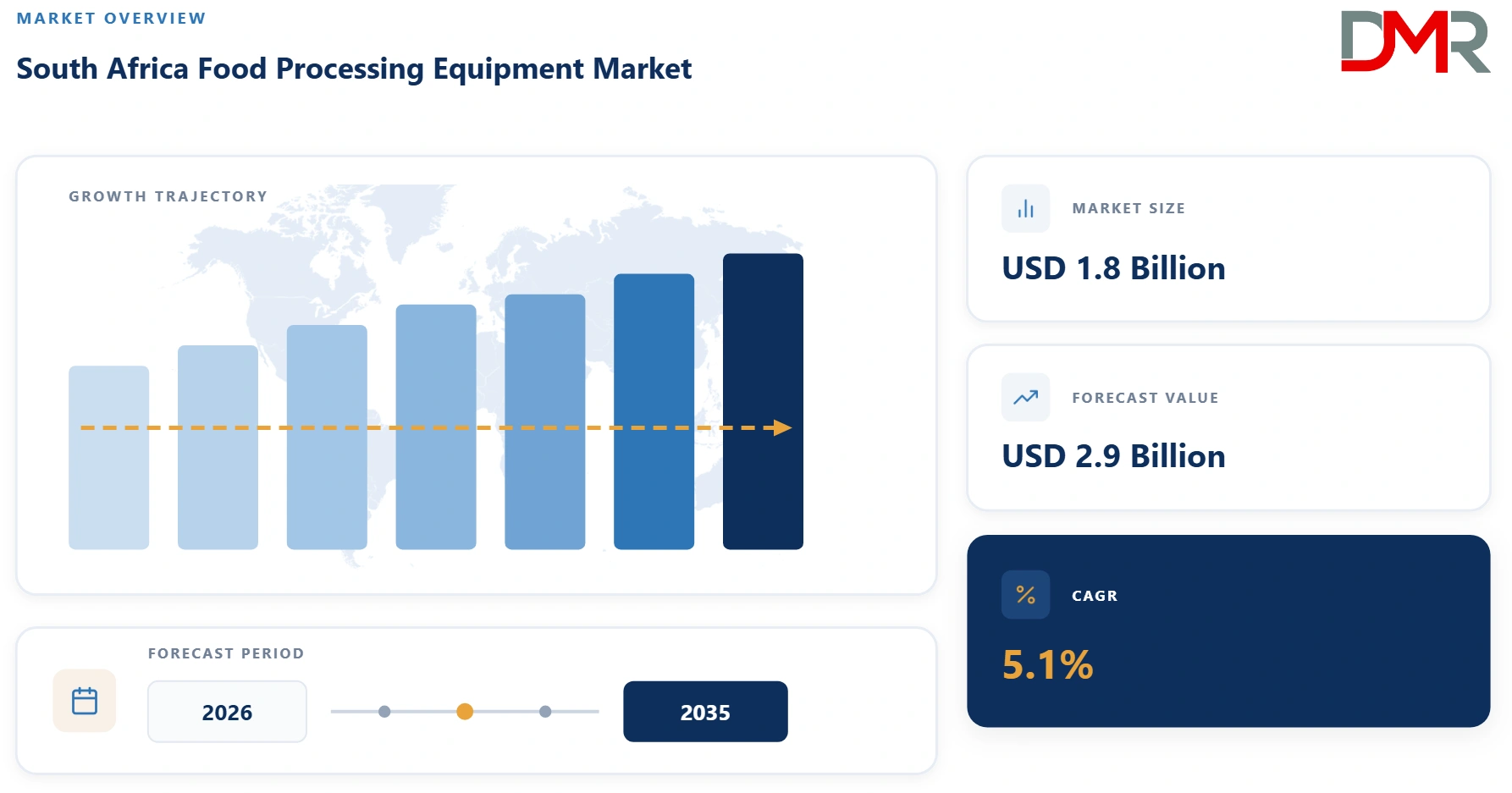
The South African market is estimated at USD 1.8 billion in 2026 and is projected to reach approximately USD 2.9 billion by 2035, representing a 5.1% CAGR.
ℹ
To learn more about this report –
Download Your Free Sample Report Here
The South Africa food processing equipment market comprises machinery, systems, controls and integrated production lines used to transform agricultural and food ingredients into processed, packaged and commercially distributed food and beverage products. It encompasses processing, packaging, material handling, cooking, cooling, cleaning, sanitation, inspection and associated automation technologies. Equipment is supplied to large industrial processors as well as SMEs and specialist producers, through direct sales, distributors, system integrators and turnkey engineering companies. The market's primary value proposition is to increase throughput, consistency, food safety and shelf life while reducing labor requirements, waste, energy consumption and total production costs.
Use Cases
- Dairy processing: Separation, homogenization, pasteurization, UHT treatment, filling and packaging of milk and dairy products.
- Meat processing: Cutting, deboning, grinding, weighing, cooking, chilling, inspection and hygienic packaging.
- Bakery production: Mixing, forming, proofing, baking, cooling, slicing and automated packaging of bakery products.
- Beverage production: Blending, filtration, pasteurization, carbonization, filling and downstream handling of beverages.
- Fruit and vegetable processing: Washing, sorting, peeling, cutting, blanching, freezing, drying and packaging.
- Grain processing: Cleaning, milling, grinding, weighing, conveying and ingredient handling for flour and cereal products.
Key Takeaways
- Market size: South Africa's food processing equipment market is estimated at USD 1.8 billion in 2026 and approximately USD 2.9 billion by 2035.
- Growth: The market is expected to expand at approximately 5.1% CAGR during 2026-2035.
- Growth drivers: Food-manufacturing investment, automation, labor-cost management, food-safety requirements and replacement of aging machinery remain fundamental demand drivers.
- Segment dominance: Processing equipment, automatic machinery, and dairy applications represent the leading segments in their respective categories.
- Fastest growth: Automatic equipment is forecast to expand at roughly 6.4% CAGR, reflecting increasing adoption of integrated automation and digitally controlled production lines.
- Competitive structure: The market combines multinational technology suppliers with local distributors, engineering companies, system integrators and specialist machinery providers.
How AI/Gen AI is Transforming the South Africa Food Processing Equipment Market?
AI, IoT, machine vision, PLC-based controls and industrial analytics are increasingly being embedded into food-processing lines. Sensors monitor temperature, pressure, flow, vibration, moisture and product quality, while connected control systems enable real-time production monitoring. Equipment suppliers are moving from standalone machines toward integrated lines combining processing, automation, digital controls and downstream handling. Tetra Pak, for example, describes integrated lines combining equipment, automation and digital solutions to reduce total cost of ownership.
The principal benefits are higher throughput, reduced downtime, predictive maintenance, improved quality consistency, lower waste and better resource utilization. Machine vision can identify defects, while predictive analytics can detect equipment degradation before breakdowns. Automated cleaning and process-control systems can also improve food safety and repeatability.
Key Drivers in the South Africa Food Processing Equipment Market
Modernization and Automation of Food Manufacturing
South African food processors are under pressure to increase productivity while controlling labor, energy, water and maintenance costs. Automation provides an attractive response because it allows manufacturers to increase throughput and consistency without proportionately increasing headcount. The shift is particularly relevant for large dairy, beverage, bakery, meat and grain processors operating continuous or high-volume production lines. Automatic equipment already represents the largest operating-mode category in the market benchmark.
Expansion and Diversification of Processed Food Production
South Africa has a mature food-manufacturing base supported by agriculture, retail, hospitality and export markets. Food, beverages and tobacco account for roughly one-fifth of manufacturing employment, according to the Department of Trade, Industry and Competition's sector data.Demand for processed, convenience and higher-value foods creates requirements for new production capacity, flexible equipment and improved packaging. Dairy, beverages, bakery products, meat, prepared foods and fruit and vegetable processing remain important equipment-consuming industries.
Restraints in the South Africa Food Processing Equipment Market
High Capital Costs and Financing Constraints
Advanced food-processing lines require substantial upfront investment, particularly for SMEs. Fully automated processing, robotic handling, integrated packaging and digitally controlled systems can have significantly higher acquisition costs than semi-automatic or manual alternatives. Financing costs, currency volatility and imported-equipment exposure can further increase project risk.
Imported Technology, Currency and Supply-Chain Exposure
A significant portion of sophisticated processing equipment is imported, exposing buyers to exchange-rate movements, international logistics and longer lead times. Trade data demonstrate the importance of imported machinery: South Africa imported approximately USD 46.5 million of machinery for making hot drinks or cooking in 2024, with the United States, China, Italy and Germany among major suppliers.
Growth Opportunities in the South Africa Food Processing Equipment Market
Smart, Energy-Efficient and Resource-Saving Equipment
Energy and water efficiency represent one of the strongest opportunities for suppliers. Food processors face ongoing pressure to reduce operating expenses and environmental impacts, creating demand for heat recovery, efficient motors, optimized refrigeration, automated cleaning-in-place, water reuse and intelligent process controls.
Regional Export Manufacturing and Flexible Production Lines
South Africa can function as a manufacturing and distribution platform for Southern African food products. Regional food manufacturers increasingly need flexible equipment capable of handling multiple recipes, package sizes and production volumes. Turnkey lines that combine raw-material handling, processing, packaging and logistics can capture more value than individual equipment sales. Tetra Pak explicitly markets integrated plant solutions designed to combine equipment, automation and digital services while reducing total cost of ownership.
Trends in the South Africa Food Processing Equipment Market
Integrated Processing and Packaging Lines
The market is moving from individual machines toward complete production systems. Integrated lines allow manufacturers to coordinate processing, filling, packaging, conveying and controls, improving throughput and reducing manual intervention. Tetra Pak's South African offering illustrates this direction by combining processing equipment, filling and downstream technologies within integrated lines.
Sustainability and Alternative-Protein Processing
Sustainability is increasingly influencing machinery specifications. Equipment buyers are evaluating energy use, water consumption, waste generation and product yield alongside throughput. Plant-based and fermentation-derived foods are also opening new equipment categories. Tetra Pak opened a New Food Technology Development Centre in 2025 to help producers scale fermentation-derived foods and ingredients, while its portfolio now includes plant-based processing technologies.
Research Scope and Analysis
The South Africa food processing equipment market is segmented by Equipment Type, Mode of Operation, Food Category and End User. These dimensions capture the machinery purchased, automation intensity, industries generating equipment demand and customer scale.
ℹ
To learn more about this report –
Download Your Free Sample Report Here
By Equipment Type Analysis
Processing Equipment is estimated to be the dominant equipment category in 2026, accounting for approximately 29.0% of market revenue. Its leadership reflects the fundamental requirement to transform raw ingredients through mixing, grinding, separation, cutting, homogenization, pasteurization and other processes before packaging. Packaging Equipment, with approximately 24.0%, is the second-largest category, supported by growing demand for shelf life, convenience formats, traceability and export-ready packaging. The fastest-growing sub-segment is estimated to be Packaging Equipment, at approximately 6.0% CAGR, as processors increasingly automate filling, sealing, labeling and inspection. Material handling equipment represents about 19.0%, while cooking and cooling, cleaning and sanitation and other specialized equipment account for the balance. Equipment suppliers increasingly compete on integrated solutions rather than individual machine specifications, particularly as customers seek lower total cost of ownership and higher plant uptime. Tetra Pak's local portfolio illustrates the breadth of processing technologies available, including blending, separation, CIP, heat exchange, pasteurization, UHT and membrane filtration.
By Mode of Operation Analysis
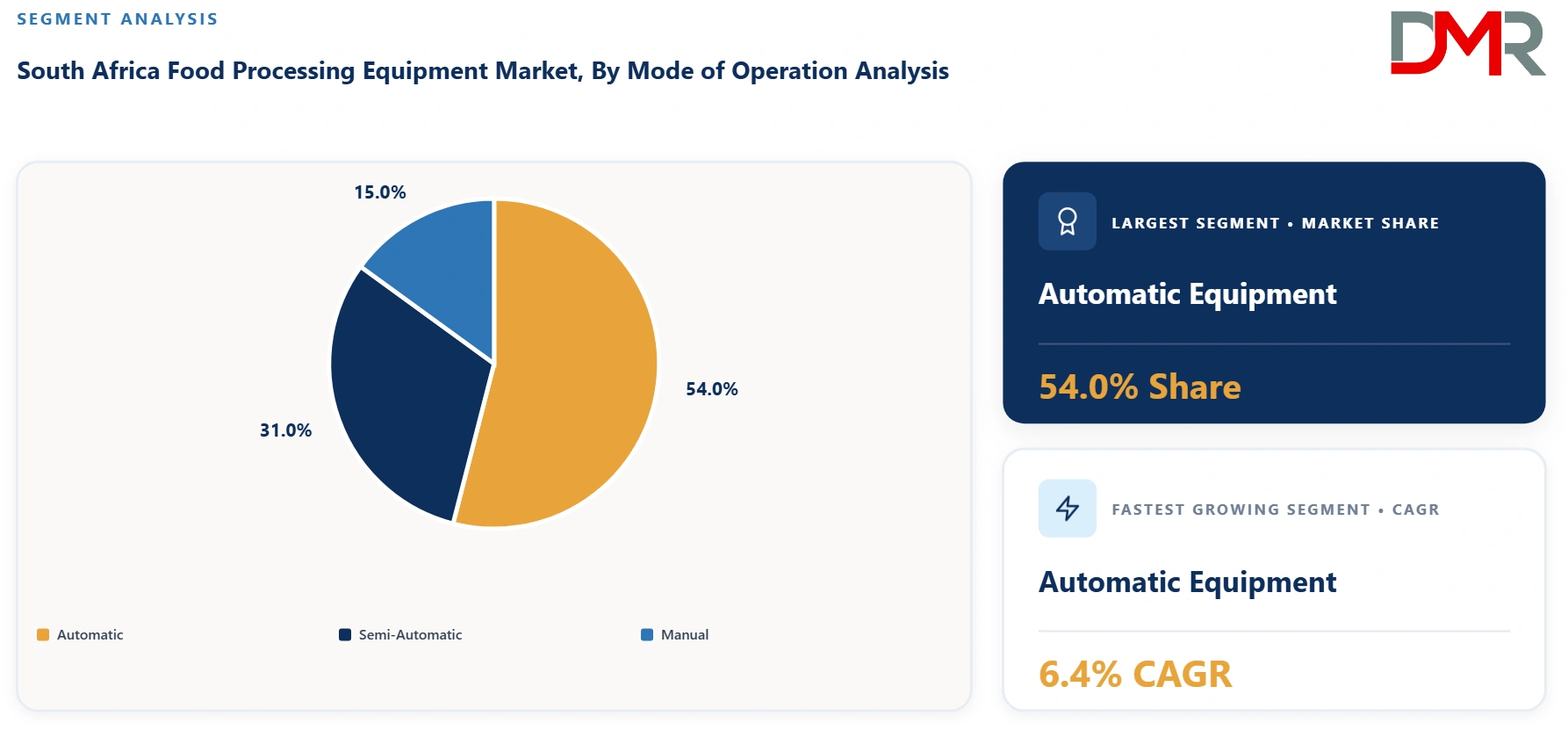
Automatic equipment is the dominant mode, representing an estimated 54.0% share in 2026, as large processors prioritize consistent output, reduced labor requirements, higher throughput and improved process control. Automatic equipment is also the fastest-growing sub-segment at approximately 6.4% CAGR through 2035. Its expansion is supported by falling sensor and automation costs, increasing availability of industrial controls and greater interest in predictive maintenance. Semi-automatic equipment, estimated at approximately 31.0%, remains the second-largest category because it offers a compromise between capital cost and productivity, particularly for SMEs and growing processors. Manual equipment accounts for approximately 15.0% and remains relevant among artisanal producers and low-volume specialty manufacturers. The market is therefore expected to experience a gradual migration from manual toward semi-automatic and automatic machinery rather than an immediate replacement of lower-automation equipment.
By Food Category Analysis
Dairy Products are estimated to be the leading food category, accounting for approximately 22.0% of equipment demand in 2026. Dairy processing requires extensive investment in separation, homogenization, pasteurization, UHT, refrigeration, filling, cleaning and hygienic handling, creating substantial equipment intensity. Beverages represent the second-largest category at approximately 19.0%, driven by high-volume production and increasingly sophisticated filling and processing requirements. Meat, Poultry and Seafood, at around 17.0%, is another major equipment-consuming category because of requirements for cutting, grinding, chilling, inspection and hygienic packaging. The fastest-growing category is estimated to be Beverages at approximately 6.1% CAGR, supported by bottled water, functional beverages, juices, energy drinks and ready-to-drink products. Plant-based beverages and protein-enriched products provide additional technology opportunities. Tetra Pak's South African portfolio spans dairy, beverages, food, plant-based products and new food applications, demonstrating the increasing diversification of processing technology demand.
By End User Analysis
Large-Scale Food Processors represent the dominant end-user category, with an estimated 64.0% market share in 2026. Large processors have the capital expenditure capacity to purchase high-throughput automated machinery and complete production lines, while their scale allows them to justify investments in energy efficiency, robotics, digital monitoring and predictive maintenance. Small and Medium-Sized Processors represent approximately 27.0% and constitute the fastest-growing customer group at an estimated 5.9% CAGR, supported by formalization, premium food categories and demand for modular automation. Artisanal and specialty food producers account for approximately 9.0%. Their requirements are smaller in volume but increasingly sophisticated, particularly in premium dairy, bakery, sauces, specialty beverages and niche prepared foods. Suppliers that offer modular systems, financing, refurbished machinery and scalable upgrades can capture this segment as producers transition from manual to semi-automatic production.
The South Africa Food Processing Equipment Market Report is segmented on the basis of the following:
By Equipment Type
- Processing Equipment
- Packaging Equipment
- Material Handling Equipment
- Cooking and Cooling Equipment
- Cleaning and Sanitation Equipment
By Mode of Operation
- Automatic
- Semi-Automatic
- Manual
By Food Category
- Dairy Products
- Meat, Poultry and Seafood
- Bakery and Confectionery
- Beverages
- Fruits and Vegetables
- Grain Milling and Processing
- Others
By End User
- Large-Scale Food Processors
- Small and Medium-Sized Processors
- Artisanal and Specialty Food Producers
Technology Analysis
Technology is becoming a central competitive differentiator in South Africa's food-processing equipment industry. Automation, IoT sensors, machine vision, advanced PLCs, robotics, digital twins and predictive-maintenance software are moving machinery from standalone capital assets toward connected production systems. The opportunity is particularly strong in large dairy, beverage, meat and bakery facilities where downtime can generate significant losses. Risks include high implementation costs, cybersecurity requirements, skills shortages and integration difficulties with legacy equipment. Vendors that combine hardware with software, remote monitoring, engineering and lifecycle support are therefore positioned to capture higher-margin service revenue. The market impact will be a gradual shift toward smart factories, condition-based maintenance, automated quality control and increasingly measurable equipment productivity.
Investment and White Space Analysis
Investment opportunities are strongest where food processors must simultaneously increase productivity and manage energy, water and labor costs. White spaces include modular automation for SMEs, energy-efficient thermal systems, advanced refrigeration, hygienic material handling, machine vision, automated packaging and equipment retrofit services. Plant-based, functional beverages, prepared foods and fermentation-derived ingredients create additional opportunities for specialized processing technologies. Investors should nevertheless account for currency exposure, imported machinery, long equipment replacement cycles and uneven capital availability among smaller processors. Local technical support can substantially improve market penetration because downtime and spare-part delays are important purchasing concerns. Companies combining imported technology with local engineering, installation and maintenance capabilities therefore have a structurally attractive position.
Competitive Landscape
The South African food processing equipment market is moderately fragmented, combining multinational technology companies, specialist international manufacturers, local distributors and engineering/system-integration firms. Major international suppliers compete through technology leadership, turnkey plant solutions, energy efficiency, automation, food-safety performance and lifecycle service. Local companies differentiate through technical support, regional knowledge, installation capability, spare-parts availability and customer relationships. Eptech, for example, provides machinery, plant design, installation, servicing and spare-parts management, while Bühler maintains a Johannesburg operation with engineering services and local spare-parts capabilities.
Some of the prominent players in the South Africa Food Processing Equipment Market are:
- Tetra Pak
- GEA Group
- Bühler Group
- JBT Marel
- Alfa Laval
- SPX FLOW
- Krones
- The Middleby Corporation
- Marel
- Heat and Control
- Ishida
- MULTIVAC
- Syntegon Technology
- IMA Group
- KHS
- Sidel
- FLSmidth
- Hosokawa Micron
- ANDRITZ
- Baker Perkins
- Clextral
- Pavan Group
- Flottweg
- FAM
- KRONEN
- Big Dutchman
- DeLaval
- DFS Process Solutions
- EPTECH
- FoodServ
- Sinofood Processing Equipment
- Dryers for Africa
- Butcher and Meat Processing Equipment
- ProXES
- Handtmann
- BAADER
- Frontmatec
- Vemag
- Bizerba
- Weber Maschinenbau
- Other Key Players
Recent Developments
- December 2025: Tetra Pak acquired Bioreactors.net to strengthen its biomass and precision-fermentation equipment capabilities, expanding its technology platform for emerging New Food production systems.
- November 2025: Bühler announced that its Southern Africa business delivered growth, innovation and resilience in 2025, while continuing to expand regional customer support and technology capabilities.
- November 2025: Bühler highlighted smart-silo technology at an African agrifood investment platform, reinforcing the industry's movement toward connected storage, automation and improved grain-handling efficiency.
- November 2025: Tetra Pak launched sunflower protein as a plant-based ingredient platform, enabling food and beverage producers to develop protein-rich beverages, dairy alternatives and other products using existing processing capabilities.
- September 2025: Bühler Johannesburg added a new die-refurbishment machine to its service offering, strengthening local maintenance and lifecycle-support capabilities for industrial customers.
Report Details
| Report Characteristics |
| Market Size (2026) |
USD 1.8 Bn |
| Forecast Value (2035) |
USD 2.9 Bn |
| CAGR (2026–2035) |
5.1% |
| Historical Data |
2021 – 2025 |
| Forecast Data |
2026 – 2035 |
| Base Year |
2025 |
| Segments Covered |
By Equipment Type, By Mode Of Operation, By Food Category, By End User |
| Country Coverage |
South Africa |
Frequently Asked Questions
What is the South Africa Food Processing Equipment Market size in 2026?
▾ The South Africa Food Processing Equipment Market is estimated at approximately USD 1.8 billion in 2026.
What will the South Africa Food Processing Equipment Market be worth in 2035?
▾ The South Africa Food Processing Equipment Market is projected to reach approximately USD 2.9 billion by 2035.
What is the CAGR of the South Africa Food Processing Equipment Market?
▾ The South Africa Food Processing Equipment Market is expected to grow at approximately 5.1% CAGR from 2026 to 2035.
What are the key drivers of the South Africa Food Processing Equipment Market?
▾ The South Africa Food Processing Equipment Market is driven by automation, food manufacturing modernization, equipment replacement, packaging demand, food safety, and energy-efficiency investments.
Which segment dominates the South Africa Food Processing Equipment Market?
▾ Processing Equipment dominates the South Africa Food Processing Equipment Market, accounting for an estimated 29.0% share in 2026.
Which is the fastest-growing segment in the South Africa Food Processing Equipment Market?
▾ Automatic Equipment is the fastest-growing segment in the South Africa Food Processing Equipment Market, with an estimated 6.4% CAGR.
Who are the key players in the South Africa Food Processing Equipment Market?
▾ Key players in the South Africa Food Processing Equipment Market include Bühler, Tetra Pak, GEA, and regional equipment suppliers and system integrators.
What are the major trends in the South Africa Food Processing Equipment Market?
▾ Major trends in the South Africa Food Processing Equipment Market include automation, integrated production lines, predictive maintenance, energy efficiency, smart processing, and flexible manufacturing.