South Korea Functional Food Ingredients Market Snapshot
- Market Size in 2026: USD 1.75 billion
- Market Size in 2035: USD 3.15 billion
- CAGR, 2026-2035: 6.8%
- Leading Ingredient Type : Probiotics, 28% share
- Leading Source: Plant-Based, 46% share
- Leading Form: Powder, 62% share
- Leading Application: Dietary Supplements, 36% share
- Leading End-Use Industry: Nutraceutical Industry, 34% share
- Fastest-Growing Segment: Microbial Source, 8.1% CAGR
What is the South Korea Functional Food Ingredients and its Market Size?
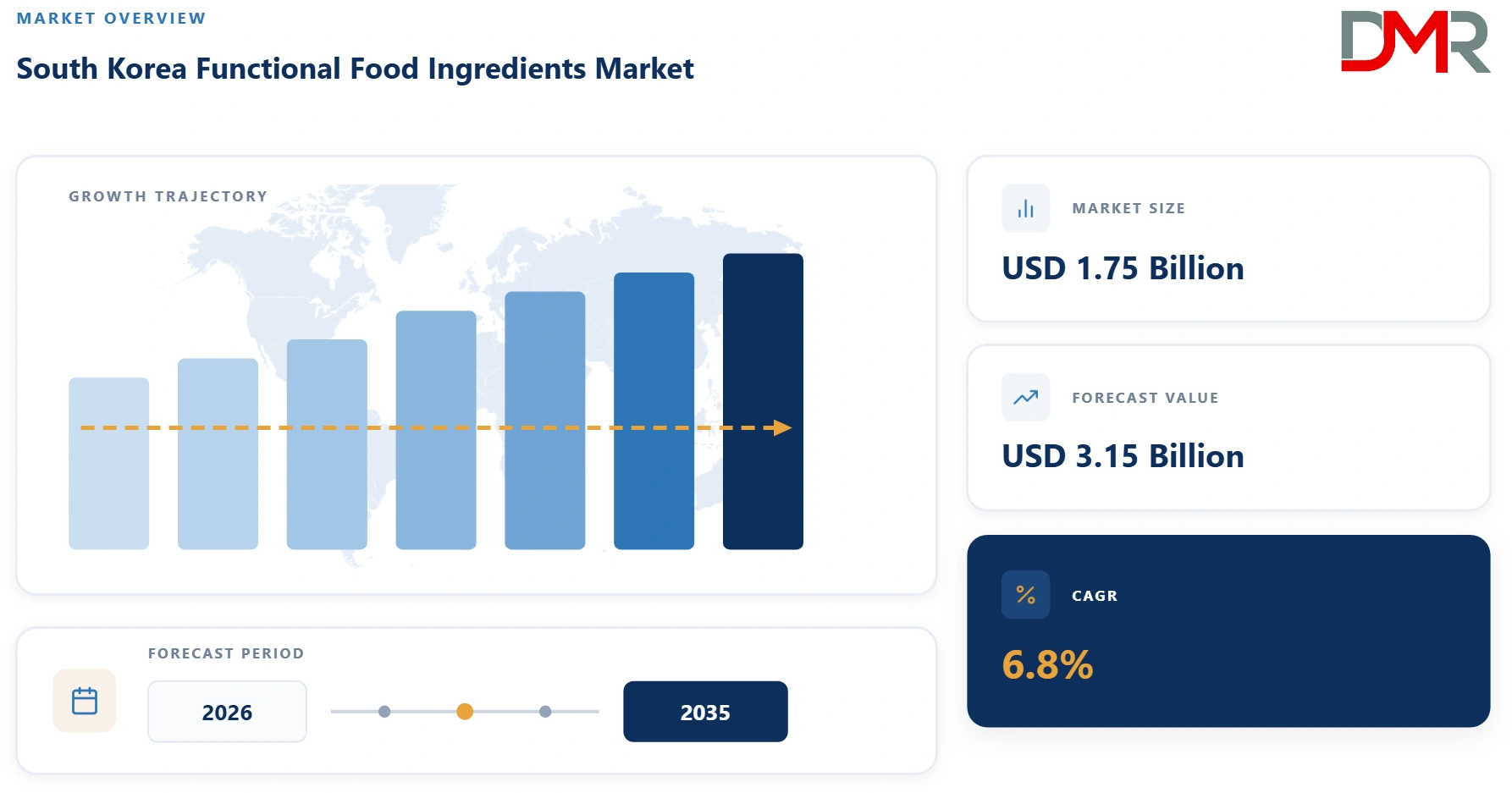
The South Korea functional food ingredients market is estimated at USD 1.75 billion in 2026 and is projected to reach approximately USD 3.15 billion by 2035, representing a 6.8% CAGR.
ℹ
To learn more about this report –
Download Your Free Sample Report Here
South Korea's functional food ingredients market comprises specialized nutritional, bioactive and health-promoting raw materials incorporated into foods, beverages, dietary supplements and other nutrition products to provide benefits beyond basic nutrition. The market includes probiotics, prebiotics, vitamins, minerals, proteins, amino acids, omega-3 fatty acids, fibers, antioxidants, plant extracts and phytochemicals. Ingredient suppliers generally sell standardized powders, liquids, concentrates, cultures or granules to food manufacturers, nutraceutical companies and supplement brands. The value proposition is the ability to formulate products around specific consumer health needs, including digestive, immune, cardiovascular, metabolic, cognitive, skin and healthy-aging benefits, while supporting differentiated product claims.
Use Cases
- Digestive Health: Probiotics, prebiotics and fibers support products positioned around gut microbiome balance and digestive wellness.
- Immune Support: Vitamins, minerals, probiotics and botanical extracts are incorporated into immunity-oriented supplements and beverages.
- Weight Management: Probiotics, proteins, fibers and plant extracts support products targeting body-fat and metabolic-health management.
- Beauty-from-Within: Collagen-supporting nutrients, probiotics, antioxidants and botanical ingredients target skin hydration and healthy aging.
- Sports Nutrition: Proteins, amino acids, electrolytes and performance-oriented ingredients support muscle recovery and active lifestyles.
- Healthy Aging: Omega-3s, vitamins, minerals, probiotics and phytochemicals address cognitive, cardiovascular and mobility-related needs.
Key Takeaways
- Market Size and Growth: The market is estimated at USD 1.75 billion in 2026, reaching USD 3.15 billion by 2035 at 6.8% CAGR.
- Growth Drivers: Preventive healthcare, aging demographics, microbiome research, premium nutrition and expanding functional-food applications are central growth catalysts.
- Segment Dominance: Probiotics lead ingredient demand, while plant-based sources, powders and dietary supplements represent the largest structural categories.
- Fastest Growth: Microbial-source ingredients are projected to grow at approximately 8.1% CAGR, driven by probiotics, postbiotics, fermentation-derived compounds and microbiome innovation.
- Industry Direction: Competition is shifting from commodity ingredients toward clinically validated, traceable, branded and individually recognized ingredients.
How AI/Gen AI is Transforming the South Korea Functional Food Ingredients Market?
AI, multi-omics, advanced fermentation and microbiome analytics are increasingly influencing Korean functional-ingredient development. Companies are using genomic screening, microbial databases, AI-assisted strain selection, organoid models and human clinical data to identify strains and bioactive compounds with targeted functionality. In June 2026, NeoCremar joined a government-supported R&D program using AI, organoids and multi-omics to develop digestive-health ingredients and commercialize individually approved functional foods. Technology improves strain discovery, fermentation yields, stability, formulation performance and evidence generation while reducing the time required to screen large candidate libraries. Advanced drying, coating and encapsulation technologies also improve probiotic survival and enable incorporation into beverages and shelf-stable foods.
Key Drivers in the South Korea Functional Food Ingredients Market
Preventive Healthcare and Healthy-Aging Demand
South Korea's aging population and increasing emphasis on preventive healthcare are expanding demand for functional ingredients addressing immunity, digestive health, cardiovascular wellness, cognition, mobility and metabolic health. Consumers increasingly view functional foods as part of routine health management rather than occasional supplementation. Korea's health-functional-food market has more than doubled over the long term, while demand has broadened beyond older consumers into younger demographics
Rapid Expansion of Microbiome-Based Nutrition
Gut-health awareness is one of the strongest ingredient-level growth engines. Probiotics already represent a major share of Korean health-functional-food sales, while manufacturers are moving toward strain-specific, multi-strain, prebiotic and postbiotic solutions.
Restraints in the South Korea Functional Food Ingredients Market
Regulatory and Clinical-Evidence Requirements
MFDS regulation is a significant market-entry barrier. Korea distinguishes between approved functional ingredients and individually recognized ingredients. As of June 2025, Korea recognized 28 nutrients, 69 approved functional ingredients and 444 individually approved functional ingredients; individually recognized ingredients require supporting safety and functionality evidence.
Premium Pricing and Product-Development Complexity
Functional ingredients often cost substantially more than conventional nutritional raw materials because of clinical validation, extraction, purification, fermentation, encapsulation and quality-control requirements. Manufacturers must also balance ingredient cost with Korean consumers' willingness to pay for finished products.
Growth Opportunities in the South Korea Functional Food Ingredients Market
Individually Recognized, Clinically Validated Ingredients
Korea's regulatory framework creates an attractive opportunity for proprietary ingredients with differentiated functionality. Individually recognized ingredients can offer stronger barriers to entry and potentially command premium B2B pricing.
Next-Generation Microbiome and Fermentation Ingredients
Postbiotics, synbiotics, precision-fermented nutrients and microbial metabolites offer opportunities beyond conventional live probiotics. Their stability advantages can expand usage into beverages, baked foods, clinical nutrition and ambient products.
Trends in the South Korea Functional Food Ingredients Market
From Generic Benefits to Precision Functionality
The Korean market is moving from broad digestive or immunity claims toward specific functionality such as body-fat management, skin health, cardiovascular support and cognitive wellness.
Convergence of Food, Beauty and Healthcare
Functional ingredients increasingly cross category boundaries, with nutrition ingredients appearing in beauty, sports, pharmaceutical-adjacent and healthy-aging products. Korean consumers' interest in “inner beauty” and personalized wellness is encouraging multifunctional formulations.
Research Scope and Analysis
The market is segmented by Ingredient Type, Source, Form, Application and End-Use Industry. Estimates reflect B2B ingredient revenue attributable to functional nutrition applications in South Korea. The analysis emphasizes 2026 market share, expected growth and structural demand drivers.
ℹ
To learn more about this report –
Download Your Free Sample Report Here
By Ingredient Type Analysis
Probiotics are estimated to dominate the ingredient-type segment with approximately 28% share in 2026, supported by Korea's mature probiotic consumer market, strong fermentation capabilities and continued expansion into digestive, immune, metabolic and beauty applications. MFDS-referenced industry data show probiotics generated approximately KRW 723.2 billion in domestic health-functional-food sales in 2025, although the figure represents finished-product sales rather than ingredient revenue. Vitamins & Minerals, at an estimated 21% share, form the second-largest category because of broad product applicability, established consumer awareness and formulation simplicity. Prebiotics are expected to be the fastest-growing sub-segment at approximately 8.4% CAGR, reflecting demand for microbiome-supporting products and synbiotic formulations. Proteins & amino acids account for approximately 14%, followed by omega-3 fatty acids, functional fibers, plant extracts and antioxidants. The shift toward clinically differentiated probiotics and microbiome ingredients should gradually reduce the relative share of conventional commodity nutrients.
By Source Analysis
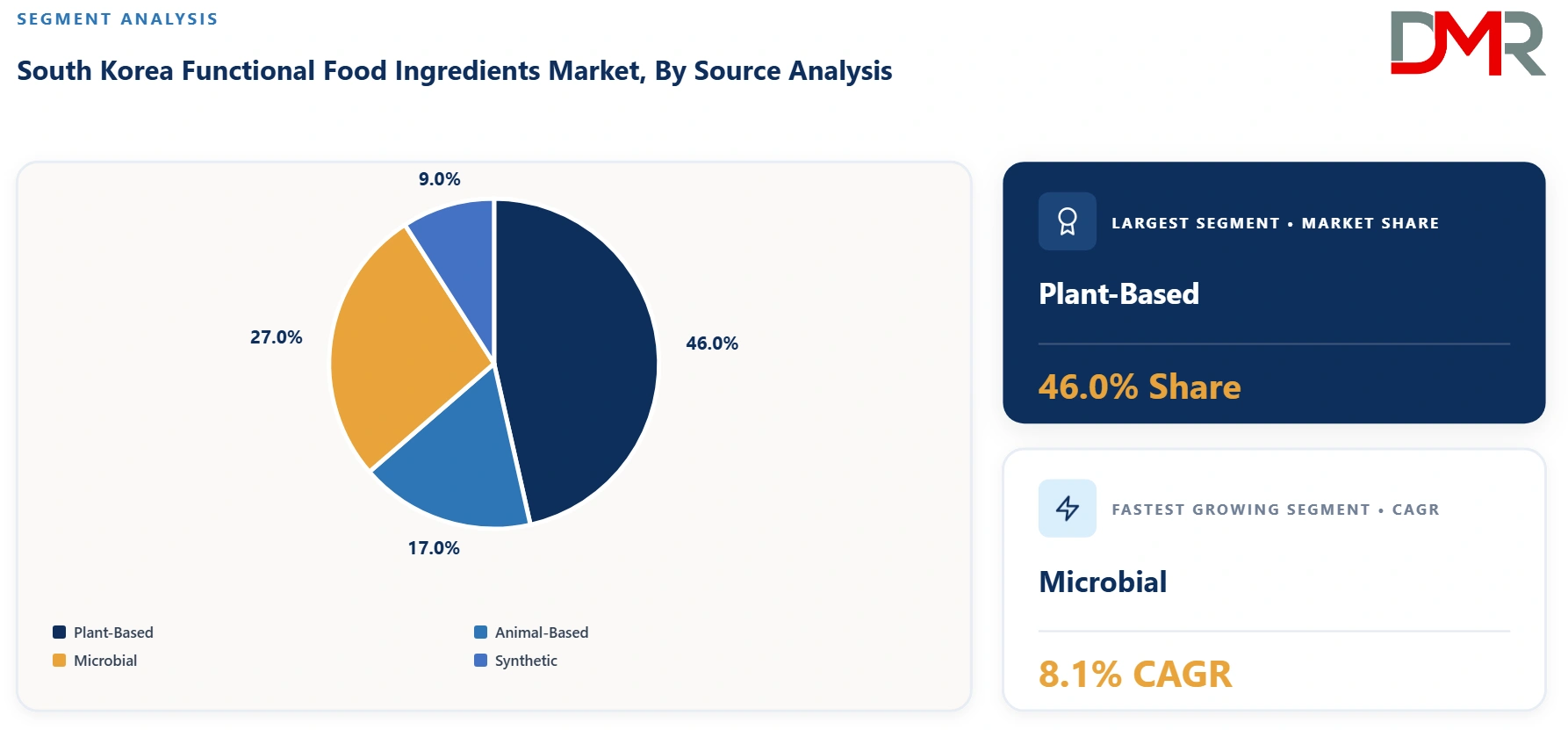
Plant-Based sources lead with approximately 46% share in 2026, reflecting Korean consumer preference for natural ingredients, botanical extracts, plant proteins and clean-label formulations. Plant-based sources are particularly important in beverages, nutraceuticals and beauty-from-within products. Microbial sources represent approximately 27%, making them the second-largest source category, driven primarily by probiotics, postbiotics, fermentation-derived ingredients and microbial metabolites. Microbial sources are also the fastest-growing category, at approximately 8.1% CAGR, because improvements in fermentation, strain screening and microbiome science are enabling new functionality. Animal-based ingredients account for approximately 17%, including marine-derived omega-3s and selected proteins, while synthetic ingredients represent approximately 10%, concentrated in vitamins, specialty nutrients and standardized compounds. The source mix is expected to shift gradually toward microbial and plant-derived solutions as clean-label and sustainability considerations gain influence.
By Form Analysis
Powder dominates the market with approximately 62% share in 2026, owing to its favorable transport economics, long shelf life, flexible dosing and compatibility with capsules, tablets, sachets, protein powders and dry food formulations. Powdered probiotics, vitamins, proteins and botanical extracts are particularly common across Korean supplement manufacturing. Liquid ingredients represent approximately 22% share and remain important for functional beverages, liquid shots, dairy applications and ready-to-drink products. Granules, at approximately 11%, are the fastest-growing form at an estimated 7.6% CAGR, supported by improved flowability, controlled release, reduced dusting and better formulation performance. Other forms account for roughly 5%. Advanced microencapsulation and coating technologies are expected to gradually expand high-value granular and protected ingredient formats, particularly for probiotics and oxidation-sensitive omega-3s.
By Application Analysis
Dietary Supplements are estimated to account for 36% of ingredient demand in 2026, making them the dominant application. Korea has a highly developed supplement ecosystem with extensive online distribution and consumers accustomed to targeted daily nutrition. Functional Food & Beverages are the second-largest application at approximately 29%, benefiting from demand for convenient nutrition and the incorporation of functional ingredients into everyday consumption occasions. Sports Nutrition is expected to be the fastest-growing application at approximately 8.0% CAGR, supported by protein consumption, active lifestyles and growing interest in muscle health. Infant nutrition represents around 10%, while clinical nutrition accounts for approximately 9%; the remainder is distributed across specialized applications. Over the forecast period, functional beverages and sports nutrition should gain share because they provide convenient delivery formats and attract younger consumers.
By End Use Industry Analysis
The Nutraceutical Industry is estimated to hold the largest share at approximately 34% in 2026, reflecting Korea's mature health-functional-food ecosystem and high demand for differentiated supplements. The Dietary Supplement Industry, representing approximately 24%, is the second-largest segment and benefits from online retail, direct-to-consumer brands and specialized formulations. The Food & Beverage Industry is expected to be the fastest-growing end-use category at approximately 7.8% CAGR, as manufacturers increasingly fortify beverages, dairy alternatives, snacks, bakery products and convenience foods. Sports nutrition accounts for approximately 13%, pharmaceutical & healthcare applications around 11%, and infant nutrition approximately 7%. The remaining demand comes from specialized nutrition products. The long-term opportunity lies in moving functional ingredients beyond pills and capsules into mainstream food and beverage consumption.
The South Korea Functional Food Ingredients Market Report is segmented on the basis of the following:
By Ingredient Type
- Probiotics
- Prebiotics
- Vitamins & Minerals
- Proteins & Amino Acids
- Omega-3 Fatty Acids
- Functional Fibers
- Antioxidants
- Plant Extracts & Phytochemicals
- Other Functional Ingredients
By Source
- Plant-Based
- Animal-Based
- Microbial
- Synthetic
By Form
- Powder
- Liquid
- Granules
- Other Forms
By Application
- Functional Food & Beverages
- Dietary Supplements
- Sports Nutrition
- Infant Nutrition
- Clinical Nutrition
By End-Use Industry
- Food & Beverage Industry
- Nutraceutical Industry
- Dietary Supplement Industry
- Sports Nutrition Industry
- Infant Nutrition Industry
- Pharmaceutical & Healthcare Industry
Regulatory Landscape
South Korea's MFDS framework is a major determinant of ingredient commercialization, product claims and competitive barriers. Approved nutrients and functional ingredients benefit from established regulatory pathways, whereas individually recognized ingredients require evidence demonstrating safety and functionality. As of June 2025, Korea recognized 69 functional ingredients plus hundreds of individually recognized materials. This environment raises development costs but creates attractive protection for companies possessing clinically validated proprietary ingredients. Recent approvals of probiotics targeting hair, joint, immune, metabolic and muscle-health applications demonstrate increasing regulatory differentiation. Companies that combine clinical evidence, standardized manufacturing, regulatory expertise and export-ready documentation are positioned to outperform commodity suppliers.
Investment and White Space Analysis
The most attractive investment opportunities lie in next-generation microbiome ingredients, metabolic health, healthy aging, muscle preservation, beauty-from-within and precision nutrition. The strongest white spaces are ingredients that solve formulation limitations—particularly heat-stable probiotics, postbiotics, encapsulated omega-3s and highly soluble plant extracts. AI-enabled screening and multi-omics can further reduce discovery costs and improve evidence quality. Government-backed R&D is also supporting commercialization: a 2026 regional innovation program involving NeoCremar and KFRI is targeting digestive-health ingredients through AI, organoids and multi-omics. Investment risk remains highest where products lack clinical differentiation or face crowded competition from established probiotics, vitamins and botanical ingredients.
Competitive Landscape
The South Korean functional food ingredients market is moderately fragmented, combining large food and biotechnology groups, specialist probiotic developers, pharmaceutical companies, botanical-extract suppliers and international ingredient companies. Competition increasingly centers on proprietary strains, clinical evidence, MFDS recognition, formulation stability, manufacturing scale and export certifications rather than basic ingredient availability. Leading players pursue R&D partnerships, proprietary strain libraries, branded ingredients, acquisitions or strategic investments and expansion into global markets. CJ CheilJedang, for example, introduced a “3B” strategy—Borrow, Buy and Build—to expand its B2B nutrition portfolio and launched the BiomeNrich functional biotics brand.
Some of the prominent players in the South Korea Functional Food Ingredients Market are:
- Kolmar BNH
- Daesang Corporation
- CJ CheilJedang
- Korea Ginseng Corporation (KGC)
- Cell Biotech
- Chong Kun Dang Bio
- Novarex
- COSMAX BIO
- HY Co., Ltd.
- Pulmuone Health & Living
- KwangDong HealthBio
- IlDong Bioscience
- Suheung
- HLSCIENCE
- Univera
- Kim Jeong Moon Aloe
- Amorepacific
- LG Household & Health Care
- Dong-A Pharmaceutical
- Lotte Wellfood
- FromBio
- Hecto Healthcare
- AceBiome
- RP BIO
- BTC Corporation
- Hurum
- Chong Kun Dang Healthcare
- CJ Wellcare
- Maiim
- Hanmi Nutrition
- Kewpie Korea
- Nongshim
- Orion
- Sempio Foods
- Kikkoman Korea
- Kyowa Hakko Bio
- Mitsubishi Corporation Life Sciences
- Ajinomoto
- BASF Korea
- DSM-Firmenich
- Other Key Players
Recent Developments
- April 2026: CKD Bio highlighted CKDB-315, a probiotic–natural extract combination developed around the gut-lung axis. The ingredient has been incorporated into Everibiome products and is being discussed with Korean pharmaceutical companies and international partners for broader applications.
- May 2025: Medytox obtained MFDS individual recognition for MT961, a proprietary Lactiplantibacillus plantarum probiotic positioned for body-fat reduction, strengthening competition in Korea's metabolic-health functional ingredient segment.
- October 2025: LISCure Biosciences announced MFDS approval of JointWorks®, a proprietary probiotic ingredient for joint health. The company positioned it as the first probiotic ingredient recognized in Korea specifically for joint functionality.
Report Details
| Report Characteristics |
| Market Size (2026) |
USD 1.75 Bn |
| Forecast Value (2035) |
USD 3.15 Bn |
| CAGR (2026–2035) |
6.8% |
| Historical Data |
2021 – 2025 |
| Forecast Data |
2026 – 2035 |
| Base Year |
2025 |
| Segments Covered |
By Ingredient Type, By Source, By Form, By Application, By End-Use Industry |
| Country Coverage |
South Korea |
Frequently Asked Questions
What is the South Korea Functional Food Ingredients Market size in 2026?
▾ The South Korea Functional Food Ingredients Market is estimated at USD 1.75 billion in 2026, covering functional ingredients supplied to food, beverage, supplement and nutrition manufacturers.
What will the South Korea Functional Food Ingredients Market be worth in 2035?
▾ The South Korea Functional Food Ingredients Market is projected to reach approximately USD 3.15 billion by 2035, supported by preventive healthcare and premium nutrition demand.
What is the CAGR of the South Korea Functional Food Ingredients Market from 2026 to 2035?
▾ The South Korea Functional Food Ingredients Market is expected to grow at approximately 6.8% CAGR during 2026-2035.
What are the key growth drivers of the South Korea Functional Food Ingredients Market?
▾ The South Korea Functional Food Ingredients Market is driven by healthy aging, preventive healthcare, microbiome awareness, premiumization, functional beverages and growing demand for targeted nutrition.
Which segment dominates the South Korea Functional Food Ingredients Market?
▾ Probiotics dominate the South Korea Functional Food Ingredients Market, accounting for an estimated 28% share in 2026, supported by strong consumer adoption and fermentation expertise.
Which is the fastest-growing segment in the South Korea Functional Food Ingredients Market?
▾ Microbial-source ingredients are expected to be the fastest-growing segment in the South Korea Functional Food Ingredients Market, with an estimated 8.1% CAGR.
What are the major trends in the South Korea Functional Food Ingredients Market?
▾ Major trends in the South Korea Functional Food Ingredients Market include precision probiotics, postbiotics, personalized nutrition, beauty-from-within products, clean-label ingredients and healthy-aging formulations.
Who are the key players in the South Korea Functional Food Ingredients Market?
▾ Key players in the South Korea Functional Food Ingredients Market include CJ CheilJedang, hy, CKD Bio, Medytox, LISCure Biosciences, ILDONG Bioscience, NeoCremar and other domestic and international ingredient suppliers.