Spain Contact and Intraocular Lenses Market Snapshot
- Spain Contact and Intraocular Lenses Market Size in 2026: USD 610.0 Million
- Spain Contact and Intraocular Lenses Market Size in 2035: USD 910.0 Million
- Spain CAGR from 2026 to 2035: 4.6%
- Monofocal IOLs is the leading product type segment in 2026: 61.5%
- Hydrophobic acrylic is the leading material segment in 2026: 52.8%
- Cataract surgery is the leading application segment in 2026: 55.6%
- Hospitals and eye clinics is the leading distribution channel segment in 2026: 58.4%
- Hospitals is the leading end-user segment in 2026: 44.8%
What is the Spain Contact and Intraocular Lenses Market and its Market Size?
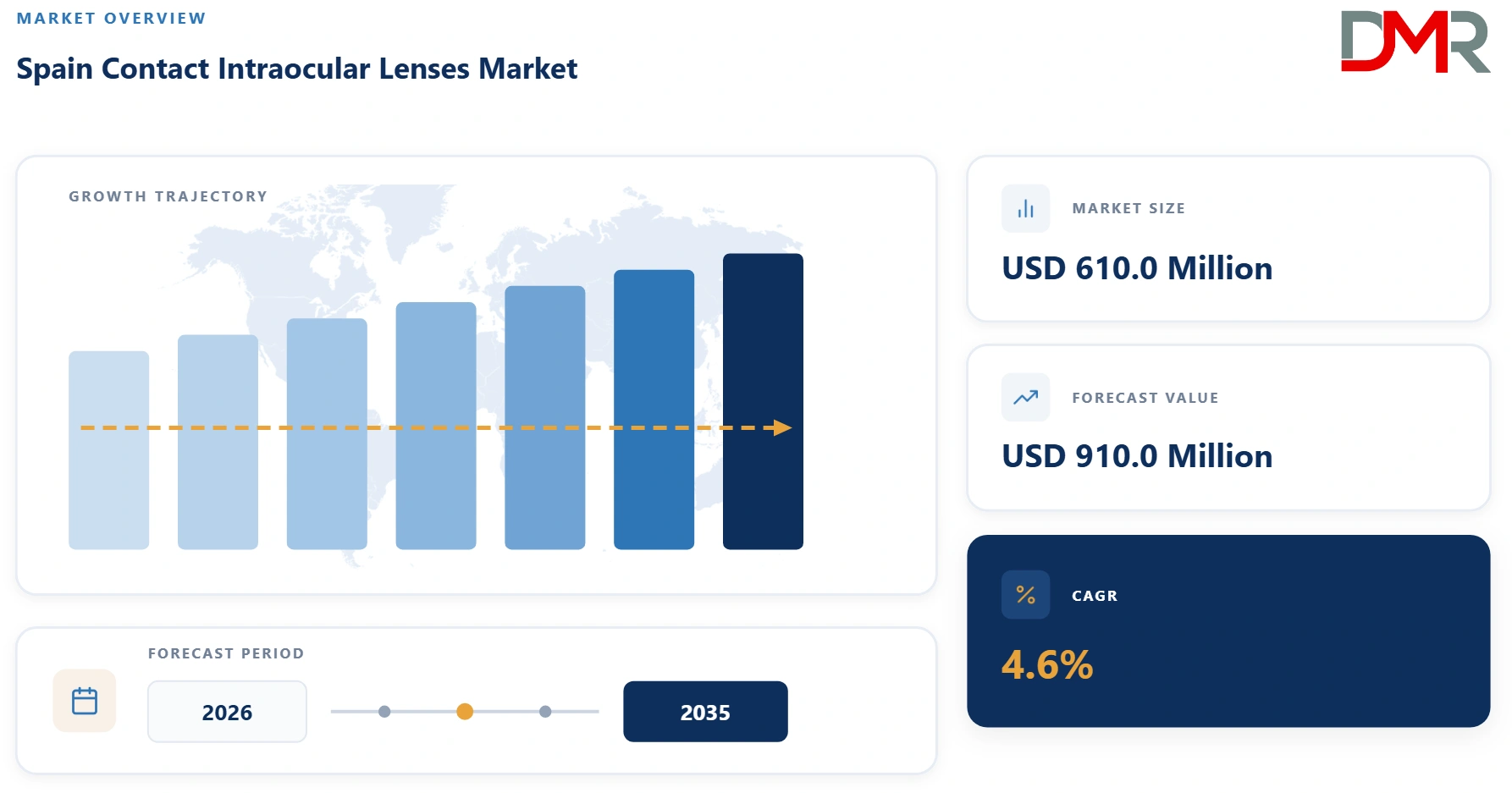
The Spain Contact and Intraocular Lenses Market is projected to reach USD 610.0 million in 2026 and grow at a compound annual growth rate of 4.6% from there until 2035 to reach a value of USD 910.0 million.
ℹ
To learn more about this report –
Download Your Free Sample Report Here
Contact and intraocular lenses are medical devices used for refractive correction, cataract treatment, presbyopia management, astigmatism correction, and cosmetic applications. Spain’s market is supported by its ageing population, established ophthalmology infrastructure, high availability of ambulatory cataract procedures, expanding optical retail network, and demand for premium vision correction. Innovation in multifocal, toric, EDOF, silicone hydrogel, and digitally fitted lenses is improving patient comfort, visual outcomes, and spectacle independence.
Use Cases
- Cataract Treatment: Intraocular lenses replace the eye’s natural clouded lens during cataract surgery, restoring visual clarity and improving daily functioning. Spanish hospitals, ophthalmology clinics, and ambulatory surgical centers use monofocal, toric, multifocal, and EDOF lenses according to patients’ visual requirements, astigmatism levels, lifestyle expectations, affordability, clinical suitability, and preference for reduced dependence on spectacles after surgery.
- Refractive Error Correction: Contact lenses support the correction of myopia, hyperopia, astigmatism, and presbyopia among children, working-age adults, and older consumers. Daily disposable, reusable, toric, multifocal, hydrogel, silicone hydrogel, and rigid gas permeable lenses offer different comfort, oxygen transmission, replacement, and visual-performance characteristics, enabling optometrists and ophthalmologists to provide individualized correction for diverse ocular and lifestyle requirements.
- Presbyopia and Lifestyle Vision: Multifocal contact lenses and premium intraocular lenses help presbyopic consumers maintain functional near, intermediate, and distance vision. These products are particularly relevant for digitally active adults seeking convenience and spectacle independence. EDOF and multifocal technologies support reading, computer use, driving, and recreational activities while manufacturers continue improving contrast sensitivity, optical transitions, comfort, and management of halos or glare.
- Astigmatism and Specialty Correction: Toric contact lenses and toric intraocular lenses compensate for corneal astigmatism and improve visual sharpness across different patient groups. Specialty rigid gas permeable and custom lenses can also support irregular corneas or demanding prescriptions. Digital topography, biometric measurement, improved stabilization designs, and precise surgical planning are strengthening fitting accuracy, rotational stability, refractive predictability, patient satisfaction, and long-term clinical outcomes.
Key Takeaways
- Market Size: The Spain Contact and Intraocular Lenses Market is anticipated to be valued at USD 610.0 million in 2026 and is forecast to reach USD 910.0 million by 2035, expanding at a CAGR of 4.6%.
- Growth Outlook: Market expansion is supported by Spain’s ageing population, increasing cataract burden, high utilization of ambulatory ophthalmic surgery, growing awareness of refractive correction, premium IOL adoption, digital device usage, expansion of optical retail chains, e-commerce penetration, and technological advances in lens materials, optical designs, diagnostics, fitting, and surgical planning.
- Primary Growth Drivers: Rising cataract procedures, increasing prevalence of myopia, presbyopia, and astigmatism, greater demand for spectacle independence, improving access to specialist eye care, premium lens availability, digital fitting platforms, advanced biometry, comfortable silicone hydrogel materials, and broader consumer awareness are accelerating demand across clinical, surgical, optical retail, and online channels.
- By Product Type Analysis: Monofocal IOLs are projected to lead the product type segment with a 61.5% share in 2026, supported by their extensive use in cataract surgery, predictable visual outcomes, clinical familiarity, and reimbursement suitability. EDOF IOLs are expected to record the highest CAGR of approximately 6.9% through 2035.
- By Material Analysis: Hydrophobic acrylic is anticipated to dominate with a 52.8% share in 2026, driven by its foldability, optical stability, controlled water content, small-incision compatibility, and established utilization in modern IOLs. Silicone hydrogel is expected to register the highest CAGR of approximately 6.2%, supported by superior oxygen permeability and contact-lens comfort.
- By Application Analysis: Cataract surgery is projected to lead with a 55.6% share in 2026, supported by Spain’s ageing population and established outpatient ophthalmology infrastructure. Presbyopia correction is expected to grow at the highest CAGR of approximately 6.1%, driven by premium multifocal, EDOF, and multifocal contact-lens adoption.
- By Distribution Channel Analysis: Hospitals and eye clinics are expected to dominate with a 58.4% share in 2026, reflecting their central role in cataract diagnosis, surgical implantation, postoperative management, and specialty lens fitting. E-commerce and online channels are projected to record the highest CAGR of approximately 7.0% through 2035.
- By End User Analysis: Hospitals are anticipated to lead with a 44.8% share in 2026, supported by surgical capacity, specialist availability, procurement contracts, and cataract procedure volumes. Ambulatory surgical centers are expected to grow at the highest CAGR of approximately 6.4%, benefiting from outpatient surgery, shorter treatment times, and operational efficiency.
How AI and Generative AI are Transforming the Spain Contact and Intraocular Lenses Market?
AI is improving lens selection, ocular measurement, surgical planning, and postoperative outcome prediction across Spain’s ophthalmology ecosystem. Algorithms can analyze corneal topography, axial length, biometric measurements, refractive history, and lifestyle preferences to recommend appropriate IOL powers and optical designs. AI-enabled contact-lens fitting platforms support faster parameter selection and identification of complicated corneal conditions. Generative AI can assist clinicians with patient education, multilingual instructions, clinical documentation, and personalized follow-up communication. However, medical validation, data protection, algorithm transparency, interoperability, and clinician oversight remain essential for safe adoption.
Key Drivers in the Spain Contact and Intraocular Lenses Market
Ageing Population and Increasing Cataract Treatment Requirements
Spain’s ageing demographic is expanding the population vulnerable to cataracts, presbyopia, and age-related visual impairment. According to Spain’s National Statistics Institute, people aged 65 and above represented approximately 21.1% of the population in 2026. This proportion is expected to rise substantially over the coming decades. Cataract surgery is commonly performed as an ambulatory procedure, allowing hospitals and specialized clinics to treat patients efficiently. Increasing procedure volumes are supporting demand for monofocal, toric, multifocal, and EDOF IOLs while encouraging investments in biometry, surgical planning, and premium lens counseling.
Growing Demand for Convenient and Premium Vision Correction
Spanish consumers increasingly seek vision-correction products that provide comfort, convenience, and reduced spectacle dependence. Daily and reusable contact lenses appeal to active consumers, digital-device users, athletes, and individuals seeking cosmetic flexibility. Within surgical care, premium toric, multifocal, and EDOF IOLs address astigmatism and presbyopia while offering functional vision across multiple distances. Expanding private ophthalmology services and improved patient education are supporting premium upgrades. Higher oxygen-transmitting materials, water-gradient surfaces, improved stabilization, enhanced optics, and digitally assisted fitting are also strengthening product acceptance and encouraging replacement of older lens technologies.
Restraints in the Spain Contact and Intraocular Lenses Market
Premium Product Costs and Uneven Reimbursement
Premium multifocal, toric, and EDOF intraocular lenses generally involve higher patient payments than conventional monofocal lenses. Public healthcare coverage prioritizes clinically necessary cataract treatment, while premium refractive benefits may require additional private expenditure. This limits adoption among price-sensitive patients and contributes to differences between public hospitals, private clinics, and autonomous communities. Advanced contact lenses also carry recurring replacement and care costs. Economic uncertainty, procurement pressure, and competition from lower-priced products can restrict manufacturers’ pricing flexibility while encouraging hospitals and optical retailers to focus on cost-effective and established lens portfolios.
Clinical Risks and Product-Adoption Limitations
Contact lenses can cause dryness, discomfort, corneal irritation, infection, or reduced adherence when fitting, hygiene, replacement schedules, and follow-up are inadequate. Premium IOLs may create halos, glare, reduced contrast sensitivity, or dissatisfaction when patient selection and expectations are poorly managed. Complex eyes, irregular corneas, retinal disease, and previous refractive procedures can make power calculation and lens selection more difficult. These clinical considerations require trained ophthalmologists, optometrists, accurate diagnostics, patient counseling, and postoperative monitoring, increasing the resources required for advanced product adoption and potentially slowing uptake.
Growth Opportunities in the Spain Contact and Intraocular Lenses Market
Expansion of Premium and Personalized Ophthalmic Lenses
Manufacturers can capture growth by expanding toric, multifocal, EDOF, and customized lens portfolios designed around patient lifestyles and ocular characteristics. Spain’s private ophthalmology sector provides opportunities for premium cataract packages incorporating advanced diagnostics, digital planning, femtosecond-assisted procedures, and postoperative optimization. Personalized contact lenses for astigmatism, presbyopia, irregular corneas, and myopia management also offer attractive potential. Companies providing broad diopter ranges, preloaded delivery systems, rotational stability, improved contrast, and reduced visual disturbances can differentiate themselves while supporting greater patient satisfaction and stronger clinical adoption.
Digital Retailing and Omnichannel Vision Care
E-commerce offers considerable potential for replacement contact lenses, particularly among experienced wearers with valid prescriptions. Optical retailers can integrate online ordering, subscription replenishment, virtual reminders, digital fitting records, and store-based clinical support to create convenient omnichannel models. Manufacturers can collaborate with optical chains, clinics, and digital platforms to improve product education and adherence. Opportunities also exist in automated inventory planning, home delivery, personalized replacement schedules, and remote follow-up. Compliance with prescription verification, data protection, medical-device traceability, and professional fitting requirements will remain important for sustainable online expansion.
Trends in the Spain Contact and Intraocular Lenses Market
Shift Toward EDOF and Enhanced Monofocal IOLs
Spanish ophthalmologists are gaining access to a wider range of EDOF, enhanced monofocal, trifocal, and full-range-of-vision IOLs. These products aim to provide stronger intermediate performance and greater spectacle independence while controlling halos, glare, and contrast loss. Enhanced monofocal lenses are emerging as an intermediate option between conventional monofocal and premium multifocal technologies. Growing use of advanced biometry, corneal topography, optical coherence tomography, and digital surgical planning supports more precise patient selection. Clinical evidence and real-world outcomes will remain important in determining adoption across public and private settings.
Increasing Adoption of High-Comfort Contact-Lens Materials
Silicone hydrogel, advanced hydrogel, water-gradient surfaces, and daily disposable formats are gaining attention because of their comfort, oxygen permeability, convenience, and reduced cleaning requirements. Digital-device usage is increasing consumer concern about dryness, fatigue, and end-of-day comfort, encouraging innovation in moisture retention and surface technologies. Toric and multifocal daily disposables are expanding the addressable population by serving astigmatic and presbyopic wearers. Optical retailers are also promoting subscription and automatic-replenishment services, creating predictable purchasing patterns while improving compliance with recommended lens-replacement schedules.
Research Scope and Analysis
The research covers Spain contact and intraocular lenses across product type, including monofocal, multifocal, toric, EDOF, and accommodating lenses, materials including hydrogel, silicone hydrogel, rigid gas permeable, hydrophobic acrylic, hydrophilic acrylic PMMA and silicone, applications, distribution channels, end users, competitive positioning, regulatory conditions, technology adoption, pricing patterns, demand indicators, historical performance and forecasts through 2035 annually.
ℹ
To learn more about this report –
Download Your Free Sample Report Here
By Product Type Analysis
Monofocal IOLs are expected to dominate the product type segment with a 61.5% share in 2026, supported by widespread cataract use, predictable distance vision, affordability, and established reimbursement.
EDOF IOLs are projected to register the highest CAGR of approximately 6.9%. Growth is supported by demand for intermediate vision, spectacle independence, and fewer visual disturbances than certain multifocal designs.
By Material Analysis
Hydrophobic acrylic is projected to lead the material segment with a 52.8% share in 2026, owing to its foldability, optical stability, biocompatibility, and compatibility with small-incision cataract surgery.
Silicone hydrogel is expected to record the highest CAGR of approximately 6.2%. Its high oxygen permeability and improved surface comfort support adoption in reusable and daily contact lenses.
By Application Analysis
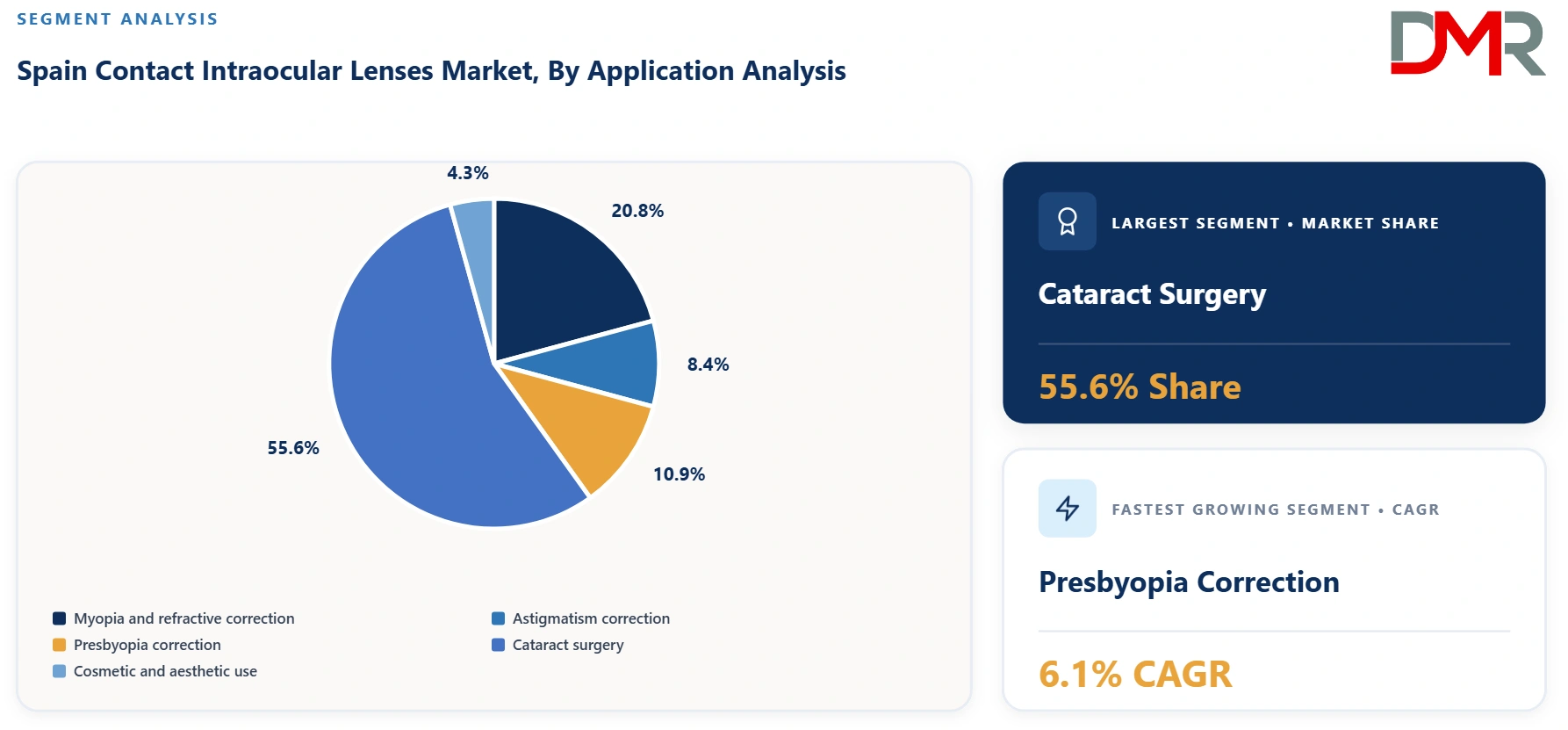
Cataract surgery is anticipated to dominate the application segment with a 55.6% share in 2026, supported by Spain’s ageing population and established ambulatory surgical infrastructure.
Presbyopia correction is expected to register the highest CAGR of approximately 6.1%. Multifocal contact lenses, EDOF IOLs, and trifocal technologies are expanding treatment choices for ageing and digitally active consumers.
By Distribution Channel Analysis
Hospitals and eye clinics are projected to lead distribution with a 58.4% share in 2026, reflecting their role in diagnosis, IOL selection, surgery, postoperative care, and specialty fitting.
E-commerce and online channels are anticipated to grow at the highest CAGR of approximately 7.0%. Convenient ordering, subscriptions, home delivery, and omnichannel retail models are supporting expansion.
By End User Analysis
Hospitals are expected to dominate the end-user segment with a 44.8% share in 2026, supported by specialist availability, public procurement, operating infrastructure, and cataract procedure volumes.
Ambulatory surgical centers are projected to register the highest CAGR of approximately 6.4%. Shorter stays, efficient workflows, specialized surgical teams, and increasing outpatient cataract procedures support their growth.
The Spain Contact and Intraocular Lenses Market Report is Segmented Based on the following:
By Product Type
- Monofocal IOLs
- Multifocal IOLs
- Toric IOLs
- Extended Depth of Focus IOLs
- Accommodating IOLs
By Material
- Hydrogel
- Silicone Hydrogel
- Rigid Gas Permeable Materials
- Hydrophobic Acrylic
- Hydrophilic Acrylic
- Polymethyl Methacrylate
- Silicone
By Application
- Myopia and Refractive Correction
- Astigmatism Correction
- Presbyopia Correction
- Cataract Surgery
- Cosmetic and Aesthetic Use
By Distribution Channel
- Hospitals and Eye Clinics
- Optical Retail Stores
- E-commerce and Online Channels
- Others
By End User
- Hospitals
- Ophthalmology and Eye Care Clinics
- Ambulatory Surgical Centers
- Retail Optical Chains
- Others
Regulatory Landscape
Contact lenses and intraocular lenses sold in Spain are governed by the European Union Medical Device Regulation and supervised nationally by the Spanish Agency of Medicines and Medical Devices. Manufacturers must establish conformity assessment, clinical evidence, risk management, post-market surveillance, vigilance, labeling, traceability, and quality-management compliance before commercialization. CE marking provides market access, while unique device identification strengthens product tracking. Regulatory transitions can increase documentation costs and create certification delays, particularly for smaller suppliers. However, stronger clinical and surveillance requirements benefit established manufacturers, improve patient protection, discourage low-quality products, and create opportunities for companies offering compliant premium lenses, digital traceability, and robust clinical evidence.
Technology Analysis
Technology development is shifting competition toward advanced optics, biocompatible materials, digital diagnostics, and integrated treatment planning. EDOF, trifocal, enhanced monofocal, and toric IOLs provide broader visual ranges and more individualized refractive outcomes. Preloaded injectors support efficient implantation and reduce lens handling. In contact lenses, silicone hydrogel, water-gradient surfaces, moisture-retaining technologies, and improved toric stabilization enhance oxygen transmission, comfort, and visual consistency. AI-assisted biometry, corneal topography, optical coherence tomography, and surgical-planning software can improve lens-power calculation and patient selection. Opportunities remain in customized lenses and connected workflows, although interoperability, clinical validation, cybersecurity, and professional training influence adoption.
Competitive Landscape
The Spain Contact and Intraocular Lenses Market features multinational ophthalmic manufacturers, European specialty IOL suppliers, contact-lens companies, laboratories, distributors, hospitals, and optical retail chains. Alcon, Johnson & Johnson Vision, Bausch + Lomb, ZEISS, HOYA, and CooperVision maintain strong positions through extensive portfolios, clinical evidence, professional relationships, and distribution capabilities. Competition focuses on optical performance, material comfort, premium lens technologies, preloaded systems, fitting support, pricing, reimbursement compatibility, and surgeon education. Smaller European companies compete through customized IOLs, specialty lenses, flexible service, and targeted clinical solutions.
Some of the Prominent Players in the Spain Contact and Intraocular Lenses Market Are
- Alcon Inc.
- Johnson & Johnson Vision Care
- Bausch + Lomb Corporation
- Carl Zeiss Meditec AG
- HOYA Corporation
- CooperVision Inc.
- EssilorLuxottica
- STAAR Surgical Company
- Rayner Intraocular Lenses Limited
- HumanOptics Holding AG
- PhysIOL
- Beaver-Visitec International
- SIFI S.p.A.
- Ophtec B.V.
- Hanita Lenses
- Lenstec Inc.
- NIDEK Co. Ltd.
- Topcon Corporation
- Menicon Co. Ltd.
- SEED Co. Ltd.
- BenQ Materials Corporation
- SynergEyes Inc.
- Art Optical Contact Lens Inc.
- X-Cel Specialty Contacts
- Contamac Ltd.
- UltraVision CLPL
- Mark’ennovy Personalized Care S.L.
- Conóptica S.L.
- Lenticon S.A.
- Servilens Fit and Cover
- AJL Ophthalmic S.A.
- Medicontur Medical Engineering Ltd.
- VSY Biotechnology GmbH
- Teleon Surgical B.V.
- Cristalens Industrie
- SAV-IOL SA
- Biotech Vision Care
- Aurolab
- Appasamy Associates
- Soleko S.p.A.
- Other Key Players
Recent Developments
- April 2026: Bausch + Lomb launched its preloaded enVista Envy full-range-of-vision intraocular lens in Europe. The lens uses the EyeGility delivery system and provides continuous vision across distance ranges with a design intended to maintain favorable dysphotopsia tolerance.
- September 2025: Alcon announced the European commercial availability of the Clareon Vivity EDOF intraocular lens, completing its European Clareon portfolio with monofocal, toric, PanOptix, and Vivity options for different cataract and presbyopia-correction requirements. Alcon
- July 2025: Johnson & Johnson expanded the TECNIS Odyssey next-generation intraocular lens across Europe, the Middle East, and Canada. The full-range-of-vision lens is designed to provide functional vision at far, intermediate, and near distances under varying lighting conditions.
- May 2025: Bausch + Lomb received European CE Mark approval for the preloaded LuxLife full-range-of-vision intraocular lens. The product is designed to provide continuous vision from distance to near and expand the company’s European premium IOL portfolio.
Report Details
| Report Characteristics |
| Market Size (2026) |
USD 610.0 Mn |
| Forecast Value (2035) |
USD 910.0 Mn |
| CAGR (2026–2035) |
4.6% |
| Historical Data |
2021 – 2025 |
| Forecast Data |
2026 – 2035 |
| Base Year |
2025 |
| Segments Covered |
By Product Type, By Material, By Application, By Distribution Channel, By End User |
Frequently Asked Questions
How big is the Spain Contact and Intraocular Lenses Market?
▾ The Spain Contact and Intraocular Lenses Market is projected to reach USD 610.0 million in 2026 and USD 910.0 million by 2035.
What is the CAGR of the Spain Contact and Intraocular Lenses Market from 2026 to 2035?
▾ The market is expected to expand at a compound annual growth rate of 4.6% from 2026 to 2035.
What factors are driving the growth of the Spain Contact and Intraocular Lenses Market?
▾ Growth is driven by population ageing, rising cataract procedures, demand for spectacle independence, increasing refractive disorders, premium IOL adoption, advanced contact-lens materials, digital fitting, and expanding ophthalmology services.
What are the major trends in the Spain Contact and Intraocular Lenses Market?
▾ Major trends include EDOF and enhanced monofocal IOL adoption, silicone hydrogel contact lenses, daily disposable formats, toric and multifocal designs, AI-assisted planning, preloaded IOL systems, and omnichannel optical retailing.
Which product type dominates the Spain Contact and Intraocular Lenses Market?
▾ Monofocal IOLs are projected to dominate the product type segment with approximately 61.5% of market revenue in 2026.
Which application holds the largest market share in Spain Contact and Intraocular Lenses Market ?
▾ Cataract surgery is expected to lead the application segment with approximately 55.6% of the market in 2026.
Who are the key players in the Spain Contact and Intraocular Lenses Market?
▾ Leading companies include Alcon, Johnson & Johnson Vision, Bausch + Lomb, Carl Zeiss Meditec, HOYA, CooperVision, STAAR Surgical, Rayner, HumanOptics, PhysIOL, and Ophtec.
How is the Spain Contact and Intraocular Lenses Market segmented?
▾ The market is segmented by product type, material, application, distribution channel, and end user.