Spain Food Processing Equipment Market Snapshot
- Spain Food Processing Equipment Market Size in 2026: USD 1.9 Billion
- Spain Food Processing Equipment Market Size in 2035: USD 3.0 Billion
- Spain CAGR from 2026 to 2035: 5.2%
- Heat Processing Equipment is the leading equipment type segment in 2026: 27.6%
- Automatic is the leading mode of operation segment in 2026: 58.4%
- Solid is the leading form of end product segment in 2026: 50.8%
- Meat and Poultry is the leading application segment in 2026: 25.7%
What is the Spain Food Processing Equipment Market and its Market Size?
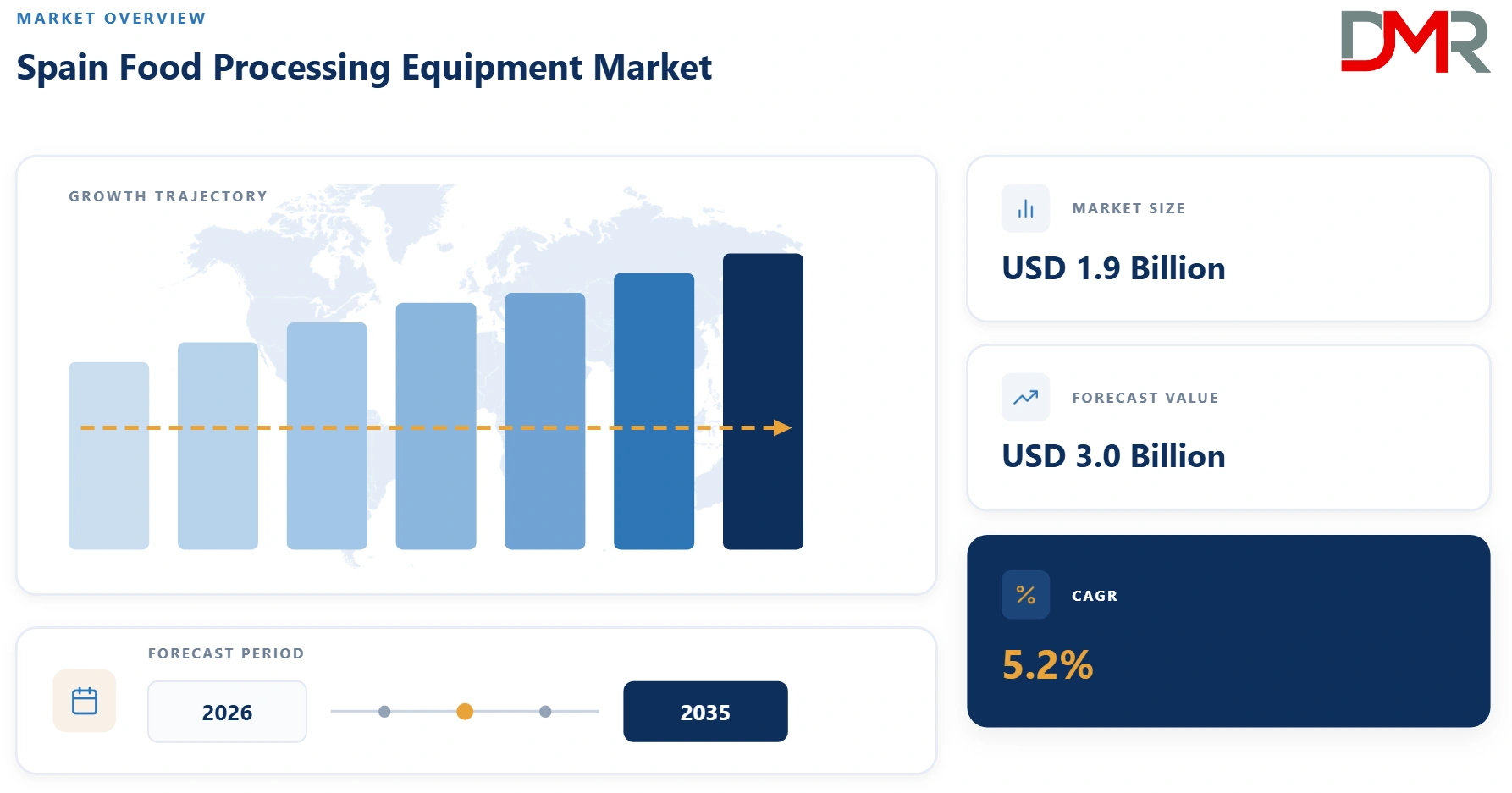
The Spain Food Processing Equipment Market is projected to reach USD 1.9 billion in 2026 and grow at a compound annual growth rate of 5.2% from there until 2035 to reach a value of USD 3.0 billion.
ℹ
To learn more about this report –
Download Your Free Sample Report Here
Food processing equipment includes machinery used to prepare, transform, preserve, package, inspect, and handle food and beverage products. Spain’s diversified food manufacturing industry generates demand across meat, seafood, dairy, bakery, beverages, edible oils, fruits, vegetables, and convenience foods. Market growth is supported by factory automation, labor shortages, export-oriented production, hygienic processing requirements, traceability regulations, sustainability targets, and investment in energy-efficient production lines.
Use Cases
- Meat and Poultry Processing: Spanish meat processors use cutting, grinding, mixing, portioning, cooking, chilling, inspection, and packaging systems to increase production consistency and reduce manual handling. Automated lines support accurate portion control, improved yield, contamination prevention, product traceability, and higher throughput. These technologies are particularly important for processed pork, cured meats, poultry products, sausages, and export-oriented packaged meat production.
- Fruit, Vegetable and Olive Processing: Sorting, washing, peeling, cutting, pulping, pressing, drying, freezing, filling, and packaging equipment supports Spain’s large fruit, vegetable, tomato, citrus, and olive industries. Optical sorting and automated inspection help processors remove defective products, standardize quality, reduce water consumption, and minimize waste. Efficient preservation and packaging systems also extend shelf life and support exports to European and international markets.
- Dairy and Beverage Manufacturing: Dairy processors and beverage companies deploy separators, homogenizers, pasteurizers, heat exchangers, fermenters, mixers, aseptic fillers, and clean-in-place systems. These technologies support milk, cheese, yogurt, juice, wine, beer, and plant-based beverage production. Integrated processing lines improve microbial control, batch consistency, energy efficiency, equipment utilization, and compliance while allowing manufacturers to introduce new formulations and packaging formats rapidly.
- Seafood Processing and Packaging: Fish and seafood companies use grading, filleting, skinning, portioning, freezing, smoking, inspection, weighing, and vacuum-packaging equipment. These systems help processors address labor-intensive operations while maintaining product freshness and yield. Automated seafood lines are particularly relevant in Galicia, Catalonia, Andalusia, and other coastal regions, where companies process fish, shellfish, cephalopods, canned seafood, and frozen products for domestic and export markets.
Key Takeaways
- Market Size: The Spain Food Processing Equipment Market is anticipated to be valued at USD 1.9 billion in 2026 and is forecast to reach USD 3.0 billion by 2035, expanding at a CAGR of 5.2%.
- Growth Rate and Outlook: Market expansion is supported by modernization of Spanish food factories, increasing automation, demand for convenience foods, export-oriented production, labor availability challenges, hygienic equipment requirements, and adoption of energy-efficient machinery. Manufacturers are also investing in connected production lines capable of improving traceability, product consistency, operational visibility, equipment availability, and resource utilization.
- Primary Growth Drivers: Expansion of processed meat, seafood, dairy, bakery, beverage, fruit, vegetable, and olive-oil production is increasing equipment requirements. Additional growth comes from stricter food-safety controls, demand for reduced processing waste, rising energy costs, increasing private-label manufacturing, shorter production cycles, sustainable packaging requirements, and the replacement of older machinery with automated, digitally monitored, and cleanable systems.
- By Equipment Type Analysis: Heat Processing Equipment is projected to lead with a 27.6% share in 2026, supported by extensive use of pasteurizers, ovens, fryers, cookers, blanchers, sterilizers, and heat exchangers. Packaging Equipment is expected to record the highest CAGR of approximately 6.0%, driven by automation, shelf-life requirements, flexible packaging, traceability, and sustainable material adoption.
- By Mode of Operation Analysis: Automatic equipment is expected to dominate with a 58.4% share in 2026 and record the highest CAGR of approximately 5.7% through 2035. Labor shortages, higher throughput requirements, standardized processing, reduced contamination risk, digital monitoring, accurate portioning, and increasing deployment of robotics and machine-vision systems support its leadership.
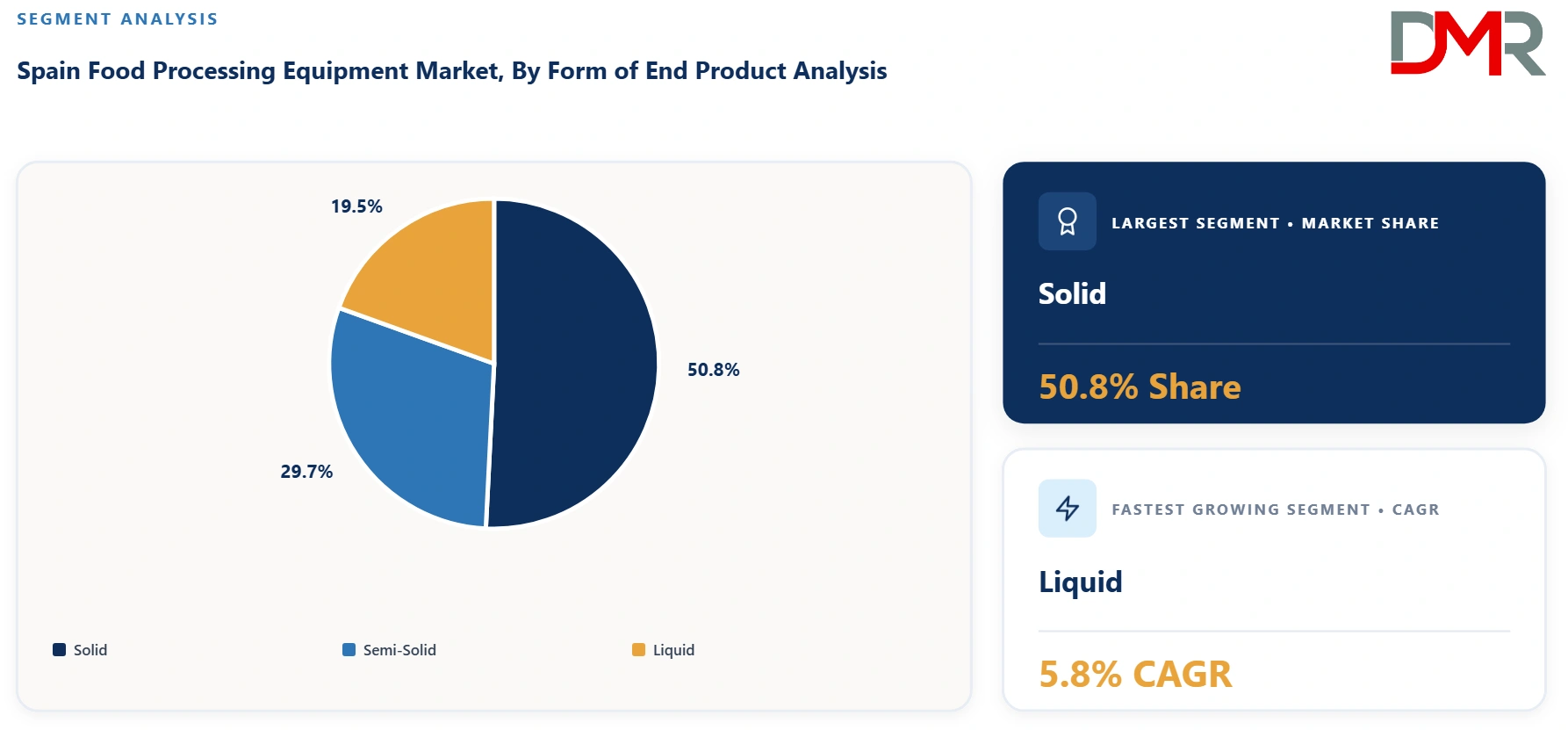
- By Form of End Product Analysis: Solid products are projected to lead with a 50.8% share in 2026, reflecting Spain’s substantial meat, bakery, seafood, cheese, fruit, vegetable, and grain-processing base. Liquid products are anticipated to expand at the highest CAGR of approximately 5.8%, supported by growing beverage, dairy, juice, wine, sauce, edible-oil, and plant-based drink production.
- By Application Analysis: Meat and Poultry is projected to dominate with a 25.7% share in 2026, supported by Spain’s established pork, cured-meat, poultry, and processed-food industries. Ready-to-Eat and Ready-to-Cook Foods are expected to grow at the highest CAGR of approximately 6.1%, driven by convenience, urban lifestyles, retail expansion, smaller households, and product innovation.
How AI and Generative AI are Transforming the Spain Food Processing Equipment Market?
Artificial intelligence is transforming Spanish food-processing operations through machine vision, predictive maintenance, automated quality inspection, production planning, and intelligent energy management. AI-enabled cameras detect defects, foreign materials, incorrect portions, and packaging failures at line speed. Predictive algorithms analyze vibration, temperature, pressure, and operating data to identify equipment problems before breakdowns occur. Generative AI assists technicians with maintenance instructions, troubleshooting, recipes, equipment configuration, and training. Digital twins and AI-supported process optimization can improve yield, reduce waste, shorten changeovers, and support consistent quality across multi-product facilities.
Key Drivers in the Spain Food Processing Equipment Market
Expansion and Modernization of Spain’s Food Manufacturing Industry
Spain possesses a highly diversified food-manufacturing base covering meat, seafood, dairy, beverages, bakery products, fruits, vegetables, preserved foods, and edible oils. Growing production complexity is encouraging companies to modernize preparation, processing, preservation, and packaging operations. According to Spain’s National Statistics Institute, manufacturing accounted for approximately 80.5% of total industrial turnover in 2023. Food manufacturers are investing in machinery capable of supporting higher throughput, repeatable quality, rapid product changes, and international food-safety standards. Export-oriented processors especially require advanced inspection, traceability, chilling, sterilization, and packaging systems to serve demanding European and international buyers.
Labor Shortages and Demand for Operational Efficiency
Labor-intensive activities such as cutting, grading, deboning, sorting, loading, inspection, and packaging are becoming increasingly difficult and expensive for processors. Automatic equipment helps manufacturers reduce repetitive manual work, increase line speed, improve employee safety, and maintain output during labor shortages. Robotic handling, automated guided systems, vision inspection, and centralized control platforms are consequently receiving greater attention. Energy and raw-material costs are also encouraging factories to improve equipment utilization and reduce product losses. Systems that deliver accurate portioning, automated cleaning, heat recovery, water recycling, remote monitoring, and preventive maintenance can generate measurable operating savings throughout their service life.
Restraints in the Spain Food Processing Equipment Market
High Capital and Integration Costs
Advanced food-processing machinery requires substantial expenditure on equipment, engineering, installation, utilities, employee training, safety systems, and ongoing maintenance. Smaller Spanish processors may struggle to justify fully automated lines when production volumes are seasonal or spread across numerous product varieties. Retrofitting modern controls into older factories can also require structural changes, upgraded electrical systems, software integration, and temporary production shutdowns. Financing costs and uncertain demand may delay replacement decisions. Although automation can generate long-term savings, extended payback periods remain a significant barrier for small and medium-sized meat, bakery, seafood, dairy, fruit, and specialty-food manufacturers.
Technical Complexity and Skilled Workforce Limitations
Digitally connected equipment requires employees capable of operating programmable controls, robotics, sensors, machine-vision systems, industrial software, and data platforms. Shortages of automation engineers, maintenance specialists, and experienced operators can prevent processors from utilizing equipment effectively. Integration becomes more difficult when factories operate machinery from multiple vendors using different communication protocols. Cybersecurity also becomes a concern as production systems connect with cloud platforms and enterprise software. Unexpected software failures or poor system configuration can interrupt operations. Equipment suppliers must therefore provide training, remote assistance, local spare parts, cybersecurity controls, and reliable after-sales support to encourage wider adoption.
Growth Opportunities in the Spain Food Processing Equipment Market
Automation Solutions for Small and Medium-Sized Processors
Spain has numerous regional, family-owned, and specialized food companies that need flexible automation without the cost or complexity of large integrated factories. Compact, modular, and scalable machinery creates a major opportunity for suppliers. Equipment that supports rapid format changes, multiple recipes, smaller batches, intuitive controls, and phased capacity expansion can attract dairy, bakery, meat, seafood, olive, and specialty-food processors. Leasing, equipment-as-a-service, remote monitoring, and performance-based maintenance models can reduce initial investment barriers. Suppliers offering local demonstrations, application testing, operator training, financing support, and dependable service networks will be well positioned to serve this underpenetrated customer group.
Sustainable and Resource-Efficient Processing Technologies
Food companies are seeking machinery that lowers electricity, heat, refrigeration, water, packaging-material, and cleaning-chemical consumption. Opportunities are growing for heat recovery, energy-efficient motors, low-water cleaning, closed-loop cooling, precision portioning, waste-recovery systems, and recyclable packaging equipment. Machinery capable of processing by-products into valuable ingredients can also support circular production. European sustainability requirements and customer procurement standards are strengthening demand for measurable environmental performance. Suppliers that provide equipment-level energy data, emissions calculations, lifecycle assessments, and resource-optimization software can differentiate their offerings while helping Spanish processors reduce operating costs and meet corporate sustainability commitments.
Trends in the Spain Food Processing Equipment Market
Connected Factories and Predictive Maintenance
Processors are increasingly connecting individual machines, production lines, quality systems, and enterprise software to obtain real-time operational visibility. Sensors monitor temperature, pressure, vibration, throughput, energy consumption, downtime, and product losses. Cloud dashboards and edge-computing systems allow managers to compare performance across equipment and facilities. Predictive-maintenance applications identify abnormal operating patterns before component failures cause costly shutdowns. Remote support also enables suppliers to diagnose problems and guide maintenance teams. Tetra Pak’s Factory OS, for example, reflects the industry’s movement toward open, scalable environments that combine automation, data, and analytics across food and beverage plants.
Flexible and Integrated Processing and Packaging Lines
Spanish processors are moving toward integrated lines that connect preparation, processing, inspection, portioning, preservation, packaging, labeling, and palletizing. These configurations reduce manual transfers, contamination points, product damage, and production delays. Flexibility is becoming essential because manufacturers handle more product varieties, package sizes, retail specifications, and seasonal batches. Equipment suppliers are therefore developing modular lines with recipe management, tool-free changeovers, automated cleaning, machine vision, and centralized controls. Demand is particularly strong in meat, seafood, bakery, dairy, and convenience foods, where consistent portions, longer shelf life, attractive packaging, and rapid format changes directly affect profitability.
Research Scope and Analysis
The Spain Food Processing Equipment Market is segmented by equipment type into preparation equipment, mechanical processing equipment, heat processing equipment, preservation equipment, packaging equipment, and others, by mode of operation into automatic, semi-automatic, and manual, by end-product form into solid, semi-solid, and liquid, and by application into dairy, bakery, meat, seafood, produce, grains, beverages, convenience foods, edible oils, and others.
ℹ
To learn more about this report –
Download Your Free Sample Report Here
By Equipment Type Analysis
Heat Processing Equipment is anticipated to dominate the equipment type segment with a 27.6% market share in 2026. Its position is supported by widespread use in dairy, bakery, meat, seafood, beverage, and prepared-food manufacturing.
Packaging Equipment is expected to record the highest CAGR of approximately 6.0% through 2035, above the overall market CAGR of 5.2%. Growth is driven by automated filling, sealing, labeling, vacuum packaging, modified-atmosphere packaging, inspection, and end-of-line handling requirements.
By Mode of Operation Analysis
Automatic equipment is projected to lead the mode of operation segment with a 58.4% share in 2026. Manufacturers favor automated machinery for higher throughput, improved hygiene, repeatable quality, accurate portioning, and reduced reliance on manual labor.
Automatic equipment is also expected to register the highest CAGR of approximately 5.7% through 2035. Robotics, machine vision, connected controls, and automated cleaning will support expansion.
By Form of End Product Analysis
Solid products are expected to dominate the form of end product segment with a 50.8% share in 2026. Demand is supported by meat, poultry, fish, bakery products, confectionery, cheese, processed vegetables, grains, and ready meals.
Liquid products are projected to record the highest CAGR of approximately 5.8% through 2035. Growth will come from dairy drinks, juices, wine, beer, sauces, edible oils, and plant-based beverages.
By Application Analysis
Meat and Poultry is projected to lead the application segment with a 25.7% share in 2026, supported by Spain’s substantial pork, processed-meat, cured-meat, and poultry industries. Demand covers slaughtering, cutting, grinding, portioning, cooking, chilling, inspection, and packaging equipment.
Ready-to-Eat and Ready-to-Cook Foods are anticipated to register the highest CAGR of approximately 6.1% through 2035, driven by changing lifestyles and convenience-oriented consumption.
The Spain Food Processing Equipment Market Report is Segmented Based on the Following
By Equipment Type
- Preparation Equipment
- Mechanical Processing Equipment
- Heat Processing Equipment
- Preservation Equipment
- Packaging Equipment
- Others
By Mode of Operation
- Automatic
- Semi-Automatic
- Manual
By Form of End Product
By Application
- Dairy Products
- Bakery and Confectionery
- Meat and Poultry
- Fish and Seafood
- Fruits and Vegetables
- Grains and Pulses
- Beverages
- Ready-to-Eat and Ready-to-Cook Foods
- Edible Oils
- Others
Technology Analysis
Spain’s equipment landscape is progressing toward intelligent, flexible, and energy-efficient processing. Machine vision is improving sorting, grading, portioning, foreign-material detection, and package inspection, while robotics is automating loading, cutting, pick-and-place, palletizing, and other repetitive operations. Industrial Internet of Things sensors enable real-time monitoring, predictive maintenance, and traceability. Digital twins support line design and process optimization before physical implementation. Opportunities are strongest for modular equipment, open-control architecture, remote diagnostics, advanced thermal processing, high-pressure processing, and low-energy refrigeration. However, legacy integration, cybersecurity exposure, interoperability limitations, employee skills, and uncertain returns can slow implementation among smaller manufacturers.
Regulatory Landscape
Food equipment sold and operated in Spain must comply with European Union and Spanish requirements covering machinery safety, hygiene, food-contact materials, worker protection, traceability, environmental performance, and waste management. Regulation EC No 852/2004 establishes general food-hygiene principles, while Regulation EC No 853/2004 provides additional requirements for foods of animal origin. Equipment must support hygienic design, cleanability, contamination prevention, controlled temperatures, and documented food-safety procedures. New machinery requirements, packaging rules, energy standards, and extended producer-responsibility obligations influence equipment design and purchasing. Compliance creates opportunities for advanced cleaning, inspection, monitoring, and sustainable packaging systems, although certification and redesign costs may burden smaller suppliers and processors.
Competitive Landscape
The Spain Food Processing Equipment Market is moderately fragmented, comprising multinational machinery groups, European specialists, domestic manufacturers, distributors, integrators, and service providers. Leading suppliers compete through equipment reliability, hygienic design, automation capabilities, processing yield, energy efficiency, lifecycle costs, and after-sales support. Large companies offer integrated production lines, while Spanish and regional suppliers compete through customization, faster service, industry knowledge, and flexible systems for smaller processors. Partnerships involving robotics, software, inspection, refrigeration, and packaging technologies are strengthening as customers increasingly demand connected end-to-end solutions.
Some of the Prominent Players in the Spain Food Processing Equipment Market Are
- GEA Group
- Tetra Pak
- JBT Marel
- Bühler Group
- Alfa Laval
- MULTIVAC Group
- Krones AG
- Syntegon Technology
- The Middleby Corporation
- SPX FLOW
- Heat and Control
- Provisur Technologies
- BAADER
- Bucher Industries
- Coperion
- FAM Stumabo
- TOMRA Food
- KHS Group
- Sidel
- Duravant
- Hosokawa Micron
- Satake Corporation
- Illinois Tool Works
- Risco S.p.A.
- Handtmann Group
- Vemag Maschinenbau
- Fenco Food Machinery
- Bertuzzi Food Processing
- Cabinplant
- CFT Group
- Metalquimia
- INOXPA
- ROSER Group
- TAVIL
- MAINCA
- Sammic
- Zumex Group
- Tecnotrip
- Dibal
- Talleres Ramón
- Other Key Players
Recent Developments
- May 2026: GEA introduced the PowerPak 5000 thermoforming packaging machine for medium-sized food producers. The system offers flexible package-format handling, stable operation, scalable automation, and simplified ownership, making it relevant for Spanish meat, cheese, seafood, and convenience-food companies seeking greater packaging flexibility.
- February 2026: MULTIVAC announced plans to present sustainable fish and seafood packaging and handling solutions at Seafood Processing Global in Barcelona. The technologies focus on extending product shelf life, improving presentation, supporting hygienic production, and increasing processing and packaging flexibility for seafood manufacturers.
- December 2025: Tetra Pak and Spanish beverage producer García Carrión introduced the first use of Tetra Pak’s paper-based barrier technology for juice packaging. The collaboration demonstrated growing integration between processing, filling, and lower-carbon packaging innovation within Spain’s beverage industry.
- May 2025: GEA showcased an automated processing and slicing-line concept incorporating product pre-scanning, intelligent portioning, line control, and reduced packaging and raw-material consumption. The technologies apply to Spanish meat, cheese, and alternative-protein processors pursuing higher capacity and sustainability.
Report Details
| Report Characteristics |
| Market Size (2026) |
USD 1.9 Bn |
| Forecast Value (2035) |
USD 3.0 Bn |
| CAGR (2026–2035) |
5.2% |
| Historical Data |
2021 – 2025 |
| Forecast Data |
2026 – 2035 |
| Base Year |
2025 |
| Segments Covered |
By Equipment Type, By Mode of Operation, By Form of End Product, By Application |
Frequently Asked Questions
How big is the Spain Food Processing Equipment Market?
▾ The Spain Food Processing Equipment Market is projected to be valued at USD 1.9 billion in 2026 and reach USD 3.0 billion by 2035.
What is the CAGR of the Spain Food Processing Equipment Market from 2026 to 2035?
▾ The Spain Food Processing Equipment Market is expected to expand at a compound annual growth rate of 5.2% from 2026 to 2035.
What factors are driving the growth of the Spain Food Processing Equipment Market?
▾ Growth is driven by food-factory modernization, labor shortages, increasing automation, strict hygiene requirements, export-oriented production, demand for convenience foods, sustainable processing, energy efficiency, and replacement of aging machinery.
What are the major trends in the Spain Food Processing Equipment Market?
▾ Major trends include robotics, machine vision, predictive maintenance, connected production lines, digital twins, energy-efficient processing, flexible machinery, automated cleaning, sustainable packaging, advanced inspection, and equipment-as-a-service models.
Who are the key players in the Spain Food Processing Equipment Market?
▾ Key players include GEA Group, Tetra Pak, JBT Marel, Bühler, Alfa Laval, MULTIVAC, Krones, Syntegon, Heat and Control, Metalquimia, INOXPA, ROSER Group, TAVIL, MAINCA, Sammic, and Zumex Group.
How is the Spain Food Processing Equipment Market segmented?
▾ The market is segmented by equipment type into preparation, mechanical processing, heat processing, preservation, packaging, and other equipment. It is also segmented by mode of operation, form of end product, and application.