What is the Supply Chain Big Data Analytics Market Size?
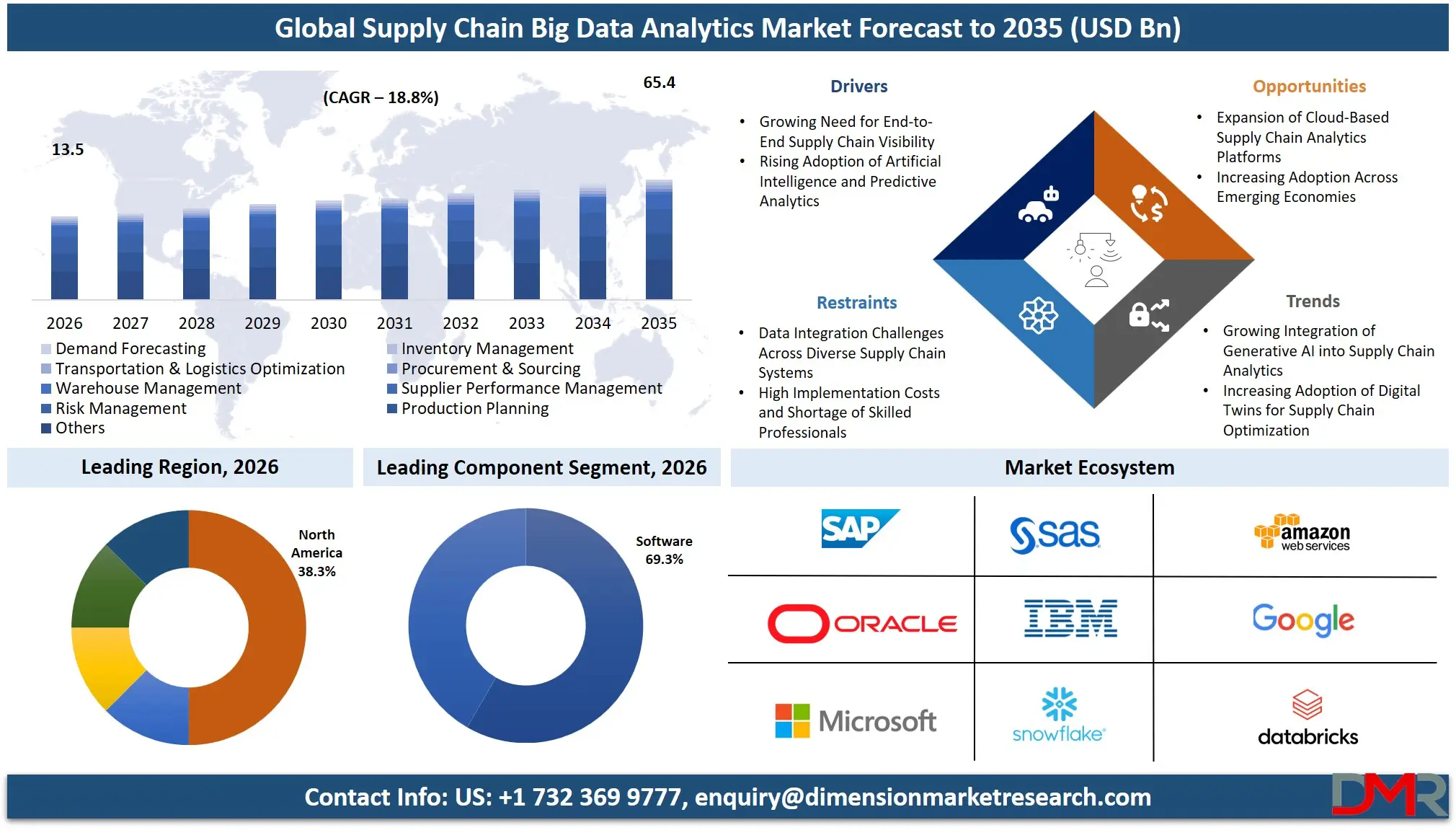
The Global Supply Chain Big Data Analytics Market is expected to reach a value of USD 13.5 billion in 2026, and it is further anticipated to reach USD 65.4 billion by 2035, growing at a CAGR of 18.8% during the forecast period.
ℹ
To learn more about this report –
Download Your Free Sample Report Here
The supply chain big data analytics market has been growing at an exponential rate as enterprises seek to build resilient, transparent, and intelligent supply networks in the face of persistent global disruptions. The market consists of software solutions and specialized services that enable organizations to ingest, process, and analyze vast datasets from internal and external sources, transforming raw logistics and inventory data into actionable strategic intelligence. The increasing complexity of multi-tier supplier networks, the adoption of IoT sensors for real-time cargo tracking, and the imperative for end-to-end visibility are driving the need for advanced analytics platforms and expert professional services. Large multinational corporations are the most frequent adopters, with cloud-based deployment remaining the most popular due to its ability to aggregate data across global ecosystems. The manufacturing, retail & e-commerce, and healthcare & pharmaceuticals industries are key players, as they require synchronized planning, stringent compliance adherence, and hyper-efficient fulfillment ecosystems.
The US Supply Chain Big Data Analytics Market
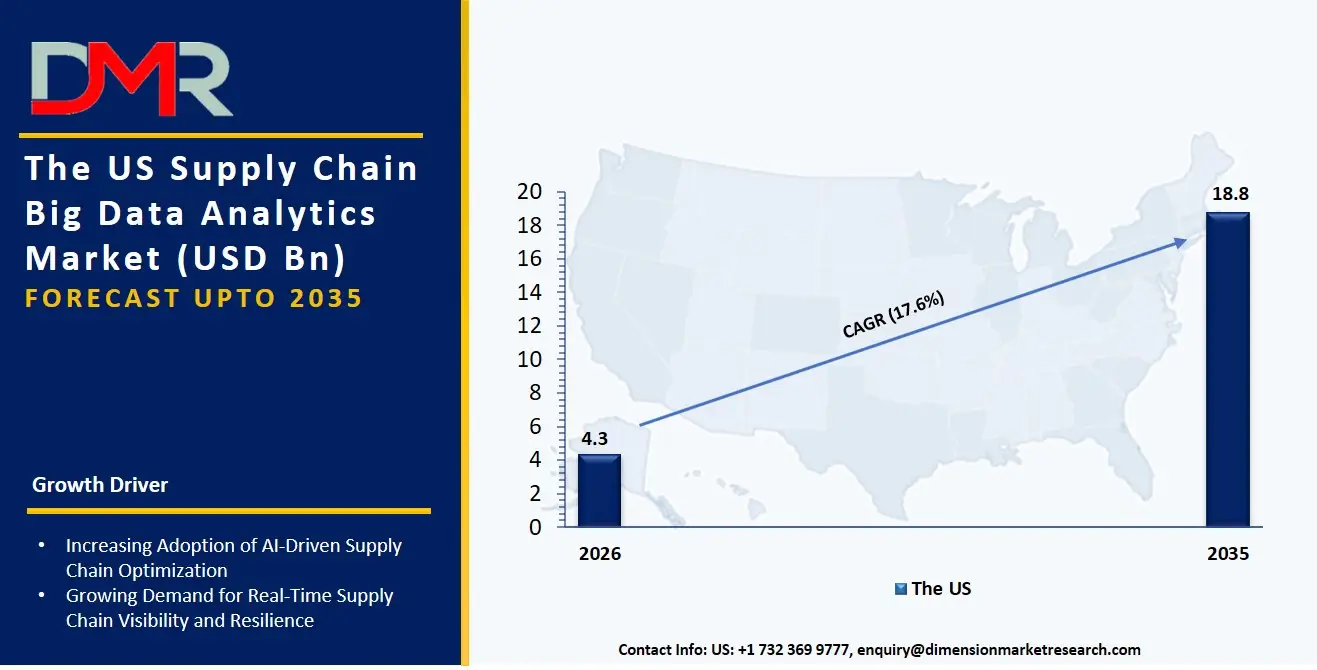
The US Supply Chain Big Data Analytics Market is projected to reach USD 4.3 billion in 2026 at a compound annual growth rate of 17.6% over its forecast period, culminating in a value of USD 18.8 billion by 2035.
ℹ
To learn more about this report –
Download Your Free Sample Report Here
The US continues to be the largest and most sophisticated market for supply chain analytics due to the aggressive digitalization of retail and manufacturing sectors and the advanced data science capabilities of Fortune 500 companies. The market has been typified by high demand for Predictive Analytics Software, whereby organizations are focused on anticipating demand volatility and mitigating upstream disruption risks. Besides, the integration of generative AI tools into supply chain control towers is producing a similar need for Risk & Compliance Analytics services to map sub-tier supplier dependencies and model ESG risk frameworks across the supply base.
The Europe Supply Chain Big Data Analytics Market
The Europe Supply Chain Big Data Analytics Market is estimated to be valued at USD 3.9 billion in 2026 and is further anticipated to reach USD 18.5 billion by 2035 at a CAGR of 18.9%. The regulatory frameworks, including GDPR and the EU's Corporate Sustainability Reporting Directive (CSRD), have a significant impact on the European market and drive the need to employ Risk & Compliance Analytics and sophisticated transportation management systems. Accelerated growth in Transportation & Logistics Optimization applications is also being experienced in the region, as automotive and industrial manufacturing hubs in Germany and France focus on creating hyper-efficient, low-carbon logistics corridors. In addition, initiatives like the European Data Strategy are challenging software vendors to create dedicated Data Management Software solutions to ensure data sovereignty, secure data sharing, and interoperability across European supply chain networks.
The Japan Supply Chain Big Data Analytics Market
The Japan Supply Chain Big Data Analytics Market is projected to be valued at USD 1.5 billion in 2026. It is further expected to witness robust growth, holding USD 6.7 billion in 2035 at a CAGR of 18.1%. The Japanese market is unique, with a corporate drive towards "Society 5.0" in response to a shrinking workforce and the need for extreme operational efficiency. Inventory & Demand Analytics and Supply Chain Visualization & Dashboards make up a large part of the spending, as large conglomerates synchronize just-in-time manufacturing models with predictive AI to avoid stockouts and production halts. There is also a strong need for deep system integration services to bridge the gap between legacy manufacturing execution systems (MES) and modern cloud-based planning platforms, which forms a niche in System Integration & Deployment and advanced inventory optimization.
Key Takeaways
- Market Size & Forecast: The Global Supply Chain Big Data Analytics market is projected to reach USD 13.5 billion in 2026, expanding dramatically to USD 65.4 billion by 2035, fueled by the dual drivers of AI-driven automation and the mandatory restructuring of global supply networks for enhanced resilience.
- Growth Rate & Outlook: Global market growth is expected at a CAGR of 18.8%, driven by a critical shortage of data scientists specializing in operations research and the escalating complexity of managing real-time data streams from IoT- enabled assets and interconnected ERP systems.
- Primary Growth Drivers: Key forces include the strategic shift from reactive logistics management to proactive, AI-orchestrated supply chains, the need for Data Management Software to break down silos between procurement, manufacturing, and logistics, and the integration of digital twin technologies requiring specialized Predictive Analytics Software.
- Key Market Trends: Major trends include the rise of industry-specific analytics solutions (e.g., cold chain integrity for pharma, omnichannel fulfillment for retail), the use of AI-powered tools within Supply Chain Visualization & Dashboards to auto-prescribe corrective actions during disruptions, and the shift toward Risk & Compliance Analytics as boards prioritize geopolitical risk and supply chain decarbonization.
- By Deployment Mode Analysis: Cloud-Based deployment models are expected to dominate enterprise discussions due to their inherent scalability and the need to onboard thousands of suppliers onto a single collaborative platform. Analytics services are increasingly required to build seamless API integration layers that connect on-premise factory systems with cloud-based supply chain control towers.
- By End User Analysis: Manufacturing and Retail & E-commerce are the most lucrative verticals due to the sheer volume and variety of data generated. Healthcare & Pharmaceuticals is the fastest-growing sector, as serialization mandates and cold chain logistics require robust Transportation & Logistics Analytics and end-to-end visibility architectures.
- Regional Leadership: North America is poised to dominate this market with 38.3% of the market share in 2026 due to its well-developed technological ecosystem, the presence of leading software vendors, and the early adoption of advanced analytics by a massive retail and logistics industry.
What is the Supply Chain Big Data Analytics Market?
Supply Chain Big Data Analytics encompasses the specialized software, platforms, and advisory services that enable organizations to process and derive insights from massive, high-velocity supply chain datasets. These solutions, unlike traditional business intelligence (BI) tools, are designed for the volume, variety, and velocity of modern supply chain data including internal ERP transactions, IoT telemetry from assets, and external data like weather, traffic, and news feeds. This involves Data Management Software to harmonize and govern data from disparate sources, Predictive Analytics Software to forecast demand and lead times, and Supply Chain Visualization & Dashboards to provide a unified command-and-control view. With 87% of chief supply chain officers prioritizing increased visibility, big data analytics is essential to achieving cost optimization, risk mitigation, and sustainability goals, transforming supply chains from a cost center into a competitive differentiator.
Use Cases
- Lean Inventory Optimization in Automotive: Automotive OEMs utilize Inventory & Demand Analytics software to analyze real-time dealer sales, tier-2 supplier capacity, and macroeconomic indicators, enabling dynamic safety-stock calculations that reduce working capital without jeopardizing production lines.
- Cold Chain Integrity in Pharmaceuticals: Pharma companies deploy Transportation & Logistics Analytics and IoT sensors to monitor temperature-sensitive vaccines in transit. Big data platforms analyze this telemetry against historical lane data to predict and automatically re-route shipments away from risk zones, ensuring regulatory compliance.
- Tier-N Risk Mapping in Manufacturing: Global manufacturers use Risk & Compliance Analytics services to ingest and analyze unstructured news, financial filings, and geopolitical risk indices, creating a dynamic risk map of 10,000+ suppliers to proactively identify and mitigate potential disruption nodes before they impact material flow.
- Omnichannel Order Orchestration in Retail: Major retailers use Supply Chain Visualization & Dashboards integrated with their order management systems to analyze real-time inventory positions across stores, warehouses, and in-transit stock, intelligently routing e-commerce orders to the most profitable and closest fulfillment node.
How AI is Transforming the Supply Chain Big Data Analytics Market?
AI is fundamentally reshaping supply chain analytics by shifting the paradigm from descriptive and diagnostic insights to fully autonomous, prescriptive action. In Predictive Analytics Software, AI-based deep learning models have the potential to automatically synthesize thousands of variables from weather patterns and port congestion to social media sentiment to generate highly accurate demand forecasts, greatly minimizing forecast error and inventory waste. Meanwhile, AI-powered features in Supply Chain Visualization & Dashboards allow managers to interact with data conversationally, using natural language queries to instantly detect constraints, model "what-if" disruption scenarios, and receive AI-curated, prescriptive resolution playbooks.
Strategy and risk management projects are also revolving around AI. In the area of consulting services, intelligent compliance agents are used to continuously monitor the multi-tier supply base and identify forced labor risks, regulatory violations, and single-point-of-failure dependencies to keep organizations in line with evolving trade compliance and ESG standards. Moreover, generative AI assistants are complementing system integration by automatically mapping complex, unstructured logistics documents to standardized data schemas, giving stakeholders a unified, clean data foundation before committing to major analytical projects.
Market Dynamics
Key Drivers in the Global Supply Chain Big Data Analytics Market
Growing Need for End-to-End Supply Chain Visibility
Organizations are increasingly investing in supply chain big data analytics to achieve complete visibility across procurement, manufacturing, warehousing, transportation, and distribution operations. Real-time insights help businesses monitor inventory levels, track shipments, evaluate supplier performance, and respond quickly to disruptions. Advanced analytics platforms integrate data from IoT devices, ERP systems, logistics networks, and customer channels, enabling proactive decision-making and operational efficiency. As global supply chains become more complex and interconnected, enterprises are prioritizing data-driven visibility to improve resilience, reduce operational costs, and enhance customer satisfaction, making this a major market growth driver.
Rising Adoption of Artificial Intelligence and Predictive Analytics
The integration of artificial intelligence, machine learning, and predictive analytics is significantly driving the growth of the Supply Chain Big Data Analytics Market. Organizations use intelligent analytics to forecast demand, optimize inventory, identify supply chain risks, improve production planning, and automate logistics operations. AI-powered analytics enables businesses to anticipate disruptions, optimize transportation routes, and improve supplier collaboration using real-time insights. As enterprises accelerate digital transformation and pursue more agile supply chain strategies, demand for advanced analytics platforms capable of delivering predictive and prescriptive recommendations continues to increase across industries.
Restraints in the Global Supply Chain Big Data Analytics Market
Data Integration Challenges Across Diverse Supply Chain Systems
Supply chain data originates from multiple internal and external sources, including ERP systems, warehouse management platforms, transportation systems, suppliers, and IoT devices. Integrating these diverse datasets into a unified analytics environment remains a significant challenge due to inconsistent data formats, legacy infrastructure, and interoperability limitations. Poor data quality and fragmented information reduce analytical accuracy and delay business decisions. Organizations often require complex integration projects and ongoing data governance initiatives, increasing deployment costs and limiting faster adoption of comprehensive supply chain analytics solutions.
High Implementation Costs and Shortage of Skilled Professionals
Implementing enterprise-scale supply chain analytics platforms requires substantial investments in software, cloud infrastructure, system integration, cybersecurity, and employee training. Organizations also face challenges in recruiting skilled professionals capable of managing big data platforms, artificial intelligence models, and advanced analytics tools. Small and medium-sized enterprises frequently encounter financial and technical barriers that slow adoption. Ongoing maintenance, software updates, and model optimization further increase operational costs, making comprehensive supply chain analytics implementation challenging for many organizations despite its long-term operational benefits.
Growth Opportunities in the Global Supply Chain Big Data Analytics Market
Expansion of Cloud-Based Supply Chain Analytics Platforms
Cloud computing presents significant growth opportunities by enabling organizations to deploy scalable and cost-effective supply chain analytics solutions. Cloud-based platforms support real-time collaboration among manufacturers, suppliers, logistics providers, and distributors while facilitating rapid implementation and seamless data sharing. Businesses increasingly adopt cloud analytics to improve demand forecasting, inventory optimization, transportation planning, and supplier collaboration without investing heavily in on-premises infrastructure. The continued migration toward cloud-first enterprise strategies is expected to expand the adoption of advanced supply chain analytics globally.
Increasing Adoption Across Emerging Economies
Rapid industrialization, digital transformation, and e-commerce expansion across emerging economies create substantial opportunities for supply chain big data analytics providers. Organizations in Asia Pacific, Latin America, the Middle East, and Africa are investing in intelligent supply chain technologies to improve operational efficiency and strengthen global competitiveness. Government initiatives promoting digital manufacturing, smart logistics, and Industry 4.0 further accelerate analytics adoption. Growing investments in modern logistics infrastructure and cloud technologies provide vendors with significant opportunities to expand their customer base in high-growth regional markets.
Trends in the Global Supply Chain Big Data Analytics Market
Growing Integration of Generative AI into Supply Chain Analytics
Generative AI is becoming an important trend within supply chain analytics by enabling automated reporting, intelligent forecasting, scenario simulation, and natural language interaction with enterprise data. Organizations are using AI assistants to generate recommendations for inventory optimization, procurement strategies, logistics planning, and risk management. The integration of generative AI enhances decision-making speed while improving accessibility for business users without advanced analytical expertise. This evolution is transforming how organizations manage increasingly complex global supply chains.
Increasing Adoption of Digital Twins for Supply Chain Optimization
Digital twin technology is gaining significant traction as organizations seek virtual representations of supply chain operations for real-time monitoring and simulation. Combined with big data analytics, digital twins enable enterprises to evaluate multiple operational scenarios, optimize logistics networks, predict disruptions, and improve production planning before implementing changes. Businesses increasingly deploy digital twins to enhance supply chain resilience, reduce operational costs, and improve customer service. As digital transformation accelerates, digital twin-enabled analytics is emerging as a key trend across modern supply chain ecosystems.
Research Scope and Analysis
The Global Supply Chain Big Data Analytics Market is segmented by Component into Software and Services, Deployment Mode, Organization Size, Analytics Type, Application, and End User, including Manufacturing, Retail and E-commerce, Healthcare and Pharmaceuticals, Transportation and Logistics, Food and Beverage, Automotive, Consumer Goods, Energy and Utilities, Information Technology and Telecommunications, and Others.
ℹ
To learn more about this report –
Download Your Free Sample Report Here
By Component Analysis
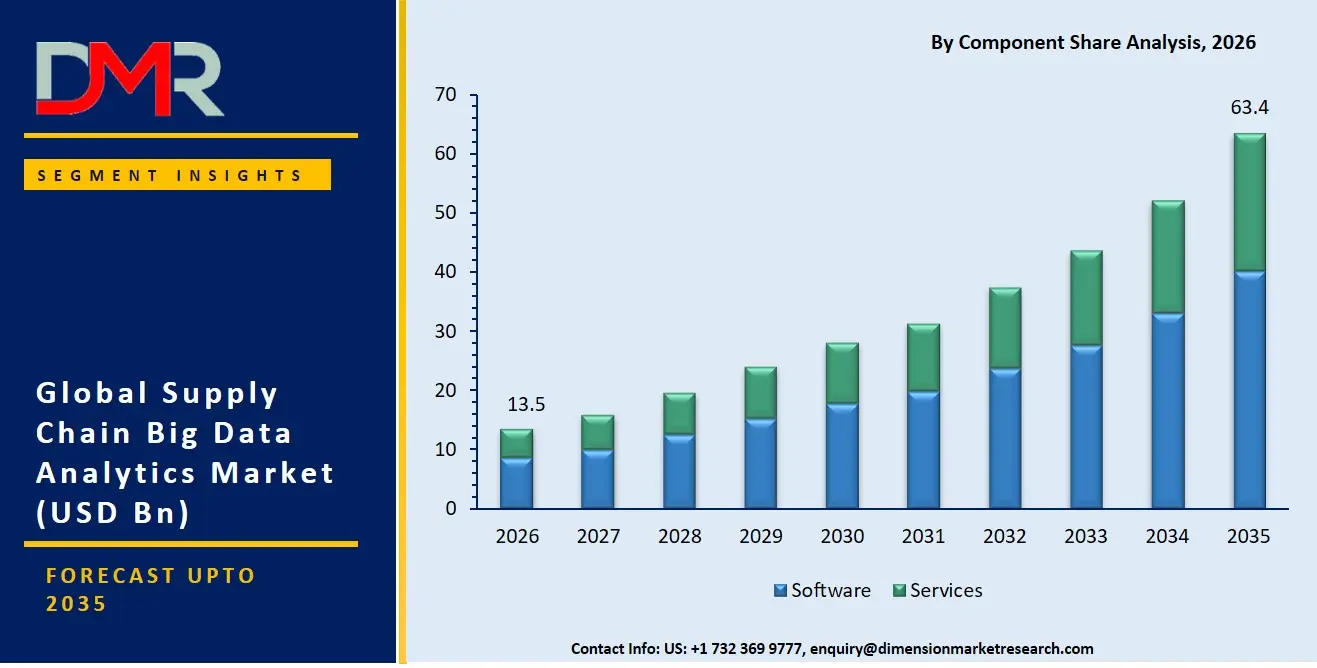
The Software segment is anticipated to dominate the Global Supply Chain Big Data Analytics Market because organizations increasingly rely on advanced analytics platforms to manage complex supply chain operations and improve decision-making.
ℹ
To learn more about this report –
Download Your Free Sample Report Here
Software solutions enable demand forecasting, inventory optimization, supplier performance analysis, transportation planning, and risk management through real-time data processing and predictive insights. Integration of artificial intelligence, machine learning, cloud computing, and IoT technologies further enhances operational visibility and business efficiency. Enterprises continue investing in scalable analytics platforms to improve resilience, reduce costs, and optimize end-to-end supply chain performance, making software the largest contributor to overall market revenue.
By Deployment Mode Analysis
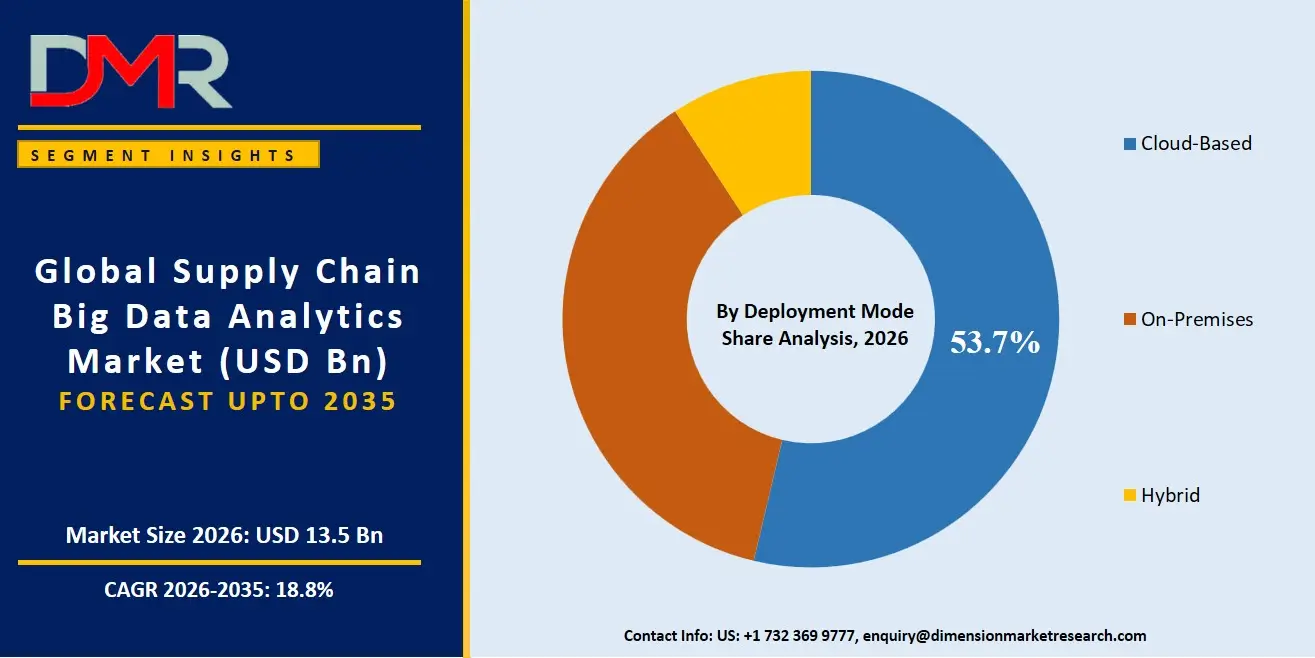
The Cloud-Based deployment segment is projected to dominate the market due to its scalability, flexibility, cost efficiency, and ability to process massive volumes of supply chain data across distributed operations. Cloud platforms enable real-time collaboration among suppliers, manufacturers, distributors, and logistics providers while supporting advanced analytics, AI, and machine learning capabilities. Organizations benefit from lower infrastructure costs, faster implementation, automatic software updates, and seamless integration with ERP and supply chain management systems. As enterprises accelerate digital transformation and global supply chain visibility initiatives, cloud deployment continues to experience the highest adoption across industries.
By Organization Size Analysis
Large Enterprises is poised to dominate the Supply Chain Big Data Analytics Market because they manage extensive global supply chains involving multiple suppliers, manufacturing facilities, logistics partners, and distribution networks. These organizations generate enormous volumes of operational data that require sophisticated analytics platforms for forecasting, inventory optimization, transportation planning, and risk mitigation. Large enterprises also possess the financial resources and technical expertise necessary to deploy enterprise-scale analytics solutions integrated with ERP, warehouse management, and procurement systems. Their continued investments in digital supply chain transformation and AI-powered decision-making reinforce their leadership within the global market.
By Analytics Type Analysis
Predictive Analytics is projected to dominates the analytics type segment because organizations increasingly focus on forecasting future demand, identifying supply chain disruptions, optimizing inventory levels, and improving procurement decisions before problems occur. Predictive models leverage historical data, artificial intelligence, and machine learning algorithms to anticipate customer demand, transportation delays, supplier risks, and production requirements. Businesses across manufacturing, retail, logistics, and consumer goods sectors rely heavily on predictive analytics to improve operational efficiency and reduce costs. Its direct contribution to proactive supply chain planning makes predictive analytics the leading analytics category in the market.
By Application Analysis
Demand Forecasting is poised to dominate the application segment because accurate prediction of customer demand is fundamental to efficient supply chain management. Organizations use big data analytics to analyze historical sales, seasonal trends, consumer behavior, economic indicators, and market conditions to optimize production schedules and inventory planning. Accurate demand forecasting reduces stock shortages, minimizes excess inventory, improves customer satisfaction, and strengthens supply chain resilience. The increasing adoption of AI-powered forecasting models and real-time market intelligence further enhances forecast accuracy, making demand forecasting the most widely adopted application within supply chain analytics.
By End User Analysis
The Manufacturing segment is anticipated to dominate the Global Supply Chain Big Data Analytics Market due to its highly complex production processes, extensive supplier networks, inventory management requirements, and global distribution operations. Manufacturers leverage big data analytics to optimize procurement, production planning, demand forecasting, warehouse management, transportation, and quality control while minimizing operational costs. Advanced analytics also improves supply chain resilience by identifying disruptions, monitoring supplier performance, and supporting predictive maintenance initiatives. The rapid adoption of Industry 4.0, smart factories, and connected manufacturing technologies continues to strengthen manufacturing as the largest end-user segment in the global market.
The Global Supply Chain Big Data Analytics Market Report is segmented on the basis of the following:
By Component
- Software
- Data Management Software
- Predictive Analytics Software
- Supply Chain Visualization & Dashboard
- Inventory & Demand Analytics
- Risk & Compliance Analytics
- Transportation & Logistics Analytics
- Others
- Services
- Consulting
- System Integration & Deployment
- Support & Maintenance
- Managed Services
By Deployment Mode
- Cloud-Based
- On-Premises
- Hybrid
By Organization Size
- Large Enterprises
- Small & Medium Enterprises (SMEs)
By Analytics Type
- Predictive Analytics
- Descriptive Analytics
- Prescriptive Analytics
- Diagnostic Analytics
By Application
- Demand Forecasting
- Inventory Management
- Transportation & Logistics Optimization
- Procurement & Sourcing
- Warehouse Management
- Supplier Performance Management
- Risk Management
- Production Planning
- Others
By End User
- Manufacturing
- Retail & E-commerce
- Healthcare & Pharmaceuticals
- Transportation & Logistics
- Food & Beverage
- Automotive
- Consumer Goods
- Energy & Utilities
- Information Technology & Telecommunications
- Others
Regional Analysis
Leading Region by Market Share
ℹ
To learn more about this report –
Download Your Free Sample Report Here
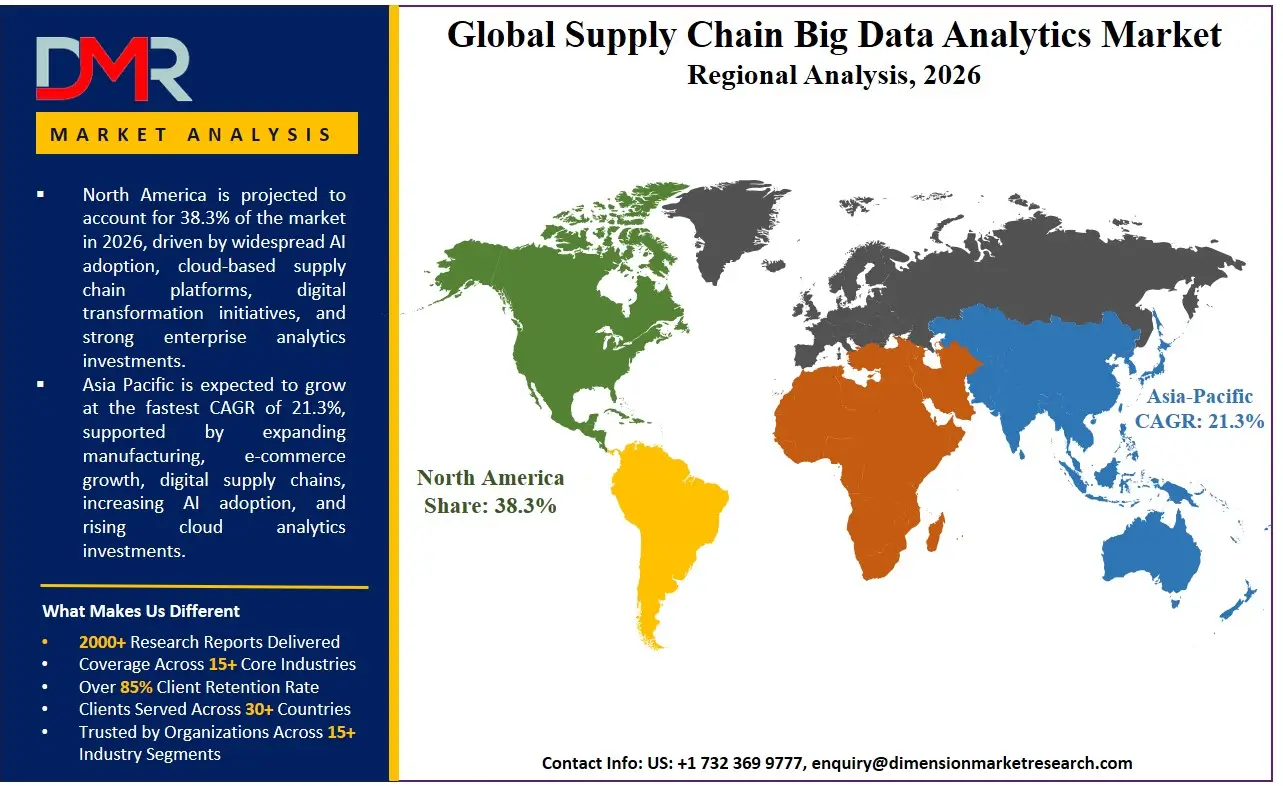
North America is poised to dominate the global supply chain big data analytics market, as it is projected to hold 38.3% of the market share by the end of 2026. The United States, which dominates North America, has the highest share in the supply chain analytics market because of the unmatched concentration of leading software vendors, hyperscale data cloud providers, and the aggressive digital transformation agendas of the world's largest retail, technology, and manufacturing firms. The area has an established ecosystem of global system integrators, boutique operations research consultancies, and a rich pool of data engineering and data science talent. Enterprise investment in digital twins, end-to-end visibility platforms, and the overall modernization of brittle legacy planning systems contribute to the continued demand for Predictive Analytics Software and Integration Services, along with continuous Managed Services for model optimization. Moreover, a robust venture capital climate persistently finances emerging AI-native supply chain startups that require expert professional services to scale their platforms and prove ROI.
Fastest-Growing Regional Market
Asia-Pacific is expected to be the most rapidly expanding supply chain big data analytics market, driven by the government-led sweeping digital infrastructure initiatives in China, India, and Southeast Asia, and the region's role as the world's factory. The fast-paced economic growth, the rise of a domestic middle-income consumer class, and the dynamic expansion of e-commerce giants are compelling established conglomerates and logistics providers to discard unproductive manual planning spreadsheets. Consulting on digital supply chain strategy is in high demand to guide these large organizations towards AI-driven, autonomous planning operating models. There is also a severe lack of qualified analytics talent in the region, making it necessary to outsource professional services for System Integration, model development, and managed data operations to bridge the skills gap and enable faster time-to-value from analytics investments.
By Region
North America
Europe
- Germany
- The U.K.
- France
- Italy
- Russia
- Spain
- Benelux
- Nordic
- Rest of Europe
Asia-Pacific
- China
- Japan
- South Korea
- India
- ANZ
- ASEAN
- Rest of Asia-Pacific
Latin America
- Brazil
- Mexico
- Argentina
- Colombia
- Rest of Latin America
Middle East & Africa
- Saudi Arabia
- UAE
- South Africa
- Israel
- Egypt
- Rest of MEA
Competitive Landscape
The competitive environment of the global supply chain big data analytics market has become highly dynamic with a heterogeneous array of multinational ERP giants, hyperscaler analytics divisions, global system integrators (GSIs), and niche AI-native software specialists. The key to success will be the profound strategic alliances and integrations with core transactional platforms like SAP, Oracle, and Microsoft, as embedded analytics activate co-selling opportunities and sticky enterprise workflows. The movement towards market consolidation is rapidly progressing, with traditional IT outsourcing companies acquiring specialized supply chain data science and digital twin engineering boutiques to stay afloat. Proprietary intellectual property, including pre-built industry data models and automated data harmonization accelerators, is becoming a more important basis of competitive differentiation than just labor arbitrage or generic project management approaches.
Some of the prominent players in the Global Supply Chain Big Data Analytics Market are:
- SAP SE
- Oracle Corporation
- IBM Corporation
- Microsoft Corporation
- SAS Institute Inc.
- Amazon Web Services Inc.
- Google LLC
- Snowflake Inc.
- Databricks Inc.
- Kinaxis Inc.
- Blue Yonder Group, Inc.
- o9 Solutions, Inc.
- Manhattan Associates, Inc.
- Infor Inc.
- QlikTech International AB
- TIBCO Software Inc.
- Teradata Corporation
- MicroStrategy Incorporated
- Palantir Technologies Inc.
- Altair Engineering Inc.
- Other Key Players
Recent Developments
- May 2026: SAP introduced Autonomous Supply Chain Management at SAP Sapphire 2026, embedding Joule AI assistants and Industry AI capabilities across planning, manufacturing, logistics, and asset management to enhance predictive analytics and automated supply chain decision-making.
- June 2026: Blue Yonder announced the 2026.1 Blue Yonder Network release, adding enhanced AI-powered predictive analytics, Supply Chain Command Center capabilities, and expanded inventory and transportation visibility to improve end-to-end supply chain performance.
- January 2026: IBM expanded its AI-powered supply chain transformation services, integrating agentic AI, hybrid cloud, and advanced analytics capabilities to improve end-to-end planning, fulfillment, and operational resilience across global supply chains.
Report Details
| Report Characteristics |
| Market Size (2026) |
USD 13.5 Bn |
| Forecast Value (2035) |
USD 65.4 Bn |
| CAGR (2026–2035) |
18.8% |
| The US Market Size (2026) |
USD 4.3 Bn |
| Historical Data |
2021 – 2025 |
| Forecast Data |
2027 – 2035 |
| Base Year |
2025 |
| Estimate Year |
2026 |
| Segments Covered |
By Component, By Deployment Mode, By Organization Size, By Analytics Type, By Application, By End User |
| Regional Coverage |
North America – The US and Canada; Europe – Germany, The UK, France, Russia, Spain, Italy, Benelux, Nordic, & Rest of Europe; Asia-Pacific – China, Japan, South Korea, India, ANZ, ASEAN, Rest of APAC; Latin America – Brazil, Mexico, Argentina, Colombia, Rest of Latin America; Middle East & Africa – Saudi Arabia, UAE, South Africa, Turkey, Egypt, Israel, & Rest of MEA |
Frequently Asked Questions
How big is the Global Supply Chain Big Data Analytics Market?
▾ The Global Supply Chain Big Data Analytics market is poised to be valued at USD 13.5 billion in 2026 and is projected to reach USD 65.4 billion by 2035, driven by the universal need to transform fragmented supply chain data into a strategic asset for resilience and competitive advantage.
What is the CAGR of the Global Supply Chain Big Data Analytics Market from 2026 to 2035?
▾ The market is expected to grow at a CAGR of 18.8% from 2026 to 2035, reflecting the accelerating complexity of global supply networks and the persistent shortage of professionals skilled in both operations research and advanced data science.
What factors are driving the growth of the Global Supply Chain Big Data Analytics Market?
▾ Key drivers include the global analytics talent gap, the imperative to modernize siloed legacy ERP systems, the complexity of achieving multi-tier supply chain visibility, and the surge in demand for Risk & Compliance Analytics amid evolving geopolitical and ESG reporting mandates.
Which region held the largest share of the Supply Chain Big Data Analytics Market in 2026?
▾ North America is projected to hold a 38.3% of the market share in 2026, driven by a mature software vendor ecosystem and aggressive enterprise investment in Demand Forecasting and Transportation & Logistics Analytics to power vast retail and industrial networks.
Which region is expected to grow the fastest in the Supply Chain Big Data Analytics Market?
▾ The Asia-Pacific region is expected to grow the fastest, fueled by rapid digitalization of manufacturing and logistics in China, India, and Southeast Asia, where Consulting and System Integration services are critical for moving large conglomerates from manual planning to AI-driven execution.
What are the major trends in the Global Supply Chain Big Data Analytics Market?
▾ Major trends include the integration of Generative AI into decision-support platforms, the rise of supply chain digital twin platforms, the demand for industry-specific analytics (e.g., cold chain, omnichannel), and the focus on composable data architectures within complex multi-vendor IT landscapes.
Who are the key players in the Global Supply Chain Big Data Analytics Market?
▾ Key players include enterprise software giants like SAP, Oracle, and Blue Yonder, hyperscalers like AWS, Microsoft, and Google Cloud, pure-play analytics platforms like Kinaxis and E2open, and Global System Integrators like Accenture, Deloitte, and TCS.
How is the Global Supply Chain Big Data Analytics Market segmented?
▾ The market is segmented by Component, Deployment Mode, Organization Size, Analytics Type, Application, and End User.