Market Overview
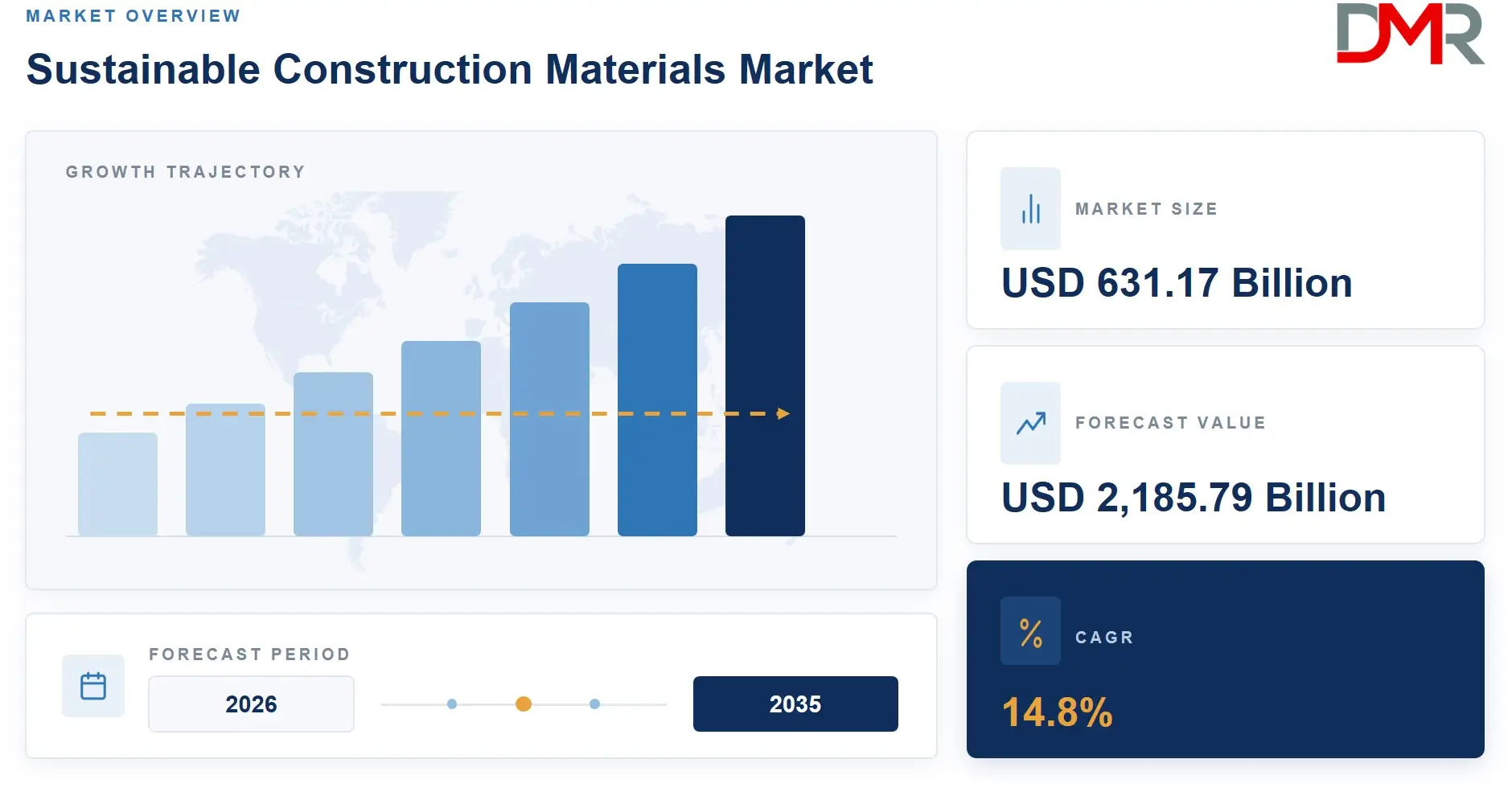
The Global Sustainable Construction Materials Market size is estimated at USD 631.17 Billion in 2026, and is projected to reach USD 2,185.79 Billion by 2035, exhibiting a CAGR of 14.8% during the forecast period.
Builders and developers accelerated specification of low-carbon materials through 2022 to 2025 as embodied carbon emerged as a regulated metric rather than a voluntary aspiration. Holcim reported recycling 8 million tonnes of construction-and-demolition material in 2025, a 23.5% increase from 6.5 million tonnes in 2024, confirming that circular-material processing had reached industrial scale by the base year. The forecast assumes continued tightening of building codes across the EU and North America, sustained green certification premiums, and growing procurement mandates from institutional real estate investors.
The market spans structural, exterior, and interior building materials produced from recycled, bio-based, or low-embodied-carbon feedstocks. Construction Technology connects this market directly to adjacent sectors in mass timber engineering, geopolymer cement chemistry, and bio-composite fabrication. Artificial intelligence now supports real-time life-cycle assessment integration into BIM workflows, allowing designers to optimize material selection at the schematic stage rather than after procurement decisions are locked.
ℹ
To learn more about this report –
Download Your Free Sample Report Here
Key Takeaways
- The market size is USD 631.17 Billion in 2026, and is projected to hit USD 2,185.79 Billion by 2035 at a CAGR of 14.8%.
- By Material Type: Bamboo led with a 42.5% share in 2025.
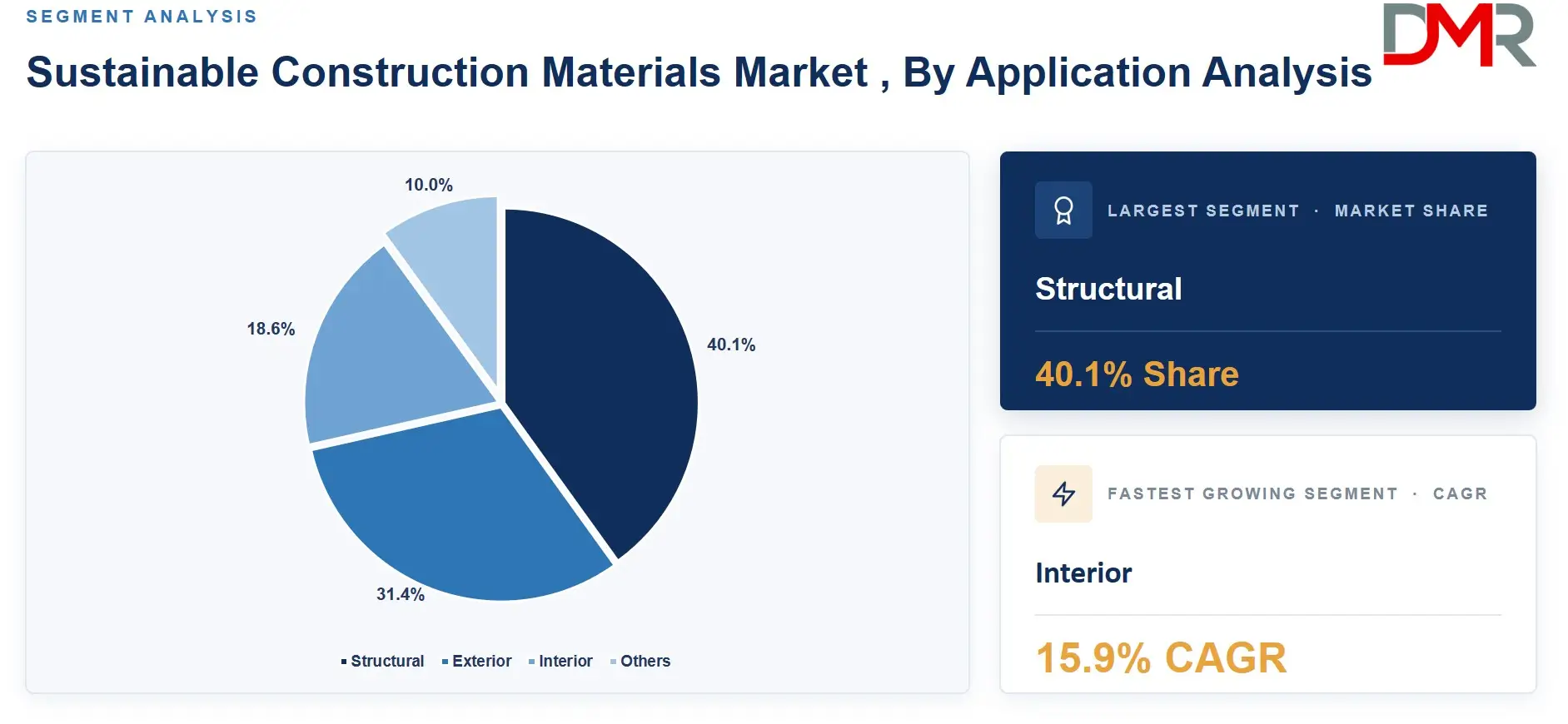
- By Application: Structural led with a 40.1% share in 2025.
- By End User: Residential led with a 37.6% share in 2025.
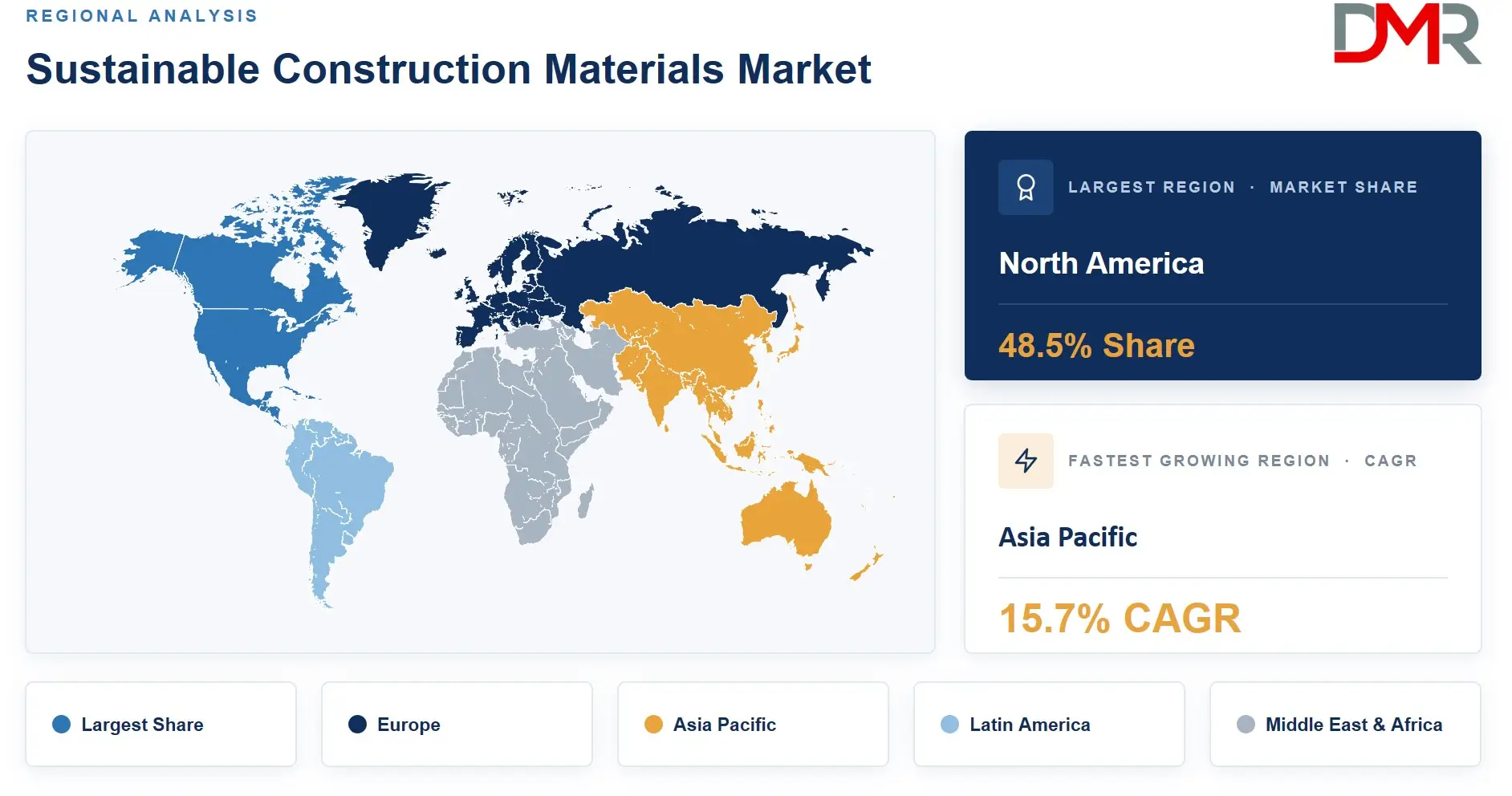
- By Region: North America led with a 48.5% share in 2025.
- Top 5 key players: Holcim Ltd., Saint-Gobain, Kingspan Group, BASF SE, Cemex S.A.B. de C.V.
Material Type Analysis
Bamboo accounted for 42.5% of Material Type demand in 2025, the highest of any category.
Bamboo's lead reflects a structural shift rather than a niche preference. Specifiers across residential and mid-rise commercial projects chose bamboo composites because the material combines high tensile strength with a carbon-sequestration profile that satisfies embodied-carbon ceilings now embedded in major municipal building codes. At 1510 Webster, all 16 mass-timber floors were installed in less than three months, as reported by WoodWorks, demonstrating that engineered wood and bio-based structural systems can meet construction schedules without concession to conventional timelines. Light Gauge Steel Framing remains a common alternative, but its higher embodied-carbon burden increasingly disqualifies it from LEED Platinum and BREEAM Outstanding specifications.
Green cement, recycled glass, and hempcrete together represent the fastest-growing material sub-segments, each benefiting from green procurement mandates requiring documented recycled content. Mycelium composites and ferrock attract pilot-scale commercial interest in fit-out applications where compressive loads are lower and carbon storytelling carries asset-valuation weight. Recycled plastic and recycled metal maintain steady demand in exterior cladding, while reclaimed wood and cork serve premium interior and acoustic applications where natural provenance commands a price premium over synthetic alternatives.
Application Analysis
Structural led the Application segment with a 40.1% share in 2025.
Structural applications dominate because the embodied-carbon intensity of a building's frame represents the single largest contributor to its whole-life carbon footprint. Structural Steel and conventional concrete remain embedded in commercial construction, but mass timber engineering advances now allow sustainable alternatives to compete in mid-rise and high-rise projects previously off-limits to bio-based systems. Regulatory pressure from the EU's Construction Products Regulation and U.S. municipal code revisions have made low-carbon structural specification a compliance matter, not a preference.
Exterior applications follow as the second-largest category, driven by sustainable insulation, cladding, and facade panels that serve both energy-performance and embodied-carbon targets in retrofit projects. Interior sustainable materials grow fastest on a percentage basis as circular economy mandates require documented material deconstruction and reuse pathways at the permit stage. Others, including infrastructure applications, represent an emerging category as public works procurement programs incorporate low-carbon concrete requirements.
ℹ
To learn more about this report –
Download Your Free Sample Report Here
End User Analysis
With a 37.6% share in 2025, Residential outpaced all other End User categories.
Residential buyers drive volume because single-family and multi-family housing construction operates at a scale that amplifies small per-unit material shifts into large aggregate demand changes. Homebuilders in the EU and UK face increasingly stringent nearly-zero-energy building standards that make sustainable insulation, timber framing, and low-carbon concrete the default rather than the upgrade. ESG-mandated institutional investors in build-to-rent residential portfolios add another procurement layer that locks sustainable specification into development briefs across multiple projects simultaneously.
Commercial end users, spanning offices, educational institutes, and hospitality assets, represent the highest-value segment per square meter. Green certification premiums in commercial real estate create a direct financial return on sustainable material investment through higher rental yields and asset appraisal uplift. Industrial end users are the fastest-growing category as manufacturing facilities face scope 3 emission accountability and begin incorporating low-carbon construction materials into new plant builds and retrofits.
Key Market Segments
By Material Type
- Bamboo
- Green Cement
- Recycled Glass
- Hempcrete
- Recycled Tires
- Reclaimed Wood
- Cork
- Mycelium
- Ferrock
- Sheep Wool
- Recycled Metal
- Recycled Plastic
- Ashcrete
- Timbercrete
- Cellulose Fiber
By Application
- Structural
- Exterior
- Interior
- Others
By End User
- Residential
- Commercial
- Offices
- Institutes
- Hospitality & Leisure
- Industrial
Regional Analysis
North America led the regional segment with a 48.5% share in 2025, representing the largest single geography by revenue.
North America
North America holds the commanding position because the U.S. and Canada combine high construction volumes with the most mature green building certification ecosystems globally. LEED certification has created three decades of buyer familiarity with sustainable material specification, giving U.S. developers the procurement infrastructure to absorb new low-carbon product categories faster than counterparts in emerging markets. Tier-1 municipalities from Boston to San Francisco now embed embodied-carbon ceilings directly into building permits, removing the voluntary dimension from sustainable material adoption entirely.
Asia Pacific
Asia Pacific is the fastest-growing region, pulled by infrastructure investment volumes and tightening green building codes in China, Japan, South Korea, and India. Saint-Gobain laid foundations for a major float glass and eco-insulation manufacturing facility in Chennai in August 2025, a direct response to rising localized demand for green-specification materials in South Asia. Seven Holcim operations across Europe consistently achieved carbon intensities below 400 kg net CO₂ per tonne of cementitious material in 2025, as reported by Holcim, providing a performance benchmark that Asian-market producers now compete to match.
ℹ
To learn more about this report –
Download Your Free Sample Report Here
Key Regions and Countries
North America
Europe
- Germany
- France
- The UK
- Spain
- Italy
- Rest of Europe
Asia Pacific
- China
- Japan
- South Korea
- India
- Australia
- Rest of APAC
Latin America
- Brazil
- Mexico
- Rest of Latin America
Middle East & Africa
- GCC
- South Africa
- Rest of MEA
Macroeconomic Impact
Interest rate cycles directly affect construction starts, and by extension, sustainable material volumes. Higher borrowing costs through 2023 and 2024 compressed new residential starts in North America and Europe, but retrofit and renovation demand partially absorbed the shortfall because existing buildings still faced energy-performance compliance deadlines regardless of capital market conditions. Alternative fuels, including biomass, supplied 39% of Holcim's thermal-energy demand for clinker production in 2025, as confirmed by Holcim, showing that input-cost diversification strategies are already moderating energy-price exposure at the producer level.
Trade policy shifts present a two-sided risk. Tariff escalation on imported construction materials can advantage domestic low-carbon producers by raising the relative cost of conventional alternatives sourced across borders. Currency depreciation in emerging markets, however, increases the import cost of specialized bio-based and engineered-wood products, slowing adoption in price-sensitive markets across Southeast Asia and Latin America.
Market Dynamics
Driver: Net-Zero Codes and ESG Mandates Redirect Material Specification
EU, UK, and U.S. municipalities embedding embodied-carbon ceilings in building permits have effectively removed sustainable material specification from the discretionary category. The 1510 Webster project reduced embodied-carbon intensity by 5%, from 279 to 265 kgCO₂e/m², as reported by Pepper Construction, confirming that mass-timber structural systems deliver measurable carbon reductions on live commercial projects. Mass timber also saved approximately two construction days per floor at 1510 Webster, producing a cumulative installation saving of more than one month across 16 floors per WoodWorks data, a schedule advantage that de-risks sustainable specification for cost-conscious developers. Gypsum Board and other conventional interior materials face displacement as LEED and BREEAM certification programs increasingly weight embodied carbon alongside operational energy metrics.
ESG capital allocation policies from institutional real estate investors mandate sustainable material specifications across entire development portfolios. Saint-Gobain unveiled plans to funnel roughly $14 billion into global capital expenditures and acquisitions by 2030, targeting Europe's net-zero transition and lightweight sustainable construction as the primary growth vectors. The 2026 Carbon Experts Report, published by One Click LCA, found that 90% of surveyed architecture, engineering, and construction professionals preferred construction products backed by Environmental Product Declarations, confirming that EPD-supported specification is now a baseline buyer expectation rather than a differentiator.
Restraint: EPD Gaps and Workforce Constraints Create Procurement Risk
Three out of four construction-product manufacturers had Environmental Product Declaration coverage for no more than 50% of their product portfolios, as reported by the 2026 Carbon Experts Report from One Click LCA. Buyers who require EPDs for all or most projects face a supply-side gap that forces either specification compromise or extended procurement timelines. Concrete Floor Coating and other legacy product categories dominate the EPD-covered product universe precisely because larger incumbent manufacturers invested earlier, leaving novel bio-based entrants with a documentation disadvantage.
Skilled trades unfamiliar with mass timber, hempcrete, and other novel bio-based installation requirements introduce project-timeline and cost risk that conservative developers actively avoid. Embodied-carbon measurement methodology inconsistency across global EPD standards adds a second layer of procurement ambiguity, making like-for-like material comparison difficult even when EPDs exist for competing products.
Opportunity: Retrofit Markets and CCUS-Enhanced Cement Scale
The retrofit and renovation segment applies sustainable insulation, cladding, and structural panels to existing building stock, a demand pool that operates independently of new-construction cycle downturns. Saint-Gobain Gyproc India commissioned the country's first near-net-zero gypsum ceiling tiles plant in Vishakhapatnam in March 2026, targeting green-certification compliance in a market where retrofit demand for certified sustainable products is outpacing new-build adoption. Heidelberg Materials' Brevik carbon-capture facility, inaugurated in June 2025, captures 400,000 tonnes of CO₂ annually, equivalent to approximately 50% of the cement plant's emissions per Heidelberg Materials data, establishing a commercially operational CCUS-enhanced cement pathway that public works procurement programs can now specify with confidence.
The 1510 Webster structural frame topped out more than one month ahead of schedule compared with the original construction program, as confirmed by WoodWorks, a result that positions mass-timber and prefabricated sustainable systems as schedule-risk mitigators rather than schedule-risk amplifiers. Carbon credit monetization frameworks for bio-based materials allow developers to recover premium material costs through carbon market revenue, improving the financial case for specification at a project level.
Porter's Five Forces
Competitive rivalry in the sustainable construction materials market is moderate-to-high, concentrated among a small number of global incumbents with large balance sheets and broad product portfolios, but fragmented at the bio-based and specialty-material tier where hundreds of regional producers compete on certification credentials and carbon performance claims. Barriers to new entrant scale are substantial: capital requirements for CCUS-enhanced cement production, mass-timber manufacturing, and circular C&D processing are prohibitive for underfunded startups. Supplier power is partially constrained by the market's reliance on agricultural and forestry feedstocks, where geographic concentration of bamboo, hemp, and timber supply creates input-cost volatility risk. Buyer power is rising as procurement specifications tighten and EPD requirements give informed buyers a standardized basis for comparison shopping across competing products. Holcim's freshwater withdrawal in 2025 reached 179 litres per tonne of cementitious material, 25% below its restated 2020 baseline per Holcim data, illustrating how resource-efficiency performance metrics are becoming a buyer qualification criterion rather than an optional disclosure. Threat of substitutes remains low in structural applications where regulatory approval processes for novel materials are lengthy, but higher in interior and fit-out categories where aesthetic and performance trade-offs are more subjective.
AI and Gen AI Impact
Artificial intelligence reshapes sustainable construction materials most visibly at the design and procurement stage. Embodied carbon software platforms now integrate real-time life-cycle assessment data directly into BIM workflows, allowing architects and engineers to compare material carbon performance at the point of specification rather than post-design. Holcim reported that its TectorPrint 3D-printing mortar can reduce material use by up to 50%, as stated in Holcim's 2025 sustainability statement, a reduction that AI-driven parametric design tools can optimize further by calculating minimum-material structural geometries that human designers would not produce manually.
Generative AI applied to supply chain planning helps manufacturers predict C&D material availability for circular product lines, reducing the mismatch between demolition feedstock supply and recycled-content product demand. Laggards who continue specifying materials without AI-assisted LCA tools face increasing audit risk as building permit applications begin requiring documented embodied-carbon calculations at submission.
Market Trends
Bio-Based Innovation and EPD Adoption Converge at the Specification Stage
The 1510 Webster mass-timber structure stored an estimated 122 kgCO₂e/m² of biogenic carbon, as reported by Pepper Construction, a figure that bio-based material producers now use as a commercial argument in tender submissions. Kingspan launched PowerPanel 2.0 across Ireland and Britain in March 2025, integrating micro-solar PV with QuadCore insulation in a single panel system that addresses both embodied and operational carbon simultaneously. Bio Based Epoxy Resin and mycelium composites attract pilot adoption in fit-out applications as circular economy building permit requirements force developers to document material deconstruction pathways. The 2026 Carbon Experts Report confirmed that 65% of AEC professionals required EPDs for all or most projects, making EPD-backed specification the default procurement condition across the professional buyer segment.
Market Competition Overview
The Sustainable Construction Materials market operates as a two-tier structure. A concentrated upper tier of five to eight global manufacturers holds dominant share across cement, insulation, and engineered-wood categories, competing through scale, certification breadth, and M&A-driven geographic expansion. Holcim's ECOCycle construction materials contained between 10% and 100% recycled construction-and-demolition content in 2025, as reported by Holcim, with ECOCycle technology operational across 12 countries in the same year. Kingspan Group confirmed in February 2026 that it had deployed over €750 million across organic capital expenditures and M&A over the previous year, prioritizing new global production facilities for its lower embodied carbon product range. These investment levels signal that market leadership in the next cycle depends on geographic reach and product carbon credentials rather than price competition alone.
A fragmented lower tier of bio-based and specialty material producers competes primarily on carbon-performance differentiation and speed to EPD certification. Share gains in this tier come from government green procurement mandates and pilot project placements rather than mass-market volume. Consolidation pressure will intensify as larger players identify bio-based specialists with proven EPD credentials as acquisition targets to fill portfolio gaps.
Pricing Analysis
Sustainable construction materials carry a price premium over conventional alternatives, but the gap is narrowing faster in structural applications than in specialty bio-based categories. At the 1510 Webster project in Oakland, the mass-timber structural system cost approximately US$20 per square foot less than a comparable structural-concrete system, as reported by Pepper Construction, a finding that directly challenges the persistent assumption that sustainable structural systems are always cost-additive. Volume-driven cost reductions in engineered-timber manufacturing and green cement production are compressing premiums from the supply side, while carbon credit monetization is compressing them from the demand side by allowing developers to offset premium material costs through carbon market revenue.
Regional pricing divergence remains significant. North American and European buyers absorb higher sustainable material costs because regulatory compliance and certification premium recovery make the economics work. Buyers in Southeast Asia and Latin America face a structurally different price equation where import costs for specialized materials and the absence of mature carbon credit markets limit sustainable specification to flagship projects and government-mandated public works.
Company Profiles
Holcim Ltd. operates as the market's most vertically integrated sustainable construction materials producer, combining low-carbon cement manufacturing, circular C&D material processing, and 3D-printing mortar technology within a single corporate structure. Holcim's 2025 net Scope 1 cement carbon intensity reached 502 kgCO₂ per tonne of cementitious material, 11% below its restated 2020 baseline per Holcim's sustainability statement, and its ECOPact and ECOPlanet product lines delivered at least 30% lower CO₂ emissions than standard CEM I products without offsets. The company operated more than 100 local circular-construction hubs in 2025 for processing and reintegrating C&D materials, creating a proprietary feedstock loop that competitors without equivalent collection infrastructure cannot replicate at comparable cost.
Saint-Gobain positions itself as a multi-material sustainable building solutions provider, competing across insulation, glass, gypsum, and waterproofing categories simultaneously. The company's $14 billion capital deployment plan through 2030 targets Europe's net-zero transition and lightweight construction as primary growth vectors, and its 2026 acquisitions in North America and Asia signal a deliberate push to pre-empt regional competitors before green building codes mature into compliance mandates in those markets. Saint-Gobain's risk lies in portfolio complexity: managing carbon-performance credentials across dozens of product lines in multiple regulatory environments requires an EPD production capacity that challenges even large organizations.
Key Players
- 3M
- Alumasc Group Plc
- Bauder Limited
- BASF SE
- CertainTeed
- DuPont
- Forbo Group
- Interface Inc.
- Kingspan Group
- Lafarge
- National Fiber
- Owens Corning
- PPG Industries
- Holcim Ltd.
- Saint-Gobain
- James Hardie Industries
- CRH plc
- Cemex S.A.B. de C.V.
- Sika AG
- Boral Limited
Supply Chain and Value Chain Analysis
The supply chain flows from agricultural and forestry feedstock suppliers, quarry operators, and C&D material collectors through primary processors, manufacturers, distributors, and finally to construction site end users. Maximum value creation occurs at the manufacturing stage where raw bio-based or recycled inputs are transformed into certified, EPD-documented products carrying carbon-performance claims. Holcim's advanced crushing technology demonstrated that 100% of processed C&D material can be upcycled into aggregates, asphalt, cement, concrete, precast products, and mortars, as reported by Holcim, collapsing the conventional linear supply chain into a closed loop. Cemex certified 31 plants as Zero Freshwater Concrete Plants in May 2026, addressing a supply-chain water-risk bottleneck that regulators in water-stressed regions are beginning to include in environmental permit conditions.
Regulatory Landscape
The EU's Construction Products Regulation and the forthcoming mandatory embodied-carbon reporting under the Energy Performance of Buildings Directive create a compliance floor that raises sustainable material adoption from voluntary to mandatory across European Union member states. U.S. federal procurement rules under the Buy Clean Initiative require low-carbon material specifications in federally funded infrastructure projects, pulling sustainable materials into public works budgets at scale. LEED, BREEAM, and EDGE green certification programs operate as a parallel quasi-regulatory layer in private commercial development, creating financial incentives that align with but exceed statutory requirements.
Embodied carbon measurement methodology inconsistency across global EPD standards remains the most significant regulatory friction point. Procurement officers in multinational development programs cannot directly compare carbon claims made under different national EPD frameworks, creating ambiguity that slows cross-border specification of sustainable materials even when regulatory intent is aligned.
Investment and White Space Analysis
Capital flows most actively into CCUS-enhanced cement, mass-timber manufacturing, and circular C&D processing, the three categories where both regulatory compliance value and scalability converge. Cemex Ventures received the BuiltWorlds Sustainability Investor of the Year Award in March 2026 for its aggressive early-stage investment in CCUS and low-carbon cement alternatives, confirming that venture capital has identified cement decarbonization as the highest-value white space in the construction materials sector. Bio-based specialty materials, including mycelium composites, fermentation-derived binders, and agricultural residue boards, represent the most underserved segment: commercial EPD documentation, consistent feedstock supply, and certified installer networks remain underdeveloped relative to the materials' carbon performance credentials.
High-growth, low-competition opportunities exist in Southeast Asia and the Middle East, where green building code adoption is accelerating but local sustainable material manufacturing capacity lags import-dependent specifications. Modular and offsite construction represents an additional white space where prefabricated sustainable material systems have not yet been systematically combined with circular end-of-life documentation to create a fully closed-loop product offering.
Recent Developments
- October 2025: Holcim entered a binding agreement to acquire Xella, a European manufacturer of sustainable walling systems, for €1.85 billion, strengthening its Building Solutions division.
- January 2026: Holcim agreed to acquire Alkern, a French precast concrete manufacturer focused on sustainable construction elements, advancing its target of making building solutions account for 50% of total net sales by 2030.
- July 2026: Saint-Gobain signed a definitive agreement to acquire Xypex in North America, a provider of crystalline concrete waterproofing admixtures and coatings designed to extend building lifecycles and reduce structural carbon footprints.
- July 2026: Saint-Gobain acquired Phu My Innovative Materials in Vietnam and took a majority stake in AGC Polymer Materials in Japan to serve rising local demand for green infrastructure materials across Asia.
- August 2026: Kingspan Group agreed to acquire 100% of BMC Manufacturing for €850 million to reinforce its insulation and building envelope portfolio.
Report Scope
| Report Characteristics |
| Market Value (2026) |
USD 631.17 Billion |
| Forecast Revenue (2035) |
USD 2,185.79 Billion |
| CAGR (2026 to 2035) |
14.8% |
| Base Year for Estimation |
2025 |
| Historic Period |
2020 to 2024 |
| Forecast Period |
2026 to 2035 |
| Report Coverage |
Revenue Forecast, Market Dynamics, Competitive Landscape, Recent Developments |
| Segments Covered |
By Material Type (Bamboo, Green Cement, Recycled Glass, Hempcrete, Recycled Tires, Reclaimed Wood, Cork, Mycelium, Ferrock, Sheep Wool, Recycled Metal, Recycled Plastic, Ashcrete, Timbercrete, Cellulose Fiber), By Application (Structural, Exterior, Interior, Others), By End User (Residential, Commercial, Industrial) |
| Regional Analysis |
North America (US and Canada), Europe (Germany, France, The UK, Spain, Italy, and Rest of Europe), Asia Pacific (China, Japan, South Korea, India, Australia, and Rest of APAC), Latin America (Brazil, Mexico, and Rest of Latin America), Middle East & Africa (GCC, South Africa, and Rest of MEA) |
| Competitive Landscape |
3M, Alumasc Group Plc, Bauder Limited, BASF SE, CertainTeed, DuPont, Forbo Group, Interface Inc., Kingspan Group, Lafarge, National Fiber, Owens Corning, PPG Industries, Holcim Ltd., Saint-Gobain, James Hardie Industries, CRH plc, Cemex S.A.B. de C.V., Sika AG, Boral Limited |
| Customization Scope |
Customization for segments and region or country level will be provided. Additional customization can be done based on requirements. |
| Purchase Options |
Three license options: Single User License, Multi-User License (Up to 5 Users), Corporate Use License (Unlimited Users and Printable PDF) |
Frequently Asked Questions
What is the biggest investment opportunity in the Sustainable Construction Materials market?
▾ CCUS-enhanced cement and bio-based specialty materials represent the highest-value white spaces, where carbon performance credentials are strong but commercial EPD documentation and certified installation infrastructure remain underdeveloped. The retrofit and renovation segment offers near-term volume opportunities because compliance deadlines for existing building stock operate independently of new-construction market cycles.
Who are the top companies in the Sustainable Construction Materials market?
▾ The leading players are Holcim Ltd., Saint-Gobain, Kingspan Group, BASF SE, and Cemex S.A.B. de C.V. These five companies compete across cement, insulation, walling, and engineered-material categories, using M&A and capital-intensive production investments to extend geographic reach and carbon-performance credentials simultaneously.
Which segment is growing fastest in the Sustainable Construction Materials market and why?
▾ Interior sustainable materials and bio-based specialty categories grow fastest on a percentage basis as circular economy building permit requirements mandate documented material deconstruction and reuse pathways. Mycelium composites, agricultural residue boards, and fermentation-derived binders attract pilot-scale commercial adoption in fit-out applications where compressive load requirements are lower and carbon storytelling carries asset-valuation weight.
Which region is growing fastest in the Sustainable Construction Materials marketand why?
▾ Asia Pacific is the fastest-growing region, driven by infrastructure investment volumes and tightening green building codes across China, Japan, South Korea, and India. Major global producers including Saint-Gobain have committed manufacturing capital to South and Southeast Asia specifically to serve local green-specification demand rather than rely on import supply chains.
What is the biggest challenge holding in the Sustainable Construction Materials market back?
▾ EPD coverage gaps across product portfolios create the most persistent procurement barrier: three out of four construction-product manufacturers had EPD documentation for no more than 50% of their product lines in 2026. Skilled trades unfamiliarity with mass timber and hempcrete installation adds a parallel execution risk that conservative developers weigh heavily when assessing project timeline certainty.