Switzerland Food Safety Testing Market Snapshot
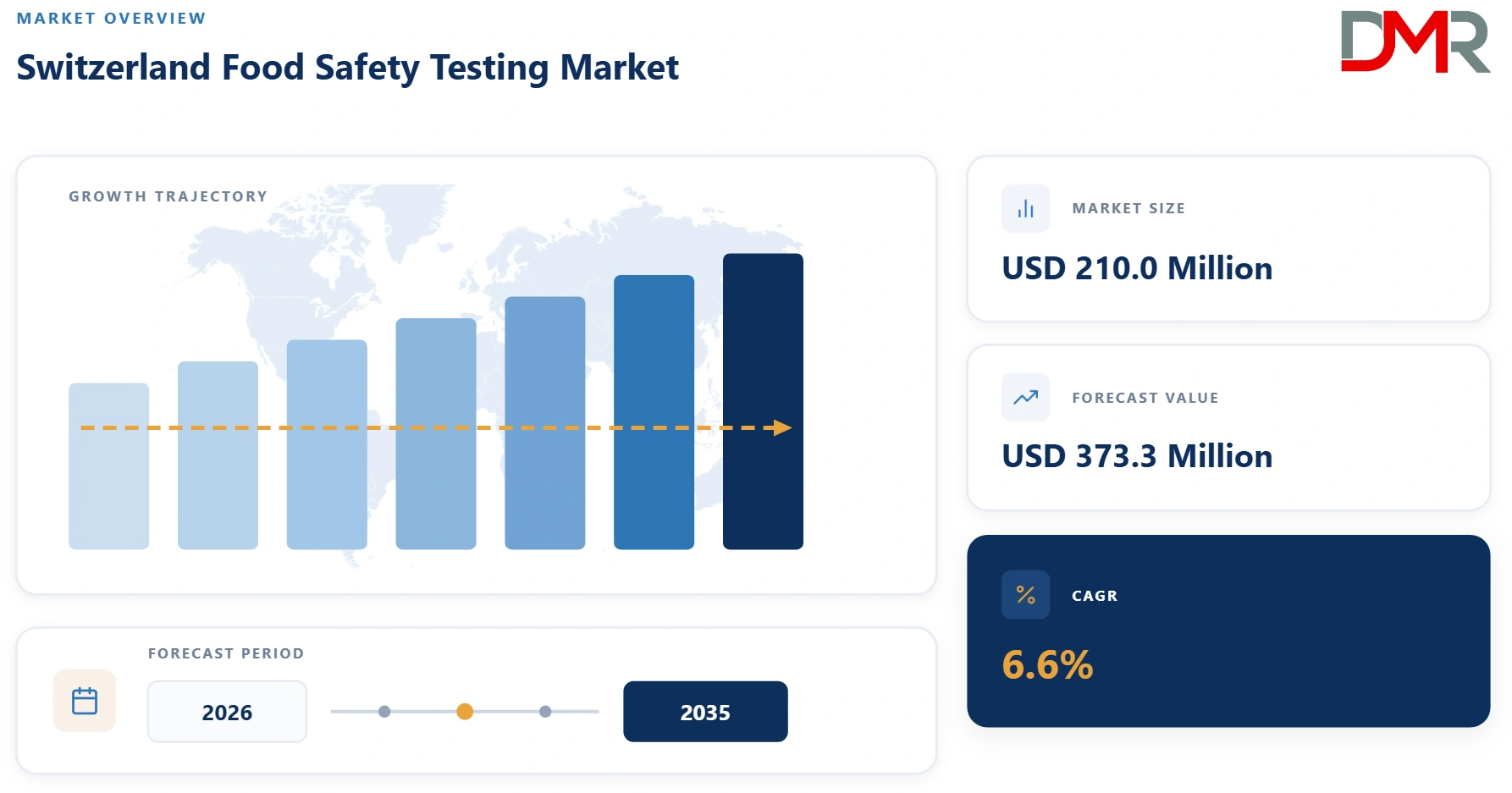
- Switzerland Food Safety Testing Market Size in 2026: USD 210.0 Million
- Switzerland Food Safety Testing Market Size in 2035: USD 373.3 Million
- Switzerland CAGR from 2026 to 2035: 6.6%
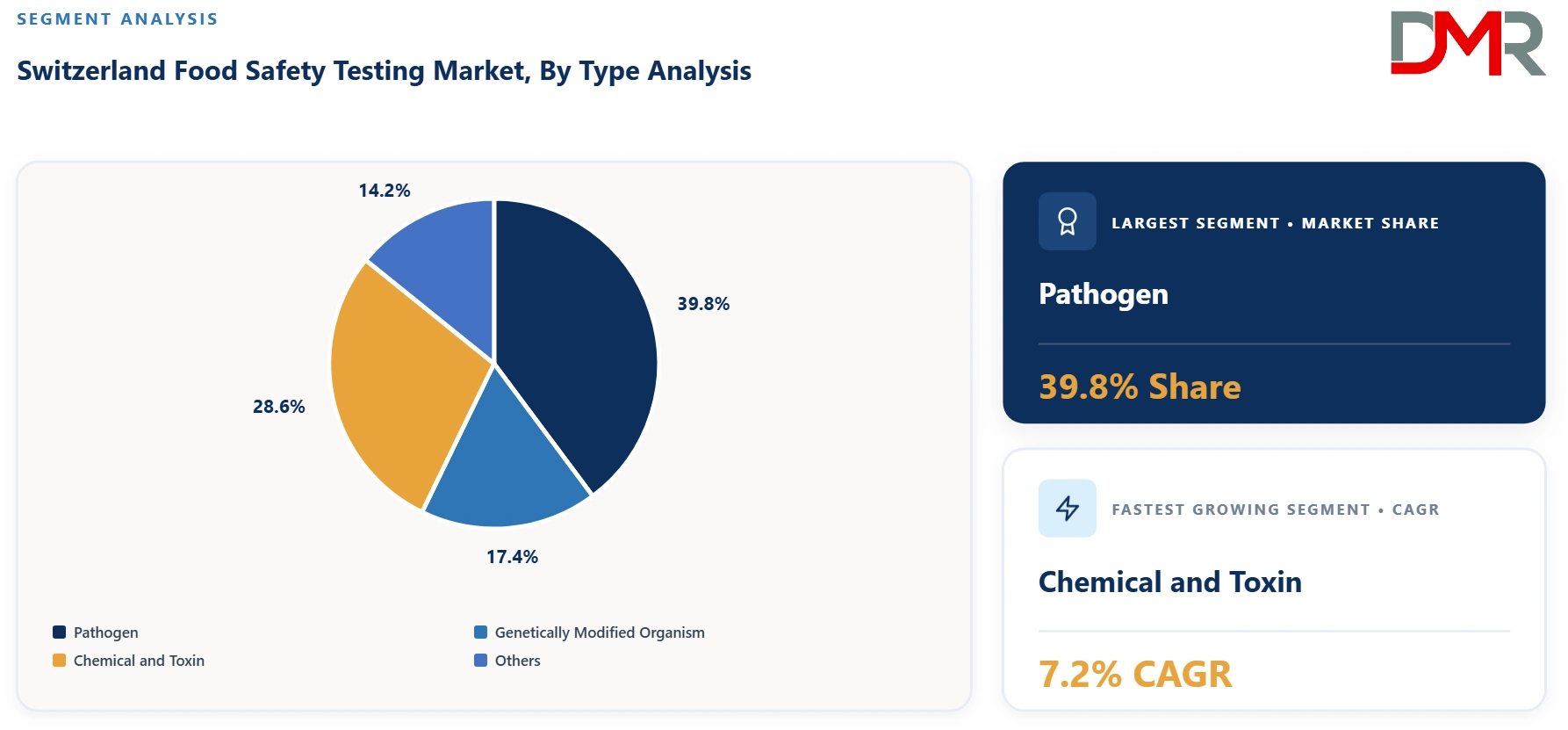
- Pathogen is the leading Type segment in 2026: 39.8%
- Meat and Meat Products is the leading Food Tested segment in 2026: 32.1%
- PCR-based Assay is the leading Technology segment in 2026: 36.4%
What is the Switzerland Food Safety Testing Market and its Market Size?
The Switzerland Food Safety Testing Market is projected to reach USD 210.0 million in 2026 and grow at a compound annual growth rate of 6.6% from there until 2035 to reach a value of USD 373.3 million.
ℹ
To learn more about this report –
Download Your Free Sample Report Here
Food safety testing in Switzerland comprises laboratory services, analytical instruments, consumables, and rapid testing solutions used to identify pathogens, toxins, chemical residues, allergens, genetically modified organisms, adulteration, and other food hazards. Demand is supported by stringent federal requirements, high consumer expectations, cross-border food trade, premium dairy and meat production, and increasing emphasis on traceability. Accredited laboratories, food manufacturers, retailers, importers, and cantonal authorities use culture, PCR, immunoassay, chromatography, and mass spectrometry workflows to verify compliance and protect public health.
Use Cases
- Pathogen Screening in Meat and Dairy: Meat processors, slaughterhouses, dairies, and cheese producers test raw materials, production environments, and finished products for Salmonella, Listeria monocytogenes, Campylobacter, and pathogenic Escherichia coli. Rapid PCR and immunoassay workflows enable earlier product release, support environmental monitoring, reduce contamination risks, verify sanitation effectiveness, and help companies comply with microbiological criteria before products enter Swiss retail and export channels.
- Chemical Residue and Toxin Detection: Food businesses and control laboratories analyze cereals, dairy products, fruits, vegetables, meat, and imported foods for pesticide residues, veterinary drug residues, mycotoxins, heavy metals, process contaminants, and unauthorized substances. Chromatography and mass spectrometry methods support precise quantification, while immunoassays provide efficient screening. Results guide supplier approval, corrective action, recall decisions, regulatory reporting, and risk-based quality assurance across supply chains.
- Authenticity, GMO, and Allergen Verification: Laboratories apply PCR, immunoassay, spectroscopy, and targeted chemical analysis to verify species identity, detect genetically modified material, confirm ingredient authenticity, and identify undeclared allergens. These services help manufacturers validate labels, prevent food fraud, protect sensitive consumers, and manage imported ingredients. Testing is particularly relevant for premium Swiss products, organic claims, plant-based foods, chocolate, cereals, processed foods, and private-label portfolios.
Key Takeaways
- Market Size: The Switzerland Food Safety Testing Market is anticipated to be valued at USD 210.0 million in 2026 and is forecast to reach USD 373.3 million by 2035, expanding at a CAGR of 6.6%.
- Growth Outlook: Market expansion is supported by stringent food legislation, risk-based official controls, rising imported-food volumes, premium product quality requirements, growing concern about pathogens and chemical contaminants, increasing adoption of rapid molecular methods, retailer testing programs, and stronger traceability expectations throughout Switzerland’s food production and distribution system.
- Primary Growth Drivers: Greater focus on preventing foodborne illness, mandatory self-control by food businesses, complex international supply chains, recurring contamination and fraud risks, heightened allergen awareness, demand for faster product release, growth in processed and convenience foods, and laboratory automation are accelerating investment in food safety testing services, instruments, assays, and data platforms.
- By Type Analysis: Pathogen testing is projected to lead the Type segment with a 39.8% share in 2026, supported by routine screening for Salmonella, Listeria, Campylobacter, and pathogenic Escherichia coli in meat, dairy, processed foods, and production environments. Chemical and Toxin testing is expected to grow fastest as scrutiny of pesticide residues, PFAS, heavy metals, mycotoxins, and process contaminants increases.
- By Food Tested Analysis: Meat and Meat Products is anticipated to dominate with a 32.1% share in 2026 because animal-origin foods require extensive microbiological controls across slaughter, processing, storage, and retail. Processed Food is expected to record the fastest growth, driven by multi-ingredient formulations, allergen risks, longer supply chains, private-label quality programs, convenience-food consumption, and demand for authenticity verification.
- By Technology Analysis: PCR-based Assay is projected to lead with a 36.4% share in 2026 due to rapid turnaround, high sensitivity, target specificity, multiplexing capability, and growing automation. PCR-based Assay is also expected to achieve the highest CAGR as food laboratories replace or supplement lengthy culture workflows with validated molecular platforms for pathogen, GMO, species, and authenticity testing.
How AI and Generative AI are Transforming the Switzerland Food Safety Testing Market?
Artificial intelligence is improving how Swiss laboratories prioritize samples, detect abnormal patterns, interpret complex chromatographic and genomic data, and predict contamination risks across food supply chains. Machine-learning models can combine test results, supplier history, environmental monitoring, production conditions, and recall information to support risk-based testing. Computer vision strengthens colony counting and plate interpretation, while AI-assisted laboratory systems automate result review and reporting. Generative AI can summarize regulations, draft investigation records, and help analysts query quality data, although validated workflows, human oversight, cybersecurity, confidentiality, and explainable decisions remain essential for regulatory use.
Key Drivers in the Switzerland Food Safety Testing Market
Stringent Controls and Extensive Official Sampling
Switzerland’s Federal Foodstuffs Act prioritizes consumer protection from unsafe food, while federal and cantonal authorities coordinate controls across the food chain. Food businesses must maintain effective self-control systems, creating continuous demand for accredited microbiological, molecular, and chemical testing. Switzerland’s multiannual control reporting documented 48,613 official food samples, including drinking water, examined by cantonal enforcement authorities in 2020. Continued oversight of domestic production, retail products, animal-origin foods, packaging migration, allergens, contaminants, and imported consignments sustains laboratory workloads and encourages validated, traceable, and increasingly rapid analytical methods.
Complex Trade Flows and High-Value Food Production
Switzerland depends on cross-border flows of ingredients and finished foods while maintaining strict import conditions for animal-origin products and selected plant foods from third countries. Importers, retailers, dairy companies, meat processors, chocolate producers, and premium food exporters therefore require supplier verification, authenticity analysis, residue screening, pathogen detection, and certificate support. High-value Swiss brands face substantial reputational costs from recalls or labeling failures, making preventive testing commercially important. Growing product complexity, alternative proteins, novel ingredients, international sourcing, and consumer demand for transparent labels further increase the number of analytes and matrices handled by laboratories.
Restraints in the Switzerland Food Safety Testing Market
High Testing Costs and Skilled-Labor Constraints
Advanced food analysis requires accredited facilities, calibrated instruments, certified reference materials, proficiency testing, method validation, controlled sample handling, and experienced microbiologists and analytical chemists. These requirements raise operating costs, particularly for chromatography, mass spectrometry, sequencing, and multi-residue methods. Smaller food manufacturers may limit nonmandatory testing or outsource samples because they cannot justify in-house laboratories. Switzerland’s high labor and facility costs intensify pressure on service prices, while shortages of specialized personnel can delay method expansion. Laboratories must balance faster turnaround and broad analytical coverage with affordability, quality assurance, and regulatory defensibility.
Method Complexity and Matrix-Related Limitations
Food matrices differ widely in fat, protein, acidity, water activity, additives, and processing history, which can inhibit PCR reactions, interfere with immunoassays, or complicate chemical extraction. A method performing well in one product may require additional validation for cheese, chocolate, spices, meat, or plant-based foods. Culture confirmation can extend turnaround, while rapid tests may produce false positives, false negatives, or results that require expert interpretation. Regulatory acceptance, harmonization with European methods, sampling representativeness, and uncertain limits for emerging contaminants may slow adoption and increase the cost of delivering reliable results.
Growth Opportunities in the Switzerland Food Safety Testing Market
Rapid, Multiplex, and On-Site Testing Solutions
Strong opportunities exist for portable, automated, and multiplex technologies that shorten time to result without sacrificing sensitivity or regulatory reliability. PCR panels capable of detecting multiple pathogens, immunoassays for allergens and toxins, biosensors, microfluidic systems, and digital readers can support release testing, environmental monitoring, and incoming-material inspection. Swiss food manufacturers can reduce inventory holds and respond faster to contamination events, while laboratories can increase throughput. Providers combining validated assays with workflow automation, training, maintenance, connected reporting, and local technical support are positioned to capture demand from large processors and smaller specialist producers.
Emerging Contaminants, Authenticity, and Preventive Analytics
Expanding concern about PFAS, mineral oil hydrocarbons, microplastics, pesticide metabolites, mycotoxins, food-contact material migration, undeclared allergens, and fraudulent origin claims creates new analytical white spaces. Laboratories can develop high-resolution mass spectrometry, non-target screening, DNA-based species verification, stable-isotope analysis, and next-generation sequencing services. Combining these capabilities with supplier-risk scoring and environmental monitoring can shift clients from reactive compliance toward preventive quality management. Switzerland’s premium food, organic, dairy, chocolate, nutraceutical, and export industries provide attractive demand for differentiated testing packages backed by scientific interpretation and traceable digital records.
Trends in the Switzerland Food Safety Testing Market
Shift from Conventional Culture to Rapid Molecular Workflows
Agar culturing remains important for enumeration, isolate recovery, and confirmation, but laboratories increasingly use real-time PCR for faster detection of Salmonella, Listeria, pathogenic Escherichia coli, and other organisms. Automated extraction, closed-tube amplification, multiplex assays, and integrated software reduce hands-on time and contamination risk. Molecular methods also support GMO analysis, species authentication, and root-cause investigations. Swiss laboratories are likely to operate hybrid workflows in which rapid screening accelerates decisions and conventional culture supplies confirmatory evidence, antimicrobial characterization, or isolates required for epidemiological investigation and regulatory follow-up.
Laboratory Automation and Connected Quality Data
Food testing is becoming more digital as laboratories adopt automated sample preparation, robotic liquid handling, barcode tracking, laboratory information management systems, electronic certificates, and dashboard-based environmental monitoring. Connected workflows reduce transcription errors, improve chain-of-custody records, and enable faster communication between laboratories, manufacturers, suppliers, and quality teams. Statistical process control and AI-based anomaly detection can reveal recurring contamination sources before finished products fail. Demand is therefore moving beyond individual test results toward integrated services connecting sampling plans, instrument data, trend analysis, corrective actions, audit records, and supplier performance.
Research Scope and Analysis
The Switzerland food safety testing market covers pathogen testing, genetically modified organism testing, chemical and toxin testing, other testing types, meat and meat products, dairy and dairy products, cereals grains and pulses, processed food, other foods, agar culturing, PCR based assays, immunoassay-based methods, other technologies, market forecasts, competition, regulations, innovations, opportunities, emerging risks, analytical services, instruments, consumables.
ℹ
To learn more about this report –
Download Your Free Sample Report Here
By Type Analysis
Pathogen testing is projected to hold the highest market share of 39.8% in 2026, supported by mandatory microbiological control and environmental monitoring across meat, dairy, and processed-food facilities. Chemical and Toxin testing is expected to register the highest CAGR of approximately 7.2% through 2035, as laboratories expand screening for residues, mycotoxins, heavy metals, PFAS, and emerging contaminants.
By Food Tested Analysis
Meat and Meat Products is expected to lead with a 32.1% market share in 2026 because of elevated pathogen exposure, temperature-sensitive handling, and intensive controls from slaughter through retail. Processed Food is projected to post the highest CAGR of around 7.1% through 2035, due to complex formulations, allergen risks, convenience-food demand, imported ingredients, and private-label testing requirements.
By Technology Analysis
PCR-based Assay is projected to account for the highest market share of 36.4% in 2026, reflecting its speed, specificity, sensitivity, and suitability for automated pathogen and GMO workflows. The segment is also expected to record the highest CAGR of approximately 7.4% through 2035, as laboratories adopt multiplex assays, automated extraction, digital reporting, and faster contamination investigations.
The Switzerland Food Safety Testing Market Report is segmented based on the following:
By Type
- Pathogen
- Genetically Modified Organism
- Chemical and Toxin
- Others
By Food Tested
- Meat and Meat Products
- Dairy and Dairy Products
- Cereals, Grains and Pulses
- Processed Food
- Others
By Technology
- Agar Culturing
- PCR-based Assay
- Immunoassay-based
- Others
Regulatory Landscape
Switzerland’s food safety framework is anchored in the Federal Act on Foodstuffs and Utility Articles, supported by ordinances governing hygiene, contaminants, microbiological criteria, labeling, allergens, genetically modified foods, food-contact materials, and official controls. The Federal Food Safety and Veterinary Office develops federal policy, while cantonal authorities perform inspections and sampling. Food businesses carry primary responsibility through self-control, traceability, and withdrawal obligations. Import conditions vary by product and origin, with additional controls for animal-origin and selected plant foods from third countries. Regulatory alignment with European requirements supports trade but creates continuing method-validation, documentation, and compliance needs, sustaining demand for accredited testing.
Technology Analysis
The technology landscape is shifting toward rapid PCR, multiplex immunoassays, automated culture interpretation, high-resolution chromatography and mass spectrometry, whole-genome sequencing, biosensors, and non-target screening. PCR delivers faster pathogen, GMO, and species identification, while culture remains essential for confirmation and enumeration. LC-MS and GC-MS platforms are expanding multi-residue, mycotoxin, PFAS, and process-contaminant capabilities. Automation in sample preparation, colony counting, liquid handling, and laboratory information management improves throughput and traceability. Opportunities center on compact platforms and validated kits for smaller producers. Key risks include high capital costs, matrix interference, cybersecurity, proprietary data formats, and the need to demonstrate equivalence with reference methods.
Competitive Landscape
The Switzerland Food Safety Testing Market combines large international testing groups, specialized Swiss laboratories, public reference institutions, and global instrument and assay suppliers. SGS and Eurofins possess strong analytical networks, while domestic providers compete through local expertise, accreditation, rapid turnaround, and tailored support. Technology vendors differentiate through PCR automation, immunoassays, culture media, chromatography, mass spectrometry, and connected laboratory software. Competition is intensifying around emerging contaminants, authenticity, environmental monitoring, multiplex detection, and digital reporting. Partnerships between laboratories, manufacturers, retailers, and technology developers remain important for method validation and market access.
Some of the prominent players in the Switzerland Food Safety Testing Market are:
- SGS SA
- Eurofins Scientific AG
- UFAG Laboratorien AG
- Swiss Quality Testing Services
- Interlabor Belp AG
- Labor Veritas AG
- Mérieux NutriSciences
- Bureau Veritas SA
- Intertek Group plc
- ALS Limited
- Tentamus Group GmbH
- NSF International
- TÜV SÜD AG
- TÜV Rheinland Group
- QIMA Limited
- bioMérieux SA
- Thermo Fisher Scientific Inc.
- Neogen Corporation
- Bio-Rad Laboratories Inc.
- Agilent Technologies Inc.
- Revvity Inc.
- Merck KGaA
- QIAGEN N.V.
- F. Hoffmann-La Roche Ltd.
- Bruker Corporation
- Shimadzu Corporation
- Waters Corporation
- SCIEX
- Hygiena LLC
- Romer Labs Division Holding GmbH
- R-Biopharm AG
- Charm Sciences Inc.
- IDEXX Laboratories Inc.
- FOSS A/S
- Anton Paar GmbH
- METTLER TOLEDO International Inc.
- Hamilton Company
- Metrohm AG
- Sartorius AG
- Pall Corporation
- Other Key Players
Recent Developments
- April 2026: bioMérieux introduced GENE-UP TYPER SLM, a real-time PCR solution designed to discriminate Salmonella strains and support faster root-cause analysis in food-industry environments, strengthening molecular contamination investigation capabilities available to Swiss laboratories and processors.
- July 2025: Neogen launched Listeria Right Now, an enrichment-free rapid assay for detecting Listeria species in environmental samples, supporting faster hygiene verification and corrective action within food-production facilities.
- February 2025: bioMérieux launched GENE-UP TYPER for rapid strain characterization of Listeria monocytogenes, helping food companies shorten root-cause investigations and distinguish recurring contamination from isolated events.
- January 2025: Neogen introduced its Molecular Detection Assay 2 Quantitative Salmonella solution, expanding molecular capabilities for quantifying Salmonella and supporting risk assessment, process validation, and contamination control.
Report Details
| Report Characteristics |
| Market Size (2026) |
USD 210.0 Mn |
| Forecast Value (2035) |
USD 373.3 Mn |
| CAGR (2026–2035) |
6.6% |
| Historical Data |
2021 – 2025 |
| Forecast Data |
2026 – 2035 |
| Base Year |
2025 |
| Segments Covered |
By Type, By Food Tested, By Technology |
Frequently Asked Questions
How big is the Switzerland Food Safety Testing Market?
▾ The Switzerland Food Safety Testing Market is estimated at USD 210.0 million in 2026 and is projected to reach USD 373.3 million by 2035.
What is the CAGR of the Switzerland Food Safety Testing Market from 2026 to 2035?
▾ The market is expected to expand at a CAGR of 6.6% during the forecast period from 2026 to 2035.
What factors are driving the growth of the Switzerland Food Safety Testing Market?
▾ Growth is driven by stringent food regulations, risk-based official controls, premium quality expectations, imported-food monitoring, pathogen concerns, emerging contaminants, product traceability, and adoption of rapid molecular testing.
What are the major trends in the Switzerland Food Safety Testing Market?
▾ Major trends include rapid PCR adoption, multiplex assays, laboratory automation, digital reporting, AI-supported risk analysis, expanded testing for emerging contaminants, non-target screening, authenticity verification, and connected environmental monitoring.
Who are the key players in the Switzerland Food Safety Testing Market?
▾ Key players include SGS, Eurofins Scientific, UFAG Laboratorien, Swiss Quality Testing Services, Interlabor Belp, bioMérieux, Thermo Fisher Scientific, Neogen, Bio-Rad Laboratories, and Agilent Technologies.
How is the Switzerland Food Safety Testing Market segmented?
▾ The market is segmented by Type into Pathogen, Genetically Modified Organism, Chemical and Toxin, and Others, by Food Tested into Meat and Meat Products, Dairy and Dairy Products, Cereals, Grains and Pulses, Processed Food, and Others, and by Technology into Agar Culturing, PCR-based Assay, Immunoassay-based, and Others.