Switzerland Premium Food Ingredients Market Snapshot
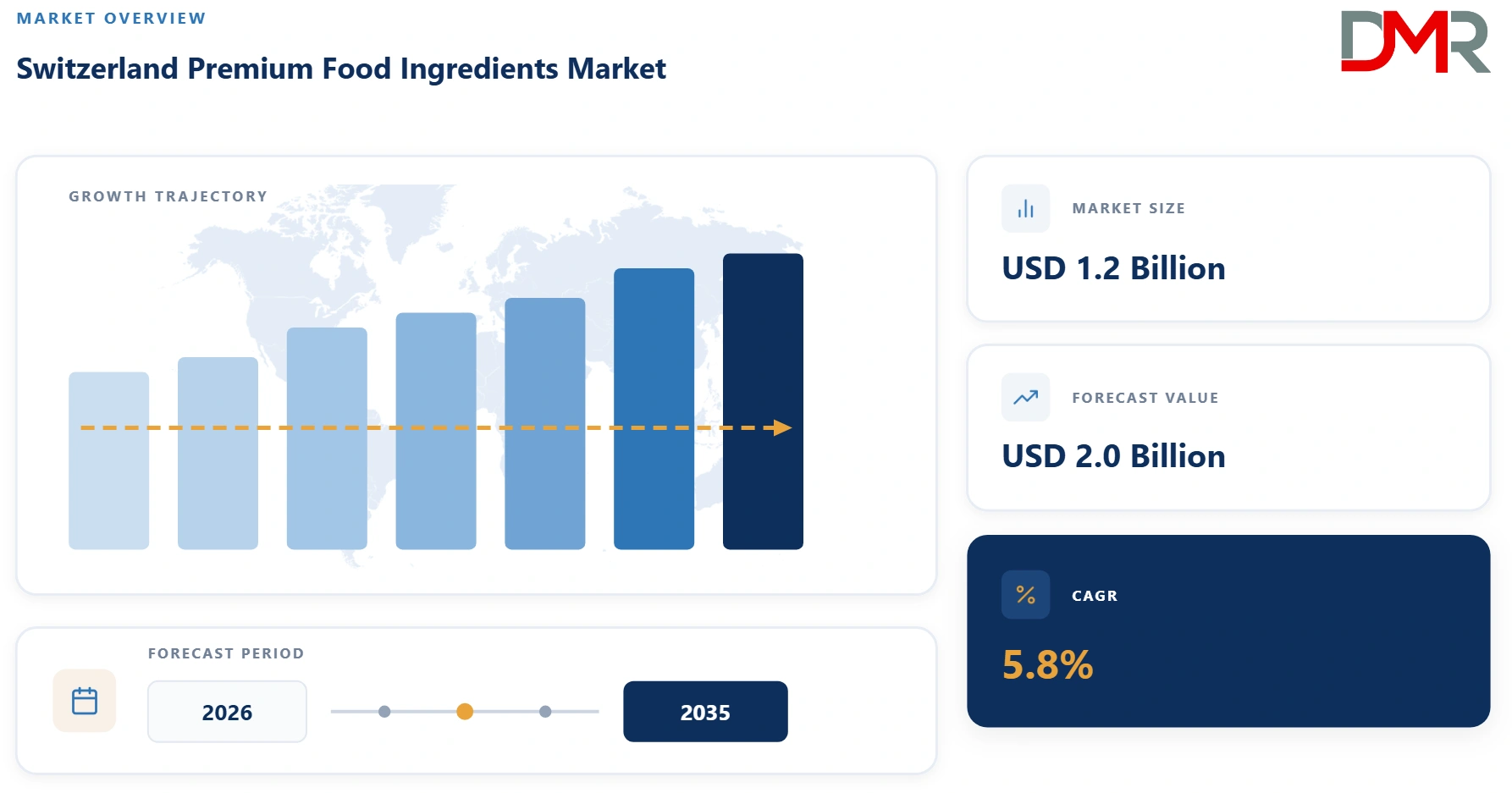
- Switzerland Premium Food Ingredients Market Size in 2026: USD 1.2 Billion
- Switzerland Premium Food Ingredients Market Size in 2035: USD 2.0 Billion
- Switzerland CAGR from 2026 to 2035: 5.8%
- Premium Flavors and Taste Enhancers is the leading ingredient type segment in 2026: 27.4%
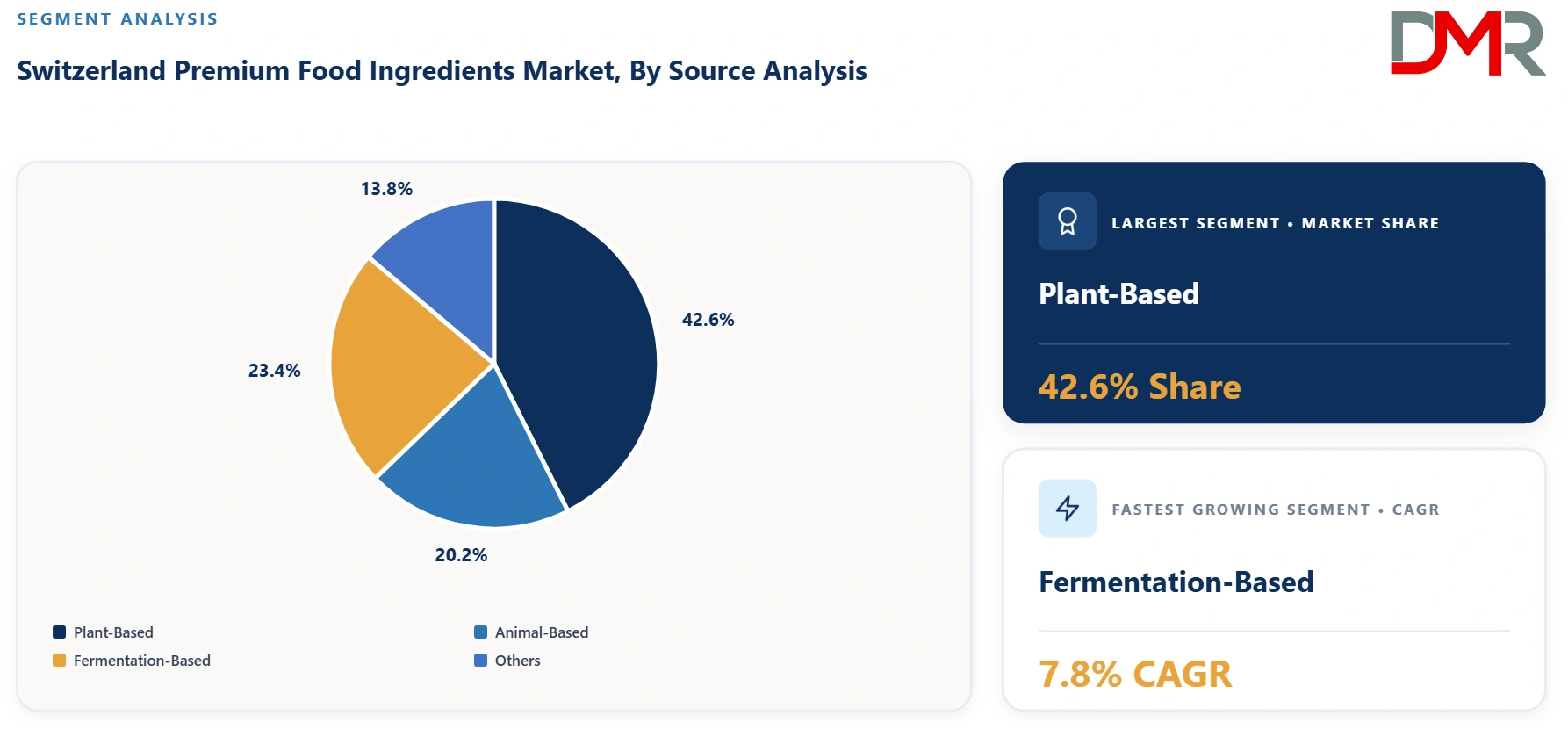
- Plant-Based is the leading source segment in 2026: 42.6%
- Taste and Flavor Enhancement is the leading function segment in 2026: 30.8%
- Bakery and Confectionery is the leading application segment in 2026: 21.7%
- Food and Beverage Manufacturers is the leading end-user segment in 2026: 55.2%
What is the Switzerland Premium Food Ingredients Market and its Market Size?
The Switzerland Premium Food Ingredients Market is projected to reach USD 1.2 billion in 2026 and grow at a compound annual growth rate of 5.8% until 2035 to reach USD 2.0 billion.
ℹ
To learn more about this report –
Download Your Free Sample Report Here
Premium food ingredients include advanced flavors, natural colors, specialty sweeteners, proteins, probiotics, enzymes, botanical extracts, vitamins, emulsifiers, and functional compounds used to improve taste, nutrition, texture, stability, and product positioning. Switzerland’s established chocolate, dairy, bakery, nutraceutical, and premium packaged-food industries support demand. High consumer purchasing power, clean-label preferences, health awareness, sophisticated retail channels, and strong domestic ingredient innovation are encouraging manufacturers to introduce naturally sourced, functional, sustainable, and scientifically supported formulations across premium food and beverage categories.
Use Cases
- Premium Chocolate and Confectionery Formulation: Swiss chocolate and confectionery manufacturers use premium flavors, natural colors, specialty sweeteners, emulsifiers, botanical extracts, dairy proteins, and texture-enhancing ingredients to create differentiated products. These ingredients support cocoa enhancement, sugar reduction, mouthfeel, stability, clean-label positioning, and seasonal innovation while helping manufacturers protect Switzerland’s reputation for premium-quality chocolate products in domestic and international markets.
- Functional Foods and Nutraceutical Products: Nutraceutical manufacturers incorporate probiotics, prebiotics, vitamins, minerals, proteins, amino acids, botanical extracts, and fermentation-derived compounds into supplements, fortified foods, nutritional beverages, and wellness products. Premium ingredients enable targeted products for immunity, digestive health, energy, healthy ageing, sports nutrition, cognition, and metabolic wellness while supporting clinically substantiated claims and differentiated consumer positioning.
- Premium Dairy and Plant-Based Alternatives: Dairy processors use cultures, enzymes, stabilizers, proteins, natural flavors, and nutritional fortification ingredients in yogurt, cheese, desserts, and functional dairy beverages. Plant-based manufacturers apply proteins, emulsifiers, masking flavors, colors, and texture systems to improve creaminess, nutritional value, stability, and sensory acceptance in dairy alternatives, meat substitutes, and hybrid products.
- Artisanal and Gourmet Food Production: Artisanal bakeries, chocolatiers, premium restaurants, specialty food producers, and private-label brands use natural flavors, botanical extracts, specialty sweeteners, proteins, and clean-label stabilizers to develop distinctive products. These ingredients support regional storytelling, organic positioning, indulgent taste, limited-edition launches, improved shelf life, and consistent quality while allowing smaller producers to command premium prices.
Key Takeaways
- Market Size: The Switzerland Premium Food Ingredients Market is anticipated to be valued at USD 1.2 billion in 2026 and is forecast to reach USD 2.0 billion by 2035, expanding at a CAGR of 5.8%.
- Growth Outlook: Market expansion is supported by premiumization, clean-label reformulation, demand for functional nutrition, rising interest in natural ingredients, sugar and fat reduction, plant-based innovation, advanced fermentation, personalized nutrition, and sustained ingredient demand from Switzerland’s chocolate, dairy, bakery, beverage, nutraceutical, and gourmet-food sectors.
- Primary Growth Drivers: High consumer purchasing power, demand for premium-quality food, strong health awareness, growing preventive-wellness spending, product reformulation, export-oriented food manufacturing, sustainability priorities, and the presence of leading flavor, nutrition, chocolate, and food-technology companies are strengthening ingredient innovation and commercial adoption.
- By Ingredient Type Analysis: Premium Flavors and Taste Enhancers is projected to dominate with a 27.4% share in 2026, supported by demand for distinctive sensory profiles across chocolate, bakery, beverages, dairy, and convenience foods. Botanical Extracts is expected to record the highest CAGR of approximately 7.6% through 2035 as manufacturers expand natural, functional, and wellness-oriented formulations.
- By Source Analysis: Plant-Based ingredients are anticipated to lead with a 42.6% share in 2026, driven by clean-label preferences, botanical products, alternative proteins, natural colors, and sustainability goals. Microbial and Fermentation-Based ingredients are expected to grow fastest at approximately 7.8%, supported by precision fermentation, probiotics, cultures, enzymes, and bio-based functional compounds.
- By Function Analysis: Taste and Flavor Enhancement is expected to dominate with a 30.8% share in 2026, reflecting the importance of sensory differentiation in premium foods. Nutritional Enrichment is projected to register the fastest CAGR of approximately 7.1% through 2035 due to expanding demand for vitamins, minerals, proteins, probiotics, botanical compounds, and condition-specific nutrition.
- By Application Analysis: Bakery and Confectionery is projected to lead with a 21.7% share in 2026, supported by Switzerland’s established chocolate, premium bakery, and artisanal confectionery industries. Functional Foods and Dietary Supplements are anticipated to record the fastest CAGR of approximately 7.5%, driven by preventive health, active nutrition, immunity, digestive wellness, and healthy-ageing products.
- By End-User Analysis: Food and Beverage Manufacturers are expected to dominate with a 55.2% share in 2026, supported by large-scale demand for sensory, functional, and processing ingredients. Nutraceutical Manufacturers are projected to grow fastest at approximately 7.4%, driven by innovation in supplements, fortified foods, medical nutrition, sports nutrition, and personalized wellness products.
How AI and GenAI are Transforming the Switzerland Premium Food Ingredients Market?
Artificial intelligence is accelerating ingredient discovery, flavor prediction, formulation optimization, quality control, and consumer-insight analysis across Switzerland’s premium food sector. Machine-learning platforms can predict ingredient interactions, sensory performance, shelf life, and nutritional outcomes before physical trials, reducing development time and material waste. Generative AI supports rapid concept creation, personalized nutrition, regulatory-document preparation, and reformulation recommendations. Manufacturers are also applying AI-enabled spectroscopy, machine vision, and predictive analytics to verify ingredient consistency, detect contamination, improve traceability, forecast demand, and optimize production parameters across premium food applications.
Key Drivers in the Switzerland Premium Food Ingredients Market
Strong Premium Food Manufacturing and Export Ecosystem
Switzerland possesses an advanced food value chain supported by premium chocolate, dairy, bakery, beverage, nutrition, and processed-food manufacturers. The Swiss Federal Statistical Office reported approximately CHF 9.6 billion in food exports, demonstrating the importance of internationally competitive food production. The country’s food ecosystem serves around 9 million consumers and includes sophisticated retail, foodservice, research, and manufacturing infrastructure. Premium manufacturers rely on specialized flavors, natural colors, proteins, enzymes, emulsifiers, probiotics, and nutritional compounds to differentiate products, maintain consistent quality, support export positioning, and meet demanding sensory and functional requirements in domestic and overseas markets.
Growing Health, Nutrition, and Clean-Label Demand
Swiss consumers increasingly evaluate foods through nutrition, ingredient transparency, sustainability, and preventive-health considerations. The Swiss Food Composition Database contains 1,059 food items reflecting local consumption and culinary patterns, supporting increasingly detailed nutritional assessment and product formulation. Demand for reduced sugar, natural colors, recognizable ingredients, digestive wellness, high-protein foods, and fortified products is encouraging manufacturers to use premium sweeteners, botanical extracts, vitamins, probiotics, prebiotics, and proteins. Strong interest in dairy alternatives is also creating opportunities, with plant-based milk accounting for approximately 17% of milk sales at Coop, including a dominant share for oat-based products.
Restraints in the Switzerland Premium Food Ingredients Market
High Input, Production, and Compliance Costs
Premium natural flavors, botanical extracts, specialty proteins, probiotics, and fermentation-derived ingredients require complex sourcing, processing, testing, and storage. Switzerland’s high wages, energy expenses, quality expectations, and strong currency can increase the total cost of domestic formulation and production. In the first quarter of 2026, Givaudan reported a 9.2% negative currency effect on reported sales, illustrating the exposure of Swiss ingredient companies to exchange-rate movements. Rising agricultural costs and volatile cocoa, dairy, botanical, and specialty-chemical prices can also pressure margins, forcing manufacturers to increase prices, reformulate products, reduce pack sizes, or negotiate longer-term supplier agreements.
Regulatory Complexity and Limited Ingredient Approval Flexibility
Food additives, health claims, novel foods, microbial ingredients, processing aids, and botanical compounds must comply with Swiss food-safety and labeling requirements. Novel ingredients may require safety documentation, compositional evidence, production-process information, toxicological assessment, and proof of historical use. Switzerland generally aligns important food rules with European frameworks, but companies must still evaluate Swiss-specific authorization and labeling obligations. The approval process can delay commercialization and raise development costs, particularly for start-ups and overseas suppliers. Novel traditional foods must demonstrate at least 25 years of safe consumption outside Switzerland and the European Union, restricting rapid market entry for unfamiliar ingredients.
Growth Opportunities in the Switzerland Premium Food Ingredients Market
Precision Fermentation and Next-Generation Functional Ingredients
Precision fermentation offers opportunities to produce premium proteins, enzymes, vitamins, flavors, fats, and bioactive compounds with improved consistency and potentially lower resource requirements. Switzerland’s biotechnology expertise, research institutions, food-technology companies, and pharmaceutical capabilities provide a strong foundation for developing fermentation-derived ingredients. Suppliers can target dairy alternatives, sports nutrition, healthy ageing, digestive wellness, specialized beverages, and medical nutrition. Opportunities also exist in strain optimization, fermentation services, ingredient purification, application testing, and regulatory support. Successful commercialization will depend on production economics, consumer communication, safety evidence, labeling clarity, and partnerships between biotechnology developers, ingredient companies, manufacturers, universities, and contract-production organizations.
Personalized Nutrition and Healthy-Ageing Products
Switzerland’s affluent, health-conscious, and ageing population creates opportunities for personalized nutrition products addressing immunity, cognition, digestive health, muscle maintenance, energy, sleep, metabolic health, and active ageing. Ingredient suppliers can develop clinically supported combinations of proteins, amino acids, probiotics, prebiotics, vitamins, minerals, omega fatty acids, and botanical extracts. Digital-health platforms and consumer diagnostics can support personalized recommendations and subscription-based nutritional products. Premium positioning is particularly attractive in dietary supplements, functional beverages, fortified dairy, medical nutrition, and convenient wellness foods. Suppliers that offer scientific substantiation, traceability, regulatory assistance, customized premixes, and application support can secure stronger relationships with Swiss nutraceutical and premium-food manufacturers.
Trends in the Switzerland Premium Food Ingredients Market
Clean-Label Reformulation and Natural Ingredient Substitution
Manufacturers are replacing artificial colors, flavors, preservatives, and high-intensity formulation systems with natural colors, botanical extracts, fermentation-derived preservatives, fruit-based sweeteners, and recognizable functional ingredients. This transition is influencing chocolate, bakery, dairy, beverages, sauces, convenience foods, and children’s nutrition. Clean-label reformulation requires careful management of taste, stability, processing tolerance, shelf life, cost, and color consistency. Ingredient suppliers are therefore developing multifunctional systems that combine sensory improvement with preservation, nutritional enrichment, or texture control. Nestlé’s commitment to eliminate artificial colorings from its products by the end of 2026 further demonstrates the strategic shift toward simpler ingredient declarations and natural alternatives.
Multifunctional Ingredients and Integrated Formulation Systems
Swiss manufacturers increasingly favor ingredients capable of delivering several benefits, such as improving texture while reducing fat, enhancing sweetness while lowering sugar, or extending shelf life while supporting clean-label positioning. Integrated ingredient systems reduce formulation complexity, accelerate product development, and help manufacturers maintain consistent quality. Demand is expanding for protein-stabilizer systems, natural flavor modulators, enzyme-based processing solutions, prebiotic fibers, fermentation-derived preservatives, and vitamin-mineral premixes. Suppliers are responding with application laboratories, sensory testing, prototype development, digital formulation tools, and customized blends designed for specific chocolate, bakery, dairy, beverage, nutritional, and plant-based applications.
Research Scope and Analysis
The Switzerland Premium Food Ingredients Market covers premium flavors, natural colors, specialty sweeteners, emulsifiers, stabilizers, enzymes, probiotics, prebiotics, vitamins, minerals, proteins, amino acids, botanical extracts, and other ingredients, across plant, animal, microbial, fermentation, and synthetic sources, serving taste, texture, nutrition, preservation, coloring, fat reduction, and sugar reduction applications, for manufacturers, producers, foodservice, retailers, and nutraceutical companies.
ℹ
To learn more about this report –
Download Your Free Sample Report Here
By Ingredient Type Analysis
Premium Flavors and Taste Enhancers are expected to lead the ingredient-type segment with a 27.4% share in 2026, supported by their extensive use in chocolate, bakery, beverages, dairy, sauces, and premium convenience foods. Botanical Extracts are projected to register the highest CAGR of approximately 7.6%, above the overall market rate of 5.8%, as demand increases for natural, functional, clean-label, and wellness-positioned formulations.
By Source Analysis
Plant-Based ingredients are projected to dominate the source segment with a 42.6% share in 2026, driven by demand for botanical extracts, plant proteins, natural colors, fibers, and clean-label ingredients. Microbial and Fermentation-Based ingredients are anticipated to record the highest CAGR of approximately 7.8%, due to growing adoption of cultures, probiotics, enzymes, and precision-fermented compounds.
By Function Analysis
Taste and Flavor Enhancement is expected to lead the function segment with a 30.8% share in 2026, reflecting the importance of sensory differentiation across Switzerland’s premium food industry. Nutritional Enrichment is projected to grow at the highest CAGR of approximately 7.1%, supported by increasing use of proteins, vitamins, minerals, probiotics, and botanical bioactive.
By Application Analysis
Bakery and Confectionery is anticipated to dominate the application segment with a 21.7% share in 2026, supported by Switzerland’s established chocolate, confectionery, and premium bakery industries. Functional Foods and Dietary Supplements are expected to register the highest CAGR of approximately 7.5%, due to rising preventive-health, active-nutrition, digestive-wellness, and healthy-ageing demand.
By End-User Analysis
Food and Beverage Manufacturers are projected to lead the end-user segment with a 55.2% share in 2026, owing to broad requirements for flavor, texture, preservation, enrichment, and processing solutions. Nutraceutical Manufacturers are forecast to record the highest CAGR of approximately 7.4%, as demand rises for supplements, fortified foods, functional beverages, and personalized nutrition.
The Switzerland Premium Food Ingredients Market Report is segmented based on the following:
By Ingredient Type
- Premium Flavors and Taste Enhancers
- Natural Colors
- Specialty Sweeteners
- Emulsifiers and Stabilizers
- Enzymes
- Probiotics and Prebiotics
- Vitamins and Minerals
- Proteins and Amino Acids
- Botanical Extracts
- Others
By Source
- Plant-Based
- Animal-Based
- Fermentation-Based
- Others
By Function
- Taste and Flavor Enhancement
- Texture Improvement
- Nutritional Enrichment
- Preservation and Shelf-Life Extension
- Coloring
- Fat and Sugar Reduction
- Others
By Application
- Bakery and Confectionery
- Dairy and Frozen Desserts
- Chocolate and Premium Confectionery
- Beverages
- Meat and Seafood Products
- Sauces Dressings and Condiments
- Functional Foods and Dietary Supplements
- Plant-Based Foods
- Convenience and Ready-to-Eat Foods
- Others
By End User
- Food and Beverage Manufacturers
- Nutraceutical Manufacturers
- Artisanal and Premium Food Producers
- Foodservice and HoReCa Operators
- Retail and Private-Label Manufacturers
- Others
Regulatory Landscape
Switzerland’s premium food ingredient sector is regulated through food-safety, additive, novel-food, labeling, health-claim, contaminant, and traceability requirements administered principally by the Swiss Federal Food Safety and Veterinary Office. Regulatory alignment with European standards facilitates regional trade but requires suppliers to maintain extensive technical documentation and monitor changing requirements. Clean-label ingredients, botanicals, microbial cultures, fermentation-derived compounds, probiotics, and novel proteins may face differing authorization pathways. Opportunities exist for regulatory-consulting and compliance-ready ingredient portfolios, while delayed approval and claim restrictions create commercialization risks. Regulatory developments will encourage stronger safety substantiation, transparent sourcing, precise labeling, validated health claims, and closer cooperation among suppliers, laboratories, manufacturers, and authorities.
Technology Analysis
Technology development is reshaping premium ingredient discovery, manufacturing, validation, and application. Precision fermentation, enzyme engineering, microencapsulation, advanced extraction, membrane filtration, spray drying, metabolomics, and high-throughput screening enable ingredients with improved purity, stability, bioavailability, taste, and processing performance. Artificial intelligence and digital twins can reduce formulation cycles and predict interactions among flavors, proteins, sweeteners, colors, and stabilizers. Opportunities are emerging in personalized nutrition, fermentation-derived proteins, natural preservation, and controlled-release bioactive. However, scale-up expenses, intellectual-property barriers, consumer acceptance, and regulatory uncertainty remain significant risks. Technology adoption will strengthen product differentiation while increasing demand for application laboratories, pilot plants, scientific validation, and specialized production partnerships.
Competitive Landscape
The Switzerland Premium Food Ingredients Market includes Swiss multinational leaders, European specialists, international ingredient manufacturers, distributors, biotechnology companies, and application-development partners. Competition centers on natural sourcing, sensory performance, scientific substantiation, formulation support, sustainability, traceability, regulatory expertise, and customized ingredient systems. Givaudan and dsm-firmenich maintain strong positions in flavors, taste, nutrition, and functional solutions, while Nestlé and Barry Callebaut influence downstream innovation. International suppliers are expanding through local distribution, technical partnerships, acquisitions, application laboratories, and specialized products for chocolate, dairy, nutraceutical, bakery, beverage, and plant-based formulations.
Some of the prominent players in the Switzerland Premium Food Ingredients Market are:
- Givaudan SA
- dsm-firmenich
- Nestlé S.A.
- Barry Callebaut AG
- Jungbunzlauer Suisse AG
- Omya International AG
- Archer Daniels Midland Company
- Cargill Incorporated
- Kerry Group
- International Flavors & Fragrances
- Symrise AG
- BASF SE
- Döhler Group
- Tate & Lyle PLC
- Ingredion Incorporated
- Roquette Frères
- Novonesis
- Corbion N.V.
- Puratos Group
- Lesaffre
- Lallemand Inc.
- ofi
- AAK AB
- BENEO
- Azelis Group
- Brenntag SE
- IMCD Group
- DKSH Holding Ltd.
- Barentz International
- Prinova Group
- Glanbia PLC
- Arla Foods Ingredients
- FrieslandCampina Ingredients
- GELITA AG
- Rousselot
- Nactarome
- MANE
- Sensient Technologies
- Kemin Industries
- Angel Yeast Co. Ltd.
- Other Key Players
Recent Developments
- July 2026 – dsm-firmenich: dsm-firmenich partnered with Nous to commercialize Koncentra, a novel functional botanical ingredient targeting energy, focus, mood, and cognitive and physical performance, supported by clinical-trial design, regulatory positioning, application expertise, and claims development.
- June 2026 – Nestlé: Nestlé announced plans to eliminate artificial food colorings across its global product portfolio by the end of 2026, increasing the company’s requirement for natural-color alternatives, reformulation expertise, stability testing, sensory validation, and clean-label ingredient technologies.
- April 2026 – Givaudan: Givaudan reported 2.8% like-for-like sales growth during the first quarter of 2026. Its Taste and Wellbeing division faced softer performance, while the company implemented pricing actions to offset input-cost pressure and continued investing in differentiated flavor and wellness solutions.
Report Details
| Report Characteristics |
| Market Size (2026) |
USD 1.2 Bn |
| Forecast Value (2035) |
USD 2.0 Bn |
| CAGR (2026–2035) |
5.8% |
| Historical Data |
2021 – 2025 |
| Forecast Data |
2026 – 2035 |
| Base Year |
2025 |
| Segments Covered |
By Ingredient Type, By Source, By Function, By Application, By End User |
Frequently Asked Questions
How big is the Switzerland Premium Food Ingredients Market?
▾ The Switzerland Premium Food Ingredients Market is projected to be valued at USD 1.2 billion in 2026 and reach USD 2.0 billion by 2035.
What is the CAGR of the Switzerland Premium Food Ingredients Market from 2026 to 2035?
▾ The market is expected to expand at a compound annual growth rate of 5.8% during the forecast period from 2026 to 2035.
What factors are driving the growth of the Switzerland Premium Food Ingredients Market?
▾ Growth is driven by premiumization, high consumer purchasing power, clean-label demand, functional nutrition, natural ingredients, product reformulation, personalized wellness, plant-based innovation, and Switzerland’s established chocolate, dairy, bakery, beverage, and nutraceutical industries.
What are the major trends in the Switzerland Premium Food Ingredients Market?
▾ Major trends include natural ingredient substitution, clean-label reformulation, precision fermentation, multifunctional ingredient systems, personalized nutrition, sugar and fat reduction, botanical extracts, advanced probiotics, sustainable sourcing, and AI-assisted formulation development.
Who are the key players in the Switzerland Premium Food Ingredients Market?
▾ Key players include Givaudan, dsm-firmenich, Nestlé, Barry Callebaut, Jungbunzlauer, Omya, ADM, Cargill, Kerry Group, IFF, Symrise, BASF, Döhler, Tate & Lyle, Ingredion, Roquette, Novonesis, and Corbion.
How is the Switzerland Premium Food Ingredients Market segmented?
▾ The market is segmented by ingredient type, source, function, application, and end user. Major categories include premium flavors, natural colors, sweeteners, enzymes, probiotics, proteins, botanical extracts, plant-based sources, nutritional enrichment, bakery and confectionery, and food and beverage manufacturers.