Thailand Seafood Processing Equipment Market Snapshot
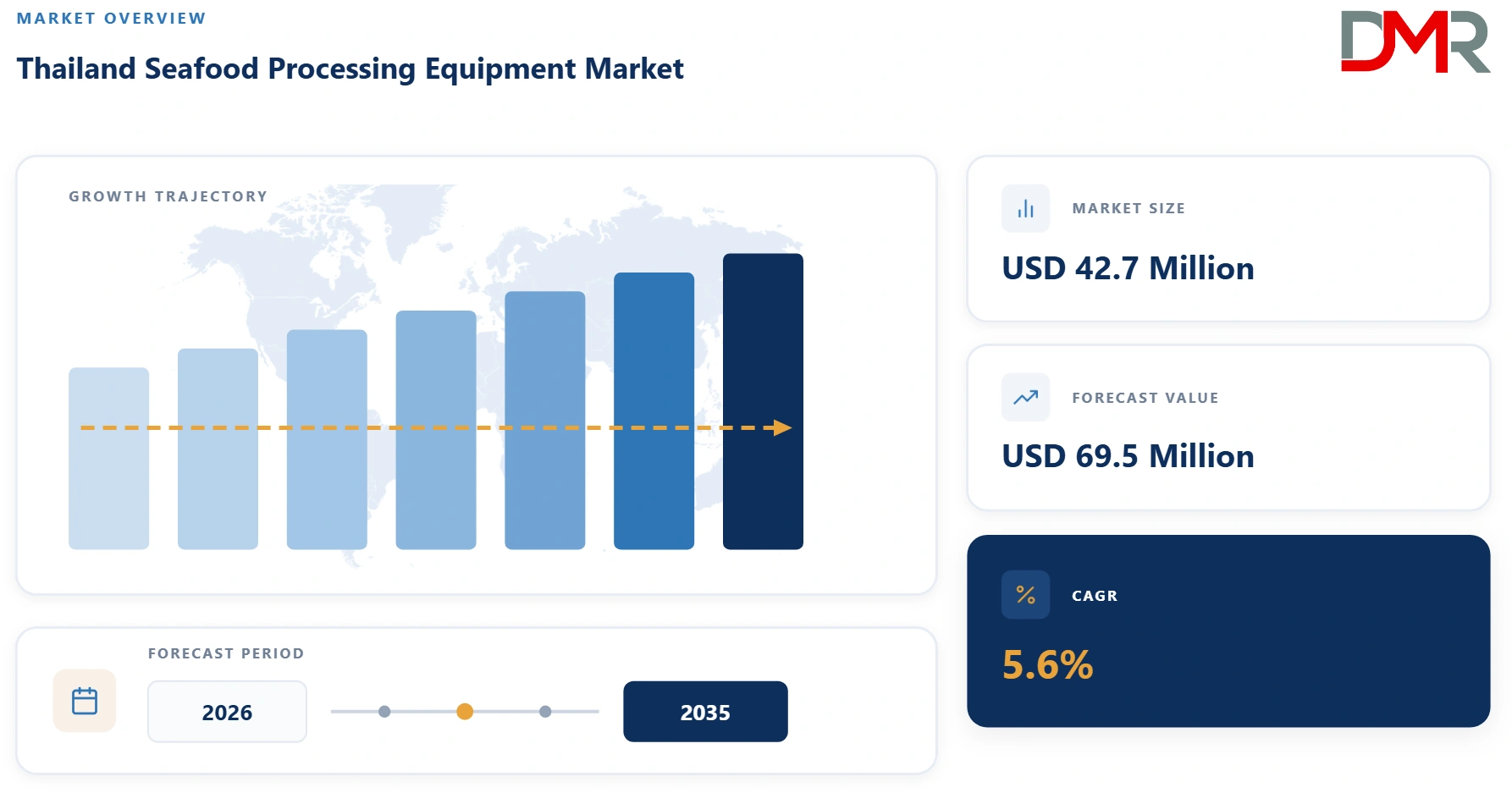
- Thailand Seafood Processing Equipment Market Size in 2026: USD 42.7 Million
- Thailand Seafood Processing Equipment Market Size in 2035: USD 69.5 Million
- Thailand CAGR from 2026 to 2035: 5.6%
- Filleting Equipment is the leading Equipment segment in 2026: 24.8%
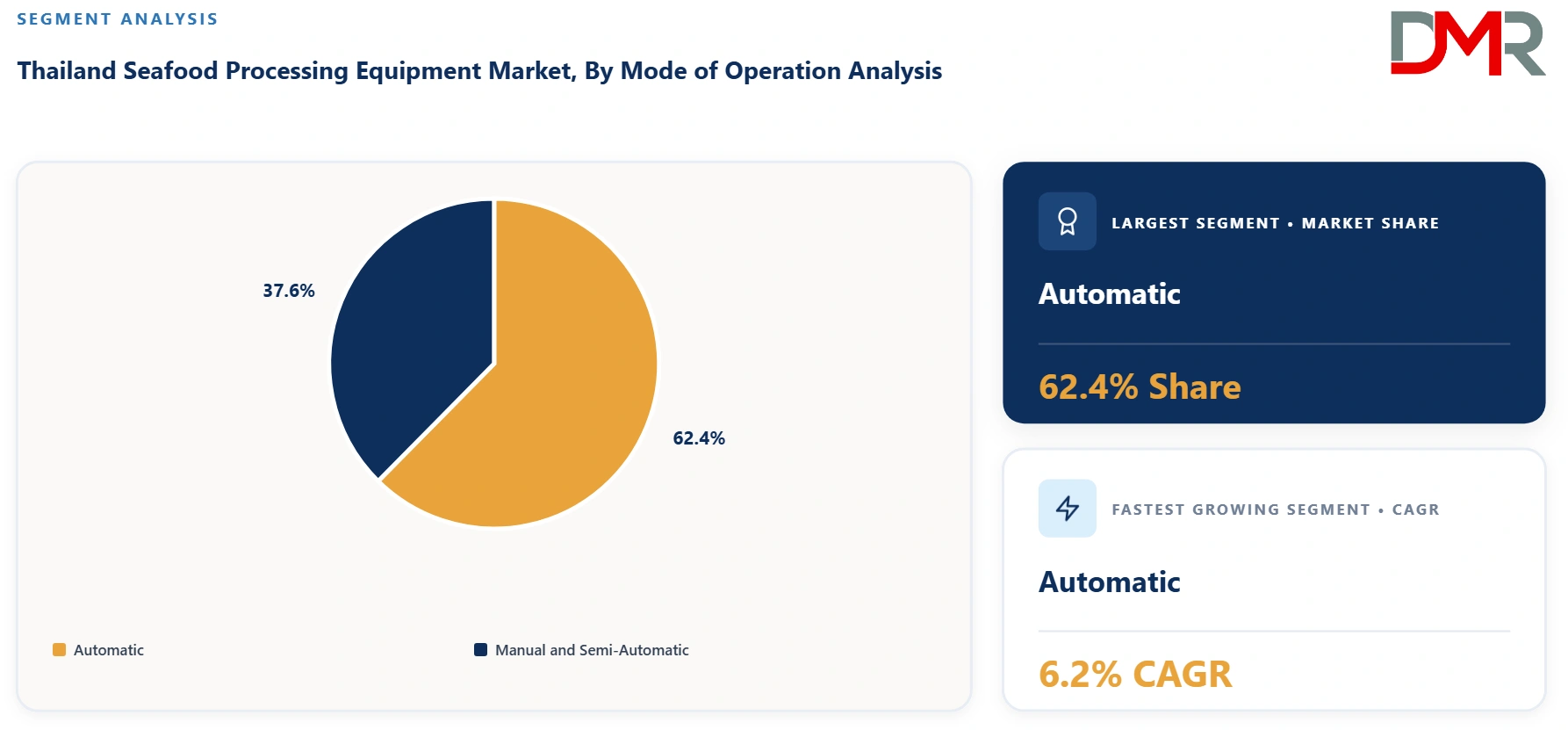
- Automatic is the leading Mode of Operation segment in 2026: 62.4%
- Fish is the leading Seafood Type segment in 2026: 44.3%
What is the Thailand Seafood Processing Equipment and its Market Size?
The Thailand Seafood Processing Equipment Market is projected to reach USD 42.7 million in 2026 and grow at a compound annual growth rate of 5.6% from there until 2035 to reach a value of USD 69.5 million.
ℹ
To learn more about this report –
Download Your Free Sample Report Here
Seafood processing equipment includes machinery used to prepare fish, shrimp, squid, shellfish, and other aquatic products for fresh, frozen, canned, smoked, dried, and packaged formats. Thailand has a mature export-oriented seafood processing base supported by tuna canning, shrimp processing, aquaculture, cold storage, and value-added food manufacturing. Demand is shifting toward automated filleting, cutting, inspection, portioning, cleaning, smoking, drying, and packaging systems that improve yield, hygiene, traceability, throughput, and consistency while reducing labor dependency and production waste.
Use Cases
- Industrial Tuna and Fish Processing: Large seafood plants use gutting, scaling, filleting, cutting, skinning, portioning, inspection, and packaging equipment to convert whole fish into export-ready products. Automated lines standardize cuts, recover more saleable meat, reduce handling, and maintain cold-chain discipline. Integrated weighing, vision inspection, and production software also help processors document yields, trace batches, control giveaway, identify defects, and meet buyer specifications across canned, frozen, chilled, and ready-to-cook formats in high-volume operations.
- Shrimp and Crustacean Value Addition: Shrimp processors deploy grading, washing, peeling, deveining, cutting, cooking, freezing, and packing machinery to produce raw, cooked, breaded, seasoned, and portion-controlled products. Mechanization reduces repetitive manual handling and improves uniformity where export customers demand consistent count, appearance, temperature, and hygiene. Modular lines enable plants to switch among species and product formats, while automated packing, metal detection, checkweighing, and labeling strengthen food safety, labor productivity, traceability, and order accuracy for global retail and foodservice buyers.
- Squid, Shellfish, and Specialty Seafood Preparation: Processors handling mollusks and cephalopods use specialized cleaning, skinning, cutting, tenderizing, drying, smoking, and vacuum-packaging equipment. These systems support squid rings, cleaned tubes, dried seafood, smoked products, and prepared shellfish with consistent dimensions and moisture levels. Controlled processing minimizes contamination and product damage while supporting premium presentation. Compact and semi-automatic equipment is particularly useful for small and medium processors that need flexible capacity, multiple recipes, shorter production runs, and compliance-ready sanitation without full-line investment.
Key Takeaways
- Market Size: The Thailand Seafood Processing Equipment Market is anticipated to be valued at USD 42.7 million in 2026 and is forecast to reach USD 69.5 million by 2035, expanding at a CAGR of 5.6%.
- Growth Rate and Outlook: Market expansion is supported by seafood export recovery, modernization of processing plants, labor productivity requirements, growth in ready-to-cook seafood, stricter food safety controls, rising demand for higher yields, and adoption of integrated automation, inspection, packaging, traceability, and energy-efficient production systems.
- Primary Growth Drivers: Thailand’s established tuna, shrimp, fish, squid, and value-added seafood industries require dependable equipment that can improve throughput and consistency. High export volumes, changing buyer specifications, hygiene compliance, skilled-labor constraints, raw-material cost pressure, waste reduction targets, and increasing product customization are accelerating the replacement of manual processes with automated and digitally monitored machinery.
- By Equipment Analysis: Filleting Equipment is projected to lead with an approximate 24.8% share in 2026 because fish remains the largest processed seafood category and fillet yield directly influences plant profitability. Packaging Equipment is expected to record the fastest CAGR of approximately 6.6% through 2035 as processors expand retail-ready, vacuum-packed, modified-atmosphere, frozen, and traceable product formats.
- By Mode of Operation Analysis: Automatic equipment is anticipated to dominate with an approximate 62.4% share in 2026 and register the fastest CAGR of approximately 6.2% through 2035. Adoption is strengthened by the need to reduce repetitive labor, standardize output, raise line capacity, improve sanitation, connect inspection data, and achieve predictable product recovery in export-oriented plants.
- By Seafood Type Analysis: Fish is projected to lead with an approximate 44.3% share in 2026, supported by Thailand’s large tuna canning and processed fish industry. Crustaceans are expected to post the fastest CAGR of approximately 6.4% through 2035 as premium shrimp products, aquaculture development, automated grading and peeling, and higher-value frozen offerings stimulate equipment investment.
How AI/Gen AI is Transforming the Thailand Seafood Processing Equipment Market?
AI is improving vision inspection, portion optimization, predictive maintenance, yield forecasting, and automated quality control across seafood lines. Cameras and machine learning can classify size, identify defects, locate bones, and guide precision cuts despite natural product variation. Connected systems analyze throughput, temperature, downtime, and giveaway to recommend operating adjustments. Generative AI can support maintenance troubleshooting, operator training, sanitation documentation, recipe changeovers, and multilingual instructions, helping Thai processors reduce errors and transfer technical knowledge while preserving human oversight for safety and compliance decisions.
Key Drivers in the Thailand Seafood Processing Equipment Market
Export-Oriented Seafood Processing Base
Thailand’s large seafood export industry creates continuous demand for efficient processing, inspection, preservation, and packaging systems. Department of Fisheries data reported that seafood exports reached about USD 7.14 billion in 2024, the highest value in a decade, compared with USD 6.29 billion in 2023. Canned tuna exports totaled approximately 548,600 tonnes and USD 2.45 billion in 2024, while shrimp and shrimp-product exports reached about 136,700 tonnes and USD 1.29 billion. These volumes require reliable, high-throughput equipment that improves yield, product uniformity, cold-chain control, traceability, and compliance with specifications imposed by major retail and foodservice customers.
Automation for Productivity and Quality Consistency
Processors are adopting automation to manage repetitive work, labor availability, hygiene risks, and inconsistent manual cuts. Thailand’s seafood plants handle variable fish sizes, delicate shrimp, and squid products that require rapid adjustment without sacrificing recovery. Automated graders, vision systems, filleting machines, portion cutters, checkweighers, and robotic packing cells can stabilize throughput and reduce giveaway. Commercial equipment results illustrate the value proposition, with JBT Marel reporting customer productivity gains of 2% to 3% in filleted salmon yield and another seafood customer reducing deviation by more than 20%. Comparable improvements are increasingly important for Thai exporters competing on cost, quality, and delivery reliability.
Restraints in the Thailand Seafood Processing Equipment Market
High Capital Cost and Uneven Processor Modernization
Advanced filleting, X-ray inspection, robotic packing, freezing, and integrated software lines require significant upfront investment, facility modification, operator training, and reliable maintenance. Large exporters can justify automation through high utilization, but smaller processors often face seasonal volumes, multiple species, limited financing, and uncertainty about payback. Imported machinery also exposes buyers to exchange-rate movements, shipping costs, duties, and expensive spare parts. If local service capacity is limited, unplanned downtime can erase productivity gains. These constraints sustain demand for manual and semi-automatic systems and encourage phased modernization instead of immediate adoption of complete automated lines.
Raw-Material Variability and Supply-Side Pressure
Seafood equipment must handle biological variation in species, size, texture, fat content, shell condition, and freshness. Reduced domestic catches, aquaculture disease, climate effects, fishing controls, and fluctuating import availability can change plant utilization and the product mix. Thailand also competes for raw materials with processors in Vietnam, China, Ecuador, and India. Equipment optimized for a narrow size range may underperform when inputs vary, increasing trimming loss, rework, or stoppages. Processors therefore require flexible tooling and skilled setup, but added versatility raises cost and complexity. Uncertain supply can also delay capacity expansion and lengthen equipment replacement cycles.
Growth Opportunities in the Thailand Seafood Processing Equipment Market
Value-Added Retail and Foodservice Seafood
Ready-to-cook portions, marinated shrimp, breaded products, smoked fish, dried squid, convenience meals, and premium chilled packs create opportunities beyond commodity processing. These formats require precise cutting, controlled cooking or drying, battering, inspection, weighing, tray sealing, vacuum packaging, and traceable labeling. Equipment suppliers can address demand with modular lines that support short batches, recipe changes, mixed pack sizes, and higher sanitation standards. Thai processors can use such systems to improve margins, diversify exports, serve tourism and modern retail, and reduce dependence on bulk products. Compact solutions tailored to medium-sized plants represent a particularly attractive white-space opportunity.
Energy-Efficient and Data-Connected Factory Upgrades
Rising electricity, refrigeration, water, and waste-disposal costs make lifecycle efficiency a major equipment-selection factor. Opportunities are expanding for low-water washers, heat recovery, efficient smokehouses and dryers, compact freezers, variable-speed drives, automated cleaning, and monitoring systems that reveal energy use per kilogram. Suppliers can combine machinery with sensors, cloud dashboards, remote diagnostics, preventive maintenance, and yield analytics. Retrofitting existing Thai plants may generate faster adoption than building new facilities because processors can target bottlenecks and document savings. Service contracts, leasing, and performance-based financing can further reduce investment barriers while building recurring supplier revenue.
Trends in the Thailand Seafood Processing Equipment Market
Flexible Modular Automation
Seafood factories increasingly favor modular equipment that can process changing species, product sizes, and customer orders without redesigning the entire line. Quick-change blades, programmable recipes, adjustable guides, compact footprints, and interoperable conveyors help plants balance automation with flexibility. This trend is particularly relevant in Thailand, where a processor may handle tuna, whitefish, shrimp, squid, and specialty products across seasons. Standalone machines can be installed first and later connected through common controls and data platforms. Modular adoption reduces project risk, allows staged capital spending, and gives suppliers opportunities to provide upgrades, integration, training, spare parts, and lifecycle services.
Hygienic Design and Digital Traceability
Export customers increasingly expect documented control of temperature, sanitation, allergens, foreign materials, product origin, and production history. Equipment design is moving toward stainless-steel construction, tool-free access, improved drainage, reduced harborage points, clean-in-place functions, and validated washdown procedures. Simultaneously, connected checkweighers, inspection systems, labels, and manufacturing software create digital batch records from intake through final packing. Thailand’s legally enforced GMP framework includes requirements covering equipment, machines, utensils, cleaning, process control, sanitation, and personal hygiene. Suppliers that combine hygienic hardware with traceability software and audit-ready reporting will gain an advantage in export-focused processing plants.
Research Scope and Analysis
The study covers seafood processing equipment sold and deployed in Thailand across gut and scale equipment, filleting equipment, cutting equipment, skinning equipment, smoke and drying equipment, packaging equipment, and other grinders and specialized cleaning systems. It evaluates automatic, manual, and semi-automatic operations across fish, crustaceans, mollusks, cephalopods, and other seafood applications during the forecast period from 2026 to 2035.
ℹ
To learn more about this report –
Download Your Free Sample Report Here
By Equipment Analysis
Filleting Equipment is expected to hold the highest market share at approximately 24.8% in 2026. Its leadership is supported by large-scale tuna and fish processing, the direct effect of fillet recovery on margins, and the need for standardized export cuts. Packaging Equipment is projected to record the highest CAGR of approximately 6.6% from 2026 to 2035 as demand grows for retail-ready, vacuum-packed, frozen, and traceable seafood formats.
By Mode of Operation Analysis
Automatic equipment is anticipated to lead the market with approximately 62.4% share in 2026. It is also expected to register the highest CAGR of approximately 6.2% from 2026 to 2035. Adoption is driven by labor productivity needs, higher line speeds, improved sanitation, consistent portioning, reduced giveaway, integrated quality inspection, and the modernization priorities of Thailand’s large export-oriented seafood processors.
By Seafood Type Analysis
Fish is projected to account for the highest market share at approximately 44.3% in 2026, reflecting Thailand’s globally significant tuna and processed fish operations. Crustaceans are forecast to expand at the highest CAGR of approximately 6.4% from 2026 to 2035. Growth is supported by premium shrimp exports, aquaculture development, and investment in automated grading, peeling, deveining, cooking, freezing, and packaging systems.
The Thailand Seafood Processing Equipment Market Report is segmented based on the following:
By Equipment
- Gut and Scale Equipment
- Filleting Equipment
- Cutting Equipment
- Skinning Equipment
- Smoke and Drying Equipment
- Packaging Equipment
- Others
By Mode of Operation
- Automatic
- Manual and Semi-Automatic
By Seafood Type
- Fish
- Crustaceans
- Mollusks
- Cephalopods
- Others
- Sub-segment 1
- Sub-segment 2
- Sub-segment 3
Regulatory Landscape Analysis
Thailand’s food manufacturing framework makes hygienic equipment and controlled processes central to seafood plant investment. The Thai Food and Drug Administration enforces GMP requirements covering production buildings, equipment, utensils, cleaning, process control, sanitation, and personnel hygiene. Exporters must additionally satisfy destination-market rules, customer audits, HACCP programs, traceability expectations, and controls addressing illegal, unreported, and unregulated fishing. Regulatory reform creates opportunities for equipment that records batch history, controls temperature, reduces contamination, and supports validated cleaning. However, changing fisheries rules, imported machinery documentation, electrical standards, and buyer-specific certification can increase compliance costs. Suppliers offering local validation, training, documentation, and after-sales support can reduce implementation risk.
Technology Analysis
Technology development is shifting the market from standalone mechanical machines toward connected processing cells combining sensors, machine vision, robotics, X-ray inspection, precision cutting, automated packing, and manufacturing software. These systems help Thai processors manage natural variation while optimizing yield, capacity, energy, and product quality. Opportunities are strongest in retrofits, modular automation, predictive maintenance, hygienic design, and flexible equipment for shrimp, tuna, squid, and mixed-species plants. Risks include cybersecurity exposure, limited interoperability, insufficient operator skills, dependence on proprietary spare parts, and unreliable returns when utilization is low. Vendors that provide open integration, remote diagnostics, local service, and measurable performance guarantees can accelerate adoption and strengthen market impact..
Competitive Landscape
The Thailand Seafood Processing Equipment Market combines multinational line suppliers, specialist fish-machinery manufacturers, packaging and inspection companies, and regional integrators. Competition centers on yield improvement, line speed, hygienic design, energy use, automation depth, species flexibility, total ownership cost, and local service availability. Global vendors lead complex automated projects, while smaller specialists compete through adaptable machines and lower capital requirements. Partnerships with Thai distributors and engineering firms are important for installation, training, spare parts, and maintenance. Consolidation and software integration are expanding demand for connected end-to-end solutions and lifecycle service contracts.
Some of the prominent players in the Thailand Seafood Processing Equipment Market are:
- JBT Marel Corporation
- BAADER Global SE
- Cabinplant A/S
- Carsoe A/S
- Optimar AS
- MMC First Process AS
- Uni-Food Technic A/S
- Pisces Fish Machinery Inc.
- VMK Fish Machinery
- Kroma A/S
- Vélfag ehf.
- Curio ehf.
- Valka ehf.
- Martak ehf.
- Ryco Equipment
- Laitram Machinery Inc.
- Steen F.P.M. International
- Josmar FoodTech Solutions
- P.P.U.H. Karpowicz
- NIEROS Metal Tovarna d.o.o.
- GEA Group AG
- MULTIVAC Group
- ULMA Packaging
- Ishida Co. Ltd.
- Heat and Control Inc.
- TNA Australia Pty Limited
- TOMRA Systems ASA
- Key Technology Inc.
- FAM STUMABO
- Urschel Laboratories Inc.
- Bettcher Industries Inc.
- Weber Food Technology SE and Co. KG
- Handtmann Group
- Middleby Corporation
- Kerres Anlagensysteme GmbH
- FESSMANN GmbH und Co. KG
- MAUTING s.r.o.
- MIVEG GmbH
- PAC Machinery
- Minipack-Torre S.p.A.
- Other Key Players
Recent Developments
- In May 2025, BAADER opened its first production facility in Asia in Malaysia, expanding regional manufacturing proximity and support capacity for food and seafood processors across Southeast Asia.
- In February 2026, JBT Marel introduced the Proseal XT2 next-generation tray-sealing machine and separately announced a canned tuna processing partnership with Dongwon, highlighting continued investment in packaging automation and integrated tuna-processing solutions.
- In April 2026, BAADER presented next-generation seafood processing solutions focused on higher yield, automation, food safety, animal welfare, and raw-material utilization at Seafood Processing Global in Barcelona.
Report Details
| Report Characteristics |
| Market Size (2026) |
USD 42.7 Mn |
| Forecast Value (2035) |
USD 69.5 Mn |
| CAGR (2026–2035) |
5.6% |
| Historical Data |
2021 – 2025 |
| Forecast Data |
2026 – 2035 |
| Base Year |
2025 |
| Segments Covered |
By Equipment, By Mode of Operation, By Seafood Type |
Frequently Asked Questions
How big is the Thailand Seafood Processing Equipment Market?
▾ The Thailand Seafood Processing Equipment Market is projected to be valued at USD 42.7 million in 2026 and reach USD 69.5 million by 2035.
What is the CAGR of the Thailand Seafood Processing Equipment Market from 2026 to 2035?
▾ The market is forecast to expand at a compound annual growth rate of 5.6% from 2026 to 2035.
What factors are driving the growth of the Thailand Seafood Processing Equipment Market?
▾ Growth is driven by Thailand’s large seafood export base, increasing automation, labor productivity requirements, food safety and traceability standards, value-added seafood demand, yield optimization, energy-efficiency targets, and the modernization of fish, tuna, shrimp, squid, and shellfish processing plants.
What are the major trends in the Thailand Seafood Processing Equipment Market?
▾ Major trends include flexible modular automation, AI-enabled vision inspection, precision cutting, robotic packing, digital traceability, predictive maintenance, hygienic machine design, energy-efficient drying and freezing, connected production software, and increased adoption of retail-ready packaging systems.
Who are the key players in the Thailand Seafood Processing Equipment Market?
▾ Key players include JBT Marel, BAADER, Cabinplant, Carsoe, Optimar, MMC First Process, Uni-Food Technic, Pisces Fish Machinery, Kroma, Valka, GEA Group, MULTIVAC, ULMA Packaging, Ishida, Heat and Control, TOMRA, and other specialized equipment manufacturers and regional integrators.
How is the Thailand Seafood Processing Equipment Market segmented?
▾ The market is segmented by Equipment into Gut and Scale, Filleting, Cutting, Skinning, Smoke and Drying, Packaging, and Others. By Mode of Operation, it includes Automatic and Manual and Semi-Automatic systems. By Seafood Type, it covers Fish, Crustaceans, Mollusks, Cephalopods, and Others.