Market Snapshot
- Market Size (2025): USD 3.4 Billion
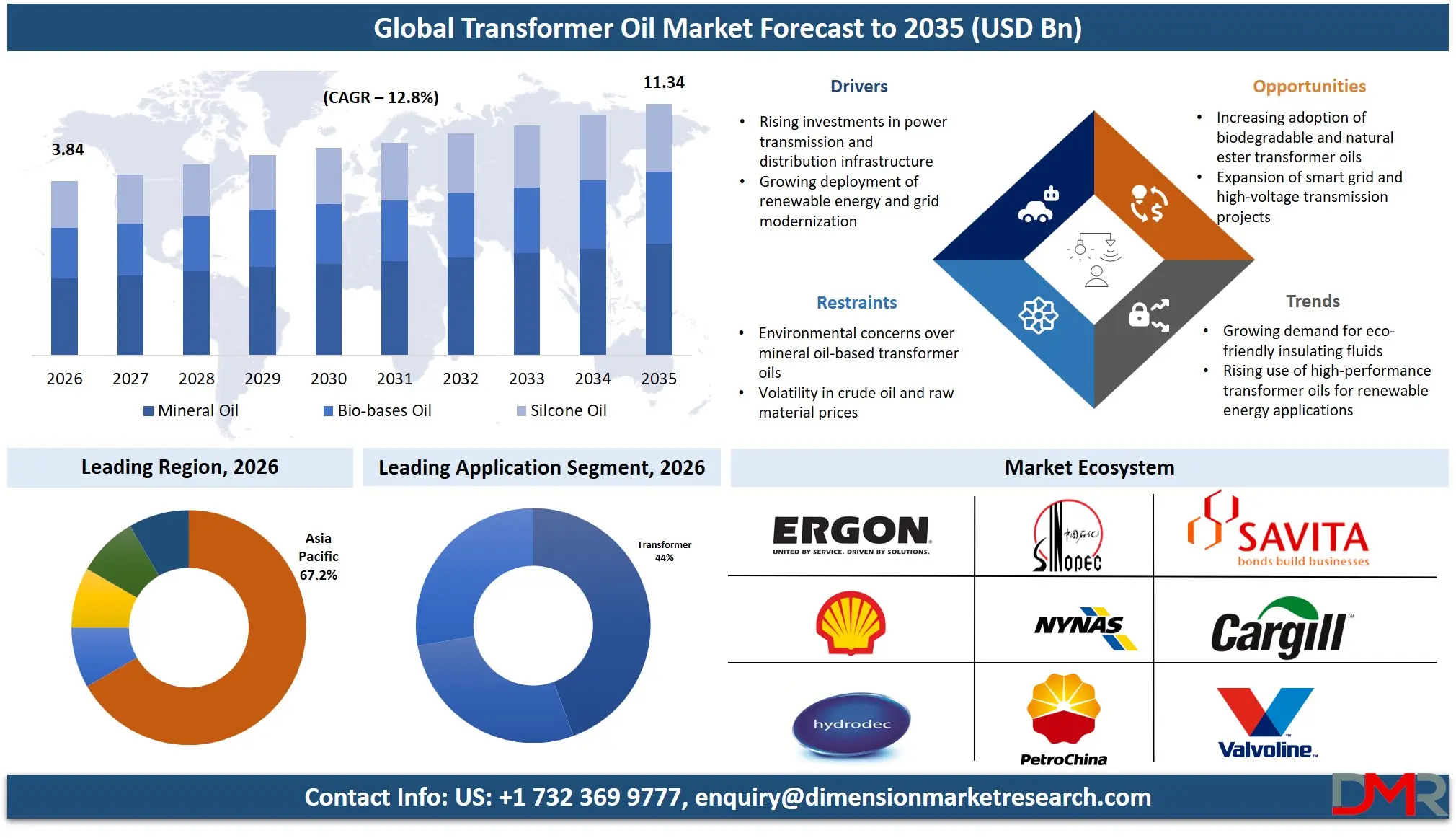
- Market Size (2026): USD 3.84 Billion
- Forecast Size (2035): USD 11.34 Billion
- CAGR (2026 to 2035): 12.8%
- Dominant Oil Type: Mineral Oil with 75.4% share (2025)
- Dominant Rating Segment: 100 MVA to 500 MVA with 43.68% share (2025)
- Dominant End-User: Transmission and Distribution with 55.94% share (2025)
- Dominant Region: Asia Pacific with 67.2% share, equivalent to approximately USD 2.28 Billion (2025)
Market Overview
The global transformer oil market operated at USD 3.4 Billion in 2025, supplying insulating and cooling fluids to power transformers, distribution transformers, switchgear, and reactors worldwide. Mineral-based formulations, synthetic fluids, and bio-derived esters each serve distinct performance requirements, from standard grid applications to high-fire-risk urban substations. The market excludes transformer hardware, solid insulation systems, and transformer services not involving fluid management.
ℹ
To learn more about this report –
Download Your Free Sample Report Here
Indian Standard IS 335, codified in a 2026 technical guide, sets a minimum breakdown voltage (BDV) of 50 kV for new transformer oil, while in-service oil remains acceptable above 40 kV. Operators managing aging fleets below that threshold face an immediate choice between filtration and full fluid replacement. As reported by oorjatechnical.in, this single standard now governs procurement decisions across one of the world's largest transformer oil markets.
Transformer oil connects to the broader electrical infrastructure industry through two reinforcing channels: capital expenditure on new grid assets and maintenance spend on existing installed bases. Procurement patterns from utilities, power generators, railway operators, and large industrials collectively set volume demand. Grid modernization commitments in China, India, North America, and Europe mean that transformer oil consumption tracks public infrastructure budgets as closely as it tracks commodity energy prices.
Market Size and Forecast
The Global Transformer Oil Market size is estimated at USD 3.84 Billion in 2026 from USD 3.4 Billion in 2025, and is projected to reach USD 11.34 Billion by 2035, exhibiting a CAGR of 12.8% during the forecast period.
A critical performance benchmark underpins this forecast. Based on data from edtengineers citing IEEE Standard 493, oil-filled transformers report a typical failure frequency of 0.0041 failures per year, equivalent to one failure per approximately 243.9 years for a single unit under normal conditions. That reliability profile depends directly on oil quality, making fluid maintenance a non-discretionary operational cost rather than a discretionary budget line. Figures from pact.in confirm that high-voltage transformers require practical dielectric strength of 50 kV/mm or higher, against a standard minimum of 30 kV/mm, a 20 kV/mm performance margin that only premium-grade oils reliably sustain.
Market confidence in circular and specialty fluids gained a commercial proof point in March 2026, when Hitachi Energy successfully deployed and tested Nynas NYTRO RR 900X, a fully re-refined circular transformer oil, in a large power transformer at its Cordoba, Spain facility. Circular fluid performance validated at utility scale removes a key adoption barrier and supports the forecast assumption that specialty oils will grow faster than the overall market through 2035.
Oil Type Analysis
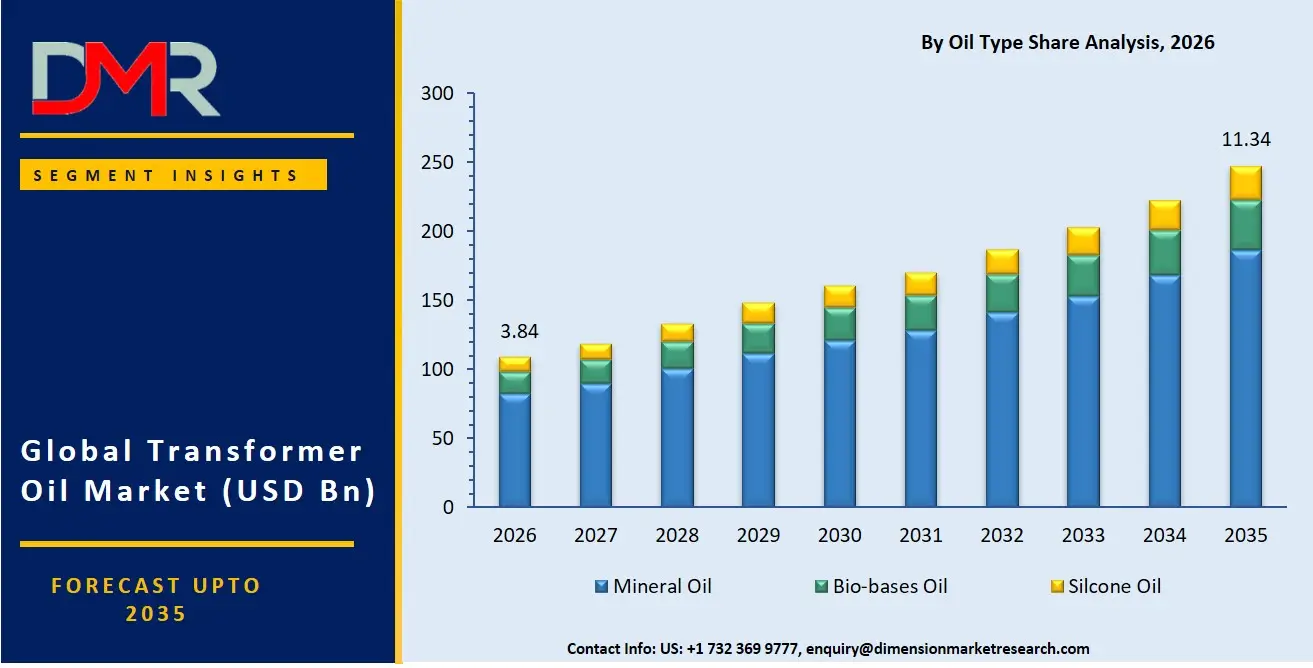
Mineral Oil led the Oil Type segment with a 75.4% share in 2025.
Mineral oil commands its position through decades of standardized handling, globally understood testing protocols, and deep OEM integration. BDV test procedures specify an electrode gap set at 2.5 mm, voltage ramped at 1 to 2 kV per second across six readings taken at 10-minute intervals with the last five averaged, all calibrated around mineral oil behavior, as specified by oilregeneration/globecore. Utilities and EPC contractors default to mineral oil because procurement, logistics, and field-testing infrastructure already exist for it.
ℹ
To learn more about this report –
Download Your Free Sample Report Here
Bio-based and silicone oils represent a structurally different value proposition. Bio-derived esters offer high flash points and biodegradability, creating a premium tier for urban substations, underground cable chambers, and tunnel installations where fire risk or environmental liability is the overriding constraint. Silicone oils address extreme-temperature operating ranges. Both categories price above mineral oil and capture margin rather than volume, a dynamic that benefits specialist producers targeting regulated or sustainability-driven procurement.
Application Analysis
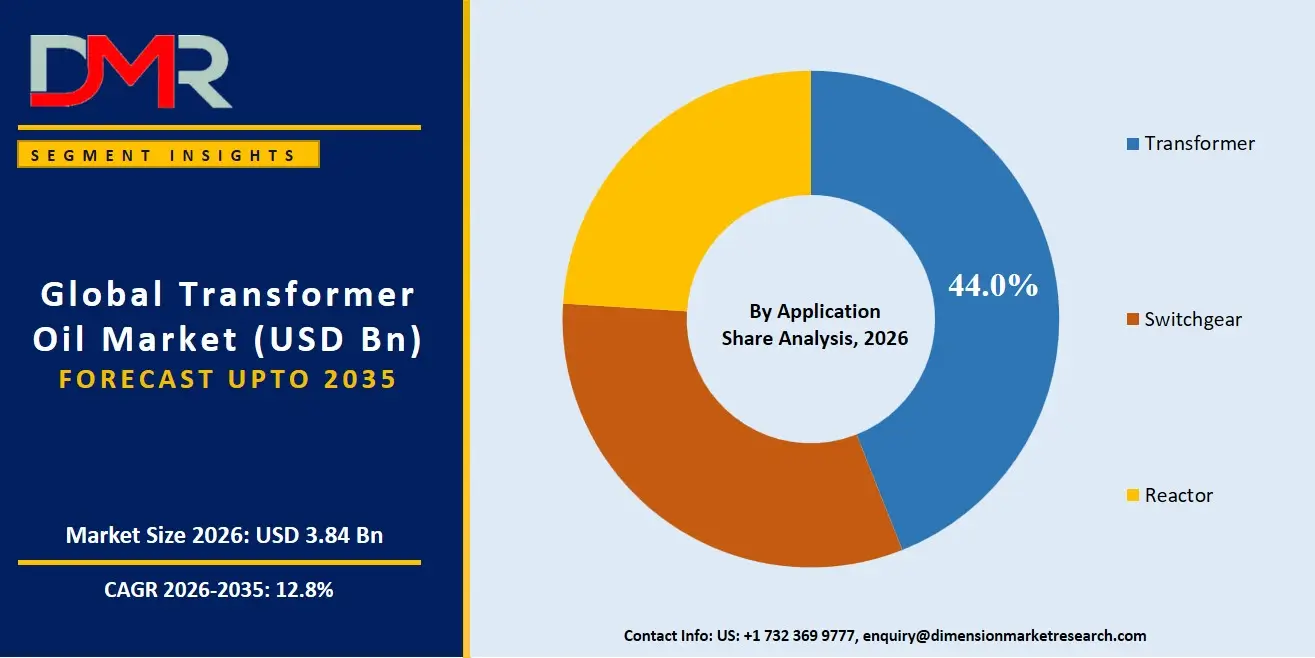
With a dominant share in 2025, Transformer outpaced all other Application categories.
Power transformers and distribution transformers absorb the largest oil volumes per unit and per installation cycle. Grid expansion programs in China and India, combined with aging-fleet replacement in North America and Europe, generate recurring demand across both transformer sub-types. Distribution transformers multiply rapidly as last-mile electrification and EV charging infrastructure roll out across urban corridors.
ℹ
To learn more about this report –
Download Your Free Sample Report Here
Switchgear and reactor applications contribute lower absolute volumes but carry higher per-unit specification requirements. Switchgear deployments in compact urban switchrooms increasingly specify low-flammability fluids, directly linking this sub-segment to the premium oil growth trajectory. Reactor applications in high-voltage transmission corridors demand oils with verified long-term thermal stability, making fluid quality a contractual rather than discretionary specification.
Rating Analysis
100 MVA to 500 MVA accounted for 43.68% of Rating demand in 2025, the highest of any category.
The 100 to 500 MVA band covers the transmission backbone, the segment where grid operators concentrate capital expenditure and where oil volume per transformer is materially larger than in distribution-scale units. China's cross-provincial transmission build-out and India's interstate grid expansion both fall squarely in this rating range. Procurement at this scale drives long-term supply contracts and favors vertically integrated oil suppliers.
Ratings below 100 MVA reflect the distribution tier, where unit counts are highest but per-unit oil volumes are lowest. The above-800 MVA category is an emerging priority in countries building ultra-high-voltage transmission networks. Fast growth in that top tier signals that a small number of very large orders will shape supplier revenue disproportionately in the second half of the forecast period.
End-User Analysis
A 55.94% share made Transmission and Distribution the clear leader across End-User categories in 2025.
Utility transmission and distribution operators buy transformer oil in bulk, under multi-year framework contracts, creating the most predictable and largest demand pool in the market. Grid expansion budgets across Asia Pacific directly translate into oil purchase commitments. Suppliers with established utility relationships and in-country blending capacity hold a structural advantage in contract renewals.
Power generation facilities, including renewable energy plants requiring step-up transformers, represent the fastest-growing end-user sub-segment as solar and wind capacity scales. Railway and metro operators form a smaller but specification-intensive buyer group, often mandating low-toxicity or fire-resistant fluids for underground and tunnel environments. Other industrial and commercial buyers provide baseline volume stability but exert less pricing power than utilities.
Key Market Segments
By Oil Type
- Mineral Oil
- Naphthenic Oil
- Paraffinic Oil
- Bio-based Oil
- Silicone Oil
By Application
- Transformer
- Power Transformer
- Distribution Transformer
- Switchgear
- Reactor
By Rating
- < 100 MVA
- 100 MVA to 500 MVA
- 501 MVA to 800 MVA
- > 800 MVA
By End-User
- Transmission and Distribution
- Power Generation
- Railways & Metros
- Others
Regional Analysis
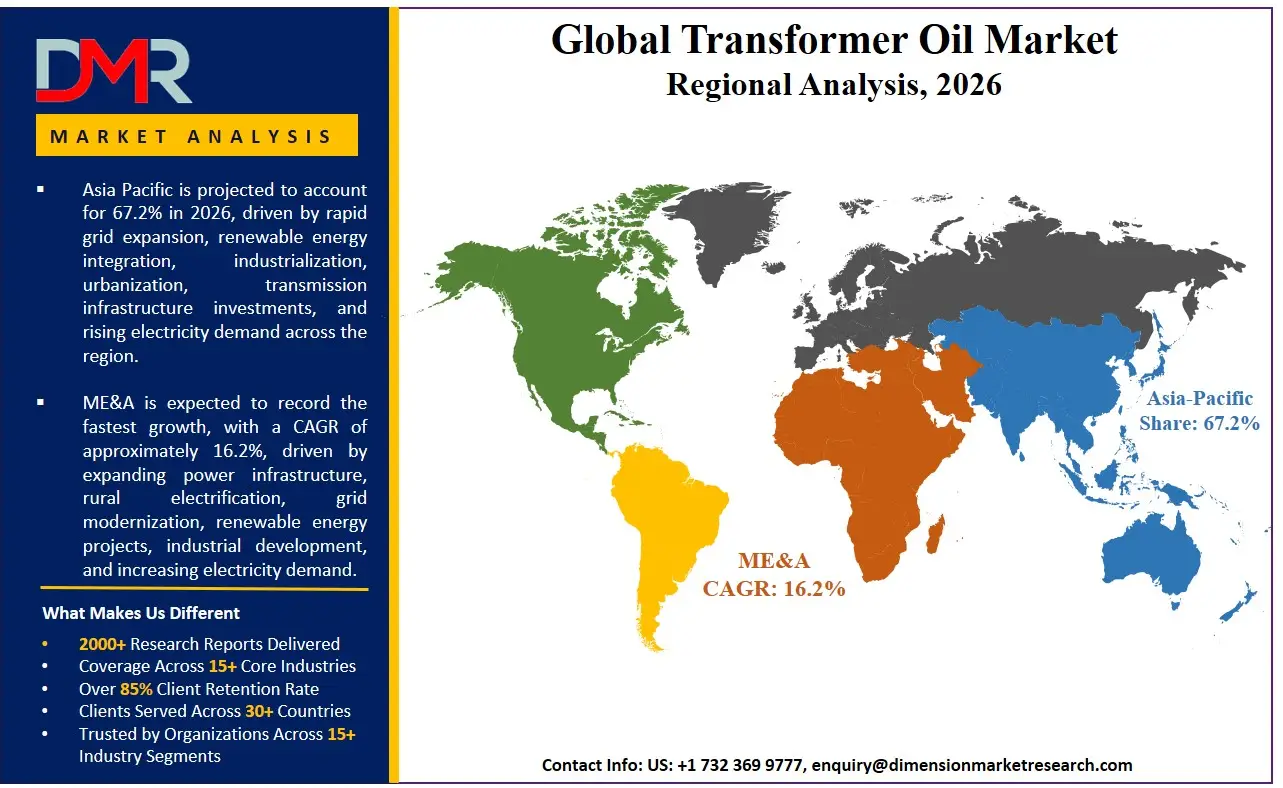
Asia Pacific led the Regional segment with a 67.2% share, equivalent to approximately USD 2.28 Billion, in 2025.
ℹ
To learn more about this report –
Download Your Free Sample Report Here
China and India collectively account for the bulk of Asia Pacific's transformer oil demand. China's state-directed ultra-high-voltage transmission build-out and India's national electricity grid expansion both require transformer oil at a scale no other region approaches. Research published in ijtech.eng.ui.ac.id on ester oil contamination confirms that even a 2 percentage-point shift in contamination level, from 7.5% to 9.5% aged mineral oil, measurably alters BDV, color index, and total acid number. Asia Pacific utilities managing dense transformer fleets invest heavily in oil quality programs because the cost of letting oil degrade past threshold exceeds the cost of monitoring it.
North America holds the second-largest share, driven by aging grid infrastructure requiring replacement rather than greenfield build. European buyers are the fastest-growing premium segment, with sustainability-linked procurement mandates pushing utilities toward certified bio-based and circular oils. Latin America and the Middle East and Africa are early-stage growth markets where EPC-led power projects, often backed by multilateral development bank financing, create lumpy but meaningful demand for transformer fluids.
Key Regions and Countries
North America
Europe
- Germany
- France
- The UK
- Spain
- Italy
- Rest of Europe
Asia Pacific
- China
- Japan
- South Korea
- India
- Australia
- Rest of APAC
Latin America
- Brazil
- Mexico
- Rest of Latin America
Middle East & Africa
- GCC
- South Africa
- Rest of MEA
Market Dynamics
Grid Replacement and New Electrification Drive Oil Procurement
Aging transformer fleets in North America and Europe create non-deferrable replacement cycles. An IEEE-based reliability analysis published in January 2025 and reported by bluefieldsafety shows that transformer failure rates climb from 0.0002 failures per year in mid-life to 0.01 at 40 years, 0.025 at 50 years, and above 0.05 at 60 years. A large share of North American transmission transformers now fall in the 40-to-60-year age bracket. Every percentage-point increase in failure probability translates directly into oil procurement orders, either for replacement units or for diagnostic and corrective maintenance programs.
Demand from new infrastructure compounds the replacement cycle. In January 2026, Nynas supplied nearly 700 metric tonnes of NYTRO Lyra X transformer oil for the first phase of Poland's largest offshore wind project, partnering with GE Vernova. Renewable energy installations of that scale require large-format step-up transformers, each demanding hundreds of liters of high-specification insulating fluid. As per oorjatechnical.in, BDV values above 60 kV are classified as excellent, a bar that renewable-connected transformers operating under variable load conditions must consistently meet.
Regulatory and Environmental Compliance Raises Legacy Costs
Mineral oil in aging transformers carries compounding liabilities. Research published in ijert.org in 2026 establishes that BDV below 40 kV in in-service oil is a strong contamination indicator requiring immediate corrective action, either purification or replacement. Utilities operating fleets with deferred maintenance face simultaneous compliance costs: PCB-legacy unit decommissioning, waste-oil disposal under tightening environmental rules, and spill-risk mitigation in areas with heightened regulatory scrutiny. Each obligation adds to the total cost of maintaining conventional mineral oil systems.
Urban and underground installation rules compound the cost pressure. Fire-safety codes in dense European and Asian cities increasingly prohibit highly flammable mineral oils below grade or in proximity to occupied buildings. Regulators in Germany, France, and Singapore have progressively tightened these standards. Operators planning substation upgrades in city centers must factor fluid type into the capital plan from the design stage, not as a retrofit decision.
Specialty Fluids and Diagnostic Services Open Premium Revenue
Service frequency requirements create a structural pull for condition monitoring contracts. A 2025 article from minimacsystems confirms that large critical transformers require oil diagnostic testing semi-annually or quarterly, up to four times per year, compared with annual or biennial cycles for smaller units. Utilities managing thousands of large transformers cannot execute that testing cadence cost-effectively without a contracted service partner. Suppliers who bundle oil supply with condition monitoring services convert commodity margins into recurring service revenues.
Certification of circular oils opens new premium positioning. In September 2024, Nynas received ISCC PLUS certification for its circular transformer oil, validating sustainability and supply-chain traceability for institutional buyers operating under ESG-linked procurement frameworks. European utilities and infrastructure funds with net-zero commitments are specifically seeking certified sustainable fluids. Natural ester and synthetic ester oils engineered for high flash point and biodegradability target fire-sensitive applications in tunnels, buildings, and urban substations, a segment that commands material price premiums over standard mineral oil.
Market Trends
Specialty Fluids, Digital Diagnostics, and ESG Procurement Reshape the Market
Utility procurement specifications are moving away from generic mineral oils. Bio-based, ester, and circular fluids increasingly appear in tender documents as accepted or preferred alternatives, not exceptions. A 2026 testing guide from pramelectech confirms routine transformer oil testing intervals of 12 to 24 months, as per manufacturer recommendations, a cadence that creates embedded service relationships between fluid suppliers and asset operators. Transformer oil condition data is being fed into digital asset-management platforms, enabling predictive maintenance decisions at fleet scale. Suppliers who control diagnostic data gain long-term account stickiness that pure commodity oil providers cannot match.
Market Competition Overview
The global transformer oil market is moderately consolidated at the top, with a small group of integrated energy and specialty chemical companies holding disproportionate contract coverage across utility and industrial buyers. Volume leadership rests with majors that combine crude-to-fluid vertical integration with global distribution networks. A 2025 BDV test report on scribd documents that a single filtration process can raise oil breakdown voltage by several kilovolts to reach IS 335:1993 compliance, a technical reality that benefits suppliers offering both fluid sales and regeneration services, since the same customer relationship covers both the product and the remediation.
Specialty fluid producers are gaining share in the premium tier, particularly in Europe and urban Asia Pacific markets where fire-safety and ESG requirements narrow the eligible supplier pool. Mid-tier regional producers in Asia compete on price and lead time for bulk mineral oil contracts. Competitive dynamics are shifting toward integrated solution providers, those who can supply, test, regenerate, and certify transformer oil under a single service agreement. Pure commodity suppliers face margin compression as buyers consolidate vendor lists around these bundled offerings.
Company Profiles
Shell plc holds a leading position in transformer insulating fluids through a combination of scale, technical breadth, and portfolio expansion. In April 2025, Shell officially launched the Shell MIDEL brand, integrating the newly acquired MIDEL ester-based transformer insulating fluids into its global transformer liquid portfolio. That move placed Shell in both the conventional mineral oil tier and the high-growth specialty ester segment simultaneously. Shell's global blending and distribution infrastructure allows it to service utility framework contracts across multiple geographies without the supply-chain constraints that limit smaller competitors.
Nynas AB pursues a differentiated strategy built around naphthenic specialty oils and circular fluid development. Nynas holds a structurally advantaged position in markets where naphthenic mineral oil properties, including low pour point, high solvency, and strong compatibility with legacy seal materials, are specified by OEMs or utilities. The company's investment in ISCC PLUS-certified circular oils and deployment partnerships with Hitachi Energy and KONCAR positions Nynas ahead of the regulatory curve on sustainability, at the cost of higher R&D and certification overhead that larger generalist competitors absorb more easily.
Key Players
- Shell plc
- Cargill Inc.
- China Petrochemical Corporation (Sinopec)
- Savita Oil Technologies Limited
- Calumet Specialty Products
- Hydrodec Group Plc.
- Engen Petroleum Ltd.
- Sinopec Lubricant Company
- Valvoline
- Nynas AB
- PetroChina Lubricant Company
- Ergon International Inc.
- Apar Industries Ltd.
- Other Key Players
Recent Developments
- January 2024 Shell Lubricants completed the acquisition of MIDEL and MIVOLT from M&I Materials, expanding its transformer insulating fluids portfolio with synthetic and natural ester-based products.
- November 2025 Nynas and KONCAR Electrical Industry commissioned Croatia's first power transformer using NYTRO BIO 300X, a fully renewable bio-based transformer oil, for the national electricity distribution network.
Report Details
| Report Characteristics |
| Market Value (2025) |
USD 3.4 Billion |
| Market Value (2026) |
USD 3.84 Billion |
| Forecast Revenue (2035) |
USD 11.34 Billion |
| CAGR (2026–2035) |
12.8% |
| Base Year for Estimation |
2025 |
| Historic Period |
2020 – 2024 |
| Forecast Period |
2026 – 2035 |
| Report Coverage |
Revenue Forecast, Market Dynamics, Competitive Landscape, Recent Developments |
| Segments Covered |
By Oil Type (Mineral Oil, Bio-based Oil, Silicone Oil), By Application (Transformer, Switchgear, Reactor), By Rating (< 100 MVA, 100 MVA to 500 MVA, 501 MVA to 800 MVA, > 800 MVA), By End-User (Transmission and Distribution, Power Generation, Railways & Metros, Others) |
| Regional Analysis |
North America – US and Canada; Europe – Germany, France, The UK, Spain, Italy, and Rest of Europe; Asia Pacific – China, Japan, South Korea, India, Australia, and Rest of APAC; Latin America – Brazil, Mexico, and Rest of Latin America; Middle East & Africa – GCC, South Africa, and Rest of MEA |
| Competitive Landscape |
Shell plc, Cargill Inc., China Petrochemical Corporation (Sinopec), Savita Oil Technologies Limited, Calumet Specialty Products, Hydrodec Group Plc., Engen Petroleum Ltd., Sinopec Lubricant Company, Valvoline, Nynas AB, PetroChina Lubricant Company, Ergon International Inc., Apar Industries Ltd., and Other Key Players |
| Customization Scope |
Customization for segments and region or country level will be provided. Additional customization can be done based on requirements. |
| Purchase Options |
Three license options: Single User License, Multi-User License (Up to 5 Users), and Corporate Use License (Unlimited Users and Printable PDF). |
Frequently Asked Questions
What is the biggest investment opportunity in Transformer Oil Market ?
▾ Natural ester and synthetic ester transformer oils represent the highest-margin growth opportunity. Fire-sensitive urban and underground applications cannot use conventional mineral oil, making specialty fluids a non-substitutable requirement in an expanding addressable market. Suppliers who combine ISCC PLUS or equivalent certified sustainable fluids with integrated diagnostic service contracts gain durable pricing power over generic oil producers.
Who are the top companies in Transformer Oil Market ?
▾ Shell plc leads through vertical integration, global distribution scale, and its 2025 MIDEL ester portfolio acquisition. Nynas AB holds a differentiated position in naphthenic specialty oils and certified circular fluids. China Petrochemical Corporation (Sinopec) and PetroChina Lubricant Company dominate the Asia Pacific volume tier through state-backed procurement relationships and domestic blending capacity.
Which segment is growing fastest in Transformer Oil Market and why?
▾ Bio-based and silicone oil types are outpacing conventional mineral oil. Urban substation rules, ESG procurement mandates from utilities, and fire-safety codes for underground installations collectively shift tender specifications toward high-flash-point, low-toxicity fluids. Premium positioning means specialty oil producers grow revenue faster than volume, compressing margin advantages for mineral oil incumbents.
Which region is growing fastest in Transformer Oil Market and why?
▾ Asia Pacific leads absolute growth. China's ultra-high-voltage transmission expansion and India's national grid buildout absorb transformer oil at a pace no other region matches. Within Asia Pacific, India is the fastest-growing single country market, as grid infrastructure investment scaled through government capital expenditure programs pulls forward oil demand ahead of earlier forecast timelines.
What is the biggest challenge holding Transformer Oil Market ?
▾ Environmental compliance obligations on legacy mineral oil systems represent the primary structural restraint. PCB-contaminated unit decommissioning, waste-oil handling costs, and urban fire-safety restrictions add lifecycle costs that slow fleet-wide replacement cycles. Operators facing those costs simultaneously also face capital budgets competing with renewable energy asset investments, delaying discretionary transformer upgrades and the oil replacements that follow.