Market Snapshot
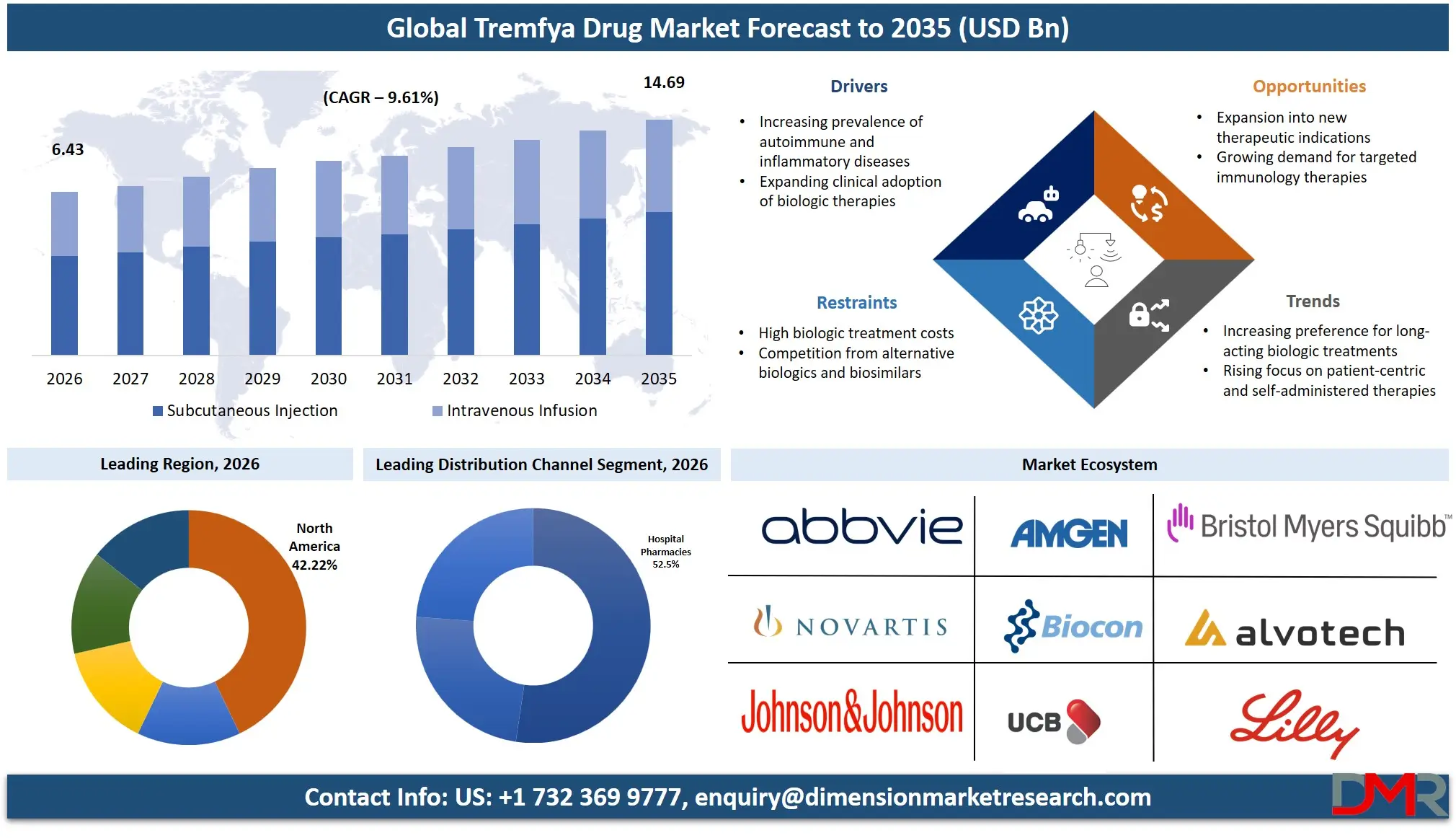
- The global Tremfya (guselkumab) drug market was valued at USD 5.87 billion in 2025, reached USD 6.43 Billion in 2026, and is projected to reach USD 14.69 billion by 2035, growing at a 9.61% CAGR.
- Plaque Psoriasis dominated the application segment with a revenue share of 86.31% in 2026.
- Subcutaneous Injection led the route of administration segment, accounting for 65.24% of the market in 2026.
- Hospital Pharmacies dominated the distribution channel segment with a market share of 52.52% in 2026.
- North America was the leading regional market, capturing 42.22% of global revenue, equivalent to approximately USD 2.48 Billion in 2026.
Market Overview
The Tremfya (guselkumab) market covers commercial sales of Johnson & Johnson's selective IL-23p19 inhibitor across four approved indications: plaque psoriasis, psoriatic arthritis, ulcerative colitis, and Crohn's disease. The market excludes other IL-23 or IL-12/23 inhibitors such as risankizumab or ustekinumab, as well as pipeline guselkumab applications not yet carrying regulatory approval. Hospital pharmacies, retail pharmacies, and online pharmacies form the distribution infrastructure; payer reimbursement decisions in the US, EU, and Japan shape accessible revenue pools at each tier.
ℹ
To learn more about this report –
Download Your Free Sample Report Here
Guselkumab sits at the premium end of the IL-23 inhibitor class and competes directly with AbbVie's Skyrizi in psoriasis and increasingly in gastroenterology. The September 2024 FDA approval for ulcerative colitis opened a high-volume GI prescriber channel that had previously been closed to guselkumab. As reported by Tremfya.com, approximately 60% of patients across all skin tones achieved PASI 90 skin clearance at 16 weeks, a benchmark that pharma buyers use to justify premium reimbursement positioning against older biologics.
Biologics intelligence systems and real-world outcomes databases now feed prescriber decision tools at major academic medical centers. Specialty pharmacy platforms now route guselkumab directly to patients through home-delivery programs, compressing the traditional hospital-to-retail dispensing chain. Payers track real-world persistence data against list-price trajectory, making long-term safety and adherence records as commercially critical as Phase 3 efficacy.
Market Size and Forecast
The Global Tremfya Drug Market size is estimated at USD 6.43 Billion in 2026 from USD 5.87 Billion in 2025, and is projected to reach USD 14.69 Billion by 2035, exhibiting a CAGR of 9.61% during the forecast period.
The 9.61% CAGR is not a passive extrapolation. The March 2025 FDA approval for Crohn's disease added a patient population exceeding 1.6 million adults in the US alone, pulling forward revenue that prior consensus models placed in the 2027–2029 window. As reported by Tremfya.com, 59% of patients on the 100 mg SC maintenance regimen achieved clinical remission at 1 year in Crohn's disease, a rate that converted hesitant gastroenterologists into early adopters faster than J&J's own launch plan anticipated.
Cross-indication revenue stacking drives the forecast's upside case. Each new approval converts Tremfya from a dermatology asset into a GI platform drug, broadening the addressable prescriber base and compounding per-patient revenue density. As reported by Tremfya.com, 48% of patients on guselkumab 100 mg SC maintenance achieved endoscopic response at 1 year versus Stelara, a head-to-head data point that accelerates label-switch decisions at centers already dispensing ustekinumab biosimilars.
Application Analysis
Plaque Psoriasis accounted for 86.31% of application demand in 2026, the highest of any category.
Eight years of real-world prescribing data in plaque psoriasis built a prescriber confidence base that no competing indication can replicate quickly. As reported by PubMed from the SPECTREM Phase IIIb trial published January 2026, nearly three-quarters of guselkumab patients had no or minimal psoriasis at Week 16 versus just over a tenth on placebo. That efficacy gap funds premium pricing and sustains payer coverage across most US formularies, making plaque psoriasis the cash engine that subsidizes Tremfya's IBD expansion.
Psoriatic arthritis, ulcerative colitis, and Crohn's disease represent the three growth levers that will reshape the application mix over the forecast period. In ulcerative colitis, data published by J&J show guselkumab patients achieved endoscopic improvement at a rate of 36% versus 12% on placebo at Week 12 in the SC induction trial, a differential that positions the drug favorably against TNF inhibitors in biologic-naïve patients. Crohn's disease is the fastest-climbing sub-indication given the 2025 FDA and EC approvals, and perianal fistulizing Crohn's remains an unclaimed sub-indication where J&J has flagged first-in-class efficacy signals. Psoriatic arthritis carries near-term upsell value for patients already on guselkumab for skin disease, letting rheumatologists extend the same biologic rather than initiating a new treatment line.
Route of Administration Analysis
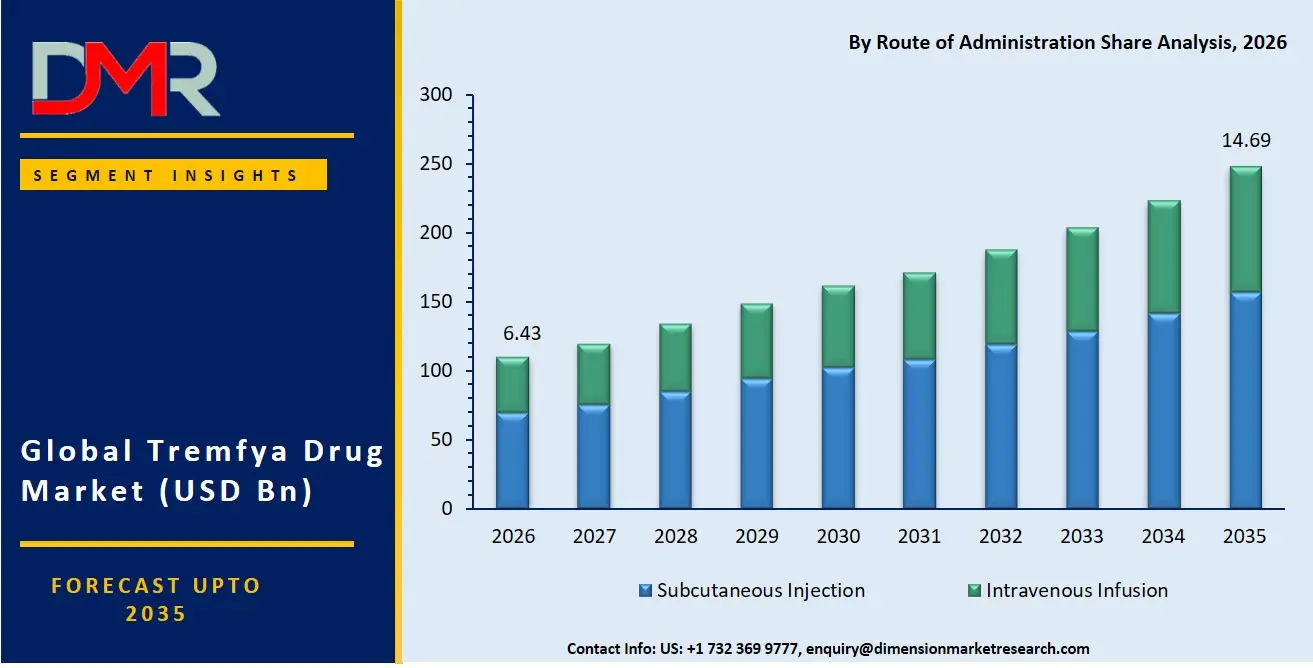
With a 65.24% share in 2026, Subcutaneous Injection outpaced all other route of administration categories.
ℹ
To learn more about this report –
Download Your Free Sample Report Here
Subcutaneous dominance reflects a structural preference among both prescribers and payers for self-administered maintenance over infusion-center-dependent regimens. Patient-controlled prefilled pens reduce per-administration cost, cut infusion-center scheduling bottlenecks, and improve adherence in chronic disease populations that require indefinite therapy. The strategic value compounds in IBD, where at-home SC maintenance converts IV-anchored patients into a lower-cost, lower-dropout cohort that sustains revenue longer per patient episode.
Intravenous infusion retains relevance as an induction pathway for severe IBD patients and institutional buyers, particularly in academic medical centers where infusion suites are already staffed. J&J's decision to pursue both SC and IV induction pathways in Crohn's disease was a deliberate market-access strategy, not a clinical necessity alone. Offering IV induction preserves hospital formulary positioning while SC maintenance locks in the at-home channel.
Distribution Channel Analysis
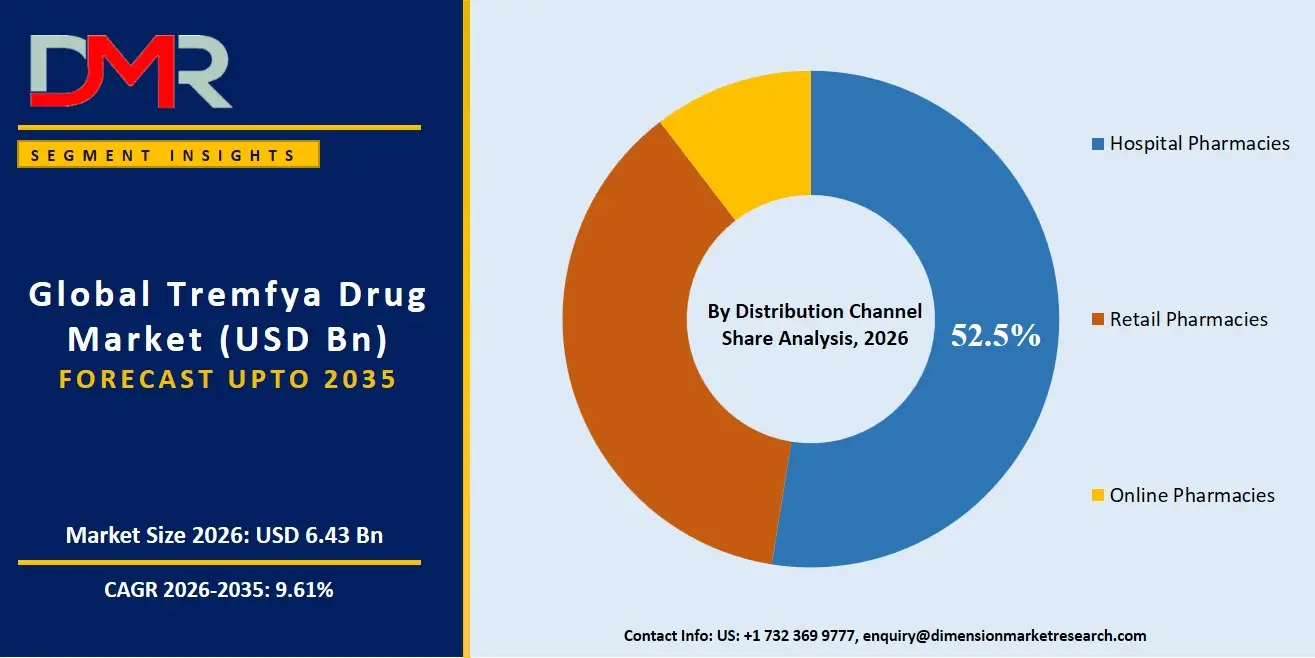
Hospital Pharmacies captured 52.52% of the distribution channel segment in 2026, ahead of all rivals.
ℹ
To learn more about this report –
Download Your Free Sample Report Here
Hospital pharmacies dominate because guselkumab induction for IBD begins in institutional settings, where infusion centers dispense the IV dose and pharmacists manage the transition to SC maintenance. That institutional handoff creates a sticky first-dispense relationship that often determines which pharmacy channel handles ongoing maintenance fills. Specialty pharmacy networks embedded within hospital systems capture that downstream volume.
Retail pharmacies service stable dermatology patients on long-term SC maintenance, while online pharmacies are gaining traction among younger plaque psoriasis patients who prefer home delivery and digital adherence tools. The online channel is the fastest-growing distribution tier and will attract payer-preferred specialty pharmacy networks as biosimilar pricing pressures compress hospital pharmacy margins.
Key Market Segments
By Application
- Plaque Psoriasis
- Psoriatic Arthritis
- Ulcerative Colitis
- Crohn's Disease
- Luminal Crohn's Disease
- Perianal Fistulizing Crohn's Disease
By Route of Administration
- Subcutaneous Injection
- Intravenous Infusion
By Distribution Channel
- Hospital Pharmacies
- Retail Pharmacies
- Online Pharmacies
Regional Analysis
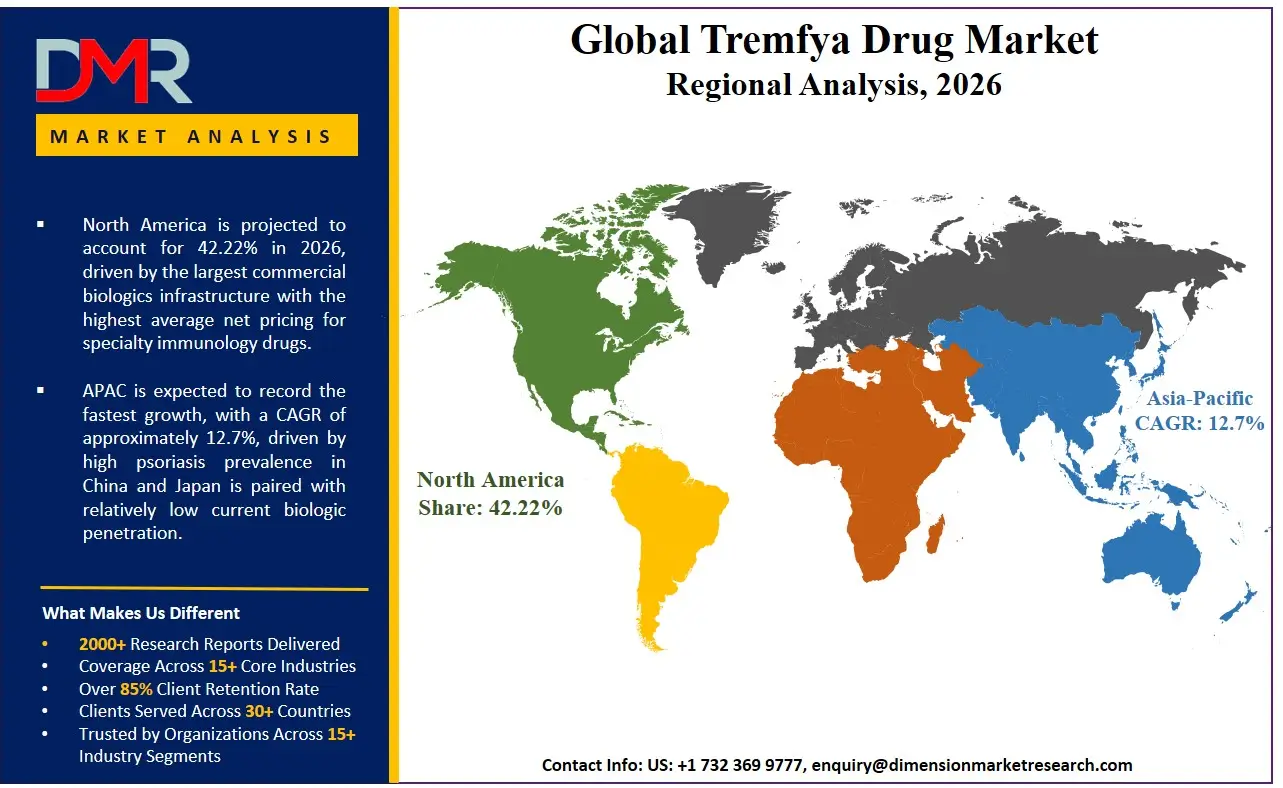
North America held a 42.22% revenue share in 2026, representing approximately USD 2.48 Billion of the global market.
ℹ
To learn more about this report –
Download Your Free Sample Report Here
North America leads because the US combines the largest commercial biologics infrastructure with the highest average net pricing for specialty immunology drugs. As reported by SNS Insider, the US Tremfya market stood at USD 2.41 Billion in 2024 and is projected to reach USD 4.14 Billion by 2032, growing at a CAGR of 7.05%. FDA milestone approvals in ulcerative colitis and Crohn's disease are sequentially expanding the addressable US patient population, and J&J's established payer contracts across Medicare Part D and commercial formularies accelerate uptake at each new label addition.
Europe is the second-largest region and the fastest-growing developed market for guselkumab in GI indications, following the May 2025 EU approval for Crohn's disease. Asia Pacific offers the most underexplored long-run growth base; high psoriasis prevalence in China and Japan is paired with relatively low current biologic penetration, suggesting prescription volume upside that present revenue figures do not yet reflect. Latin America and Middle East & Africa remain early-adoption markets where J&J's commercial infrastructure and reimbursement negotiations determine the pace of entry rather than clinical demand.
Key Regions and Countries
North America
Europe
- Germany
- France
- The UK
- Spain
- Italy
- Rest of Europe
Asia Pacific
- China
- Japan
- South Korea
- India
- Australia
- Rest of APAC
Latin America
- Brazil
- Mexico
- Rest of Latin America
Middle East & Africa
- GCC
- South Africa
- Rest of MEA
Market Dynamics
Sequential Indication Expansion Drives Per-Patient Revenue Depth
Cross-indication approval stacking is the primary revenue engine for guselkumab. Each regulatory win converts a single-indication dermatology drug into a multi-indication platform, compounding prescriber familiarity with each new disease area. As per J&J Phase 3 data, more than 40% of Tremfya-treated patients across both dose groups achieved ACR50 at Week 24 in psoriatic arthritis, a threshold that compels rheumatologists to retain rather than switch patients already on guselkumab for skin disease.
In ulcerative colitis, guselkumab patients achieved clinical remission in 26% of cases versus 7% on placebo at Week 12 in the SC induction trial, as confirmed by J&J data. Separately, findings from J&J confirmed Tremfya became the first and only IL-23 inhibitor with both subcutaneous and intravenous induction pathways for Crohn's disease in March 2025. That dual-pathway advantage over Skyrizi and risankizumab is not merely a clinical differentiator. It is a formulary negotiation lever that J&J uses to secure preferred status at hospital systems operating both infusion suites and home-infusion programs.
The September 2025 pediatric label expansion for children aged 6 and above in plaque psoriasis and psoriatic arthritis adds a patient lifecycle dimension that competitors have not yet matched. Pediatric approvals extend the prescribing relationship by decades, compounding long-term revenue density per patient cohort beyond what adult-only labels allow.
Biosimilar Entry and IRA Price Controls Compress Long-Term Margins
Ustekinumab biosimilar erosion is the most immediate margin threat to guselkumab's pricing floor. As Wezlana and subsequent Stelara biosimilars compress net pricing across the IL-12/23 reference-product pool, payers reset their willingness-to-pay benchmarks for the entire IL-23 class. Guselkumab's net price is anchored partly by the comparator it beats in head-to-head trials. When that comparator loses 30 to 50% of its net price, the reference benchmark for J&J's premium shifts accordingly.
The IRA Maximum-Fair-Price mechanism adds a structural pricing ceiling for high-spend Medicare Part D self-administered biologics. Post-2027 negotiated-price margin compression is not speculative. Guselkumab's cross-indication volume growth makes it exactly the kind of high-spend asset CMS targets for price negotiation. As reported by the FDA prescribing information, adverse events occurred in 49% of Tremfya subjects versus 47% on placebo in pooled 16-week psoriasis trials, suggesting the drug's safety profile does not differentiate from placebo enough to shield it from payer formulary pressure in a biosimilar-competitive landscape.
IBD White Space and At-Home Conversion Create Untapped Revenue Pools
Perianal fistulizing Crohn's disease represents the clearest near-term white space opportunity. J&J's May 2026 first-in-class efficacy readout in this sub-indication is the single most important unpublished data event for the forecast period. A positive approval would address a complication affecting roughly 25% of Crohn's patients that has no purpose-built biologic therapy approved specifically for it, creating a protected revenue lane that Skyrizi and risankizumab do not yet occupy.
Early first-line intervention in biologic-naïve IBD patients is the second high-value opportunity. Data published by Tremfya.com show 59% of patients on 200 mg SC maintenance and 56% on 100 mg SC maintenance remained in clinical remission at 2 years in Crohn's disease. Durable remission at two years is the clinical argument that converts gastroenterologists from step-therapy adherents into first-line guselkumab prescribers, capturing patients before structural bowel damage forecloses surgical avoidance.
Market Trends
SC Induction Normalization and IL-23 Class Consolidation Reshape Prescriber Patterns
Migration toward subcutaneous induction regimens is displacing infusion-center visits as the default IBD treatment initiation pathway. Per FDA labeling, the SC induction regimen for Crohn's disease uses 400 mg at weeks 0, 4, and 8, followed by 100 mg every 8 weeks or 200 mg every 4 weeks, providing clear at-home dosing structure. Venture and pharma capital are consolidating around IL-23 as the dominant inflammatory disease target class, while AbbVie's Skyrizi leapfrogging Lilly's Omvoh in ulcerative colitis share signals that three-way IL-23 class combat is intensifying faster than payer formularies can lock in preferred-tier positioning. CMS extension of drug price negotiation to Medicare Part B physician-administered products will reshape the long-term reimbursement calculus for infused biologics and push manufacturers toward SC delivery models to escape Part B price controls.
Market Competition Overview
The Tremfya drug market is moderately concentrated. Johnson & Johnson holds a dominant share as the sole originator manufacturer, but competitive pressure from other IL-23 inhibitors is intensifying across dermatology and gastroenterology simultaneously. AbbVie's Skyrizi is the primary share-capture threat in both psoriasis and IBD, having demonstrated faster-than-expected GI share gains in ulcerative colitis over the past 12 months. The market's structure will shift as biosimilar guselkumab candidates advance through regulatory pathways, with Alvotech, Samsung Bioepis, and Bio-Thera Solutions among the pipeline entrants positioned to erode the originator's pricing power.
Originator strategy centers on cross-indication stacking and clinical differentiation through head-to-head data. Based on data from the FDA prescribing information, the safety database covers 1,823 adult plaque psoriasis subjects, of whom 1,393 were exposed for at least 6 months, providing a real-world evidence base that biosimilar entrants cannot replicate at launch. That long-term safety record is a competitive moat that sustains prescriber preference among cautious rheumatologists and gastroenterologists even after price parity between originator and biosimilar narrows.
Company Profiles
Johnson & Johnson (Janssen Biotech) built guselkumab's commercial advantage through a disciplined multi-indication expansion strategy rather than relying solely on the initial plaque psoriasis approval. The March 2025 FDA Crohn's disease approval, the dual SC plus IV induction pathway, and the September 2025 pediatric label expansion represent compounding clinical events that each extend patient reach and deepen prescriber loyalty. J&J's Stelara loss-of-exclusivity succession strategy is transparent and deliberate: every guselkumab approval is designed to migrate existing ustekinumab prescribers before biosimilar-compressed Stelara pricing destroys the revenue base. That sequencing gives J&J a conversion funnel that competitors entering the IL-23 class without an incumbent position cannot replicate.
AbbVie Inc. is the most credible share-capture threat across both dermatology and gastroenterology. Skyrizi's superiority data in plaque psoriasis PASI 90 endpoints pressure guselkumab's formulary positioning at cost-sensitive payers who use head-to-head outcomes to justify preferred tier placement. AbbVie's gastroenterology infrastructure, built through its Humira commercial network, gives Skyrizi channel access advantages in IBD that newer IL-23 entrants cannot buy quickly. AbbVie's ability to bundle Skyrizi with Humira biosimilar contracting in payer negotiations is a price-leverage tool that J&J's single-molecule guselkumab portfolio cannot easily counter.
Key Players
- Johnson & Johnson (incl. Janssen Biotech)
- AbbVie Inc.
- Novartis AG
- Eli Lilly and Company
- UCB S.A.
- Amgen Inc.
- Bristol Myers Squibb
- Sun Pharmaceutical Industries Ltd.
- Biocon Biologics
- MorphoSys AG
- Bio-Thera Solutions
- Alvotech
- Samsung Bioepis
- Arven Pharmaceuticals
Supply Chain and Value Chain Analysis
Guselkumab is a recombinant human IgG1 monoclonal antibody produced in Chinese hamster ovary cell lines, placing upstream value creation in bioreactor cell culture, purification, and fill-finish biologics manufacturing. J&J controls the originator supply chain through Janssen Biologics manufacturing sites in Leiden and Malvern, with contract manufacturers supporting secondary fill-finish capacity. The highest-margin step sits at the drug product stage, where formulation and prefilled-pen assembly command premium pricing over active pharmaceutical ingredient alone. Cold-chain logistics from manufacturing site to hospital pharmacy or specialty distributor represent the primary bottleneck risk, as temperature excursions during last-mile delivery can cause batch failures that are not recoverable without re-supply lead times of several weeks.
Regulatory Landscape
The US regulatory pathway has been consistently favorable for guselkumab across each new indication, with FDA priority review designations reducing approval timelines in IBD. As reported by NHPRI Medicaid policy citing FDA labeling, Tremfya 100 mg/mL carries a quantity limit of 1 prefilled syringe or pen per 56 days, and the 200 mg/2 mL strength is limited to 1 per 28 days, reflecting CMS formulary controls that cap per-patient dispensing volumes and shape pharmacy channel revenue ceilings. The IRA's drug price negotiation mechanism is the most structurally significant regulatory shift of the forecast period. Any guselkumab negotiated-price determination post-2027 will set a price ceiling that flows through to commercial payer reference pricing, compressing list-to-net spread across all distribution channels.
The European regulatory environment added guselkumab's Crohn's disease indication following a positive CHMP opinion in March 2025 and European Commission approval in May 2025. EU member state reimbursement negotiations follow at the national level, where health technology assessment bodies in Germany, France, and England will assess guselkumab's incremental benefit over ustekinumab biosimilars before granting preferred formulary placement.
Investment and White Space Analysis
Capital flow in the guselkumab market is concentrating around two vectors: originator clinical pipeline expansion and biosimilar entrant financing. J&J is directing R&D investment toward perianal fistulizing Crohn's disease and the pediatric psoriasis indication as the next revenue-generating frontiers. Biosimilar developers including Alvotech, Samsung Bioepis, and Bio-Thera Solutions are attracting manufacturing investment to position for originator patent expiry, which creates a post-exclusivity white space for cost-competitive guselkumab versions in the 2028 to 2031 window.
The clearest underserved geography is Asia Pacific, where biologics penetration rates in inflammatory disease remain below 10% in most markets despite high disease prevalence. Japan and South Korea offer near-term entry points given established regulatory infrastructure and high physician familiarity with biologic prescribing. China represents the largest long-run white space but requires local clinical data and NMPA regulatory approval processes that extend timelines by two to four years beyond Western market entry.
Recent Developments
- March 2025: Johnson & Johnson reported that pooled GALAXI study data demonstrated TREMFYA's superiority versus STELARA across all pooled endoscopic endpoints within a registrational Crohn's disease trial, providing the head-to-head evidence base that drives label-switch decisions at centers already dispensing ustekinumab.
- March 2025: The European Medicines Agency's Committee for Medicinal Products for Human Use issued a positive opinion recommending TREMFYA for adults with moderately to severely active Crohn's disease, completing the pre-approval regulatory milestone ahead of EC decision.
- May 2025: The European Commission granted formal approval for TREMFYA for Crohn's disease across the European Union, opening the second-largest commercial biologics market to guselkumab's GI indication and triggering national health technology assessment processes in Germany, France, and the UK.
Report Details
| Report Characteristics |
| Market Value (2025) |
USD 5.87 Billion |
| Market Value (2026) |
USD 6.43 Billion |
| Forecast Revenue (2035) |
USD 14.69 Billion |
| CAGR (2026–2035) |
9.61% |
| Base Year for Estimation |
2025 |
| Historic Period |
2020 – 2024 |
| Forecast Period |
2026 – 2035 |
| Report Coverage |
Revenue Forecast, Market Dynamics, Competitive Landscape, Recent Developments |
| Segments Covered |
By Application (Plaque Psoriasis, Psoriatic Arthritis, Ulcerative Colitis, Crohn's Disease); By Route of Administration (Subcutaneous Injection, Intravenous Infusion); By Distribution Channel (Hospital Pharmacies, Retail Pharmacies, Online Pharmacies) |
| Regional Analysis |
North America – US and Canada; Europe – Germany, France, The UK, Spain, Italy, and Rest of Europe; Asia Pacific – China, Japan, South Korea, India, Australia, and Rest of APAC; Latin America – Brazil, Mexico, and Rest of Latin America; Middle East & Africa – GCC, South Africa, and Rest of MEA |
| Competitive Landscape |
Johnson & Johnson (incl. Janssen Biotech), AbbVie Inc., Novartis AG, Eli Lilly and Company, UCB S.A., Amgen Inc., Bristol Myers Squibb, Sun Pharmaceutical Industries Ltd., Biocon Biologics, MorphoSys AG, Bio-Thera Solutions, Alvotech, Samsung Bioepis, Arven Pharmaceuticals |
| Customization Scope |
Customization for segments and region or country level will be provided. Additional customization can be done based on requirements. |
| Purchase Options |
Three license options: Single User License, Multi-User License (Up to 5 Users), and Corporate Use License (Unlimited Users and Printable PDF). |
Frequently Asked Questions
What is the biggest investment opportunity in Tremfya (guselkumab) Market?
▾ Perianal fistulizing Crohn's disease is the highest-value unclaimed sub-indication. J&J's May 2026 efficacy readout positions guselkumab as the only biologic with first-in-class data in this complication, affecting roughly 25% of the Crohn's disease patient population. A positive approval would open a protected revenue lane that neither Skyrizi nor risankizumab currently occupies.
Who are the top companies in Tremfya (guselkumab) Market?
▾ Johnson & Johnson through Janssen Biotech is the sole originator manufacturer and dominant commercial player. AbbVie Inc. is the primary competitive threat across psoriasis and gastroenterology through its Skyrizi franchise. Biosimilar developers including Alvotech, Samsung Bioepis, and Bio-Thera Solutions are the emerging challengers building toward originator patent expiry.
Which segment is growing fastest in Tremfya (guselkumab) Market and why?
▾ Crohn's disease is the fastest-growing application sub-segment following the March 2025 dual FDA approval for both SC and IV induction pathways. The segment benefits from a large biologic-naïve patient pool, head-to-head superiority versus ustekinumab, and a 59% one-year clinical remission rate that converts hesitant gastroenterologists into active prescribers. Ulcerative colitis is the second-fastest, backed by the September 2024 FDA approval for adult SC induction.
Which region is growing fastest in Tremfya (guselkumab) Market and why?
▾ Europe is the fastest-growing developed region, following the May 2025 EU Crohn's disease approval that opened national reimbursement processes across Germany, France, and the UK simultaneously. Asia Pacific is the fastest-growing emerging region, where biologics penetration in inflammatory disease remains below 10% in key markets despite high psoriasis and IBD prevalence.
What is the biggest challenge holding Tremfya (guselkumab) Market back?
▾ IRA Maximum-Fair-Price exposure combined with accelerating ustekinumab biosimilar erosion is the most structurally damaging dual threat. Ustekinumab biosimilars compress the reference pricing benchmark that justifies guselkumab's premium, while CMS price negotiation threatens to set a net-price ceiling post-2027 that flows through to commercial payer benchmarks and shrinks the list-to-net spread across all channels.