UAE AI Automation Agency Market Snapshot
- UAE AI Automation Agency Market Size in 2026: USD 412.0 Million
- UAE AI Automation Agency Market Size in 2035: USD 2,684.3 Million
- UAE CAGR from 2026 to 2035: 23.1%
- Conversational AI and Chatbots is the leading service type segment in 2026: 31.6%
- Cloud Deployment is the leading deployment mode segment in 2026: 58.3%
- Large Enterprises is the leading enterprise size segment in 2026: 64.7%
- BFSI is the leading industry vertical segment in 2026: 24.8%
- Direct Engagement (In-House Agency Contracts) is the leading end user channel in 2026: 47.2%
What is the UAE AI Automation Agency and its Market Size?
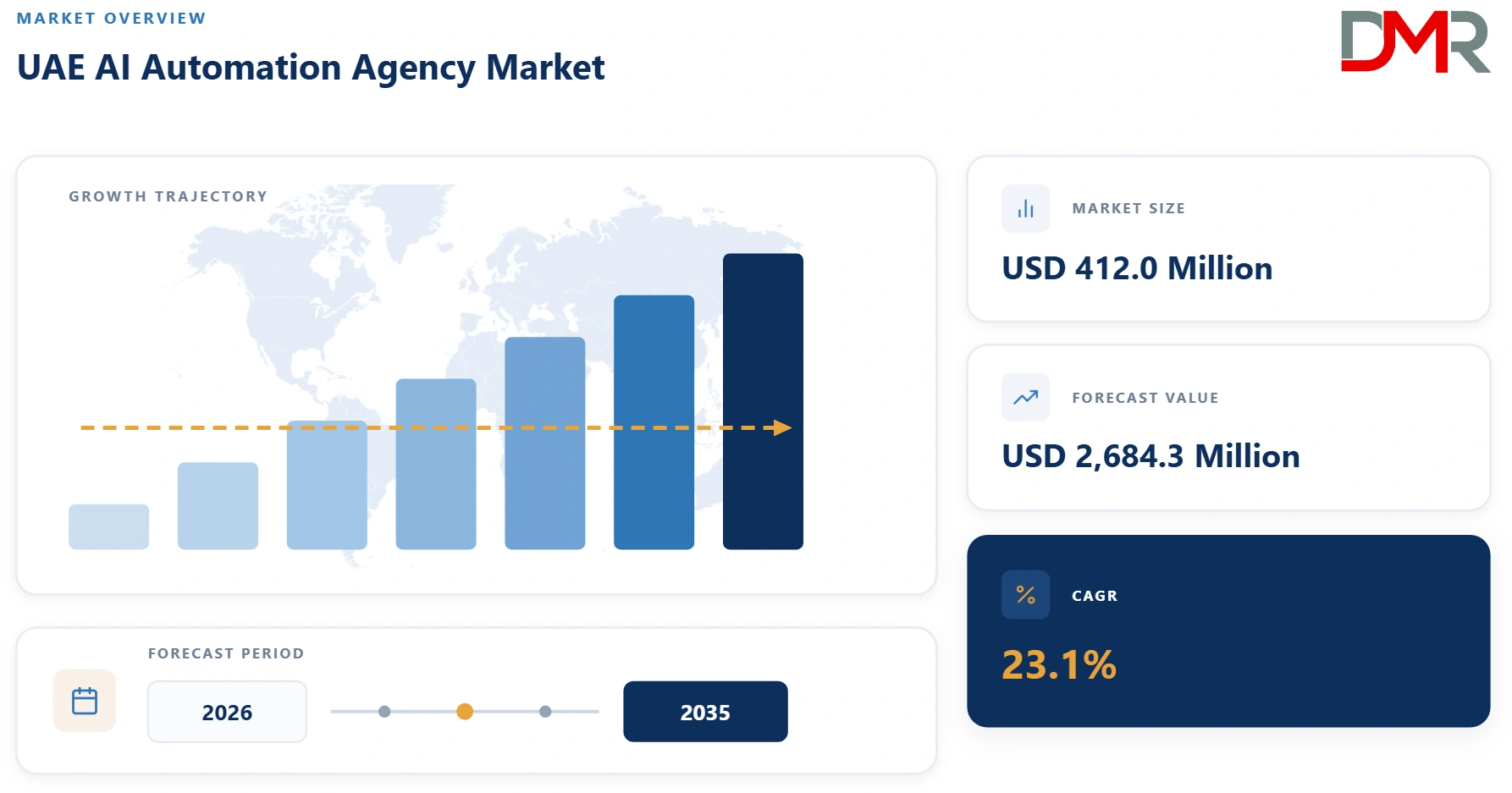
The UAE AI Automation Agency Market is projected to be valued at USD 412.0 Million in 2026 and is projected to reach USD 2,684.3 Million by 2035, expanding at a CAGR of 23.1% during the forecast period.
ℹ
To learn more about this report –
Download Your Free Sample Report Here
Growth is being propelled by the UAE's national strategy to position itself as a global AI hub, sustained government investment channelled through initiatives tied to the UAE Strategy for Artificial Intelligence 2031, and rapid enterprise adoption of agentic automation across banking, government services, logistics, and real estate. The proliferation of large language model-powered workflow agents, the expansion of free-zone AI clusters offering regulatory and tax incentives, and the entry of global systems integrators alongside home-grown boutique automation studios are reshaping the market from bespoke robotic process automation projects toward outcome-based, subscription-style agentic AI deployments. Investment is accelerating as both government entities and private enterprises shift from pilot-stage automation toward enterprise-wide agentic operating models embedded across customer service, back-office, and compliance functions.
Use Cases
- Government Service Digitisation and Citizen-Facing Agents: Federal and emirate-level entities deploy Arabic- and English-fluent conversational AI agents integrated with national digital identity systems to automate visa processing, licensing renewals, and citizen enquiries, reducing average service completion time from days to minutes.
- Banking Back-Office and Compliance Automation: UAE banks and financial institutions engage automation agencies to build AI agents that reconcile transactions, automate anti-money-laundering document review, and generate regulatory reporting, reducing manual processing headcount while improving audit traceability.
- Retail and E-Commerce Personalisation Agents: Retail groups and e-commerce platforms commission AI agencies to build recommendation and inventory-forecasting agents that integrate with point-of-sale and warehouse systems, dynamically adjusting pricing and restocking triggers during peak shopping periods.
- Real Estate and Logistics Workflow Orchestration: Property developers and logistics operators deploy multi-agent systems that automate lead qualification, tenancy contract generation, customs documentation, and freight routing, cutting administrative turnaround across high-volume transactional workflows.
Key Takeaways
- Market Size: The UAE AI Automation Agency Market is anticipated to be valued at USD 412.0 Million in 2026 and is forecast to reach USD 2,684.3 Million by 2035, expanding at a CAGR of 23.1%.
- Growth Outlook: Market expansion is sustained by national AI strategy funding, rapid enterprise appetite for agentic automation, expansion of free-zone AI ecosystems, and rising demand for Arabic-language conversational AI tailored to regional regulatory and cultural context.
- Primary Growth Drivers: Government-backed AI adoption mandates, a maturing pool of regionally headquartered automation talent, growing comfort with outcome-based automation contracts, and increasing integration of generative AI agents into core enterprise systems are accelerating agency engagement volumes.
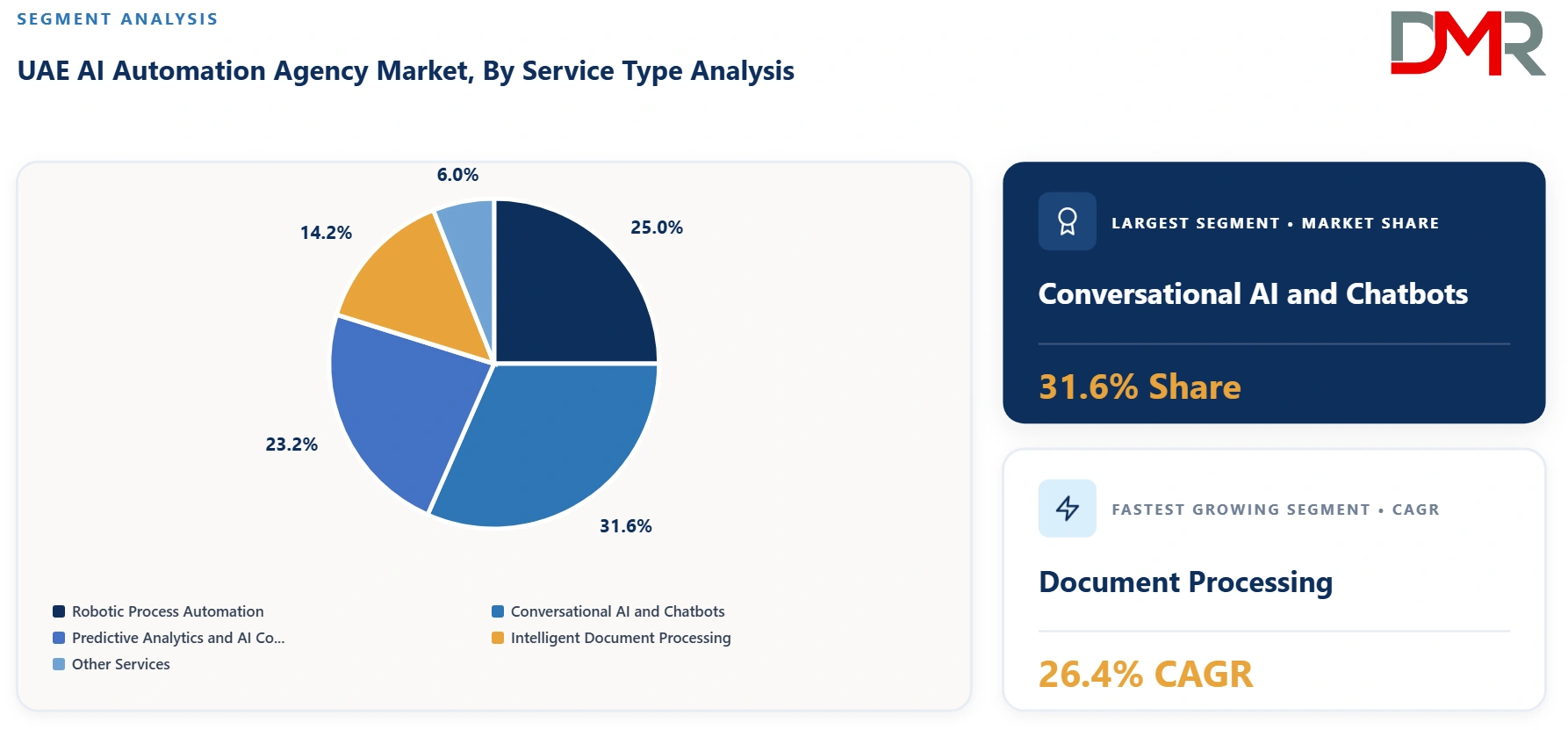
- By Service Type Analysis: Conversational AI and Chatbots is projected to lead the service segment with a 31.6% share in 2026, driven by government and banking demand for multilingual citizen and customer engagement agents. Intelligent Document Processing is the fastest-growing service segment at 26.4% CAGR, propelled by compliance-heavy sectors automating high-volume document review.
- By Deployment Mode Analysis: Cloud Deployment is expected to dominate with a 58.3% share in 2026, reflecting enterprise preference for rapid scalability. Hybrid Deployment is projected to exhibit the highest CAGR at 27.9%, as regulated sectors such as banking and government balance cloud agility with data residency requirements.
- By Enterprise Size Analysis: Large Enterprises are poised to lead with a 64.7% share in 2026, reflecting greater automation budgets and multi-department rollout capacity. Small and Medium Enterprises is the fastest-growing enterprise size segment at 25.7% CAGR, driven by falling entry costs for pre-built automation agent templates.
- By Industry Vertical Analysis: BFSI is expected to command a 24.8% share in 2026, underpinned by compliance automation and customer service transformation. Government and Public Sector is the fastest-growing vertical at 27.3% CAGR, fuelled by national digital government mandates.
- By End User Analysis: Direct Engagement through in-house agency contracts is projected to lead with a 47.2% share in 2026. Managed AI-as-a-Service Contracts is the fastest-growing end-user model at 29.5% CAGR, as enterprises increasingly prefer ongoing managed agent operation over one-off project delivery.
Key Drivers in the UAE AI Automation Agency Market
National AI Strategy and Government-Led Digital Transformation Mandates
The UAE's strong commitment to artificial intelligence and digital transformation is a major driver of the AI Automation Agency Market. Government initiatives promoting paperless services, automated citizen engagement, smart infrastructure, and AI-enabled public administration are creating sustained demand for automation expertise. Federal and emirate-level entities increasingly engage specialized agencies to design conversational AI, workflow automation, intelligent document processing, and agentic systems. Government adoption also provides important validation for automation technologies, encouraging private enterprises to accelerate investment. Continued public-sector funding, supportive AI policies, digital service targets, and national economic diversification programs are expected to strengthen agency opportunities and establish long-term market demand.
Rapid Enterprise Adoption Across Banking, Retail, and Logistics
Rapid adoption of artificial intelligence across banking, retail, logistics, and other major UAE industries is accelerating demand for automation agency services. Enterprises increasingly deploy AI agents to improve customer support, automate repetitive processes, optimize supply chains, detect fraud, and reduce operational costs. Successful early implementations demonstrating measurable productivity and cycle-time improvements are encouraging broader enterprise deployments beyond pilot projects. Large organizations are expanding automation across multiple departments, while mid-sized businesses increasingly adopt standardized and affordable AI solutions. Growing competitive pressure, digital-first customer expectations, and increasing availability of scalable automation technologies are consequently expanding contract sizes, engagement volumes, and recurring service opportunities for specialized agencies.
Restraints in the UAE AI Automation Agency Market
Talent Scarcity and Reliance on Expatriate AI Specialists
Shortages of specialized artificial intelligence professionals represent a significant restraint on the UAE AI Automation Agency Market. Advanced automation projects require expertise in agentic architecture, large language models, machine learning, data engineering, cybersecurity, and enterprise integration. Although national education and training programs are expanding domestic capabilities, agencies continue relying substantially on international technical professionals. Competition from multinational technology companies and regional digital hubs increases salaries and employee turnover. Recruiting experienced specialists can therefore raise project costs and restrict delivery capacity. Agencies must strengthen internal training, talent retention, automation development frameworks, and international recruitment strategies to scale effectively while maintaining implementation quality and profitability.
Growth Opportunities in the UAE AI Automation Agency Market
Arabic-Language and Culturally Localised Agentic AI
Arabic-language and culturally localized agentic AI represents a significant growth opportunity within the UAE AI Automation Agency Market. Government agencies, financial institutions, healthcare organizations, and customer-facing enterprises require automation systems capable of understanding Modern Standard Arabic and regional dialects accurately. Agencies developing Arabic-first conversational agents, localized large language models, and culturally appropriate workflows can differentiate themselves from generic international platforms. Integration with local digital identity, payment, and government service infrastructure could further strengthen adoption. Growing requirements for regulatory compliance, data sovereignty, multilingual customer engagement, and contextual accuracy are expected to create substantial opportunities for providers capable of delivering reliable Arabic-native enterprise automation solutions.
Cross-Border Expansion Through UAE-Based Regional Hubs
The UAE's strategic location, advanced digital infrastructure, free zones, and business-friendly environment provide automation agencies with opportunities to expand throughout the GCC and broader Middle East and North Africa region. Agencies can leverage experience gained from sophisticated UAE government and enterprise deployments to address similar digital transformation requirements in Saudi Arabia, Qatar, Bahrain, Kuwait, Oman, and neighboring markets. Regional organizations increasingly demand AI-powered customer engagement, workflow automation, intelligent documents, and operational optimization. Establishing UAE headquarters also provides access to international talent and technology partnerships. Cross-border expansion can diversify revenue streams, improve scalability, and transform domestic automation specialists into regional AI service providers.
Trends in the UAE AI Automation Agency Market
Shift From Project-Based Delivery to Managed Agent Operations
The UAE AI Automation Agency Market is increasingly shifting from one-time implementation projects toward recurring managed agent operations. Enterprises require continuous monitoring, model updates, workflow optimization, security management, compliance checks, and performance improvements after AI agents are deployed. Automation agencies are consequently developing subscription and managed-service models that provide ongoing technical support and operational oversight. This transition creates predictable recurring revenue while strengthening long-term relationships between agencies and clients. Managed services also reduce the need for enterprises to maintain large internal AI teams. As agentic systems become integrated into mission-critical workflows, demand for continuous optimization and governance services is expected to increase substantially.
Convergence of Automation Agencies With Systems Integrators and Cloud Providers
Automation agencies in the UAE are increasingly collaborating with cloud providers, systems integrators, enterprise software companies, and technology consultancies to deliver integrated AI transformation solutions. Rather than implementing automation as an independent layer, agencies are embedding intelligent agents within enterprise resource planning, customer relationship management, cloud infrastructure, and data platforms. These partnerships provide access to larger enterprise contracts, technical resources, established customer relationships, and scalable infrastructure. Enterprises benefit from unified technology environments and reduced integration complexity. Continued convergence is expected to strengthen ecosystem-based competition, encourage development of industry-specific automation solutions, and position specialized agencies as important components of broader enterprise digital transformation programs.
Research Scope and Analysis
The UAE AI Automation Agency Market is segmented by service type, deployment mode, enterprise size, industry vertical, and end user, covering automation, conversational AI, consulting, document processing, cloud and hybrid deployment, enterprises, BFSI, government, healthcare, and managed AI services.
ℹ
To learn more about this report –
Download Your Free Sample Report Here
By Service Type Analysis
Conversational AI and Chatbots are projected to dominate the UAE AI Automation Agency Market with an estimated 31.6% share in 2026, supported by strong demand from government agencies, banks, retailers, and service organizations for multilingual customer engagement. Organizations increasingly deploy intelligent virtual assistants to provide continuous support, automate enquiries, and improve service efficiency. Intelligent Document Processing is anticipated to register the highest CAGR of 26.4% during 2026–2035. Expansion is driven by compliance-intensive industries automating contracts, invoices, trade documents, claims, and regulatory filings. Advances in generative AI, computer vision, and natural language processing are further improving document automation accuracy and scalability.
By Deployment Mode Analysis
Cloud Deployment is expected to dominate the UAE AI Automation Agency Market with approximately 58.3% share in 2026, reflecting enterprise preference for scalable infrastructure, rapid implementation, and lower upfront technology investment. Cloud environments enable organizations to deploy AI agents quickly while accessing advanced computing resources and continuously updated platforms. Hybrid Deployment is projected to register the highest CAGR of 27.9% between 2026 and 2035. Growth is supported by banks, government entities, healthcare providers, and regulated organizations requiring sensitive information to remain within controlled infrastructure while utilizing cloud resources for less-sensitive workloads. Data sovereignty requirements are further strengthening hybrid architecture adoption.
By Enterprise Size Analysis
Large Enterprises are anticipated to dominate the UAE AI Automation Agency Market with an estimated 64.7% share in 2026, supported by substantial technology budgets, complex operational environments, and capacity to implement automation across multiple departments. Large organizations increasingly invest in customer service agents, document automation, compliance workflows, and predictive systems. Small and Medium Enterprises are projected to register the fastest CAGR of 25.7% through 2035. Affordable cloud platforms, standardized automation templates, and subscription-based AI services are reducing implementation barriers for smaller companies. Growing competitive pressure and limited internal staffing are also encouraging SMEs to outsource automation development and management to specialized agencies.
By Industry Vertical Analysis
BFSI is expected to lead the UAE AI Automation Agency Market by industry vertical, accounting for approximately 24.8% share in 2026. Banks, insurers, and financial institutions are investing extensively in customer service automation, fraud detection, compliance monitoring, document processing, and personalized financial interactions. Government and Public Sector is projected to record the fastest CAGR of 27.3% during 2026–2035. National digital transformation targets, smart government initiatives, and growing deployment of AI-enabled citizen services are driving agency engagement. Requirements for multilingual digital assistants, automated administrative processes, intelligent document handling, and secure government workflows are creating substantial opportunities for specialized automation service providers.
By End User Analysis
Direct Engagement through agency contracts is projected to dominate the UAE AI Automation Agency Market with approximately 47.2% share in 2026, as large organizations increasingly commission customized automation solutions aligned with specific operational requirements. Direct contracts provide greater control over system architecture, integrations, security, and workflow customization. Managed AI-as-a-Service Contracts are expected to register the highest CAGR of 29.5% through 2035. Enterprises increasingly prefer outsourcing continuous monitoring, retraining, maintenance, governance, and optimization of deployed agents rather than building extensive internal capabilities. Recurring managed services provide scalability and predictable costs while enabling agencies to develop longer-term customer relationships and recurring revenue streams.
The UAE AI Automation Agency Market Report is segmented based on the following:
By Service Type
- Robotic Process Automation
- Attended Automation
- Unattended Automation
- Conversational AI and Chatbots
- Customer Service Agents
- Citizen Service Agents
- Predictive Analytics and AI Consulting
- Demand Forecasting
- Risk and Fraud Analytics
- Intelligent Document Processing
- Contract Review Automation
- Regulatory Filing Automation
- Other Services
By Deployment Mode
By Enterprise Size
- Large Enterprises
- Small and Medium Enterprises
By Industry Vertical
- BFSI
- Government and Public Sector
- Retail and E-Commerce
- Real Estate
- Logistics and Transportation
- Healthcare
- Others
By End User
- Direct Engagement (In-House Agency Contracts)
- Managed AI-as-a-Service Contracts
- Project-Based Consulting Engagements
Technology Analysis
Technology advancement is central to the UAE AI Automation Agency Market as enterprises increasingly adopt generative AI, agentic systems, robotic process automation, intelligent document processing, and conversational AI. Growing integration of large language models with ERP, CRM, cloud, and enterprise data platforms is enabling agencies to automate increasingly complex workflows. Arabic-language AI, multimodal agents, low-code automation, and retrieval-augmented generation represent significant differentiation opportunities. Demand for sovereign cloud and hybrid architectures is also increasing across regulated industries. However, hallucinations, cybersecurity vulnerabilities, integration complexity, model reliability, and data quality remain important risks. Continuous technological innovation is expanding agency capabilities, increasing contract scope, and accelerating enterprise adoption across government, BFSI, retail, logistics, and healthcare.
Investment and White Space Analysis
Investment opportunities in the UAE AI Automation Agency Market are expanding as government digital transformation, enterprise AI adoption, and regional technology investment create demand for specialized automation capabilities. White-space opportunities are particularly strong in Arabic-first AI agents, industry-specific automation, managed agent operations, compliance automation, and solutions designed for SMEs. Agencies can also develop specialized offerings for banking, government, healthcare, logistics, and real estate, where localized workflows and regulatory requirements create barriers for generic global platforms. Growing venture funding and corporate partnerships can support market entry and scaling. However, intense competition, specialist talent costs, dependence on global AI infrastructure, and rapid technology obsolescence create risks, requiring agencies to maintain differentiation and recurring revenue models.
Competitive Landscape
The UAE AI Automation Agency Market is highly competitive, combining domestic AI specialists, global technology consultancies, cloud providers, systems integrators, and automation platform companies. Competition is increasingly centered on agentic AI, Arabic-language capabilities, sovereign infrastructure, conversational AI, intelligent document processing, and managed automation services. UAE-based companies benefit from local regulatory knowledge, government relationships, and Arabic AI expertise, while multinational providers contribute extensive enterprise platforms and global implementation capabilities. Strategic partnerships are becoming critical as agencies integrate automation with cloud, ERP, CRM, cybersecurity, and data platforms. The market is shifting toward recurring managed AI services and industry-specific agents. Providers offering secure deployment, measurable productivity improvements, regulatory compliance, and rapid implementation are positioned to capture growing government and enterprise spending.
Some of the prominent players in the UAE AI Automation Agency Market are:
- G42
- Core42
- Presight
- Inception
- AIQ
- Verofax
- e& enterprise
- du
- Microsoft
- IBM
- Oracle
- SAP
- Salesforce
- UiPath
- Automation Anywhere
- ServiceNow
- Google Cloud
- Amazon Web Services
- Accenture
- Deloitte
- PwC
- EY
- KPMG
- Capgemini
- Cognizant
- Tata Consultancy Services
- Infosys
- Wipro
- HCLTech
- Tech Mahindra
- NTT DATA
- Avanade
- Sutherland
- Concentrix
- Zoho
- Red Hat
- SAS
- Pegasystems
- Appian
- SS&C Blue Prism
- Other Key Players
Recent Developments
- July 2026: Inception42 and Microsoft announced collaboration to move agentic AI from pilots into government and enterprise operations, enabling governed agent ecosystems with domestic data processing and supporting the UAE’s national agentic AI initiative.
- July 2026: e& UAE and Core42 partnered to deliver sovereign AI infrastructure combining AI compute, private connectivity, and local support, creating infrastructure for deploying intelligent agents across government and regulated enterprise operations.
- June 2026: Core42 expanded its Compass ecosystem with Open Innovation AI applications, strengthening sovereign enterprise AI capabilities and providing organizations with additional tools for deploying AI-powered applications within secure infrastructure.
- May 2026: The UAE Cabinet approved a federal framework for Agentic AI implementation, establishing governance responsibilities across ministries and supporting the national objective of deploying AI agents across 50% of government services and operations.
Report Details
| Report Characteristics |
| Market Size (2026) |
USD 412.0 Mn |
| Forecast Value (2035) |
USD 2,684.3 Mn |
| CAGR (2026–2035) |
23.1% |
| Historical Data |
2021 – 2025 |
| Forecast Data |
2026 – 2035 |
| Base Year |
2025 |
| Segments Covered |
By Service Type, By Deployment Mode, By Enterprise Size, By Industry Vertical, and By End User |
| Country Coverage |
UAE |
Frequently Asked Questions
How big is the UAE AI Automation Agency Market?
▾ The UAE AI Automation Agency Market is valued at USD 412.0 Million in 2026 and is projected to reach USD 2,684.3 Million by 2035, reflecting strong demand for conversational AI, robotic process automation, and agentic AI services across government, banking, and enterprise clients.
What is the CAGR of the UAE AI Automation Agency Market from 2026 to 2035?
▾ The market is projected to expand at a compound annual growth rate (CAGR) of 23.1% between 2026 and 2035, supported by national AI strategy funding, rapid enterprise adoption, and expanding managed AI service models.
What factors are driving the growth of the UAE AI Automation Agency Market?
▾ Growth is driven by government-led digital transformation mandates, rising enterprise adoption of agentic automation in banking and retail, expanding free-zone AI ecosystems, and increasing demand for Arabic-language conversational AI.
What are the major trends in the UAE AI Automation Agency Market?
▾ Major trends include the shift from project-based delivery to managed agent operations, deeper convergence between automation agencies and global cloud and systems integration providers, and growing investment in culturally localised, Arabic-first agentic AI.
Who are the key players in the UAE AI Automation Agency Market?
▾ Key market participants include G42, Presight AI, Bayanat AI, IBM Middle East, Microsoft UAE, Accenture UAE, and a growing cohort of homegrown Emirati AI automation studios, among other global and regional technology firms.
How is the UAE AI Automation Agency Market segmented?
▾ The market is segmented by service type, deployment mode, enterprise size, industry vertical, and end user, with demand analysis concentrated across Dubai, Abu Dhabi, and the remaining northern emirates.