UAE Automation Equipment Market Snapshot
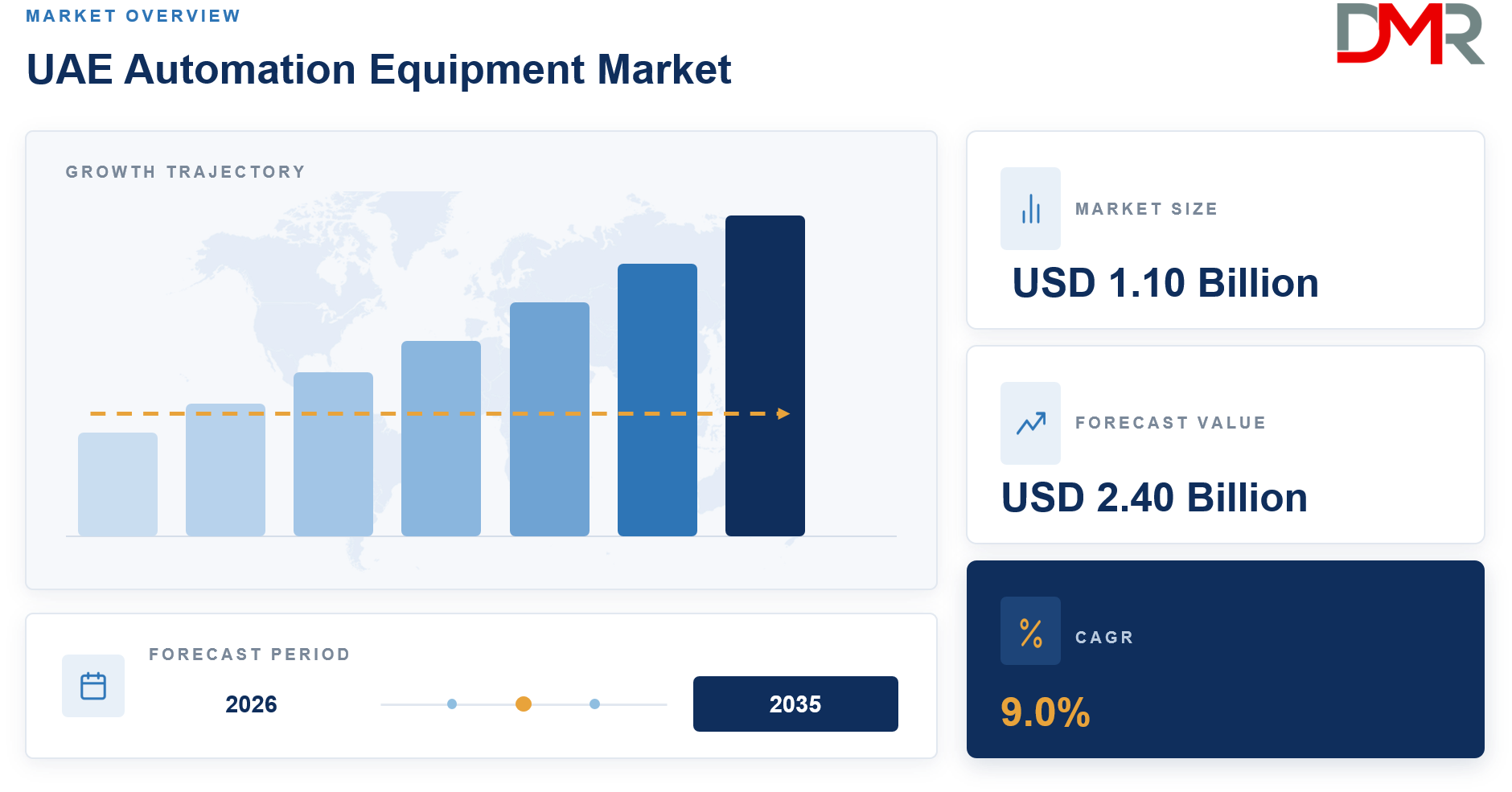
- Market Value: UAE automation equipment market is valued at USD 1.10 billion in 2026 and is projected to reach USD 2.40 billion by 2035.
- CAGR: UAE automation equipment market is expected to grow at a CAGR of 9.0% from 2026 to 2035.
- By Equipment Type Segment Analysis: Control Systems (PLC, DCS, SCADA, and HMI) led the equipment type segment with a 34.5% share in 2026, supported by extensive use across oil & gas, utilities, manufacturing, and infrastructure facilities.
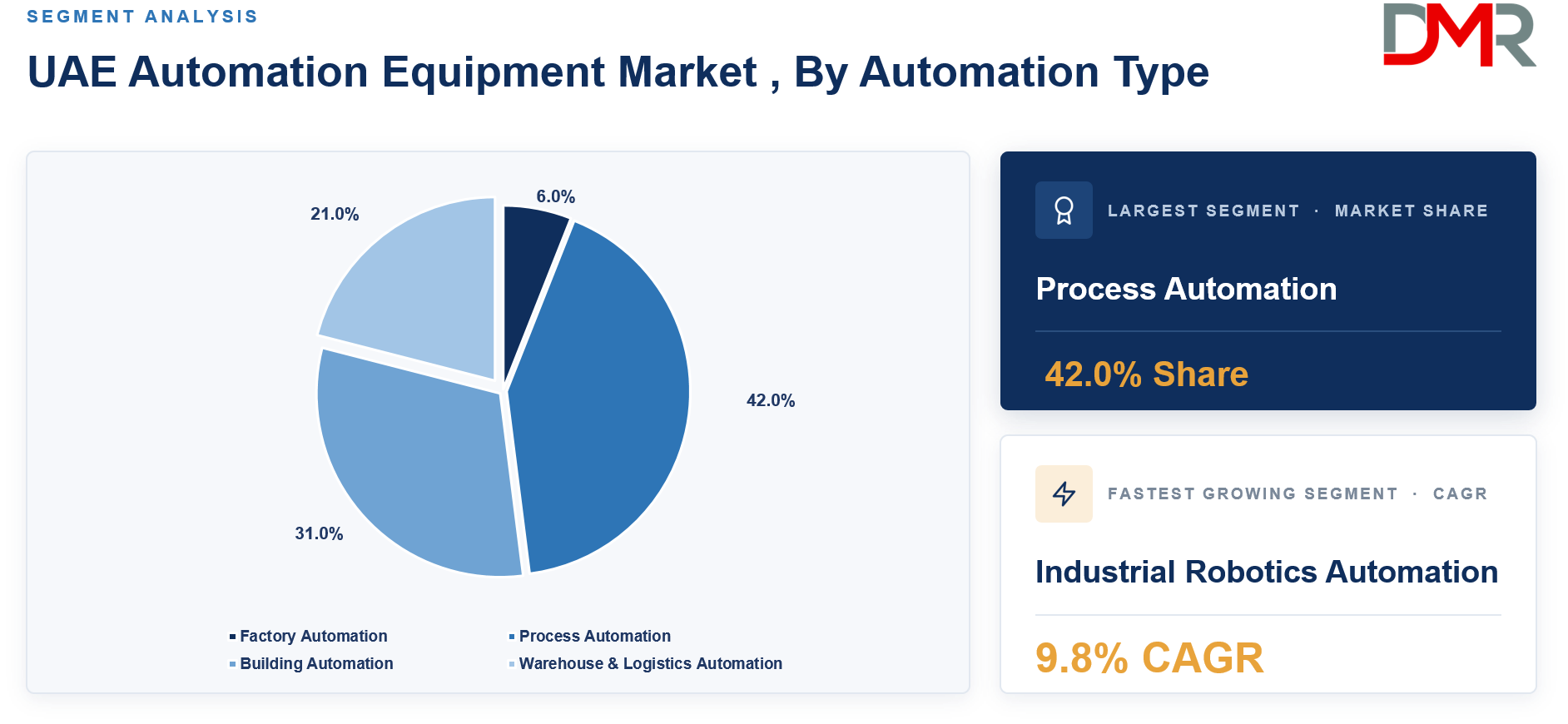
- By Automation Type Segment Analysis: Process Automation held the leading position with a 42.0% share in 2026, supported by demand from oil & gas, petrochemical, power generation, and water treatment industries.
- By Technology Segment Analysis: Industrial Internet of Things (IIoT) Enabled Automation accounted for a 28.6% share in 2026, driven by connected factories, smart assets, and Industry 4.0 adoption.
- Major Players: Siemens AG, ABB Ltd., Schneider Electric SE, Honeywell International Inc., and Emerson Electric Co.
What is the UAE Automation Equipment Market and its Market Size?
The UAE Automation Equipment Market size is projected to be valued at USD 1.10 billion in 2026 and is expected to reach USD 2.40 billion by 2035, expanding at a CAGR of 9.0% during the forecast period. Automation equipment includes industrial control systems, robotics, sensors, drives, field devices, software, and connected platforms used to monitor and control industrial operations. Demand is rising as the UAE expands advanced manufacturing, energy infrastructure, logistics, utilities, and smart industrial facilities. Government-led industrial transformation is also supporting adoption. Operation 300bn targets an increase in the industrial sector's contribution to GDP from AED 133 billion to AED 300 billion by 2031, while UAE Industry 4.0 is positioned as a major pillar of the country's industrial modernization strategy.
ℹ
To learn more about this report –
Download Your Free Sample Report Here
Use Cases
- Oil & Gas Process Control: PLC, DCS, SCADA, sensors, control valves, and advanced monitoring equipment automate drilling, processing, refining, storage, and pipeline operations. These systems improve process visibility, operational stability, asset utilization, and safety while helping operators manage geographically distributed energy infrastructure.
- Smart Manufacturing: UAE manufacturers are integrating industrial robots, IIoT sensors, machine vision, servo systems, and automated production lines to improve throughput and product consistency. Connected automation supports real-time production data, flexible manufacturing, predictive maintenance, quality assurance, and reduced manual intervention.
- Water & Utility Automation: SCADA platforms, smart sensors, flow meters, drives, and automated control systems are used across desalination facilities, wastewater plants, pumping stations, and electricity networks. Automation helps utilities monitor remote infrastructure, manage energy consumption, detect abnormalities, and optimize service reliability.
- Logistics & Warehousing: Automated conveyors, robotic handling systems, machine vision, warehouse control systems, and connected sensors help distribution centers handle growing shipment volumes. Automation improves inventory movement, picking accuracy, palletizing, storage utilization, and order processing across the UAE's expanding logistics ecosystem.
- Infrastructure & Buildings: Building management systems, intelligent controllers, sensors, actuators, and energy management platforms automate HVAC, lighting, access control, and other building functions. Large commercial developments, airports, transport facilities, data centers, and smart-city projects create sustained demand for integrated automation equipment.
How AI/Gen AI is Transforming the UAE Automation Equipment Market?
Artificial intelligence is expanding the capabilities of industrial automation from predefined control to predictive and adaptive operations. UAE factories, refineries, utilities, warehouses, and infrastructure operators can combine IIoT sensor data with machine learning to identify abnormal equipment behavior, forecast maintenance requirements, optimize energy use, and improve production scheduling. Machine vision supported by AI can automate defect detection, while intelligent robotics can adapt more efficiently to changing production conditions. Digital twins are also becoming more relevant because operators can compare real-time plant data with virtual models before modifying processes or maintenance schedules. These developments strengthen demand for connected controllers, edge devices, sensors, industrial networks, robotic equipment, and advanced automation software.
Generative AI adds another layer by simplifying interaction with large volumes of operational information. Industrial teams can use natural-language interfaces to search maintenance histories, summarize alarms, prepare operating reports, and support troubleshooting. The wider investment environment is favorable to this transition. UAE-backed investors are increasing their focus on the convergence of AI and robotics, while the country continues expanding AI infrastructure and advanced technology capabilities. The next stage of UAE automation equipment market growth is therefore likely to combine reliable industrial control with AI-based analytics, autonomous systems, digital twins, and human-machine collaboration. Cybersecurity, validated data, explainability, and operational safety will remain important when these technologies are applied to critical industrial assets.
Key Drivers in the UAE Automation Equipment Market
National Industrial Expansion and Industry 4.0 Adoption
The UAE's industrial diversification strategy is accelerating investment in smart factories, connected production assets, industrial robotics, and advanced control systems. Operation 300bn aims to raise the industrial sector's GDP contribution from AED 133 billion to AED 300 billion by 2031. UAE Industry 4.0 also promotes digital transformation across manufacturing. As new facilities are developed and existing plants modernize, demand for PLCs, DCS platforms, sensors, drives, industrial robots, machine vision, IIoT gateways, and automation services is expected to rise.
Modernization of Energy and Critical Infrastructure
Oil & gas, utilities, water treatment, transportation, and major infrastructure facilities require high levels of operational reliability and process control. Operators are increasingly upgrading legacy assets with advanced SCADA, DCS, intelligent sensors, condition monitoring, and predictive maintenance systems. Remote monitoring is especially valuable for geographically distributed energy and utility assets. These modernization programs support recurring demand for automation hardware, software, cybersecurity capabilities, engineering services, and system integration across the UAE automation equipment industry.
Restraints in the UAE Automation Equipment Market
High Initial Investment and Integration Complexity
Advanced automation projects require significant expenditure on controllers, sensors, robots, industrial networks, software licenses, cybersecurity, engineering, installation, testing, and workforce training. Integration becomes more difficult when companies operate older equipment from multiple vendors. Large industrial groups can absorb these costs more easily, while smaller manufacturers may delay modernization because the investment case depends on production scale and measurable efficiency gains. These factors can slow automation equipment adoption among SMEs and facilities with limited capital budgets.
Industrial Cybersecurity and Skilled Workforce Challenges
Higher connectivity between operational technology and enterprise IT systems expands the potential cyberattack surface. Critical industries therefore require secure architecture, controlled remote access, network segmentation, software updates, and continuous monitoring. At the same time, advanced automation requires engineers familiar with robotics, industrial networks, AI, PLC programming, data analytics, and cybersecurity. Competition for specialized technical skills can raise implementation costs and extend project schedules, particularly for complex digital transformation programs involving multiple industrial platforms.
Growth Opportunities in the UAE Automation Equipment Market
Expansion of Smart and Advanced Manufacturing
The UAE's goal of developing higher-value manufacturing creates strong opportunities for suppliers of robotics, machine vision, motion control, smart sensors, digital twins, and IIoT platforms. Emirates Development Bank has committed substantial financing support to strategic industrial development under the wider Operation 300bn agenda. As pharmaceutical, food, metals, chemicals, electronics, and advanced manufacturing investments expand, equipment suppliers can address both greenfield projects and factory modernization. Flexible automation solutions suitable for medium-sized manufacturers offer additional growth potential.
Automation of Logistics, Utilities, and Sustainable Infrastructure
The UAE's position as a major trade and logistics hub creates opportunities for warehouse robots, automated material handling, machine vision, conveyor controls, and warehouse management integration. Utilities represent another attractive area as desalination, water distribution, renewable power, district cooling, and electricity networks require accurate monitoring and intelligent control. Automation vendors that combine equipment with energy management, predictive maintenance, digital twin, and remote asset monitoring capabilities can benefit from growing demand for efficient and sustainable infrastructure.
Trends in the UAE Automation Equipment Market
Convergence of IIoT, Edge Computing, and Digital Twins
Industrial automation architectures are moving toward connected environments where sensors, controllers, machines, and enterprise applications exchange operational data continuously. Edge computing allows selected analytics to run close to equipment, reducing latency and supporting faster industrial decisions. Digital twins provide virtual representations of physical assets that can assist with process optimization and maintenance planning. This convergence is increasing demand for smart sensors, industrial gateways, interoperable control platforms, secure networks, and software capable of turning machine data into actionable operational information.
Growing Adoption of Collaborative and Intelligent Robotics
Robotics adoption is expanding beyond conventional automotive production into food processing, logistics, metal fabrication, packaging, inspection, pharmaceuticals, and general manufacturing. Collaborative robots are attractive for operations requiring flexible human-machine interaction, while machine vision improves robotic inspection and handling accuracy. AI-supported robotics is also advancing as systems become better at responding to variations in products and production conditions. These trends are strengthening demand for robots, servo drives, safety systems, vision equipment, controllers, and specialist integration services.
Research Scope and Analysis
The UAE Automation Equipment Market study evaluates market size, share, growth, demand, competitive developments, technology adoption, industry investment, and emerging automation trends throughout the 2026 to 2035 forecast period. The research considers industrial modernization, government manufacturing initiatives, energy-sector investment, digital transformation, technology convergence, and the growing use of robotics and connected industrial systems.
ℹ
To learn more about this report –
Download Your Free Sample Report Here
The UAE Automation Equipment Market is segmented based on Equipment Type, Automation Type, Technology, Application, End-Use Industry, Component, Deployment Type, Enterprise Size, and Sales Channel. The study provides an in-depth analysis of key segments and sub-segments, covering their applications, industry adoption, demand patterns, and contribution to overall market growth.
By Equipment Type;
Control Systems, including PLC, DCS, SCADA, and HMI platforms, led the equipment type segment with a 34.5% market share in 2026. Their leadership reflects the UAE's large base of continuous-process industries, utilities, refineries, petrochemical facilities, water infrastructure, and advanced manufacturing operations. DCS solutions manage complex continuous processes, while PLCs remain essential for machine and production-line control. SCADA platforms provide centralized supervision of geographically distributed assets, and HMIs enable operators to visualize equipment status and alarms. Modernization of legacy infrastructure, greater cybersecurity requirements, IIoT integration, and demand for real-time operational data should sustain control-system investment throughout the forecast period.
By Automation Type;
Process Automation accounted for the largest automation type share at 42.0% in 2026. The segment benefits from the country's extensive oil & gas, refining, chemicals, petrochemicals, power, water, and desalination infrastructure, where continuous process control is essential. Automated instrumentation, DCS platforms, control valves, sensors, SCADA systems, and advanced analytics allow operators to maintain process variables within defined operating limits while reducing unplanned interruptions. Growing use of predictive maintenance and remote asset monitoring is expanding the role of process automation beyond basic control. Future opportunities will emerge from refinery modernization, cleaner energy infrastructure, smart utilities, industrial decarbonization, and integration between operational technology and enterprise data platforms.
The UAE Automation Equipment Market Report is segmented on the basis of the following:
By Equipment Type
- Control Systems
- Industrial Robots
- Articulated Robots
- SCARA Robots
- Collaborative Robots
- Cartesian Robots
- Industrial Sensors & Field Devices
- Temperature Sensors
- Pressure Sensors
- Proximity Sensors
- Level Sensors
- Flow Sensors
- Motion Control Equipment
- Servo Drives
- Variable Frequency Drives
- Motion Controllers
- Industrial Control Components
- Actuators
- Control Valves
- Industrial Switches & Relays
By Automation Type
- Factory Automation
- Process Automation
- Building Automation
- Warehouse & Logistics Automation
By Technology
- Industrial Internet of Things (IIoT)
- Robotics & Robotic Automation
- Artificial Intelligence-Based Automation
- Machine Vision
- Digital Twin Technology
- Cloud-Based Automation
By Application
- Process Monitoring & Control
- Material Handling
- Assembly & Production Lines
- Quality Inspection
- Packaging & Palletizing
- Predictive Maintenance
- Energy Management
By End-Use Industry
- Oil & Gas
- Chemicals & Petrochemicals
- Manufacturing
- Food & Beverage
- Pharmaceuticals & Healthcare
- Power & Utilities
- Water & Wastewater Treatment
- Automotive & Transportation
- Logistics & Warehousing
- Construction & Infrastructure
By Component
- Hardware
- Software
- Services
By Deployment Type
- On-Premise
- Cloud-Based
- Hybrid
By Enterprise Size
- Small & Medium Enterprises
- Large Enterprises
By Sales Channel
- Direct Sales
- System Integrators
- Distributors
Competitive Landscape
The UAE automation equipment market is moderately consolidated around global automation companies supported by specialized distributors, engineering firms, and system integrators. Siemens, ABB, Schneider Electric, Honeywell, Emerson, Rockwell Automation, Yokogawa, Mitsubishi Electric, Omron, and Bosch Rexroth compete across PLCs, DCS, SCADA, industrial software, drives, sensors, field instrumentation, and control technologies. FANUC, KUKA, and Yaskawa strengthen competition in robotics, while Beckhoff is positioned around PC-based control and integrated automation. Cognex competes strongly in machine vision and industrial inspection. Competition increasingly extends beyond equipment specifications toward lifecycle services, cybersecurity, interoperability, remote monitoring, digital twins, AI-supported analytics, and local engineering capabilities. Vendors with established UAE service organizations and relationships with energy companies, utilities, industrial groups, EPC contractors, and system integrators can address large modernization projects more effectively. As connected factories and smart infrastructure expand, partnerships between automation manufacturers, software providers, cloud companies, and local engineering specialists are expected to become a more important competitive strategy.
Some of the prominent players in the UAE Automation Equipment Industry are:
- Siemens AG
- ABB Ltd.
- Schneider Electric SE
- Honeywell International Inc.
- Emerson Electric Co.
- Rockwell Automation Inc.
- Yokogawa Electric Corporation
- Mitsubishi Electric Corporation
- Omron Corporation
- Bosch Rexroth AG
- FANUC Corporation
- KUKA AG
- Yaskawa Electric Corporation
- Beckhoff Automation GmbH & Co. KG
- Cognex Corporation
- Others
Technology Analysis
The UAE automation equipment market is undergoing rapid technology advancement as industries combine Industrial Internet of Things (IIoT), robotics, artificial intelligence, machine vision, digital twins, edge computing, and cloud-connected automation with traditional control infrastructure. IIoT-enabled automation accounted for a 28.6% share in 2026, reflecting growing demand for connected sensors, smart controllers, industrial gateways, and real-time equipment monitoring. Oil & gas companies, utilities, manufacturers, and logistics operators are using these technologies to improve asset visibility, predictive maintenance, process efficiency, quality control, and energy management. Digital twins are gaining importance for virtual asset monitoring and process optimization, while machine vision and intelligent robotics support automated inspection, assembly, handling, and packaging. Hybrid and edge architectures are also expanding as operators seek faster data processing while retaining control of critical operational data, creating sustained opportunities for automation hardware, software, cybersecurity, and integration providers.
Investment and White Space Analysis
Investment opportunities in the UAE automation equipment market are expanding as the country directs capital toward advanced manufacturing, energy modernization, logistics, utilities, and digitally enabled infrastructure. Operation 300bn and the UAE's wider Industry 4.0 agenda are encouraging manufacturers to modernize production facilities and adopt robotics, smart sensors, industrial control systems, and connected technologies. Major white spaces remain in SME-focused automation, predictive maintenance, industrial cybersecurity, warehouse robotics, machine vision, digital twins, and energy management solutions, where adoption has room to expand beyond large enterprises. Suppliers can also address demand for retrofitting legacy plants with IIoT gateways, intelligent sensors, modern PLCs, and interoperable software without requiring complete equipment replacement. Local engineering, system integration, training, and lifecycle services represent additional opportunities because industrial operators require specialized support to deploy and maintain increasingly complex systems. Vendors offering scalable, secure, and industry-specific automation solutions are therefore positioned to capture emerging UAE market demand.
Recent Developments
- August 2026: Honeywell International Inc. Honeywell introduced its AI-enabled Experion Cognition platform for autonomous control-room operations at Borouge’s UAE facilities, targeting safer, self-optimizing production in petrochemicals and process industries across the Emirates.
- November 2025: Emerson Electric Co., Yokogawa Electric Corporation, ABB Ltd., Schneider Electric SE, Honeywell International Inc. ADNOC signed AED 2.6 billion framework agreements with Emerson, Yokogawa, ABB, Schneider and Honeywell to locally manufacture advanced automation, control and safety systems in the UAE, accelerating In-Country Value and plant digitalization.
Report Details
| Report Characteristics |
| Market Size (2026) |
USD 1.10 Billion |
| Forecast Value (2035) |
USD 2.40 Billion |
| CAGR (2026–2035) |
9.0% |
| Historical Data |
2021 – 2025 |
| Forecast Data |
2027 – 2035 |
| Base Year |
2025 |
| Estimate Year |
2026 |
| Segments Covered |
By Equipment Type (Control Systems {PLC, DCS, SCADA, HMI}, Industrial Robots {Articulated Robots, SCARA Robots, Collaborative Robots, Cartesian Robots}, Industrial Sensors & Field Devices {Temperature Sensors, Pressure Sensors, Proximity Sensors, Level Sensors, Flow Sensors}, Motion Control Equipment {Servo Drives, Variable Frequency Drives, Motion Controllers}, and Industrial Control Components {Actuators, Control Valves, Industrial Switches & Relays}), By Automation Type (Factory Automation, Process Automation, Building Automation, and Warehouse & Logistics Automation), By Technology (Industrial Internet of Things {IIoT}, Robotics & Robotic Automation, Artificial Intelligence-Based Automation, Machine Vision, Digital Twin Technology, and Cloud-Based Automation), By Application (Process Monitoring & Control, Material Handling, Assembly & Production Lines, Quality Inspection, Packaging & Palletizing, Predictive Maintenance, and Energy Management), By End-Use Industry (Oil & Gas, Chemicals & Petrochemicals, Manufacturing, Food & Beverage, Pharmaceuticals & Healthcare, Power & Utilities, Water & Wastewater Treatment, Automotive & Transportation, Logistics & Warehousing, and Construction & Infrastructure), By Component (Hardware, Software, and Services), By Deployment Type (On-Premise, Cloud-Based, and Hybrid), By Enterprise Size (Small & Medium Enterprises and Large Enterprises), and By Sales Channel (Direct Sales, System Integrators, and Distributors) |
| Regional Coverage |
United Arab Emirates (UAE) |
Frequently Asked Questions
What is the current size of the UAE Automation Equipment Market?
▾ The UAE Automation Equipment Market size is valued at around USD 1.10 billion in 2026 and is forecast to reach USD 2.40 billion by 2035. Market expansion is supported by rising investment in industrial automation, smart manufacturing, oil & gas modernization, connected infrastructure, robotics, and advanced control systems across the UAE.
What is the growth rate of the UAE Automation Equipment Market during the forecast period?
▾ The UAE Automation Equipment Market is expected to grow at a CAGR of 9.0% during the forecast period from 2026 to 2035. Growth is supported by Industry 4.0 adoption, industrial digitalization, expansion of smart factories, and increasing deployment of IIoT-enabled equipment, robotics, sensors, control systems, and predictive maintenance solutions.
What factors are driving the growth of the UAE Automation Equipment Market?
▾ Growth of the UAE Automation Equipment Market is driven by industrial diversification, smart manufacturing programs, oil & gas modernization, and rising investment in utilities, logistics, and infrastructure. Growing adoption of IIoT, robotics, digital twins, machine vision, smart sensors, and advanced process control is also increasing demand for automation equipment across major industries.
What are the major challenges restraining the UAE Automation Equipment Market?
▾ The UAE Automation Equipment Market faces challenges from high initial equipment and integration costs, industrial cybersecurity risks, legacy system compatibility, and shortages of specialized automation professionals. Complex deployment requirements can also extend project timelines, while smaller companies may delay advanced automation investments due to limited budgets and uncertainty regarding short-term returns on investment.
Which segment holds the largest share of the UAE Automation Equipment Market?
▾ Control Systems, including PLC, DCS, SCADA, and HMI, hold the largest equipment type share of the UAE Automation Equipment Market at 34.5% in 2026. Their leadership is supported by extensive deployment across oil & gas, petrochemicals, manufacturing, utilities, water treatment, and infrastructure facilities requiring reliable process monitoring and industrial control.
Who are the leading companies in the UAE Automation Equipment Market?
▾ Leading companies in the UAE Automation Equipment Market include Siemens AG, ABB Ltd., Schneider Electric SE, Honeywell International Inc., Emerson Electric Co., Rockwell Automation Inc., Yokogawa Electric Corporation, Mitsubishi Electric Corporation, Omron Corporation, Bosch Rexroth AG, FANUC Corporation, KUKA AG, Yaskawa Electric Corporation, Beckhoff Automation GmbH & Co. KG, and Cognex Corporation.
How is AI influencing the UAE Automation Equipment Market?
▾ AI is influencing the UAE Automation Equipment Market by enabling predictive maintenance, intelligent process control, automated quality inspection, machine vision, energy optimization, and smarter robotics. Manufacturers and industrial operators are combining AI with IIoT sensors, digital twins, and connected control platforms to detect anomalies, reduce downtime, optimize assets, and improve real-time operational decisions.
What are the future opportunities and trends in the UAE Automation Equipment Market?
▾ Future opportunities in the UAE Automation Equipment Market include smart factories, collaborative robotics, AI-based automation, digital twins, industrial cybersecurity, predictive maintenance, and warehouse automation. Growing investment in advanced manufacturing, energy efficiency, logistics, utilities, and connected infrastructure will support demand for scalable IIoT platforms, machine vision, edge computing, and integrated automation solutions.