Market Snapshot
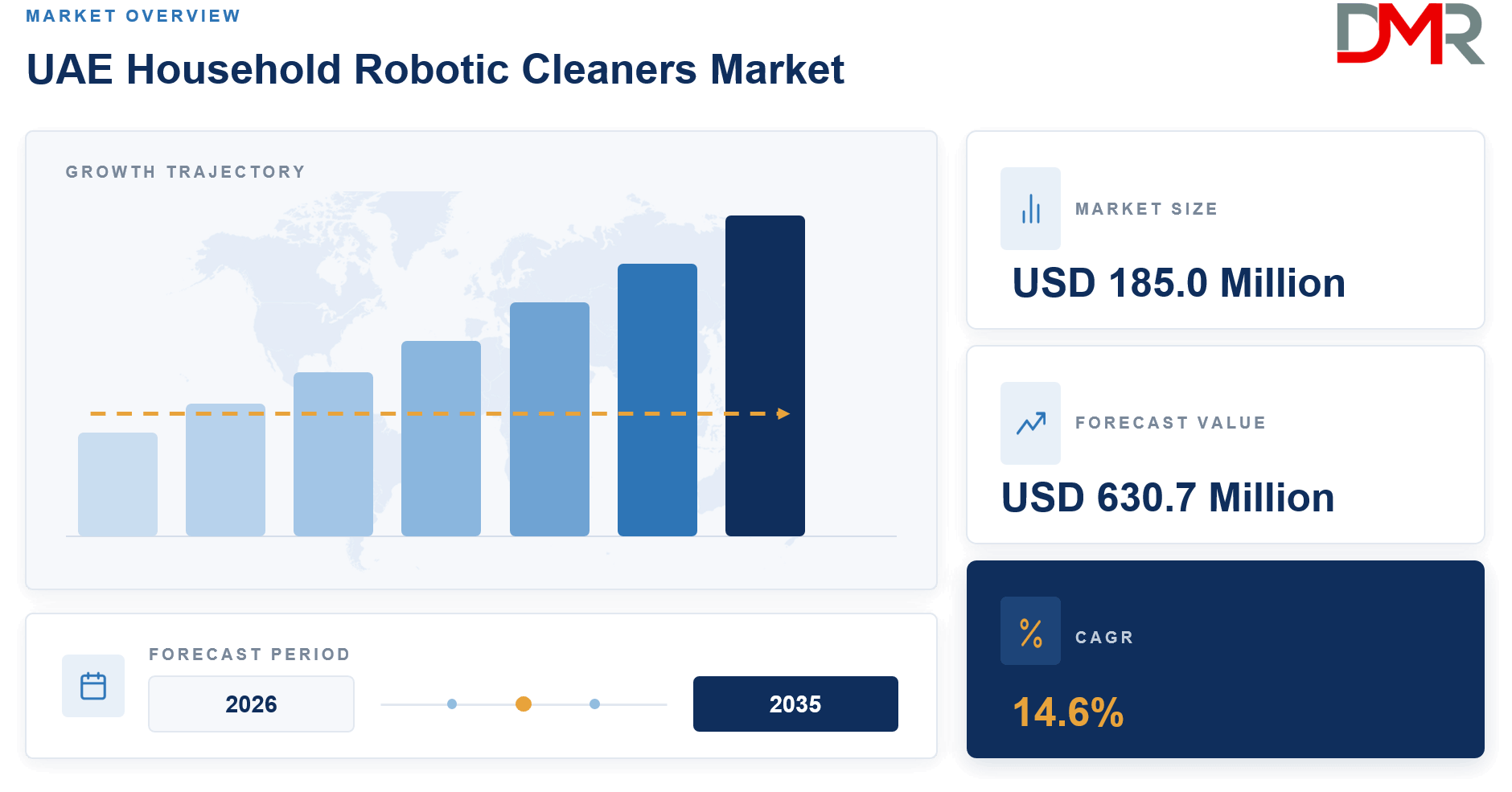
- Market Size (2026): USD 185.0 Mn
- Forecast Value (2035): USD 630.7 Mn
- CAGR (2026-2035): 14.6%
- Leading Product Type (2026): Robotic Vacuum Cleaners, approximately 71%
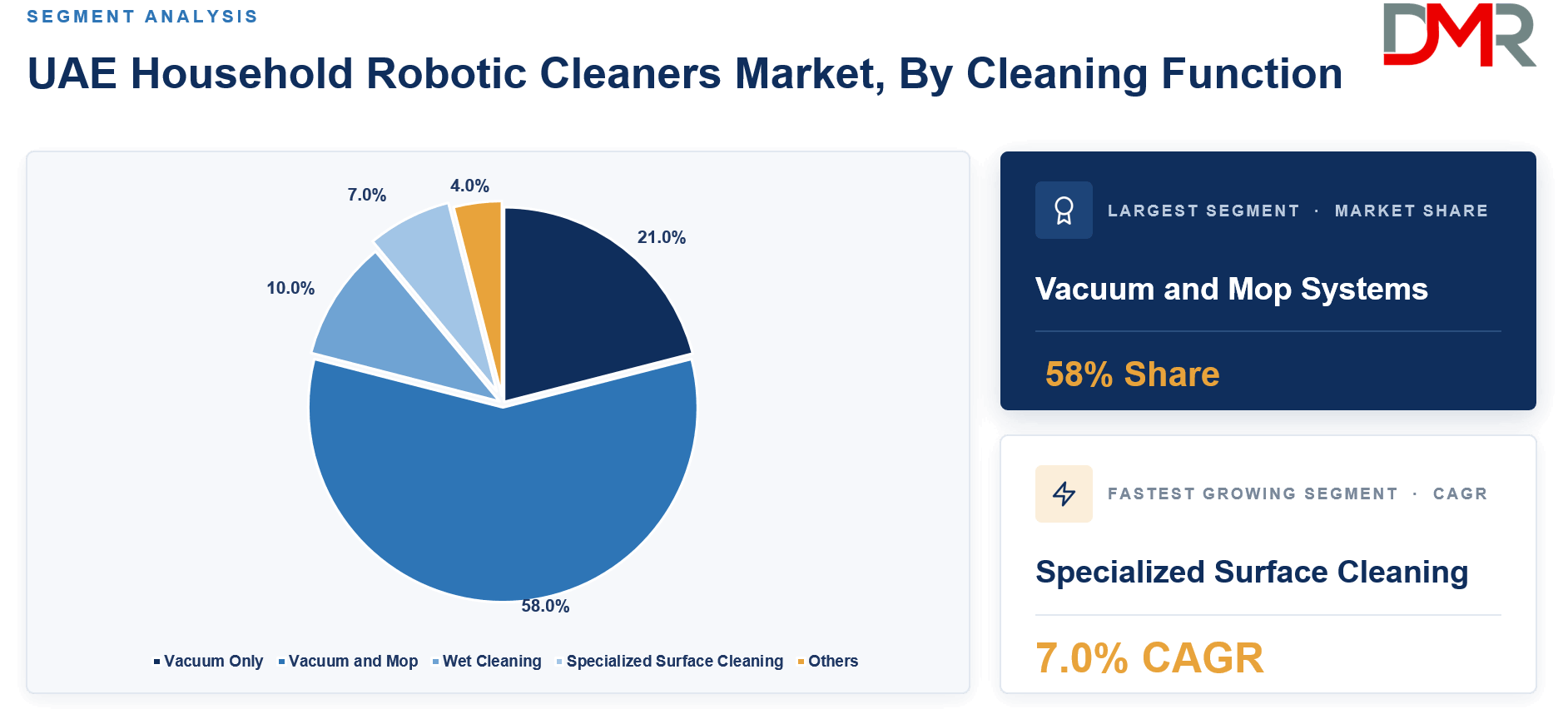
- Leading Cleaning Function (2026): Vacuum and Mop, around 58%
- Key Players: ECOVACS Robotics, Roborock, Dreame Technology and others
What is UAE Household Robotic Cleaners Market and its Market Size?
The UAE Household Robotic Cleaners Market size is estimated to reach USD 185.0 Mn in 2026 and is further anticipated to reach USD 630.7 Mn by 2035, at a CAGR of 14.6%.
ℹ
To learn more about this report –
Download Your Free Sample Report Here
Household robotic cleaners are autonomous or semi-autonomous consumer appliances that use sensors, mapping software, motors and cleaning systems to perform routine domestic cleaning with limited manual intervention. The scope covers robotic vacuum cleaners, vacuum-and-mop systems, robotic window cleaners, pool-cleaning robots and selected robotic lawn cleaners purchased for residential use. It excludes conventional corded and cordless vacuum cleaners, commercial janitorial robots and professional cleaning services.
The figures cover demand inside the UAE rather than worldwide revenue generated by companies headquartered or registered in the country. Dubai and Abu Dhabi form the deepest demand pools because of high smart-home adoption, premium apartment and villa stock, strong e-commerce penetration and a consumer base accustomed to connected appliances. Tile, marble, rugs and carpets within the same home create a practical need for multi-surface navigation and automatic cleaning-mode adjustment.
Competition is moving beyond basic suction toward self-maintaining docks, LiDAR and vision navigation, obstacle recognition, automated mop washing, hot-water cleaning, edge cleaning and app-based room control. Premium models increasingly compete on how much human intervention they remove. Entry and mid-range products remain important, however, because online discounting is reducing the price barrier and expanding robotic cleaning beyond early technology adopters.
Use Cases
- Apartment Floor Maintenance: Urban households deploy compact robot vacuum and mop systems to maintain tile, marble and carpeted rooms between deeper manual cleaning sessions. Scheduled operation reduces repetitive floor work and allows residents to manage cleaning remotely through mobile applications while preserving room-specific settings.
- Large Villa Cleaning: Villa owners use mapping robots with long battery life and automated docks to cover larger multi-room layouts. The system divides the home into zones, returns for charging or maintenance when needed and reduces the effort required to keep frequently used living areas consistently clean.
- Residential Window Cleaning: Households in apartments and villas use specialized window-cleaning robots on large glazed surfaces where repeated manual cleaning is inconvenient. Suction attachment, route planning and edge sensing allow the device to cover glass systematically while reducing the amount of hands-on wiping required.
- Private Pool Maintenance: Homeowners with residential pools deploy robotic pool cleaners to collect debris and scrub submerged surfaces without connecting a manual vacuum system. Automated cycles reduce routine maintenance time and can complement professional servicing by keeping the pool cleaner between scheduled visits.
Key Takeaways
- Market Size & Share: Mid-range products are expected to represent roughly 44% of 2026 revenue as buyers balance automation features with price.
- Product Type Analysis: Robotic vacuum cleaners lead in 2026, while robotic window cleaners are forecast to expand at 17.3% through 2035.
- Demand Concentration: Online retail is projected to account for close to 57% of 2026 sales because comparison shopping and promotional pricing are influential.
- Navigation Shift: AI vision and hybrid navigation systems are forecast to grow at 18.1% through 2035.
- Functional Momentum: Vacuum and mop systems dominate current spending, while specialized surface cleaning is projected to grow at 17.0%.
- Premiumization: Premium robotic cleaners are forecast to expand at a CAGR of 16.8% as self-maintaining docks become more common.
How AI/Gen AI is Transforming the UAE Household Robotic Cleaners Market?
AI is changing robotic cleaning mainly through perception and autonomous decision-making. Computer vision can distinguish cables, shoes, furniture legs, pet waste and other obstacles, while simultaneous localization and mapping helps a cleaner understand room geometry and plan routes. Sensor fusion combining LiDAR, cameras, ultrasonic sensing and wheel odometry improves localization across bright rooms, dark spaces and mixed floor surfaces common in UAE homes.
Generative AI has a smaller consumer-facing role but can improve natural-language control, troubleshooting and personalized cleaning routines. The more immediate commercial impact comes from machine learning that recognizes floor types, estimates dirt levels and adjusts suction, brush speed or mop behavior. Cloud-connected applications also allow software improvements after purchase, making firmware support and data privacy part of product differentiation.
- Object Recognition: Vision models classify household obstacles and alter routes before collisions or entanglement occur.
- Adaptive Cleaning: Algorithms adjust suction and mopping intensity according to detected surfaces and debris conditions.
- Mapping Intelligence: SLAM and sensor fusion build room maps, establish no-go zones and optimize repeated cleaning routes.
- Natural-Language Control: LLM-supported interfaces can translate conversational requests into room, schedule and cleaning-mode instructions.
Key Drivers in the UAE Household Robotic Cleaners Market
Adoption is being driven by smart-home behavior and by consumers assigning greater value to appliances that remove repetitive domestic tasks.
- Rising Preference for Automated Home Maintenance: Robotic vacuum cleaners are expected to account for approximately 71% of product revenue in 2026 because floor cleaning is frequent, measurable and well suited to automation. UAE households increasingly use app-controlled appliances, connected lighting, cameras and climate systems, making robotic cleaning easier to add to existing smart-home routines. Dual-income households and time-sensitive consumers also value scheduled cleaning that can operate while residents are away. As mapping quality and docking automation improve, the product shifts from a novelty purchase toward a recurring household appliance category, supporting replacement cycles and multi-device ownership.
- Expansion of E-Commerce and Premium Electronics Retail: Online retail is set to capture around 57% of 2026 sales, reflecting the importance of digital product comparison, reviews, flash promotions and direct-to-consumer brand stores. Robotic cleaners benefit from online channels because specifications such as suction power, navigation type, dock functions and battery performance can be compared easily. UAE consumers also have access to broad international brand assortments and rapid delivery. Physical electronics stores remain important for demonstrations, but e-commerce lowers discovery costs for newer Chinese brands and enables aggressive promotional pricing, widening the addressable buyer base.
Restraints in the UAE Household Robotic Cleaners Market
High acquisition cost at the premium end and uneven performance across complex home layouts remain the main brakes on faster household penetration.
- Premium Pricing and Replacement Economics: Premium models are estimated to represent nearly 31% of 2026 revenue, but their high absolute price limits unit penetration. Advanced docks, cameras, LiDAR modules, heated mop systems and high-capacity batteries add hardware cost, while proprietary consumables and replacement parts raise lifetime ownership expense. Buyers comparing a robotic cleaner with conventional vacuuming or domestic cleaning services may delay replacement when the existing device remains functional. Frequent online discounting can also train consumers to wait for promotions, creating price pressure even as manufacturers add more expensive autonomy features.
- Navigation Limitations and Maintenance Requirements: LiDAR-based navigation is projected to hold close to 49% of 2026 navigation revenue because it offers dependable mapping, yet household layouts still create failure points. Thick rugs, cables, reflective surfaces, thresholds, stairs and tightly spaced furniture can interrupt autonomous operation. Mop pads, brushes, filters and dirty-water tanks also require periodic attention, so the product is not fully maintenance-free. Consumer dissatisfaction can rise when premium claims imply complete autonomy but the robot still needs rescue or cleaning. Brands therefore need stronger onboarding, local support and clearer expectations around maintenance intervals.
Growth Opportunities in the UAE Household Robotic Cleaners Market
White space is strongest in specialized robotic cleaning and in premium systems designed around the floor materials and larger residences common across the Emirates.
- Robotic Window Cleaning for High-Glass Residences: Robotic window cleaners are forecast to grow at a CAGR of 17.3% between 2026 and 2035. Large windows, balcony glazing and villa facades create a recurring cleaning problem that floor robots cannot address. The segment remains smaller than robotic vacuuming, leaving room for brands to improve attachment security, edge detection, route coverage and cleaning-pad design. Retailers can also bundle window robots with broader smart-home cleaning portfolios. Products that demonstrate reliable operation on large panes and offer accessible local replacement parts have a clearer route to repeat demand.
- Self-Maintaining Premium Cleaning Stations: Premium robotic cleaners are forecast to expand at 16.8% through 2035 as consumers pay for lower intervention rather than suction alone. Multifunction docks can empty dust, refill clean water, wash and dry mop systems and automate routine maintenance. This fits affluent UAE households where convenience and smart-home integration carry significant value. The opportunity is especially attractive in villas and larger apartments with mixed surfaces. Manufacturers can differentiate through quieter docks, smaller footprints, hot-water washing, detergent control and longer periods between manual servicing.
Trends in the UAE Household Robotic Cleaners Market
Product development is shifting toward combined wet-and-dry cleaning, stronger obstacle intelligence and retail portfolios spanning several price tiers.
- Vacuum and Mop Becomes the Default Premium Format: Combined vacuum and mop products are expected to hold around 58% of cleaning-function revenue in 2026 because hard flooring is common in UAE residences and buyers prefer one device to perform both routine tasks. Rotating or extending mop pads, automatic lifting over carpets and dock-based washing are improving usability. The format also gives manufacturers more room to differentiate than suction-only products. Competition is increasingly centered on edge coverage, stain removal, water management and how effectively the robot transitions between marble, tile, rugs and carpet without manual configuration.
- AI Vision and Hybrid Navigation Move Down the Price Curve: AI vision and hybrid navigation are forecast to grow at a CAGR of 18.1% through 2035. Cameras combined with LiDAR or structured-light sensors allow robots to classify obstacles while retaining reliable spatial mapping. These capabilities were initially concentrated in flagship models but are moving into broader portfolios as component costs decline. In the UAE, where consumers can compare international models online, feature diffusion occurs quickly. The result is a shorter differentiation window for premium brands and greater pressure to pair navigation intelligence with stronger cleaning mechanics and software support.
Research Scope and Analysis
Segment performance is assessed across product type, cleaning function, navigation technology, price range and distribution channel. Each axis identifies where 2026 revenue is concentrated and which sub-segment is expected to expand fastest through 2035, together with the commercial reason behind that movement.
ℹ
To learn more about this report –
Download Your Free Sample Report Here
By Product Type
Robotic vacuum cleaners are projected to hold the largest product share in 2026, accounting for approximately 71% of revenue because floor cleaning offers the broadest recurring household use case and the deepest brand assortment. The installed base is also supported by strong replacement demand as users upgrade from basic robots to mapping and self-emptying systems. Growth, however, is concentrated in robotic window cleaners, expanding at a CAGR of 17.3% between 2026 and 2035. Large glazed areas in apartments and villas create an application where automation can reduce awkward manual work. Better adhesion, route planning and edge sensing are improving confidence, while specialist brands are expanding availability through UAE e-commerce channels.
By Cleaning Function
Vacuum and mop systems are expected to lead cleaning-function revenue in 2026 with around 58%, supported by the prevalence of hard floors and mixed surfaces in UAE homes. Buyers increasingly expect a single robot to vacuum rugs and carpets while mopping tile or marble, which raises the value of automatic mop lifting and surface recognition. The steeper trajectory sits with specialized surface cleaning, forecast to expand at a CAGR of 17.0% through 2035. Window, pool and other targeted robots address tasks that conventional floor robots cannot perform. Improved sensing and stronger application-specific cleaning mechanisms are making these devices more practical as second robotic-cleaning purchases.
By Navigation Technology
LiDAR-based navigation is projected to account for close to 49% of 2026 revenue because it provides accurate mapping, dependable operation in varying light and established support across mid-range and premium products. Room recognition, virtual boundaries and route planning have made LiDAR a familiar purchase criterion. Growth is stronger in AI vision and hybrid navigation, which is forecast to expand at 18.1% through 2035. Combining cameras, structured light and LiDAR allows cleaners to interpret small obstacles rather than merely map walls. As processors and sensors become less expensive, these systems are moving into lower price bands and increasing competitive pressure on navigation-only differentiation.
By Price Range
Mid-range robotic cleaners are expected to represent roughly 44% of 2026 revenue because this tier captures buyers seeking mapping, app control and credible cleaning performance without flagship pricing. Online promotions frequently bring advanced functions into the middle of the market, reinforcing value-based competition. Premium products, however, are forecast to grow at a CAGR of 16.8% through 2035. Self-emptying and self-washing docks, stronger obstacle recognition, high suction and automated water management increase willingness to trade up. Affluent households and smart-home enthusiasts form a natural customer base, while faster flagship feature cycles encourage existing robot owners to replace devices before mechanical end of life.
By Distribution Channel
Online retail is projected to hold the largest distribution share in 2026 at approximately 57%, supported by high digital shopping adoption, marketplace promotions and direct brand websites. Consumers can compare technical specifications and reviews across many imported brands, making robotic cleaners particularly suited to digital sales. Growth, however, is concentrated in brand-owned and specialist smart-home channels, forecast to expand at a CAGR of 16.2% through 2035. As products become more complex, demonstrations of mapping, obstacle avoidance and dock automation become valuable. Flagship stores and specialist retailers can also support accessories, setup and after-sales service, reducing the uncertainty associated with premium purchases.
The UAE Household Robotic Cleaners Market Report is Segmented Based on the Following
By Product Type
- Robotic Vacuum Cleaners
- Robotic Window Cleaners
- Robotic Pool Cleaners
- Robotic Lawn Cleaners
- Others
By Cleaning Function
- Vacuum Only
- Vacuum and Mop
- Wet Cleaning
- Specialized Surface Cleaning
- Others
By Navigation Technology
- LiDAR-Based Navigation
- Camera-Based Navigation
- Gyroscope and Sensor-Based Navigation
- AI Vision and Hybrid Navigation
- Others
By Price Range
- Economy
- Mid-Range
- Premium
- Ultra-Premium
- Others
By Distribution Channel
- Online Retail
- Electronics and Appliance Stores
- Hypermarkets and Department Stores
- Brand-Owned and Specialist Smart-Home Stores
- Others
Competitive Landscape
Competition is moderately fragmented because UAE consumers can access a wide set of international robotic-cleaning brands through marketplaces, electronics retailers and direct brand channels. ECOVACS, Roborock and Dreame compete aggressively in autonomous docking, navigation and combined vacuum-mop performance, while Dyson, Samsung, LG and other appliance groups bring established consumer-electronics brands and service networks. Chinese specialists have shortened product cycles and pushed flagship features into lower price bands. Competition therefore centers on obstacle recognition, mixed-surface cleaning, dock automation, suction, app quality, warranty coverage and promotional pricing. Offline flagship stores are becoming more relevant for premium demonstrations, while e-commerce remains essential for rapid assortment expansion and price comparison.
Some of the Prominent Players in the UAE Household Robotic Cleaners Market Are
- ECOVACS Robotics
- Roborock
- Dreame Technology
- Dyson
- Samsung Electronics
- LG Electronics
- Xiaomi
- iRobot Corporation
- Midea Group
- Eufy (Anker Innovations)
- Narwal Robotics
- MOVA
- SwitchBot
- ILIFE Robotics
- SharkNinja
- Panasonic
- Hitachi
- Haier
- Hisense
- TCL
- Beko
- Philips Domestic Appliances
- Kärcher
- Bosch
- Electrolux
- Tineco
- Miele
- Rowenta
- Eureka
- Lefant
- AIRROBO
- Yeedi
- Proscenic
- Mamibot
- EZVIZ
- Hobot Technology
- Moneual
- Ecovitta
- Geepas
- Black+Decker
- Other Key Players
Technology Analysis
Technology Analysis is highly relevant to the UAE Household Robotic Cleaners Market as product differentiation increasingly depends on AI navigation, LiDAR mapping, computer vision, obstacle recognition, voice integration, and automated docking systems. Consumers are shifting toward robotic cleaners capable of intelligent room mapping, multi-floor navigation, app-based scheduling, and combined vacuuming and mopping. Opportunities are emerging for advanced models adapted to large villas, tiled surfaces, carpets, pet hair, and smart home ecosystems. However, high development costs, software reliability issues, cybersecurity concerns, and rapid product obsolescence create risks. Continued innovation will strengthen premiumization, improve cleaning efficiency, and accelerate replacement demand across UAE households.
Export Import Analysis
Export Import Analysis is highly relevant because the UAE Household Robotic Cleaners Market depends heavily on imported products from major manufacturing hubs, particularly China, South Korea, Europe, and other Asian markets. Import trends influence product availability, brand competition, retail pricing, technology access, and distributor margins. Opportunities arise from the UAE’s strong logistics infrastructure, re-export capabilities, expanding e-commerce channels, and demand for international smart appliance brands. However, currency fluctuations, freight costs, geopolitical disruptions, customs requirements, and supply chain concentration can affect landed costs and inventory availability. Growing import volumes are expected to intensify competition while encouraging distributors to expand portfolios across premium, mid-range, and value-oriented robotic cleaner categories.
Recent Developments
- In August 2026, Roborock introduced the Saros 20 across the UAE and Saudi Arabia, targeting larger Gulf homes with improved threshold crossing, carpet cleaning and intelligent navigation.
- In July 2026, Dreame launched the X60 Ultra Complete in the UAE, extending premium competition around low-profile design, AI object recognition, high suction and multifunction dock automation.
- In July 2026, Roborock launched the Qrevo S Pro for UAE consumers, adding another self-maintaining vacuum-and-mop system positioned below the highest-priced flagship tier.
Report Details
| Report Characteristics |
| Market Size (2026) |
USD 185.0 Mn |
| Forecast Value (2035) |
USD 630.7 Mn |
| CAGR (2026-2035) |
14.6% |
| Historical Data |
2021 - 2025 |
| Forecast Data |
2026 - 2035 |
| Base Year |
2025 |
| Segments Covered |
By Product Type, By Cleaning Function, By Navigation Technology, By Price Range and By Distribution Channel |
| Regional Coverage |
The UAE |
Frequently Asked Questions
How big is the UAE Household Robotic Cleaners Market?
▾ Domestic revenue is estimated at USD 185.0 Mn in 2026. The scope includes residential robotic vacuum, mopping, window, pool and selected lawn-cleaning systems sold inside the Emirates. Floor-cleaning robots form the core of demand, while premium multifunction docks and specialized robots are broadening household spending beyond basic autonomous vacuuming.
What is the growth rate of the UAE Household Robotic Cleaners Market?
▾ The industry is forecast to expand at a CAGR of 14.6% from 2026 to 2035. Growth is supported by smart-home adoption, high digital retail penetration, premium household spending and faster diffusion of AI navigation and self-maintaining docks. Specialized window and surface-cleaning robots are expected to add incremental demand beyond the core floor-cleaning category.
What is driving demand in the UAE Household Robotic Cleaners Market?
▾ Demand is being driven by consumers seeking automated maintenance for apartments and villas, combined with strong access to international smart-home brands. Mixed floor surfaces make vacuum-and-mop functionality particularly relevant, while online retail reduces discovery and comparison costs. Higher autonomy through self-emptying, mop washing and obstacle recognition is also improving the value proposition for repeat buyers.
Who are the key players in the UAE Household Robotic Cleaners Market?
▾ Key participants include ECOVACS Robotics, Roborock, Dreame Technology, Dyson, Samsung Electronics, LG Electronics and Xiaomi. The competitive set also includes specialist robotic-cleaning brands and diversified appliance manufacturers. Product cycles are relatively short, so local availability, warranty support, software quality and promotional pricing can materially affect brand performance alongside cleaning specifications.
Which product type holds the largest share?
▾ Robotic vacuum cleaners are expected to account for approximately 71% of product-type revenue in 2026. Their lead reflects broad applicability across apartments and villas, established consumer awareness and a large range of price points. Increasingly, the category includes combined vacuum-and-mop devices with self-emptying or self-washing docks rather than simple suction-only robots.
Which navigation technology is growing fastest?
▾ AI vision and hybrid navigation are forecast to expand at a CAGR of 18.1% from 2026 to 2035. These systems combine mapping with object interpretation, helping robots recognize small household obstacles and adapt routes. Falling sensor and processor costs are allowing capabilities once limited to flagship products to appear in a broader range of models.
What technologies are shaping the UAE Household Robotic Cleaners Market?
▾ The UAE Household Robotic Cleaners Market is increasingly shaped by LiDAR, SLAM, computer vision, structured-light sensing, AI object recognition, automated mop lifting, self-emptying docks, hot-water mop washing and app-based room controls. The strongest product differentiation is moving toward lower manual maintenance and more reliable navigation across mixed floor surfaces rather than suction power alone.