Market Snapshot
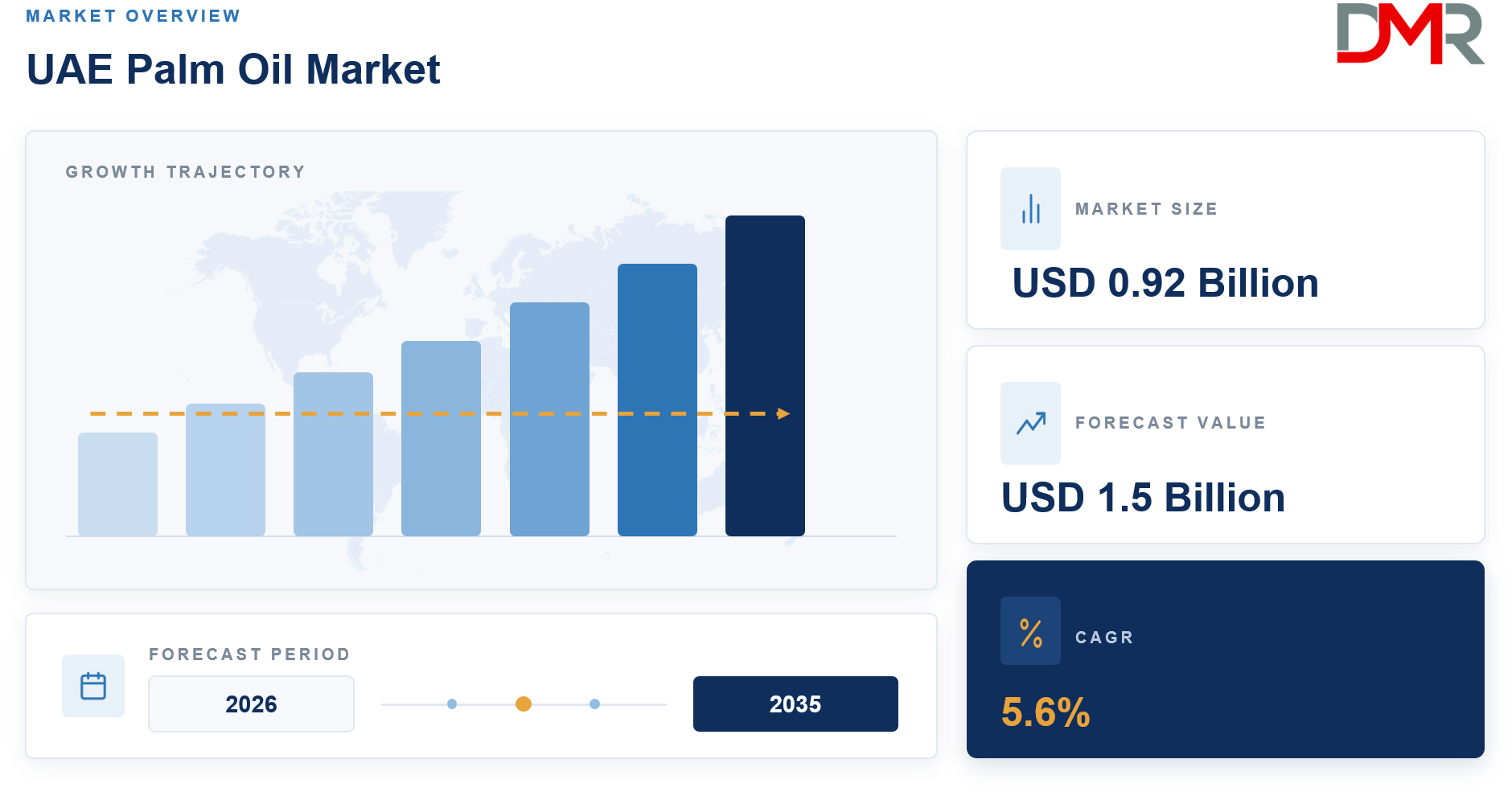
- Market Size (2026): USD 0.92 Bn
- Forecast Value (2035): USD 1.5 Bn
- CAGR (2026-2035): 5.6%
- Leading Product (2026): RBD Palm Oil, approximately 46%
- Leading Application (2026): Food Processing, around 61%
- Leading End Use Industry (2026): Food & Beverages, close to 66%
- Key Players: IFFCO Group, United Foods Company, Wilmar International and others
What is UAE Palm Oil Market and its Market Size?
The UAE Palm Oil Market size is estimated to reach USD 0.92 Bn in 2026 and is further anticipated to reach USD 1.5 Bn by 2035, at a CAGR of 5.6%.
ℹ
To learn more about this report –
Download Your Free Sample Report Here
The market covers palm-derived oils and fractions sold into the United Arab Emirates for food manufacturing, foodservice, retail cooking, personal care, industrial formulations and selected oleochemical uses. The boundary is based on demand inside the UAE, including imported palm oil that is refined, fractionated, blended, packed or distributed locally. It does not represent worldwide revenue of companies headquartered in the country.
Palm oil is valued by UAE buyers for its functional consistency, frying stability, neutral taste after refining, versatility across formulations and competitive economics compared with several alternative vegetable oils. RBD palm oil and palm olein are especially relevant to processors that require predictable performance in frying, bakery, confectionery, instant foods and prepared meals. Palm stearin and specialty fractions serve more specific formulation requirements, while palm kernel oil participates in selected food and personal-care applications.
Demand is shaped by the UAE's large foodservice ecosystem, a sizeable imported-food base, hospitality activity and its role as a distribution hub for the wider Gulf. Import dependence makes procurement strategy important because landed costs are influenced by crude palm oil prices, freight, currency movements, origin mix and refining economics. Buyers increasingly evaluate traceability, certification, packaging efficiency and supplier reliability alongside headline price.
The market is therefore moving from simple commodity purchasing toward differentiated sourcing. Large food manufacturers favor contracted supply and technical specifications, while distributors and smaller processors need flexible pack sizes and shorter replenishment cycles. Sustainability documentation, food-safety compliance and formulation support are becoming more visible purchasing criteria, particularly for multinational food companies and premium consumer brands operating in the UAE.
Use Cases
- Industrial Frying: Large food manufacturers use palm olein in continuous frying systems for snacks, frozen foods and prepared products. Procurement teams prioritize oxidative stability, repeatable performance and predictable replenishment, allowing production lines to reduce oil-management variability and maintain consistent finished-product quality.
- Bakery and Confectionery: Bakeries and confectionery producers use palm fractions where controlled melting behavior, texture and shelf stability are required. Formulation teams select fractions according to product structure, temperature tolerance and mouthfeel, supporting consistent biscuits, fillings, shortenings and coated products without relying on a single oil specification.
- Foodservice Operations: Hotels, restaurant groups, caterers and central kitchens purchase palm-based frying oils when high-volume cooking requires stable performance and manageable operating cost. Bulk delivery and standardized oil specifications simplify purchasing across multiple kitchens and help operators maintain consistent cooking practices.
- Personal Care Formulation: Cosmetic and home-care manufacturers use palm-derived fractions and palm kernel derivatives in selected formulations where emolliency, cleansing performance or functional lipid properties are required. Buyers increasingly combine technical requirements with supplier documentation on origin, traceability and responsible sourcing.
Key Takeaways
- Market Size & Share: UAE Palm Oil Market is estimated at USD 0.92 Bn in 2026 and is projected to reach USD 1.5 Bn by 2035.
- Product Analysis: RBD Palm Oil is expected to account for approximately 46% of 2026 revenue, supported by broad food and industrial usability.
- Demand Concentration: Food & Beverages is projected to represent close to 66% of 2026 demand, reflecting the depth of the UAE food-processing and foodservice base.
- Supply Structure: Direct B2B Supply is expected to hold around 58% of 2026 distribution, reflecting large-volume contracts and technical specifications.
- Growth Opportunity: Specialty Palm Fractions are forecast to expand at a CAGR of 7.4% from 2026 to 2035 as formulators seek differentiated melting and functional properties.
- Channel Shift: Modern Retail & E-commerce is forecast to grow at a CAGR of 6.8% as branded and packaged cooking-oil purchases become more searchable and promotion-driven.
How AI/Gen AI is Transforming the UAE Palm Oil Market?
Artificial intelligence is entering palm oil operations mainly through procurement, quality control, inventory planning and demand sensing rather than through direct replacement of physical processing. UAE importers and refiners can combine historical purchase data, commodity prices, freight information, customer orders and warehouse levels to identify replenishment risks before they become costly stockouts or excess inventory.
Generative AI also has a practical role in documentation-heavy workflows. Procurement teams can use large language models to summarize supplier specifications, compare certificates, organize tender responses and flag missing compliance documents, while machine-learning models can improve demand forecasts by customer, pack size and application. These systems are most valuable when connected to validated enterprise data and human approval processes.
- Demand Forecasting: Machine-learning models combine sales history, promotions and customer orders to improve short-term replenishment planning.
- Document Processing: LLM-based document processing can classify certificates, specifications, invoices and supplier declarations for faster review.
- Quality Analytics: Computer vision and statistical models can support packaging inspection and detect visible defects in high-throughput filling operations.
- Supply Planning: Optimization algorithms can compare inventory, lead times and purchase commitments to recommend more resilient sourcing schedules.
Key Drivers in the UAE Palm Oil Market
Two forces are shaping demand most directly: the scale of food production and foodservice consumption, and the economic advantages of palm-based formulations.
- Expansion of Processed Food and Foodservice Demand: Food processing is projected to hold approximately 61% of 2026 application demand because palm oil can support frying, bakery, confectionery and prepared-food formulations across multiple production formats. Growth in hospitality, catering and convenience-oriented food consumption broadens the number of commercial kitchens and processors requiring consistent edible-oil supply. For buyers, the mechanism is straightforward: higher production throughput creates recurring oil consumption, while standardized formulations encourage repeat procurement from suppliers able to provide stable specifications and reliable delivery.
- Cost and Functional Performance of Palm Fractions: RBD palm oil is expected to represent around 46% of 2026 product demand because refining and fractionation provide processors with oils suited to distinct thermal and texture requirements. Palm olein supports frying, while stearin and specialty fractions can be selected for structured fats and formulation control. This versatility reduces the need for multiple raw-material systems in some applications, improving purchasing efficiency and helping manufacturers manage formulation cost when alternative oil prices become less attractive.
Restraints in the UAE Palm Oil Market
Supply exposure, sustainability scrutiny and commodity-price volatility are the main brakes on market expansion.
- Import and Commodity Price Exposure: UAE demand depends heavily on international supply chains, leaving buyers exposed to changes in crude palm oil prices, freight rates, origin availability and currency conditions. Direct B2B supply accounts for approximately 58% of 2026 distribution because larger buyers can negotiate contracts and logistics, but smaller processors may have less protection against sudden landed-cost changes. Working-capital requirements also rise when buyers hold additional inventory to protect production schedules.
- Sourcing, Sustainability and Compliance Requirements: Food manufacturers increasingly require traceability, food-safety documentation and responsible-sourcing evidence from suppliers. Specialty palm fractions are expected to grow at a CAGR of 7.4% through 2035, but suppliers must support this growth with consistent specifications and documentation. Companies that cannot provide clear origin information, quality records or recognized sustainability credentials can face longer qualification cycles and reduced access to multinational procurement programs.
Growth Opportunities in the UAE Palm Oil Market
The strongest opportunities sit in value-added fractions, foodservice supply models and higher-service distribution.
- Specialty Fractions for Formulation: Specialty palm fractions offer a route beyond commodity pricing by addressing specific melting, texture and stability requirements. Their forecast CAGR of 7.4% exceeds the headline market rate, creating room for suppliers that combine technical support with consistent fraction quality. Food, confectionery, bakery and personal-care formulators are natural targets.
- Contract Supply for Foodservice: Central kitchens, hotel groups and large restaurant operators can benefit from scheduled deliveries, standardized specifications and used-oil collection partnerships. Suppliers that integrate bulk supply with inventory planning can compete on total operating cost rather than price per kilogram alone.
- Traceable and Certified Product Lines: Sustainability documentation can become a commercial differentiator where multinational food companies impose supplier standards. Traceable sourcing, digital documentation and clear chain-of-custody records can help UAE distributors qualify for higher-value accounts and reduce procurement friction.
- Private Label and Smaller Pack Formats: Modern Retail & E-commerce is projected to grow at a CAGR of 6.8%, creating opportunities for branded palm olein and blended cooking-oil products positioned around cooking performance, value and transparent sourcing.
Trends in the UAE Palm Oil Market
The market is shifting toward more differentiated purchasing. Buyers are comparing not only oil grade and price, but also consistency, packaging, delivery reliability, traceability and supplier responsiveness.
Another trend is the expansion of fraction-specific solutions. Instead of treating palm oil as one commodity, processors are increasingly matching palm olein, stearin, palm kernel oil and specialty fractions to individual formulation needs. This encourages suppliers to provide technical data and formulation guidance alongside physical product.
Channel structures are also becoming more segmented. Large manufacturers continue to favor direct contracts, while smaller businesses depend on distributors that can supply flexible volumes and mixed product portfolios. Digital ordering can improve visibility for smaller buyers without eliminating the role of local wholesalers.
Finally, sustainability is moving from a corporate reporting topic toward procurement screening. The commercial effect is strongest where suppliers serve multinational manufacturers, exporters and consumer brands that require traceable sourcing and documented supplier controls.
Research Scope and Analysis
Segment performance is assessed across product, form, application, end use industry and distribution channel. Each axis identifies the sub-segment carrying the largest share of 2026 revenue and the one expanding fastest through 2035, with the commercial reason behind each position.
ℹ
To learn more about this report –
Download Your Free Sample Report Here
By Product
Refined, Bleached and Deodorized (RBD) Palm Oil is projected to hold the largest share by product in 2026, accounting for approximately 46% of revenue, because RBD specifications fit the broadest set of commercial food and industrial applications and are widely traded in standardized grades. Growth, however, is concentrated in Palm Olein, expanding at a CAGR of 7.1% between 2026 and 2035 as formulators seek tighter control over melting behavior, texture and application performance.
By Form
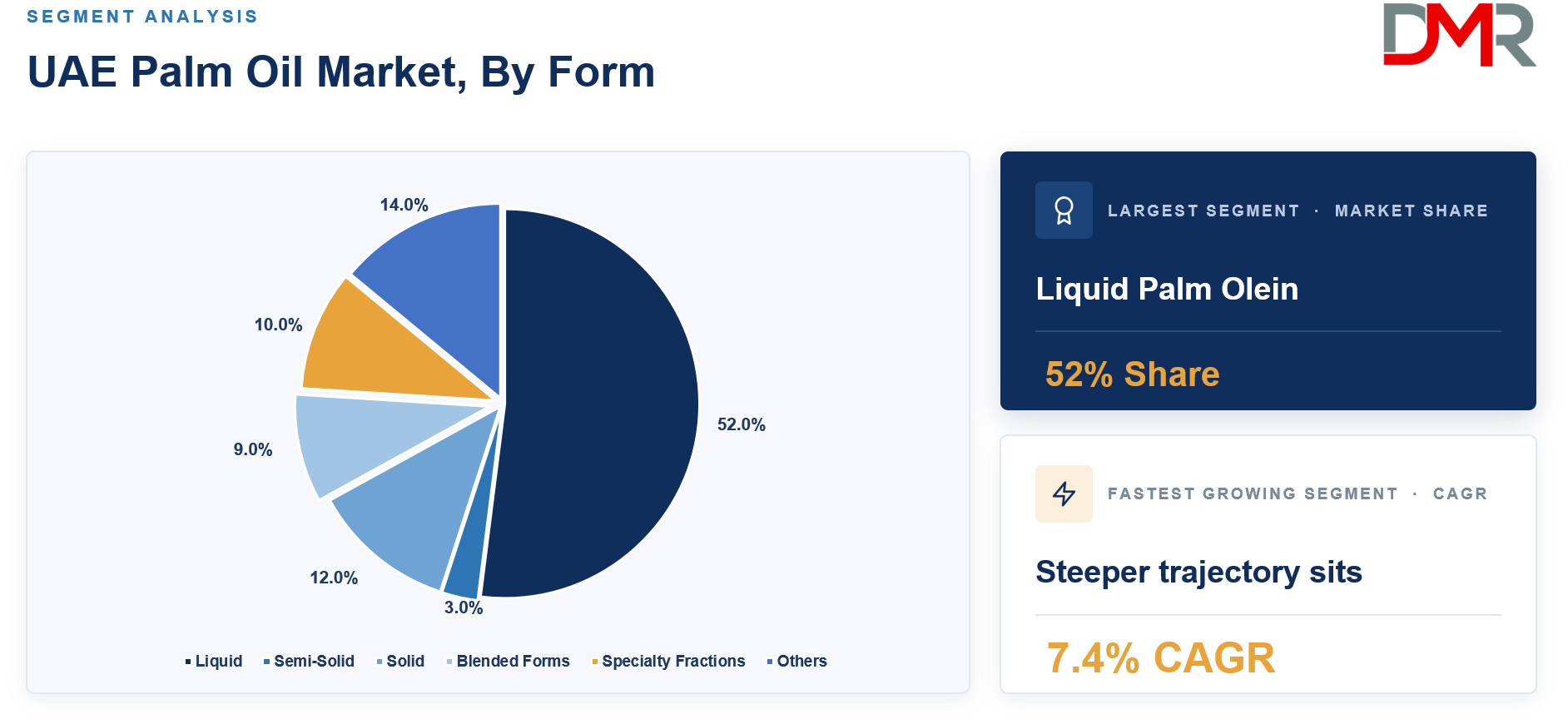
Liquid Palm Olein is expected to lead by form in 2026, representing around 52% of revenue because liquid oils move efficiently through bulk storage, frying systems and packaged cooking applications. The steeper trajectory sits with Specialty Palm Fractions, which is forecast to expand at a CAGR of 7.4% as specialty food and non-food formulators demand more precise functional characteristics.
By Application
Food Processing is projected to account for close to 61% of 2026 application revenue, supported by recurring consumption in frying, bakery, confectionery and prepared foods. Growth, however, is concentrated in Personal Care & Cosmetics, advancing at a CAGR of 7.0% as UAE manufacturers and brand owners broaden personal-care formulations and seek renewable lipid-based ingredients with consistent specifications.
By End Use Industry
Food & Beverages is expected to command approximately 66% of 2026 end-use demand because food and beverage manufacturing, hospitality and retail cooking create a broad recurring consumption base. The faster path belongs to Foodservice, growing at a CAGR of 6.9% as centralized kitchens, catering operators and hotel groups professionalize procurement and consolidate oil specifications across multiple locations.
By Distribution Channel
Direct B2B Supply is forecast to hold around 58% of 2026 distribution revenue because large processors prefer contracted supply, predictable specifications and direct logistics coordination. Growth, however, is concentrated in Modern Retail & E-commerce, expanding at a CAGR of 6.8% as packaged products become easier to discover online and smaller buyers adopt digital replenishment for repeat purchases.
The UAE Palm Oil Market Report is Segmented Based on the Following
By Product
- RBD Palm Oil
- Palm Olein
- Palm Stearin
- Crude Palm Oil
- Palm Kernel Oil
- Specialty Palm Fractions
- Others
By Form
- Liquid
- Semi-Solid
- Solid
- Blended Forms
- Specialty Fractions
- Others
By Application
- Food Processing
- Foodservice
- Bakery & Confectionery
- Personal Care & Cosmetics
- Industrial Uses
- Animal Feed
- Others
By End Use Industry
- Food & Beverages
- Hospitality & Restaurants
- Retail Cooking Oils
- Personal Care
- Oleochemicals
- Other Industrial Users
- Others
By Distribution Channel
- Direct B2B Supply
- Distributors & Wholesalers
- Modern Retail
- Traditional Retail
- Foodservice Suppliers
- E-commerce
- Others
Competitive Landscape
Competition is shaped by access to imported feedstock, refining and fractionation capability, quality consistency, logistics reach and the ability to meet buyer documentation requirements. Larger integrated suppliers can manage procurement and inventory across several markets, while UAE specialists compete through local relationships, faster delivery and tailored pack or formulation support. Commodity pricing remains important, but long-term accounts increasingly reward reliability and specification control.
Some of the Prominent Players in the UAE Palm Oil Market Are,
- Wilmar International
- Cargill
- ADM
- Bunge
- Olam Agri
- Louis Dreyfus Company
- Sime Darby Oils
- IOI Corporation
- Kuala Lumpur Kepong (KLK)
- Musim Mas
- Golden Agri-Resources
- First Resources
- Apical
- Mewah International
- AAK
- Fuji Oil Holdings
- Intercontinental Specialty Fats
- AA Middle East FZE
- ICC Oils and Fats FZE
- KLK Alami Edible Oils
- FELDA IFFCO
- United Foods Company
- Savola Group
- IFFCO Group
- Hayel Saeed Anam Group
- Emirates Refining Company
- Abu Dhabi Vegetable Oil Company (ADVOC)
- Al Ghurair Foods
- Sharjah Vegetable Oil Company
- Gulf Processing Industries
- Star Shell General Trading
- Ethraa General Trading
- Safitex General Trading
- AAA Oils and Fats
- NutriDor Dairy Manufacturing
- Al Dahra
- Truebell
- Transmed
- Bidfood Middle East
- Chef Middle East
- Other Key Players
Recent Developments
- In March 2026, KLK Alami Edible Oils featured a portfolio of palm-oil-related products at Gulfood, highlighting applications across cooking, pastry and confectionery. The activity reinforces Dubai's role as a commercial meeting point for palm-based edible-oil suppliers and regional buyers.
- In July 2026, UAE trade data tracking showed a broad active supplier and buyer network for palm oil and vegetable cooking oil, indicating continued sourcing activity across importers, distributors and overseas suppliers. This supports the market's reliance on diversified procurement routes rather than a single channel.
Report Details
| Report Characteristics |
| Market Size (2026) |
USD 0.92 Bn |
| Forecast Value (2035) |
USD 1.5 Bn |
| CAGR (2026-2035) |
5.6% |
| Historical Data |
2021 - 2025 |
| Forecast Data |
2026 - 2035 |
| Base Year |
2025 |
| Segments Covered |
By Product, By Form, By Application, By End Use Industry, By Distribution Channel |
| Regional Coverage |
The UAE |
Frequently Asked Questions
How big is the UAE Palm Oil Market?
▾ The UAE Palm Oil Market is estimated to reach USD 0.92 Bn in 2026. Demand is supported by food processing, foodservice, retail cooking and selected personal-care applications. The market includes palm-derived oils and fractions consumed within the UAE, covering imported feedstock and locally refined, fractionated, blended, packed or distributed products.
What is the growth rate of the UAE Palm Oil Market?
▾ The UAE Palm Oil Market is expected to grow at a CAGR of 5.6% during 2026-2035, reaching USD 1.5 Bn by 2035. Expansion is tied to recurring food and foodservice demand, broader use of functional palm fractions and continued investment in local refining, packaging and distribution capabilities.
What is driving demand in the UAE Palm Oil Market?
▾ Demand is primarily driven by food and beverage production, commercial frying, bakery and confectionery manufacturing, hospitality and foodservice activity. Buyers also value palm oil for functional consistency and the ability to source different fractions for different formulations, while the UAE's trading infrastructure supports efficient import and regional distribution.
Who are the key players in the UAE Palm Oil Market?
▾ Key participants include IFFCO Group, United Foods Company, Wilmar International, Cargill, ADM, Bunge and Emirates Refining Company, alongside regional distributors and specialty suppliers. Competition centers on feedstock access, refining capability, product consistency, logistics coverage, technical support and supplier documentation.
Which product segment leads the UAE Palm Oil Market?
▾ RBD Palm Oil is expected to remain the leading product segment in 2026, accounting for approximately 46% of market revenue. Its position reflects broad use in food manufacturing, frying and formulated products, as well as standardized specifications that simplify procurement for large commercial buyers.
Which application is growing fastest in the UAE Palm Oil Market?
▾ Personal Care & Cosmetics is projected to be the faster-growing application, with a CAGR of 7.0% from 2026 to 2035. Growth is supported by demand for functional lipid ingredients and the use of palm-derived fractions in selected cosmetic and personal-care formulations.
What is the outlook for the UAE Palm Oil Market through 2035?
▾ The outlook is moderately positive, with the market projected to reach USD 1.5 Bn by 2035. Growth will depend on food and foodservice consumption, commodity-price conditions, sourcing requirements and the ability of suppliers to provide reliable, traceable products. Specialty fractions and digital distribution offer additional upside.