Market Snapshot
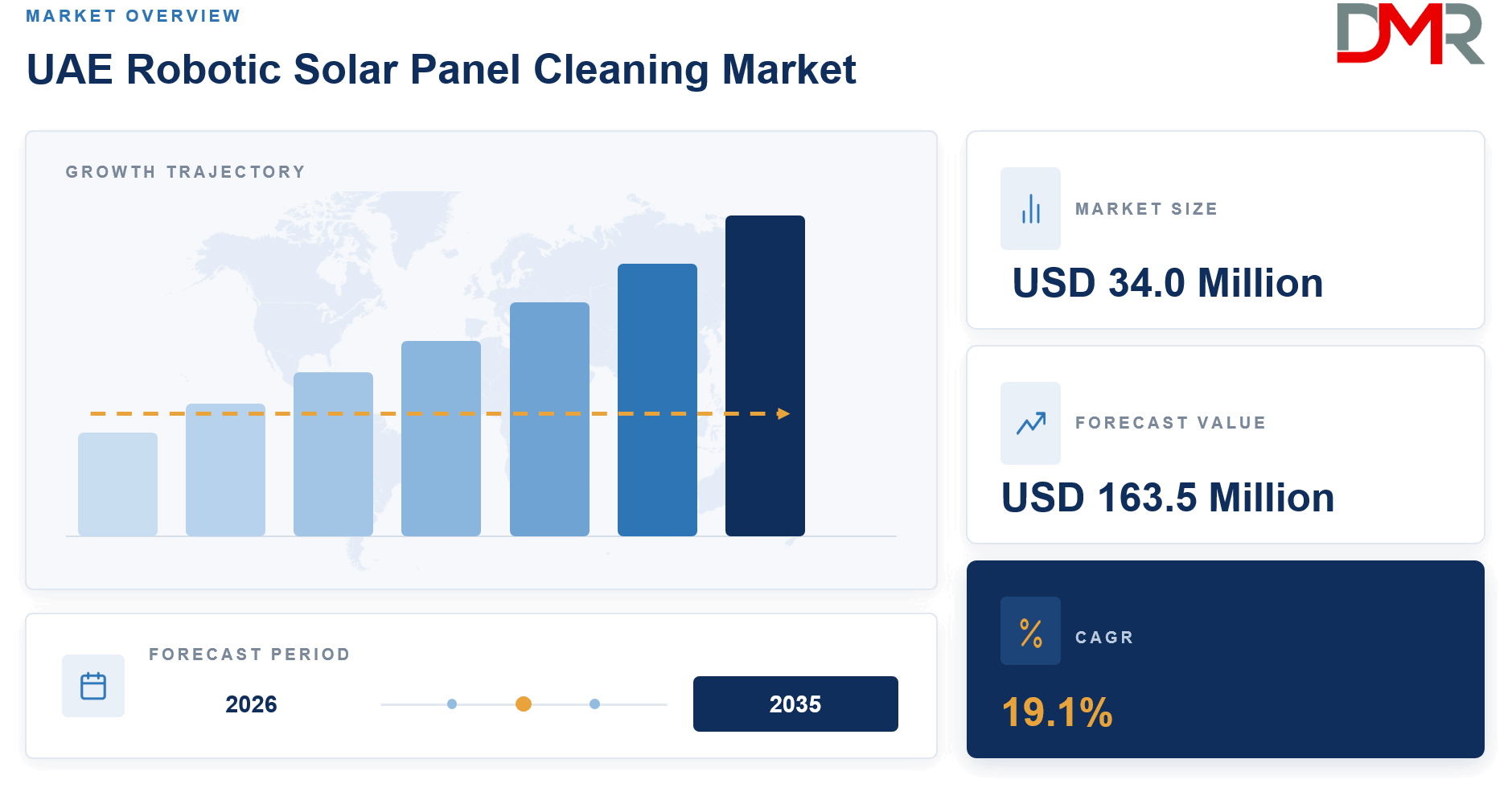
- Market Size (2026): USD 34.0 Mn
- Forecast Value (2035): USD 163.5 Mn
- CAGR (2026-2035):19.1%
- Leading Cleaning Mode (2026): Water-Free Dry, approximately 52%
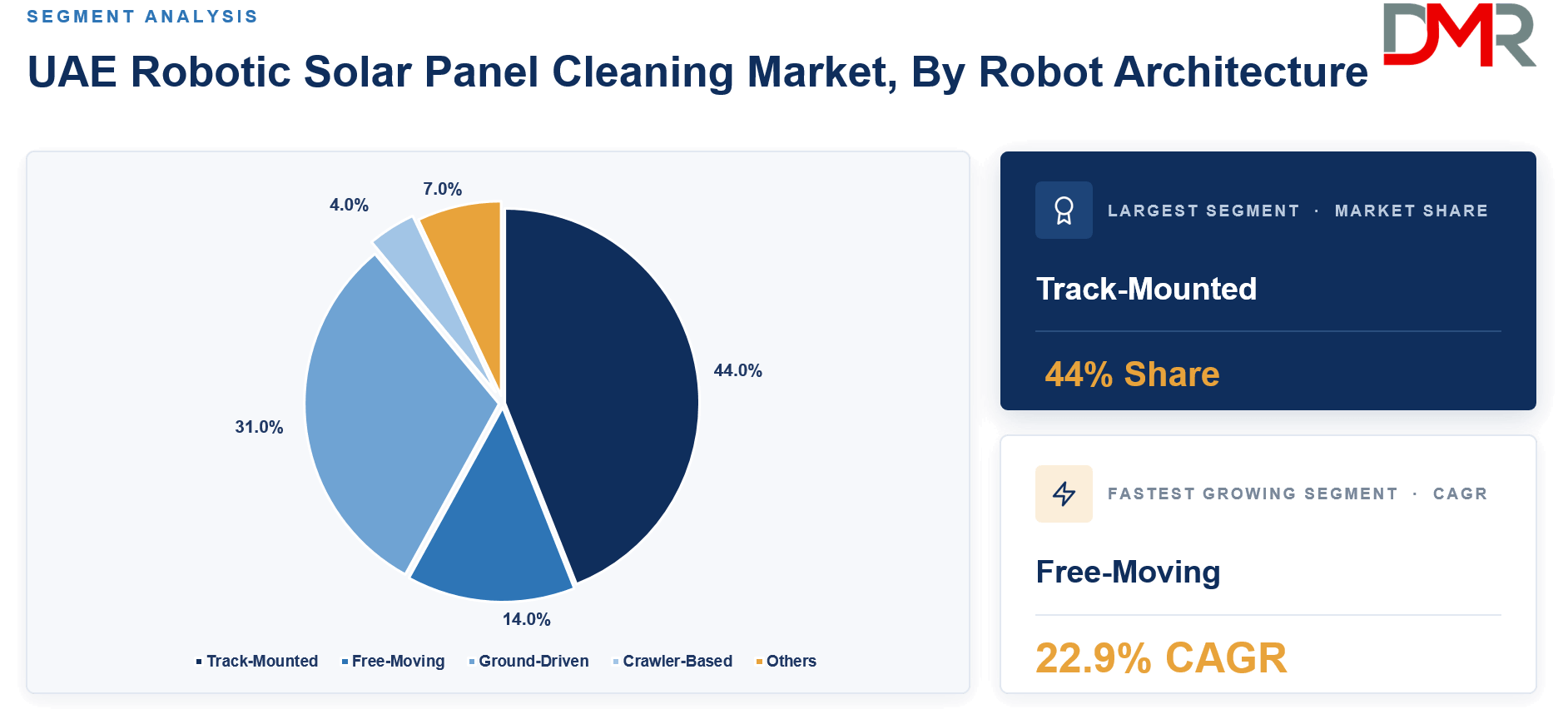
- Leading Robot Architecture (2026): Track-Mounted, around 44%
- Key Players: Masdar, Dubai Electricity & Water Authority, Liwal, and others
What is UAE Robotic Solar Panel Cleaning Market and its Market Size?
The UAE Robotic Solar Panel Cleaning Market size is estimated to reach USD 34.0 Mn in 2026 and is further anticipated to reach USD 163.5 Mn by 2035, at a CAGR of 19.1%.
ℹ
To learn more about this report –
Download Your Free Sample Report Here
The market covers autonomous and semi-autonomous machines used to remove dust, sand, residue and other soiling from photovoltaic modules installed inside the United Arab Emirates. It includes robot hardware, control systems, docking equipment, brushes, mobility mechanisms, remote monitoring and associated deployment services. Manual cleaning crews, conventional truck-mounted washing systems and general solar O&M expenditure are outside the core market boundary unless robotic cleaning is the purchased service.
UAE demand is shaped by a difficult operating environment. Solar arrays face airborne dust, sand deposition, high temperatures, humidity and limited rainfall, while large projects create long cleaning routes that are expensive to service repeatedly with personnel and water-based equipment. Robotic systems allow operators to schedule cleaning around generation cycles, reduce dependence on site labour and, in water-free configurations, avoid much of the logistics associated with transporting and handling cleaning water.
Utility developers and power producers form the commercial centre of demand, but commercial rooftops, industrial estates, oil and gas facilities and public infrastructure are widening the buyer base. Large photovoltaic parks favour fixed or guided machines because repeated coverage can be automated across thousands or millions of modules. Smaller distributed sites increasingly favour lighter free-moving platforms that can be deployed without dedicated rails.
The technology is also shifting from simple mechanical cleaning toward connected asset management. Sensors, remote diagnostics, weather inputs, soiling measurement and machine learning can determine when cleaning is economically justified rather than treating every panel row identically. This changes the value proposition from a cleaning machine to a recurring productivity system linked to photovoltaic performance.
Use Cases
- Utility Solar Parks: Independent power producers deploy robotic cleaners across large photovoltaic fields where repeated manual access would require extensive labour and vehicle movement. Automated schedules maintain module availability between generation cycles, while water-free operation reduces dependence on tanker deliveries and limits the operational burden of water handling.
- Industrial Rooftops: Facility energy managers use compact robotic systems on manufacturing and logistics roofs where access windows are constrained by plant operations. Automated cleaning reduces the need to bring workers onto elevated surfaces, allowing maintenance teams to focus on electrical faults, inspections and other higher-value tasks.
- Oil and Gas Sites: Energy operators deploy robotic cleaning around remote photovoltaic assets supporting field facilities, where dust accumulation can interact with already demanding maintenance conditions. Machines that operate with limited human intervention reduce repeated travel requirements and help standardise cleaning routines across dispersed installations.
- Municipal Infrastructure: Public-sector asset owners use robotic cleaning for solar installations on parking structures, service buildings and other municipal facilities. Automated operation makes cleaning more predictable across geographically separated assets and can support sustainability targets without adding a large permanent cleaning workforce.
Key Takeaways
- Market Size & Share: The domestic market is estimated at USD 34.0 Mn in 2026 and is projected to reach USD 163.5 Mn by 2035 at a CAGR of 19.1%.
- Cleaning Mode Analysis: Water-Free Dry systems are expected to hold approximately 52% of 2026 revenue because large solar parks prioritise low water consumption and repeatable automated operation.
- Demand Concentration: Utility-scale deployments are expected to account for nearly 61% of 2026 demand as large photovoltaic assets provide the strongest economic case for automation.
- Automation Economics: Commercial rooftop systems are forecast to expand at a CAGR of 24.1% through 2035 as smaller buyers adopt lower-infrastructure robots and service-based purchasing.
- Desert Operating Conditions: Track-mounted systems are projected to represent around 44% of 2026 robot architecture revenue because fixed array geometry supports repeatable machine paths.
- Industrial Expansion: Oil and gas installations are anticipated to grow at a CAGR of 23.5% as remote energy assets seek lower recurring maintenance requirements.
How AI/Gen AI is Transforming the UAE Robotic Solar Panel Cleaning Market?
Artificial intelligence is moving robotic cleaning from fixed schedules toward condition-based operation. Computer vision can classify surface contamination, edge conditions and obstacles, while sensor fusion combines dust measurements, panel output and weather signals to decide whether a cleaning cycle should run. Machine learning can also compare site-level production against expected output to identify soiling-related performance loss.
Generative AI has a narrower but useful role. Large language models can convert maintenance logs, alerts and inspection notes into structured work orders, while retrieval-based systems can help operators query equipment histories and service procedures. The larger operational change still comes from conventional AI, telemetry and autonomous navigation rather than conversational interfaces.
- Computer Vision: Detects dust patterns, obstacles and module-edge conditions to improve navigation and cleaning decisions.
- Predictive Analytics: Correlates soiling, weather and power-output data to prioritise cleaning when lost generation justifies intervention.
- Digital Twins: Model robotic routes, array geometry and maintenance schedules before equipment is deployed across large sites.
- LLM Document Processing: Converts maintenance reports, alerts and inspection records into searchable operational summaries and structured tasks.
Key Drivers in the UAE Robotic Solar Panel Cleaning Market
Two demand forces are particularly strong: expanding photovoltaic capacity and the operating economics of cleaning under desert conditions.
- Expansion of Large Photovoltaic Assets: New solar capacity increases the number of module surfaces that require recurring maintenance, creating a larger addressable installed base for robotic cleaning. Large projects also spread fixed automation costs over extensive arrays, improving the business case compared with manual labour. Utility-scale deployments are expected to represent nearly 61% of domestic demand in 2026 because operators can standardise routes, charging points and control software across large sites. As new solar projects use bifacial modules, single-axis trackers and higher module densities, cleaning systems must also maintain consistent contact and navigation performance across changing array geometries.
- Water and Labour Efficiency: Desert operating conditions make cleaning frequency economically significant, while water availability and site logistics constrain conventional washing models. Water-free robots can operate without tankers, hoses and repeated water procurement, while autonomous navigation reduces the number of workers required for routine cycles. Water-Free Dry systems are expected to hold approximately 52% of 2026 market revenue because utility operators can link cleaning schedules directly to generation requirements. The strongest adoption is therefore occurring where the value of predictable cleaning exceeds the cost of deploying dedicated robotic equipment and supporting infrastructure.
Restraints in the UAE Robotic Solar Panel Cleaning Market
Adoption remains constrained by capital discipline, equipment reliability and the need to prove performance across different photovoltaic structures.
- Reliability in Harsh Desert Conditions: Robotic equipment must withstand heat, dust ingress, abrasive particles, humidity, wind exposure and repeated mechanical movement without damaging photovoltaic surfaces. Batteries, motors, sensors and seals can require more frequent attention when operating continuously in harsh environments. Track-Mounted systems are projected to account for around 44% of 2026 architecture revenue partly because guided movement reduces navigation uncertainty on standardised arrays. However, dedicated infrastructure can raise installation costs and complicate retrofit projects. Buyers therefore assess total operating cost over the asset life rather than selecting machines on purchase price alone.
- Project-Specific Integration Costs: Solar arrays differ in module dimensions, tracker geometry, row spacing, tilt, cable routing and access conditions. A robot proven on one site may require mechanical changes, docking modifications or software configuration before it can operate safely on another. This limits the ability of vendors to sell a single standard configuration across every UAE installation. Commercial rooftop adoption is growing rapidly, but buyers remain sensitive to roof loading, access, drainage and electrical safety requirements. These integration hurdles can delay procurement and encourage customers to retain manual or semi-mechanised cleaning where the installation is too small to justify automation.
Growth Opportunities in the UAE Robotic Solar Panel Cleaning Market
Growth opportunities are shifting toward distributed assets, service contracts and intelligent cleaning decisions rather than equipment sales alone.
- Robotics-as-a-Service for Commercial Solar: Smaller rooftop owners often lack the capital, technical staff and fleet-management capability needed to purchase and maintain dedicated robots. A cleaning-as-a-service model can convert the investment into an operating expense, allowing facility owners to pay for cleaning coverage rather than owning the machine. Commercial rooftop deployment is forecast to grow at a CAGR of 24.1% through 2035, creating room for local operators to aggregate multiple sites, centralise monitoring and improve robot utilisation across portfolios.
- Soiling-Triggered Cleaning: Integrating soiling sensors with inverter data, irradiance measurements and weather forecasts can reduce unnecessary cleaning cycles while protecting output during severe dust events. This creates an opportunity for software subscriptions layered onto existing robotic fleets. Predictive cleaning can become particularly valuable for operators managing mixed portfolios because the system can rank sites by expected lost generation rather than applying one cleaning frequency to every installation.
Trends in the UAE Robotic Solar Panel Cleaning Market
Technology and buyer behaviour are converging around lower water use, remote operation and compatibility with more complex solar structures.
- Water-Free Automation: Dry cleaning is becoming a preferred design direction for large arrays because it reduces the dependence on water supply infrastructure. Microfiber elements, controlled airflow, rotating brushes and self-powered charging systems are being combined to remove dust without wet washing. The commercial emphasis is shifting from maximum cleaning force toward repeatable removal that protects module coatings and glass.
- Remote Fleet Management: Buyers increasingly expect dashboards that show battery status, cleaning completion, fault alerts and robot location. Centralised control reduces the need for technicians to visit every row and allows operators to schedule activity around generation, wind and site access conditions. This trend also creates recurring software and support revenue alongside hardware sales.
- Tracker Compatibility: Single-axis tracking is becoming more common in large solar projects, forcing cleaning robots to accommodate changing panel angles and transitions between adjacent tables. Lightweight designs, bridge mechanisms and adaptive navigation are therefore becoming important procurement criteria. Compatibility with bifacial modules and frameless designs further expands the engineering requirements.
- Outcome-Based Purchasing: Solar owners are increasingly evaluating cleaning equipment by recovered generation, labour savings and maintenance cost rather than machine specifications alone. This favours vendors that can provide monitoring, commissioning, maintenance and performance reporting as a combined offering. It also supports recurring service models for distributed commercial assets.
Research Scope and Analysis
Segment performance is assessed across cleaning mode, robot architecture, deployment, application and end use industry. Each axis identifies where 2026 revenue is concentrated and which buyer or technology category is moving fastest through 2035, with the operational reason behind each position.
ℹ
To learn more about this report –
Download Your Free Sample Report Here
By Cleaning Mode
Water-Free Dry systems are projected to hold the largest share of 2026 revenue, accounting for approximately 52%, because utility-scale operators need repeatable cleaning without the recurring logistics of water transport and wet washing. Water-assisted systems remain important where stuck grime or heavier residue requires additional cleaning force. Growth, however, is concentrated in Hybrid systems, expanding at a CAGR of 22.7% between 2026 and 2035 as buyers seek machines that can switch between dry removal and targeted wet intervention. Hybrid designs address the practical reality that UAE sites experience different contamination profiles across seasons, locations and industrial environments. The faster trajectory is also supported by commercial rooftops where owners prefer one machine capable of handling routine dust as well as occasional heavier contamination.
By Robot Architecture
Track-Mounted systems are expected to command around 44% of 2026 revenue because fixed solar rows provide predictable travel paths and make automated docking comparatively straightforward. These systems are especially suitable for large utility arrays designed around repeatable geometry. The steeper trajectory sits with Free-Moving robots, which are forecast to grow at a CAGR of 22.9% from 2026 to 2035 as commercial and industrial buyers seek solutions that can move between differently configured sections without installing dedicated rails. Lower infrastructure requirements improve the economics of retrofit projects, while advances in edge detection, obstacle sensing and remote control reduce navigation risk. Free-moving designs also broaden the addressable market beyond large centralised solar parks.
By Deployment
Utility-Scale deployment is set to represent nearly 61% of 2026 revenue because very large solar fields generate enough recurring cleaning work to justify automation, fleet management and dedicated charging infrastructure. High module counts also make labour savings material over the operating life of the plant. Growth, however, is concentrated in Commercial Rooftop systems, expanding at a CAGR of 24.1% between 2026 and 2035 as distributed solar adoption creates demand for compact machines with limited infrastructure requirements. Service-based procurement is particularly important in this segment because individual rooftop owners may not want to own robotics equipment. Aggregated portfolios can make fleet utilisation more attractive to specialist operators.
By Application
Routine Dust Removal is expected to capture approximately 48% of 2026 application revenue because fine dust and airborne particulate deposition create a recurring operational requirement across photovoltaic assets. Automated daily or scheduled cleaning is therefore the most established use of robotic equipment. The steeper trajectory sits with Predictive Cleaning, growing at a CAGR of 23.8% through 2035 as operators combine soiling sensors, irradiance data, production analytics and weather information. Instead of cleaning every row at a fixed interval, predictive systems can prioritise sites where the expected generation loss exceeds the cost of intervention. This improves machine utilisation and creates a stronger link between robotics expenditure and measurable energy output.
By End Use Industry
Utilities are projected to hold close to 58% of 2026 revenue because large power producers operate the biggest and most consistently maintained solar assets in the country. Procurement decisions are typically driven by lifetime O&M cost, generation availability and safety across extensive sites. Growth, however, is concentrated in Oil & Gas applications, expanding at a CAGR of 23.5% through 2035 as industrial operators deploy solar across remote and energy-intensive facilities. These sites place a premium on reducing routine personnel travel and maintaining predictable asset performance in difficult environments. The segment also benefits from broader decarbonisation programs that increase the number of photovoltaic installations attached to industrial operations.
The UAE Robotic Solar Panel Cleaning Market Report is Segmented Based on the Following
By Cleaning Mode
- Water-Free Dry
- Water-Assisted
- Hybrid
- Wet
- Others
By Robot Architecture
- Track-Mounted
- Free-Moving
- Ground-Driven
- Crawler-Based
- Others
By Deployment
- Utility-Scale
- Commercial Rooftop
- Industrial
- Distributed Ground-Mounted
- Others
By Application
- Routine Dust Removal
- Deep Soiling Removal
- Sandstorm Recovery
- Bird Fouling Removal
- Predictive Cleaning
- Others
By End Use Industry
- Utilities
- Industrial
- Commercial Buildings
- Oil & Gas
- Public Infrastructure
- Residential and Other
- Others
Competitive Landscape
The competitive environment combines specialist robotic cleaning vendors with solar developers, utilities, EPC contractors, facility managers and equipment suppliers. Competition is based on cleaning effectiveness, water consumption, reliability in heat and dust, compatibility with tracker systems, navigation accuracy and lifecycle service. Large operators increasingly favour vendors able to integrate robotics with existing O&M workflows rather than supplying standalone machines. Local engineering capability also matters because array geometry, site access and maintenance practices vary materially across UAE projects.
Some of the Prominent Players in the UAE Robotic Solar Panel Cleaning Market Are
- Masdar
- Dubai Electricity & Water Authority
- Emirates Water and Electricity Company
- Abu Dhabi National Energy Company
- SirajPower
- Yellow Door Energy
- Enerwhere Sustainable Energy
- Emerge
- Etihad Energy Services Company
- Enova
- Farnek Services
- Imdaad
- Al Shirawi Group
- SolarME
- Saffaf Renewable Energy
- BSC Solar Energy
- Altaaqa Renewable Energy
- Soltron Energy Systems
- Servotech Renewable International
- Solaris Hydrobotics
- Liwal International
- Aegeus Technologies
- Ecoppia
- SolarCleano
- SunBrush mobil
- Serbot
- AirTouch Solar
- Alion Energy
- JinkoSolar
- JA Solar
- LONGi
- Trina Solar
- Canadian Solar
- First Solar
- Sungrow
- Huawei Digital Power
- SMA Solar Technology
- Nextracker
- Array Technologies
- POWERCHINA
- Other Key Players
Technology Analysis
The UAE robotic solar panel cleaning market is being shaped by advancements in autonomous robotics, artificial intelligence, IoT connectivity, and water-free cleaning technologies. Harsh desert conditions, including dust accumulation and high soiling rates, are increasing demand for automated systems that maintain photovoltaic efficiency while reducing manual intervention. Robotic solutions integrated with sensors, remote monitoring, and predictive cleaning algorithms are gaining importance in utility-scale solar projects. Opportunities are emerging through AI-based scheduling, drone-assisted inspection, and energy optimization platforms that improve operational performance. However, high initial costs, technology reliability challenges, and the need for specialized maintenance can restrict adoption among smaller solar operators. Continued innovation will enhance efficiency, reduce operating expenses, and accelerate deployment across UAE solar infrastructure.
Investment and White Space Analysis
Investment and white space opportunities in the UAE robotic solar panel cleaning market are expanding due to rising solar capacity, increasing focus on renewable energy targets, and the need for cost-efficient maintenance solutions. Large-scale solar projects create demand for robotic cleaning systems that reduce water consumption and improve energy generation consistency. Opportunities exist in partnerships between solar developers, robotics companies, and energy service providers to develop customized solutions for desert environments. Emerging white spaces include autonomous cleaning-as-a-service models, AI-driven maintenance platforms, and integration with smart solar management systems. Key risks include capital-intensive deployment, limited awareness among smaller project owners, and competition from traditional cleaning methods. Strategic investments in localized manufacturing and advanced automation can strengthen market penetration and long-term growth.
Recent Developments
- In August 2026, Dubai Electricity & Water Authority published findings from desert-condition testing of autonomous photovoltaic cleaning robots, highlighting differences in cleaning performance and practical reliability. The work gives UAE buyers more local evidence for evaluating batteries, corrosion resistance, ingress protection and mechanical durability.
- In January 2026, Masdar and ENGIE reached financial close for the 1.5GW Khazna Solar photovoltaic project in Abu Dhabi. The project strengthens the future installed base that will require recurring module maintenance and increases the addressable opportunity for automated cleaning services.
- In January 2026, Dubai Electricity & Water Authority reported that the sixth phase of the Mohammed bin Rashid Al Maktoum Solar Park had added substantial clean generation capacity, with additional photovoltaic capacity still scheduled for completion. Continued expansion increases the scale of automated cleaning requirements around large solar assets.
Report Details
| Report Characteristics |
| Market Size (2026) |
USD 34.0 Mn |
| Forecast Value (2035) |
USD 163.5 Mn |
| CAGR (2026-2035) |
19.1% |
| Historical Data |
2021 - 2025 |
| Forecast Data |
2026 - 2035 |
| Base Year |
2025 |
| Segments Covered |
By Cleaning Mode, By Robot Architecture, By Deployment, By Application, and By End Use Industry |
| Regional Coverage |
The UAE |
Frequently Asked Questions
How big is the UAE Robotic Solar Panel Cleaning Market?
▾ The UAE Robotic Solar Panel Cleaning Market is estimated at USD 34.0 Mn in 2026. Demand is supported by large photovoltaic installations, desert soiling conditions and the growing use of automated operation and maintenance systems. Utility-scale solar assets account for the largest deployment base, while commercial and industrial applications are widening the addressable customer pool.
What is the growth rate of the UAE Robotic Solar Panel Cleaning Market?
▾ The market is anticipated to expand at a CAGR of 19.1% from 2026 to 2035. Expansion is being supported by additional photovoltaic capacity, pressure to reduce recurring cleaning costs, limited water use and stronger interest in remote asset management. Commercial rooftop deployments are expected to grow faster as service-based robotic models become more accessible.
What is driving demand in the UAE Robotic Solar Panel Cleaning Market?
▾ Demand is primarily driven by the combination of expanding solar capacity and the operating burden created by dust, sand and limited rainfall. Large photovoltaic sites can achieve a clearer economic case for automation because repeated cleaning requires extensive labour and logistics. Water-free systems also reduce dependence on conventional wet-cleaning infrastructure.
Who are the key players in the UAE Robotic Solar Panel Cleaning Market?
▾ Prominent participants include Masdar, Dubai Electricity & Water Authority, SirajPower, Yellow Door Energy, Liwal International, Aegeus Technologies and Ecoppia. The competitive field also includes solar EPC companies, facility-management providers, photovoltaic equipment suppliers and international robotic-cleaning specialists with UAE project or distribution exposure.
Which cleaning mode is leading the UAE Robotic Solar Panel Cleaning Market?
▾ Water-Free Dry cleaning is expected to lead in 2026, accounting for approximately 52% of market revenue. Its position reflects the economics of large solar sites where recurring water transport and wet-cleaning infrastructure add operating complexity. Dry robotic systems can support frequent cleaning while reducing dependence on external water supplies.
Which deployment segment is growing fastest?
▾ Commercial Rooftop deployment is forecast to expand at a CAGR of 24.1% between 2026 and 2035. Growth is linked to distributed solar adoption among commercial facilities, where buyers prefer compact systems with limited infrastructure requirements. Cleaning-as-a-service models can further reduce the upfront capital barrier for smaller photovoltaic portfolios.
What is the expected value of the UAE Robotic Solar Panel Cleaning Market by 2035?
▾ The UAE Robotic Solar Panel Cleaning Market is further anticipated to reach USD 163.5 Mn by 2035. Expansion will depend on continued photovoltaic capacity additions, stronger integration of soiling analytics, wider commercial rooftop adoption and greater use of remote robotic fleets for recurring solar operation and maintenance.