UAE Wealth Management Market Snapshot
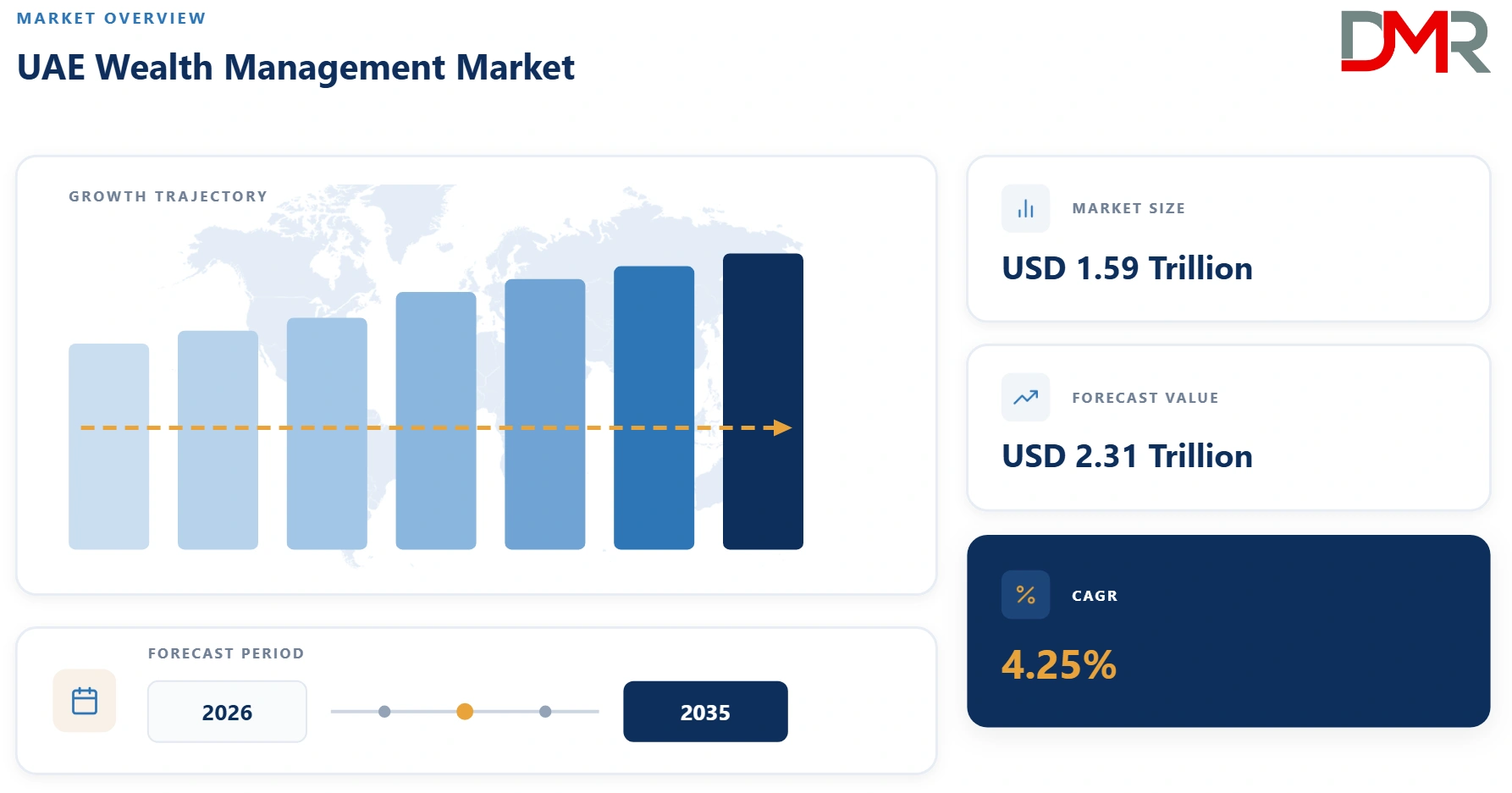
- UAE Wealth Management Market Size in 2026: USD 1.59 Trillion
- UAE Wealth Management Market Size in 2035: USD 2.31 Trillion
- CAGR from 2026 to 2035: 4.25%
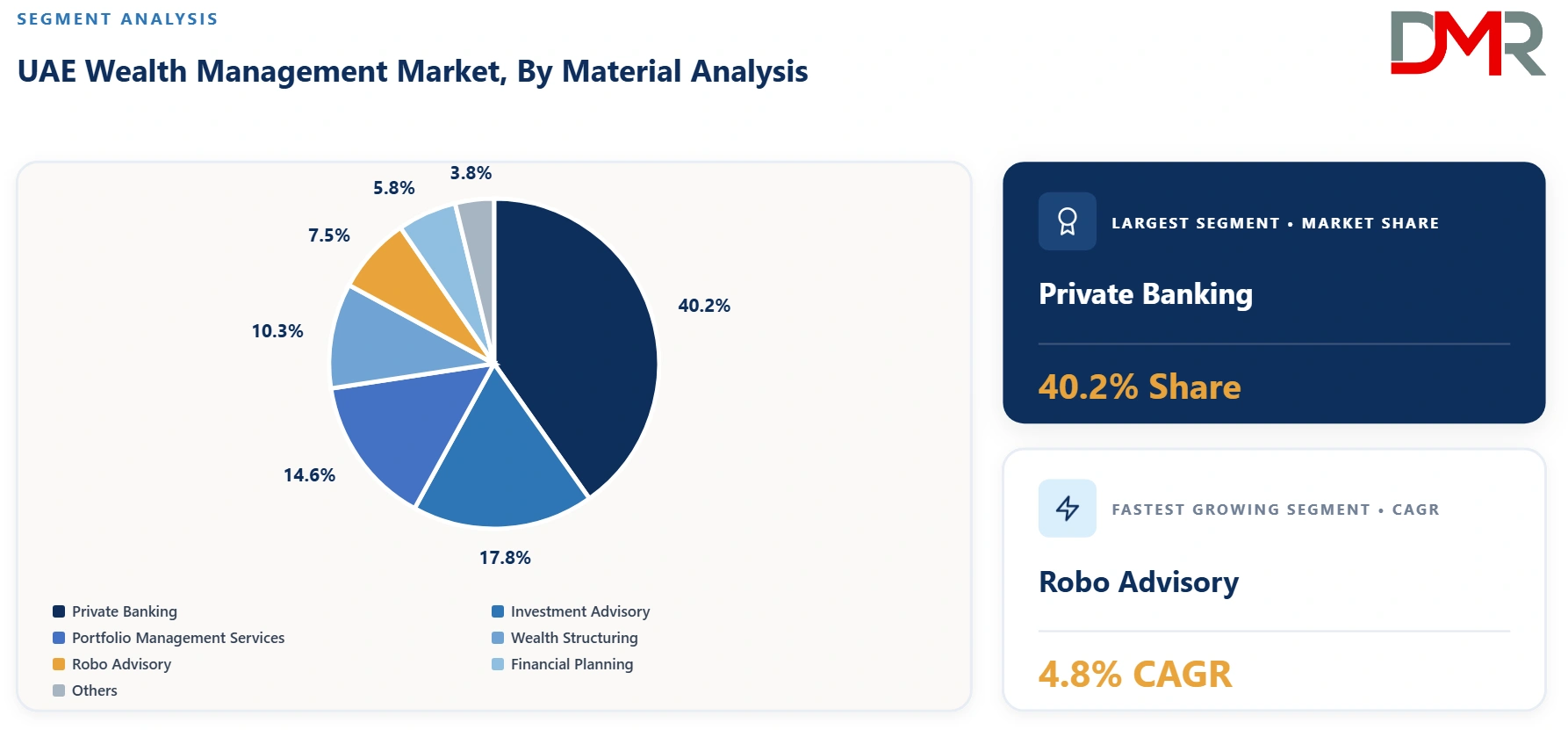
- Private Banking is the leading Service Type segment in 2026: 40.2%
- Equities is the leading Asset Class segment in 2026: 32.3%
- High Net Worth Individuals (HNWIs) is the leading End Use segment in 2026: 31.8%
What is the UAE Wealth Management Market and its Market Size?
The UAE Wealth Management Market is projected to reach USD 1.59 trillion in 2026 and grow at a compound annual growth rate of 4.25% through 2035, reaching USD 2.31 trillion. The market encompasses professional investment management, private banking, financial advisory, portfolio management, and digital wealth solutions designed for affluent and high-net-worth clients. Growth is supported by increasing wealth migration, expanding HNW populations, favorable financial regulations, and the strengthening of Dubai and Abu Dhabi as international wealth-management hubs.
ℹ
To learn more about this report –
Download Your Free Sample Report Here
Use Cases
- Private Wealth Management: Wealth management services help high net worth individuals structure, preserve, and grow financial assets through personalized investment strategies, portfolio diversification, tax planning, and risk management. UAE private banks increasingly provide tailored solutions addressing clients’ complex domestic and international financial requirements.
- Investment Portfolio Management: Portfolio management enables investors to allocate wealth across equities, fixed income, real estate, funds, and alternative assets according to financial objectives and risk tolerance. Professional managers continuously evaluate market conditions, rebalance investments, and identify opportunities to improve long term portfolio performance.
- Family Office and Succession Planning: Family offices use wealth management solutions to coordinate investments, estate planning, succession strategies, governance, and intergenerational wealth transfer. These services are increasingly important in the UAE as wealthy families seek structured approaches for protecting assets and maintaining financial continuity across generations.
- Digital Wealth and Robo Advisory: Digital wealth platforms provide automated investment recommendations, portfolio monitoring, financial planning, and accessible advisory services through technology-driven interfaces. They expand wealth management accessibility among digitally active investors while enabling providers to deliver personalized services efficiently, reduce operating costs, and improve engagement.
Key Takeaways
- Market Size: The UAE Wealth Management Market is anticipated to be valued at USD 1.59 trillion in 2026 and is forecast to reach USD 2.31 trillion by 2035, expanding at a CAGR of 4.25% during the forecast period.
- Growth Rate and Outlook: Market expansion is supported by rising private wealth, increasing migration of high-net-worth individuals, expanding family offices, favorable investment policies, financial sector development, and the strengthening of Dubai and Abu Dhabi as international financial and wealth management hubs.
- Primary Growth Drivers: Increasing numbers of affluent and high-net-worth individuals, strong expatriate wealth inflows, business-friendly regulations, expanding private banking services, demand for diversified investment portfolios, succession planning requirements, digital wealth platforms, and growing alternative investment opportunities are accelerating market development.
- By Service Type Analysis: Private Banking is projected to lead the service type segment with a 40.2% share in 2026, supported by strong demand for personalized investment advisory, portfolio management, estate planning, wealth structuring, and cross-border financial solutions among affluent and high-net-worth clients.
- By Client Type Analysis: High Net Worth Individuals are expected to lead the client type segment with a 32.3% share in 2026. Growing millionaire migration, entrepreneurial wealth, international investment activity, demand for personalized advisory, and sophisticated portfolio diversification strategies are strengthening this segment.
- By Asset Class Analysis: Equities are anticipated to dominate the asset class segment with a 31.8% share in 2026, driven by demand for capital appreciation, portfolio diversification, access to domestic and international stock markets, professionally managed investment strategies, and increasing participation in global financial assets.
How AI/Gen AI is Transforming the UAE Wealth Management Market?
Artificial Intelligence and Generative AI are reshaping the UAE Wealth Management Market by enabling more personalized, efficient, and data-driven financial services. Wealth managers are using AI-powered analytics to evaluate client profiles, investment behavior, market conditions, and risk tolerance, allowing advisors to deliver customized portfolio strategies and identify emerging opportunities. Gen AI supports relationship managers by generating investment summaries, research insights, portfolio reports, and personalized client communications more efficiently. AI also strengthens fraud detection, regulatory compliance, transaction monitoring, and risk management through automated analysis of large financial datasets. Robo-advisory platforms are expanding access to professional investment services among mass-affluent and digitally active investors.
Key Drivers in the UAE Wealth Management Market
Rising High Net Worth Population and International Wealth Migration
The UAE is increasingly attracting high net worth and ultra high net worth individuals due to its favorable tax environment, political stability, premium lifestyle, global connectivity, and expanding financial ecosystem. Continued relocation of entrepreneurs, investors, executives, and family businesses is increasing demand for private banking, investment advisory, portfolio management, estate planning, and wealth structuring services. Dubai and Abu Dhabi are strengthening their positions as international wealth hubs, encouraging financial institutions to expand dedicated private wealth capabilities. Growing investable assets among residents and expatriates are also supporting demand for diversified portfolios covering equities, fixed income, real estate, private markets, and alternative investments.
Supportive Financial Regulations and Expanding Investment Ecosystem
The UAE's development of sophisticated financial centers, investor-friendly regulations, and internationally connected capital markets is accelerating wealth management activity. Financial ecosystems in Dubai and Abu Dhabi provide platforms for private banks, asset managers, family offices, fintech companies, and investment advisors to serve domestic and international investors. Regulatory initiatives supporting financial innovation, digital investment services, fund structures, and professional wealth advisory are broadening available solutions. Increasing access to regional and international investment products is also encouraging portfolio diversification. As institutions strengthen advisory capabilities and introduce specialized products for affluent clients, the country's financial infrastructure continues to support long-term expansion of the UAE Wealth Management Market.
Restraints in the UAE Wealth Management Market
Market Volatility and Exposure to Global Economic Uncertainty
Wealth portfolios in the UAE are exposed to changing global interest rates, equity market volatility, geopolitical developments, commodity price movements, currency fluctuations, and economic uncertainty. These factors can reduce investor confidence and influence allocations toward lower-risk or highly liquid assets, affecting demand for certain wealth management products. High net worth investors generally maintain geographically diversified portfolios, meaning international market disruptions can directly affect portfolio performance and investment decisions. Wealth managers must continuously adjust asset allocation and risk strategies while maintaining client expectations. Prolonged volatility may consequently restrict investment activity, delay portfolio expansion, and increase demand for capital preservation rather than higher-growth strategies.
Regulatory Compliance and Increasing Operational Complexity
Wealth management providers face increasingly complex requirements concerning anti-money laundering controls, know-your-customer procedures, suitability assessments, cross-border investments, tax transparency, cybersecurity, and data protection. Serving internationally mobile wealthy clients can further increase compliance complexity because their assets, businesses, residences, and investments may span multiple jurisdictions. Institutions must invest significantly in compliance professionals, digital monitoring systems, cybersecurity infrastructure, and regulatory technology to maintain effective controls. These requirements can increase operating costs and create entry barriers for smaller advisory firms. Balancing regulatory obligations with seamless, personalized client experiences remains challenging, particularly as wealth managers expand digital services and offer increasingly sophisticated investment products across international markets.
Growth Opportunities in the UAE Wealth Management Market
Expansion of Family Offices and Intergenerational Wealth Services
The expanding family office ecosystem presents significant opportunities for wealth managers to provide integrated services covering investment management, succession planning, governance, estate structuring, philanthropy, and alternative investments. Wealthy families increasingly require institutional-quality solutions to preserve capital and transfer assets efficiently between generations. The UAE's growing attractiveness to international family offices also creates opportunities for private banks, asset managers, legal advisors, and independent wealth specialists to develop customized offerings. Providers capable of combining global investment access with regional expertise can strengthen long-term relationships with wealthy families. Rising succession requirements among established business families are expected to further increase demand for structured intergenerational wealth planning and advisory solutions.
Digital Wealth Platforms and Mass Affluent Investor Expansion
Digital wealth management provides substantial growth opportunities by extending professional investment services beyond traditional private banking clients. Robo-advisory platforms, mobile investment applications, automated portfolio construction, AI-powered recommendations, and digital onboarding can help providers efficiently serve mass affluent and younger investors. The UAE's digitally connected population and advanced financial technology ecosystem create favorable conditions for scalable digital advisory models. Hybrid approaches combining automated tools with human advisors can provide personalized services while controlling operating costs. Wealth managers can also use analytics to identify changing client preferences and deliver targeted products. Growing participation among younger professionals and technology-oriented investors is expected to broaden the addressable wealth management customer base.
Trends in the UAE Wealth Management Market
Growing Allocation Toward Alternative and Private Market Investments
High net worth investors are increasingly exploring alternative assets to diversify portfolios beyond conventional equities and fixed income securities. Private equity, private credit, venture capital, real estate, infrastructure, hedge funds, and other private market strategies are becoming more relevant within sophisticated wealth portfolios. Investors are seeking differentiated returns, inflation protection, diversification, and exposure to long-term structural growth themes. In response, wealth managers are expanding access to specialized funds and private investment opportunities while strengthening due diligence and portfolio construction capabilities. This shift is encouraging providers to develop broader product platforms capable of combining traditional investments with alternatives according to individual liquidity requirements and risk profiles.
Shift Toward Personalized, AI-Enabled and Hybrid Advisory Models
Personalization is becoming central to wealth management as clients increasingly expect investment strategies tailored to their financial objectives, risk tolerance, liquidity needs, values, and life stages. Artificial intelligence, advanced analytics, and Generative AI are supporting advisors by improving portfolio analysis, investment research, client segmentation, reporting, and communication. At the same time, investors continue to value human expertise for complex financial decisions, creating momentum for hybrid advisory models combining digital capabilities with relationship managers. Wealth management firms are consequently investing in integrated technology platforms that improve advisor productivity and client engagement. This trend is expected to enhance service scalability while maintaining personalized, high-touch wealth management experiences.
Research Scope and Analysis
The UAE Wealth Management Market is segmented by service type, covering private banking, investment advisory, portfolio management services, wealth structuring, robo advisory, and others. Client type includes high net worth individuals, ultra high net worth individuals, mass affluent individuals, family offices, corporates, institutions and others. Asset classes include equities, fixed income, real estate, mutual funds and ETFs, alternative investments, cash and deposits.
ℹ
To learn more about this report –
Download Your Free Sample Report Here
By Service Type Analysis
Private Banking is projected to lead the Service Type segment with a 40.2% market share in 2026, supported by demand for personalized investment and financial advisory services. Robo Advisory is expected to register the highest CAGR of 4.8% from 2026 to 2035, driven by digital adoption, automated portfolio management, AI-enabled advisory, and cost-efficient investment solutions.
By Asset Class Analysis
Equities are anticipated to dominate the Asset Class segment with a 32.3% market share in 2026, supported by portfolio diversification and capital appreciation opportunities. Alternative Investments are expected to record the highest CAGR of 4.7% from 2026 to 2035, driven by growing allocations toward private equity, private credit, infrastructure, real estate, and other alternative assets.
By Client Type Analysis
High Net Worth Individuals are expected to lead the Client Type segment with a 31.8% market share in 2026, supported by rising private wealth and increasing wealth migration into the UAE. Family Offices are projected to register the highest CAGR of 4.6% from 2026 to 2035, driven by succession planning, intergenerational wealth transfer, portfolio diversification, and wealth preservation requirements.
The UAE Wealth Management Market Report is segmented based on the following:
By Service Type
- Private Banking
- Investment Advisory
- Portfolio Management Services
- Wealth Structuring
- Robo Advisory
- Financial Planning
- Others
By Client Type
- High Net Worth Individuals
- Ultra High Net Worth Individuals
- Mass Affluent Individuals
- Family Offices
- Corporates
- Institutional Investors
- Others
By Asset Class
- Equities
- Fixed Income
- Real Estate
- Mutual Funds and ETFs
- Alternative Investments
- Cash and Deposits
- Others
Regulatory Landscape Analysis
The UAE Wealth Management Market is strongly influenced by an evolving regulatory framework designed to strengthen investor protection, financial transparency, compliance, and international competitiveness. Regulators across major financial centers are encouraging robust governance, anti-money laundering controls, suitability assessments, data protection, and responsible digital finance practices. Increasing regulatory clarity creates opportunities for private banks, asset managers, family offices, and fintech platforms to introduce sophisticated investment and advisory solutions. However, stricter compliance requirements increase operational costs, particularly for smaller wealth managers serving internationally mobile clients. Cross-border taxation, client verification, cybersecurity, and reporting obligations remain key risks. Overall, regulatory development strengthens market credibility, attracts global wealth, and supports the UAE's position as an international wealth management hub.
Investment and White Space Analysis
The UAE Wealth Management Market presents significant investment opportunities across private banking, family offices, digital advisory, alternative investments, and personalized portfolio solutions. Rising numbers of wealthy residents and international investors are creating white space for specialized services targeting high net worth individuals, entrepreneurs, younger investors, and multigenerational families. Opportunities are expanding in private equity, private credit, real estate, sustainable investments, succession planning, and technology enabled advisory platforms. Wealth managers can differentiate through global investment access, tailored products, digital capabilities, and hybrid advisory models. Key risks include intense competition, volatile financial markets, changing investor preferences, and high client acquisition costs. Continued wealth migration and financial ecosystem development should support investment and market expansion.
Competitive Landscape
The UAE Wealth Management Market is moderately fragmented, with strong competition among domestic banks and global wealth management institutions. Major players include Emirates NBD, First Abu Dhabi Bank, Abu Dhabi Commercial Bank, HSBC, UBS Group, Citigroup, Barclays, Standard Chartered, Deutsche Bank, Julius Baer Group, Lombard Odier, and Pictet Group. Companies compete through personalized advisory, private banking, alternative investments, digital platforms, family office services, and global investment access, while expanding capabilities to attract the UAE’s growing affluent investor base.
Some of the prominent players in the UAE Wealth Management Market are:
- Emirates NBD
- First Abu Dhabi Bank
- Abu Dhabi Commercial Bank
- HSBC
- UBS Group
- Citigroup
- Barclays
- Standard Chartered
- Deutsche Bank
- Julius Baer Group
- Lombard Odier
- Pictet Group
- Mashreq
- J. Safra Sarasin
- RAKBANK
- EFG International
- Mirabaud Group
- Wio Bank
- Goldman Sachs
- Morgan Stanley
- BNP Paribas
- BlackRock
- State Street
- Edmond de Rothschild
- Investec
- Nuvama Wealth Management
- Sarwa
- StashAway
- Capital Group
- Man Group
- DWS Group
- KKR
- Partners Group
- Wellington Management
- PGIM
- Nuveen
- General Atlantic
- Blue Owl Capital
- Hamilton Lane
- Polen Capital
- Other Key Players
Recent Developments
- In July 2026, Dubai International Financial Centre reported that its ecosystem had surpassed 10,000 active registered companies, while regulated financial services firms increased 16% year over year to 1,134. AI, FinTech, and innovation companies also reached 1,933, reinforcing Dubai’s expanding infrastructure for wealth management, asset management, private banking, and financial technology services.
- In July 2026, Blackstone was reported to be planning a new office in Dubai International Financial Centre while retaining its Abu Dhabi presence. The expansion reflects increasing interest from major global alternative asset managers in the UAE’s growing private wealth, family office, and alternative investment ecosystem.
- In February 2026, DIFC reported more than 1,289 family-related entities within its ecosystem, strengthening its position as a major UAE hub for family wealth. The expanding ecosystem of private banks, asset managers, legal advisers, and family offices is supporting succession planning, intergenerational wealth transfer, and sophisticated investment management services.
Report Details
| Report Characteristics |
| Market Size (2026) |
USD 1.59 Trn |
| Forecast Value (2035) |
USD 2.31 Trn |
| CAGR (2026–2035) |
4.25% |
| Historical Data |
2021 – 2025 |
| Forecast Data |
2026 – 2035 |
| Base Year |
2025 |
| Segments Covered |
By Service Type, By Asset Class, By Client Type |
Frequently Asked Questions
How big is the UAE Wealth Management Market?
▾ The UAE Wealth Management Market is projected to reach USD 1.59 trillion in 2026 and is expected to increase to USD 2.31 trillion by 2035.
What is the CAGR of the UAE Wealth Management Market from 2026 to 2035?
▾ The UAE Wealth Management Market is expected to expand at a CAGR of 4.25% during the forecast period from 2026 to 2035.
What factors are driving the growth of the UAE Wealth Management Market?
▾ Growth is driven by rising high net worth populations, international wealth migration, favorable regulations, expanding family offices, private banking growth, digital wealth platforms, portfolio diversification, and increasing alternative investments.
What are the major trends in the UAE Wealth Management Market?
▾ Major trends include growing allocation toward alternative and private market investments, AI-enabled advisory, personalized portfolio management, hybrid advisory models, robo advisory adoption, and increasing demand for family office services.
Who are the key players in the UAE Wealth Management Market?
▾ Key players include Emirates NBD, First Abu Dhabi Bank, Abu Dhabi Commercial Bank, HSBC, UBS Group, Citigroup, Barclays, Standard Chartered, Deutsche Bank, Julius Baer Group, Lombard Odier, Pictet Group, Mashreq, and EFG International.
How is the UAE Wealth Management Market segmented?
▾ The UAE Wealth Management Market is segmented by Service Type into Private Banking, Investment Advisory, Portfolio Management Services, Wealth Structuring, Robo Advisory, Financial Planning, and Others; by Client Type into HNWIs, UHNWIs, Mass Affluent Individuals, Family Offices, Corporates, Institutional Investors, and Others; and by Asset Class into Equities, Fixed Income, Real Estate, Mutual Funds and ETFs, Alternative Investments, Cash and Deposits, and Others.