UK Automated Truck Loading System Market Snapshot
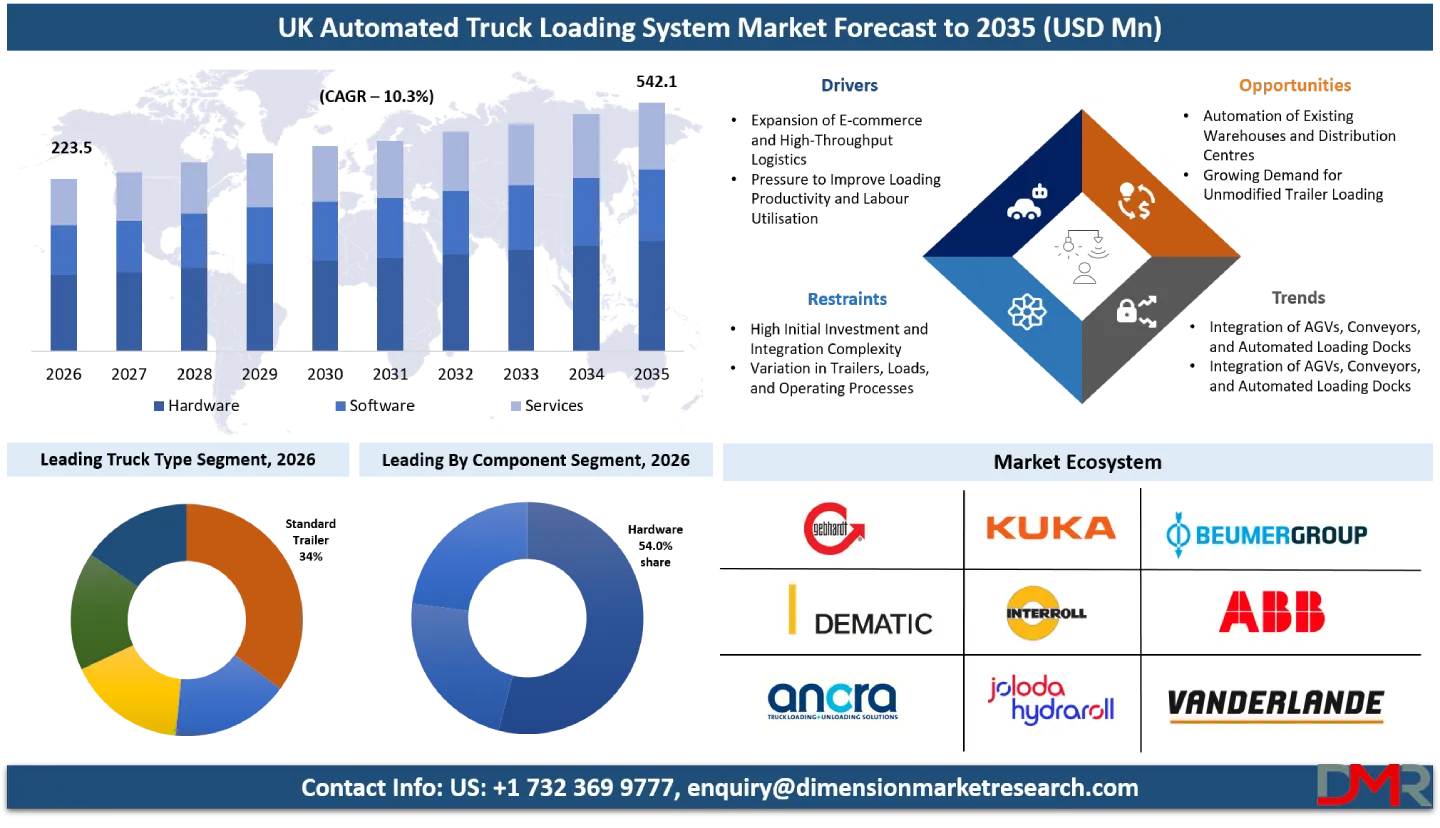
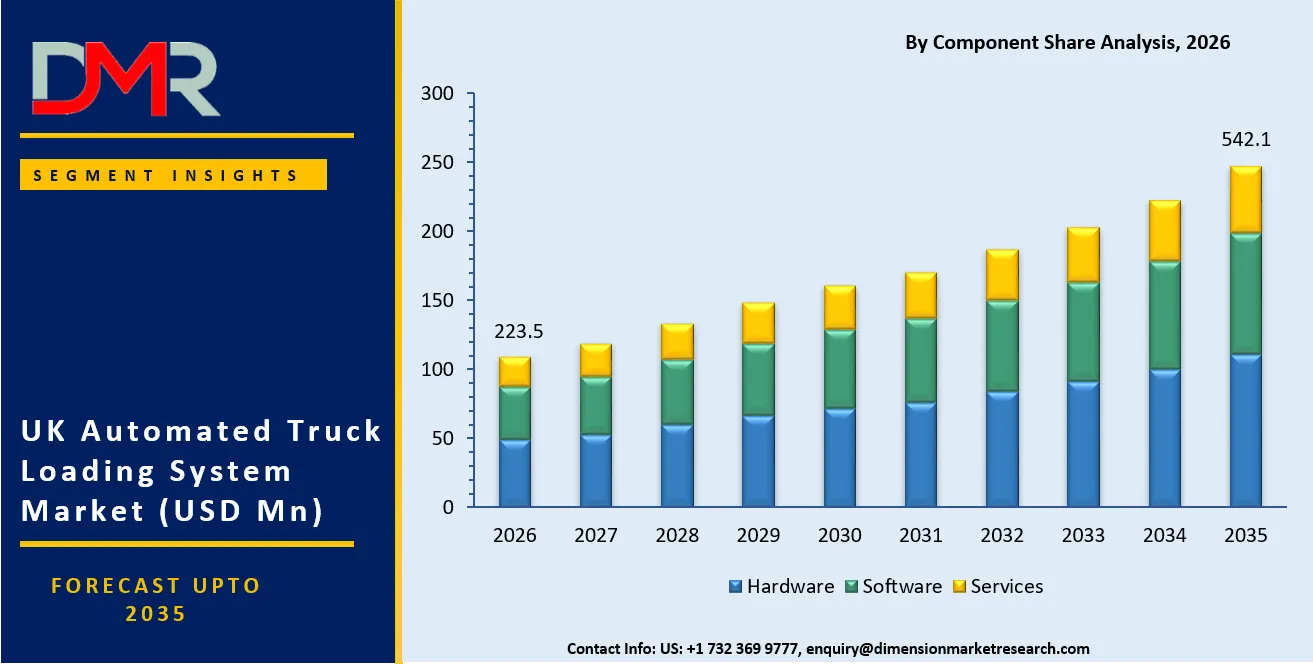
- Market Value: The UK Automated Truck Loading System market is expected to reach USD 542.1 million by 2035 from USD 223.5 million in 2026, at a CAGR of 10.3%.
- By System Type Segment Analysis: Belt Conveyor System segment dominated with 28.5% share in 2026.
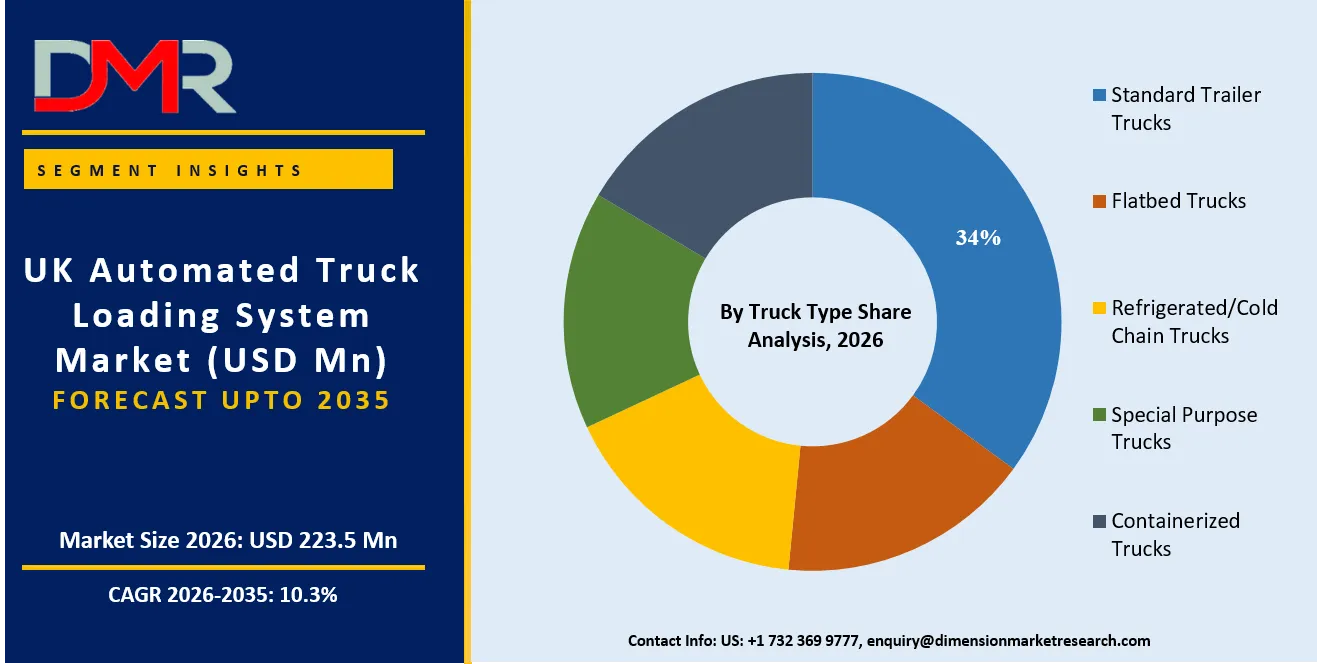
- By Truck Type Segment Analysis: Standard Trailer Trucks led truck types with 34.0% share in 2026.
- By Industry Segment Analysis: E-commerce and Logistics held 29.0% share in 2026.
- By Automation Level Segment Analysis: Semi-Automated Systems accounted for 58.0% share in 2026.
- Major Key Players: Swisslog, ABB, Ancra Systems B.V., Dematic, GEBHARDT Fördertechnik, Joloda Hydraroll Group and Others.
What is the UK Automated Truck Loading System Market and its Market Size?
The UK Automated Truck Loading System Market size is projected to be valued at USD 223.5 million in 2026 and is expected to reach USD 542.1 million by 2035, expanding at a CAGR of 10.3% during the forecast period. Automated truck loading systems, also known as ATLS or automated trailer loading systems, use conveyors, loading platforms, robotic equipment, sensors, controls, and connected software to transfer goods between warehouses and trucks with limited manual handling. Their adoption is increasing as distribution centres seek faster vehicle turnaround, safer loading operations, lower forklift traffic, and better integration between warehouse automation and outbound logistics.
ℹ
To learn more about this report –
Download Your Free Sample Report Here
The UK provides a favourable operating environment for loading automation because road freight remains central to domestic distribution. In 2025, GB-registered HGVs operating in the UK lifted about 1.53 billion tonnes of goods, moved 162 billion tonne-kilometres, and travelled 19.0 billion vehicle kilometres. At the same time, 26% of HGV businesses reported driver vacancies in the fourth quarter of 2025. These operating pressures support demand for technologies that shorten loading cycles and improve utilisation of drivers, trailers, loading bays, and warehouse labour.
Use Cases
- High-Volume Distribution Centres: Automated truck loading systems move palletised products directly from staging or conveyor areas into trailers. They help large distribution centres increase dock throughput, reduce repetitive forklift movements, improve loading consistency, and shorten the time trucks remain at loading bays.
- E-commerce Fulfilment: E-commerce operators use loading automation to manage high shipment volumes and tight dispatch schedules. UK internet sales represented 27.4% of total retail sales in 2025 and 27.8% in the second quarter of 2026, reinforcing the need for efficient outbound logistics and scalable fulfilment infrastructure.
- Manufacturing Logistics: Manufacturers integrate automated trailer loading with production conveyors, pallet handling equipment, AGVs, and warehouse management systems. Finished products can flow from production or storage to dispatch with fewer intermediate handling stages, supporting predictable cycle times and reduced product damage.
- 3PL Operations: Third-party logistics providers can use automated and unmodified trailer loading technologies where fleets contain multiple vehicle formats. Solutions designed for standard, non-modified trailers are particularly useful where operators do not control every vehicle arriving at a distribution facility.
- Food and Beverage Distribution: High-throughput food and beverage operations benefit from automated pallet movement, fast turnaround, and repeatable loading patterns. Reduced forklift travel can also support safer dock environments and more reliable handling of packaged beverages, grocery products, and other high-volume consumer goods.
How AI/Gen AI is Transforming the UK Automated Truck Loading System Market?
Artificial intelligence is strengthening automated truck loading by improving sensing, equipment coordination, exception handling, and predictive maintenance. Camera systems, LiDAR, machine vision, and intelligent controls can help identify trailer position, load dimensions, available space, and obstacles before loading begins. Research into 3D LiDAR-based truck compartment localisation also demonstrates how automated systems can identify key points within vehicle compartments, supporting more precise robotic positioning in complex loading environments.
AI-based software can also connect loading equipment with warehouse management systems, conveyors, AGVs, robotics, and transport scheduling platforms. This enables operators to predict loading demand, sequence pallets, detect abnormal equipment behaviour, and optimise dock assignments. Generative AI may increasingly support maintenance teams through troubleshooting guidance and operating documentation, while predictive models can help managers identify bottlenecks before they affect dispatch. The larger opportunity is the creation of connected loading docks where physical equipment and digital systems coordinate decisions in real time.
Key Drivers in the UK Automated Truck Loading System Market
Expansion of E-commerce and High-Throughput Logistics
The continuing scale of online retail is a major driver of UK automated truck loading system demand. ONS data shows internet sales represented 27.4% of total UK retail sales in 2025, compared with 19.2% in 2019. Higher parcel and fulfilment volumes require distribution centres to process more outbound movements within fixed dock capacity. Loading automation can increase vehicle throughput without proportional growth in labour or loading bays, making automated conveyor, pallet handling, and trailer loading technologies increasingly attractive to e-commerce, retail, parcel, and 3PL operators.
Pressure to Improve Loading Productivity and Labour Utilisation
UK freight operators face pressure to use drivers and warehouse workers more efficiently. Department for Transport statistics show 26% of HGV businesses reported driver vacancies in Q4 2025. Automated loading can reduce the time drivers spend waiting at docks and limit manual forklift movements during dispatch. Technology providers report that conventional forklift trailer loading can take roughly 30 to 45 minutes, while certain automated solutions can complete loading in under five minutes. Actual performance varies by cargo, system layout, and trailer configuration.
Restraints in the UK Automated Truck Loading System Market
High Initial Investment and Integration Complexity
Automated truck loading projects can require significant investment in conveyors, loading platforms, sensors, controls, dock modifications, vehicle interfaces, software, and safety systems. Existing facilities may also need layout changes before automation can be deployed. The business case is therefore strongest in high-volume operations with repeatable load patterns. Smaller warehouses or facilities with irregular dispatch volumes can find payback periods less attractive, encouraging gradual adoption through modular or semi-automated systems rather than immediate deployment of fully automated loading infrastructure.
Variation in Trailers, Loads, and Operating Processes
UK logistics networks handle varied trailer dimensions, pallet formats, cargo types, customer requirements, and loading procedures. Such variation can reduce the ease of standardising a single automated loading configuration across all routes. Dedicated systems may perform best in closed-loop shuttle operations where trailers and loading units are controlled by the same company. Direct-to-customer and 3PL networks may require solutions compatible with regular non-modified trailers, increasing engineering requirements and making system flexibility an important purchasing criterion.
Growth Opportunities in the UK Automated Truck Loading System Market
Automation of Existing Warehouses and Distribution Centres
The installed base of UK logistics facilities creates a significant retrofit opportunity. ONS analysis found that transport and storage business premises were 88% higher in 2021 than in 2011, while warehouse construction orders reached £5.6 billion in 2021. Many existing facilities were designed before end-to-end automation became a priority. Suppliers that offer modular loading technologies capable of integrating with conveyors, AGVs, pallet handling systems, and existing docks can address this large brownfield market without requiring operators to construct entirely new distribution centres.
Growing Demand for Unmodified Trailer Loading
Systems capable of loading standard trailers without permanent vehicle modification represent an important growth opportunity. They are relevant for retailers, manufacturers, and 3PL companies using mixed or third-party fleets where dedicated automated trailers are impractical. Modern solutions can handle palletised and non-palletised cargo while connecting with existing warehouse automation. Wider compatibility lowers a key adoption barrier and can extend automated loading beyond repetitive shuttle routes into more flexible distribution and direct-to-customer networks.
Trends in the UK Automated Truck Loading System Market
Integration of AGVs, Conveyors, and Automated Loading Docks
Truck loading is becoming part of an integrated intralogistics environment rather than an isolated dock activity. AGVs can transport pallets from storage or production to dispatch, while conveyors provide accumulation and sequencing before goods enter trailers. Dematic identifies trailer loading as an AGV application that can automate pallet movement into trailers and reduce manual dock labour and forklift traffic. This convergence supports end-to-end material flow from automated storage through staging and final vehicle loading.
Safety-Led Reduction of Manual Dock Activity
Safety is becoming a stronger factor in loading automation investment. The UK Health and Safety Executive notes that loading and unloading can expose workers to moving vehicles, machinery, heavy loads, falls, and overturning equipment. Automated systems can reduce direct interaction between pedestrians, forklifts, and trailers by moving more activity into controlled mechanical processes. The trend supports solutions featuring sensors, guarding, interlocks, automated positioning, and remote monitoring alongside improvements in productivity and loading consistency.
Research Scope and Analysis
The UK Automated Truck Loading System Market is segmented based on system type, truck type, industry, automation level, component, and other relevant categories. The study provides an in-depth analysis of key segments and sub-segments, covering their applications, industry adoption, demand patterns, technological development, operational requirements, and contribution to overall market growth.
ℹ
To learn more about this report –
Download Your Free Sample Report Here
By System Type;
The Belt Conveyor System segment dominated the UK Automated Truck Loading System market with a 28.5% share in 2026. Belt-based systems benefit from continuous material movement, established conveyor technology, and compatibility with production and warehouse handling lines. They are particularly suitable for operations requiring regular movement of cartons, parcels, packaged products, and selected unit loads. Their ability to connect loading docks directly with upstream conveyor infrastructure supports higher throughput and fewer manual transfer stages. Demand is also supported by e-commerce, parcel, manufacturing, and distribution facilities seeking reliable technology that can operate as part of a broader warehouse automation system.
By Truck Type;
Standard Trailer Trucks accounted for 34.0% of the UK market in 2026, making them the leading truck type segment. Their position reflects their widespread use across domestic road freight, retail distribution, manufacturing logistics, and third-party transport networks. Compatibility with conventional trailers is becoming increasingly important because many companies cannot maintain dedicated modified fleets for every customer or route. Automated loading systems designed around standard trailers can therefore address a wider installed vehicle base. Solutions for unmodified trailers also support 3PL and direct-to-customer operations, creating additional opportunities for flexible automated loading technology.
By Automation Level;
Semi-Automated Systems accounted for 58.0% of the UK market in 2026. Their leadership reflects a practical balance between productivity improvement, investment requirements, operational flexibility, and human oversight. Semi-automated solutions allow businesses to mechanise repetitive loading tasks while retaining operators for positioning, exceptions, mixed loads, and process control. This approach is well suited to brownfield warehouses where completely redesigning docks or vehicle fleets would require substantial capital. As sensors, vision systems, software, and autonomous handling technology improve, some users are expected to upgrade progressively toward higher levels of automation.
ℹ
To learn more about this report –
Download Your Free Sample Report Here
By Component;
The Hardware segment led the market with a 54.0% share in 2026. Automated truck loading requires substantial physical infrastructure, including conveyors, rollers, loading platforms, drives, motors, sensors, robotic equipment, docking devices, safety systems, and control hardware. Hardware therefore accounts for a major share of project expenditure, particularly during new installations. Demand is also supported by replacement cycles, facility expansions, and upgrades to existing loading lines. Over the forecast period, software and services are expected to gain strategic importance as operators seek predictive maintenance, fleet integration, analytics, remote monitoring, and tighter links between loading equipment and warehouse management platforms.
By Industry;
E-commerce and Logistics held 29.0% of the UK Automated Truck Loading System market in 2026. The segment benefits from high shipment frequency, time-sensitive fulfilment, large distribution networks, and the need to maximise loading bay utilisation. UK online retail remains structurally above its pre-pandemic level, with internet sales accounting for 27.4% of retail sales in 2025 compared with 19.2% in 2019. This creates sustained pressure on fulfilment centres and logistics providers to automate outbound processes. Automated trailer loading can complement sorting, pallet handling, AS/RS, conveyors, and mobile robotics, allowing operators to build more connected distribution workflows.
The UK Automated Truck Loading System Market Report is segmented on the basis of the following:
By System Type
- Belt Conveyor System
- Robotic Arm-Based System
- Roller Track System
- Chain Conveyor System
- Automated Guided Vehicles (AGVs) Based System
- Skate Conveyor System
- Slat Conveyor System
- Others
By Truck Type
- Flatbed Trucks
- Refrigerated/Cold Chain Trucks
- Special Purpose Trucks
- Standard Trailer Trucks
- Containerized Trucks
By Loading Dock Design
- Sawtooth Docks
- Open Docks
- Flush Docks
- Enclosed Docks
By Industry
- Pharmaceuticals and Healthcare
- Automotive
- Postal and Courier
- Food and Beverage
- E-commerce and Logistics
- Chemicals
- FMCG and Retail
- Others (Textile, Electronics, Aerospace, etc.)
By Automation Level
- Fully Automated Systems
- Semi-Automated Systems
By Component
- Services (Installation, Maintenance, Integration)
- Software
- Hardware
Major Countries Analysis
England Automated Truck Loading System Market
England represents the principal demand centre within the UK due to its concentration of distribution centres, manufacturing facilities, ports, retailers, and major road freight corridors. The Midlands is particularly important to logistics operations. ONS analysis identified a logistics triangle in the West Midlands positioned within a four-hour drive of around 90% of the British population. Large fulfilment and warehousing clusters create attractive conditions for conveyor loading, automated pallet handling, dock automation, and integrated trailer loading systems designed to increase throughput at high-volume sites.
Scotland Automated Truck Loading System Market
Scotland offers growth potential as retailers, manufacturers, food and beverage companies, and logistics providers modernise distribution operations serving geographically dispersed customers. Automated loading can help businesses improve trailer turnaround, standardise dispatch processes, and use warehouse labour more efficiently. Opportunities are strongest at high-volume facilities connecting production plants, regional distribution centres, ports, and national transport networks. Modular systems that can operate with standard trailers and integrate with existing conveyors or pallet handling equipment are likely to support gradual adoption across established facilities.
Competitive Landscape
The UK Automated Truck Loading System market is competitive and includes global warehouse automation groups, material handling specialists, conveyor suppliers, robotics providers, and companies focused specifically on automated trailer loading.
Some of the prominent players in the UK Automated Truck Loading System Industry are:
- Juniper Networks, Inc.
- Samsung Electronics Co., Ltd.
- Amdocs Limited
- Ericsson
- ZTE Corporation
- Hewlett Packard Enterprise (HPE)
- Nokia Corporation
- Mavenir Systems, Inc.
- Cisco Systems, Inc.
- Huawei Technologies Co., Ltd.
- Others
Recent Developments:
-
February 2026: Dematic announced a rail-free, aerial AS/RS with robotic handling, reflecting the UK market’s shift toward flexible, scalable automation supporting faster warehouse-to-truck operations.
-
July 2025: Joloda Hydraroll launched LoadMatic Lite, a compact automated loading system for standard trailers, enabling UK facilities to automate without major fleet or site modifications.
- September 2025: Ancra Systems highlighted a frozen-food installation that reduced trailer loading time from about 45 minutes to three minutes, demonstrating strong efficiency gains for UK logistics users.
Report Details
| Report Characteristics |
| Market Size (2026) |
USD 223.5 Million |
| Forecast Value (2035) |
USD 542.1 Million |
| CAGR (2026–2035) |
10.3% |
| Historical Data |
2021 - 2025 |
| Forecast Data |
2027 - 2035 |
| Base Year |
2025 |
| Estimate Year |
2026 |
| Segments Covered |
By System Type, By Truck Type, By Industry, By Automation Level, By Component |
| Major Market Players |
Swisslog, ABB, Ancra Systems B.V., Dematic, GEBHARDT Fördertechnik, Joloda Hydraroll Group, KUKA, Interroll Group, BEUMER Group, Vanderlande Industries, Loading Automation Inc., Körber Supply Chain, Honeywell Intelligrated, Secon Components, Bastian Solutions, and Others |
Frequently Asked Questions
What is the current size of the UK Automated Truck Loading System Market?
▾ The UK Automated Truck Loading System Market is USD 223.5 million in 2026 and may reach USD 542.1 million by 2035.
What is the growth rate of the UK Automated Truck Loading System Market during the forecast period?
▾ The UK Automated Truck Loading System Market is forecast to grow at a CAGR of 10.3% from 2026 to 2035.
What factors are driving the growth of the UK Automated Truck Loading System Market?
▾ E-commerce, logistics automation, labour efficiency, and throughput drive the UK Automated Truck Loading System Market.
What are the major challenges restraining the UK Automated Truck Loading System Market?
▾ High installation costs and integration complexity restrain growth in the UK Automated Truck Loading System Market.
Which segment holds the largest share of the UK Automated Truck Loading System Market?
▾ Semi-Automated Systems lead the UK Automated Truck Loading System Market with a 58.0% share in 2026.
Who are the leading companies in the UK Automated Truck Loading System Market?
▾ Swisslog, ABB, Ancra Systems B.V., Dematic, GEBHARDT Fördertechnik, Joloda Hydraroll Group, KUKA, Interroll Group, BEUMER Group, Vanderlande Industries, Loading Automation Inc., Körber Supply Chain, Honeywell Intelligrated, Secon Components, and Bastian Solutions are leading companies in the UK Automated Truck Loading System Market.
How is AI influencing the UK Automated Truck Loading System Market?
▾ AI improves maintenance, sensing, scheduling, and dock efficiency in the UK Automated Truck Loading System Market.
What are the future opportunities and trends in the UK Automated Truck Loading System Market?
▾ Smart docks, AGV integration, AI, and trailer loading create growth in the UK Automated Truck Loading System Market.