UK Contact Intraocular Lenses Market Snapshot
- UK Contact Intraocular Lenses Market Size in 2026: USD 325.0 million
- UK Contact Intraocular Lenses Market Size in 2035: USD 522.0 million
- UK CAGR from 2026 to 2035: 5.4%
- Monofocal IOLs is the leading Product Type segment in 2026: 42.0%
- Hydrophobic acrylic is the leading Material segment in 2026: 53.0%
- Cataract surgery is the leading Application segment in 2026: 62.0%
- Hospitals and eye clinics is the leading Distribution Channel segment in 2026: 71.0%
- Hospitals is the leading End User segment in 2026: 48.0%
What is the UK Contact Intraocular Lenses Market and its Market Size?
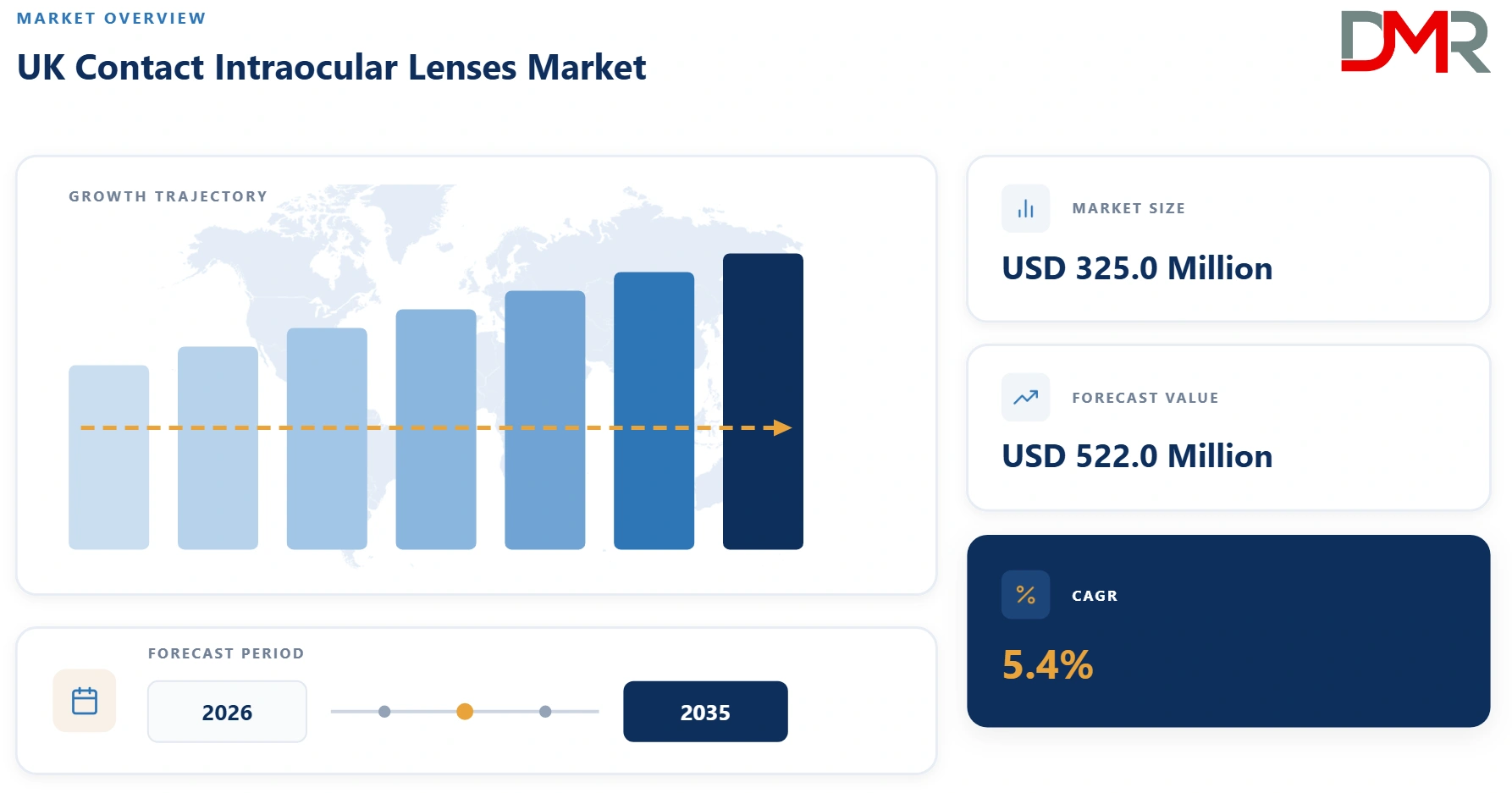
The UK Contact Intraocular Lenses Market is projected to reach USD 325.0 million in 2026 and grow at a compound annual growth rate of 5.4% from 2026 to 2035 to reach a value of USD 522.0 million. The market comprises intraocular lenses used primarily to restore or enhance vision following cataract extraction and for refractive correction. Demand is supported by the UK's aging population, high cataract surgery volumes, improvements in ophthalmic surgery, increasing preference for premium vision correction, and technological advances in multifocal, toric, EDOF, and other advanced IOL designs.
ℹ
To learn more about this report –
Download Your Free Sample Report Here
The underlying procedure base remains substantial. England recorded 608,133 admissions for cataract surgery among people aged 65 and over in the financial year ending 2025, with the rate increasing from the previous year. NHS cataract operations also increased from approximately 432,000 in 2018/19 to 706,000 in 2024/25, according to evidence submitted by the Royal College of Ophthalmologists.
Use Cases
- Cataract Surgery:Intraocular lenses are primarily used to replace the natural crystalline lens removed during cataract surgery. Modern IOLs restore distance vision while enabling surgeons to address additional refractive requirements such as astigmatism and presbyopia. The UK's large and expanding cataract surgery base creates consistent underlying demand for IOLs. Increasing surgical volumes, aging demographics, shorter waiting times, independent-sector participation, and improvements in surgical techniques continue to support IOL utilization across NHS and private ophthalmology providers.
- Presbyopia Correction:Premium IOL technologies are increasingly used to address presbyopia alongside cataract treatment. Multifocal, EDOF, enhanced monofocal, and full-range lenses provide alternatives to conventional monofocal correction for patients seeking reduced dependence on spectacles. Product innovation is expanding the range of visual outcomes available to surgeons and patients. Recent European launches, including Alcon's Clareon Vivity and newer Rayner full-range technologies, demonstrate the industry's movement toward broader depth of focus and improved visual quality.
- Astigmatism Correction:Toric IOLs provide a surgical option for correcting pre-existing corneal astigmatism during cataract surgery. Growing availability of toric versions across monofocal, EDOF, and premium IOL platforms is improving treatment flexibility. Manufacturers increasingly combine toric correction with advanced optical designs to address multiple visual requirements within a single procedure. The expanding availability of toric products from major manufacturers is supporting adoption among patients seeking improved postoperative refractive outcomes and reduced spectacle dependence.
- Refractive Lens Exchange:IOLs can also be used during refractive lens exchange procedures for patients seeking correction of significant refractive errors or age-related visual changes without conventional cataract surgery. Demand is concentrated within private ophthalmology and refractive surgery settings where patients may prioritize spectacle independence and premium optical performance. Advances in multifocal, EDOF, and full-range IOL technologies are increasing the suitability of lens-based correction for carefully selected patients seeking correction across multiple viewing distances.
Key Takeaways
- Market Size: The UK Contact Intraocular Lenses Market is anticipated to reach USD 325.0 million in 2026 and is forecast to reach USD 522.0 million by 2035, expanding at a 5.4% CAGR.
- Growth Outlook: Market expansion is supported by increasing cataract surgery volumes, population aging, growing ophthalmology capacity, demand for refractive correction, technological improvements in IOL optics, increasing adoption of premium lenses, and rising availability of advanced toric, EDOF, and full-range products. England recorded more than 608,000 cataract surgery admissions among people aged 65 and over in the financial year ending 2025.
- Primary Growth Drivers: Increasing cataract prevalence, rising surgical volumes, expanding independent-sector ophthalmology provision, improvements in surgical techniques, growing awareness of premium IOL options, and demand for spectacle independence are supporting market development. The expansion of NHS cataract activity has created a large recurring procedure base for IOL manufacturers.
- By Product Type Analysis: Monofocal IOLs are projected to lead with a 42.0% share in 2026, supported by their established clinical use, predictable visual outcomes, broad suitability for cataract patients, and extensive adoption within NHS-funded procedures. EDOF IOLs are expected to record the fastest growth at approximately 7.2% CAGR, driven by demand for enhanced intermediate and functional near vision while maintaining a monofocal-like visual profile.
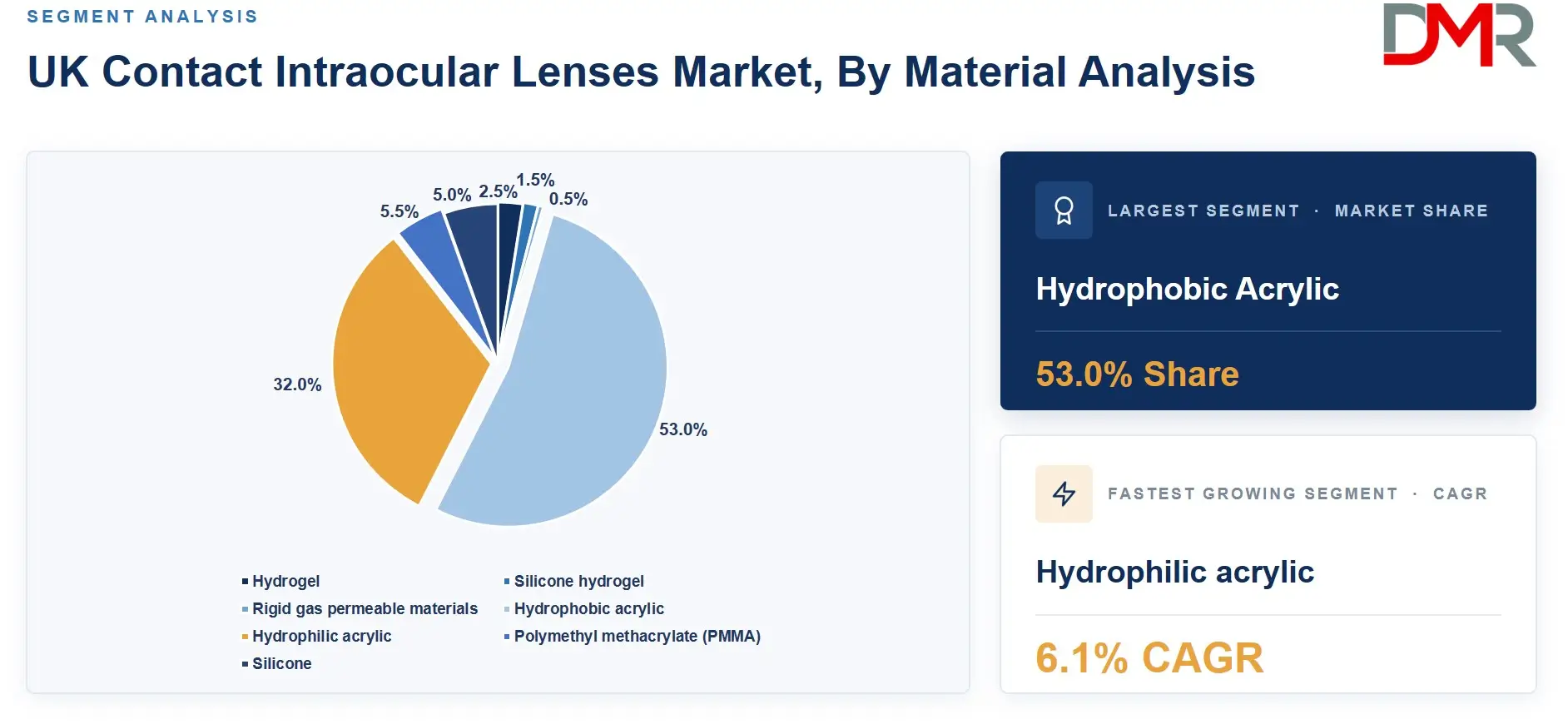
- By Material Analysis: Hydrophobic acrylic is projected to lead with a 53.0% share in 2026, supported by its established use in modern foldable IOL designs, optical performance, durability, and compatibility with small-incision cataract procedures. Hydrophilic acrylic is expected to record growth of approximately 6.1% CAGR, supported by continued product development and demand for flexible lens designs.
- By Application Analysis: Cataract surgery is expected to dominate with a 62.0% share in 2026, reflecting the UK's substantial cataract procedure volume and the central role of IOL implantation in lens replacement surgery. Presbyopia correction is projected to record the fastest growth at approximately 6.6% CAGR, supported by premium IOL adoption and demand for reduced spectacle dependence.
- By Distribution Channel Analysis: Hospitals and eye clinics are projected to account for 71.0% of the market in 2026, reflecting the concentration of IOL implantation within clinical and surgical settings. E-commerce and online channels are expected to record the fastest growth at approximately 8.0% CAGR, although their role remains more relevant to related ophthalmic products and selected non-implantable products than direct IOL implantation.
- By End User Analysis: Hospitals are anticipated to lead with a 48.0% share in 2026, supported by high cataract surgery volumes and NHS-funded ophthalmic procedures. Ophthalmology and eye care clinics are expected to grow at approximately 6.5% CAGR, driven by increasing independent-sector activity, private ophthalmology services, refractive procedures, and demand for premium IOL technologies.
How AI/Gen AI is Transforming the UK Contact Intraocular Lenses Market?
AI is increasingly influencing IOL development, patient selection, biometry, lens-power calculation, surgical planning, and postoperative outcome analysis. Manufacturers are using computational approaches to optimize optical profiles and develop lenses that provide broader ranges of vision. Rayner's RayOne Galaxy represents a notable example, with its spiral optic developed using a proprietary AI engine trained on patient outcomes. AI-assisted diagnostic and planning systems can also help surgeons evaluate ocular parameters and select appropriate IOL characteristics, supporting more personalized treatment and potentially improving refractive predictability.
Key Drivers in the UK Contact Intraocular Lenses Market
Rising Cataract Surgery Volumes and Aging Population
The increasing number of cataract procedures is creating a strong underlying requirement for intraocular lenses across the UK. England recorded 608,133 admissions for cataract surgery among people aged 65 and over in the financial year ending 2025, compared with 581,369 in the previous financial year. The broader cataract workload has also expanded substantially, with NHS cataract operations reaching approximately 706,000 in 2024/25. An aging population, increasing prevalence of age-related lens opacity, improved case identification, and continued investment in ophthalmology services are therefore supporting recurring demand for IOL implantation.
Increasing Demand for Premium Vision Correction
Growing patient expectations for postoperative visual quality are encouraging adoption of advanced IOL technologies beyond conventional monofocal lenses. Multifocal, toric, EDOF, and full-range IOLs can address combinations of distance, intermediate, near vision, astigmatism, and presbyopia. Manufacturers are expanding premium portfolios to provide surgeons with more personalized choices. Alcon's Clareon Vivity received European CE Mark approval and began commercial rollout in 2025, while Rayner has expanded its full-range portfolio with Galaxy and Galaxy Toric. Such innovation is increasing awareness of premium lens options among private patients and selected NHS pathways.
Restraints in the UK Contact Intraocular Lenses Market
High Cost of Premium IOL Technologies
Premium IOLs generally involve greater product and procedural costs than standard monofocal lenses, limiting adoption among price-sensitive patients and within publicly funded healthcare pathways. NHS procurement and reimbursement considerations can favor cost-effective monofocal technologies when premium visual benefits are not considered essential. Private patients may be more willing to pay for advanced lenses, but affordability remains an important constraint. Differences in clinical suitability, patient expectations, postoperative visual phenomena, and the need for detailed counseling can further limit universal adoption of premium multifocal and EDOF technologies.
Regulatory and Clinical Requirements
IOL manufacturers must satisfy stringent medical-device requirements covering safety, performance, quality systems, clinical evidence, conformity assessment, and post-market surveillance. UK ophthalmic products are regulated under the UK Medical Devices Regulations 2002, while applicable devices require UKCA, CE, or CE UKNI marking under current requirements. Higher-risk medical devices may require certification by an EU Notified Body or UK Approved Body. These requirements can increase product development timelines, compliance costs, documentation requirements, and market-entry complexity, particularly for innovative premium IOL technologies.
Growth Opportunities in the UK Contact Intraocular Lenses Market
Expansion of EDOF and Full-Range IOLs
EDOF and full-range IOLs represent an important opportunity because they target patients seeking broader functional vision while maintaining favorable visual quality. Recent innovation is expanding this category. Rayner's RayOne Galaxy and Galaxy Toric use a non-diffractive spiral optic designed to provide a continuous range of vision, while Alcon's Clareon Vivity provides extended depth of focus correction and entered European commercialization in 2025. Continued improvements in optical design, patient selection, and clinical evidence can accelerate premium IOL adoption across private ophthalmology and selected NHS pathways.
Growth of Independent Ophthalmology and Surgical Providers
The increasing role of independent providers in delivering NHS cataract procedures creates opportunities for IOL manufacturers and distributors. Government data show that independent providers treated 267,011 NHS patients through cataract surgery in 2024/25. Independent surgical centers can provide manufacturers with additional procurement channels beyond traditional NHS hospitals. Providers competing on patient experience and surgical capacity may also have incentives to adopt efficient preloaded delivery systems, toric lenses, premium IOLs, and advanced surgical technologies that support differentiated patient outcomes and streamlined operating-room workflows.
Trends in the UK Contact Intraocular Lenses Market
Shift Toward Broader Range of Vision
The UK IOL market is moving beyond conventional distance-focused monofocal correction toward lenses designed to provide improved intermediate and near vision. EDOF, enhanced monofocal, multifocal, and full-range designs are becoming increasingly important within premium ophthalmology. Rayner's RayOne EMV provides an increased range of focus, while its Galaxy platform extends the concept toward full-range vision. Alcon's Vivity platform is also expanding European availability. This trend reflects growing patient expectations for functional vision across multiple distances.
Increasing Use of Advanced Preloaded Delivery Systems
IOL manufacturers are increasingly integrating lenses with preloaded injectors to simplify implantation and improve procedural consistency. Rayner reports that more than six million RayOne fully preloaded systems had been produced before its 2025 manufacturing expansion, while the company subsequently doubled annual IOL manufacturing capacity at its Worthing facility to four million lenses. Preloaded systems can reduce preparation requirements, standardize lens delivery, and support operating-room efficiency. The trend is particularly relevant as cataract surgery volumes increase and healthcare providers seek higher throughput without compromising surgical quality.
Research Scope and Analysis
The UK Contact Intraocular Lenses Market covers product types, materials, applications, distribution channels and end users, with analysis of monofocal multifocal, toric, EDOF and accommodating lenses, key materials, refractive and cataract applications, clinical and retail distribution pathways, hospitals clinics, surgical centers and other healthcare settings, competitive dynamics, technology developments, regulatory factors, market trends, growth opportunities and forecasts through 2035.
ℹ
To learn more about this report –
Download Your Free Sample Report Here
By Product Type Segmentation Analysis
Monofocal IOLs are expected to maintain the highest market share at approximately 42.0% in 2026, supported by established clinical use and broad patient suitability.
EDOF IOLs are projected to record the highest CAGR at approximately 7.2% through 2035.
Demand for EDOF products is being supported by increasing interest in intermediate vision and reduced spectacle dependence.
Premium optical innovation is expected to gradually increase the contribution of EDOF and other advanced IOL categories.
By Material Segmentation Analysis
Hydrophobic acrylic is expected to dominate the material segment with approximately 53.0% market share in 2026, reflecting widespread use in modern foldable IOL designs.
Hydrophilic acrylic is projected to achieve the fastest growth at approximately 6.1% CAGR through 2035.
Material development remains focused on optical clarity, stability, biocompatibility, handling characteristics, and resistance to postoperative complications.
Continued innovation in foldable and preloaded IOL platforms will support material demand.
By Application Segmentation Analysis
Cataract surgery is projected to remain the largest application with approximately 62.0% share in 2026, reflecting the high volume of lens replacement procedures.
Presbyopia correction is expected to achieve the highest CAGR of approximately 6.6% through 2035.
Increasing awareness of premium IOL options and demand for spectacle independence will support presbyopia-focused products.
The expansion of advanced multifocal and EDOF technologies will further strengthen this application.
By Distribution Channel Segmentation Analysis
Hospitals and eye clinics are projected to dominate distribution with approximately 71.0% share in 2026, reflecting the clinical nature of IOL implantation.
E-commerce and online channels are expected to record the fastest growth at approximately 8.0% CAGR, although their direct role in implantable IOL distribution remains limited.
Digital procurement and supplier platforms can improve product discovery and ordering efficiency for ophthalmic providers.
Clinical procurement networks will remain the primary channel for implantable IOLs.
By End User Segmentation Analysis
Hospitals are projected to lead the end-user segment with approximately 48.0% share in 2026, supported by substantial cataract surgery activity.
Ophthalmology and eye care clinics are expected to record the highest CAGR at approximately 6.5% through 2035.
Independent-sector expansion and private ophthalmology growth are increasing the importance of specialist clinics.
Premium IOL adoption is expected to be particularly relevant in private and specialist ophthalmic settings.
The UK Contact Intraocular Lenses Market Report is segmented based on the following:
By Product Type
- Monofocal IOLs
- Multifocal IOLs
- Toric IOLs
- Extended depth of focus EDOF IOLs
- Accommodating IOLs
By Material
- Hydrogel
- Silicone hydrogel
- Rigid gas permeable materials
- Hydrophobic acrylic
- Hydrophilic acrylic
- Polymethyl methacrylate PMMA
- Silicone
By Application
- Myopia and refractive correction
- Astigmatism correction
- Presbyopia correction
- Cataract surgery
- Cosmetic and aesthetic use
By Distribution Channel
- Hospitals and eye clinics
- Optical retail stores
- E-commerce online channels
- Others
By End User
- Hospitals
- Ophthalmology and eye care clinics
- Ambulatory surgical centers
- Retail optical chains
- Others
Regulatory Landscape
The UK Contact Intraocular Lenses Market operates under a regulated medical-device framework in which manufacturers must demonstrate safety, performance, quality, conformity, and appropriate post-market monitoring. Ophthalmic products are subject to the UK Medical Devices Regulations 2002, with applicable products requiring UKCA, CE, or CE UKNI marking under the current regulatory framework. Higher-risk devices can require assessment by a UK Approved Body or EU Notified Body. Regulatory compliance creates entry barriers but also supports product quality and patient confidence. Changes to acceptance periods for CE-marked devices, UK registration requirements, clinical evidence expectations, and post-market surveillance can affect launch timing, development expenditure, supplier strategies, and competitive positioning.
Technology Analysis
Technology development is shifting the UK IOL market toward enhanced visual ranges, improved optical quality, personalized lens selection, and more efficient implantation systems. EDOF and full-range optics are gaining attention as manufacturers attempt to provide functional intermediate and near vision while limiting dysphotopsia. Rayner has developed AI-assisted optical design for its RayOne Galaxy spiral IOL, while Alcon has expanded its Clareon platform with Vivity and additional advanced IOL technologies. Preloaded delivery systems are also becoming more important because they can simplify preparation and support surgical efficiency. Future innovation is expected to combine AI-assisted design, improved biometry, personalized power calculations, advanced materials, and digitally enabled surgical planning.
Competitive Landscape
The UK Contact Intraocular Lenses Market is competitive and includes major multinational ophthalmic companies alongside specialist IOL manufacturers. Alcon, Johnson & Johnson Vision, Bausch + Lomb, ZEISS, and Rayner maintain strong positions across cataract and premium IOL technologies. Rayner has a distinctive domestic manufacturing position and describes itself as the only UK manufacturer of IOLs. Competitive differentiation increasingly centers on premium optics, EDOF and full-range technologies, toric correction, preloaded delivery systems, clinical outcomes, surgeon relationships, procurement contracts, and manufacturing capacity.
Some of the prominent players in the UK Contact Intraocular Lenses Market are:
- Alcon Inc.
- Johnson & Johnson Vision
- Bausch + Lomb
- Carl Zeiss Meditec AG
- Rayner
- HOYA Corporation
- STAAR Surgical Company
- HumanOptics AG
- Lenstec Inc.
- EyeKon Medical
- SIFI S.p.A.
- PhysIOL
- Medicontur
- VSY Biotechnology
- Aurolab
- Appasamy Associates
- Biotech Visioncare
- Teleon Surgical B.V.
- Oculentis GmbH
- AJL Ophthalmic
- Cristalens Industrie
- Care Group
- Hanita Lenses
- NIDEK Co. Ltd.
- Omni Lens Pvt. Ltd.
- Nanyang Xinghua Ophthalmic Medical Co.
- HOYA Surgical Optics
- LensGen
- RxSight
- Rayner Surgical Group
- BVI Medical
- Glaukos Corporation
- CorNeat Vision
- Ocular Therapeutix
- Anew Vision
- InfiniteVision Optics
- SAV-IOL
- IOL Innovations
- Aurolab UK
- Ophtalmos
Recent Developments
- Rayner expanded IOL manufacturing capacity in April 2025, completing an expansion of its Worthing facility that doubled annual IOL manufacturing capacity to 4 million lenses. The expansion supports growing demand for Rayner's IOL portfolio, including RayOne products.
- Alcon commercialized Clareon Vivity in Europe in 2025 after receiving CE Mark approval. The company stated that commercial rollout began in early Q2 2025, with Clareon Vivity and Clareon Vivity Toric expanding its premium IOL portfolio.
- Rayner's RayOne EMV received the King's Award for Enterprise 2025 in recognition of innovation. The lens uses a non-diffractive optic designed to increase the range of focus while maintaining characteristics associated with monofocal vision.
- Alcon launched Clareon TruPlus in 2026, an enhanced-design monofocal and toric IOL platform, expanding its Clareon portfolio and demonstrating continued innovation in monofocal and astigmatism-correcting lenses.
Report Details
| Report Characteristics |
| Market Size (2026) |
USD 325.0 Mn |
| Forecast Value (2035) |
USD 522.0 Mn |
| CAGR (2026–2035) |
5.4% |
| Historical Data |
2021 – 2025 |
| Forecast Data |
2026 – 2035 |
| Base Year |
2025 |
| Segments Covered |
By Product Type, By Material, By Application, By Distribution Channel, By End User |
Frequently Asked Questions
How big is the UK Contact Intraocular Lenses Market?
▾ The UK Contact Intraocular Lenses Market is projected to reach USD 325.0 million in 2026 and is forecast to reach USD 522.0 million by 2035.
What is the CAGR of the UK Contact Intraocular Lenses Market from 2026 to 2035?
▾ The UK Contact Intraocular Lenses Market is expected to expand at a 5.4% CAGR from 2026 to 2035.
What factors are driving the growth of the UK Contact Intraocular Lenses Market?
▾ Key growth factors include rising cataract surgery volumes, population aging, increasing ophthalmology capacity, demand for premium vision correction, growing interest in spectacle independence, and technological advances in multifocal, toric, EDOF, and full-range IOLs. England recorded 608,133 cataract surgery admissions among people aged 65 and over in the financial year ending 2025.
What are the major trends in the UK Contact Intraocular Lenses Market?
▾ Major trends include increasing adoption of premium IOLs, growth of EDOF and full-range lenses, development of AI-assisted optical designs, greater use of toric IOLs, increasing adoption of preloaded delivery systems, and continued expansion of independent-sector cataract surgery.
Who are the key players in the UK Contact Intraocular Lenses Market?
▾ Major players include Alcon, Johnson & Johnson Vision, Bausch + Lomb, Carl Zeiss Meditec, Rayner, HOYA, STAAR Surgical, HumanOptics, Lenstec, EyeKon Medical, SIFI, PhysIOL, Medicontur, and VSY Biotechnology. Industry sources identify Alcon, Johnson & Johnson, Carl Zeiss, Bausch + Lomb, and Rayner among the leading ophthalmology-device companies operating in the UK.
How is the UK Contact Intraocular Lenses Market segmented?
▾ The market is segmented by Product Type, Material, Application, Distribution Channel, and End User. Product types include monofocal, multifocal, toric, EDOF, and accommodating IOLs, while end users include hospitals, ophthalmology and eye care clinics, ambulatory surgical centers, retail optical chains, and others.