United Kingdom Food Processing Equipment Market Snapshot
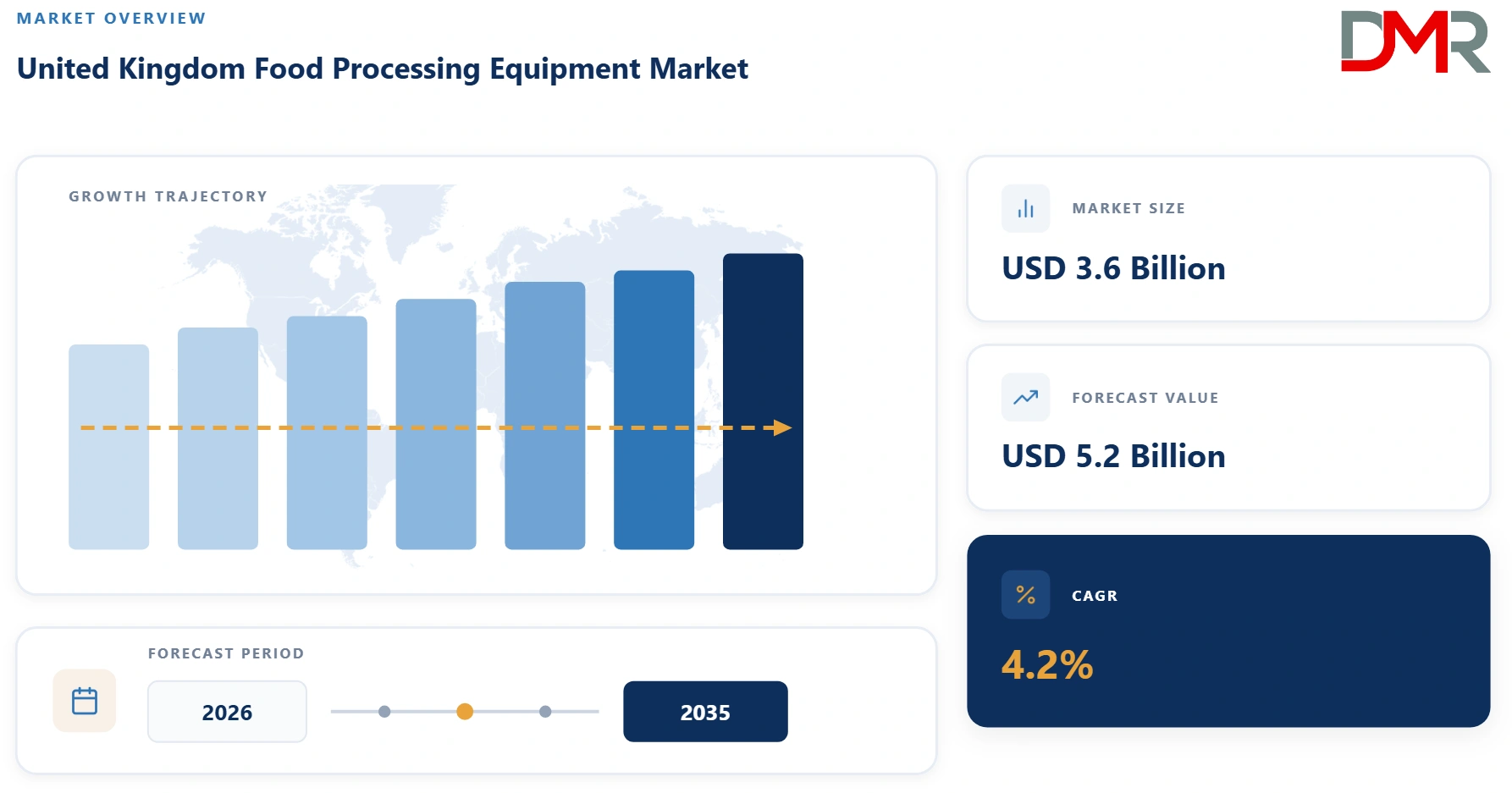
- United Kingdom Food Processing Equipment Market Size in 2026: USD 3.6 billion
- United Kingdom Food Processing Equipment Market Size in 2035: USD 5.2 billion
- United Kingdom CAGR from 2026 to 2035: 4.2%
- Heat Processing Equipment is the leading equipment type segment in 2026: 28.6%
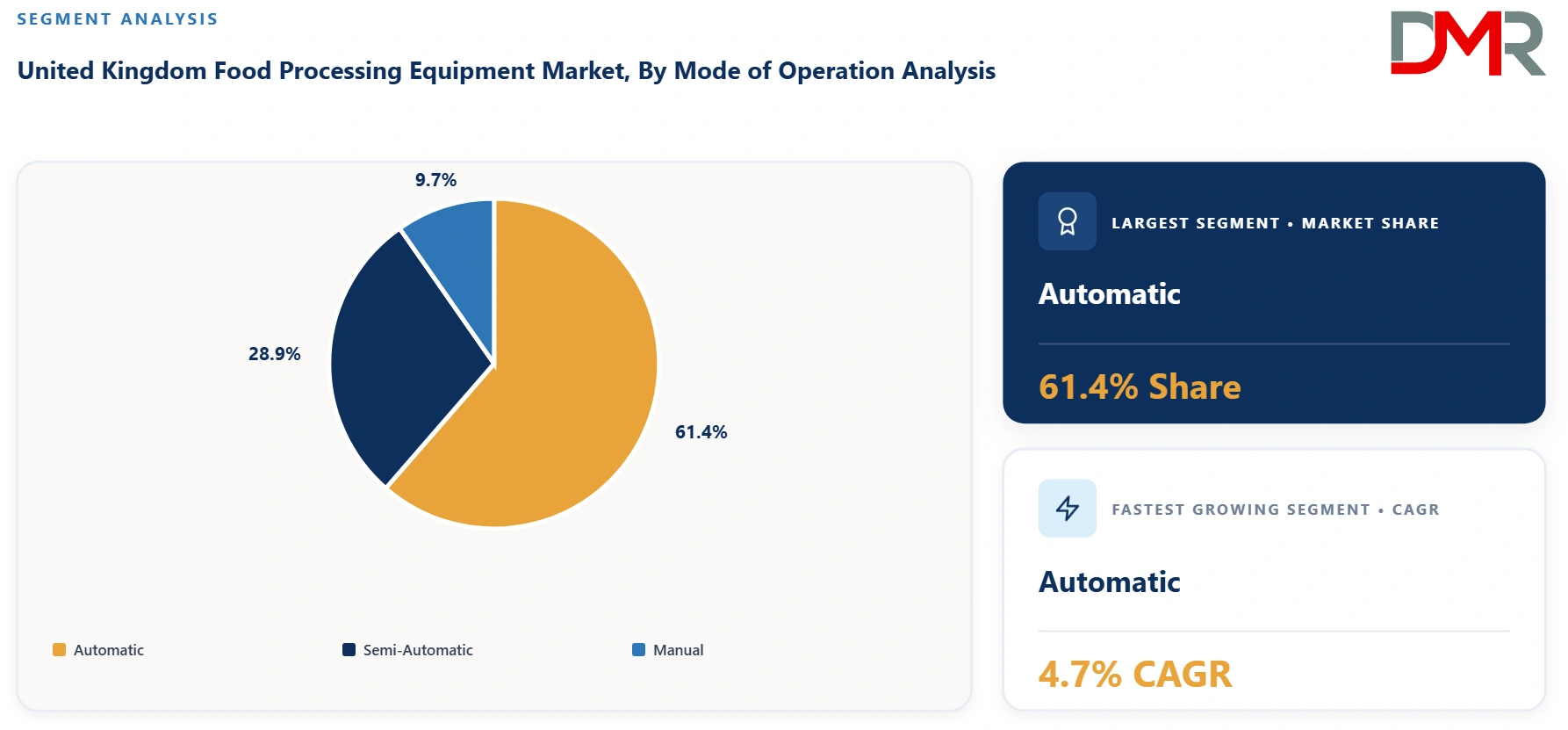
- Automatic is the leading mode of operation segment in 2026: 61.4%
- Solid is the leading form of end product segment in 2026: 49.2%
- Bakery & Confectionery is the leading application segment in 2026: 23.8%
What is the United Kingdom Food Processing Equipment Market and its Market Size?
The United Kingdom Food Processing Equipment Market is projected to reach USD 3.6 billion in 2026 and grow at a compound annual growth rate of 4.2% through 2035 to reach USD 5.2 billion.
ℹ
To learn more about this report –
Download Your Free Sample Report Here
Food processing equipment includes machinery and integrated systems used to prepare, transform, preserve, package, and handle raw agricultural and food ingredients. The market serves dairy, bakery, confectionery, meat, seafood, beverage, produce, grain, edible oil, and convenience-food manufacturers. Factory automation, labour shortages, strict hygiene requirements, production modernization, energy-efficiency targets, and growing consumption of packaged and ready-to-eat foods support demand. The United Kingdom’s established food manufacturing base is encouraging processors to adopt automated, digitally connected, flexible, and hygienically designed equipment capable of improving throughput, product consistency, traceability, food safety, and resource utilization.
Use Cases
- Automated Bakery and Confectionery Production: Bakeries use mixers, dough dividers, proofers, ovens, cooling systems, depositors, enrobers, and packaging machinery to manufacture bread, biscuits, cakes, pastries, and chocolates consistently. Automated lines control temperature, portion size, baking time, and product weight while reducing labour requirements. Integrated inspection and packaging equipment improves food safety, production speed, waste control, shelf life, and presentation across high-volume retail operations.
- Meat, Poultry, and Seafood Processing: Meat, poultry, and seafood manufacturers deploy cutting, deboning, grinding, mixing, forming, cooking, freezing, inspection, and packaging equipment. These systems improve processing accuracy, hygiene, yield, throughput, worker safety, and cold-chain integrity. Automated portioning and vision inspection reduce material losses and contamination risks while enabling processors to satisfy retailer specifications, traceability requirements, product consistency standards, and rapidly changing consumer demand.
- Dairy and Beverage Manufacturing: Dairy and beverage processors use separators, homogenizers, pasteurizers, sterilizers, evaporators, filtration systems, filling machines, and clean-in-place technologies. Equipment controls microbial risks, temperature, composition, viscosity, and product quality while extending shelf life. Connected processing lines support milk, cheese, yoghurt, juices, soft drinks, and alternative beverages by improving energy efficiency, water consumption, recipe management, sanitation, capacity utilization, and production flexibility.
Key Takeaways
- Market Size: The United Kingdom Food Processing Equipment Market is anticipated to be valued at USD 3.6 billion in 2026 and is forecast to reach USD 5.2 billion by 2035, expanding at a CAGR of 4.2%.
- Growth Rate and Outlook: Market expansion is supported by food-factory modernization, labour shortages, automation adoption, smart manufacturing, rising convenience-food consumption, energy-efficiency requirements, stricter hygiene standards, growing demand for flexible production lines, and investment in equipment capable of improving production efficiency, traceability, food quality, consistency, shelf life, and resource utilization.
- Primary Growth Drivers: The United Kingdom’s extensive food and beverage manufacturing base, increasing production costs, shortages of skilled factory workers, retailer quality requirements, demand for packaged foods, and pressure to reduce waste are stimulating equipment upgrades. Food and drink manufacturing supports around 486,500 jobs across 12,195 UK businesses, demonstrating the sizeable addressable manufacturing base.
- By Equipment Type Analysis: Heat Processing Equipment is projected to lead with a 28.6% share in 2026, supported by its widespread use in baking, cooking, pasteurization, sterilization, drying, roasting, and frying. Packaging Equipment is expected to record the fastest CAGR as manufacturers invest in automated filling, sealing, labelling, inspection, and sustainable packaging systems.
- By Mode of Operation Analysis: Automatic equipment is anticipated to dominate with a 61.4% share in 2026. The segment is also expected to record the fastest growth, driven by labour shortages, higher wage costs, greater throughput requirements, automated quality control, robotic handling, reduced human contact, better traceability, and demand for consistent production across high-volume food facilities.
- By Form of End Product Analysis: Solid products are projected to lead with a 49.2% share in 2026, reflecting the extensive processing of bakery goods, confectionery, meat, seafood, produce, grains, and prepared meals. Liquid products are forecast to register the fastest growth due to investments in dairy, beverages, sauces, plant-based drinks, nutritional formulations, and hygienic fluid-processing systems.
- By Application Analysis: Bakery & Confectionery is expected to lead with a 23.8% share in 2026, supported by established domestic production and frequent product innovation. Ready-to-Eat & Ready-to-Cook Foods are projected to grow fastest as consumers increasingly demand convenient meals, prepared ingredients, food-to-go products, portion-controlled foods, and products requiring minimal preparation.
How AI and GenAI are Transforming the United Kingdom Food Processing Equipment Market?
Artificial intelligence is transforming food processing equipment through machine vision, predictive maintenance, automated sorting, process optimization, and real-time quality control. AI-enabled cameras identify defects, foreign materials, incorrect portions, and packaging failures faster than conventional inspection. Predictive models evaluate temperature, vibration, pressure, energy use, and production data to identify equipment failure risks before breakdowns occur. Generative AI can support recipe development, production planning, maintenance guidance, operator training, and digital-twin simulations. Adoption remains dependent on data quality, system interoperability, cybersecurity, technical skills, and investment capacity, particularly among smaller processors. The UK Food Standards Agency has highlighted the need for capacity building and workforce support to enable effective AI adoption.
Key Drivers in the United Kingdom Food Processing Equipment Market
Labour Shortages and Rising Production Costs
Persistent labour availability challenges are encouraging food manufacturers to automate repetitive, hazardous, physically demanding, and precision-sensitive processes. The UK food and drink sector’s vacancy rate reached 5.0% in Q4 2025, compared with 2.1% across manufacturing and 2.3% across the wider economy. Furthermore, 66% of surveyed businesses identified payroll and staffing costs as their greatest concern. Automated cutting, sorting, mixing, inspection, palletizing, cleaning, and packaging equipment can reduce dependence on manual labour while improving throughput and consistency. However, processors increasingly favour modular automation that can deliver measurable productivity improvements without requiring immediate replacement of complete production lines.
Large and Diverse Domestic Food Manufacturing Base
The United Kingdom has a substantial food and drink manufacturing ecosystem serving supermarkets, food-service operators, exporters, and private-label brands. The sector includes approximately 12,195 businesses and 486,500 employees, while the number of food and drink manufacturing businesses increased 14% between 2019 and 2024. This broad customer base creates recurring demand for preparation, thermal processing, preservation, packaging, inspection, and material-handling equipment. Different product categories require specialized machinery, making flexible and configurable processing platforms increasingly valuable. Growing product variety, short production runs, allergen management, retailer specifications, and rapid recipe changes are also encouraging investment in equipment that supports faster cleaning, automated changeovers, and integrated traceability.
Restraints in the United Kingdom Food Processing Equipment Market
High Capital Costs and Restrained Manufacturing Investment
Advanced food processing lines require substantial expenditure on machinery, installation, factory modification, software, safety systems, workforce training, validation, and maintenance. These costs can be difficult for small and medium-sized processors with restricted borrowing capacity and uncertain order volumes. In 2025, 41% of surveyed food and drink manufacturers reported scaling back investment, while average production costs increased 4.5% during the year to March. Energy, ingredients, labour, packaging compliance, and financing costs can redirect budgets from long-term equipment modernization toward immediate operating requirements. Processors therefore increasingly demand equipment leasing, phased implementation, retrofit solutions, and clearly demonstrated payback periods before approving large automation projects.
Integration Complexity and Shortage of Technical Skills
Food factories frequently operate equipment from multiple suppliers, installed across different technology generations and controlled through incompatible software. Connecting older machinery with sensors, manufacturing execution systems, enterprise platforms, machine-vision tools, and cloud analytics can require expensive engineering work. Integration failures may disrupt production, compromise traceability, or increase cybersecurity exposure. Smaller processors can also lack internal automation engineers, data specialists, and maintenance technicians capable of managing connected machinery. Training requirements, production downtime during installation, and uncertainty concerning data ownership can further delay adoption. Equipment providers must offer open communication protocols, secure remote support, simplified interfaces, workforce training, and retrofit-compatible systems to overcome these barriers.
Growth Opportunities in the United Kingdom Food Processing Equipment Market
Modular Automation for Small and Medium-Sized Processors
Small and medium-sized enterprises account for around 98% of UK food and drink manufacturing businesses, creating a sizeable opportunity for compact, affordable, and scalable processing systems. Instead of investing in fully automated greenfield factories, smaller producers can deploy individual robotic cells, optical sorters, automated fillers, compact ovens, inspection systems, and digital monitoring platforms. Equipment-as-a-service, leasing, remote maintenance, and performance-based financing can reduce upfront costs. Suppliers offering modular equipment that integrates with existing lines can address the needs of artisanal manufacturers, regional brands, contract producers, and private-label suppliers seeking greater capacity without sacrificing product flexibility.
Sustainable and Resource-Efficient Processing Systems
Energy, water, food loss, and packaging waste are becoming increasingly important equipment-purchasing considerations. Manufacturers need heat-recovery systems, efficient motors, low-water cleaning technologies, precision portioning, optimized refrigeration, and monitoring software that measures utilities at equipment level. Opportunities are expanding for continuous processing systems that reduce idle time and digital controls that adjust heat, pressure, flow, and cleaning cycles automatically. Equipment suppliers can differentiate through independently verified energy savings, lifecycle assessments, recyclable construction materials, and upgradeable components. Growing investment in alternative proteins, plant-based beverages, food-waste valorization, fermentation, and by-product recovery also creates demand for specialized separation, drying, extrusion, and filtration equipment.
Trends in the United Kingdom Food Processing Equipment Market
Smart Factories and Connected Production Lines
Manufacturers are moving from isolated machines toward connected production environments that integrate sensors, programmable controls, manufacturing execution systems, quality platforms, and enterprise software. Connected lines give operators real-time visibility into output, downtime, energy use, waste, maintenance requirements, and product quality. Cloud dashboards and secure remote diagnostics are becoming more common, while digital twins support line configuration and performance simulation before physical changes are made. Tetra Pak’s Factory OS, introduced in November 2025, reflects this direction by combining equipment and systems into a unified, real-time factory view designed to support analytics and AI adoption.
AI-Based Sorting, Inspection, and Predictive Maintenance
Artificial intelligence is becoming increasingly visible in optical sorting, foreign-material detection, grading, portioning, packaging inspection, and equipment maintenance. Deep-learning systems can adapt to natural variations in food products and detect complex defects that rule-based inspection systems may miss. Bühler launched its SORTEX AI700 optical sorter in London in May 2025, initially targeting the removal of gluten-containing grains from oats. Such developments demonstrate how processors can enhance product integrity while protecting yield. Predictive maintenance is also expanding as connected machines analyze vibration, temperature, current, and production patterns to reduce unexpected downtime and optimize component replacement.
Research Scope and Analysis
Research covers United Kingdom food processing equipment market across equipment type, preparation mechanical processing heat processing preservation packaging and others, operation mode covering automatic semi-automatic and manual, end product form covering solid semi solid and liquid, and applications spanning dairy bakery confectionery meat poultry seafood fruits vegetables grains pulses beverages prepared foods oils and others.
ℹ
To learn more about this report –
Download Your Free Sample Report Here
By Equipment Type Analysis
Heat Processing Equipment is expected to hold the highest market share of 28.6% in 2026, driven by its essential role in cooking, pasteurization, baking, frying, roasting, drying, and sterilization.
Packaging Equipment is projected to record the highest CAGR of approximately 4.8%, owing to automated packing, labelling, sealing, inspection, traceability, and sustainable-material requirements.
By Mode of Operation Analysis
Automatic equipment is projected to dominate the market with a 61.4% share in 2026, supported by demand for high throughput, standardized production, worker safety, reduced contamination, and lower dependence on manual labour.
Automatic equipment is also expected to register the highest CAGR of approximately 4.7%, rate as processors invest in robotics, machine vision, automated controls, and connected production lines.
By Form of End Product Analysis
Solid products are anticipated to account for the highest market share of 49.2% in 2026, reflecting extensive equipment use across bakery, confectionery, meat, seafood, grain, vegetable, and convenience-food manufacturing.
Liquid products are forecast to expand at the highest CAGR of approximately 4.6%, supported by increasing processing of dairy beverages, juices, sauces, functional drinks, and plant-based liquid formulations.
By Application Analysis
Bakery & Confectionery is projected to lead with a 23.8% share in 2026, supported by established UK production, retail demand, continuous product launches, and extensive requirements for mixing, forming, baking, cooling, coating, and packaging.
Ready-to-Eat & Ready-to-Cook Foods are expected to register the highest CAGR of approximately 5.1%, driven by convenience, food-to-go consumption, smaller households, and demand for quick meal preparation.
The United Kingdom Food Processing Equipment Market Report is Segmented Based on the Following
By Equipment Type
- Preparation Equipment
- Mechanical Processing Equipment
- Heat Processing Equipment
- Preservation Equipment
- Packaging Equipment
- Others
By Mode of Operation
- Automatic
- Semi-Automatic
- Manual
By Form of End Product
By Application
- Dairy Products
- Bakery & Confectionery
- Meat & Poultry
- Fish & Seafood
- Fruits & Vegetables
- Grains & Pulses
- Beverages
- Ready-to-Eat & Ready-to-Cook Foods
- Edible Oils
- Others
Technology Analysis
Technology development is shifting food processing equipment toward automated, sensor-enabled, software-controlled, and interconnected systems. Machine vision improves sorting, grading, portioning, and contamination detection, while predictive analytics reduces unplanned downtime. Robotics supports cutting, picking, packing, palletizing, and repetitive handling tasks in cold or hazardous environments. Digital twins allow manufacturers to simulate production changes, optimize capacity, and assess equipment performance before implementation. Opportunities are emerging in retrofittable sensors, modular robots, secure remote monitoring, automated clean-in-place systems, and low-code production software. However, interoperability, cybersecurity, data ownership, integration expenses, and technical skill shortages remain important adoption risks, particularly across older facilities and smaller manufacturing businesses.
Regulatory Landscape
Food processing equipment in the United Kingdom must satisfy requirements covering machinery safety, worker protection, food hygiene, materials in contact with food, electrical systems, and product traceability. Hygienic design must minimize contamination risks and enable effective cleaning, drainage, inspection, and maintenance. The UK Health and Safety Executive identifies British and European standards addressing the safety design of food machinery. Regulatory compliance creates opportunities for suppliers offering certified equipment, hygienic surfaces, automated sanitation, contamination controls, documentation, and validation support. However, evolving UKCA and CE marking arrangements, retained legislation, regulatory divergence, and compliance costs can complicate market access and equipment procurement, especially for imported machinery and smaller suppliers.
Competitive Landscape
The United Kingdom Food Processing Equipment Market is competitive and includes multinational technology groups, specialized processing-equipment manufacturers, packaging-system providers, and domestic engineering companies. Competition is based on automation capability, hygienic design, energy efficiency, throughput, product yield, equipment reliability, integration, lifecycle costs, and aftermarket service. Large suppliers increasingly offer complete processing lines, software, remote monitoring, maintenance, and consulting. Specialized manufacturers compete through application expertise and customized machinery. Partnerships, acquisitions, demonstration centres, AI-enabled equipment, modular automation, and local technical support are becoming important strategies as processors seek measurable productivity improvements and faster returns on investment.
Some of the Prominent Players in the United Kingdom Food Processing Equipment Market Are
- JBT Marel Corporation
- GEA Group AG
- Bühler AG
- Tetra Pak International S.A.
- Alfa Laval AB
- Krones AG
- MULTIVAC Group
- The Middleby Corporation
- SPX FLOW Inc.
- Syntegon Technology GmbH
- Heat and Control Inc.
- Provisur Technologies Inc.
- BAADER Group
- Duravant LLC
- Coperion GmbH
- Hosokawa Micron Group
- Key Technology Inc.
- TOMRA Systems ASA
- Ishida Co Ltd
- KHS GmbH
- Sacmi Imola SC
- Sidel Group
- GEA CFS
- Handtmann Group
- Vemag Maschinenbau GmbH
- Risco S.p.A.
- Treif Maschinenbau GmbH
- Bettcher Industries Inc.
- Weber Maschinenbau GmbH
- FAM Stumabo
- Urschel Laboratories Inc.
- Baker Perkins Ltd
- BCH Ltd
- DC Norris & Company Ltd
- Marel UK Ltd
- Fortress Technology Europe Ltd
- Loma Systems
- TNA Solutions Pty Ltd
- Rotex Global LLC
- Advanced Food Technology Ltd
- Other Key Players
Recent Developments
- May 2026 – Bühler: Bühler introduced multiple new and upgraded technologies across its Grains & Food portfolio at Interpack 2026. The developments focused on processing efficiency, digitalization, product quality, and more sustainable food production.
- November 2025 – Tetra Pak: Tetra Pak launched Factory OS, a modular and scalable automation and digitalization portfolio designed to connect factory equipment, unify production data, provide real-time insights, and prepare food and beverage factories for AI-enabled operations.
- August 2025 – Bühler: Bühler launched the SORTEX R500 optical sorter in London. The equipment is designed to operate with greater autonomy, improve rice-processing efficiency, simplify operation, reduce material waste, and support processors facing labour and margin pressures.
- January 2025 – JBT Marel: JBT completed its acquisition of Marel, creating JBT Marel Corporation and combining complementary technologies across meat, poultry, seafood, prepared foods, beverages, and automated processing systems.
Report Details
| Report Characteristics |
| Market Size (2026) |
USD 3.6 Bn |
| Forecast Value (2035) |
USD 5.2 Bn |
| CAGR (2026–2035) |
4.2% |
| Historical Data |
2021 – 2025 |
| Forecast Data |
2026 – 2035 |
| Base Year |
2025 |
| Segments Covered |
By Equipment Type, By Mode of Operation, By Form of End Product, By Application |
Frequently Asked Questions
How big is the United Kingdom Food Processing Equipment Market?
▾ The United Kingdom Food Processing Equipment Market is projected to reach USD 3.6 billion in 2026 and USD 5.2 billion by 2035.
What is the CAGR of the United Kingdom Food Processing Equipment Market from 2026 to 2035?
▾ The market is expected to expand at a compound annual growth rate of 4.2% between 2026 and 2035.
What factors are driving the growth of the United Kingdom Food Processing Equipment Market?
▾ Growth is driven by automation, labour shortages, rising production costs, strict food-safety standards, convenience-food demand, factory modernization, sustainability targets, and increasing adoption of connected processing equipment.
What are the major trends in the United Kingdom Food Processing Equipment Market?
▾ Major trends include AI-powered optical sorting, machine vision, predictive maintenance, robotic handling, connected production lines, digital twins, modular automation, hygienic equipment design, and energy-efficient processing technologies.
Who are the key players in the United Kingdom Food Processing Equipment Market?
▾ Major players include JBT Marel, GEA Group, Bühler, Tetra Pak, Alfa Laval, Krones, MULTIVAC, Middleby, Syntegon, Heat and Control, Provisur Technologies, TOMRA, Ishida, Baker Perkins, and DC Norris.
How is the United Kingdom Food Processing Equipment Market segmented?
▾ The market is segmented by equipment type, mode of operation, form of end product, and application. Major applications include dairy, bakery and confectionery, meat and poultry, seafood, fruits and vegetables, grains, beverages, prepared foods, and edible oils.