United Kingdom Food Traceability Technology Market Snapshot
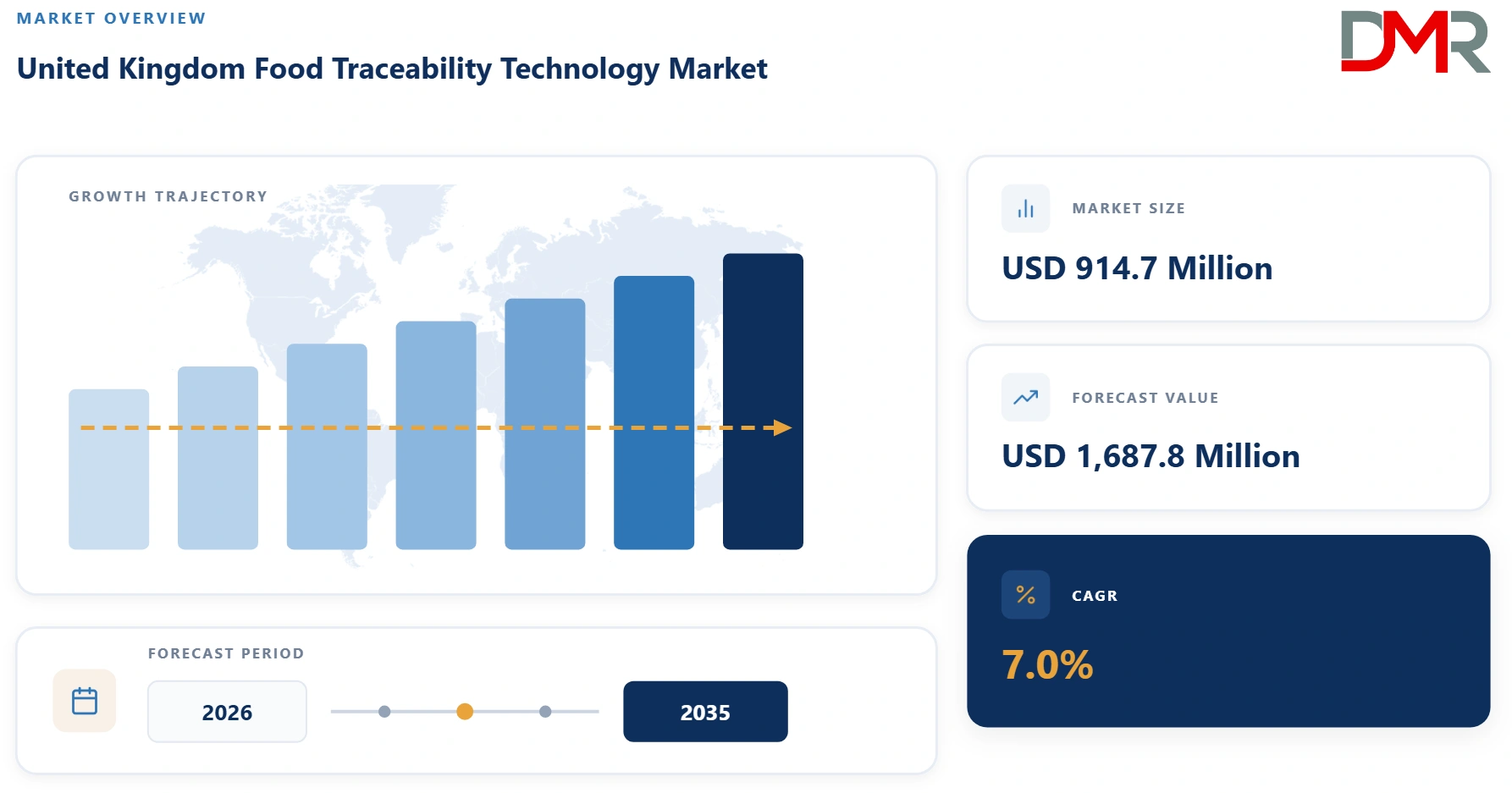
- United Kingdom Food Traceability Technology Market Size in 2026: USD 914.7 Million
- United Kingdom Food Traceability Technology Market Size in 2035: USD 1,687.8 Million
- United Kingdom CAGR from 2026 to 2035: 7.0%
- Software and Platforms is the leading component segment in 2026: 47.2%
- RFID and Barcode or QR Code Systems is the leading technology segment in 2026: 46.8%
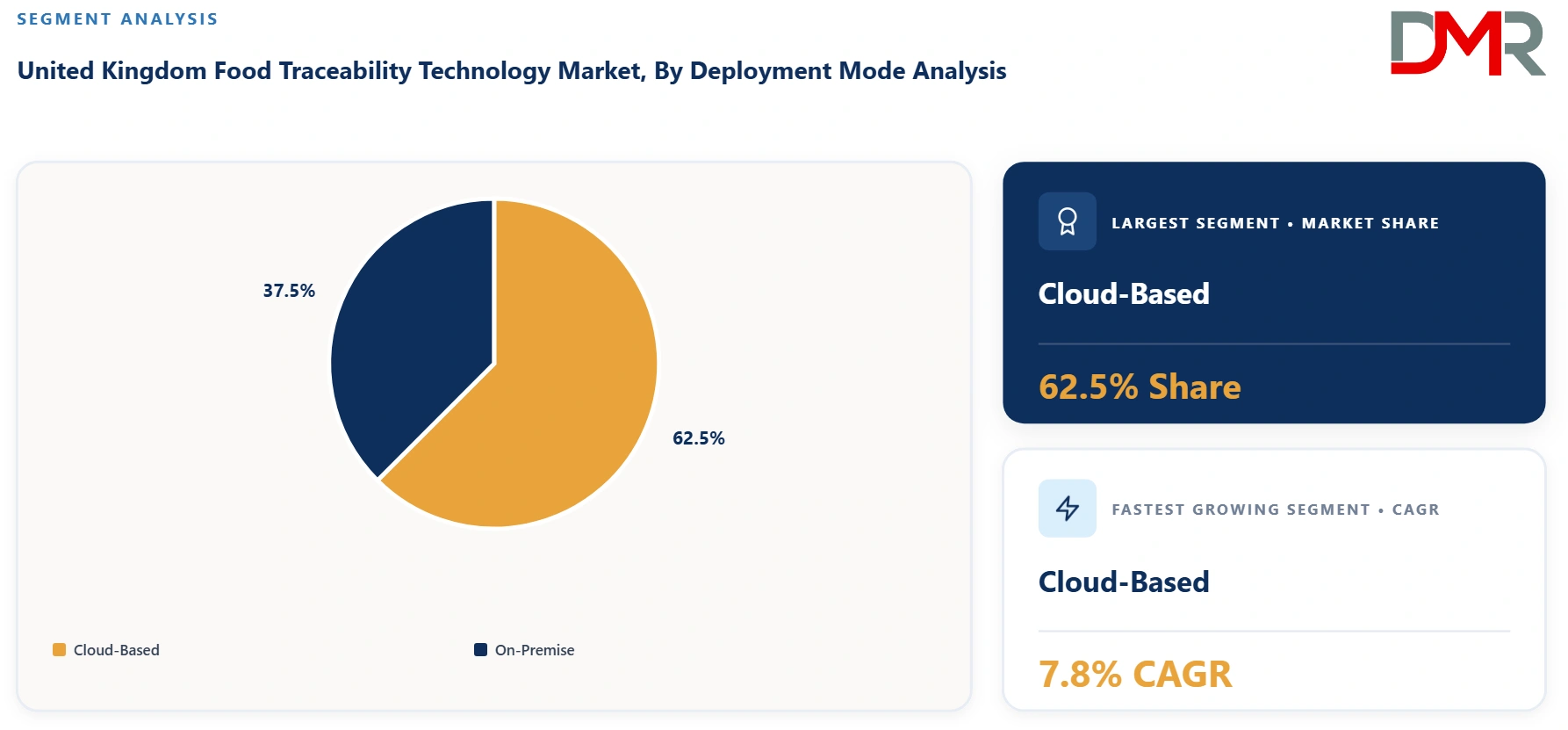
- Cloud Based is the leading deployment mode segment in 2026: 62.5%
- Supply Chain Visibility and Track and Trace is the leading application segment in 2026: 36.4%
- Food and Beverage Manufacturers is the leading end-user segment in 2026: 38.7%
What is the United Kingdom Food Traceability Technology Market and its Market Size?
The United Kingdom Food Traceability Technology Market is projected to reach USD 914.7 million in 2026 and grow at a compound annual growth rate of 7.0% through 2035 to reach USD 1,687.8 million.
ℹ
To learn more about this report –
Download Your Free Sample Report Here
Food traceability technology enables businesses to identify, record, verify, and exchange product information from farms and ingredient sources through processing, logistics, retail, foodservice, and final sale. The United Kingdom market includes software platforms, scanners, labels, RFID infrastructure, IoT sensors, analytics, blockchain networks, and implementation services. Adoption is expanding as manufacturers and retailers modernize recall readiness, supplier assurance, inventory control, sustainability reporting, and regulatory documentation. Cloud platforms and standards-based product identifiers are connecting fragmented supply chains, while artificial intelligence converts high-volume operational data into risk alerts and decision support for quality, safety, and waste reduction.
Use Cases
- End-to-End Track and Trace: Manufacturers assign standardized identifiers to ingredients, batches, pallets, and finished products, creating a connected record from supplier receipt through production and dispatch. Barcode, RFID, and cloud platforms capture each custody event, helping businesses locate affected lots, verify provenance, reduce manual recordkeeping, answer customer inquiries, and improve visibility across complex domestic and imported food supply networks.
- Food Recall and Safety Response: Traceability platforms connect supplier documents, production records, testing results, shipment data, and customer locations so safety teams can investigate incidents quickly. Automated alerts identify potentially affected stock and trading partners, support targeted withdrawals, and preserve audit trails for regulators. Faster data access limits unnecessary disposal, reduces consumer exposure, and protects brand reputation during contamination or allergen events.
- Cold Chain and Freshness Monitoring: IoT temperature, humidity, and location sensors monitor chilled and frozen foods during storage and transportation. Platforms analyze readings against product thresholds, notify teams about excursions, and associate conditions with individual lots or shipments. Operators can intervene before spoilage, demonstrate handling compliance, improve shelf-life decisions, reduce food waste, and strengthen accountability among logistics providers and receiving locations.
Key Takeaways
- Market Size: The United Kingdom Food Traceability Technology Market is anticipated to be valued at USD 914.7 million in 2026 and is forecast to reach USD 1,687.8 million by 2035, expanding at a CAGR of 7.0%.
- Growth Outlook: Expansion is supported by food safety obligations, retailer supplier assurance programs, greater QR code adoption, cloud transformation, demand for verifiable provenance, rising recall readiness, cross-border documentation needs, and integration of connected sensors and analytics across manufacturing, logistics, grocery, and foodservice operations.
- Primary Growth Drivers: Mandatory traceability records, complex global sourcing, food fraud concerns, allergen management, consumer demand for transparency, inventory digitization, sustainability reporting, cold chain monitoring, and the need for rapid targeted recalls are accelerating investment in interoperable food traceability platforms and automated data capture.
- By Component Analysis: Software and Platforms is projected to lead with a 47.2% share in 2026, supported by demand for centralized records, supplier portals, compliance workflows, recall management, analytics, and integration with enterprise systems. Services should expand rapidly as organizations need implementation, data mapping, training, validation, and managed support.
- By Technology Analysis: RFID and Barcode or QR Code Systems is expected to lead with a 46.8% share in 2026 because standardized identifiers are affordable, familiar, scalable, and compatible with retail and warehouse workflows. Blockchain is projected to grow strongly as higher-value and complex supply chains seek shared, tamper-evident provenance records.
- By Deployment Mode Analysis: Cloud Based deployment is anticipated to dominate with a 62.5% share in 2026. Subscription access, easier supplier onboarding, remote collaboration, scalability, and faster updates support adoption. Cloud solutions also simplify data exchange across dispersed plants, logistics partners, restaurants, and retailers while reducing internal infrastructure requirements.
- By Application Analysis: Supply Chain Visibility and Track and Trace is projected to lead with a 36.4% share in 2026. Food Safety and Recall Management is expected to record robust growth as businesses prioritize faster incident investigation, precise lot identification, automated notifications, and evidence-based response across increasingly interconnected food networks.
- By End-User Analysis: Food and Beverage Manufacturers is anticipated to dominate with a 38.7% share in 2026 due to extensive supplier, batch, quality, allergen, and production data requirements. Logistics and Distribution Providers should grow rapidly as real-time location, condition monitoring, and custody-event capture become central to service differentiation and compliance.
How AI and Gen AI are Transforming the United Kingdom Food Traceability Technology Market?
Artificial intelligence is shifting traceability from passive recordkeeping toward predictive risk management. Machine learning analyzes supplier performance, temperature excursions, complaints, test results, and transaction anomalies to flag contamination, fraud, or disruption risks before they escalate. Computer vision verifies labels, dates, packaging, and product identity on production lines. Generative AI helps quality teams query complex records, summarize incidents, draft recall communications, and map regulatory evidence. Wider adoption will depend on validated models, secure data governance, explainable outputs, and human oversight because inaccurate recommendations can create safety, compliance, and reputational consequences.
Key Drivers in the United Kingdom Food Traceability Technology Market
Mandatory Records and Stronger Recall Readiness
UK food businesses must maintain up-to-date records of suppliers and the businesses they supply, creating a durable compliance foundation for digital traceability. Regulators emphasize that traceability supports efficient and accurate withdrawals and recalls when food safety problems arise. Digital platforms replace fragmented spreadsheets and paper records with searchable lot histories, standardized identifiers, and auditable workflows. Adoption is also reinforced by retailer assurance schemes and customer requirements that often exceed minimum legal obligations. As supply networks span imported ingredients, contract manufacturing, wholesalers, and multiple retail formats, rapid access to trustworthy records becomes essential for containing incidents, demonstrating due diligence, and maintaining market access.
Product Transparency and Connected Packaging
Consumer interaction with connected packaging is strengthening the business case for modern identifiers. GS1 UK reported that 79% of consumers had interacted with a product through a QR code and 51% expected to do so again within twelve months. QR codes powered by GS1 can connect a single product identifier with provenance, nutrition, allergen, recycling, and sustainability information while supporting operational scanning. A Tesco UK pilot subsequently tested GS1-enabled QR codes to provide shoppers with trusted information on nutrition, sourcing, and recycling. This convergence of consumer engagement and supply chain data encourages brands and retailers to invest in accurate master data, interoperable standards, and item-level digital identities.
Restraints in the United Kingdom Food Traceability Technology Market
Legacy Integration and Fragmented Supplier Data
Food supply chains include farms, processors, importers, contract manufacturers, laboratories, logistics providers, wholesalers, restaurants, and retailers using different identifiers and software. Integrating traceability platforms with ERP, warehouse, quality, and point-of-sale systems can require extensive data cleansing and process redesign. Smaller suppliers may lack digital capability or standardized records, forcing larger buyers to maintain parallel manual workflows. Inconsistent event definitions, incomplete lot coding, and weak master data reduce end-to-end visibility even when individual organizations deploy advanced tools. These interoperability challenges lengthen implementation schedules, increase consulting requirements, and can prevent businesses from realizing expected recall speed and inventory benefits.
Implementation Cost Cybersecurity and Organizational Resistance
Hardware readers, smart labels, sensor infrastructure, software subscriptions, integration, validation, training, and ongoing support can create a high total cost for businesses operating on narrow margins. RFID economics may be difficult for low-value or short-lifecycle products, while IoT devices require maintenance and reliable connectivity. Centralized cloud records and connected equipment also expand the cybersecurity attack surface and raise concerns about commercially sensitive supplier data. Employees and trading partners may resist new scanning steps when workflows appear burdensome. Projects can therefore stall without clear governance, measurable operational benefits, phased deployment, strong access controls, and executive sponsorship across quality, operations, procurement, technology, and commercial functions.
Growth Opportunities in the United Kingdom Food Traceability Technology Market
SME-Ready Cloud Platforms and Managed Compliance
A significant opportunity exists for configurable cloud platforms that allow smaller manufacturers, foodservice operators, and suppliers to digitize traceability without large internal technology teams. Vendors can offer modular subscriptions, mobile scanning, prebuilt templates, automated certificate collection, and integrations with accounting or inventory applications. Managed onboarding and data-normalization services can help connect suppliers that still depend on spreadsheets or paper. Solutions designed around UK regulatory workflows, allergen controls, retailer questionnaires, and recall simulations can reduce implementation friction. Providers that demonstrate rapid time to value and transparent pricing can expand adoption beyond large grocery and manufacturing groups while building network effects across shared supplier communities.
IoT AI and Sustainability Data Convergence
Combining traceability records with temperature, location, freshness, waste, carbon, and sourcing data creates opportunities beyond basic compliance. IoT sensors can associate real-time conditions with batches and shipments, while AI identifies abnormal routes, shelf-life risks, fraud signals, and recurring supplier problems. The UK Food Data Transparency Partnership seeks consistent and science-led environmental impact measurement across agri-food businesses, increasing demand for reliable product and supply chain data. Technology vendors can develop shared data layers that support recalls, operational optimization, sustainability claims, and consumer communication. Strong verification and interoperable standards will be critical to prevent greenwashing and ensure that insights remain auditable.
Trends in the United Kingdom Food Traceability Technology Market
Migration from Linear Barcodes to Data-Rich QR Codes
Retail and food businesses are moving toward two-dimensional identifiers that can support checkout scanning while linking users to continually updated digital information. GS1-based QR codes allow brands to connect product identity with batch data, provenance, allergens, nutrition, recycling instructions, and engagement content without crowding packaging. This change encourages improved product master data and closer collaboration among manufacturers, retailers, packaging suppliers, and technology providers. Adoption will proceed gradually because printing quality, scanner readiness, data governance, and legacy barcode compatibility must be managed. Vendors that provide verification tools, resolver services, and standards-based integration are positioned to benefit from this transition.
From Periodic Audits to Continuous Risk Monitoring
Traceability programs are increasingly incorporating live operational signals instead of relying only on retrospective documentation. Connected sensors, supplier portals, automated document validation, and analytics continuously assess temperature, certification status, lot movement, testing, and exception patterns. Artificial intelligence can prioritize investigations and predict where failures are most likely, helping limited quality teams focus on higher-risk products or suppliers. The FSA has recommended the development of validation standards and a code of practice for AI used in food safety and authenticity, highlighting the need for assurance alongside innovation. Consequently, vendors are adding explainability, model governance, audit logs, and human approval controls to traceability workflows.
Research Scope and Analysis
The report examines United Kingdom food traceability technology across software platforms hardware services blockchain RFID barcode QR systems IoT sensors artificial intelligence analytics cloud based and on premise deployment supply chain visibility recall management compliance reporting quality assurance inventory management manufacturers foodservice operators retailers grocery chains logistics providers market dynamics competition regulation technology adoption investment opportunities.
ℹ
To learn more about this report –
Download Your Free Sample Report Here
By Component Analysis
Software and Platforms is expected to hold the largest component share of 47.2% in 2026, supported by centralized compliance records, supplier collaboration, recall workflows, and analytics. Services is projected to record the highest component CAGR of approximately 7.8% through 2035 as organizations require integration, implementation, validation, training, data migration, and managed operational support.
By Technology Analysis
RFID and Barcode or QR Code Systems is projected to dominate technology with a 46.8% share in 2026 due to affordability, standardized identification, and established scanning workflows. Blockchain is anticipated to register the highest technology CAGR of around 8.5% through 2035 as businesses seek tamper-evident provenance, shared records, and stronger trust across complex supply networks.
By Deployment Mode Analysis
Cloud-based deployment is expected to lead with a 62.5% share in 2026, reflecting subscription accessibility, scalability, remote collaboration, and easier supplier onboarding. Cloud-based solutions are also projected to post the highest deployment CAGR of approximately 7.8% through 2035 as businesses modernize systems and connect dispersed supply chain participants.
By Application Analysis
Supply Chain Visibility and Track and Trace is anticipated to hold the largest application share of 36.4% in 2026 because product movement and custody records underpin traceability programs. Food Safety and Recall Management is projected to achieve the highest application CAGR of around 7.7% through 2035 as targeted response and incident readiness become strategic priorities.
By End-User Analysis
Food and Beverage Manufacturers is projected to lead end users with a 38.7% share in 2026 due to extensive batch, supplier, production, and quality documentation needs. Logistics and Distribution Providers is expected to record the highest end-user CAGR of approximately 7.6% through 2035 as connected condition monitoring and custody visibility expand.
The United Kingdom Food Traceability Technology Market Report is segmented based on the following
By Component
- Software and Platforms
- Hardware
- Services
By Technology
- Blockchain
- RFID and Barcode or QR Code Systems
- IoT Sensors
- Artificial Intelligence and Data Analytics
- Others
By Deployment Mode
By Application
- Supply Chain Visibility and Track and Trace
- Food Safety and Recall Management
- Regulatory Compliance Reporting
- Quality Assurance and Inventory Management
- Others
By End User
- Food and Beverage Manufacturers
- Foodservice and Restaurant Operators
- Retailers and Grocery Chains
- Logistics and Distribution Providers
Regulatory Landscape
The UK regulatory landscape makes traceability a core operating requirement across food production and distribution. Food businesses must keep current supplier and business-customer records and make them available for inspection, supporting one-step-backward and one-step-forward visibility. Recall and withdrawal obligations strengthen demand for searchable lot histories, communication workflows, and evidence preservation. Devolved enforcement and differences across England, Wales, Scotland, and Northern Ireland require configurable compliance content. Post-Brexit trade arrangements and prospective UK-EU sanitary and phytosanitary alignment may change documentation processes. Opportunities favour standards-based platforms that update rules efficiently, while risks include inaccurate records, inaccessible evidence, privacy failures, and overreliance on unvalidated automated decisions.
Technology Analysis
Technology development is moving from isolated barcode databases toward interoperable digital identity ecosystems. RFID supports rapid non-line-of-sight inventory capture, QR codes connect operational and consumer information, and IoT sensors add continuous condition data. Cloud platforms integrate supplier documents, production events, transport records, and retail transactions, while blockchain can preserve shared provenance where multiple parties require trust. Artificial intelligence identifies anomalies, predicts safety risks, and summarizes complex evidence. The strongest opportunities lie in combining these tools through open standards and application programming interfaces. However, poor master data, sensor calibration errors, cybersecurity threats, vendor lock-in, limited small-supplier readiness, and insufficient AI validation can weaken accuracy and market confidence.
Competitive Landscape
The United Kingdom market is fragmented across global enterprise software providers, automatic identification specialists, sensor manufacturers, laboratory and assurance groups, and food-focused cloud platforms. Competition centers on interoperability, supplier-network reach, regulatory workflow depth, analytics, ease of deployment, cybersecurity, and total ownership cost. Large vendors combine hardware, cloud, and integration capabilities, while specialists differentiate through food-industry expertise and rapid configuration. Partnerships with retailers, manufacturers, standards organizations, packaging companies, and logistics providers are becoming important. Vendors are also expanding AI, connected packaging, sustainability data, and managed compliance services to increase recurring revenue and customer retention.
Some of the Prominent Players in the United Kingdom Food Traceability Technology Market Are
- IBM Corporation
- SAP SE
- Oracle Corporation
- Microsoft Corporation
- Zebra Technologies Corporation
- Avery Dennison Corporation
- Honeywell International Inc.
- Siemens AG
- Schneider Electric SE
- Rockwell Automation Inc.
- Mettler-Toledo International Inc.
- Cognex Corporation
- SATO Holdings Corporation
- Datalogic S.p.A.
- Impinj Inc.
- Alien Technology LLC
- Toshiba Tec Corporation
- TEKLYNX International
- Loftware Inc.
- TraceGains Inc.
- Trustwell
- FoodLogiQ
- ReposiTrak Inc.
- rfxcel Corporation
- Antares Vision Group
- OPTEL Group
- Kezzler AS
- Mojix Inc.
- iFoodDS
- Wiliot Ltd.
- FreshKampo
- Overhaul Group Inc.
- Roambee Corporation
- Controlant
- Sensitech Inc.
- SGS SA
- Bureau Veritas SA
- Intertek Group plc
- Oritain Global Limited
- Industrial Technology Systems Ltd.
- Other Key Players
Recent Developments
- February 2026 — Avery Dennison: Avery Dennison launched the AD IdentiFresh inlay series for bakery, meat, deli, and produce, extending RFID-enabled real-time inventory visibility to fresh-food categories and supporting freshness, operational efficiency, and waste reduction.
- November 2025 — GS1 UK and Tesco UK: GS1 UK reported that a Tesco UK pilot used GS1-enabled QR codes to give shoppers trusted product information covering nutrition, sourcing, and recycling, demonstrating how connected packaging can unite consumer transparency with standardized product data.
- September 2025 — Avery Dennison and Wiliot: Avery Dennison and Wiliot expanded their strategic partnership to scale ambient IoT manufacturing, performance, and global market reach, strengthening the availability of connected sensing technologies for real-time supply chain intelligence.
Report Details
| Report Characteristics |
| Market Size (2026) |
USD 914.7 Mn |
| Forecast Value (2035) |
USD 1687.8 Mn |
| CAGR (2026–2035) |
7.0% |
| Historical Data |
2021 – 2025 |
| Forecast Data |
2026 – 2035 |
| Base Year |
2025 |
| Segments Covered |
By Component, By Technology, By Deployment Mode, Application, By End User |
Frequently Asked Questions
How big is the United Kingdom Food Traceability Technology Market?
▾ The United Kingdom Food Traceability Technology Market is projected to be valued at USD 914.7 million in 2026 and reach USD 1,687.8 million by 2035.
What is the CAGR of the United Kingdom Food Traceability Technology Market from 2026 to 2035?
▾ The market is expected to expand at a CAGR of 7.0% during the 2026–2035 forecast period.
What factors are driving the growth of the United Kingdom Food Traceability Technology Market?
▾ Growth is driven by mandatory recordkeeping, recall readiness, connected packaging, complex sourcing, consumer transparency, cloud adoption, IoT monitoring, and demand for reliable compliance evidence.
What are the major trends in the United Kingdom Food Traceability Technology Market?
▾ Major trends include GS1-enabled QR codes, cloud supplier networks, RFID adoption in fresh foods, continuous IoT monitoring, AI-based risk detection, blockchain provenance, and integrated sustainability data.
Who are the key players in the United Kingdom Food Traceability Technology Market?
▾ Key participants include IBM, SAP, Oracle, Microsoft, Zebra Technologies, Avery Dennison, Honeywell, TraceGains, Trustwell, FoodLogiQ, SGS, Intertek, Oritain, and other specialized providers.
How is the United Kingdom Food Traceability Technology Market segmented?
▾ The market is segmented by component, technology, deployment mode, application, and end user, covering software platforms, hardware, services, blockchain, RFID, barcode and QR systems, IoT sensors, AI analytics, cloud, and on-premise solutions.