Market Snapshot
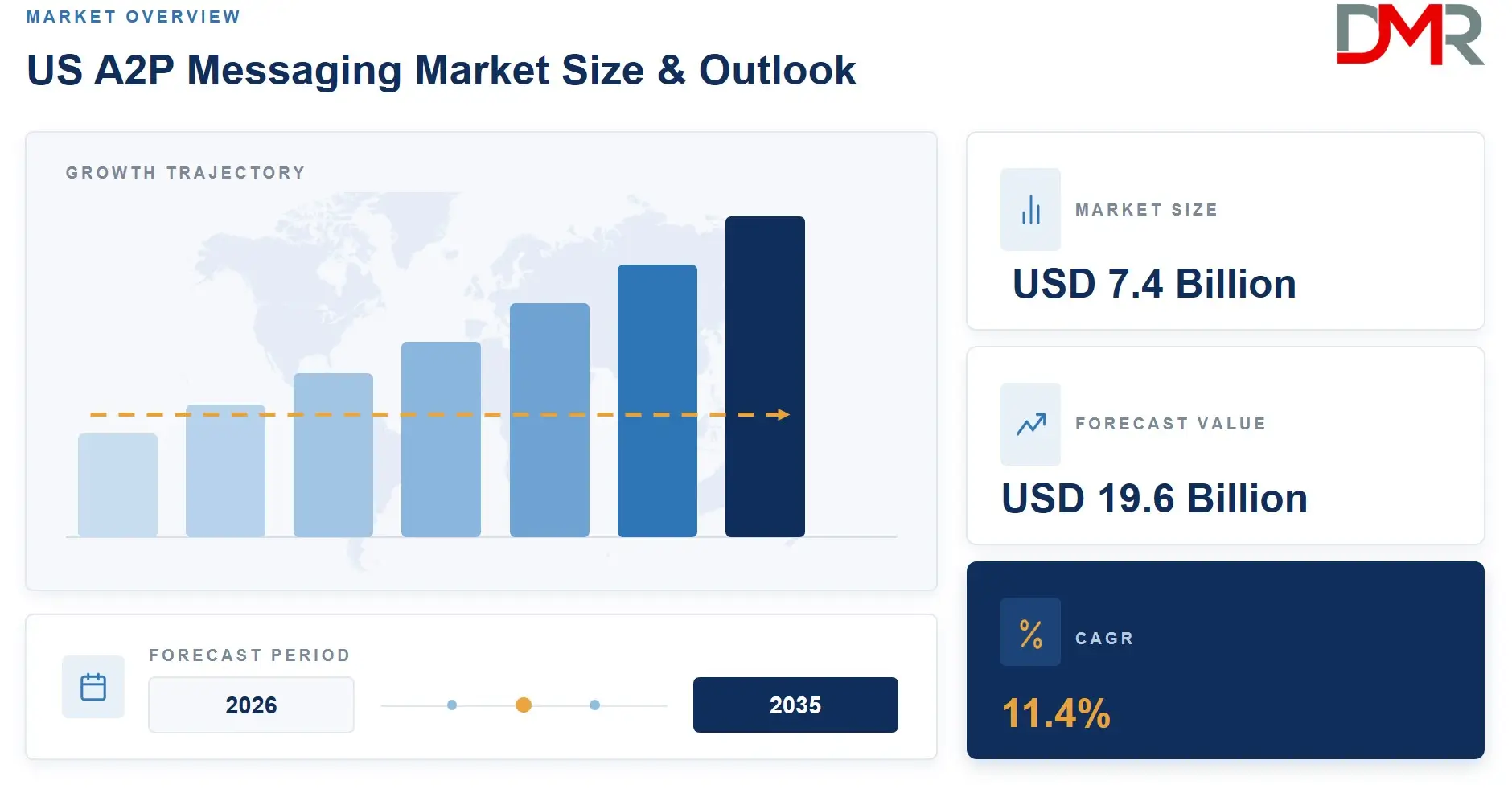
- Market Size (2026): USD 7.4 Bn
- Forecast Value (2035): USD 19.6 Bn
- CAGR (2026-2035): 11.4%
- Leading Messaging Channel (2026): SMS, around 50%
- Leading Application (2026): Marketing & Promotional, around 34%
- Key Players: Twilio, Bandwidth Inc., Sinch, and others
What is US A2P Messaging Market and its Market Size?
The US A2P Messaging Market size is estimated to reach USD 7.4 Bn in 2026 and is further anticipated to reach USD 19.6 Bn by 2035, at a CAGR of 11.4%.
ℹ
To learn more about this report –
Download Your Free Sample Report Here
Application-to-person messaging covers text traffic that a business system, rather than a person, originates and routes to a consumer handset through a registered 10DLC number, a toll-free number, a short code, or an RCS-verified sender profile. The figures in this report cover demand generated inside the United States: message volumes billed to US-registered brands and delivered to US mobile subscribers, not the worldwide billings of vendors that happen to be headquartered domestically. Retailers, banks, healthcare systems, and logistics operators are the primary buyers, paying per-message carrier and platform fees to reach customers with a channel that still clears inboxes at a rate no app-based alternative matches.
The category sits on top of a compliance layer that did not exist a decade ago. The Campaign Registry now vets brand identity and use case before a single message clears a carrier gateway, and AT&T, T-Mobile, and Verizon each enforce their own throughput and content rules on top of that baseline. This registration regime has turned a once-informal channel into a metered, auditable utility, which is precisely what has let large regulated buyers, banks and hospital networks among them, commit budget to it at scale.
What is structurally changing is the channel mix sitting inside that regulated pipe. SMS still carries the largest share of billed volume, but RCS Business Messaging now reaches subscribers on every major domestic carrier and on both Android and iOS handsets, giving brands a native, media-rich alternative that does not require a downloaded app. That shift is pulling incremental spend toward richer, more interactive campaign formats even as the underlying 10DLC and toll-free registration mechanics stay the primary compliance gate for both.
Use Cases
- Retail Order and Delivery Alerts: National e-commerce chains trigger 10DLC-registered SMS at checkout, shipping, and delivery milestones, replacing email notifications that customers routinely miss, which measurably lifts repeat-purchase engagement during peak shopping periods.
- Bank Fraud and OTP Verification: Regional and national banks route one-time passcodes and suspicious-transaction alerts over toll-free and short code channels, since sub-ten-second delivery on a registered sender materially cuts account-takeover losses. This use case accounted for close to 28% of application-level volume in 2026.
- Hospital Appointment Reminders: Regional hospital networks and telehealth platforms send appointment confirmations and prescription-ready notices through HIPAA-mindful messaging vendors, cutting missed-visit rates without adding staff to a call center.
- Field Service Dispatch Updates: Home-services franchises and logistics carriers push technician arrival windows and route changes to customers over RCS-verified sender profiles, letting dispatchers replace phone confirmation calls with a single automated, trackable message.
Key Takeaways
- Market Size & Share: The market is valued at USD 7.4 Bn in 2026, expanding to USD 19.6 Bn by 2035.
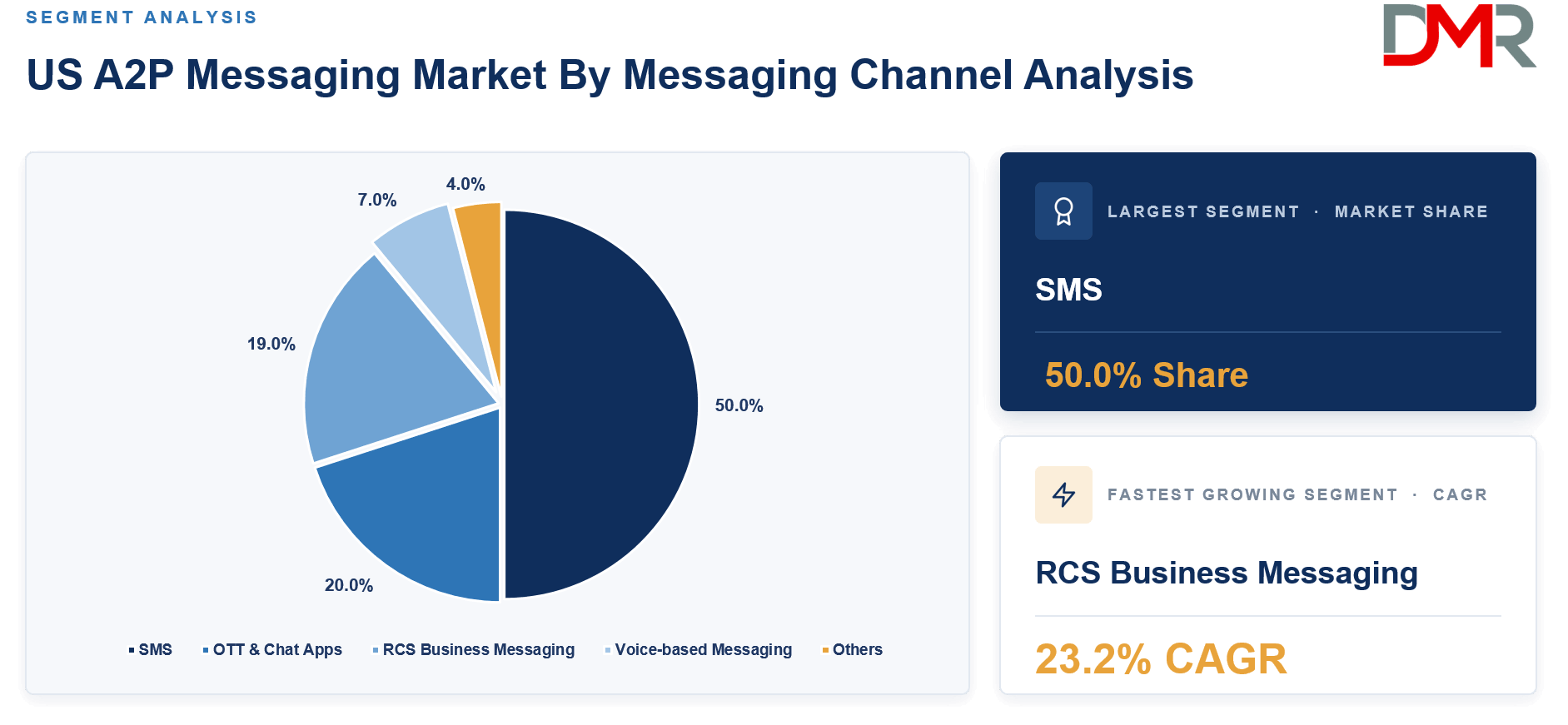
- Messaging Channel Analysis: SMS is expected to hold approximately 50% of channel revenue in 2026, with RCS Business Messaging the fastest-growing channel at a 23.2% CAGR.
- Sender ID Analysis: 10DLC accounts for close to 52% of registered sender-ID volume in 2026, reflecting its role as the default compliance path for enterprise texting.
- Demand Concentration: Retail and e-commerce buyers are projected to generate around 32% of end-use demand in 2026, ahead of banking, financial services and insurance.
- Compliance Cost Pressure: Carrier pass-through fees on 10DLC and toll-free traffic rose across every Tier 1 carrier in 2026, raising the effective per-message cost of the dominant channel.
- Technology Shift: Full domestic carrier coverage for RCS Business Messaging, reached in late 2025, is pulling incremental enterprise budget toward richer, app-like campaign formats.
How AI/Gen AI is Transforming the US A2P Messaging Market?
Artificial intelligence in this market is concentrated on the two things a text channel is bad at without help: judging intent in a two-way reply and proving a sender is legitimate before a carrier throttles it. Large language model classifiers now sit inline on inbound message threads, routing a shopper's "where is my order" reply to a resolution flow without a human agent ever opening a ticket. On the compliance side, machine-learning models score outbound campaigns against carrier filtering rules before a single message leaves the platform, catching content likely to trip a spam gateway ahead of send rather than after a block.
Generative techniques are reshaping the RCS side of the channel specifically. Brands increasingly use generative design tools to auto-produce carousel cards, product imagery, and reply-button layouts for rich messaging campaigns, cutting production time that previously required a dedicated creative cycle per campaign. None of this displaces the underlying 10DLC and RCS registration mechanics; it sits on top of them, making the regulated channel more responsive rather than replacing the compliance layer itself.
- Conversational AI Triage: LLM-based classifiers route two-way SMS and RCS replies to the correct fulfillment, billing, or support workflow.
- Pre-Send Compliance Scoring: Machine-learning filters flag content likely to be blocked by carrier spam gateways before a campaign is sent.
- Generative RCS Creative: Automated generation of carousel cards and reply-button layouts for rich messaging campaigns.
- Predictive Send-Time Optimization: Models learn individual recipient engagement windows to time delivery for higher open and response rates.
Key Drivers in the US A2P Messaging Market
Two forces are pulling enterprise text spend upward at the same time, one regulatory and one behavioral.
- Mandatory Registration Formalizing a Once-Informal Channel: Since carrier-wide enforcement began blocking unregistered A2P traffic, every business sending programmatic SMS at scale must hold a verified 10DLC brand and campaign registration through The Campaign Registry. That gate has converted a channel once run informally on ordinary long codes into a metered, auditable line item that finance and compliance teams can budget for with confidence, which has in turn made it easier for regulated buyers such as banks and hospital systems to commit multi-year spend. The registration requirement also filters out low-quality senders, improving deliverability and inbox trust for compliant brands, which reinforces continued volume growth rather than suppressing it.
- Consumer Preference for Native Inbox Engagement: US consumers open text messages at a rate that email and push notifications do not match, and that behavior has held steady even as app-based messaging has proliferated. Retailers, banks, and healthcare providers have responded by shifting time-sensitive notifications, order updates, fraud alerts, appointment reminders, off email and onto SMS and RCS. The arrival of full carrier coverage for RCS Business Messaging has strengthened this pull further, since brands can now deliver image-rich, interactive content directly inside the native messaging app on both Android and iOS without asking a customer to install anything.
Restraints in the US A2P Messaging Market
The channel's own growth has created cost and complexity pressure that buyers cannot fully engineer around.
- Rising Carrier Pass-Through Fees: AT&T, T-Mobile, Verizon, and smaller carriers such as US Cellular have each raised per-message A2P surcharges on 10DLC and toll-free traffic within the same twelve-month window, and T-Mobile now bills fees on inbound as well as outbound messages. These charges sit on top of platform and campaign registration fees that businesses already pay, and because they are set unilaterally by carriers rather than negotiated with messaging vendors, high-volume senders have limited ability to offset them beyond consolidating traffic or optimizing throughput.
- Registration Friction for New Senders: Brand vetting and campaign approval through The Campaign Registry can take one to four weeks depending on use case and volume, and toll-free verification now requires a documented business registration number and legal entity type. For smaller businesses without dedicated compliance staff, that lag delays time-to-market for new campaigns and creates an operational burden that larger, established senders with existing registrations do not face to the same degree.
Growth Opportunities in the US A2P Messaging Market
The clearest white space sits where regulated, high-trust buyers still under-use the channel relative to their transaction volume.
- Healthcare Patient Engagement at Scale: Regional hospital networks and telehealth platforms remain comparatively light users of registered A2P messaging relative to retail and banking, despite carrying some of the highest no-show and missed-refill costs in the economy. Vendors that can package HIPAA-mindful messaging workflows, appointment reminders, refill nudges, post-discharge check-ins, as a compliant, pre-vetted bundle stand to convert a large base of health systems that have so far relied on phone-based outreach.
- Direct Carrier and In-House Integration: A growing share of high-volume enterprise senders are building direct 10DLC and RCS integrations rather than routing every message through a third-party CPaaS layer, seeking to cut per-message markup on top of already-rising carrier surcharges. This opens a market for integration tooling, compliance-as-a-service platforms, and consulting support aimed specifically at enterprises large enough to justify owning their own messaging infrastructure.
Trends in the US A2P Messaging Market
Two shifts are visible in how brands buy and deploy the channel right now, distinct from the drivers pulling overall demand.
- RCS Displacing Plain SMS for Flagship Campaigns: With RCS Business Messaging now reaching Android and iOS subscribers across every major domestic carrier, brands are increasingly reserving their highest-value campaigns, loyalty offers, order tracking, product launches, for RCS-verified sender profiles while routing routine transactional alerts through plain SMS. This is a deliberate tiering of the channel by message value rather than a wholesale migration away from SMS.
- Fee Transparency Becoming a Vendor Selling Point: As carrier pass-through fees have risen and shifted multiple times within a single year, messaging platforms have begun competing on itemized, real-time fee pass-through rather than bundled pricing, giving buyers visibility into which charges are carrier-set and unavoidable versus vendor markup they can negotiate.
Research Scope and Analysis
Segment performance is assessed across five axes: messaging channel, application, end use industry, sender ID type, and distribution channel. Each axis identifies the sub-segment carrying the largest share of 2026 revenue and the one expanding fastest through 2035.
ℹ
To learn more about this report –
Download Your Free Sample Report Here
By Messaging Channel
SMS is projected to hold the largest share by messaging channel in 2026, accounting for approximately 50% of revenue, since it remains the only format guaranteed to reach every registered handset regardless of device or carrier plan and carries the deepest install base of existing brand integrations. The steeper trajectory sits with RCS Business Messaging, expanding at a CAGR of 23.2% between 2026 and 2035 as full domestic carrier coverage removes the fragmentation that previously forced brands to fall back to SMS for a meaningful share of their audience, unlocking rich media formats that convert at materially higher rates.
By Application
Marketing and promotional messaging is expected to account for close to 34% of application-level revenue in 2026, the largest single use case, driven by a mature ecosystem of e-commerce SMS marketing platforms built around cart-recovery and loyalty campaigns. Growth, however, is concentrated in customer engagement and support messaging, projected at a CAGR of 19.6% through 2035 as brands extend two-way conversational flows, order changes, service scheduling, live agent handoff, beyond the one-way alerts that dominated the category historically.
By End Use Industry
Retail and e-commerce buyers are set to generate around 32% of end-use demand in 2026, the leading vertical, reflecting the sheer transaction volume of order confirmations, shipping updates, and cart-recovery campaigns run by national and regional chains. The fastest-growing vertical is healthcare and life sciences, forecast at a CAGR of 20.1% between 2026 and 2035, as hospital networks and telehealth operators formalize appointment, refill, and post-care messaging that has historically run through call centers.
By Sender ID Type
10DLC is projected to remain the leading sender ID type in 2026, accounting for close to 52% of registered volume, since carrier enforcement since early 2025 has pushed nearly every conversational and marketing use case onto registered long codes as the default compliance path. Growth is fastest in RCS Agent ID and verified-sender profiles, forecast at a CAGR of approximately 23.0% through 2035, tracking the same carrier-coverage expansion driving channel-level RCS growth.
By Distribution Channel
CPaaS platforms and aggregators are expected to carry approximately 46% of distribution-channel revenue in 2026, the largest share, since most brands outside the largest enterprises lack the scale to justify direct carrier relationships and instead route traffic through a platform that handles registration, delivery, and fallback logic. The fastest-growing channel is in-house enterprise integration, projected at a CAGR of 18.8% through 2035, as the largest senders build direct 10DLC and RCS connections to reduce per-message markup layered on top of already-rising carrier surcharges.
The US A2P Messaging Market Report is Segmented Based on the Following
By Messaging Channel
- SMS
- OTT & Chat Apps
- RCS Business Messaging
- Voice-based Messaging
- Others
By Application
- Marketing & Promotional
- OTP & Authentication
- Transactional & Alerts
- Customer Engagement & Support
- Others
By End Use Industry
- Retail & E-commerce
- BFSI
- Healthcare & Life Sciences
- Travel & Hospitality
- IT & Telecom
- Others
By Sender ID Type
- 10DLC
- Short Code
- Toll-Free Number
- RCS Agent ID & Verified Sender
- Others
By Distribution Channel
- CPaaS Platforms & Aggregators
- Direct Carrier Connectivity
- System Integrators & Resellers
- In-house Enterprise Integration
- Others
Regulatory Landscape
Every registered A2P sender in the United States now clears a two-layer gate: brand and campaign vetting through The Campaign Registry, then carrier-specific throughput and content rules enforced independently by AT&T, T-Mobile, and Verizon. That structure has hardened since carriers began blocking unregistered traffic outright, and toll-free verification has added its own documentation requirement, a business registration number and legal entity type, on top of existing brand vetting. What is shifting now is enforcement granularity: carriers are moving from blanket surcharges toward message-type-specific fees, and platforms are being required to publish working privacy policy and terms links before a campaign submission is even accepted. The commercial opening sits with vendors that can turn this complexity into a managed compliance product for buyers who lack in-house registration expertise. The risk is that continued fee and documentation escalation raises the entry cost for smaller senders faster than it raises revenue per message, which could slow new-brand onboarding even as existing registered volume keeps growing.
Technology Analysis
RCS Business Messaging has moved from a fragmented, carrier-by-carrier rollout to full coverage across every major domestic network on both Android and iOS handsets, a milestone reached through platform integrations that unified previously separate carrier onboarding processes. What is shifting now is the creative layer built on top of that coverage: verified sender profiles increasingly carry carousel cards, branded imagery, and interactive reply buttons generated with the help of AI tooling rather than built manually per campaign. The commercial opening is clearest for brands running high-frequency campaigns, retail and travel especially, where richer formats measurably outperform plain SMS on engagement. The brake is device and carrier fragmentation that persists at the margins, meaning platforms must still maintain automatic SMS fallback, which keeps SMS infrastructure investment necessary even as RCS captures a growing share of premium campaign budget and reshapes how brands prioritize spend across the two formats.
Competitive Landscape
The market is moderately consolidated at the infrastructure layer, where a small number of CPaaS platforms and Tier 1 carriers control the registration and delivery pipe nearly every sender depends on, but highly fragmented at the application layer, where hundreds of vertical-specific marketing and engagement platforms compete on usability and integration depth rather than raw delivery capability. Competition centers on three axes: deliverability and throughput management under carrier filtering rules, breadth of RCS carrier coverage, and transparency of carrier fee pass-through as surcharges have risen. Consolidation among application-layer vendors, several notable acquisitions of smaller conversational messaging platforms by larger marketing clouds, continues alongside organic growth from newer entrants building AI-native customer engagement tools on top of the same registered messaging rails.
Some of the Prominent Players in the US A2P Messaging Market Are
- AT&T
- Verizon
- T-Mobile US
- Twilio
- Sinch
- Infobip
- Vonage
- Bandwidth Inc.
- Syniverse
- Bird
- Plivo
- Telnyx
- Mavenir
- IBM
- Microsoft
- Salesforce
- Attentive
- Klaviyo
- Postscript
- SimpleTexting
- EZ Texting
- Textedly
- SlickText
- Podium
- Braze
- OneSignal
- Iterable
- Genesys
- Five9
- RingCentral
- 8x8
- NICE
- CM.com
- Comviva
- Tanla Platforms
- Route Mobile
- Zeta Global
- Sendbird
- Yotpo
- MessageBird Enterprise Solutions
- Other Key Players
Recent Developments
- In May 2026, Verizon raised its A2P pass-through fees on 10DLC and toll-free traffic, following AT&T's own increase a month earlier, extending a pattern of Tier 1 carrier fee escalation into a second consecutive year.
- In April 2026, AT&T increased its per-message A2P carrier fees, adding to the cost pressure already flagged by CPaaS platforms passing through carrier surcharges to enterprise senders.
- In January 2026, T-Mobile and US Cellular both introduced revised A2P pass-through fee schedules effective the same day, with T-Mobile extending charges to inbound as well as outbound 10DLC and toll-free messages for the first time.
- In October 2025, Twilio added RCS Business Messaging support for AT&T numbers on its platform, completing coverage across all three major US carriers for programmatic RCS delivery.
- In September 2025, toll-free verification providers began optionally collecting business registration numbers ahead of a requirement that became mandatory for new submissions in early 2026.
- In May 2025, Clerk Chat launched what it described as the first simultaneous multi-carrier RCS Business Messaging deployment across Verizon, T-Mobile, and AT&T in partnership with Google and Infobip.
Report Details
| Report Characteristics |
| Market Size (2026) |
USD 7.4 Bn |
| Forecast Value (2035) |
USD 19.6 Bn |
| CAGR (2026-2035) |
11.4% |
| Historical Data |
2021 - 2025 |
| Forecast Data |
2026 - 2035 |
| Base Year |
2025 |
| Segments Covered |
By Messaging Channel, By Application, By End Use Industry, By Sender ID Type, By Distribution Channel |
| Regional Coverage |
The US |
Frequently Asked Questions
How big is the US A2P Messaging Market?
▾ The US A2P Messaging Market is estimated at USD 7.4 Bn in 2026 and is projected to reach USD 19.6 Bn by 2035, expanding at a compound annual growth rate through the forecast period.
What is the growth rate of the US A2P Messaging Market?
▾ The market is projected to expand at a CAGR of 11.4% between 2026 and 2035, supported by mandatory carrier registration formalizing enterprise text spend and rising consumer preference for native inbox engagement over email.
What is driving demand in the US A2P Messaging Market?
▾ Demand is driven primarily by mandatory 10DLC and toll-free registration, which has turned enterprise texting into an auditable channel that regulated buyers such as banks and hospital systems can budget for, alongside the recent arrival of full domestic carrier coverage for RCS Business Messaging.
Who are the key players in the US A2P Messaging Market?
▾ Prominent players include Twilio, Bandwidth Inc., Sinch, Infobip, Vonage, AT&T, and Verizon, alongside vertical-specific marketing and engagement platforms such as Attentive and Klaviyo.
Which sender ID type leads the US A2P Messaging Market?
▾ 10DLC leads sender ID types, accounting for close to 52% of registered volume in 2026, since carrier enforcement has pushed most conversational and marketing use cases onto registered long codes as the default compliance path for enterprise texting.
How is RCS Business Messaging changing the US A2P Messaging Market?
▾ Full domestic carrier coverage on Android and iOS is pulling flagship marketing and loyalty campaigns toward RCS-verified sender profiles, the fastest-growing channel at a 23.2% CAGR, while routine transactional alerts continue to run over plain SMS with automatic fallback.
Which industry generates the most demand in the US A2P Messaging Market?
▾ Retail and e-commerce is the leading end-use industry, accounting for around 32% of 2026 demand through order confirmations, shipping updates, and cart-recovery campaigns, ahead of banking, financial services, insurance, and healthcare.