Market Overview
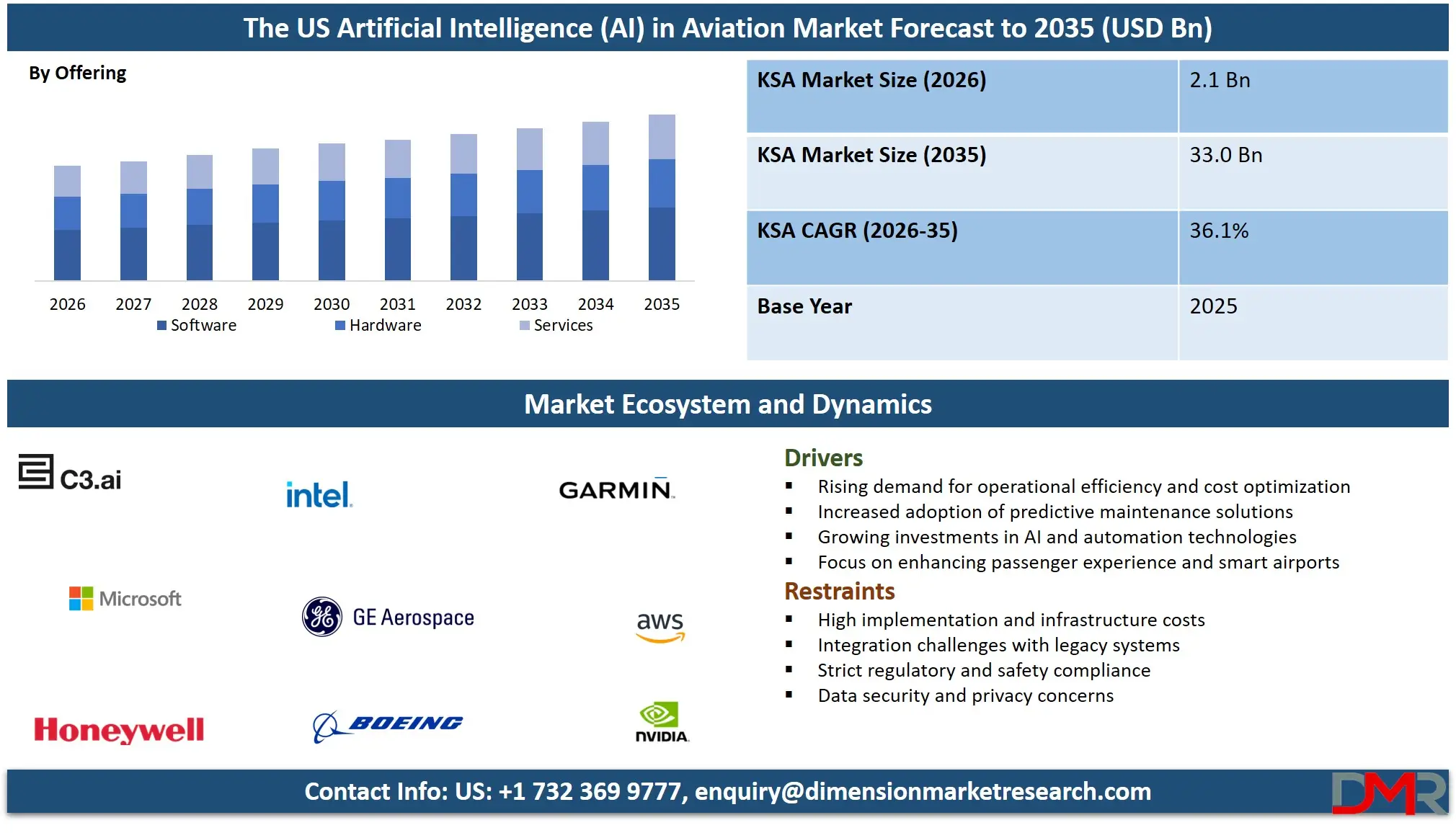
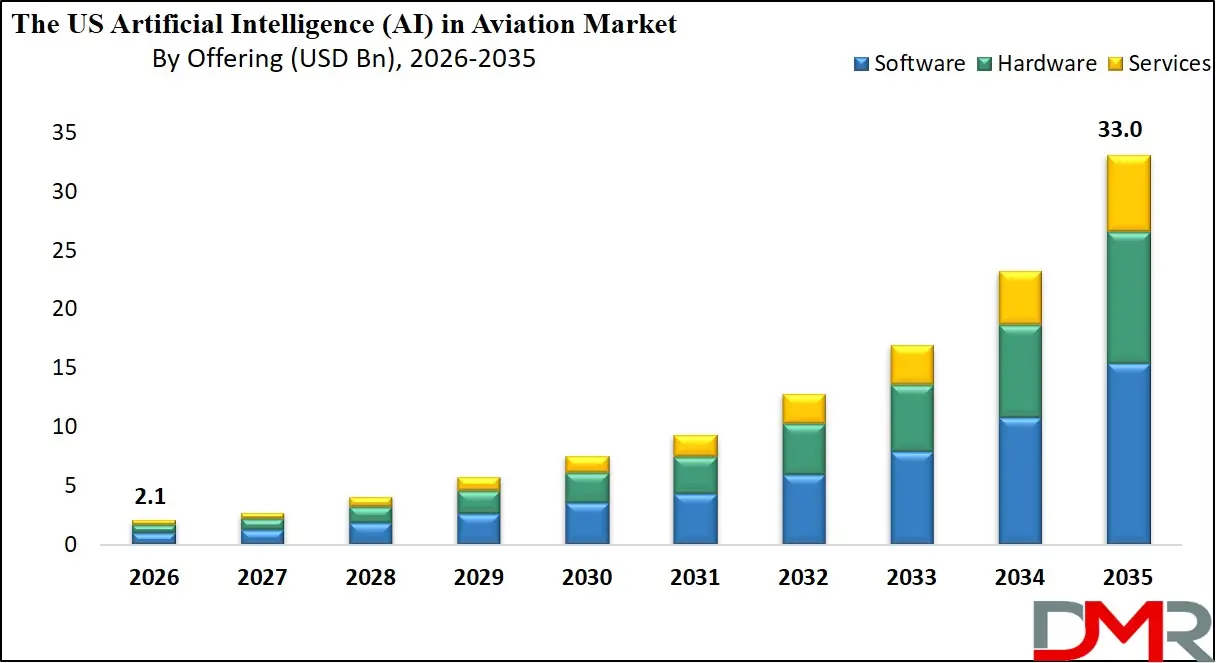
The US Artificial Intelligence (AI) in Aviation Market size is projected to reach USD 2.1 billion in 2026 and grow at a compound annual growth rate of 36.1% to reach a value of USD 33.0 billion in 2035.
ℹ
To learn more about this report –
Download Your Free Sample Report Here
The term 'artificial intelligence in aviation' can be defined as the application of advanced algorithms, machine learning technologies, computer vision, and data analytics in aviation systems, which helps in the enhancement of the efficiency, safety, and decision-making of aviation operations.
The aviation sector is one of the key areas in the aviation ecosystem that helps in the modernization of aviation systems by reducing flight delays, fuel costs, and the customer experience. The new trends in AI include autonomous flight systems, AI-based predictive maintenance, data processing in real-time, which is helping in the adoption of AI in aviation systems and thus shaping the future of aviation globally.
ℹ
To learn more about this report –
Download Your Free Sample Report Here
The US Artificial Intelligence (AI) in Aviation Market: Key Takeaways & Influencing Factors
- Market Growth: The US Artificial Intelligence (AI) in Aviation Market size is expected to grow by USD 30.3 billion, at a CAGR of 36.1%, during the forecasted period of 2027 to 2035.
- By Offering: The software segment is anticipated to get the majority share of the US Artificial Intelligence (AI) in Aviation market in 2026.
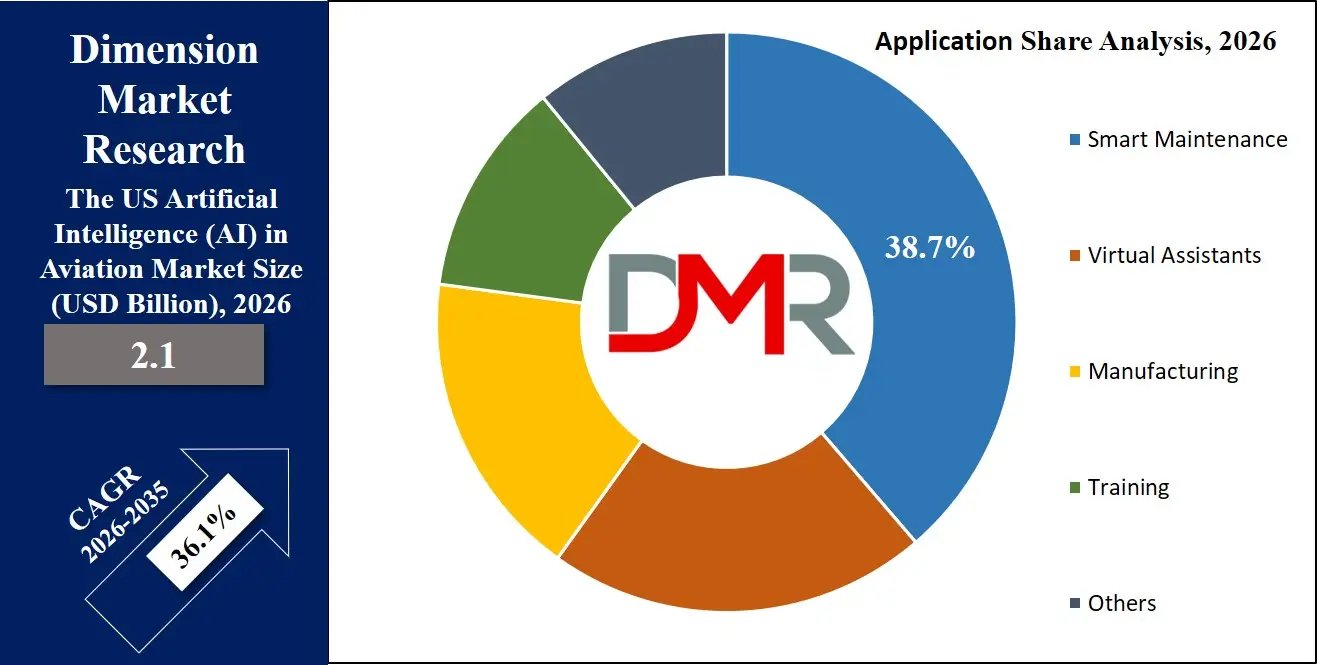
- By Application: The smart maintenance segment is expected to get the largest revenue share in 2026 in the US Artificial Intelligence (AI) in Aviation market.
- Use Cases: Some of the use cases of Artificial Intelligence (AI) in Aviation include predictive maintenance, passenger experience enhancement, and more.
- Federal Aviation Administration (FAA): The organization reported in 2025 that over 70% of major U.S. airlines have integrated AI-based predictive maintenance systems to improve operational reliability.
- U.S. Department of Transportation: It stated in 2024 that AI-driven air traffic management systems reduced average flight delays by approximately 15% across major U.S. airports.
- National Aeronautics and Space Administration (NASA): The administration confirmed in 2026 that AI-enabled autonomous flight research programs improved flight efficiency metrics by nearly 20% in test environments.
- International Air Transport Association (IATA): The association indicated in 2025 that AI adoption in aviation could reduce global airline operating costs by up to 10% through optimization technologies.
The US Artificial Intelligence (AI) in Aviation Market: Use Cases
- Predictive Maintenance: AI analyzes aircraft sensor data to forecast component failures before they occur. This reduces unplanned downtime, lowers maintenance costs, and improves aircraft availability while ensuring enhanced safety compliance across airline operations.
- Air Traffic Management Optimization: AI systems process vast datasets to optimize flight paths, reduce congestion, and improve scheduling accuracy. This leads to reduced delays, fuel savings, and more efficient utilization of airspace infrastructure.
- Passenger Experience Enhancement: AI-powered chatbots, facial recognition, and personalization tools streamline check-ins, security, and boarding processes while offering tailored services, improving overall passenger satisfaction and operational efficiency.
- Autonomous and Assisted Flight Operations: AI supports pilot decision-making through real-time analytics and assists in semi-autonomous flight operations, enhancing safety, reducing human error, and paving the way for future fully autonomous aviation systems.
Market Dynamic
Driving Factors in the US Artificial Intelligence (AI) in Aviation Market
Rising Demand for Operational Efficiency and Cost Reduction
Increasing pressure on airlines to reduce operational costs and improve efficiency is a major driver for AI adoption. AI technologies enable predictive maintenance, route optimization, and fuel efficiency improvements, directly lowering costs. Airlines are leveraging AI to minimize delays, enhance asset utilization, and improve turnaround times, making operations more streamlined and competitive.
Government Support and Technological Advancements
Strong government initiatives and investments in aviation modernization are accelerating AI adoption. Advancements in machine learning, big data analytics, and cloud computing are enabling scalable AI deployment. Regulatory bodies are also supporting innovation through pilot programs and funding, encouraging airlines and airports to integrate AI into critical systems.
Restraints in the US Artificial Intelligence (AI) in Aviation Market
High Implementation and Integration Costs
Deploying AI systems in aviation requires significant capital investment in infrastructure, software, and skilled workforce. Integration with legacy aviation systems adds complexity and cost burdens. Smaller airlines and operators often face challenges in adopting AI due to budget constraints and long return-on-investment timelines.
Data Security and Regulatory Challenges
AI systems rely heavily on large volumes of sensitive data, raising concerns about cybersecurity and data privacy. Strict aviation regulations and certification requirements can slow down AI deployment. Compliance with safety standards and data protection laws creates additional hurdles for market players.
Opportunities in the US Artificial Intelligence (AI) in Aviation Market
Growth of Autonomous Aviation Technologies
The development of autonomous and unmanned aircraft presents significant growth opportunities. AI plays a central role in enabling self-piloting capabilities and intelligent navigation systems. Increasing investments in urban air mobility and drone technologies are expected to create new revenue streams.
Expansion of Smart Airports and Digital Ecosystems
The emergence of smart airports integrating AI-driven systems offers vast opportunities. AI enhances passenger flow management, security screening, and baggage handling. Growing demand for seamless travel experiences is pushing airports to adopt advanced digital solutions.
Trends in the US Artificial Intelligence (AI) in Aviation Market
Integration of AI with IoT and Big Data Analytics
The convergence of AI with IoT and big data is transforming aviation operations. Connected aircraft systems generate real-time data that AI analyzes for actionable insights. This trend is enabling predictive analytics, improving maintenance, and enhancing operational decision-making.
Adoption of Computer Vision and Biometrics
Airports and airlines are increasingly using AI-powered computer vision and biometric systems for identity verification and security. Facial recognition technologies are streamlining passenger processing, reducing wait times, and enhancing overall travel efficiency.
Impact of Iran War on the US Artificial Intelligence (AI) in Aviation Market
Geopolitical risks such as the Iran war affect aviation operations by affecting routes in space and increasing fuel prices, hence forcing aviation organizations to increasingly use AI for route optimization. This helps in mitigating risks as AI can analyze geopolitical risks and act accordingly. Disruptions in the supply chain are another factor forcing aviation organizations to increasingly use AI for logistics optimization.
Research Scope and Analysis
By Offering Analysis
The segment has a projected market share of 46.3% in 2026, primarily due to the increasing adoption of AI platforms and solutions for predictive analytics, passenger management, and optimization. AI software is preferred for its flexibility, scalability, and ease of integration with existing aviation technology. This segment is also boosted by the growing trend of cloud-based AI solutions and real-time analytics. The segment with the highest growth potential is services, specifically integration and development services, as organizations look for customized AI solutions, upgrades, and technical assistance for optimal system performance.
By Technology Analysis
Machine learning is poised to lead with a share of 42.8% in 2026, considering it is at the core of predictive maintenance, route optimization, demand prediction, etc. The capacity to process large amounts of data efficiently with useful outputs is the reason why machine learning is dominating the market. The dynamic nature of deep learning models is also contributing to the popularity of machine learning. Computer vision is growing at the fastest rate with more applications in security systems at airports. NLP is gaining popularity with the rise of virtual assistants.
By Equipment Analysis
Coordinate Measuring Machines (CMM) has the highest share size, valued at 31.5% in 2026. This is because such machines offer precise inspection and quality assurance for aircraft components. Their contribution to the maintenance of strict aviation safety standards is a critical factor. These machines offer improved accuracy in measurements and minimize the chances of human errors. Optical Digitizers & Scanners (ODS) has the highest growth rate because of the increased demand for digital inspection, reverse engineering, and 3D modeling in the maintenance of aviation components. Digital twin technology adoption has also contributed to the increased demand for such machines.
By Application Analysis
The smart maintenance segment is expected to lead the market, with a share of 38.7% in 2026, as more and more airlines rely on predictive maintenance to reduce the downtime and operational cost of the aircraft. The AI-based maintenance system increases the reliability and dependability of the fleet.
ℹ
To learn more about this report –
Download Your Free Sample Report Here
Additionally, the amount of data generated by the aircraft also boosts the growth of the smart maintenance segment. Virtual assistants will experience the highest growth rate due to the increased customer service requirements, support services, and communication. Virtual assistants are also being integrated with the airline app and technology to provide a personalized customer experience.
The US Artificial Intelligence (AI) in Aviation Market Report is segmented on the basis of the following:
By Offering
- Hardware
- Software
- Services
- Integration & Development
- Support & Maintenance
By Technology
- Machine Learning
- Deep Learning
- Supervised Learning
- Semi-supervised Learning
- Unsupervised Learning
- Reinforcement Learning
- Natural Language Processing
- Context Awareness Computing
- Computer Vision
By Equipment
- Autocollimator
- Profile Projector
- Measuring Microscope
- Optical Digitizers & Scanners (ODS)
- Co-ordinate Measuring Machine (CMM)
- Vision Measuring Machine (VMM)
By Application
- Virtual Assistants
- Smart Maintenance
- Manufacturing
- Training
- Others
Competitive Landscape
The US Artificial Intelligence in Aviation Market has highly competitive nature due to constant innovation, partnerships, and high R&D spending. The focus of the players in the industry is to create advanced AI products suited for the aviation sector.
ℹ
To learn more about this report –
Download Your Free Sample Report Here
The entry barriers in the industry are high due to the need for regulatory compliance. Partnerships with airlines and airports, along with investing in cloud computing and data analytics technologies, are the key to achieving competitive advantage in the market.
Some of the prominent players in the US Artificial Intelligence (AI) in Aviation are:
- Honeywell International Inc.
- General Electric Company (GE Aerospace)
- Microsoft Corporation
- Amazon Web Services (AWS)
- IBM Corporation
- Intel Corporation
- NVIDIA Corporation
- Garmin Ltd.
- Boeing
- Lockheed Martin Corporation
- Northrop Grumman Corporation
- Raytheon Technologies (RTX Corporation)
- Palantir Technologies
- C3.ai
- SparkCognition
- Uptake Technologies
- SAS Institute Inc.
- Oracle Corporation
- Google (Alphabet Inc.)
- Salesforce, Inc.
- Other Key Players
Recent Developments
- In February 2026, Lockheed Martin achieved a milestone in the integration of AI technology when it tested the capabilities of the artificial intelligence-powered targeting system on its F-35 Lightning II fighter jet in a program called Project Overwatch, held at the US Air Force's Nellis Air Force Base. The system was able to use a machine learning algorithm to process environmental information and recommend potential targets to the pilot.
- In November 2025, Archer Aviation is taking its acquisition strategy further with the acquisition of the patent portfolio of Lilium and the USD 126M deal to acquire Hawthorne Airport. The acquisition of the airport is intended to be the main operating center for the planned LA air taxi network and the proposed AI-based aviation rollout.
- In August 2025, The U.S. General Services Administration has developed USAi, a safe generative AI bundle. This bundle will enable federal agencies to securely and speedily test and deploy tools such as chat, coding, and summarization, all for free. USAi will also support the America's AI Action Plan by enhancing innovation, modernization, and the adoption of AI by the federal government.
Report Details
| Report Characteristics |
| Market Size (2026) |
USD 2.1 Bn |
| Forecast Value (2035) |
USD 33.0 Bn |
| CAGR (2026–2035) |
36.1% |
| Historical Data |
2021 – 2025 |
| Forecast Data |
2027 – 2035 |
| Base Year |
2025 |
| Estimate Year |
2026 |
| Report Coverage |
Market Revenue Estimation, Market Dynamics, Competitive Landscape, Growth Factors and etc. |
| Segments Covered |
By Offering (Hardware, Software, Services), By Technology (Machine Learning, Natural Language Processing, Context Awareness Computing, Computer Vision), By Equipment (Autocollimator, Profile Projector, Measuring Microscope, Optical Digitizers & Scanners (ODS), Co-ordinate Measuring Machine (CMM), Vision Measuring Machine (VMM)), By Application (Virtual Assistants, Smart Maintenance, Manufacturing, Training, Others) |
| Country Coverage |
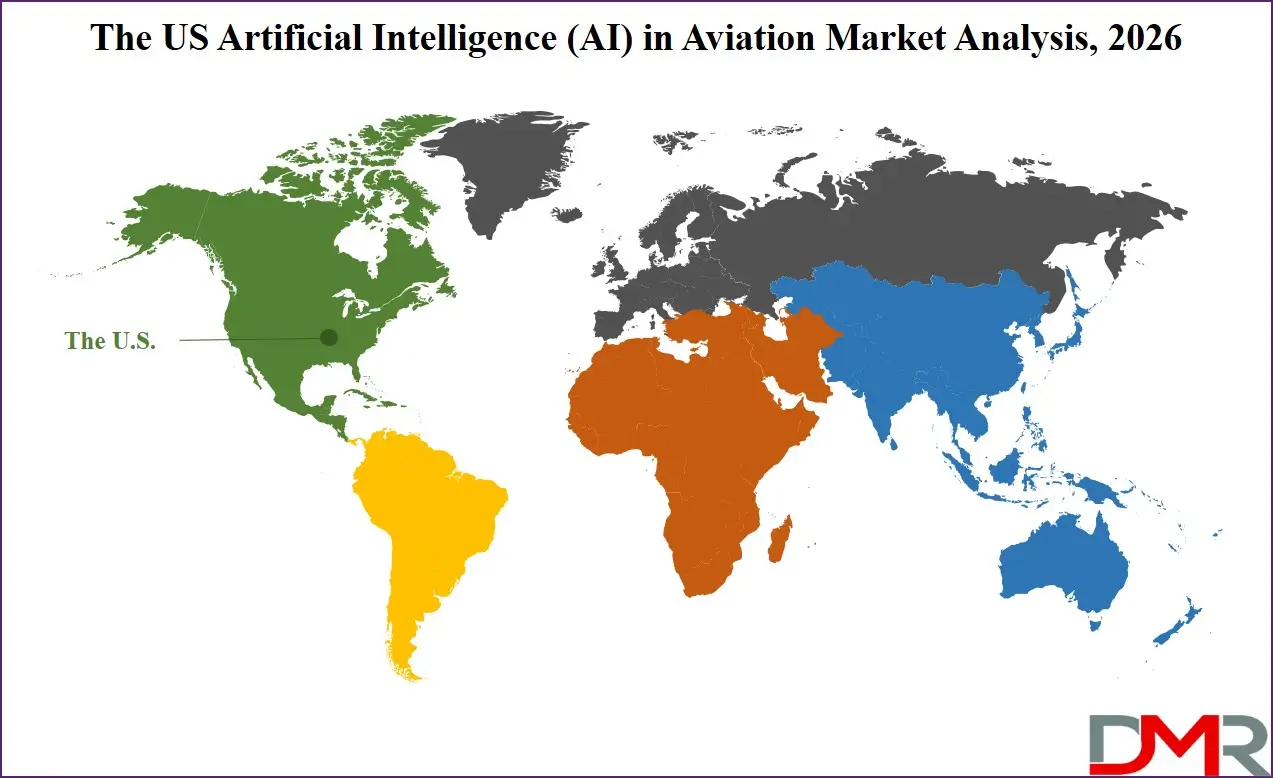
The US |
| Prominent Players |
Honeywell International Inc., General Electric Company (GE Aerospace), Microsoft Corporation, Amazon Web Services (AWS), IBM Corporation, Intel Corporation, NVIDIA Corporation, Garmin Ltd., Boeing, Lockheed Martin Corporation, Northrop Grumman Corporation, Raytheon Technologies (RTX Corporation), Palantir Technologies, C3.ai, SparkCognition, Uptake Technologies, SAS Institute Inc., Oracle Corporation, Google (Alphabet Inc.), Salesforce, Inc., and Other Key Players |
| Purchase Options |
We have three licenses to opt for: Single User License (Limited to 1 user), Multi-User License (Up to 5 Users) and Corporate Use License (Unlimited User) along with free report customization equivalent to 0 analyst working days, 3 analysts working days and 5 analysts working days respectively. |
Frequently Asked Questions
How big is the US Artificial Intelligence (AI) in Aviation Market?
▾ The US Artificial Intelligence (AI) in Aviation Market size is expected to reach USD 2.1 billion by 2026 and is projected to reach USD 33.0 billion by the end of 2035.
Who are the key players in the US Artificial Intelligence (AI) in Aviation Market?
▾ Some of the major key players in the US Artificial Intelligence (AI) in Aviation Market include IBM, Intel, AWS, and others.
What is the growth rate in the US Artificial Intelligence (AI) in Aviation Market?
▾ The market is growing at a CAGR of 36.1 percent over the forecasted period.