US BESS Diagnostic Equipment Market Snapshot
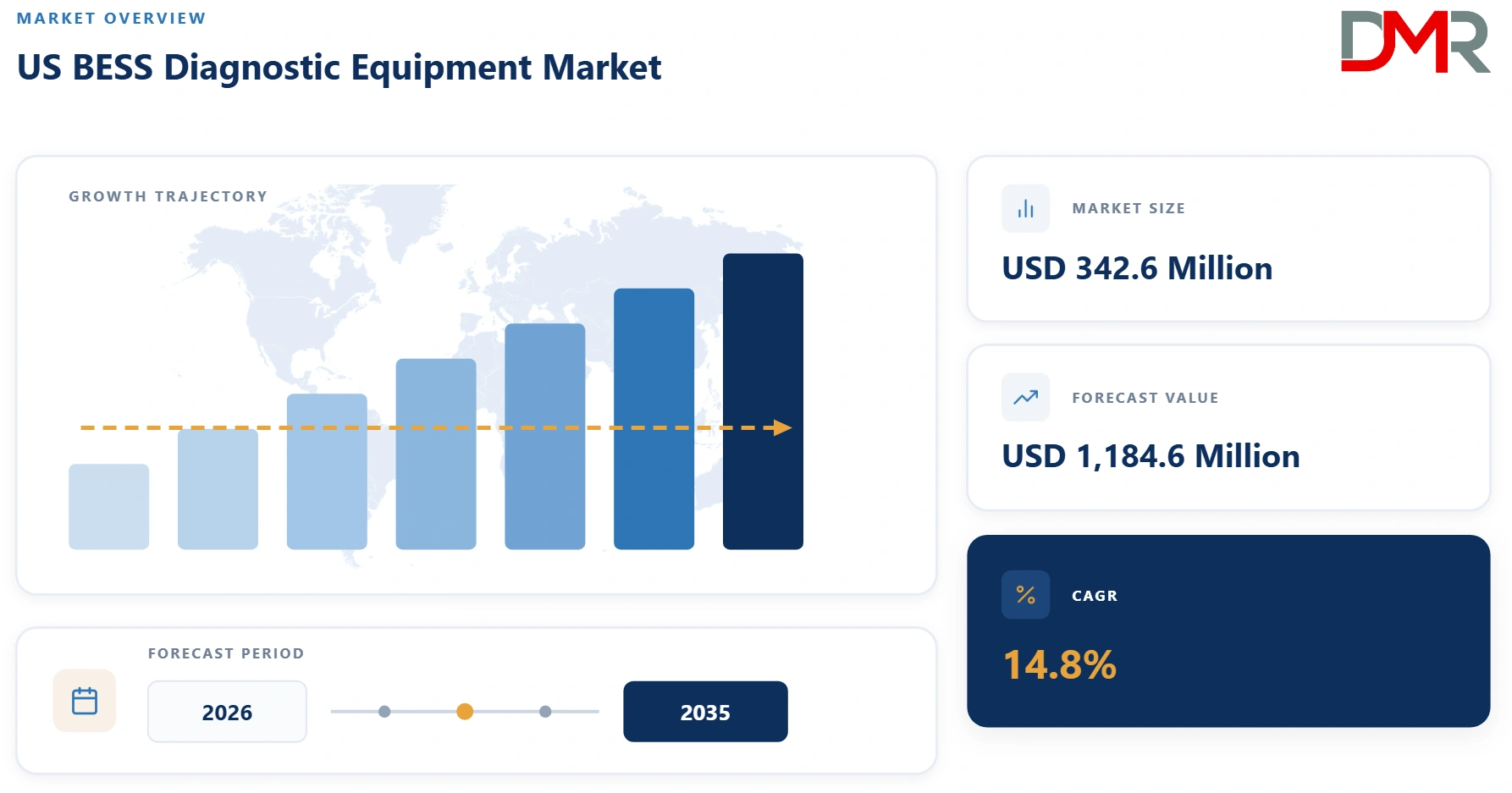
- US BESS Diagnostic Equipment Market Size in 2026: USD 342.6 Million
- US BESS Diagnostic Equipment Market Size in 2035: USD 1,184.6 Million
- US CAGR from 2026 to 2035: 14.8%
- Battery Management System (BMS) Diagnostic Tools is the leading equipment type segment in 2026: 32.4%
- Cloud-Based Remote Diagnostic Platforms is the leading deployment type segment in 2026: 46.8%
- Fault Detection and Early Warning is the leading application segment in 2026: 38.6%
- Utility-Scale BESS Operators is the leading end user segment in 2026: 48.3%
What is the US BESS Diagnostic Equipment Market and its Market Size?
The US BESS Diagnostic Equipment Market is projected to be valued at USD 342.6 Million in 2026 and is projected to reach USD 1,184.6 Million by 2035, expanding at a CAGR of 14.8% during the forecast period.
ℹ
To learn more about this report –
Download Your Free Sample Report Here
Growth is being propelled by the rapidly expanding installed base of utility-scale and commercial battery energy storage systems across the United States requiring ongoing operational diagnostic monitoring, heightened industry attention to early fault detection and thermal event prevention following high-profile BESS fire incidents that have intensified focus on real-time gas detection and thermal anomaly monitoring, and growing insurance underwriter and financing institution requirements for comprehensive diagnostic monitoring supporting risk management and asset performance verification. The maturing of cloud-based remote diagnostic platforms enabling continuous, real-time fleet-wide BESS health monitoring without requiring on-site technician intervention, growing integration of AI-enhanced predictive analytics capable of identifying early-stage degradation and fault patterns before they progress to safety-critical failures, and continued expansion of third-party operations and maintenance service providers offering diagnostic monitoring as a core component of BESS asset management contracts are reshaping the market from a largely reactive, fault-response diagnostic approach into an increasingly proactive, continuous, and predictive BESS health monitoring industry. Investment is accelerating as BESS operators, integrators, and service providers expand diagnostic monitoring capability to protect the substantial and growing capital investment represented by the country's expanding battery storage fleet.
Use Cases
- Continuous State of Health Monitoring for Utility-Scale BESS Asset Management: Utility-scale BESS operators deploy comprehensive state of health diagnostic systems to continuously track battery degradation and performance characteristics across large-scale storage installations, supporting asset management decisions and performance warranty verification with battery suppliers.
- Early Gas Detection and Off-Gassing Monitoring for Thermal Event Prevention: BESS operators and safety system integrators deploy gas detection and off-gassing sensors capable of identifying early indicators of cell degradation or thermal stress before conditions progress to thermal runaway, supporting proactive safety intervention and reflecting heightened industry attention following BESS fire incidents.
- Cloud-Based Fleet-Wide Diagnostic Monitoring for Distributed BESS Portfolios: Commercial and industrial BESS operators and third-party asset managers use cloud-based remote diagnostic platforms to monitor battery health and performance across geographically distributed, multi-site storage portfolios from centralized operations centers, improving monitoring efficiency relative to site-by-site manual inspection.
- Predictive Maintenance Diagnostic Analysis Supporting O&M Contract Performance: Third-party operations and maintenance service providers use integrated diagnostic equipment and AI-enhanced analytics to identify emerging equipment issues before they result in unplanned downtime, supporting performance guarantee commitments made to BESS project owners under long-term O&M service contracts.
Key Takeaways
- Market Size: The US BESS Diagnostic Equipment Market is anticipated to be valued at USD 342.6 Million in 2026 and is forecast to reach USD 1,184.6 Million by 2035, expanding at a CAGR of 14.8%.
- Growth Outlook: Market expansion is sustained by the rapidly expanding installed BESS base requiring ongoing diagnostic monitoring, heightened safety focus following fire incidents, and growing insurance and financing institution diagnostic monitoring requirements.
- Primary Growth Drivers: Rapidly expanding installed base of utility-scale and commercial BESS requiring operational diagnostics, heightened industry focus on early fault detection following safety incidents, growing insurance and financing institution monitoring requirements, and continued third-party O&M service provider expansion are accelerating market growth.
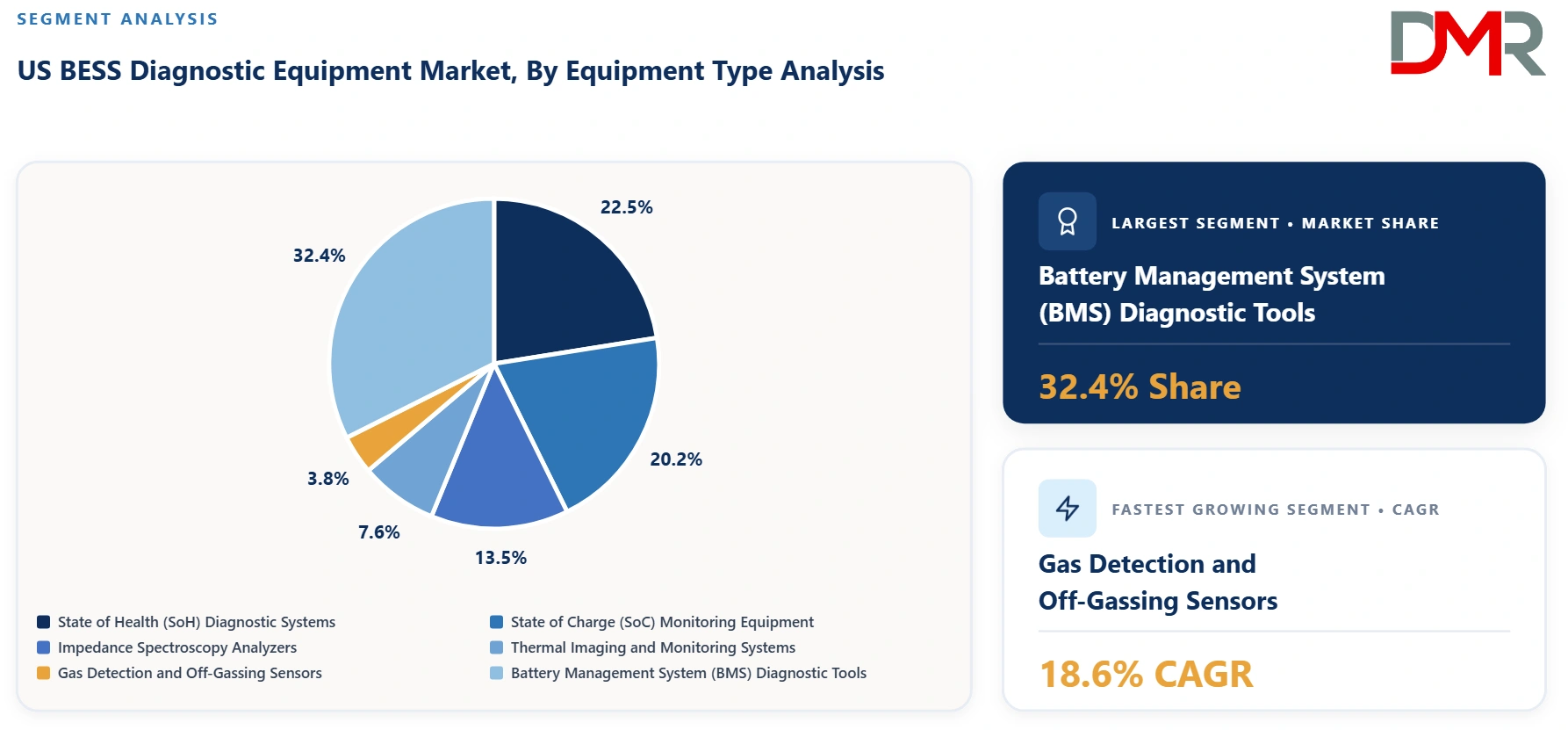
- By Equipment Type Analysis: Battery Management System (BMS) Diagnostic Tools is projected to lead the equipment type segment with a 32.4% share in 2026, reflecting the central role BMS diagnostics play in continuous, integrated battery health monitoring. Gas Detection and Off-Gassing Sensors is the fastest-growing equipment type segment at 18.6% CAGR, driven directly by heightened thermal event early-warning focus following industry safety incidents.
- By Deployment Type Analysis: Cloud-Based Remote Diagnostic Platforms is expected to dominate with a 46.8% share in 2026, supported by growing operator preference for centralized, efficient fleet-wide monitoring capability. Cloud-Based Remote Diagnostic Platforms is also the fastest-growing deployment type segment given continued expansion of distributed, multi-site BESS portfolios requiring centralized oversight.
- By Application Analysis: Fault Detection and Early Warning is poised to lead with a 38.6% share in 2026, reflecting the safety-critical priority placed on early identification of emerging battery issues. Warranty and Insurance Verification is the fastest-growing application segment at 16.9% CAGR, driven by growing insurer and financing institution diagnostic monitoring requirements.
- By End User Analysis: Utility-Scale BESS Operators are projected to dominate with a 48.3% share in 2026, reflecting the scale and capital intensity of utility-scale storage assets justifying comprehensive diagnostic monitoring investment. Third-Party O&M Service Providers is the fastest-growing end-user segment at 17.4% CAGR, driven by growing outsourcing of BESS operations and maintenance, including diagnostic monitoring responsibilities.
Key Drivers in the US BESS Diagnostic Equipment Market
Rapidly Expanding Installed Base of Utility-Scale and Commercial BESS Requiring Operational Diagnostics
The United States continues to add substantial battery energy storage capacity across utility-scale, commercial and industrial, and residential market segments, creating a rapidly growing installed base of operational BESS assets requiring ongoing diagnostic monitoring throughout their operational lifespan. As this installed base continues to expand, the corresponding demand for diagnostic equipment and monitoring services grows correspondingly, reflecting the essential and non-discretionary nature of ongoing health and performance monitoring for capital-intensive, safety-relevant battery storage infrastructure.
Heightened Industry Focus on Early Fault Detection Following Safety Incidents
High-profile battery energy storage system fire incidents have substantially heightened industry, regulatory, and insurance underwriter attention to early fault detection and thermal event prevention capability, driving strong demand for diagnostic equipment capable of identifying early-stage battery degradation or thermal stress indicators before conditions progress to safety-critical failure. This heightened safety focus represents one of the most significant and directly attributable growth drivers within the current US BESS Diagnostic Equipment Market, as operators, insurers, and regulators increasingly view comprehensive diagnostic monitoring as an essential risk mitigation requirement rather than an optional operational enhancement.
Restraints in the US BESS Diagnostic Equipment Market
Data Integration Complexity Across Diverse Battery Chemistries and BMS Platforms
The diversity of battery chemistries, cell formats, and battery management system platforms deployed across the US BESS installed base creates meaningful data integration complexity for diagnostic equipment and platform providers, representing a restraint on the US BESS Diagnostic Equipment Market. Diagnostic platforms must often be adapted or customized to effectively interface with and interpret data from the wide range of battery and BMS technology deployed across different BESS installations, particularly for older installations using legacy technology, complicating the development of universally applicable diagnostic solutions and potentially increasing integration costs for comprehensive fleet-wide monitoring deployments.
Growth Opportunities in the US BESS Diagnostic Equipment Market
AI-Enhanced Predictive Analytics Platform Development
Growing availability of extensive operational battery performance data across the expanding US BESS installed base presents a substantial opportunity for diagnostic equipment and software companies to develop increasingly sophisticated AI-enhanced predictive analytics capability, identifying subtle degradation and fault patterns that might not be apparent through traditional threshold-based diagnostic approaches. Companies capable of demonstrating superior predictive accuracy in identifying emerging battery issues before they result in performance degradation or safety incidents can capture significant market share as the industry increasingly prioritizes predictive over purely reactive diagnostic capability.
Standardized Diagnostic Data Platforms Supporting Insurance and Financing Institution Requirements
Growing insurance underwriter and project financing institution interest in standardized, comprehensive diagnostic monitoring data supporting risk assessment and asset performance verification presents a substantial opportunity for diagnostic equipment and platform companies to develop standardized reporting and data platforms specifically addressing these institutional stakeholder requirements. Companies capable of providing diagnostic monitoring data in formats and detail levels meeting insurance and financing institution due diligence and ongoing monitoring requirements can capture premium positioning as this institutional stakeholder influence over BESS project diagnostic monitoring requirements continues to grow.
Trends in the US BESS Diagnostic Equipment Market
Growing Integration of Diagnostic Monitoring with Broader BESS Asset Management Platforms
US BESS operators and third-party asset managers increasingly integrate diagnostic monitoring data directly with broader BESS asset management platforms, combining diagnostic health data with financial performance, energy market participation, and maintenance scheduling information within unified operational dashboards. This integration trend reflects growing sophistication in BESS asset management practices as the country's installed base matures and asset owners increasingly seek comprehensive, unified operational visibility rather than siloed diagnostic monitoring systems.
Continued Expansion of Third-Party Diagnostic Monitoring and O&M Service Provision
The US BESS Diagnostic Equipment Market is experiencing continued expansion of third-party operations and maintenance service providers offering comprehensive diagnostic monitoring as a core component of outsourced BESS asset management service contracts. This trend reflects growing BESS project owner preference for outsourcing specialized diagnostic monitoring and maintenance expertise rather than developing extensive in-house capability, particularly among smaller project developers and commercial BESS owners without dedicated technical operations teams.
Research Scope and Analysis
The US BESS Diagnostic Equipment Market is segmented by equipment type, deployment type, application, and end user, covering state of health and state of charge diagnostics, impedance spectroscopy, thermal imaging, gas detection sensors, and BMS diagnostic tools across fixed, portable, and cloud-based deployment models.
ℹ
To learn more about this report –
Download Your Free Sample Report Here
By Equipment Type Analysis
Battery Management System (BMS) Diagnostic Tools is projected to dominate the US BESS Diagnostic Equipment Market with 32.4% share in 2026, reflecting the central and foundational role BMS diagnostics play in continuous, integrated battery health and safety monitoring across virtually all deployed battery energy storage systems. Gas Detection and Off-Gassing Sensors is expected to register the highest CAGR of 18.6% during 2026-2035, driven directly by heightened thermal event early-warning focus and safety system integration following high-profile industry safety incidents.
By Deployment Type Analysis
Cloud-Based Remote Diagnostic Platforms are anticipated to dominate the US BESS Diagnostic Equipment Market by deployment type, accounting for 46.8% share in 2026, supported by growing operator preference for centralized, efficient fleet-wide monitoring capability that reduces reliance on site-by-site manual inspection and technician deployment. Cloud-Based Remote Diagnostic Platforms are also projected to register the highest CAGR, driven by continued expansion of distributed, multi-site BESS portfolios requiring centralized diagnostic oversight and reporting capability.
By Application Analysis
Fault Detection and Early Warning is projected to lead the US BESS Diagnostic Equipment Market with an estimated 38.6% share in 2026, reflecting the safety-critical industry priority placed on early identification of emerging battery issues before they progress to performance degradation or safety incidents. Warranty and Insurance Verification is expected to register the fastest CAGR of 16.9% through 2035, driven by growing insurer and project financing institution diagnostic monitoring requirements supporting risk assessment and ongoing asset performance verification.
By End User Analysis
Utility-Scale BESS Operators are projected to dominate the US BESS Diagnostic Equipment Market with 48.3% share in 2026, reflecting the scale and capital intensity of utility-scale storage assets that justify comprehensive diagnostic monitoring investment given the substantial financial and grid reliability stakes involved. Third-Party O&M Service Providers is expected to register the fastest CAGR of 17.4% through 2035, driven by growing outsourcing of BESS operations and maintenance responsibilities, including diagnostic monitoring, particularly among smaller project developers and commercial BESS owners.
The US BESS Diagnostic Equipment Market Report is segmented based on the following:
By Equipment Type
- State of Health (SoH) Diagnostic Systems
- State of Charge (SoC) Monitoring Equipment
- Impedance Spectroscopy Analyzers
- Thermal Imaging and Monitoring Systems
- Gas Detection and Off-Gassing Sensors
- Battery Management System (BMS) Diagnostic Tools
By Deployment Type
- Fixed/Installed Diagnostic Systems
- Portable Diagnostic Equipment
- Cloud-Based Remote Diagnostic Platforms
By Application
- Predictive Maintenance
- Fault Detection and Early Warning
- Performance Degradation Analysis
- Warranty and Insurance Verification
By End User
- Utility-Scale BESS Operators
- Commercial and Industrial BESS Operators
- BESS Integrators and OEMs
- Third-Party O&M Service Providers
Technology Analysis
Technology development is central to the trajectory of the US BESS Diagnostic Equipment Market as companies invest in advanced electrochemical impedance spectroscopy technology supporting more accurate state of health assessment, highly sensitive gas detection sensors capable of identifying trace off-gassing compounds indicating early cell degradation, and AI-enhanced predictive analytics platforms capable of identifying subtle degradation patterns across large operational datasets. Growing integration of thermal imaging with automated anomaly detection is supporting more efficient identification of temperature irregularities across large-scale battery installations. Opportunities are expanding for companies developing standardized diagnostic data platforms addressing insurance and financing institution requirements, as well as diagnostic technology specifically adapted to interface effectively across the diverse battery chemistries and BMS platforms deployed across the existing US installed base. However, achieving reliable, universally applicable diagnostic technology amid the significant technical diversity of deployed battery and BMS systems remains an ongoing technical challenge across the industry.
Investment and White Space Analysis
Investment opportunities in the US BESS Diagnostic Equipment Market are expanding alongside the rapidly growing installed BESS base, heightened safety and early fault detection focus following industry incidents, and growing insurance and financing institution diagnostic monitoring requirements. Significant white space exists in AI-enhanced predictive analytics platform development, standardized diagnostic data platforms supporting institutional stakeholder requirements, and diagnostic technology solutions addressing data integration complexity across diverse deployed battery and BMS technology. Companies with strong predictive analytics capability, established relationships with utility-scale BESS operators and third-party O&M service providers, and standardized institutional reporting capability are positioned to capture premium, longer-duration growth opportunities. However, data integration complexity across diverse battery chemistries and BMS platforms can complicate the development and deployment of comprehensive, universally applicable diagnostic solutions, particularly for fleet-wide monitoring across mixed-technology BESS portfolios.
Competitive Landscape
The US BESS Diagnostic Equipment Market is fragmented and increasingly competitive, comprising large diversified global battery diagnostic and monitoring technology companies with substantial US operations, specialized BESS-focused diagnostic software and analytics companies, and third-party operations and maintenance service providers offering integrated diagnostic monitoring services. Competition centers on predictive analytics accuracy and sophistication, data integration capability across diverse battery and BMS technology platforms, established relationships with utility-scale BESS operators and O&M service providers, and standardized reporting capability meeting insurance and financing institution requirements. Large diversified companies benefit from established monitoring technology and broader energy industry customer relationships, while specialized BESS diagnostic companies compete through deep technical expertise in battery-specific diagnostic analytics and closer relationships with BESS integrators. Companies increasingly differentiate through predictive analytics sophistication and institutional stakeholder reporting capability rather than basic monitoring hardware alone.
Some of the prominent players in the US BESS Diagnostic Equipment Market are:
- Arbin Instruments
- Bitrode Corporation
- Chroma ATE
- Maccor
- Digatron Power Electronics
- Midtronics
- Neware Technology
- NH Research
- Keysight Technologies
- NI (National Instruments)
- AMETEK Programmable Power
- Megger
- Hioki
- Fluke Corporation
- Yokogawa Test & Measurement
- Rohde & Schwarz
- B&K Precision
- EA Elektro-Automatik
- Regatron
- BioLogic Science Instruments
- Gamry Instruments
- Pine Research Instrumentation
- Scribner Associates
- AVL
- HORIBA
- Dewesoft
- HBK
- Thermotron Industries
- Cincinnati Sub-Zero
- ESPEC North America
- Zaxis
- Cadex Electronics
- Eagle Eye Power Solutions
- Alber
- Vertiv
- Schneider Electric
- Emerson
- UL Solutions
- Intertek
- DNV
- Other Key Players
Recent Developments
- September 2026: Arbin Instruments expanded its advanced battery testing capabilities through the SBTR Series, supporting high-current cell testing with integrated thermal control for improved battery diagnostics.
- June 2026: Chroma ATE advanced synchronized battery pack testing solutions that capture voltage, current, BMS signals, and temperature data to improve fault detection and performance analysis.
- April 2026: Keysight Technologies strengthened its BESS testing portfolio with regenerative power systems and battery-emulation software for validating battery packs, inverters, and energy storage control systems.
- February 2026: Midtronics expanded AI-enabled battery diagnostic capabilities, using intelligent algorithms and connected testing platforms to improve battery health assessment and condition-based maintenance.
Report Details
| Report Characteristics |
| Market Size (2026) |
USD 342.6 Mn |
| Forecast Value (2035) |
USD 1,184.6 Mn |
| CAGR (2026–2035) |
14.8% |
| Historical Data |
2021 – 2025 |
| Forecast Data |
2026 – 2035 |
| Base Year |
2025 |
| Segments Covered |
By Equipment Type, By Deployment Type, By Application, and By End User |
| Country Coverage |
The US |
Frequently Asked Questions
How big is the US BESS Diagnostic Equipment Market?
▾ The US BESS Diagnostic Equipment Market is valued at USD 342.6 Million in 2026 and is projected to reach USD 1,184.6 Million by 2035, reflecting the rapidly expanding installed BESS base and heightened industry focus on early fault detection and safety.
What is the CAGR of the US BESS Diagnostic Equipment Market from 2026 to 2035?
▾ The market is projected to expand at a compound annual growth rate (CAGR) of 14.8% between 2026 and 2035, supported by continued BESS deployment growth, heightened safety monitoring requirements, and expanding third-party O&M service adoption.
What factors are driving the growth of the US BESS Diagnostic Equipment Market?
▾ Growth is driven by the rapidly expanding installed base of utility-scale and commercial BESS requiring operational diagnostics, heightened industry focus on early fault detection following safety incidents, growing insurance and financing institution monitoring requirements, and continued third-party O&M service provider expansion.
What are the major trends in the US BESS Diagnostic Equipment Market?
▾ Major trends include growing integration of diagnostic monitoring with broader BESS asset management platforms, continued expansion of third-party diagnostic monitoring and O&M service provision, and rising adoption of AI-enhanced predictive analytics.
Who are the key players in the US BESS Diagnostic Equipment Market?
▾ Key market participants include Fluence Energy, Wärtsilä Energy Storage & Optimisation, Stem Inc., ACCURE Battery Intelligence, and Honeywell, among other diversified energy technology companies and specialized BESS diagnostic providers.
How is the US BESS Diagnostic Equipment Market segmented?
▾ The market is segmented by equipment type, deployment type, application, and end user, with demand analysis concentrated across Texas, California, Arizona, and the broader Southeast BESS deployment corridor.