US BESS Thermal Management System Market Snapshot
- US BESS Thermal Management System Market Size in 2026: USD 682.4 Million
- US BESS Thermal Management System Market Size in 2035: USD 2,146.8 Million
- US CAGR from 2026 to 2035: 13.6%
- Liquid Cooling Systems is the leading technology type segment in 2026: 52.6%
- Heat Exchangers is the leading component segment in 2026: 28.4%
- Utility-Scale BESS is the leading application segment in 2026: 64.8%
- Utility-Scale BESS Operators/IPPs is the leading end user segment in 2026: 58.3%
What is the US BESS Thermal Management System Market and its Market Size?
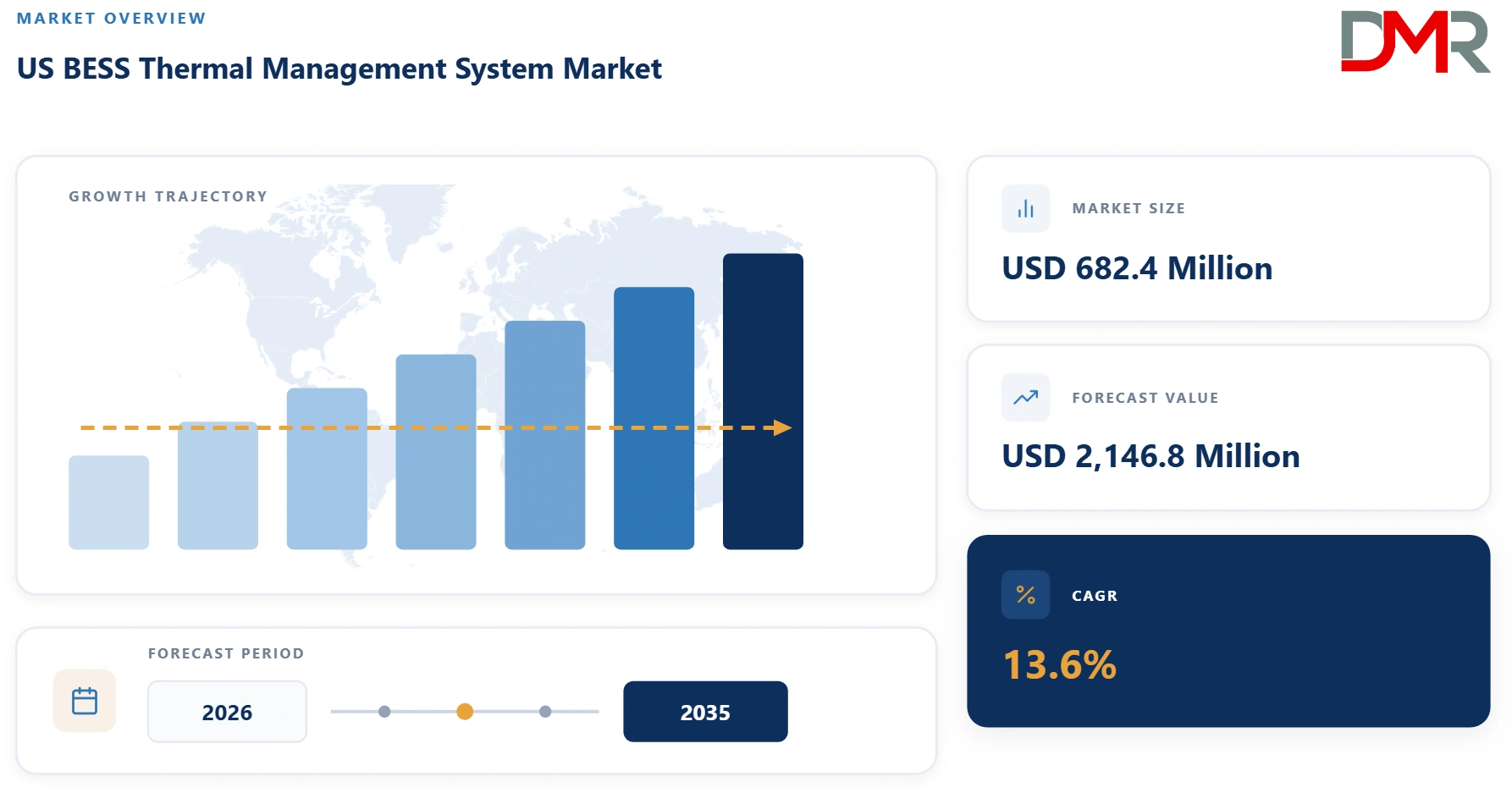
The US BESS Thermal Management System Market is projected to be valued at USD 682.4 Million in 2026 and is projected to reach USD 2,146.8 Million by 2035, expanding at a CAGR of 13.6% during the forecast period.
ℹ
To learn more about this report –
Download Your Free Sample Report Here
Growth is being propelled by rapidly expanding utility-scale battery energy storage system deployment across the United States requiring increasingly sophisticated thermal management to maintain battery performance, safety, and longevity, heightened industry safety focus on thermal runaway prevention following high-profile BESS fire incidents that have intensified scrutiny of thermal management system design and reliability, and continued trend toward higher energy density battery containers and racks that generate greater heat loads requiring more advanced cooling technology than earlier-generation, lower-density BESS designs. The maturing of liquid cooling and direct-to-cell immersion cooling technologies offering superior thermal uniformity and cooling capacity relative to traditional air-based cooling approaches, growing recognition that effective thermal management directly extends battery cycle life and reduces degradation rates supporting improved project economics, and continued evolution of fire safety codes and standards increasingly emphasizing robust thermal management system design as a core safety requirement are reshaping the market from a largely basic, air-cooling-dominated category into an increasingly sophisticated, liquid-cooling-focused thermal management industry. Investment is accelerating as BESS integrators and thermal management technology companies expand advanced cooling system development to support both safety compliance and improving battery system performance and longevity.
Use Cases
- Liquid Cooling System Integration for High-Density Utility-Scale BESS Containers: BESS integrators deploy liquid cooling systems within utility-scale battery storage containers to manage the substantial heat loads generated by increasingly high energy density battery configurations, maintaining battery cells within optimal temperature ranges supporting performance and longevity.
- Direct-to-Cell Immersion Cooling for Next-Generation High-Performance BESS Designs: Leading BESS technology developers deploy direct-to-cell immersion cooling technology for next-generation, high-performance battery storage system designs, offering superior thermal uniformity and cooling capacity supporting both enhanced safety margins and improved battery cycle life.
- Thermal Management Retrofit for Existing BESS Fleet Safety Upgrades: BESS operators retrofit or upgrade thermal management systems within existing operational battery storage installations to improve safety margins and address evolving fire code requirements, reflecting heightened industry attention to thermal management following safety incidents.
- Hybrid Cooling System Deployment for Commercial and Industrial BESS Installations: Commercial and industrial BESS integrators deploy hybrid cooling systems combining air and liquid cooling elements for mid-scale battery storage installations, balancing thermal management performance against cost and system complexity considerations appropriate for smaller-scale deployments.
Key Takeaways
- Market Size: The US BESS Thermal Management System Market is anticipated to be valued at USD 682.4 Million in 2026 and is forecast to reach USD 2,146.8 Million by 2035, expanding at a CAGR of 13.6%.
- Growth Outlook: Market expansion is sustained by rapidly expanding utility-scale BESS deployment, heightened safety focus on thermal runaway prevention, and continued trend toward higher energy density battery configurations requiring advanced cooling technology.
- Primary Growth Drivers: Rapidly expanding utility-scale battery energy storage deployment, heightened industry safety focus on thermal runaway prevention following fire incidents, continued shift toward higher energy density battery configurations, and growing recognition of thermal management's role in extending battery cycle life are accelerating market growth.
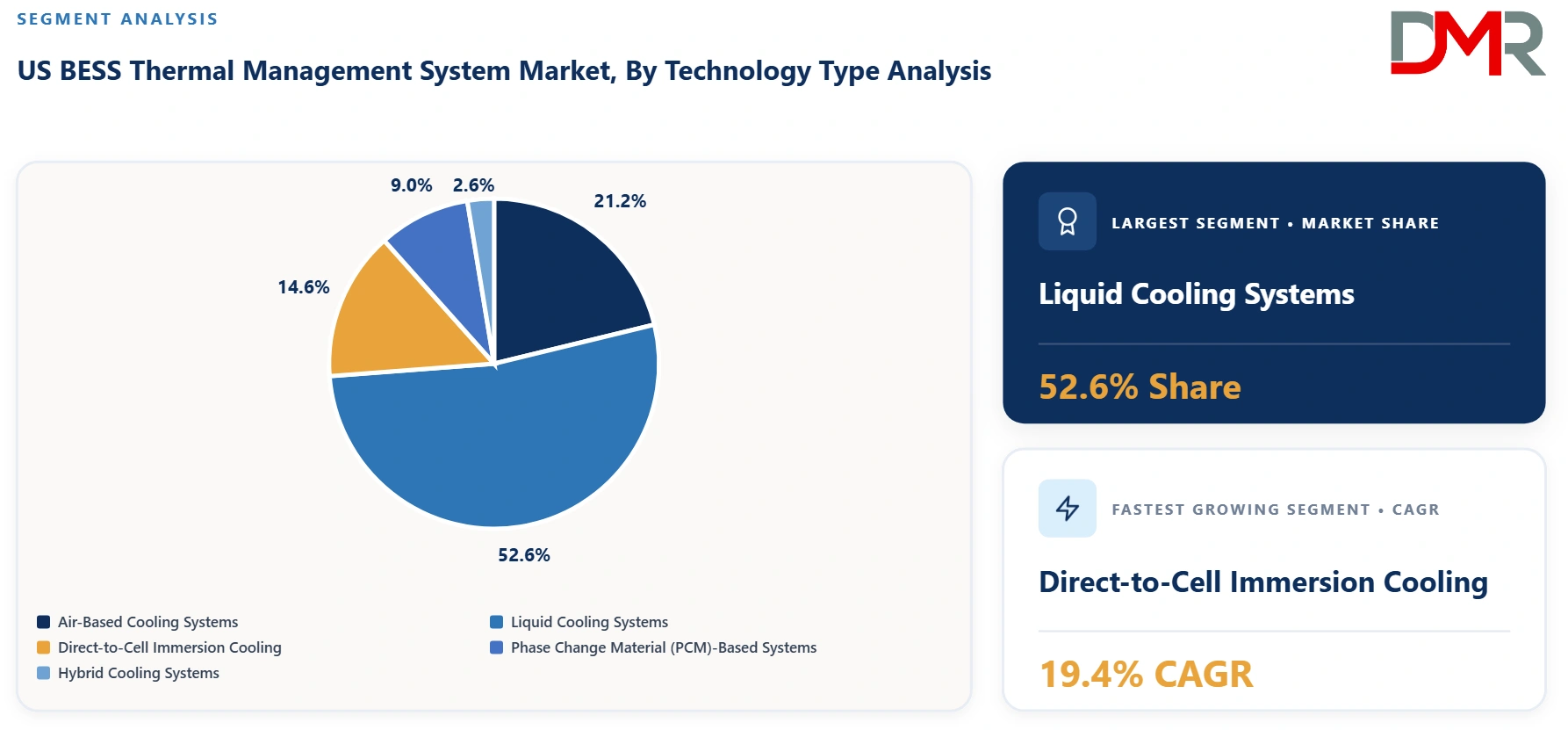
- By Technology Type Analysis: Liquid Cooling Systems is projected to lead the technology type segment with a 52.6% share in 2026, reflecting its superior thermal management capability increasingly favored for utility-scale, high-density BESS applications. Direct-to-Cell Immersion Cooling is the fastest-growing technology type segment at 19.4% CAGR, driven by growing adoption in next-generation, high-performance BESS designs.
- By Component Analysis: Heat Exchangers is expected to dominate with a 28.4% share in 2026, reflecting their essential role across virtually all liquid and hybrid cooling system configurations. Thermal Sensors and Controllers is the fastest-growing component segment at 15.8% CAGR, driven by growing integration of sophisticated thermal monitoring and control capability supporting safety and performance optimization.
- By Application Analysis: Utility-Scale BESS is poised to lead with a 64.8% share in 2026, reflecting the scale and heat management complexity of large-scale battery storage installations. Commercial and Industrial BESS is the fastest-growing application segment at 14.9% CAGR, driven by continued growth in mid-scale commercial storage deployment requiring effective thermal management solutions.
- By End User Analysis: Utility-Scale BESS Operators/IPPs are projected to dominate with a 58.3% share in 2026, reflecting the substantial capital investment and safety stakes associated with utility-scale battery storage assets. BESS Integrators and OEMs is the fastest-growing end user segment at 15.6% CAGR, driven by growing integration of advanced thermal management technology directly into standardized battery storage product offerings.
Key Drivers in the US BESS Thermal Management System Market
Rapidly Expanding Utility-Scale Battery Energy Storage Deployment
The United States continues to experience substantial and sustained growth in utility-scale battery energy storage system deployment, driven by declining battery costs, growing renewable energy integration needs, and supportive federal and state policy frameworks. Each new utility-scale BESS installation requires comprehensive thermal management system integration to maintain battery cells within optimal operating temperature ranges, directly driving thermal management system demand growth in proportion to the country's continued battery storage capacity expansion trajectory.
Heightened Industry Safety Focus on Thermal Runaway Prevention Following Fire Incidents
High-profile battery energy storage system fire incidents have substantially heightened industry, regulatory, and insurance underwriter attention to thermal management system design and reliability as a core safety consideration, given the direct relationship between effective thermal management and thermal runaway risk mitigation. This heightened safety focus is driving BESS integrators and operators to invest in more sophisticated, reliable thermal management technology, positioning thermal management system quality and performance as an increasingly central consideration in BESS technology selection and safety certification processes.
Restraints in the US BESS Thermal Management System Market
Higher Capital and Complexity Costs of Advanced Liquid Cooling Technology
The higher capital cost and increased system complexity associated with advanced liquid cooling and direct-to-cell immersion cooling technology, relative to simpler air-based cooling approaches, represents a meaningful restraint on the US BESS Thermal Management System Market, particularly for smaller-scale commercial and industrial BESS installations where the incremental thermal management performance benefits may be more difficult to economically justify. This cost and complexity consideration can slow the pace of advanced cooling technology adoption within smaller-scale market segments relative to utility-scale applications where the scale and safety stakes more clearly justify premium thermal management system investment.
Growth Opportunities in the US BESS Thermal Management System Market
Direct-to-Cell Immersion Cooling Technology Commercialization for Next-Generation BESS Designs
Continued technology development and commercialization of direct-to-cell immersion cooling technology, offering superior thermal uniformity and cooling capacity compared to traditional cold plate liquid cooling approaches, presents a substantial opportunity for thermal management companies to capture premium positioning within next-generation, high-performance BESS product development. Companies achieving reliable, cost-competitive immersion cooling technology commercialization can capture significant market share as BESS technology developers increasingly seek differentiated thermal management capability supporting both enhanced safety margins and improved battery longevity.
Retrofit Thermal Management Upgrade Services for Existing BESS Fleet Safety Enhancement
Growing industry and regulatory emphasis on thermal management system safety presents a substantial opportunity for thermal management companies to develop retrofit and upgrade service offerings addressing the existing installed base of BESS systems that may benefit from improved thermal management capability. Companies capable of offering effective, cost-efficient retrofit thermal management solutions can capture significant value from BESS operators seeking to enhance safety margins and address evolving fire code requirements across their existing operational asset portfolios.
Trends in the US BESS Thermal Management System Market
Continued Shift from Air-Based Toward Liquid and Immersion Cooling Technology
The US BESS Thermal Management System Market continues to experience a structural shift away from traditional air-based cooling approaches toward liquid cooling and, increasingly, direct-to-cell immersion cooling technology, reflecting both the superior thermal management performance these technologies offer and their growing cost-competitiveness as adoption scales across the industry. This technology shift trend reflects the industry's broader move toward higher energy density battery configurations that generate heat loads increasingly difficult to manage effectively through air-based cooling alone.
Growing Integration of Thermal Management with Broader BESS Safety and Diagnostic Systems
BESS integrators increasingly design thermal management systems as an integrated component of broader battery safety and diagnostic architecture, combining thermal management with gas detection, thermal imaging, and battery management system diagnostics within unified safety system designs. This integration trend reflects growing industry recognition that effective thermal runaway prevention requires coordinated design across thermal management, monitoring, and diagnostic systems rather than treating these as independent, separately engineered components.
Research Scope and Analysis
The US BESS Thermal Management System Market is segmented by technology type, component, application, and end user, covering air-based, liquid, immersion, and phase change material cooling technologies, chillers, heat exchangers, and thermal sensors, and utility-scale, commercial, and residential applications.
ℹ
To learn more about this report –
Download Your Free Sample Report Here
By Technology Type Analysis
Liquid Cooling Systems is projected to dominate the US BESS Thermal Management System Market with 52.6% share in 2026, reflecting its superior thermal management capability and growing preference for utility-scale, high-density battery storage applications requiring effective heat dissipation across substantial battery capacity. Direct-to-Cell Immersion Cooling is expected to register the highest CAGR of 19.4% during 2026-2035, driven by growing adoption in next-generation, high-performance BESS designs seeking superior thermal uniformity and enhanced safety margins.
By Component Analysis
Heat Exchangers are anticipated to dominate the US BESS Thermal Management System Market by component, accounting for 28.4% share in 2026, supported by their essential and foundational role across virtually all liquid and hybrid cooling system configurations deployed within US battery storage installations. Thermal Sensors and Controllers is projected to register the highest CAGR of 15.8% between 2026 and 2035, driven by growing integration of sophisticated thermal monitoring and control capability supporting both safety compliance and performance optimization objectives.
By Application Analysis
Utility-Scale BESS is projected to lead the US BESS Thermal Management System Market with an estimated 64.8% share in 2026, reflecting the scale and heat management complexity of large-scale battery storage installations that generate substantial aggregate heat loads requiring sophisticated thermal management infrastructure. Commercial and Industrial BESS is expected to register the fastest CAGR of 14.9% through 2035, driven by continued growth in mid-scale commercial storage deployment requiring increasingly effective thermal management solutions as system energy density continues to rise across this market segment.
By End User Analysis
Utility-Scale BESS Operators/IPPs are projected to dominate the US BESS Thermal Management System Market with 58.3% share in 2026, reflecting the substantial capital investment and safety stakes associated with utility-scale battery storage assets justifying comprehensive thermal management system investment. BESS Integrators and OEMs is expected to register the fastest CAGR of 15.6% through 2035, driven by growing integration of advanced thermal management technology directly into standardized battery storage product offerings as a core design element rather than an optional add-on component.
The US BESS Thermal Management System Market Report is segmented based on the following:
By Technology Type
- Air-Based Cooling Systems
- Liquid Cooling Systems
- Direct-to-Cell Immersion Cooling
- Phase Change Material (PCM)-Based Systems
- Hybrid Cooling Systems
By Component
- Chillers
- Coolant Distribution Units
- Heat Exchangers
- Thermal Sensors and Controllers
- Pumps and Fans
- Others
By Application
- Utility-Scale BESS
- Commercial and Industrial BESS
- Residential BESS
By End User
- Utility-Scale BESS Operators/IPPs
- Commercial and Industrial Enterprises
- BESS Integrators and OEMs
Technology Analysis
Technology development is central to the trajectory of the US BESS Thermal Management System Market as companies invest in advanced dielectric fluid formulations supporting direct-to-cell immersion cooling performance and safety, high-efficiency heat exchanger design improving cooling system energy efficiency, and integrated thermal-electrical-safety system architecture combining cooling, monitoring, and diagnostic capability within unified BESS safety designs. Growing use of AI-enhanced thermal modeling and predictive cooling system control is supporting more efficient, responsive thermal management adapting to real-time battery operating conditions and ambient environmental factors. Opportunities are expanding for companies developing cost-competitive immersion cooling technology suited to broader commercial market adoption, as well as retrofit-compatible thermal management upgrade solutions addressing the existing US BESS installed base. However, achieving cost-effective advanced cooling technology performance while managing system complexity and reliability requirements remains an ongoing technical and economic consideration across the industry.
Investment and White Space Analysis
Investment opportunities in the US BESS Thermal Management System Market are expanding alongside rapidly growing utility-scale battery energy storage deployment, heightened thermal runaway prevention safety focus, and continued shift toward higher energy density battery configurations. Significant white space exists in direct-to-cell immersion cooling technology commercialization for next-generation BESS designs, retrofit thermal management upgrade services for existing BESS fleet safety enhancement, and integrated thermal-safety-diagnostic system architecture development. Companies with strong advanced cooling technology development capability, established relationships with utility-scale BESS integrators and operators, and retrofit service capability addressing the existing installed base are positioned to capture premium, longer-duration growth opportunities. However, higher capital and complexity costs of advanced liquid cooling technology can constrain adoption pace within smaller-scale commercial and industrial market segments relative to utility-scale applications where safety and performance stakes more clearly justify premium thermal management investment.
Competitive Landscape
The US BESS Thermal Management System Market is moderately fragmented and increasingly competitive, comprising large diversified global thermal management and HVAC technology companies with substantial US operations, specialized BESS-focused cooling technology companies developing advanced liquid and immersion cooling solutions, and BESS integrators developing proprietary in-house thermal management capability as a core product differentiator. Competition centers on advanced cooling technology performance and reliability, established relationships with utility-scale BESS integrators and operators, retrofit and upgrade service capability, and integrated safety system design expertise. Large diversified thermal management companies benefit from established HVAC and industrial cooling technology and broader energy industry customer relationships, while specialized BESS cooling technology companies compete through deep technical expertise in battery-specific thermal management challenges. Companies increasingly differentiate through advanced immersion cooling capability and integrated safety system design rather than basic cooling equipment supply alone.
Some of the prominent players in the US BESS Thermal Management System Market are:
- Vertiv
- Schneider Electric
- Johnson Controls
- Trane Technologies
- Carrier Global
- Emerson Electric
- Honeywell International
- Modine Manufacturing Company
- Pfannenberg USA
- HOTSTART
- Bergstrom
- Laird Thermal Systems
- Boyd Corporation
- Parker Hannifin
- Gentherm
- BorgWarner
- Dana Incorporated
- MAHLE
- Valeo
- Advanced Cooling Technologies
- KULR Technology Group
- AllCell Technologies
- Henkel
- 3M
- Rogers Corporation
- Wakefield-Vette
- Aavid
- Lytron
- Munters
- Danfoss
- STULZ
- Rittal
- Daikin Industries
- Mitsubishi Electric
- Siemens
- ABB
- Guchen Industry
- Delta Electronics
- Sungrow
- CATL
- Other Key Players
Recent Developments
- July 2026: ESS Tech launched its Bridge modular sodium-ion BESS, designed for grid-scale, data center, and commercial applications. The system operates using simple air cooling rather than complex HVAC or liquid-cooling systems, highlighting growing competition among alternative thermal-management approaches in U.S. energy storage.
- June 2026: ESS Tech accelerated development of its U.S.-made sodium-ion BESS platform after reporting strong customer interest. The technology targets safer operation and reduced thermal-runaway risk, increasing demand for simplified and lower-maintenance thermal-management architectures.
- April 2026: Vertiv and CPower announced integration of the Vertiv EnergyCore Grid BESS with CPower's VPP platform for U.S. data centers. The development reflects increasing deployment of integrated BESS platforms where thermal management, power electronics, controls, and grid-interactive operation are managed as coordinated systems.
- August 2026: Industry research highlighted advances in BESS thermal management, particularly optimized liquid-cooling channels, advanced coolants, phase-change materials, and heat-pipe technologies aimed at improving battery safety, cooling efficiency, and service life.
Report Details
| Report Characteristics |
| Market Size (2026) |
USD 682.4 Mn |
| Forecast Value (2035) |
USD 2,146.8 Mn |
| CAGR (2026–2035) |
13.6% |
| Historical Data |
2021 – 2025 |
| Forecast Data |
2026 – 2035 |
| Base Year |
2025 |
| Segments Covered |
By Technology Type, By Component, By Application, By End User |
| Country Coverage |
The US |
Frequently Asked Questions
How big is the US BESS Thermal Management System Market?
▾ The US BESS Thermal Management System Market is valued at USD 682.4 Million in 2026 and is projected to reach USD 2,146.8 Million by 2035, reflecting rapidly expanding utility-scale battery storage deployment and heightened thermal safety focus.
What is the CAGR of the US BESS Thermal Management System Market from 2026 to 2035?
▾ The market is projected to expand at a compound annual growth rate (CAGR) of 13.6% between 2026 and 2035, supported by continued BESS deployment growth, advanced cooling technology adoption, and rising energy density battery configurations.
What factors are driving the growth of the US BESS Thermal Management System Market?
▾ Growth is driven by rapidly expanding utility-scale battery energy storage deployment, heightened industry safety focus on thermal runaway prevention following fire incidents, continued shift toward higher energy density battery configurations, and growing recognition of thermal management's role in extending battery cycle life.
What are the major trends in the US BESS Thermal Management System Market?
▾ Major trends include continued shift from air-based toward liquid and immersion cooling technology, growing integration of thermal management with broader BESS safety and diagnostic systems, and rising investment in AI-enhanced predictive thermal control.
Who are the key players in the US BESS Thermal Management System Market?
▾ Key market participants include Vertiv Holdings, Johnson Controls, Trane Technologies, Danfoss, and Fluence Energy, among other diversified thermal management companies and specialized BESS cooling technology providers.
How is the US BESS Thermal Management System Market segmented?
▾ The market is segmented by technology type, component, application, and end user, with demand analysis concentrated across Texas, California, Arizona, and the broader Southeast BESS deployment corridor.