Market Snapshot
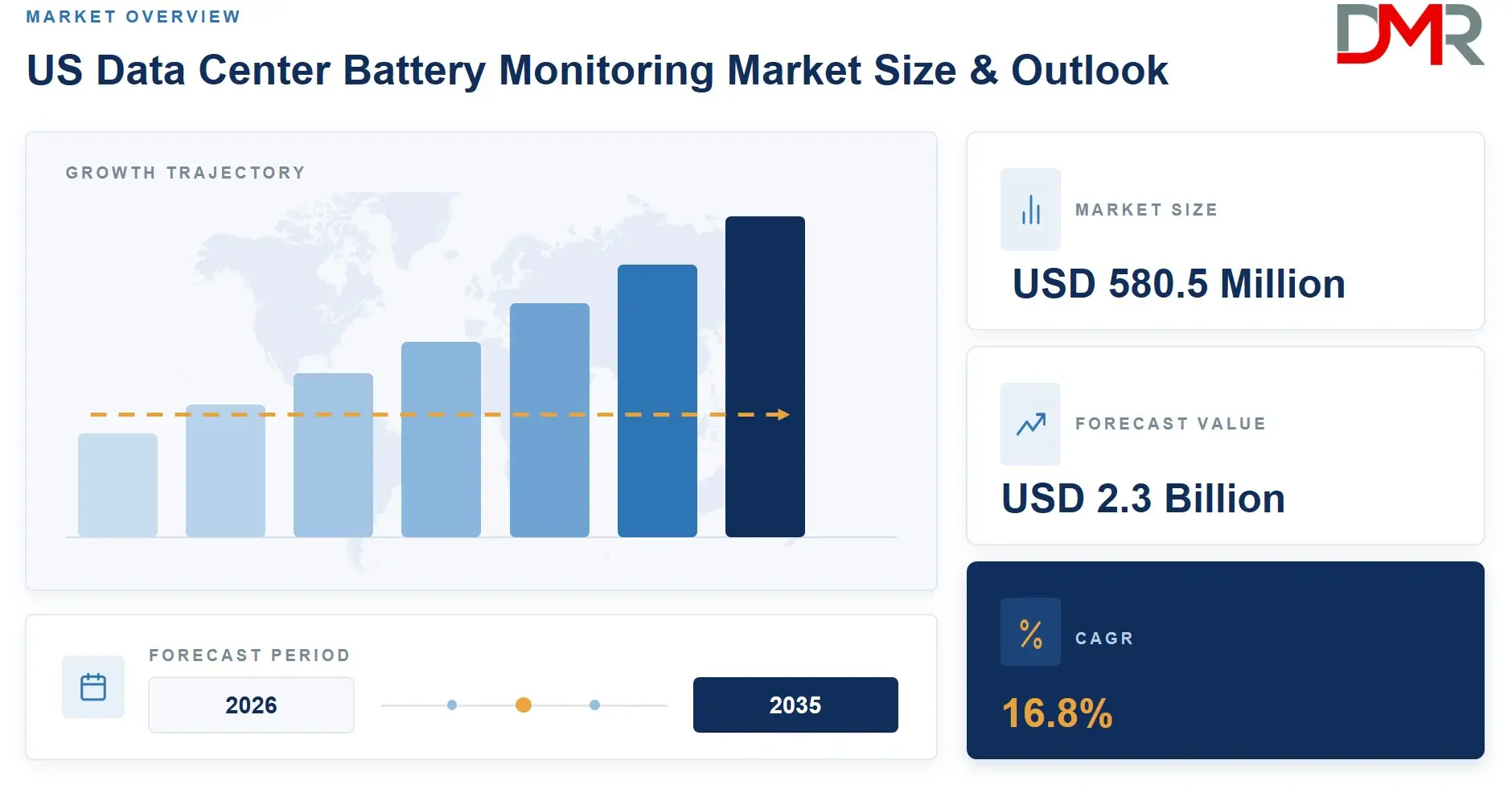
- Market Size (2026): USD 580.5 Mn
- Forecast Value (2035): USD 2.3 Bn
- CAGR (2026-2035): 16.8%
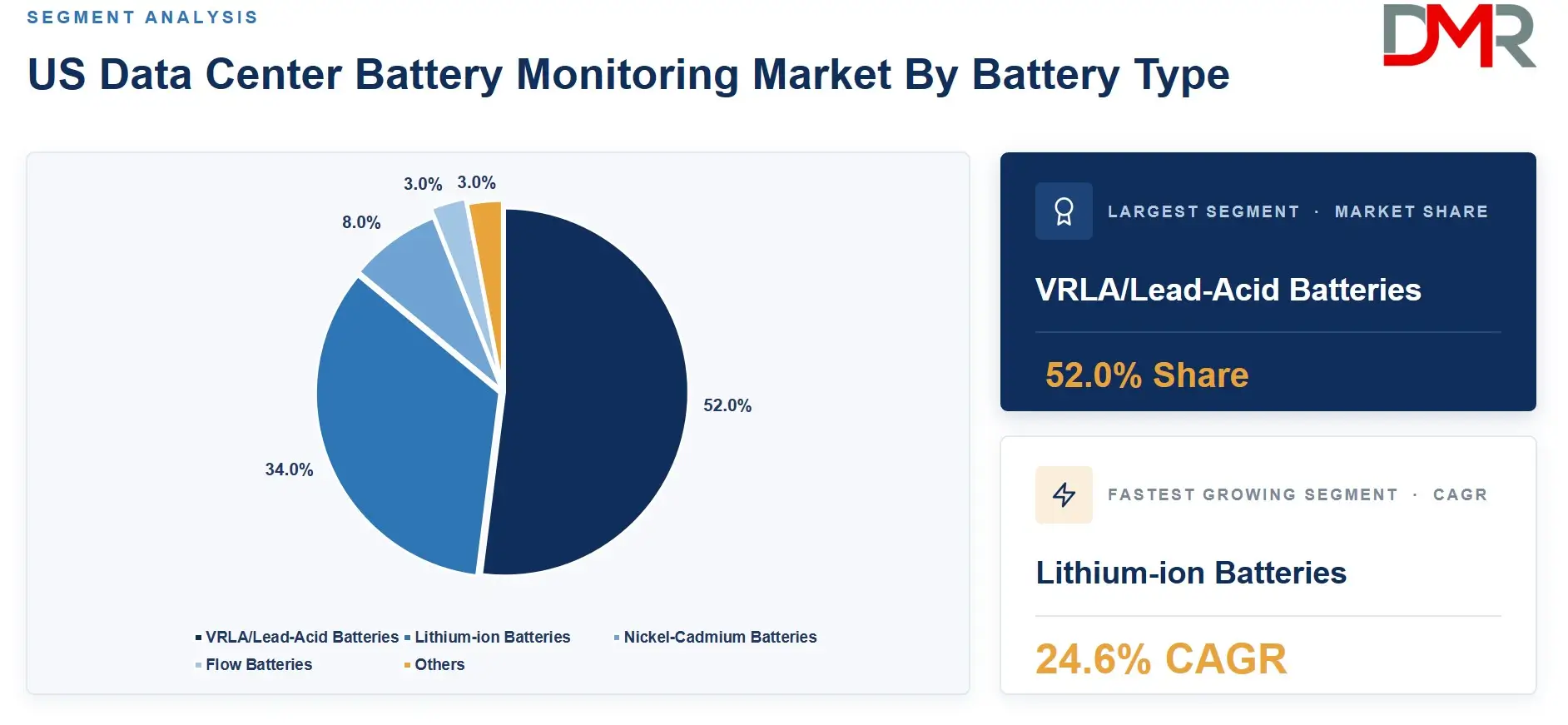
- Leading Battery Type (2026): VRLA/Lead-Acid Batteries, around 52%
- Leading Component (2026): Hardware (Sensors & Monitoring Units), close to 46%
- Key Players: Vertiv, Eaton, Texas Instruments and others
What is US Data Center Battery Monitoring Market and its Market Size?
The US Data Center Battery Monitoring Market size is estimated to reach USD 580.5 Mn in 2026 and is further anticipated to reach USD 2.3 Bn by 2035, at a CAGR of 16.8%.
ℹ
To learn more about this report –
Download Your Free Sample Report Here
The figures presented here cover demand for battery monitoring hardware, software and associated services deployed inside data center facilities located in the United States. They measure spending by US-based hyperscale, colocation and enterprise operators, not the worldwide revenue of vendors that happen to be headquartered in the country. A buyer based in Frankfurt or Singapore purchasing from a US-based supplier does not count toward this figure; a facility in Ashburn or Dallas purchasing from a foreign supplier does.
Battery monitoring in this context refers to the sensors, communication modules, software platforms and testing services that continuously track cell voltage, internal resistance, temperature and state of health across the backup battery strings that support uninterruptible power supply systems. Rather than relying on periodic manual load tests, operators install fixed monitoring units on each battery string or, increasingly, on each cell, feeding data into local controllers and cloud dashboards that flag degrading units before they fail during an actual outage event.
Buyers are concentrated among data center operators who cannot tolerate an unplanned outage: hyperscale cloud providers, wholesale colocation landlords, financial services firms running their own facilities and managed service providers responsible for contractual uptime guarantees. The purchase decision typically sits with facilities engineering and critical infrastructure teams rather than IT, and it is frequently bundled into the initial UPS and switchgear procurement rather than bought as a standalone retrofit, although retrofit demand remains substantial across the country's older colocation stock.
What is structurally changing is the battery chemistry itself. VRLA batteries still make up most of the installed base, but new hyperscale builds are increasingly specifying lithium-ion battery cabinets, which carry integrated battery management electronics and shift the monitoring conversation from simple voltage and temperature alarms toward cell-level diagnostics, state of health forecasting and remote fleet management across hundreds of facilities at once.
Use Cases
- Hyperscale Fleet Health Monitoring: Cloud platform operators running dozens of campuses deploy centralized battery monitoring dashboards that aggregate cell-level data across every facility, letting a single operations team triage degrading battery strings before a utility outage turns into a customer-facing service disruption.
- Colocation Tenant SLA Assurance: Wholesale and retail colocation landlords install continuous monitoring across shared UPS plants so that a single failing battery string does not jeopardize the uptime guarantees, close to 99.999%, written into tenant leases spanning dozens of customers on one power train.
- Enterprise Retrofit Programs: Banks, hospital systems and government agencies running older on-premises data halls retrofit legacy VRLA strings with clip-on monitoring units rather than replacing entire UPS plants, extending asset life while closing a visibility gap left by discontinued manual load testing programs.
- Managed Monitoring Services: Facilities without dedicated power engineering staff, particularly smaller edge and regional colocation sites, outsource battery health tracking to third-party monitoring providers who deliver alerts, compliance reporting and dispatch technicians only when a cell trends toward failure.
Key Takeaways
- Market Size & Share: The market is valued at USD 580.5 Mn in 2026 and is projected to expand at a CAGR of 16.8% through 2035.
- Battery Type Analysis: VRLA/Lead-Acid batteries account for approximately 52% of 2026 revenue, while Lithium-ion is the fastest-growing chemistry at a 24.6% CAGR.
- Demand Concentration: Hyperscale facilities are expected to represent nearly 44% of 2026 demand, reflecting the pace of AI-driven data center construction across the country.
- Lithium-ion Transition: New-build UPS specifications are shifting toward lithium-ion battery cabinets, pulling monitoring spend toward cell-level diagnostics rather than string-level alarms.
- Monitoring Technology Shift: Cloud-based remote monitoring is expected to account for around 37% of 2026 deployment mode revenue, ahead of the on-site-only monitoring approach that historically dominated the category.
- Competitive Landscape: The market spans power management majors, semiconductor battery-monitor IC suppliers and independent monitoring specialists, with no single vendor holding a dominant share of the installed base.
How AI/Gen AI is Transforming the US Data Center Battery Monitoring Market?
Artificial intelligence is changing battery monitoring from a threshold-alarm exercise into a predictive discipline. Machine learning models trained on years of voltage, resistance and temperature readings can now estimate remaining useful life for an individual cell rather than waiting for it to breach a fixed alarm limit, letting facilities teams schedule replacements around planned maintenance windows instead of emergency truck rolls. This matters more as US data centers add lithium-ion strings, where degradation patterns are less linear than the lead-acid behavior that older monitoring firmware was designed around.
Generative AI has a narrower but growing role, mainly in turning raw telemetry into plain-language incident summaries and maintenance recommendations that non-specialist facility staff can act on without interpreting a resistance trend chart themselves. The more consequential shift so far is operational rather than conversational: computer vision assisted inspection, anomaly detection on time-series sensor data and automated compliance documentation are doing the heavy lifting in newly deployed platforms.
- Predictive Failure Modeling: Time-series anomaly detection flags individual cells drifting from their historical baseline weeks before a conventional threshold alarm would trigger.
- Automated Compliance Documentation: Platforms auto-generate the test and inspection records facilities teams need for internal audits and insurance requirements, replacing manually compiled spreadsheets.
- Fleet-Level Prioritization: Machine learning ranks thousands of monitored strings across a multi-site portfolio so operations teams address the highest-risk assets first rather than reviewing sites in a fixed rotation.
- Natural-Language Alert Summaries: Generative models translate multi-parameter sensor readings into short incident narratives that on-call staff without electrical engineering backgrounds can act on immediately.
Key Drivers in the US Data Center Battery Monitoring Market
Two forces are pulling demand in different but reinforcing directions.
- Hyperscale and AI-Driven Data Center Construction: The buildout of new hyperscale and AI training capacity across the United States is adding UPS-backed critical power capacity at a pace few facilities teams can staff for manually. Every new UPS plant, whether VRLA or lithium-ion, ships with an expectation of continuous monitoring rather than periodic manual testing, and operators managing dozens of new campuses simultaneously have little choice but to standardize on automated systems from day one. This construction wave is concentrated in established corridors as well as newer secondary markets, both of which are adding monitored battery capacity faster than the broader data center market has historically grown.
- Rising Cost of Unplanned Downtime: Battery failure remains one of the leading root causes of data center power incidents, and the financial exposure from a single missed service level agreement at a large colocation or cloud facility can run into the millions of dollars. As facilities scale and customer contracts tighten uptime language, operators increasingly treat continuous battery monitoring as a required control rather than an optional add-on, a shift reinforced by insurers who now factor monitoring coverage into critical-facility risk assessments.
Restraints in the US Data Center Battery Monitoring Market
Growth is not unconstrained.
- Retrofit Cost and Downtime Risk: Installing monitoring hardware on an existing live battery string requires careful sequencing to avoid disturbing a system that is, by definition, supposed to remain available at all times. Facilities running older VRLA plants often delay retrofit projects until a scheduled maintenance window opens, which slows adoption across the substantial base of legacy colocation and enterprise sites relative to what new-build specification rates alone would suggest.
- Fragmented Legacy Infrastructure and Integration Cost: Many US data centers run UPS and battery plants from several different manufacturers installed across different construction phases, and a monitoring platform that reads cleanly from one vendor's communication protocol often needs custom integration work to read from another. This fragmentation raises the effective cost of a facility-wide rollout beyond the per-string hardware price and pushes some operators toward partial rather than complete monitoring coverage.
Growth Opportunities in the US Data Center Battery Monitoring Market
Two areas of white space stand out.
- Edge and Secondary-Market Colocation: As data center construction spreads beyond the traditional Northern Virginia and Dallas-Fort Worth corridors into secondary metros with less mature facilities engineering staff, monitoring vendors that package hardware with a managed alerting service, rather than raw dashboards alone, are positioned to win business from operators who cannot support an in-house power engineering team at every site.
- Lithium-ion Retrofit and Cabinet-Level Services: As operators swap VRLA strings for lithium-ion cabinets to reclaim floor space and extend replacement cycles, the removal and disposal of the old battery plant, commissioning of the new cabinet's integrated battery management system and ongoing cell-level diagnostics create a services revenue stream that a hardware sale alone does not capture.
Trends in the US Data Center Battery Monitoring Market
Buyer behavior and technology choices are both shifting.
- Cell-Level Rather Than String-Level Granularity: Newer platforms increasingly monitor individual cells rather than aggregating a whole string into a single reading, a shift driven partly by lithium-ion's less forgiving failure characteristics compared with lead-acid and partly by facilities teams wanting earlier warning on any chemistry.
- Consolidation Onto Cloud-Native Platforms: Operators managing multi-site portfolios are moving away from site-local monitoring software toward centralized, subscription-priced platforms that a single operations team can view across every facility, changing the commercial model from a one-time hardware sale toward recurring software revenue.
Research Scope and Analysis
Segment performance is assessed across five axes: battery type, component, monitoring level, data center type and deployment mode. Each axis identifies the sub-segment carrying the largest share of 2026 revenue and the one expanding fastest through 2035, along with the commercial reason behind each position.
ℹ
To learn more about this report –
Download Your Free Sample Report Here
By Battery Type
VRLA/Lead-Acid batteries hold the largest share of the battery type axis in 2026, accounting for around 52% of revenue, a position built on the sheer size of the installed base across older colocation and enterprise facilities and on lead-acid's lower upfront cost per kilowatt-hour of backup capacity. Growth, however, is concentrated in Lithium-ion batteries, expanding at a CAGR of 24.6% between 2026 and 2035 as new hyperscale builds specify lithium-ion cabinets for their smaller footprint, longer service life and integrated battery management electronics, pulling monitoring spend toward cell-level diagnostics as the installed lithium-ion base grows.
By Component
Hardware, meaning the sensors, communication modules and monitoring units physically attached to a battery string, is projected to hold the largest share by component in 2026, close to 46% of revenue, since every monitored string requires physical instrumentation regardless of which software platform sits above it. The steeper trajectory sits with Software and Analytics Platforms, forecast to grow at a CAGR of 22.4% through 2035, as operators shift spending toward subscription-priced dashboards, predictive analytics and fleet-management tools that consolidate data from hardware already in place across a growing multi-site portfolio.
By Monitoring Level
String-Level Monitoring remains the largest sub-segment in 2026 at approximately 38% of revenue, reflecting its status as the default configuration across most existing VRLA installations, where a single monitoring point per string was historically considered sufficient. Growth is concentrated in Cell-Level Monitoring, expanding at a CAGR of 25.8% through 2035, pushed by lithium-ion's need for individual cell voltage and temperature visibility and by facilities teams retrofitting older strings with finer-grained instrumentation after learning that string-level averages can mask a single degrading cell.
By Data Center Type
Hyperscale Data Centers represent the largest share of demand in 2026, an estimated 44%, driven by the sheer scale and pace of new construction tied to cloud and AI compute buildout across the country. The fastest expansion, however, sits with Edge Data Centers, projected to grow at a CAGR of 27.6% through 2035 as distributed compute and low-latency application requirements push smaller facilities into secondary and tertiary metros that still need the same monitoring discipline as a flagship campus, just at a smaller physical scale per site.
By Deployment Mode
On-Premises Monitoring, where data and dashboards stay within a facility's own network, holds the largest share in 2026 at roughly 51%, a position reinforced by security and compliance policies at financial services and government-adjacent facilities that restrict telemetry from leaving site. Cloud-Based and Remote Monitoring is the fastest-growing mode, forecast at a CAGR of 21.4% through 2035, as multi-site operators consolidate visibility into centralized platforms that a single operations team can access from anywhere, trading some data-locality preference for lower total cost of ownership across a growing facility count.
The US Data Center Battery Monitoring Market Report is Segmented Based on the Following
By Battery Type
- VRLA/Lead-Acid Batteries
- Lithium-ion Batteries
- Nickel-Cadmium Batteries
- Flow Batteries
- Others
By Component
- Hardware (Sensors & Monitoring Units)
- Software & Analytics Platforms
- Installation & Integration Services
- Maintenance & Support Services
- Others
By Monitoring Level
- Cell-Level Monitoring
- String-Level Monitoring
- Rack/Cabinet-Level Monitoring
- Facility-Wide Monitoring
- Others
By Data Center Type
- Hyperscale Data Centers
- Colocation Data Centers
- Enterprise Data Centers
- Edge Data Centers
- Others
By Deployment Mode
- On-Premises Monitoring
- Cloud-Based/Remote Monitoring
- Hybrid Monitoring
- Others
Technology Analysis
Monitoring architecture in US data centers is moving from string-level voltage checks toward cell-level sensing paired with algorithmic state of health estimation, a shift accelerated by the growing lithium-ion installed base. Communication is consolidating around standard protocols that let a single software layer read hardware from multiple UPS vendors rather than requiring a proprietary dashboard per manufacturer. The commercial opening sits with platforms that can retrofit onto legacy VRLA strings and lithium-ion cabinets alike without forcing an operator to run two separate systems. The principal brake is integration cost across the country's fragmented, multi-vendor legacy base, where older UPS communication interfaces were never designed for the level of telemetry a modern platform expects, slowing full-facility rollouts even where the underlying case for monitoring is not in question.
Geopolitical Analysis
Lithium-ion cell manufacturing remains heavily concentrated outside the United States, leaving domestic battery cabinet assemblers and monitoring hardware makers exposed to import cost and lead-time volatility even when final assembly and software development happen domestically. Trade policy affecting battery cells and electronic components has shifted more than once in recent years, and facilities teams planning multi-year data center buildouts increasingly factor tariff exposure into vendor selection alongside price and performance. The commercial opening favors monitoring and battery-management suppliers that can diversify component sourcing or that manufacture domestically, positioning them as a hedge against further trade disruption. The risk cuts the other way for vendors dependent on a narrow set of overseas suppliers, where a single policy change can compress margins or delay hardware shipments into facilities already committed to a construction timeline.
Competitive Landscape
The market is moderately fragmented, spanning power management majors that sell monitoring as part of a broader UPS and switchgear portfolio, semiconductor companies supplying the battery-monitor integrated circuits embedded inside cabinets, and independent specialists that sell monitoring as a standalone hardware, software or managed-service offering. Competition centers on integration breadth across multiple UPS brands, the accuracy and lead time of predictive failure alerts, and increasingly on whether a vendor can support both legacy VRLA and newer lithium-ion chemistries from a single platform. Vendors with an existing UPS installed base hold a natural advantage in cross-selling monitoring, while independent specialists compete on multi-vendor compatibility and depth of analytics.
Some of the Prominent Players in the US Data Center Battery Monitoring Market Are
- Vertiv Holdings
- Eaton Corporation
- Schneider Electric
- ABB
- Legrand
- Texas Instruments
- Analog Devices
- Infineon Technologies
- NXP Semiconductors
- Toshiba
- C&D Technologies
- EnerSys
- HBL Power Systems
- BTECH Inc.
- Alpine Power Systems
- Eagle Eye Power Solutions
- BatteryDAQ
- CPG Beyond the Cloud
- Cadex Electronics
- Midtronics
- Benchmark Electronics
- NDSL Inc.
- PowerShield
- Newmar
- Microchip Technology
- STMicroelectronics
- onsemi
- Renesas Electronics
- Delta Electronics
- Riello UPS
- Socomec
- Piller Power Systems
- Mitsubishi Electric
- Fuji Electric
- Rittal
- Panduit
- Nlyte Software
- Sunbird Software
- Device42
- Keysight Technologies
- Other Key Players
Recent Developments
- In June 2026, Texas Instruments introduced the BQ79826Z-Q1 battery monitor with an integrated electrochemical impedance spectroscopy engine, adding cell-level diagnostic depth relevant to the lithium-ion backup batteries increasingly specified in US data center UPS cabinets.
- In 2026, Vertiv began rolling out the second-generation Liebert EXL S1 UPS platform across its North American hyperscale installed base, adding native lithium-ion battery management system integration that removes the need for a separate third-party monitoring layer on new deployments.
- In 2025, Eaton updated its 9PX 20K to 30K modular UPS family for US edge and colocation deployments, adding a new remote monitoring module alongside enhanced parallel operation for N plus 1 redundancy configurations.
- In June 2025, Eaton and Siemens Energy announced a collaboration pairing Eaton's US-supplied UPS, switchgear and battery storage equipment with modular on-site power generation, aimed at shortening data center construction timelines nationwide.
Report Details
| Report Characteristics |
| Market Size (2026) |
USD 580.5 Mn |
| Forecast Value (2035) |
USD 2.3 Bn |
| CAGR (2026-2035) |
16.8% |
| Historical Data |
2021 - 2025 |
| Forecast Data |
2026 - 2035 |
| Base Year |
2025 |
| Segments Covered |
By Battery Type, By Component, By Monitoring Level, By Data Center Type, and By Deployment Mode |
| Regional Coverage |
The US |
Frequently Asked Questions
How big is the US Data Center Battery Monitoring Market?
▾ The US Data Center Battery Monitoring Market is estimated at USD 580.5 Mn in 2026 and is projected to reach USD 2.3 Bn by 2035, reflecting sustained investment in continuous monitoring across the country's expanding data center footprint.
What is the growth rate of the US Data Center Battery Monitoring Market?
▾ The market is projected to grow at a CAGR of 16.8% between 2026 and 2035, supported by hyperscale construction, the shift toward lithium-ion battery chemistries and rising demand for predictive rather than reactive battery maintenance.
What is driving demand in the US Data Center Battery Monitoring Market?
▾ Demand is driven primarily by the pace of hyperscale and AI-related data center construction, which adds new UPS-backed critical power capacity faster than facilities teams can staff for manual testing, and by the rising financial cost of unplanned downtime tied to undetected battery failures.
Who are the key players in the US Data Center Battery Monitoring Market?
▾ Leading participants include Vertiv, Eaton, Schneider Electric, Texas Instruments, Analog Devices, EnerSys and C&D Technologies, alongside independent monitoring specialists such as BTECH, Eagle Eye Power Solutions and BatteryDAQ.
How is artificial intelligence influencing battery monitoring deployments?
▾ Artificial intelligence is shifting battery monitoring from fixed-threshold alarms toward predictive failure modeling, letting facilities teams schedule battery replacements around planned maintenance windows rather than reacting to an alarm once a cell has already begun to fail.