Market Snapshot
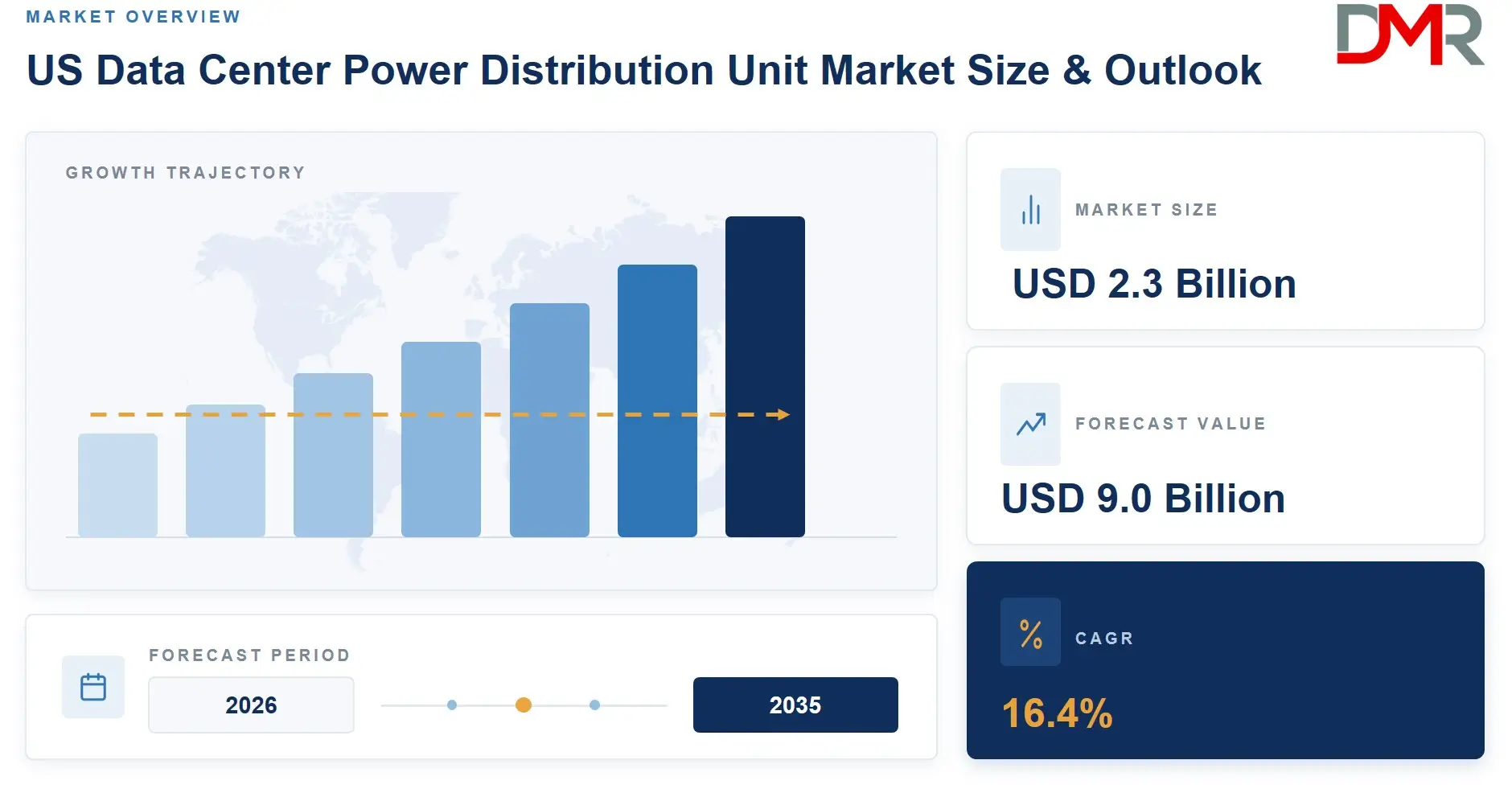
- Market Size (2026): USD 2.3 Bn
- Forecast Value (2035): USD 9.0 Bn
- CAGR (2026-2035): 16.4%
- Leading Type (2026): Basic PDU, around 23%
- Leading Application (2026): Hyperscale/Cloud Data Centers, approximately 38%
- Key Players: Vertiv, Eaton and Schneider Electric, among others
What is US Data Center Power Distribution Unit Market and its Market Size?
The US Data Center Power Distribution Unit Market size is estimated to reach USD 2.3 Bn in 2026 and is further anticipated to reach USD 9.0 Bn by 2035, at a CAGR of 16.4%.
ℹ
To learn more about this report –
Download Your Free Sample Report Here
The scope of this analysis is confined to power distribution units installed, ordered or retrofitted at data center sites physically located within the United States. It measures demand generated inside the country rather than the worldwide revenue of companies headquartered there, since several of the largest suppliers to this market sell the bulk of their output outside US borders. A power distribution unit sits between upstream power sources, uninterruptible power supplies, switchgear or busway, and downstream IT loads, converting a single high-current feed into multiple monitored, protected circuits at the rack or row level.
Buyers fall into a narrow set of operator types: hyperscale cloud platforms building gigawatt-scale campuses, colocation providers leasing white space to enterprise and AI tenants, and corporate IT departments running on-premises or edge facilities. Purchase decisions increasingly favor units with remote outlet-level monitoring and switching, since operators managing thousands of racks across multiple sites need visibility into load balance and the ability to power-cycle equipment without a site visit. Procurement is typically bundled into a broader electrical build-out alongside switchgear, busway and static transfer switches rather than sourced as a standalone line item.
What is changing structurally is the power draw per rack. Cabinets built for general-purpose compute historically drew under 10 kilowatts; GPU-dense AI training and inference racks now routinely draw 40 to 100 kilowatts or more, a shift that has pushed the market away from single-phase, low-amperage basic units toward three-phase, high-capacity, remotely switched designs capable of balancing load across redundant power paths. That transition, combined with a wave of new hyperscale and colocation capacity under construction across the country, is the primary force reshaping unit specifications, price points and replacement cycles through 2035.
Use Cases
- Hyperscale AI Training Clusters: Cloud platforms building GPU training campuses deploy three-phase switched PDUs rated above 40 kilowatts per rack, replacing single-phase basic units that cannot safely carry the current draw of dense accelerator racks, which lets operators balance load across redundant feeds without manual intervention.
- Colocation Multi-Tenant Billing: Colocation providers install metered and monitored PDUs at the cabinet level so they can invoice tenants for actual power consumption rather than reserved capacity, a shift that improves revenue accuracy across shared facilities serving dozens of enterprise customers on a single floor.
- Enterprise On-Premises Retrofit: Corporate IT teams upgrading legacy server rooms to support internal AI inference workloads swap basic strip PDUs for monitored units with remote outlet switching, cutting the need for after-hours site visits when a hung server needs a manual power cycle.
- Edge and Regional Facility Rollouts: Telecom and retail operators deploying small edge data centers near population centers standardize on compact, monitored rack PDUs that report temperature and current draw back to a central operations team overseeing dozens of unstaffed sites, accounting for close to 7% of 2026 application demand.
Key Takeaways
- Market Size & Share: The market is estimated at USD 2.3 Bn in 2026, expanding to USD 9.0 Bn by 2035 at a CAGR of 16.4%.
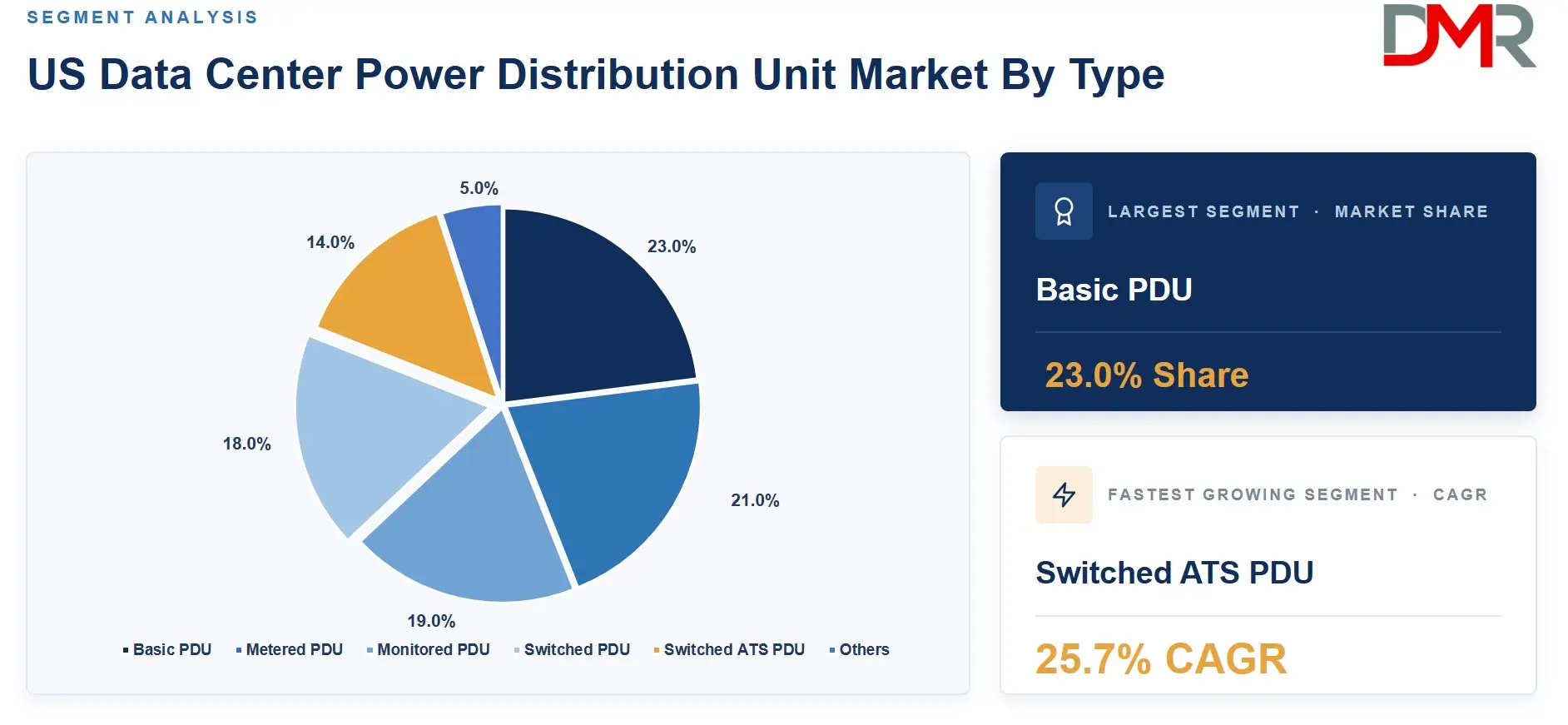
- Type Analysis: Basic PDU holds the largest 2026 share at around 23%, while Switched ATS PDU is forecast to grow fastest at a CAGR of 25.7% through 2035.
- Demand Concentration: Hyperscale and cloud data centers account for approximately 38% of 2026 demand, the largest of any application segment tracked in this report.
- Power Density Shift: PDUs rated above 60 kilowatts, the tier built for AI-dense racks, are projected to expand at a CAGR of 27.9% between 2026 and 2035, the fastest of any power-rating tier.
- Deployment Mix: Rack-mounted units remain dominant, holding close to 52% of 2026 revenue by deployment format.
- Competitive Landscape: The market spans more than 40 tracked suppliers, led by Vertiv, Eaton and Schneider Electric, alongside a deep bench of US-headquartered specialists.
How AI/Gen AI is Transforming the US Data Center Power Distribution Unit Market?
Artificial intelligence is reshaping this market less through the PDU hardware itself and more through the software and planning tools wrapped around it. Because rack-level power has become the binding constraint on how fast a data hall can be filled with compute, operators are turning to computer-vision-assisted commissioning, predictive load analytics and digital twin design tools to plan and manage distribution before a single unit is installed.
Digital twins built from PDU telemetry let engineering teams simulate how a proposed rack layout will draw and balance power months before construction, cutting the redesign cycles that used to follow late-stage density changes. Predictive analytics applied to outlet-level current and temperature data flag failing components or unbalanced phases before they trip a breaker, extending the interval between manual electrical audits. Generative design tools are also being used earlier in the process, testing dozens of feeder and busway configurations against a target rack density to shorten the path from site selection to energized floor.
- Predictive Maintenance Analytics: Outlet-level current and thermal data feed models that flag an at-risk breaker or connector before failure.
- Digital Twin Capacity Planning: Simulated rack and row layouts validate phase balance and headroom ahead of physical build-out.
- Generative Electrical Design: Automated configuration testing shortens the time needed to size feeders, busway and PDU counts for a given density target.
- Remote DCIM Integration: AI-assisted data center infrastructure management platforms aggregate PDU telemetry across sites for centralized load balancing.
Key Drivers in the US Data Center Power Distribution Unit Market
Two forces are pulling US demand for power distribution units ahead of the broader data center build-out.
- AI-Driven Rack Power Density: GPU training and inference clusters have pushed typical rack draw from single digits into the 40 to 100 kilowatt range, a level single-phase basic PDUs were never engineered to carry safely. Operators are replacing or specifying three-phase, high-amperage, remotely switched units capable of balancing load across redundant A and B feeds, which is why PDUs rated above 60 kilowatts are forecast to grow at 27.9% annually through 2035, far outpacing the market's 16.4% headline rate. Every new hyperdense hall built for accelerator hardware effectively locks in a higher-value PDU specification for its full operating life.
- Hyperscale and Colocation Capacity Build-Out: With several thousand new or expanding data center projects underway across the country to serve cloud and AI workloads, each new hall requires a full complement of rack and floor PDUs sized to its design density. Colocation operators leasing white space to multiple AI tenants are standardizing on metered and monitored units so that power draw, not just floor area, can be billed and managed tenant by tenant, reinforcing demand for intelligent rather than basic hardware across new construction.
Restraints in the US Data Center Power Distribution Unit Market
Two brakes temper how quickly this demand converts into installed hardware.
- Grid Interconnection and Capital Timelines: New data center campuses increasingly wait years for utility interconnection and substation upgrades before a site can be energized, which delays the point at which PDUs actually get installed even after a project is fully funded. Capital earmarked for electrical infrastructure, PDUs included, can sit idle through permitting and grid-study queues that now stretch well beyond the construction schedule for the building itself, pushing out revenue recognition for suppliers even as order backlogs grow.
- Component and Skilled-Labor Constraints: High-amperage PDUs depend on semiconductor-based metering and switching components, copper busbars and specialized enclosures that compete for the same manufacturing capacity as switchgear and transformers, both of which are also in acute shortage. At the same time, commissioning three-phase, high-density electrical distribution requires licensed electricians and controls engineers in numbers the industry has not trained fast enough to supply, lengthening installation timelines at sites that already cleared the interconnection hurdle.
Growth Opportunities in the US Data Center Power Distribution Unit Market
Two areas of white space stand out for suppliers positioned to serve them.
- Edge Facility Standardization: Telecom carriers and retailers rolling out distributed edge sites to support low-latency AI inference represent a smaller but fast-growing buyer group, with the Edge application segment on pace for a 26.8% CAGR through 2035. Suppliers that package compact, pre-configured, remotely monitored PDUs for unstaffed sites can capture a channel that hyperscale-focused vendors are not built to serve efficiently at scale.
- Retrofit of Existing Colocation Capacity: A large base of colocation halls built for pre-AI rack densities cannot host today's accelerator hardware without an electrical upgrade, creating a retrofit cycle distinct from new construction. Vendors offering modular, in-row and busway-integrated distribution that can be installed without a full shutdown of adjacent live racks are positioned to win this replacement demand ahead of the next new-build wave.
Trends in the US Data Center Power Distribution Unit Market
Two shifts are visible in how PDUs are specified and bought right now.
- Migration Toward Higher-Voltage DC Architectures: Suppliers are bringing 800 volt DC power portfolios to market ahead of next-generation accelerator platforms, aiming to cut copper usage and conversion losses compared with traditional AC distribution as rack power climbs toward the hundreds of kilowatts. Early deployments remain concentrated in the newest hyperscale halls, but the architecture is expected to work down into colocation specifications over the back half of the forecast period.
- Consolidation of Purchasing Around Intelligent Units: Buyers across hyperscale, colocation and enterprise segments are converging on metered, monitored or switched PDUs as the default specification even outside the highest-density racks, treating basic units as a shrinking legacy category reserved for low-criticality space. This is compressing the price gap between basic and intelligent hardware as manufacturers standardize monitoring electronics across their rack PDU lines.
Research Scope and Analysis
Demand across this market is assessed along five axes: type, power rating, deployment format, application and end use industry. Each axis identifies the sub-segment carrying the largest share of 2026 revenue and the one expanding fastest through 2035, with the commercial logic behind each position.
ℹ
To learn more about this report –
Download Your Free Sample Report Here
By Type
Basic PDU holds the largest share of 2026 revenue at around 23%, reflecting the sheer number of lower-criticality racks across enterprise and legacy colocation space where a simple, unmonitored strip remains sufficient and cost stays the deciding factor. Growth, however, is concentrated in Switched ATS PDU, expanding at a CAGR of 25.7% between 2026 and 2035 as hyperscale and AI-tenant colocation operators standardize on units that can fail over between redundant feeds and be power-cycled remotely, a requirement that basic hardware cannot meet regardless of price.
By Power Rating
The 20 to 40 kilowatt tier leads 2026 revenue at close to 29%, the band that matches most colocation and enterprise rack designs specified before the current AI build-out began. The steeper trajectory sits with PDUs rated above 60 kilowatts, forecast to grow at a CAGR of 27.9% through 2035 as GPU training racks push past the thermal and electrical limits of legacy specifications, forcing a wholesale upgrade in the units purpose-built for the newest halls.
By Deployment
Rack-mounted PDUs account for approximately 52% of 2026 revenue by deployment format, the default choice for virtually every server cabinet regardless of operator type or facility age. Growth, however, is concentrated in in-row and busway-integrated distribution, projected to expand at a CAGR of 24.3% between 2026 and 2035 as hyperscale operators favor modular, prefabricated power delivery that can be reconfigured as rack density targets change without rewiring an entire row.
By Application
Hyperscale and cloud data centers lead 2026 demand at nearly 38% of the market, driven by the scale and pace of the AI infrastructure campuses these operators are bringing online across the country. The fastest expansion, though, is in edge data centers, which are set to post a CAGR of 26.8% through 2035 as telecom and retail operators push compute closer to end users for latency-sensitive inference workloads, a buyer group still in the early stages of standardizing its PDU specifications.
By End Use Industry
IT and telecom operators represent the largest end-use share of 2026 revenue at around 34%, consistent with their position as both the primary consumers of data center capacity and, in the case of telecom carriers, direct site owners. Growth is sharpest in media and entertainment, which is projected to expand at a CAGR of 23.1% between 2026 and 2035 as streaming and cloud gaming platforms scale the GPU-dense infrastructure that underpins content rendering and recommendation workloads.
The US Data Center Power Distribution Unit Market Report is Segmented Based on the Following
By Type
- Basic PDU
- Metered PDU
- Monitored PDU
- Switched PDU
- Switched ATS PDU
- Others
By Power Rating
- Below 20 kW
- 20 to 40 kW
- 40 to 60 kW
- Above 60 kW
- Others
By Deployment
- Rack-Mounted
- Floor-Mounted / Cabinet
- In-Row / Busway-Integrated
- Others
By Application
- Hyperscale / Cloud Data Centers
- Colocation Data Centers
- Enterprise Data Centers
- Edge Data Centers
- Others
By End Use Industry
- IT & Telecom
- BFSI
- Government & Defense
- Healthcare
- Media & Entertainment
- Others
Technology Analysis
US PDU design is mid-transition from AC-only, single or three-phase distribution toward higher-voltage DC architectures purpose-built for next-generation accelerator racks, with early 800-volt portfolios reaching market ahead of the platforms they are meant to support. What is shifting now is the integration layer: monitoring electronics, once an add-on for switched units, are becoming standard across the product line as buyers converge on remote visibility as a baseline requirement rather than a premium feature. The commercial opening sits with suppliers who can certify DC-capable and high-amperage AC units against the same rack footprint, letting operators hedge which architecture ultimately dominates a given hall. The risk is stranded specification, since a facility built around one voltage architecture can face a costly retrofit if the industry consolidates around the other, a real possibility while accelerator platform requirements keep iterating year over year, a dynamic that will keep suppliers hedging their roadmaps well into the back half of the forecast period.
Geopolitical Analysis
Manufacturers serving this market have spent the past two years reshoring capacity, adding switchgear, transformer and rack-system production across several states to reduce reliance on imported electrical components exposed to tariff risk and shipping delays. What is shifting now is the pace of that build-out, with new plants announced faster than they can be staffed or brought online, leaving near-term supply tighter even as domestic capacity expands. The commercial opening favors suppliers with US-based manufacturing already qualified for utility and hyperscale procurement, since buyers are increasingly weighting domestic content and lead time alongside price. The risk is that continued trade-policy uncertainty around imported semiconductors, copper and steel inputs keeps raising the landed cost of components that even domestic assembly still depends on, a pressure that could slow how quickly price-sensitive buyers absorb increases without deferring upgrades.
Competitive Landscape
The US market for data center power distribution units is moderately fragmented, spanning a handful of diversified electrical majors that bundle PDUs into full grid-to-rack power packages alongside a long tail of specialists competing on monitoring depth, lead time and rack-level engineering. Competition centers on three levers: breadth of intelligent monitoring and remote switching features, US manufacturing capacity that shortens lead times against an industry-wide component backlog, and the ability to bundle PDUs with adjacent switchgear, busway and rack infrastructure into a single procurement package. Diversified majors compete primarily on scale and integration, securing multi-site hyperscale contracts, while specialists differentiate on faster customization, distributor reach and support for legacy or non-standard rack formats that larger vendors deprioritize.
Some of the Prominent Players in the US Data Center Power Distribution Unit Market Are
- Schneider Electric SE
- Vertiv Holdings Co
- Eaton Corporation plc
- Legrand SA
- ABB Ltd
- Siemens AG
- Rittal GmbH & Co. KG
- nVent Electric plc
- Delta Electronics Inc.
- Emerson Electric Co.
- Chatsworth Products Inc.
- Panduit Corp
- Enlogic Systems LLC
- ZPE Systems Inc.
- Black Box Corporation
- Hubbell Incorporated
- Belden Inc.
- TDK-Lambda Corporation
- Bel Fuse Inc.
- Mean Well Enterprises Co., Ltd.
- Socomec Group
- CyberPower Systems Inc.
- Sinetica Industries Ltd
- Riello Elettronica S.p.A.
- Conteg s.r.o.
- Power Distribution, Inc. (PDI)
- WESCO International Inc.
- Graybar Electric Company Inc.
- CDW Corporation
- Insight Enterprises Inc.
- Corning Incorporated
- ePlus Inc.
- ScanSource Inc.
- TD SYNNEX Corporation
- Ingram Micro Inc.
- Kohler Co.
- Generac Holdings Inc.
- Littelfuse Inc.
- Amphenol Corporation
- Molex LLC
- Other Key Players
Recent Developments
- In April 2026, Eaton announced an investment of more than USD 30 million to build a new switchgear manufacturing facility near Omaha, Nebraska, adding capacity aimed at the electrical supply constraints facing new US data center projects.
- In March 2026, Eaton introduced its Beam Rubin DSX platform in collaboration with NVIDIA, a modular grid-to-chip power and infrastructure package designed for gigawatt-scale AI data center build-outs.
- In March 2026, Vertiv confirmed four new or expanded manufacturing facilities across the Americas, growing its production capacity for power management and rack infrastructure equipment sold into US data center projects.
- In November 2025, Schneider Electric signed contracts worth approximately USD 2.3 billion for US data center cooling and power equipment, phased for delivery across 2025 and 2026.
- In September 2025, Vertiv launched an expanded PowerIT rack PDU line rated up to 57.6 kilowatts, targeting the higher current draw of AI and high-performance computing racks.
Report Details
| Report Characteristics |
| Market Size (2026) |
USD 2.3 Bn |
| Forecast Value (2035) |
USD 9.0 Bn |
| CAGR (2026-2035) |
16.4% |
| Historical Data |
2021 - 2025 |
| Forecast Data |
2026 - 2035 |
| Base Year |
2025 |
| Segments Covered |
By Type, By Power Rating, By Deployment, By Application, and By End Use Industry |
| Regional Coverage |
The US |
Frequently Asked Questions
How big is the US Data Center Power Distribution Unit Market?
▾ The market is estimated at USD 2.3 Bn in 2026 and is projected to reach USD 9.0 Bn by 2035, expanding at a CAGR of 16.4% across the forecast period as AI-driven rack density and new hyperscale capacity fuel demand nationwide, alongside a broader wave of colocation and enterprise electrical upgrades.
What is the growth rate of the US Data Center Power Distribution Unit Market?
▾ The market is forecast to grow at a CAGR of 16.4% between 2026 and 2035, well above the pace of the broader electrical equipment industry, driven primarily by the shift toward higher-density, three-phase and intelligent power distribution hardware needed to support AI training and inference workloads across new and retrofitted data center capacity nationwide.
What is driving demand in the US Data Center Power Distribution Unit Market?
▾ Demand is driven chiefly by rising rack power density, as AI accelerator clusters push draw from single digits into the 40 to 100 kilowatt range, alongside a wave of new hyperscale and colocation capacity under construction nationwide that requires a full complement of rack and floor-level distribution hardware sized to each facility's design density.
Who are the key players in the US Data Center Power Distribution Unit Market?
▾ Leading suppliers include Vertiv, Eaton, Schneider Electric, Legrand, ABB, Siemens and Chatsworth Products, among more than 40 companies tracked in this report spanning diversified electrical majors, rack-level specialists and the distributors that route their products into hyperscale and colocation build-outs across the country.
Which PDU type leads the US Data Center Power Distribution Unit Market?
▾ Basic PDU holds the largest share of 2026 revenue, at around 23%, reflecting its continued use across lower-criticality enterprise and legacy colocation racks, though Switched ATS PDU is forecast to grow fastest, at a CAGR of 25.7%, as operators standardize on remotely switchable, redundant-feed hardware for AI-dense capacity.
What role does AI play in the US Data Center Power Distribution Unit Market?
▾ Artificial intelligence workloads are the single largest force behind rising rack power density, but AI also shapes the market operationally through digital twin capacity planning, predictive maintenance analytics on outlet-level telemetry and generative design tools that shorten the time needed to size feeders, busway and PDU counts for a target density.
Which application segment is expected to grow fastest in the US Data Center Power Distribution Unit Market?
▾ Edge data centers are projected to expand fastest among application segments in the US Data Center Power Distribution Unit Market, at a CAGR of 26.8% through 2035, as telecom and retail operators deploy distributed, low-latency sites to support AI inference workloads closer to end users, even though the segment still accounts for a comparatively small share of 2026 demand.