U.S. Defense Manufacturing Robotics Market Snapshot
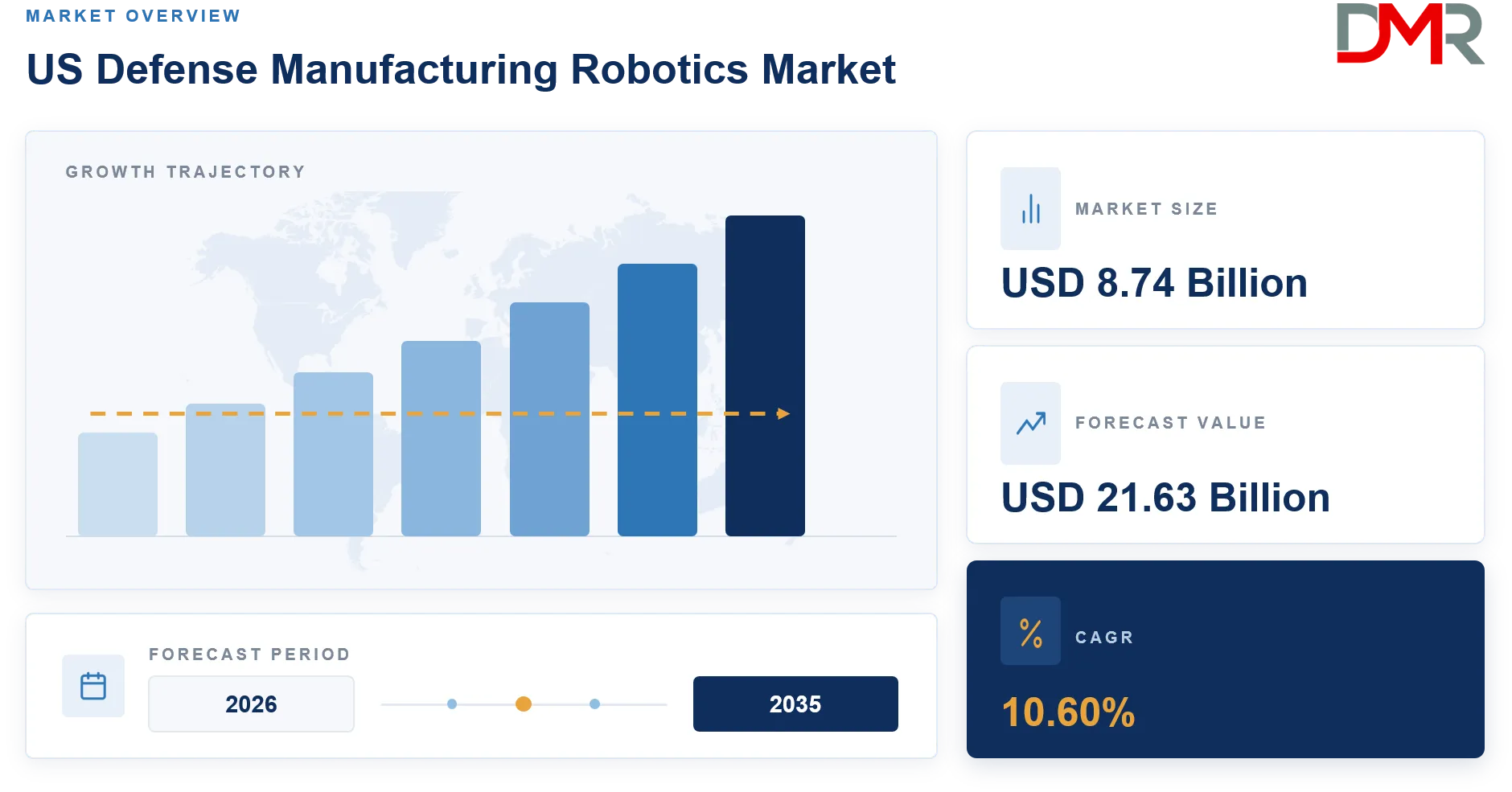
- Market Value: The U.S. defense manufacturing robotics market is valued at USD 8.74 billion in 2026 and is projected to reach USD 21.63 billion by 2035.
- CAGR: The U.S. defense manufacturing robotics market is expected to grow at a CAGR of 10.6% from 2026 to 2035.
- By Platform Segment Analysis: Airborne platforms dominated the market with a 55.8% share in 2026.
- By Application Segment Analysis: Intelligence, surveillance and reconnaissance held the leading application share of 26.4% in 2026.
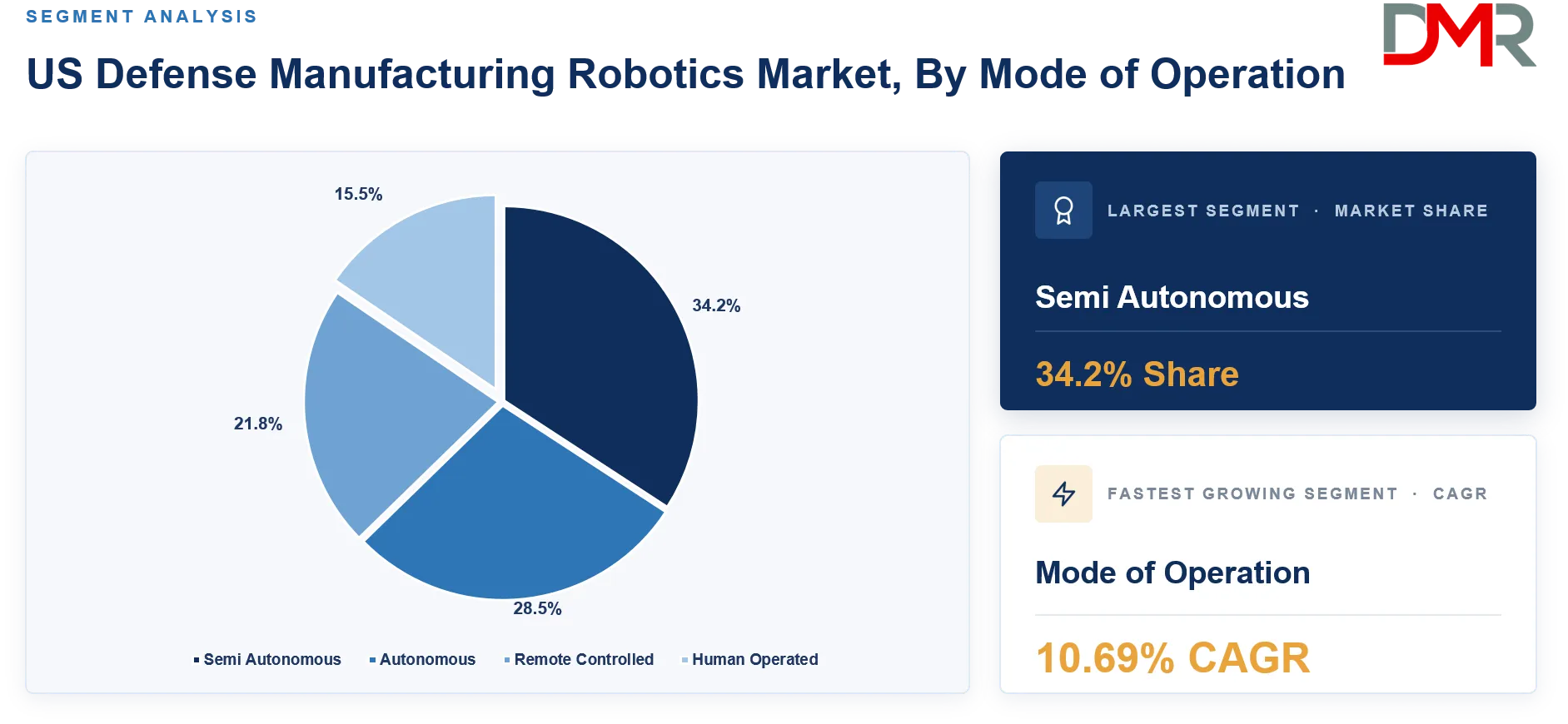
- By Mode of Operation Segment Analysis: Semi-autonomous systems led the market with a 34.2% share in 2026.
- By End User Segment Analysis: Armed forces accounted for the largest end-user share at 63.7% in 2026.
- Major Players: Lockheed Martin Corporation, Boeing, General Dynamics Corporation, Northrop Grumman Corporation, and Others.
What is the U.S. Defense Manufacturing Robotics Market and its Market Size?
The U.S. Defense Manufacturing Robotics Market size is projected to be valued at USD 8.74 billion in 2026 and is projected to reach USD 21.63 billion by 2035, expanding at a CAGR of 10.6% during the forecast period. Defense manufacturing robotics includes unmanned aerial, ground and marine platforms as well as robotic systems, autonomy software, sensors, secure communications, navigation technologies and mission payloads developed for military and homeland security requirements.
ℹ
To learn more about this report –
Download Your Free Sample Report Here
Demand is moving beyond conventional remotely operated equipment as the Department of Defense expands autonomous capabilities while seeking greater production capacity across the domestic defense industrial base. The proposed FY2026 defense budget identified USD 13.4 billion for autonomy and autonomous systems, including USD 9.4 billion for unmanned and remotely operated aerial vehicles, USD 1.7 billion for on-water autonomous systems and USD 1.2 billion for enabling autonomy capabilities. These programs are strengthening demand for scalable production, advanced electronics, sensor fusion, mission software and secure communications across U.S. defense robotics supply chains.
Use Cases
- Persistent Intelligence and Surveillance: Airborne drones equipped with electro-optical cameras, infrared sensors, radar and communications payloads provide persistent intelligence, surveillance and reconnaissance. These platforms extend situational awareness over contested terrain while allowing personnel to collect mission data without continuous physical exposure.
- Explosive Ordnance Disposal: Ground robots allow military teams to inspect, manipulate and neutralize explosive threats from safer distances. Rugged mobility, dexterous manipulators, cameras and secure control links make robotic EOD systems important for bases, urban operations, route clearance and hazardous-site assessment.
- Autonomous Logistics: Robotic ground and aerial platforms can support ammunition movement, resupply, equipment transport and last-mile logistics. Autonomous navigation and human robot teaming can reduce repetitive workload while extending supply operations into areas where conventional transport exposes personnel and vehicles to greater risk.
- Maritime Operations: Unmanned surface and underwater vehicles support reconnaissance, mine detection, harbor security, seabed monitoring and persistent maritime surveillance. Growing demand for distributed naval operations is increasing the importance of autonomous navigation, resilient communications and modular sensor payloads.
- Defense Production and Inspection: Robotics is also being adopted inside the defense industrial base for inspection, welding, material handling and precision production. The Department of Defense Manufacturing Technology Program is supporting advanced production techniques, including autonomous drone inspection systems designed to scan ships for defects.
How AI and Gen AI are Transforming the U.S. Defense Manufacturing Robotics Market?
AI is shifting defense robotics from equipment that follows predefined commands toward systems that can perceive surroundings, classify objects, plan routes and assist operators with complex mission decisions. Sensor fusion combines radar, cameras, inertial measurement, positioning and other inputs to create a more complete operating picture. Computer vision supports navigation and target recognition, while machine learning improves anomaly detection and predictive maintenance. DARPA's autonomy programs also reflect growing interest in systems capable of operating in unpredictable environments with reduced human supervision, particularly where communications may be limited or disrupted.
Generative AI has a different but complementary role across engineering, simulation and human machine interaction. Defense manufacturers can use generative models to accelerate design exploration, produce synthetic training environments, summarize maintenance information and assist software development. Within robotics operations, natural-language interfaces can reduce the complexity of configuring missions or reviewing large volumes of sensor information. Adoption will remain governed by cybersecurity, verification, data provenance and human authorization requirements because military robotic decisions require predictable and auditable behavior. This creates demand for secure edge computing, validated autonomy stacks and human robot teaming architectures rather than unrestricted automation.
Key Drivers in the U.S. Defense Manufacturing Robotics Market
Expansion of U.S. Autonomous Defense Programs
Federal investment in unmanned and autonomous platforms is creating a direct demand signal for defense robotics manufacturers. The FY2026 defense budget proposal identified USD 13.4 billion for autonomy and autonomous systems across aerial, ground, surface, underwater and enabling technologies. Programs seeking rapid fielding of unmanned capabilities are expanding opportunities for airframe suppliers, sensor manufacturers, communications providers and autonomy software companies while encouraging production models designed for higher volumes and shorter delivery cycles.
Defense Industrial Base Modernization
The modernization of U.S. defense production capacity is strengthening demand for robotics both as deployable military systems and as factory automation tools. DOD ManTech is focused on reducing manufacturing cost and production time through advanced technologies, while the FY2026 budget proposal included additional funding for industrial base supply-chain improvements and munitions production expansion. Robotic inspection, automated welding, precision assembly and material handling can help manufacturers increase throughput while maintaining demanding aerospace and defense quality standards.
Restraints in the U.S. Defense Manufacturing Robotics Market
Secure Supply Chain and Component Dependencies
Defense robotics depends on sensors, motors, batteries, processors, communications hardware, specialty materials and electronic components that can have complex international supply chains. GAO reported that DOD relies on a network of more than 200,000 suppliers and continues to face challenges in understanding lower-tier dependencies. Restrictions involving foreign components can extend qualification periods, raise procurement costs and limit the ability of manufacturers to scale production rapidly when demand changes.
Verification, Cybersecurity and Operational Reliability
Military robotics must perform reliably in environments that may include electronic warfare, degraded GPS, communications loss, difficult terrain and deliberate cyber threats. Higher autonomy therefore creates additional requirements for software verification, secure communications, fail-safe behavior and operator oversight. Qualification and testing can increase development timelines compared with commercial robotics. Manufacturers that cannot demonstrate resilient navigation, protected command links and predictable system behavior may face barriers during defense procurement and operational evaluation.
Growth Opportunities in the U.S. Defense Manufacturing Robotics Market
Scalable Production of Attritable Autonomous Systems
Defense procurement is creating opportunities for manufacturers capable of producing autonomous systems at higher volumes and lower unit costs. The Replicator initiative accelerated fielding across unmanned aerial and surface platforms and brought traditional contractors together with nontraditional technology suppliers. This purchasing model supports modular architectures, commercial manufacturing techniques and faster production cycles, creating room for emerging robotics companies as well as established defense primes.
Domestic Robotics Manufacturing and Advanced Automation
Onshoring of critical defense manufacturing creates an opportunity to deploy industrial robots, autonomous mobile robots and automated inspection systems across U.S. production facilities. The Office of Strategic Capital has identified advanced manufacturing and autonomous mobile robots among strategically important technology areas. Suppliers that combine robotics hardware with machine vision, secure software and flexible automation can address defense manufacturers seeking higher throughput without relying only on additional skilled labor.
Trends in the U.S. Defense Manufacturing Robotics Market
Shift Toward Human Robot Teaming
The market is moving from simple teleoperation toward mission architectures in which personnel supervise several robotic assets and intervene when needed. Semi-autonomous systems remain particularly relevant because they combine machine navigation and perception with human decision authority. This approach supports ISR, logistics and hazardous missions while allowing defense organizations to introduce greater autonomy progressively. Demand is therefore increasing for intuitive control interfaces, common autonomy software and secure multi-platform communications.
Modular Sensors, Software and Mission Payloads
Defense buyers increasingly value platforms that can be adapted without redesigning the complete robotic system. Modular cameras, radar, electronic sensing, communications packages and mission payloads allow the same platform family to serve surveillance, reconnaissance, targeting, logistics or protection missions. This is increasing competitive emphasis on open architectures, software-defined capabilities and payload integration. Manufacturers able to shorten integration cycles can address changing mission requirements more efficiently and improve lifecycle value for defense customers.
Research Scope and Analysis
The U.S. defense manufacturing robotics market is segmented based on Platform, Application, Mode of Operation, End User, Technology and Payload Type. The study evaluates the role of unmanned systems and defense robotics across mission operations while also examining technologies enabling autonomous navigation, sensor fusion, secure communications and human robot teaming. The analysis considers procurement demand, domestic manufacturing capacity, defense modernization, supplier ecosystems and technology adoption influencing market growth through 2035.
ℹ
To learn more about this report –
Download Your Free Sample Report Here
By Platform
Airborne platforms led the U.S. defense manufacturing robotics market with a 55.8% share in 2026. Unmanned aerial vehicles, tactical drones and combat drones benefit from broad mission applicability across ISR, targeting support, communications relay, perimeter monitoring and contested-environment operations. Their relatively rapid deployment cycle and ability to cover large areas strengthen procurement demand. The U.S. government's autonomy spending profile also reinforces the segment's position, with unmanned and remotely operated aerial vehicles representing the largest identified portion of proposed FY2026 autonomy funding. Continued demand for modular payloads, longer endurance, resilient navigation and lower-cost systems is expected to support airborne platform growth.
By Application
Intelligence, surveillance and reconnaissance accounted for 26.4% of the market in 2026, making ISR the leading application. Robotic platforms allow defense operators to gather persistent imagery, radar information, signals and environmental data while reducing the need to place personnel directly inside hazardous areas. The application is relevant across aerial, ground, surface and underwater platforms, which expands its addressable equipment base. Improvements in electro-optical imaging, thermal sensors, edge processing and sensor fusion are increasing the volume and quality of information that robotic platforms can provide. Future opportunities center on autonomous sensor management, distributed surveillance networks and faster conversion of raw data into actionable intelligence.
By Mode of Operation
Semi-autonomous systems held a 34.2% share in 2026. Their leadership reflects the operational value of combining automated navigation, obstacle avoidance and sensor processing with human supervision for critical decisions. This operating model can lower operator workload without removing human judgment from missions involving uncertain environments or sensitive rules of engagement. Semi-autonomy also provides a practical transition path for agencies that already operate remotely controlled platforms. Advances in navigation, edge computing and human machine interfaces are expected to improve the ability of a single operator to supervise multiple robotic assets.
By End User
Armed forces represented 63.7% of market revenue in 2026, supported by acquisition across the U.S. Army, Navy, Air Force, Marine Corps and related defense organizations. Military users require robotic systems for ISR, explosive ordnance disposal, combat support, logistics, mine countermeasures and other high-risk operations. The breadth of missions creates demand across airborne, ground, surface and underwater platforms. Homeland security, special operations forces and internal security agencies form additional demand pools, particularly for surveillance, hazardous-object handling and facility protection applications.
The U.S. Defense Manufacturing Robotics Market Report is Segmented on the Basis of the Following:
By Platform
- Airborne
- Unmanned Aerial Vehicles
- Tactical Drones
- Combat Drones
- Land
- Unmanned Ground Vehicles
- Bomb Disposal Robots
- Tactical Robots
- Marine
- Unmanned Surface Vehicles
- Unmanned Underwater Vehicles
By Application
- Intelligence Surveillance Reconnaissance
- Combat Support
- Explosive Ordnance Disposal
- Search and Rescue
- Transportation
- Mine Clearance
- Firefighting
By Mode of Operation
- Autonomous
- Semi Autonomous
- Remote Controlled
- Human Operated
By End User
- Armed Forces
- Homeland Security
- Special Operations Forces
- Internal Security Agencies
By Technology
- Artificial Intelligence Systems
- Advanced Navigation Systems
- Sensor Fusion Systems
- Secure Communication Links
- Swarm Robotics Systems
- Human Robot Teaming
By Payload Type
- Sensors
- Cameras
- Weapons
- Radar Systems
- LCD Screens
Competitive Landscape
The U.S. defense manufacturing robotics market includes established defense primes, unmanned-system specialists and newer defense technology companies competing across platforms, autonomy software, sensors, communications and mission integration. Lockheed Martin, Boeing, General Dynamics and Northrop Grumman benefit from established military programs, engineering scale and systems-integration capabilities.
AeroVironment, General Atomics, Kratos and Textron maintain strong positions in unmanned aircraft and mission platforms, while L3Harris and RTX contribute sensors, communications and mission technologies. Anduril Industries represents the growing role of software-led defense companies focused on autonomous systems and scalable production. Boston Dynamics and Ghost Robotics extend competition into advanced ground mobility, while Red Cat, Redwire and other specialized companies address emerging platform and subsystem opportunities. Procurement initiatives that seek participation from nontraditional vendors are increasing competitive pressure on incumbents to shorten development cycles and improve manufacturing scalability.
Some of the prominent players in the U.S. Defense Manufacturing Robotics Industry are:
- Lockheed Martin Corporation
- Boeing
- General Dynamics Corporation
- Northrop Grumman Corporation
- AeroVironment, Inc.
- General Atomics
- BAE Systems plc
- RTX
- L3Harris Technologies, Inc.
- Textron Inc.
- Anduril Industries
- Boston Dynamics
- Kratos Defense & Security Solutions
- Red Cat Holdings Inc.
- Redwire Corp
- Knightscope, Inc.
- Ghost Robotics Corporation
- QinetiQ Group plc
- Elbit Systems Ltd.
- Science Applications International Corp. (SAIC)
- Others
Regulatory Landscape
The U.S. defense manufacturing robotics market operates within a strict framework covering procurement, cybersecurity, export controls, supply-chain security and autonomous-system governance. Defense contractors supplying robotic platforms, sensors, navigation systems and secure communications must align with Department of Defense acquisition requirements, while controlled defense articles and technical data can fall under International Traffic in Arms Regulations. Cybersecurity requirements are becoming more important as connected robots exchange mission and operational data across defense networks. The Department of Defense is also strengthening supply-chain visibility and restricting certain foreign-sourced components in sensitive unmanned systems. For autonomous capabilities, DoD Directive 3000.09 establishes policy for autonomy in weapon systems and emphasizes appropriate levels of human judgment over the use of force. These requirements favor suppliers that can demonstrate secure-by-design engineering, traceable components, resilient communications, software assurance and reliable human oversight throughout system development and deployment.
Investment and White Space Analysis
Investment opportunities in the U.S. defense manufacturing robotics market are expanding as procurement shifts toward scalable autonomous platforms, domestic production and faster technology deployment. The proposed FY2026 defense budget identified USD 13.4 billion for autonomy and autonomous systems, creating opportunities beyond complete robotic platforms. Attractive white spaces include low-cost navigation for GPS-denied environments, modular sensor payloads, secure communications, edge computing, counter-electronic-warfare capabilities, autonomous logistics and human robot teaming software. Manufacturing infrastructure presents another opportunity as defense suppliers seek automated inspection, robotic welding, precision assembly and flexible production systems that can increase throughput. Smaller technology companies can also address gaps in batteries, actuators, rugged electronics, perception software and interoperable control systems. Companies that combine commercially scalable manufacturing with defense-grade cybersecurity and domestic supply chains are positioned to capture demand as agencies seek more systems at lower unit costs and shorter delivery cycles.
Recent Developments
- August 2026: BAE Systems plc Modernized its Nashua, New Hampshire microelectronics center with CHIPS Act-supported manufacturing tools to raise defense-chip capacity, accelerate deliveries, and reduce costs.
- July 2026: Lockheed Martin Corporation Received a seven-year, up-to-$53.86 billion PAC-3 MSE production award, supporting major capacity expansion and advanced manufacturing across its US defense industrial base.
- January 2026: Anduril Industries Announced a 1.18-million-square-foot Long Beach, California campus, adding roughly 5,500 jobs and expanding US capacity for autonomous defense systems.
Report Details
| Report Characteristics |
| Market Size (2026) |
USD 8.74 Bn |
| Forecast Value (2035) |
USD 21.63 Bn |
| CAGR (2026–2035) |
10.6% |
| Historical Data |
2021 – 2025 |
| Forecast Data |
2027 – 2035 |
| Base Year |
2025 |
| Estimate Year |
2026 |
| Segments Covered |
By Platform (Airborne {Unmanned Aerial Vehicles, Tactical Drones, and Combat Drones}, Land {Unmanned Ground Vehicles, Bomb Disposal Robots, and Tactical Robots}, and Marine {Unmanned Surface Vehicles and Unmanned Underwater Vehicles}), By Application (Intelligence Surveillance Reconnaissance, Combat Support, Explosive Ordnance Disposal, Search and Rescue, Transportation, Mine Clearance, and Firefighting), By Mode of Operation (Autonomous, Semi Autonomous, Remote Controlled, and Human Operated), By End User (Armed Forces, Homeland Security, Special Operations Forces, and Internal Security Agencies), By Technology (Artificial Intelligence Systems, Advanced Navigation Systems, Sensor Fusion Systems, Secure Communication Links, Swarm Robotics Systems, and Human Robot Teaming), By Payload Type (Sensors, Cameras, Weapons, Radar Systems, and LCD Screens) |
| Regional Coverage |
United States |
Frequently Asked Questions
What is the current size of the U.S. Defense Manufacturing Robotics Market?
▾ The U.S. Defense Manufacturing Robotics Market is valued at USD 8.74 billion in 2026, reaching USD 21.63 billion by 2035.
What is the growth rate of the U.S. Defense Manufacturing Robotics Market during?
▾ The U.S. Defense Manufacturing Robotics Market is forecast to expand at a CAGR of 10.6% during the 2026-2035 period.
What factors are driving the growth of the U.S. Defense Manufacturing Robotics Market?
▾ Autonomy investment and unmanned platform procurement drive U.S. Defense Manufacturing Robotics Market growth.
What are the major challenges restraining the U.S. Defense Manufacturing Robotics Market?
▾ Cybersecurity, component sourcing and system verification restrain U.S. Defense Manufacturing Robotics Market growth.
Which segment holds the largest share of the U.S. Defense Manufacturing Robotics Market?
▾ Airborne platforms lead the U.S. Defense Manufacturing Robotics Market with a 55.8% market share in 2026.
Who are the leading companies in the U.S. Defense Manufacturing Robotics Market?
▾ Lockheed Martin Corporation, Boeing, General Dynamics Corporation, Northrop Grumman Corporation, AeroVironment, Inc., General Atomics, BAE Systems plc, RTX, L3Harris Technologies, Inc., Textron Inc., Anduril Industries, Boston Dynamics, Kratos Defense & Security Solutions, Red Cat Holdings Inc., Redwire Corp, Knightscope, Inc., Ghost Robotics Corporation, QinetiQ Group plc, Elbit Systems Ltd., and Science Applications International Corp. (SAIC) are leading companies in the U.S. Defense Manufacturing Robotics Market.
How is AI influencing the U.S. Defense Manufacturing Robotics Market?
▾ AI improves navigation, sensor fusion and mission planning across the U.S. Defense Manufacturing Robotics Market.
What are the future opportunities and trends in the U.S. Defense Manufacturing Robotics Market?
▾ Scalable autonomy and domestic production create new U.S. Defense Manufacturing Robotics Market opportunities.