Market Overview
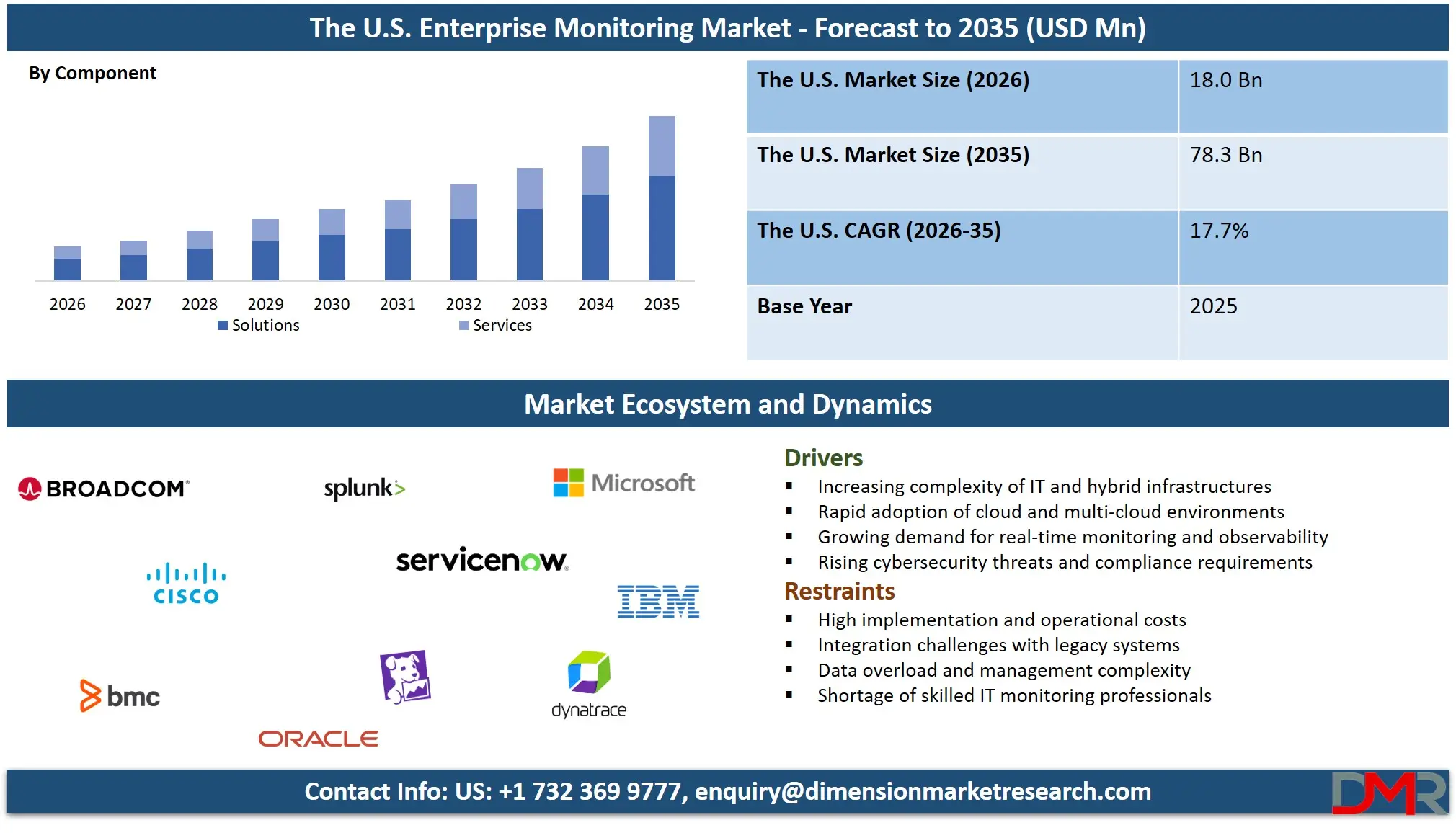
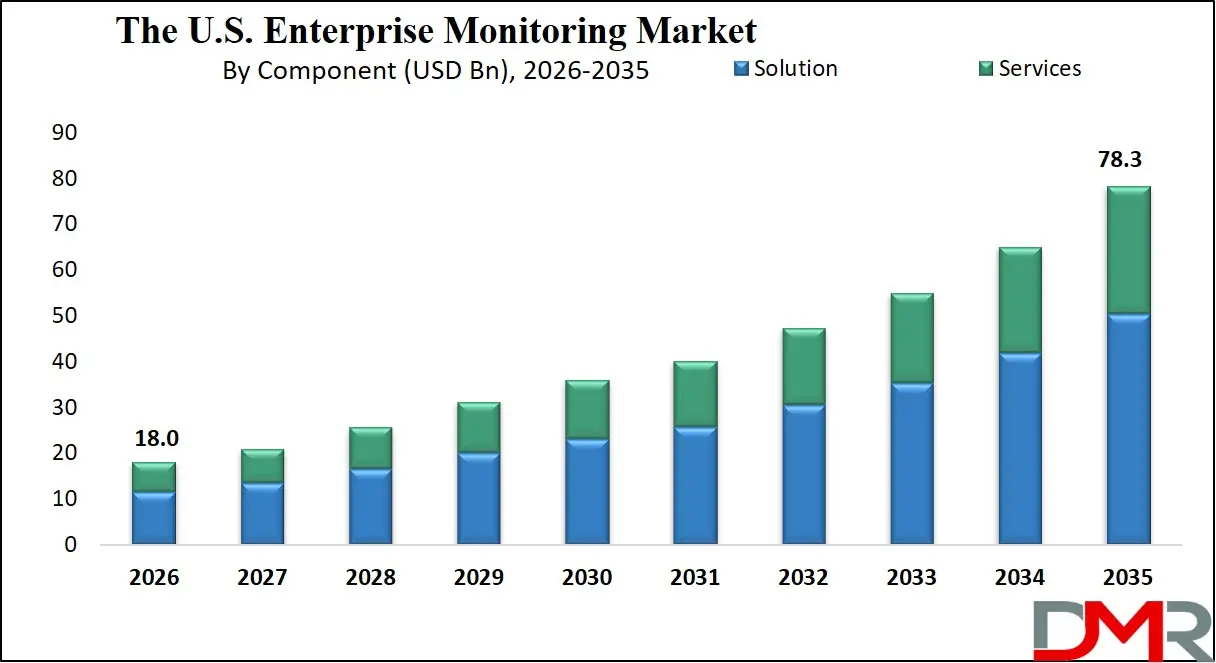
The U.S. Enterprise Monitoring Market size is projected to reach USD 18.0 billion in 2026 and grow at a compound annual growth rate of 17.7% to reach a value of USD 78.3 billion in 2035.
ℹ
To learn more about this report –
Download Your Free Sample Report Here
Enterprise monitoring refers to a comprehensive approach used by organizations to track, analyze, and manage the performance, availability, and security of their IT infrastructure, applications, networks, and digital services. It involves a combination of software platforms, analytics tools, and monitoring services designed to provide real-time visibility across complex enterprise environments. These solutions typically integrate capabilities for infrastructure, application, network, database, and digital experience monitoring. Enterprise monitoring plays a crucial role in ensuring operational continuity, minimizing downtime, improving system performance, and supporting data-driven decision-making within modern digital enterprises.
In the U.S. enterprise monitoring landscape, rapid digital transformation across industries has increased the complexity of IT environments, driving organizations to adopt advanced monitoring solutions. The growing adoption of hybrid and multi-cloud infrastructure, containerized applications, and microservices architecture has significantly expanded the scope of enterprise monitoring tools. Organizations are increasingly prioritizing real-time analytics, predictive maintenance, and automation to ensure system resilience and maintain optimal application performance. Increased reliance on digital platforms for business operations has further reinforced the importance of monitoring tools capable of managing distributed systems and ensuring seamless user experiences.
ℹ
To learn more about this report –
Download Your Free Sample Report Here
The sector has also experienced significant technological evolution, with vendors integrating artificial intelligence, machine learning, and advanced analytics to enhance monitoring capabilities. Strategic partnerships between technology providers and cloud infrastructure companies have accelerated innovation in this field. Additionally, regulatory requirements related to data security and operational transparency have encouraged organizations to adopt robust monitoring frameworks. Investments in observability platforms, along with the expansion of managed monitoring services, are shaping the trajectory of enterprise monitoring adoption across the U.S.
The U.S. Enterprise Monitoring Market: Key Takeaways
- Market Growth: The U.S. Enterprise Monitoring Market size is expected to grow by USD 57.4 billion, at a CAGR of 17.7%, during the forecasted period of 2027 to 2035.
- By Component: The solutions segment is anticipated to get the majority share of the U.S. Enterprise Monitoring market in 2026.
- By Deployment Mode: The cloud segment is expected to get the largest revenue share in 2026 in the U.S. Enterprise Monitoring market.
- Use Cases: Some of the use cases of Enterprise Monitoring include IT infrastructure performance optimization, application performance management, and more.
The U.S. Enterprise Monitoring Market: Use Cases
- IT Infrastructure Performance Optimization: Enterprise monitoring tools are widely used to track server health, storage utilization, virtualization environments, and infrastructure performance. Organizations rely on these platforms to identify system bottlenecks, reduce downtime, and optimize resource allocation across data centers and hybrid cloud infrastructures.
- Application Performance Management: Businesses use enterprise monitoring platforms to measure application performance and user interactions continuously. Real-time monitoring allows IT teams to detect latency issues, identify application errors, and ensure smooth digital experiences across web, mobile, and enterprise software platforms.
- Network Visibility and Security Monitoring: Monitoring solutions enable organizations to analyze network traffic, detect anomalies, and ensure secure connectivity across corporate networks. These tools help IT teams identify unusual network behavior, prevent cyber threats, and maintain consistent network performance across distributed infrastructures.
- Digital Experience Monitoring: Enterprises increasingly deploy monitoring systems to measure end-user digital experiences across websites, mobile apps, and enterprise software. These platforms simulate user interactions, detect performance issues, and ensure seamless customer experiences across digital channels.
- Database Monitoring and Performance Management: Database monitoring tools help enterprises track database performance metrics, query efficiency, and data availability. These solutions enable IT teams to identify performance bottlenecks, improve query optimization, and maintain database stability for mission-critical applications.
- Cloud Infrastructure Monitoring: Organizations adopting cloud computing rely on enterprise monitoring tools to track the performance of public, private, and hybrid cloud environments. Monitoring solutions provide insights into cloud resource utilization, workload efficiency, and service availability.
- Compliance and Operational Governance: Enterprise monitoring systems assist organizations in meeting regulatory requirements related to system availability, data protection, and operational transparency. Monitoring platforms provide audit trails, reporting capabilities, and alerts that help enterprises maintain compliance with industry standards.
Stats & Facts
- U.S. Bureau of Labor Statistics reported that employment in computer and information technology occupations grew by 356,700 new jobs between 2023 and 2024 in the United States.
- U.S. Census Bureau stated that 21.3% of U.S. businesses used advanced cloud computing services in 2024 for operational management and data processing.
- National Institute of Standards and Technology (NIST) reported in 2025 that more than 70% of federal IT systems now operate in hybrid or cloud-based environments.
- Federal Communications Commission (FCC) reported that 95% of the U.S. population had access to broadband internet as of 2024.
- U.S. Department of Commerce indicated that digital economy activities contributed 10.3% of U.S. GDP in 2024.
- Cybersecurity and Infrastructure Security Agency (CISA) documented over 1,200 significant cyber incident reports across U.S. critical infrastructure sectors in 2024.
- National Telecommunications and Information Administration (NTIA) reported that 92% of U.S. adults used the internet regularly in 2024.
- U.S. Energy Information Administration (EIA) recorded that U.S. data center electricity consumption exceeded 176 terawatt hours in 2024.
- U.S. Government Accountability Office (GAO) stated in 2025 that federal agencies manage over 7,000 major IT systems requiring continuous monitoring.
- International Telecommunication Union (ITU) reported that the United States had over 331 million internet users in 2024.
- World Bank stated that fixed broadband subscriptions in the United States reached 39.2 per 100 people in 2024.
- Organisation for Economic Co-operation and Development (OECD) reported that over 60% of U.S. enterprises used cloud-based digital services in 2025.
Market Dynamic
Driving Factors in the U.S. Enterprise Monitoring Market
Rising Complexity of IT Infrastructure
Organizations across the United States are increasingly operating in complex IT environments that involve hybrid cloud systems, distributed applications, container platforms, and microservices architectures. As enterprises scale their digital infrastructure, maintaining system visibility and operational control becomes increasingly challenging. Enterprise monitoring platforms help organizations maintain performance consistency by providing centralized dashboards, automated alerts, and real-time system insights. The growth of large-scale digital ecosystems, particularly in sectors such as financial services, healthcare, and telecommunications, has significantly accelerated the demand for advanced monitoring solutions capable of handling complex enterprise IT environments.
Growing Demand for Operational Efficiency and Downtime Prevention
Modern enterprises rely heavily on digital platforms to deliver services, manage operations, and support customer engagement. Even short periods of system downtime can result in financial losses, reputational damage, and operational disruptions. Enterprise monitoring tools enable organizations to detect potential issues before they escalate into system failures. Predictive analytics, automated remediation tools, and proactive alerting systems allow IT teams to maintain high levels of system reliability and performance. The increasing emphasis on business continuity, operational efficiency, and service availability is therefore contributing significantly to the adoption of enterprise monitoring solutions across the U.S.
Restraints in the U.S. Enterprise Monitoring Market
Rising Complexity of IT Infrastructure
Organizations across the United States are increasingly operating in complex IT environments that involve hybrid cloud systems, distributed applications, container platforms, and microservices architectures. As enterprises scale their digital infrastructure, maintaining system visibility and operational control becomes increasingly challenging. Enterprise monitoring platforms help organizations maintain performance consistency by providing centralized dashboards, automated alerts, and real-time system insights. The growth of large-scale digital ecosystems, particularly in sectors such as financial services, healthcare, and telecommunications, has significantly accelerated the demand for advanced monitoring solutions capable of handling complex enterprise IT environments.
Growing Demand for Operational Efficiency and Downtime Prevention
Modern enterprises rely heavily on digital platforms to deliver services, manage operations, and support customer engagement. Even short periods of system downtime can result in financial losses, reputational damage, and operational disruptions. Enterprise monitoring tools enable organizations to detect potential issues before they escalate into system failures. Predictive analytics, automated remediation tools, and proactive alerting systems allow IT teams to maintain high levels of system reliability and performance. The increasing emphasis on business continuity, operational efficiency, and service availability is therefore contributing significantly to the adoption of enterprise monitoring solutions across the United States.
Opportunities in the U.S. Enterprise Monitoring Market
Expansion of Cloud-Native and Observability Platforms
The growing adoption of cloud-native technologies, including containers and microservices, has created new opportunities for advanced observability platforms. These platforms provide deeper insights into application performance, infrastructure health, and user experiences across distributed systems. As enterprises continue migrating workloads to public and hybrid cloud environments, demand for modern monitoring solutions capable of handling dynamic cloud infrastructures is expected to increase significantly. This shift toward cloud-native monitoring represents a major growth opportunity for vendors offering scalable and flexible monitoring platforms.
Increasing Adoption in Emerging Industry Verticals
Industries such as healthcare, retail, logistics, and energy are increasingly investing in digital technologies to enhance operational efficiency and customer engagement. These sectors are adopting enterprise monitoring solutions to manage connected devices, digital platforms, and cloud-based applications. As digital transformation accelerates across traditionally less digitized industries, the demand for monitoring platforms is expected to grow. Vendors that develop industry-specific monitoring solutions tailored to these sectors may benefit from expanding adoption across diverse enterprise environments.
Trends in the U.S. Enterprise Monitoring Market
Integration of AI-Driven Observability
Artificial intelligence and machine learning technologies are increasingly being integrated into enterprise monitoring platforms to enhance system visibility and predictive capabilities. AI-driven observability tools can automatically detect anomalies, analyze system patterns, and predict potential failures before they occur. These capabilities allow organizations to move from reactive monitoring to proactive system management. As AI technologies continue to evolve, their integration within monitoring platforms is expected to transform how enterprises manage IT operations and system performance.
Adoption of Unified Monitoring Platforms
Enterprises are increasingly seeking unified monitoring platforms that combine infrastructure monitoring, application performance monitoring, network monitoring, and digital experience monitoring within a single system. Consolidating multiple monitoring functions into a centralized platform allows organizations to streamline operations, reduce tool complexity, and gain holistic visibility across their IT environments. Unified monitoring solutions also enable better collaboration between IT operations, development teams, and cybersecurity departments, contributing to more efficient enterprise system management.
Impact of Artificial Intelligence in the U.S. Enterprise Monitoring Market
- Predictive System Analytics: AI algorithms analyze historical system data to predict potential failures, allowing IT teams to take preventive actions before system disruptions occur.
- Automated Incident Detection: AI-powered monitoring platforms can automatically detect anomalies across networks, applications, and infrastructure without manual intervention.
- Intelligent Root Cause Analysis: Machine learning models help identify the root cause of system issues faster by analyzing multiple infrastructure layers simultaneously.
- Self-Healing Infrastructure: AI systems can trigger automated remediation actions such as restarting services or reallocating resources to resolve performance issues.
- Real-Time Data Correlation: AI platforms correlate data from servers, networks, databases, and applications to generate comprehensive performance insights.
- Enhanced Cybersecurity Monitoring: AI monitoring tools detect suspicious patterns in network traffic and system activity, improving enterprise threat detection.
- Dynamic Resource Optimization: AI helps optimize cloud and infrastructure resource usage by analyzing workload demands and adjusting system capacity automatically.
- Improved User Experience Monitoring: AI enables better digital experience monitoring by analyzing user behavior patterns and identifying performance bottlenecks.
- Operational Efficiency Improvements: Automation powered by AI reduces manual monitoring tasks and allows IT teams to focus on strategic initiatives.
Research Scope and Analysis
By Component Analysis
Solutions represent the dominant segment in the U.S. enterprise monitoring market and are expected to account for approximately 64.3% of the market share in 2026. Enterprises increasingly prefer comprehensive monitoring platforms that provide integrated capabilities such as infrastructure monitoring, network monitoring, application performance monitoring, and digital experience analytics. These solutions enable organizations to gain centralized visibility across complex IT environments, which is essential for maintaining system stability and operational efficiency. Additionally, the growing adoption of hybrid cloud infrastructure and distributed applications has increased the demand for advanced monitoring software capable of managing diverse technology environments. Enterprises are investing in scalable monitoring solutions that support real-time analytics, automation, and predictive performance management. As digital transformation initiatives expand across multiple industries, the demand for enterprise monitoring solutions is expected to remain strong.
Services are emerging as the fastest-growing segment as organizations increasingly seek professional expertise to deploy and manage monitoring platforms. Managed services providers offer continuous monitoring, system optimization, and incident response support, enabling enterprises to maintain system performance without maintaining large internal IT teams. Professional services also assist organizations in customizing monitoring frameworks according to specific operational needs. As enterprise IT infrastructures become more complex, the demand for external monitoring expertise is expected to grow rapidly, particularly among small and medium-sized businesses that require cost-efficient monitoring support.
By Deployment Mode Analysis
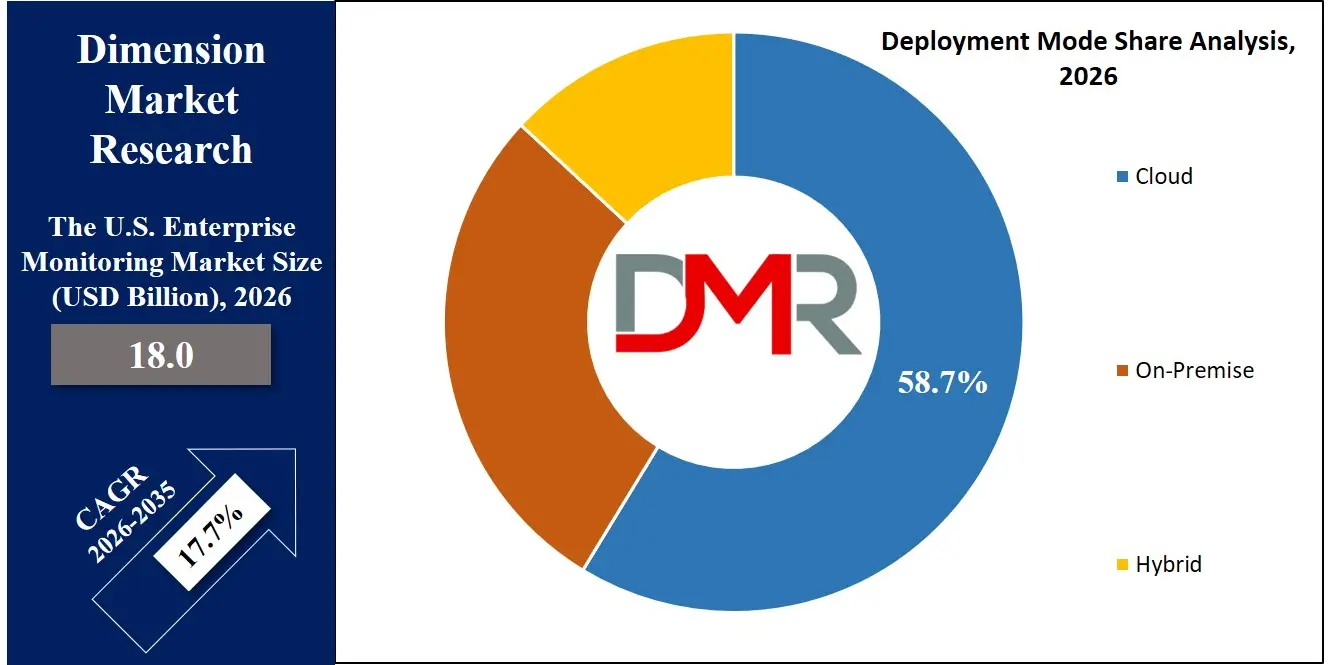
Cloud deployment dominates the market and is projected to hold about 58.7% of the market share in 2026. Cloud-based monitoring platforms allow enterprises to monitor distributed systems, remote workloads, and cloud applications more efficiently. These platforms provide scalability, flexibility, and centralized management across geographically distributed IT environments. With organizations increasingly migrating workloads to cloud infrastructure, cloud-based monitoring solutions are becoming essential for managing application performance and infrastructure health. Additionally, cloud monitoring platforms support real-time analytics, automated alerts, and remote access capabilities, making them highly suitable for modern digital enterprises operating across hybrid and multi-cloud environments.
ℹ
To learn more about this report –
Download Your Free Sample Report Here
Hybrid deployment is experiencing rapid growth due to the increasing adoption of hybrid IT environments combining on-premises infrastructure with cloud services. Many organizations prefer hybrid monitoring systems that allow them to maintain control over critical infrastructure while benefiting from the scalability and flexibility of cloud technologies. Hybrid monitoring platforms provide unified visibility across both traditional data centers and cloud-based systems. As enterprises gradually transition toward cloud environments, hybrid monitoring solutions are expected to gain further adoption.
By Monitoring Type Analysis
Infrastructure monitoring is the leading segment and is expected to account for around 28.6% of the market share in 2026. Enterprises rely on infrastructure monitoring tools to track the performance of servers, storage systems, virtualization platforms, and network resources. These tools help IT teams maintain system reliability, optimize resource utilization, and identify infrastructure bottlenecks. With increasing reliance on digital infrastructure to support business operations, infrastructure monitoring has become a fundamental component of enterprise IT management strategies.
Application performance monitoring is the fastest-growing segment as organizations prioritize delivering seamless digital experiences to customers and employees. APM platforms enable enterprises to track application performance metrics, identify latency issues, and optimize application behavior across distributed systems. The rapid growth of web-based and mobile applications has significantly increased the importance of monitoring application performance in real time.
By Organization Size Analysis
Large enterprises dominate the U.S. enterprise monitoring market and are projected to hold approximately 67.5% of the market share in 2026. These organizations operate complex IT infrastructures consisting of multiple data centers, cloud platforms, and enterprise applications. To maintain operational efficiency and ensure system reliability, large enterprises invest heavily in advanced monitoring platforms capable of managing extensive IT environments. They also possess the financial resources and technical expertise required to deploy comprehensive monitoring frameworks across multiple business units.
Small and medium enterprises represent the fastest-growing segment due to increasing digital adoption among smaller organizations. SMEs are investing in cloud-based monitoring tools that offer scalable and cost-effective solutions for managing IT systems. As more SMEs migrate their operations to digital platforms, the need for efficient monitoring tools is expected to grow rapidly.
By End User Industry Analysis
The IT and telecommunications sector leads the market and is expected to account for approximately 26.9% of the market share in 2026. This sector operates highly complex digital infrastructures that require continuous monitoring to ensure system reliability and service availability. Telecommunications providers, cloud service companies, and technology firms rely on enterprise monitoring tools to maintain network performance, manage application workloads, and ensure seamless connectivity for millions of users.
Healthcare and life sciences represent one of the fastest-growing segments due to increasing adoption of digital health platforms, electronic health records, and connected medical systems. Monitoring platforms help healthcare organizations maintain system uptime, ensure data security, and support critical healthcare operations. As healthcare systems become more digitalized, the demand for enterprise monitoring solutions is expected to increase.
The U.S. Enterprise Monitoring Market Report is segmented on the basis of the following:
By Component
- Solutions
- Services
- Professional Services
- Managed Services
By Deployment Mode
- On-Premises
- Cloud
- Public Cloud
- Private Cloud
- Hybrid
By Monitoring Type
- Infrastructure Monitoring
- Server Monitoring
- Storage Monitoring
- Virtualization Monitoring
- Application Performance Monitoring (APM)
- Network Monitoring
- Database Monitoring
- Security Monitoring
- Digital Experience Monitoring
By Organization Size
- Large Enterprises
- Small & Medium Enterprises (SMEs)
By End-User Industry
- IT & Telecommunications
- BFSI
- Healthcare & Life Sciences
- Manufacturing
- Retail & E-Commerce
- Government & Public Sector
- Transportation & Logistics
- Energy & Utilities
Competitive Landscape
The U.S. enterprise monitoring market is characterized by intense competition driven by rapid technological innovation and evolving enterprise requirements. Market participants are focusing heavily on research and development to integrate advanced technologies such as artificial intelligence, machine learning, and predictive analytics into their monitoring platforms.
ℹ
To learn more about this report –
Download Your Free Sample Report Here
Companies are also expanding their cloud-based offerings to support hybrid and multi-cloud infrastructures. Strategic partnerships with cloud providers, system integrators, and cybersecurity firms are becoming common approaches to strengthen technological capabilities and expand market reach. High entry barriers exist due to the complexity of monitoring technologies, the need for large-scale infrastructure integration, and strong brand loyalty among enterprise customers.
Some of the prominent players in the U.S. Enterprise Monitoring are:
- IBM
- Microsoft
- Cisco
- Oracle
- Dynatrace
- Datadog
- Splunk
- ServiceNow
- BMC Software
- Broadcom (CA Technologies)
- SolarWinds
- Elastic
- New Relic
- VMware
- Google
- Amazon Web Services
- NetScout Systems
- Zoho Corporation (ManageEngine)
- Nagios Enterprises
- Zabbix
- Other Key Players
Recent Developments
- In June 2025, IBM introduced an upgraded enterprise observability platform designed to enhance monitoring capabilities for hybrid cloud and AI-driven environments. The platform integrates infrastructure monitoring, application performance monitoring, and automation tools within a unified system. IBM also incorporated machine learning algorithms capable of predicting system anomalies and identifying root causes of performance issues. The launch was accompanied by strategic partnerships with cloud infrastructure providers and technology integrators to expand the platform's adoption among large enterprises.
- In February 2025, Microsoft announced the expansion of its Azure monitoring capabilities through new integrations within its Azure Monitor platform. The company introduced advanced AI-driven analytics tools designed to provide deeper visibility into hybrid cloud infrastructures. These updates enable enterprises to monitor applications, virtual machines, containers, and network performance across distributed environments. The new features include automated anomaly detection, enhanced real-time dashboards, and expanded integrations with third-party observability tools.
Report Details
| Report Characteristics |
| Market Size (2026) |
USD 18.0 Bn |
| Forecast Value (2035) |
USD 78.3 Bn |
| CAGR (2026–2035) |
17.7% |
| Historical Data |
2021 – 2025 |
| Forecast Data |
2027 – 2035 |
| Base Year |
2025 |
| Estimate Year |
2026 |
| Report Coverage |
Market Revenue Estimation, Market Dynamics, Competitive Landscape, Growth Factors and etc. |
| Segments Covered |
By Component (Solutions, Services), By Deployment Mode (On-Premises, Cloud, Hybrid), By Monitoring Type (Infrastructure Monitoring, Application Performance Monitoring (APM), Network Monitoring, Database Monitoring, Security Monitoring, Digital Experience Monitoring), By Organization Size (Large Enterprises, Small & Medium Enterprises (SMEs)), By End-User Industry (IT & Telecommunications, BFSI, Healthcare & Life Sciences, Manufacturing, Retail & E-Commerce, Government & Public Sector, Transportation & Logistics, Energy & Utilities) |
| Country Coverage |
The US |
| Prominent Players |
IBM, Microsoft, Cisco, Oracle, Dynatrace, Datadog, Splunk, ServiceNow, BMC Software, Broadcom (CA Technologies), SolarWinds, Elastic, New Relic, VMware, Google, Amazon Web Services, NetScout Systems, Zoho Corporation (ManageEngine), Nagios Enterprises, Zabbix, and Other Key Players |
| Purchase Options |
We have three licenses to opt for: Single User License (Limited to 1 user), Multi-User License (Up to 5 Users) and Corporate Use License (Unlimited User) along with free report customization equivalent to 0 analyst working days, 3 analysts working days and 5 analysts working days respectively. |
Frequently Asked Questions
How big is the U.S. Enterprise Monitoring Market?
▾ The U.S. Enterprise Monitoring Market size is expected to reach USD 18.0 billion by 2026 and is projected to reach USD 78.3 billion by the end of 2035.
Who are the key players in the US Enterprise Monitoring Market?
▾ Some of the major key players in the U.S. Enterprise Monitoring Market include IBM, Microsoft, Cisco, and others.
What is the growth rate in the U.S. Enterprise Monitoring Market?
▾ The market is growing at a CAGR of 17.7 percent over the forecasted period.