U.S. Generator Sales Market Snapshot
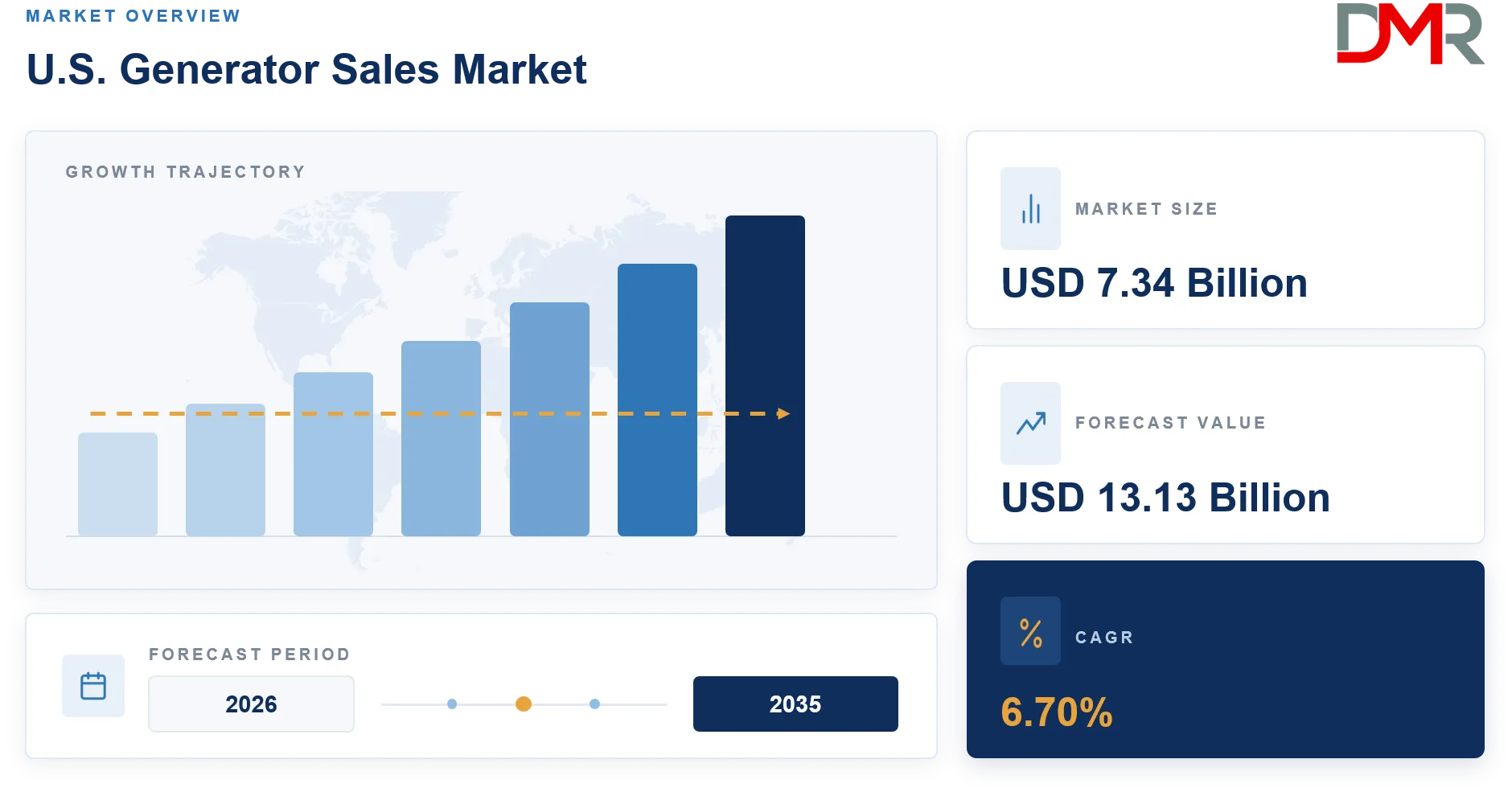
- Market Value: The U.S. generator sales market is estimated at USD 7.34 billion in 2026 and is projected to reach USD 13.13 billion by 2035.
- CAGR: The U.S. generator sales market is expected to grow at a CAGR of 6.7% from 2026 to 2035.
- By Power Rating Segment Analysis: The 75–375 kVA segment led the power-rating categories with a 31.6% share in 2026.
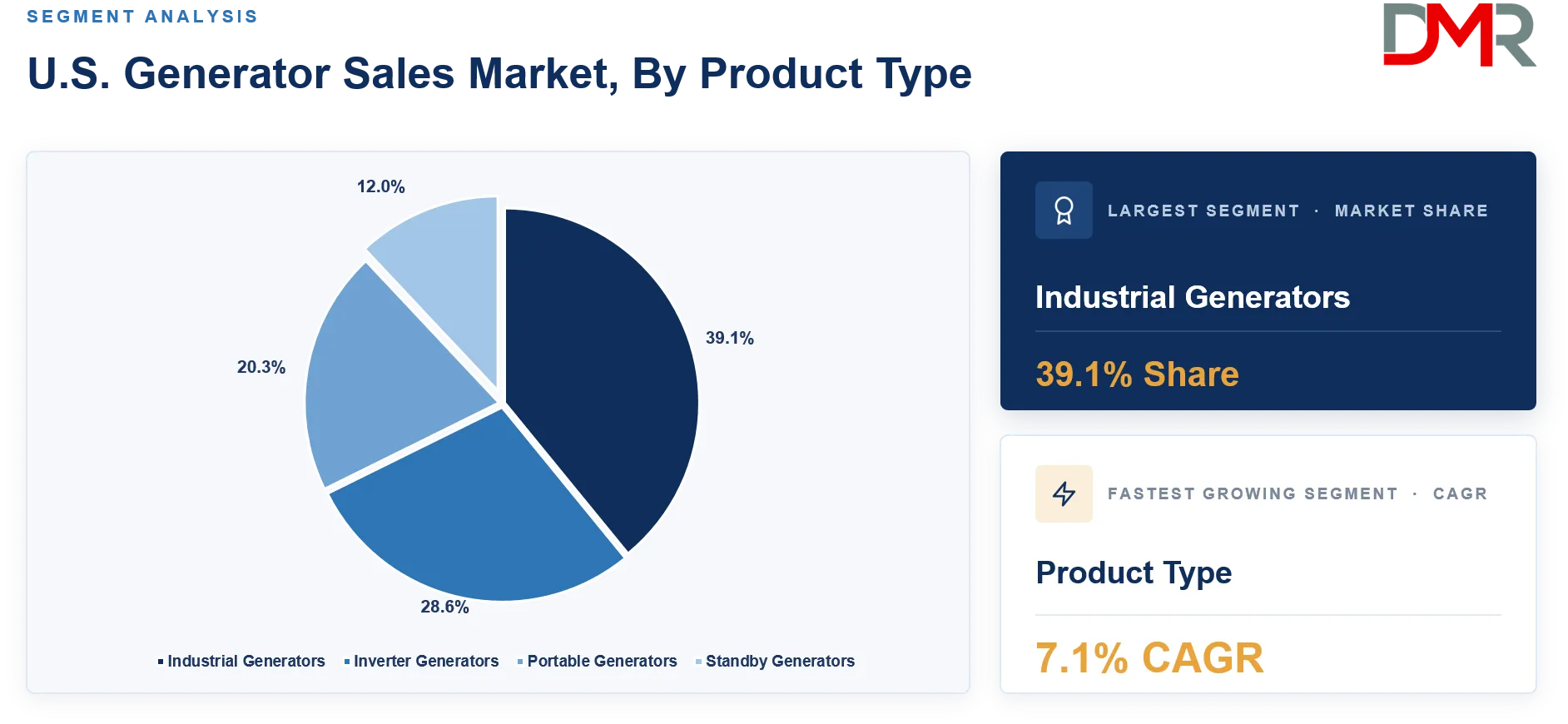
- By Product Type Segment Analysis: Industrial generators led product types with a 39.1% share in 2026.
- By Sales Channel Segment Analysis: Distributor/dealer networks dominated sales channels with a 42.7% share in 2026.
- By Fuel Type Segment Analysis: Diesel generators held the largest fuel-type share at 45.6% in 2026.
- Major Players: Caterpillar Inc., Cummins Inc., Generac Holdings Inc., Rehlko, and Rolls-Royce Power Systems AG.
What is the U.S. Generator Sales Market and its Market Size?
The U.S. Generator Sales Market size is projected to be valued at USD 7.34 billion in 2026 and is projected to reach USD 13.13 billion by 2035, expanding at a steady CAGR of 6.7% during the forecast period. The market covers the sale of generator sets used to provide standby, prime, continuous, and peak power across industrial, commercial, infrastructure, telecom, construction, residential, marine, oil and gas, mining, and healthcare-related environments.
ℹ
To learn more about this report –
Download Your Free Sample Report Here
Demand is increasingly shaped by electricity reliability requirements, higher-density computing infrastructure, factory investment, severe-weather preparedness, and longer utility interconnection timelines. U.S. electricity generation reached a record 4.43 thousand TWh in 2025, while electricity demand growth has accelerated markedly since 2020, creating a stronger operating case for onsite and backup generation assets.
Use Cases
- Mission-Critical Backup Power: Data centers, hospitals, telecom sites, financial facilities, and digital infrastructure use generator systems to sustain essential loads when utility supply is interrupted. Automatic transfer equipment, paralleling controls, fuel systems, and redundant generator architectures help reduce downtime exposure and maintain continuity during grid disturbances.
- Industrial Production Continuity: Manufacturers deploy generator sets to keep production lines, automation systems, refrigeration, process controls, pumps, and safety equipment operating through outages. This use case is especially important in plants where even a short interruption can create scrap, restart costs, equipment damage, missed delivery schedules, or process instability.
- Construction and Temporary Power: Contractors use portable and industrial generator systems at sites where utility connections are unavailable, delayed, or insufficient. Generators support cranes, welding equipment, pumps, lighting, HVAC, temporary offices, concrete operations, and specialized tools, making construction activity an important source of unit demand and rental-company purchases.
- Distributed and Behind-the-Meter Power: Large commercial and digital infrastructure projects are increasingly evaluating generator sets alongside battery storage, microgrid controls, switchgear, and natural gas systems. These configurations can provide capacity while grid connections are constrained and can also support load management, resilience, and phased facility expansion.
- Emergency and Weather Resilience: Businesses and households in hurricane, storm, wildfire, heat, and winter-weather corridors use standby and portable generators as resilience assets. Demand can rise sharply after major outage events, encouraging distributors, dealers, rental fleets, installers, and equipment manufacturers to maintain regional inventory and service capabilities.
How AI/Gen AI is Transforming the U.S. Generator Sales Market?
Growth in high-density computing is changing generator demand from a conventional backup-power discussion into a broader power-infrastructure strategy. AI-focused and hyperscale data centers require substantial electrical capacity, strict uptime performance, fast transient response, and highly redundant backup systems. Generator manufacturers are responding with larger platforms, integrated switchgear, controls, battery interfaces, and modular configurations. Generac introduced large generator products ranging up to 3.25 MW for data-center and mission-critical applications, while Caterpillar has expanded U.S. large-engine production capacity to address rising power demand from data centers.
The impact also extends beyond standby systems. Grid connection delays and rapidly rising computing loads are encouraging some developers to assess behind-the-meter generation and microgrids. Cummins announced a 2026 agreement to supply natural-gas generator sets for a high-performance computing data-center microgrid in Texas, with deliveries planned through 2030. Generac is also integrating battery systems, inverters, controls, and onsite generators for data-center applications. These developments expand addressable demand for generator OEMs from emergency backup toward coordinated onsite energy infrastructure.
Key Drivers in the U.S. Generator Sales Market
Rising Data Center and Mission-Critical Power Requirements
U.S. data-center expansion is creating large orders for high-capacity standby and onsite generation systems. Power availability has become a site-selection and commissioning constraint as AI and cloud workloads increase facility load. The U.S. Department of Energy has reported that data-center electricity use could double or triple by 2028 from recent levels. This expansion supports demand for diesel and natural-gas generators, switchgear, controls, enclosures, fuel systems, and multi-unit redundant installations.
Power Reliability and Business Continuity Investment
Manufacturers, commercial operators, telecom networks, healthcare facilities, warehouses, and critical infrastructure cannot always absorb the financial or operational impact of outages. This keeps standby generation embedded in capital planning. The 58.4% share held by standby load in 2026 reflects the importance of continuity-focused purchases. Higher electricity demand, weather exposure, localized grid constraints, and increased dependence on digital operations are reinforcing the generator market growth outlook.
Restraints in the U.S. Generator Sales Market
Emission Compliance and Permitting Complexity
Diesel generators remain the leading fuel type, yet installations must operate within increasingly detailed air-quality and engine requirements. EPA rules cover stationary compression-ignition engines under 40 CFR Part 60 Subpart IIII, while spark-ignition systems are addressed separately. Permitting can also vary by state and local air district. For large multi-generator projects, emissions modeling, operating-hour limits, testing requirements, documentation, and after-treatment considerations can increase project cost and planning time.
Competition from Alternative Resilience Technologies
Battery energy storage, renewable-plus-storage configurations, fuel cells, demand-response systems, and advanced microgrids are expanding the range of backup and distributed-energy options. These technologies do not eliminate generator demand, particularly for long-duration resilience, but they can reduce generator run time or alter system sizing. Vendors must therefore compete on lifecycle economics, reliability, emissions performance, fuel availability, controls integration, maintenance support, and compatibility with hybrid power architectures.
Growth Opportunities in the U.S. Generator Sales Market
Natural Gas and Integrated Microgrid Deployment
Behind-the-meter power is opening a significant opportunity for generator suppliers serving data centers, industrial campuses, and large commercial facilities. Natural-gas generator sets can be integrated with batteries, grid connections, and microgrid controls to provide prime power, capacity support, or resilience. Caterpillar and Cummins are already participating in large U.S. data-center power projects using natural-gas generation, demonstrating how the generator industry can expand beyond conventional emergency installations.
Expansion of Service, Controls, and Lifecycle Revenue
The installed generator base creates recurring opportunities in maintenance agreements, remote monitoring, spare parts, fuel-system services, load-bank testing, controls modernization, switchgear upgrades, and equipment replacement. Buyers increasingly evaluate uptime support rather than equipment cost alone. This favors manufacturers and distributor networks with technicians, parts availability, commissioning capabilities, and nationwide service coverage, strengthening the strategic importance of the distributor/dealer channel that held 42.7% of 2026 sales.
Trends in the U.S. Generator Sales Market
Shift Toward Higher-Capacity Generator Platforms
Growth in hyperscale computing and mission-critical infrastructure is moving more supplier investment toward multi-megawatt generator platforms. Generac expanded its data-center range with models reaching 3.25 MW, while Cummins continues to develop high-horsepower generator products for data-center applications. Large systems also increase demand for paralleling switchgear, acoustic enclosures, cooling equipment, fuel infrastructure, emissions controls, and sophisticated power-management systems.
Hybridization of Generator and Energy Storage Systems
Generator purchasing decisions increasingly sit within broader distributed-energy strategies. Businesses are combining engine generators with battery storage, energy-management controls, solar assets, and microgrid software to improve response time and optimize generator operation. This trend is changing competition from a product-only market toward integrated power solutions. Suppliers that can connect generation, controls, switchgear, storage, and monitoring into a coordinated platform are positioned to capture higher-value commercial and industrial projects.
Research Scope and Analysis
The U.S. Generator Sales Market is segmented based on power rating, application, end-user, product type, sales channel, fuel type, and regional demand. The study evaluates the commercial position of each category, including applications, purchasing behavior, industry adoption, demand patterns, distribution structures, technology shifts, and contribution to overall market growth.
By Power Rating;
The 75–375 kVA category held the leading position with a 31.6% share in 2026. Its dominance reflects broad applicability across manufacturing facilities, commercial buildings, construction sites, telecom infrastructure, warehouses, smaller healthcare facilities, and distributed industrial operations. The range provides greater capacity than light-duty units while avoiding the footprint and capital cost of very large generator systems. Below-75 kVA units remain relevant for portable and smaller commercial applications, while 375–750 kVA and above-750 kVA systems gain importance in larger industrial and mission-critical projects.
ℹ
To learn more about this report –
Download Your Free Sample Report Here
By Product Type;
Industrial generators accounted for 39.1% of sales in 2026. Their leadership is supported by high-capacity requirements across factories, data centers, construction operations, oil and gas assets, hospitals, warehouses, and commercial facilities. Industrial systems offer higher duty capability, advanced controls, synchronization, remote monitoring, and integration with transfer switches and switchgear. Standby, portable, and inverter generators address different requirements, particularly residential, light commercial, mobile, event, emergency-response, and small-load applications.
By Sales Channel;
Distributor/dealer networks generated 42.7% of market revenue in 2026. Generator purchases often require engineering support, sizing, site assessment, installation coordination, permitting, commissioning, maintenance, and rapid parts access, which gives established dealers a stronger role than in many equipment categories. Direct sales remain important for large industrial and mission-critical projects, while rental companies serve temporary-power demand. Online sales are more relevant to standardized portable and lower-capacity products.
By Fuel Type;
Diesel generators led the U.S. generator sales market with a 45.6% share in 2026. Diesel remains deeply established in standby and industrial applications because of its high power density, mature service ecosystem, fuel-storage capability, and wide availability of generator platforms. Natural gas is gaining strategic attention in large behind-the-meter and continuous-power projects where pipeline access exists. Gasoline is concentrated in smaller portable products, while LPG/propane is used across selected residential, commercial, and remote applications.
The U.S. Generator Sales Market Report is segmented on the basis of the following:
By Power Rating
- 375–750 kVA
- Above 750 kVA
- Below 75 kVA
- 75–375 kVA
By Application
- Standby Load
- Continuous Load
- Peak Load
By End-User
- Manufacturing
- Mining
- Commercial
- Marine
- Oil & Gas
- Pharmaceuticals
- Construction
- Telecom
- Residential
- Others
By Product Type
- Industrial Generators
- Inverter Generators
- Portable Generators
- Standby Generators
By Sales Channel
- Rental Companies
- Online Sales
- Direct Sales
- Distributor/Dealer Network
By Fuel Type
- Gasoline
- Diesel
- LPG/Propane
- Natural Gas
- Others
Competitive Landscape
The U.S. generator sales market has a competitive structure spanning multinational engine manufacturers, dedicated power-generation companies, regional equipment suppliers, dealer networks, and integrated energy-system providers. Caterpillar and Cummins compete strongly in large industrial and data-center installations, while Generac has expanded beyond its established residential position into commercial, industrial, and hyperscale applications.
Generac reported that its Commercial & Industrial sales increased about 29% year over year to USD 556.5 million in the second quarter of 2026, with data-center products contributing to core growth. Caterpillar is expanding large-engine capacity, while Rehlko, Rolls-Royce Power Systems, Mitsubishi Heavy Industries, HIMOINSA, Atlas Copco, Yanmar, Multiquip, Briggs & Stratton, Taylor Power Systems, Winco, and Kirloskar compete across specific capacity, fuel, mobile, industrial, and distribution niches. Competition is moving toward complete power ecosystems encompassing generators, controls, switchgear, storage integration, remote monitoring, emissions performance, and lifecycle service.
Some of the prominent players in the U.S. Generator Sales Industry are:
- Taylor Power Systems, Inc.
- Atlas Copco AB
- Caterpillar Inc.
- Yanmar Holdings Co., Ltd.
- Generac Holdings Inc.
- Kirloskar Oil Engines Limited
- Rolls-Royce Power Systems AG (MTU)
- Multiquip Inc.
- Cummins Inc.
- HIMOINSA S.L.
- Mitsubishi Heavy Industries Ltd.
- Briggs & Stratton Corporation
- Rehlko (Formerly Kohler Energy)
- Winco Inc.
- Others
Technology Analysis
Technology development in the U.S. generator sales market is shifting from standalone engine-generator systems toward connected, lower-emission, and digitally controlled power platforms. Diesel remains important for high-load standby applications, while natural-gas generators are gaining relevance in data centers, industrial campuses, and behind-the-meter power projects where pipeline infrastructure is available. Manufacturers are expanding multi-megawatt platforms and integrating generators with automatic transfer switches, paralleling switchgear, battery energy storage, microgrid controllers, and remote monitoring. Electronic engine controls and predictive maintenance tools allow operators to track fuel consumption, load, operating hours, temperature, battery condition, and fault events. Hybrid generator-storage configurations can handle short-duration load changes while reserving engine capacity for longer outages. EPA emission requirements are also encouraging advanced combustion, after-treatment, and cleaner-fuel solutions. These advances are making reliability, emissions, controls interoperability, serviceability, and system-level efficiency major technology differentiators in generator purchasing decisions.
Investment and White Space Analysis
Investment opportunities in the U.S. generator sales market are expanding around data centers, advanced manufacturing, grid-constrained developments, microgrids, and lifecycle services rather than conventional equipment sales alone. The South, which accounted for 34.8% of market revenue in 2026, offers attractive potential due to data-center construction, manufacturing investment, Gulf Coast industrial activity, severe-weather exposure, and large energy infrastructure in states such as Texas. White space is emerging in natural-gas generation for behind-the-meter power, multi-megawatt systems for AI and hyperscale facilities, and hybrid architectures combining generators with batteries and intelligent controls. Additional opportunities exist in low-emission retrofits, remote fleet monitoring, predictive maintenance, generator refurbishment, rental fleets, fuel-system services, and long-term maintenance contracts. Distributor and dealer networks, already representing 42.7% of 2026 sales, can capture more recurring revenue by expanding engineering, commissioning, parts, monitoring, and field-service capabilities. Suppliers that address both immediate power capacity and long-term resilience can access higher-value projects.
Recent Developments
-
July 2026: Rolls-Royce Power Systems AG (MTU) Opened a $24 million Mankato, Minnesota expansion, adding a 250,000-square-foot logistics center and more than doubling Series 4000 generator-set production capacity.
- June 2026: Generac Holdings Inc. Acquired a Belvidere, Illinois facility to expand large-megawatt generator packaging capacity, supporting growth in commercial, industrial, data-center, and mission-critical applications.
- June 2026: Rehlko Announced a new Kenosha, Wisconsin assembly facility for eFRAME enclosures used with backup generators up to 4 MW, with production planned for late 2026 and full capacity in 2027.
Report Details
| Report Characteristics |
| Market Size (2026) |
USD 7.34 Bn |
| Forecast Value (2035) |
USD 13.13 Bn |
| CAGR (2026–2035) |
6.7% |
| Historical Data |
2021 – 2025 |
| Forecast Data |
2027 – 2035 |
| Base Year |
2025 |
| Estimate Year |
2026 |
| Segments Covered |
By Power Rating (375–750 kVA, Above 750 kVA, Below 75 kVA, and 75–375 kVA), By Application (Standby Load, Continuous Load, and Peak Load), By End-User (Manufacturing, Mining, Commercial, Marine, Oil & Gas, Pharmaceuticals, Construction, Telecom, Residential, and Others), By Product Type (Industrial Generators, Inverter Generators, Portable Generators, and Standby Generators), By Sales Channel (Rental Companies, Online Sales, Direct Sales, and Distributor/Dealer Network), and By Fuel Type (Gasoline, Diesel, LPG/Propane, Natural Gas, and Others) |
| Regional Coverage |
United States |
Frequently Asked Questions
What is the current size of the U.S. Generator Sales Market?
▾ The U.S. Generator Sales Market size is valued at USD 7.34 billion in 2026 and is forecast to reach USD 13.13 billion by 2035.
What is the growth rate of the U.S. Generator Sales Market during?
▾ The U.S. Generator Sales Market is expected to grow at a CAGR of 6.7% during the forecast period from 2026 to 2035.
What factors are driving the growth of the U.S. Generator Sales Market?
▾ Data center expansion, power reliability needs, manufacturing growth, and backup power demand are driving the U.S. Generator Sales Market.
What are the major challenges restraining the U.S. Generator Sales Market?
▾ Emission regulations, permitting complexity, equipment costs, and alternative energy systems are restraining the U.S. Generator Sales Market.
Which segment holds the largest share of the U.S. Generator Sales Market?
▾ Standby load holds the largest U.S. Generator Sales Market application share at 58.4%, driven by business continuity requirements.
Who are the leading companies in the U.S. Generator Sales Market?
▾ Taylor Power Systems, Inc., Atlas Copco AB, Caterpillar Inc., Yanmar Holdings Co., Ltd., Generac Holdings Inc., Kirloskar Oil Engines Limited, Rolls-Royce Power Systems AG (MTU), Multiquip Inc., Cummins Inc., HIMOINSA S.L., Mitsubishi Heavy Industries Ltd., Briggs & Stratton Corporation, Rehlko (Formerly Kohler Energy), and Winco Inc. are prominent companies in the U.S. Generator Sales Market.
How is AI influencing the U.S. Generator Sales Market?
▾ AI data center growth is increasing high-capacity backup power demand and accelerating advanced generator adoption in the U.S. Generator Sales Market.
What are the future opportunities and trends in the U.S. Generator Sales Market?
▾ Natural gas generators, microgrids, hybrid storage, remote monitoring, and data centers offer opportunities in the U.S. Generator Sales Market.