Market Snapshot
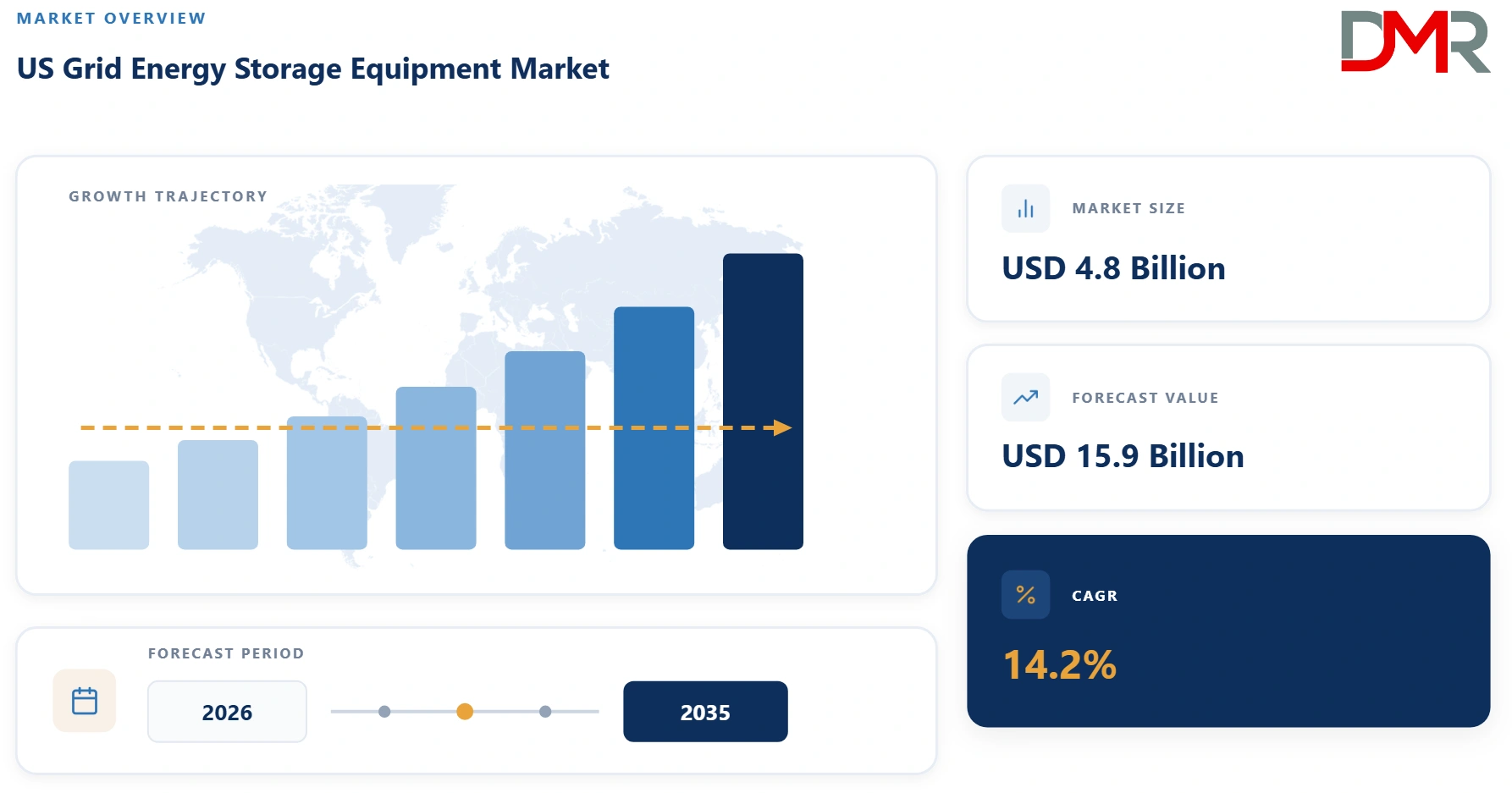
- Market Size (2026): USD 4.8 Bn
- Forecast Value (2035): USD 15.9 Bn
- CAGR (2026-2035): 14.2%
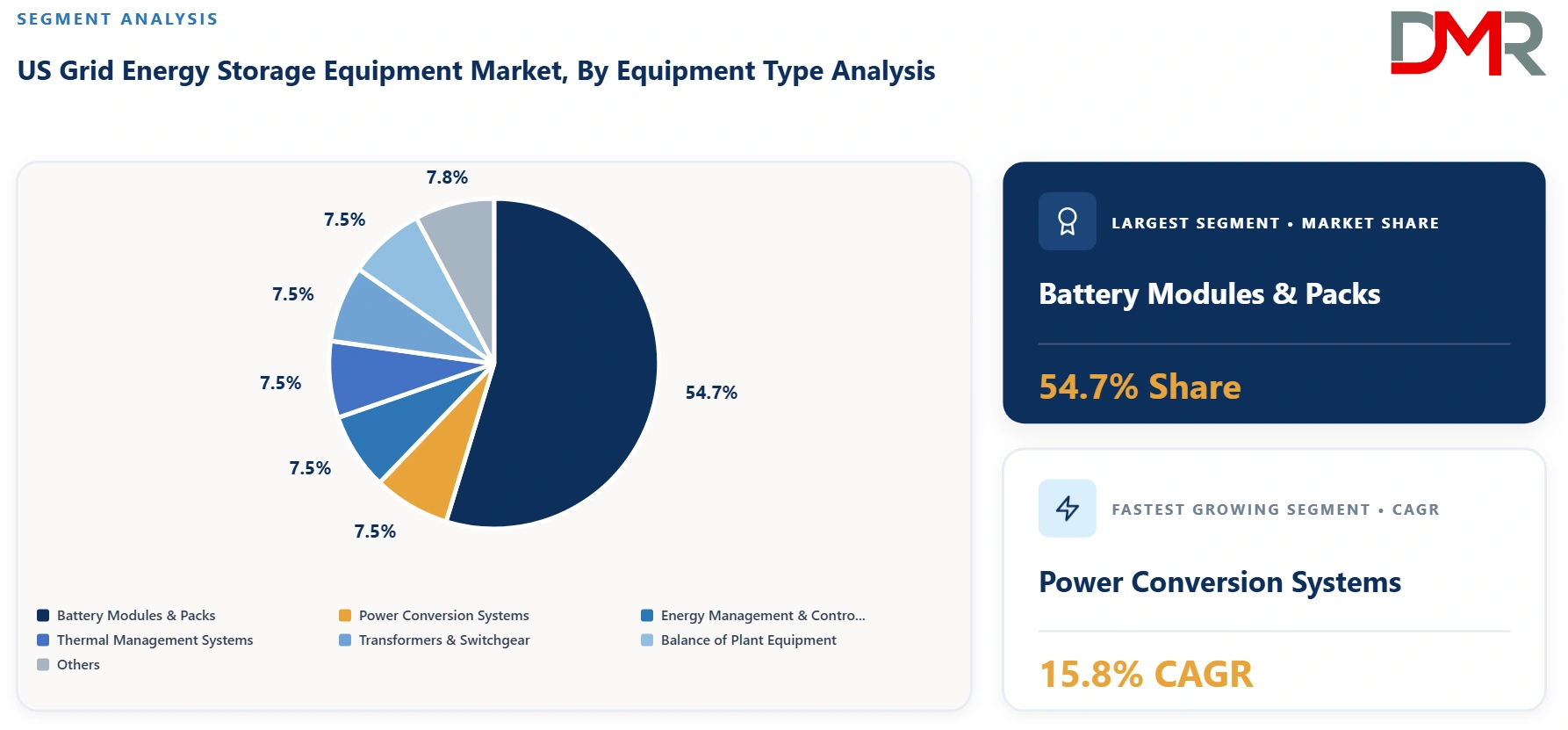
- Leading Equipment Type (2026): Battery Modules & Packs, around 54.7%
- Leading Technology (2026): Lithium-Ion Batteries, close to 87.3%
- Key Players: Tesla, Inc., Fluence Energy, Inc., Wärtsilä Energy Storage & Optimisation, and Others
What is US Grid Energy Storage Equipment Market and its Market Size?
The US Grid Energy Storage Equipment Market size is estimated to reach USD 4.8 Bn in 2026 and is further anticipated to reach USD 15.9 Bn by 2035, at a CAGR of 14.2%.
ℹ
To learn more about this report –
Download Your Free Sample Report Here
Grid energy storage equipment comprises the physical and digital hardware used to receive electricity from the grid or generation assets, store it, condition power, and discharge it when system operators require energy or grid services. The equipment boundary includes battery modules and racks, containers, power conversion systems, battery management systems, supervisory controls, thermal management, transformers, switchgear, protection equipment, fire detection and suppression, and associated balance-of-plant hardware. The market excludes electricity sales and most stand-alone software revenue unless the software is embedded in equipment supply.
Demand is increasingly shaped by utility-scale projects ranging from tens of megawatts to multi-hundred-megawatt installations. Procurement decisions focus on usable energy, duration, round-trip efficiency, degradation guarantees, safety certifications, augmentation strategy, warranty bankability, domestic content, interconnection compatibility, and long-term service support. Four-hour lithium-ion systems remain the commercial reference configuration, while longer-duration technologies are gaining attention for capacity adequacy, renewable firming, and transmission-constrained regions.
The equipment market is benefiting from rapid growth in utility-scale battery capacity, renewable generation, data-center and industrial load growth, and the need for flexible capacity. U.S. developers increasingly favor standardized containerized platforms that shorten engineering cycles and reduce site labor. At the same time, domestic manufacturing incentives, tariffs, fire-safety requirements, and supply-chain localization are changing equipment sourcing and vendor qualification.
Competition is moving beyond cell pricing toward integrated system performance. Suppliers are differentiating through higher enclosure energy density, improved thermal architecture, inverter efficiency, advanced controls, safer cell chemistries, faster commissioning, and service models that protect availability over the operating life of the asset.
Use Cases
- Renewable Firming: Solar and wind developers deploy grid storage equipment to absorb excess generation and discharge during evening peaks or periods of low renewable output, improving dispatchability, reducing curtailment, and supporting more predictable delivery under power purchase agreements.
- Capacity and Peak Support: Utilities and independent power producers use battery systems as fast-deploying capacity resources that respond to peak demand, defer some conventional peaking generation, and provide flexible power in load pockets experiencing rapid population, industrial, or data-center growth.
- Ancillary Services: Storage operators use inverters, controls, and battery systems for frequency regulation, spinning reserve, voltage support, and other grid services. Fast response and precise dispatch allow equipment owners to stack multiple revenue streams while supporting power-system stability.
- Transmission and Distribution Deferral: Utilities place storage near constrained substations, feeders, or transmission nodes to reduce short-duration overloads, improve resilience, and delay selected network upgrades where load growth is concentrated or construction lead times are long.
Key Takeaways
- Market Size & Share: The market is estimated at USD 4.8 Bn in 2026 and is projected to expand at 14.2% through 2035.
- Equipment Type Analysis: Power Conversion Systems are expected to be the fastest-growing major equipment category, with an estimated CAGR of 15.8%.
- Technology Analysis: Lithium-Ion Batteries lead with approximately 87.3% of 2026 equipment revenue due to mature supply chains and bankable operating history.
- Demand Concentration: The South and West together are estimated to represent more than 68.0% of 2026 demand, supported by solar additions, load growth, and active storage pipelines.
- Commercial Catalyst: Utility-scale battery capacity exceeding 50 GW in 2026 is expanding the installed base for replacement, augmentation, power conversion, and service-linked equipment.
- Competitive Dynamics: Integrated system vendors, cell manufacturers, inverter suppliers, and electrical equipment majors increasingly compete through domestic content, safety validation, warranties, and delivery certainty.
How AI/Gen AI is Transforming the US Grid Energy Storage Equipment Market?
AI is increasingly embedded in energy storage equipment through battery management systems, energy management controllers, inverter diagnostics, and fleet-level asset monitoring. Machine-learning models can estimate state of charge, state of health, thermal behavior, degradation, and failure probability using high-frequency operating data. These capabilities improve dispatch accuracy, reduce unnecessary cycling, identify abnormal cell or rack behavior earlier, and support condition-based maintenance. Equipment suppliers are also using AI-assisted engineering to evaluate thermal layouts, component tolerances, warranty risk, and expected operating profiles before systems are deployed.
Generative AI is emerging in engineering support, maintenance workflows, alarm interpretation, and technician knowledge systems. It can summarize operating events, convert equipment logs into service recommendations, and help engineering teams compare configuration options. Adoption remains controlled because grid-connected assets require deterministic controls, cybersecurity protections, validated operating envelopes, and human oversight. The strongest near-term value is therefore in decision support around the control system rather than unrestricted autonomous operation.
- Predictive Maintenance: Models identify abnormal temperature, voltage, impedance, and inverter behavior before failures cause availability losses.
- Degradation Forecasting: AI estimates remaining useful life and supports augmentation planning based on cycling, temperature, and state-of-charge history.
- Dispatch Optimization: Embedded analytics coordinate charge and discharge schedules with market prices, renewable output, interconnection limits, and warranty constraints.
- Service Intelligence: Gen AI tools summarize alarms, manuals, maintenance histories, and troubleshooting procedures for field technicians and remote operations teams.
Key Drivers in the US Grid Energy Storage Equipment Market
Rapid Expansion of Utility-Scale Battery Capacity
U.S. grid operators are adding battery capacity at an exceptional pace as solar penetration rises and power systems require more flexible resources. Each new storage project creates demand not only for battery cells and modules but also for inverters, transformers, switchgear, thermal systems, controls, enclosures, fire protection, and commissioning hardware. Larger project sizes are also increasing equipment standardization and factory integration. As developers move from individual projects toward multi-gigawatt pipelines, suppliers with repeatable platforms, secure component sourcing, and proven field performance gain an advantage. The growing installed base also creates recurring demand for augmentation, replacement power electronics, monitoring hardware, and lifecycle service components.
Load Growth, Reliability Needs, and Renewable Integration
Electricity demand from data centers, advanced manufacturing, electrification, and population growth is increasing the value of fast-deploying flexible capacity. Storage equipment can be installed more quickly than many transmission or conventional generation assets and can respond within milliseconds to grid instructions. At the same time, rising solar and wind generation creates periods of excess production followed by steep net-load ramps. Battery systems shift energy across these periods and provide ancillary services without fuel consumption. These combined reliability and renewable-integration requirements are supporting larger storage durations, higher inverter power ratings, and more sophisticated thermal and control equipment.
Restraints in the US Grid Energy Storage Equipment Market
Supply Chain, Tariff, and Domestic Content Complexity
Equipment economics remain sensitive to battery-cell sourcing, trade policy, tariffs, critical-mineral exposure, and changing domestic-content requirements. Developers must evaluate not only headline equipment prices but also tax-credit eligibility, country-of-origin rules, logistics, warranty enforceability, and the financial strength of suppliers. Rapid policy changes can alter procurement decisions after projects have entered development. Domestic manufacturing reduces some exposure but can carry higher near-term costs or limited availability during ramp-up. This complexity increases contracting time, encourages dual sourcing, and can delay final investment decisions for projects whose economics depend on precise equipment cost and incentive assumptions.
Safety, Permitting, and Interconnection Constraints
Grid storage projects face detailed fire-safety, siting, environmental, and interconnection reviews. Thermal runaway concerns have increased scrutiny of cell chemistry, enclosure spacing, ventilation, gas detection, fire suppression, emergency response plans, and large-scale fire testing. Equipment vendors must demonstrate compliance with evolving codes and utility requirements, which can raise engineering and certification costs. Interconnection queues can also delay equipment orders or force redesign when grid studies change project power ratings or operating limits. These constraints do not eliminate demand, but they can shift project schedules and favor vendors with documented safety performance and flexible system architectures.
Growth Opportunities in the US Grid Energy Storage Equipment Market
Domestic Manufacturing and Localized Component Supply
The localization of battery cells, modules, enclosures, thermal systems, inverters, controls, transformers, and switchgear creates a major equipment opportunity. Developers increasingly value domestic content because it can reduce logistics risk, improve procurement visibility, and support qualification for available project incentives. Vendors that build multi-tier U.S. supply networks can differentiate on delivery certainty rather than relying only on imported turnkey systems. Localization also creates opportunities for component specialists that supply battery management hardware, HVAC and liquid cooling systems, power electronics, protection devices, and steel enclosures to integrated storage platform providers.
Long-Duration and Alternative Chemistry Platforms
Lithium-ion remains dominant, but grid planners are increasingly evaluating storage beyond four hours for resource adequacy, renewable firming, resilience, and congestion management. This creates opportunities for flow batteries, sodium-ion systems, iron-air technologies, compressed-air systems, and other long-duration configurations. Alternative technologies must still prove bankability, efficiency, safety, manufacturing scale, and lifetime economics. Equipment suppliers that can integrate multiple chemistries with common power conversion, controls, transformers, and grid interfaces may capture demand as utilities diversify storage portfolios and seek technologies with lower critical-mineral exposure or longer discharge durations.
Trends in the US Grid Energy Storage Equipment Market
Higher Energy Density and Factory-Integrated Container Platforms
Storage platforms are moving toward higher usable megawatt-hours per enclosure, fewer field connections, simplified thermal architecture, and pre-integrated controls. Higher density reduces land requirements and can lower balance-of-plant costs, while factory integration shortens site installation and commissioning. Vendors are also designing platforms that accommodate multiple cell suppliers or future cell generations without changing the entire system architecture. This modularity is becoming important as battery formats, chemistries, and domestic sourcing requirements evolve. The result is a shift from bespoke project engineering toward configurable product families optimized for logistics, safety, serviceability, and repeat deployment.
Safety Validation and Lifecycle Performance Guarantees
Procurement is increasingly centered on validated safety performance and long-term availability rather than initial equipment price alone. Developers and financiers want evidence from large-scale fire and explosion testing, clear thermal propagation behavior, cybersecurity controls, and transparent emergency response design. At the same time, warranties are becoming more sophisticated, incorporating throughput, capacity retention, augmentation assumptions, and operating windows. Equipment vendors are responding with better sensing, string-level controls, predictive diagnostics, and service agreements. This trend favors suppliers that can combine hardware, controls, field data, and bankable guarantees across the full project lifecycle.
Research Scope and Analysis
The study evaluates the US grid energy storage equipment market by equipment type, technology, power rating, application, and end user, with segment leadership and growth assessed across the 2026-2035 forecast period.
ℹ
To learn more about this report –
Download Your Free Sample Report Here
By Equipment Type
Battery Modules & Packs is estimated to lead the equipment type segment with around 54.7% of 2026 revenue. Its position reflects established procurement practices, broad supplier availability, proven integration experience, and compatibility with the dominant utility-scale project architecture. Buyers prioritize equipment configurations that can be financed, delivered at scale, and supported through long-term warranties. Growth, however, is concentrated in Power Conversion Systems, which is projected to expand at a CAGR of 15.8% between 2026 and 2035. Expansion is supported by changing grid requirements, larger project sizes, domestic manufacturing investment, and the need for more flexible system designs as storage becomes a core capacity and reliability resource.
By Technology
Lithium-Ion Batteries is estimated to lead the technology segment with around 87.3% of 2026 revenue. Its position reflects established procurement practices, broad supplier availability, proven integration experience, and compatibility with the dominant utility-scale project architecture. Buyers prioritize equipment configurations that can be financed, delivered at scale, and supported through long-term warranties. Growth, however, is concentrated in Sodium-Ion Batteries, which is projected to expand at a CAGR of 24.6% between 2026 and 2035. Expansion is supported by changing grid requirements, larger project sizes, domestic manufacturing investment, and the need for more flexible system designs as storage becomes a core capacity and reliability resource.
By Power Rating
51-100 MW is estimated to lead the power rating segment with around 31.6% of 2026 revenue. Its position reflects established procurement practices, broad supplier availability, proven integration experience, and compatibility with the dominant utility-scale project architecture. Buyers prioritize equipment configurations that can be financed, delivered at scale, and supported through long-term warranties. Growth, however, is concentrated in Above 250 MW, which is projected to expand at a CAGR of 18.9% between 2026 and 2035. Expansion is supported by changing grid requirements, larger project sizes, domestic manufacturing investment, and the need for more flexible system designs as storage becomes a core capacity and reliability resource.
By Application
Renewable Energy Integration is estimated to lead the application segment with around 34.8% of 2026 revenue. Its position reflects established procurement practices, broad supplier availability, proven integration experience, and compatibility with the dominant utility-scale project architecture. Buyers prioritize equipment configurations that can be financed, delivered at scale, and supported through long-term warranties. Growth, however, is concentrated in Transmission & Distribution Deferral, which is projected to expand at a CAGR of 17.4% between 2026 and 2035. Expansion is supported by changing grid requirements, larger project sizes, domestic manufacturing investment, and the need for more flexible system designs as storage becomes a core capacity and reliability resource.
By End User
Independent Power Producers is estimated to lead the end user segment with around 38.5% of 2026 revenue. Its position reflects established procurement practices, broad supplier availability, proven integration experience, and compatibility with the dominant utility-scale project architecture. Buyers prioritize equipment configurations that can be financed, delivered at scale, and supported through long-term warranties. Growth, however, is concentrated in Municipal & Cooperative Utilities, which is projected to expand at a CAGR of 16.7% between 2026 and 2035. Expansion is supported by changing grid requirements, larger project sizes, domestic manufacturing investment, and the need for more flexible system designs as storage becomes a core capacity and reliability resource.
The US Grid Energy Storage Equipment Market Report is Segmented Based on the Following
By Equipment Type
- Battery Modules & Packs
- Power Conversion Systems
- Energy Management & Control Systems
- Thermal Management Systems
- Transformers & Switchgear
- Balance of Plant Equipment
- Others
By Technology
- Lithium-Ion Batteries
- Flow Batteries
- Sodium-Ion Batteries
- Lead-Acid Batteries
- Flywheel Storage
- Compressed Air & Other Mechanical Storage
- Others
By Power Rating
- Below 10 MW
- 10-50 MW
- 51-100 MW
- 101-250 MW
- Above 250 MW
- Others
By Application
- Renewable Energy Integration
- Peak Shaving & Capacity Support
- Frequency Regulation & Ancillary Services
- Transmission & Distribution Deferral
- Backup Power & Grid Resilience
- Energy Arbitrage
- Others
By End User
- Investor-Owned Utilities
- Independent Power Producers
- Municipal & Cooperative Utilities
- Renewable Energy Developers
- Commercial & Industrial Grid Participants
- Government & Public Infrastructure
- Others
Regulatory Landscape
The U.S. regulatory environment for grid energy storage equipment combines federal tax and trade policy, state siting rules, utility interconnection requirements, and technical safety standards. Equipment selection is influenced by domestic-content qualification, tariff exposure, battery sourcing restrictions, fire and electrical codes, and requirements adopted by authorities having jurisdiction. Projects commonly evaluate standards and testing frameworks covering energy storage system safety, battery modules, inverters, grid interconnection, fire propagation, and emergency response. Regulatory complexity varies by state and utility territory, making certification history and documentation quality important vendor-selection criteria. Policy changes can materially affect equipment sourcing, project economics, and the timing of procurement decisions.
Technology Analysis
Lithium iron phosphate battery systems dominate current U.S. grid deployments because they combine manufacturing scale, established safety characteristics, competitive cost, and broad integration support. Equipment development is focused on higher-density enclosures, improved liquid cooling, more efficient power conversion, string-level controls, advanced battery management, and simplified field installation. Alternative chemistries including sodium-ion, flow batteries, and iron-based long-duration systems are progressing where longer discharge duration, reduced critical-mineral exposure, or different degradation profiles create value. Power conversion systems are also evolving toward higher power density and grid-forming capabilities, while digital controls increasingly integrate predictive diagnostics, cybersecurity, and automated asset-performance management.
Competitive Landscape
The US grid energy storage equipment market combines large battery manufacturers, integrated system providers, inverter specialists, electrical equipment companies, and emerging long-duration storage developers. Competition centers on delivered cost per usable kilowatt-hour, system efficiency, energy density, safety validation, warranty structure, domestic content, financing acceptance, and delivery certainty. Integrated suppliers increasingly source multiple cell options while retaining proprietary controls, battery management, thermal systems, and enclosure architecture. Large electrical equipment companies compete strongly in power conversion, transformers, switchgear, protection, and grid integration. Consolidation and strategic partnerships are likely as customers favor suppliers with bankable balance sheets, domestic supply networks, and long-term service capability.
Some of the Prominent Players in the US Grid Energy Storage Equipment Market Are:
- Tesla, Inc.
- Fluence Energy, Inc.
- Wärtsilä Energy Storage & Optimisation
- Powin, LLC
- Sungrow Power Supply Co., Ltd.
- CATL
- BYD Energy Storage
- LG Energy Solution
- Samsung SDI
- Panasonic Energy
- EVE Energy
- Hithium Energy Storage
- Envision Energy
- Trina Storage
- Canadian Solar e-STORAGE
- GE Vernova
- Siemens Energy
- Hitachi Energy
- Schneider Electric
- Eaton
- ABB
- Honeywell
- Emerson Electric Co.
- Nidec Conversion
- Parker Hannifin
- Delta Electronics
- TMEIC
- Socomec
- Dynapower
- Prevalon Energy
- Saft
- EnerSys
- ESS Tech, Inc.
- Eos Energy Enterprises, Inc.
- Form Energy
- Energy Vault
- Invinity Energy Systems
- Primus Power
- Lockheed Martin Energy
- Viridi
- Other Key Players
Recent Developments
- In January 2026, Fluence announced that its Gridstack Pro system would supply the 300 MW / 1,200 MWh Pioneer Clean Energy Center in Arizona, using U.S.-manufactured cells, modules, enclosures, and thermal management systems.
- In 2025, Tesla introduced Megapack 3 and Megablock as next-generation industrial energy storage products and prepared Megafactory Houston for production ramp-up in 2026.
- In September 2025, Fluence shipped its first domestic-content Gridstack Pro systems using U.S.-made batteries, modules, thermal management systems, controls, and enclosures.
- In August 2025, Fluence began production of thermal management equipment at a Houston facility supporting its Gridstack Pro battery energy storage systems.
- In June 2025, Fluence completed large-scale fire and explosion safety testing for the Gridstack Pro 5000 Series, which provides up to 5.6 MWh in a 20-foot enclosure.
- In May 2025, Fluence started production of U.S.-steel enclosures and battery management system hardware at a new manufacturing facility in Goodyear, Arizona.
| Report Characteristics |
| Market Size (2026) |
USD 4.8 Bn |
| Forecast Value (2035) |
USD 15.9 Bn |
| CAGR (2026-2035) |
14.2% |
| Historical Data |
2021-2025 |
| Forecast Data |
2026-2035 |
| Base Year |
2025 |
| Segments Covered |
By Equipment Type, By Technology, By Power Rating, By Application, By End User |
| Geographic Coverage |
United States |
Frequently Asked Questions
How big is the US Grid Energy Storage Equipment Market?
▾ The US Grid Energy Storage Equipment Market size is estimated to reach USD 4.8 Bn in 2026 and is projected to reach USD 15.9 Bn by 2035, growing at a CAGR of 14.2%.
What is the growth rate of the US Grid Energy Storage Equipment Market?
▾ The market is expanding at an estimated CAGR of 14.2% from 2026 to 2035, supported by utility-scale battery additions, renewable integration, load growth, reliability requirements, and investment in domestic storage equipment manufacturing.
Which US area holds the largest share in the US Grid Energy Storage Equipment Market?
▾ The South is estimated to hold the largest demand concentration in 2026, supported by large project pipelines in Texas and the Southwest, rapid solar development, population and industrial load growth, and strong demand for flexible grid capacity.
Who are the key players in the US Grid Energy Storage Equipment Market?
▾ Prominent operating companies include Tesla, Inc., Fluence Energy, Inc., Wärtsilä Energy Storage & Optimisation, Powin, LLC, Sungrow, CATL, GE Vernova, and other battery, inverter, and electrical equipment suppliers.
Which segment is leading the US Grid Energy Storage Equipment Market?
▾ The Battery Modules & Packs segment commands the highest equipment-type share, accounting for roughly 54.7% in 2026 because battery hardware remains the largest cost component in most utility-scale electrochemical storage installations.
Which segment is expanding fastest in the US Grid Energy Storage Equipment Market?
▾ Within major equipment categories, Power Conversion Systems are projected to record the highest growth, registering an estimated CAGR of 15.8% through 2035 as projects require higher power density, grid-forming functionality, and more sophisticated inverter controls.
What are the major growth drivers in the US Grid Energy Storage Equipment Market?
▾ Market expansion is primarily propelled by rapid utility-scale battery capacity additions, rising renewable penetration, data-center and industrial load growth, grid reliability needs, transmission constraints, and increasing investment in domestically manufactured battery systems and supporting electrical equipment.