US Healthcare IT Software Market Snapshot
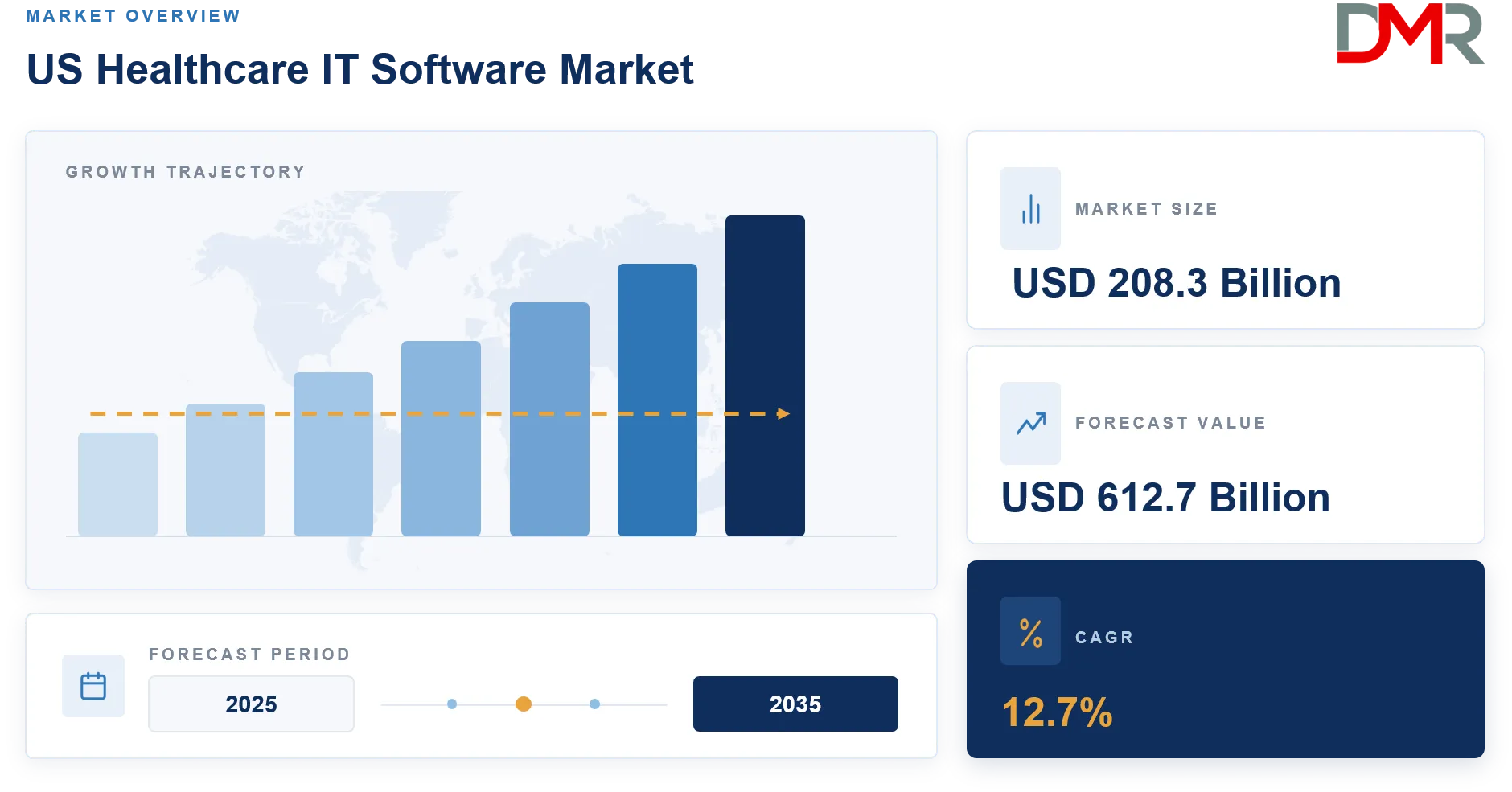
- Market Value: US Healthcare IT Software Market is valued at USD 208.3 billion in 2026 and is projected to reach USD 612.7 billion by 2035.
- CAGR: US Healthcare IT Software Market is expected to grow at a CAGR of 12.7% from 2026 to 2035.
- By Software Type Segment Analysis: Revenue Cycle Management (RCM) dominated the software type segment with an 18.4% share in 2026.
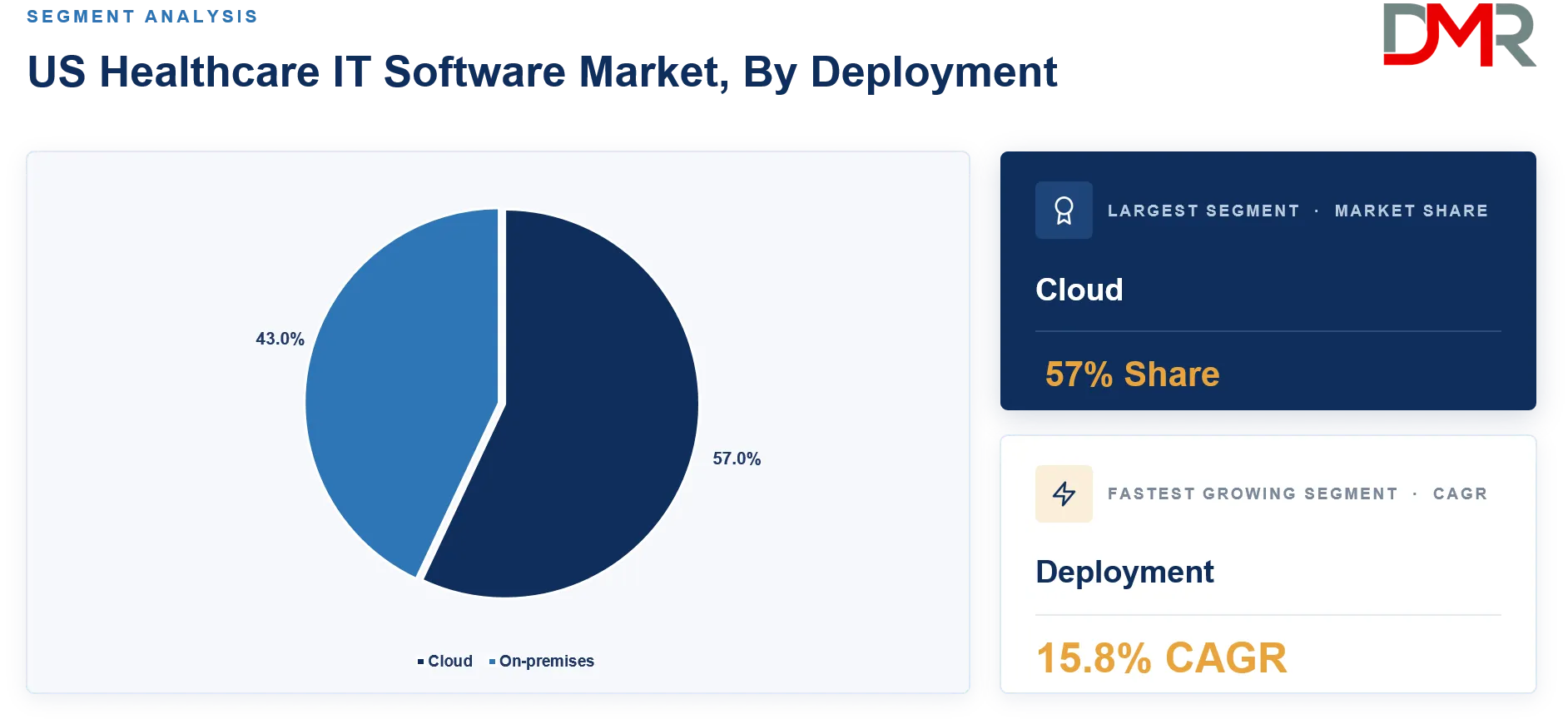
- By Deployment Segment Analysis: Cloud deployment led deployment models with a 57.0% share in 2026.
- Major Players: IQVIA, Oracle, Carestream Health, SAP, and Novarad.
What is the US Healthcare IT Software Market and its Market Size?
The US Healthcare IT Software Market size is projected to be valued at USD 208.3 billion in 2026 and is projected to reach USD 612.7 billion by 2035, expanding at a steady CAGR of 12.7% during the forecast period. The market covers software used by healthcare providers, payers, laboratories, imaging centers, pharmacies, research organizations, and other healthcare enterprises to manage clinical, administrative, financial, operational, and analytical workflows. Major solution categories include revenue cycle management, healthcare analytics, clinical information systems, medical imaging software, eClinical platforms, population health management, payer technology, telehealth, e-prescribing, laboratory information systems, and healthcare CRM.
ℹ
To learn more about this report –
Download Your Free Sample Report Here
US healthcare IT software demand is increasingly influenced by the need to connect clinical and financial data across historically fragmented systems. Interoperability has moved from a technical feature to a procurement requirement as health systems, payers, and technology vendors expand API-based data exchange. TEFCA provides a nationwide framework for secure electronic health information exchange, while CMS interoperability policies are creating additional requirements for payer APIs and prior authorization processes. These changes favor software platforms that can combine workflow automation, standards-based integration, security controls, analytics, and scalable cloud infrastructure.
Use Cases
- Revenue Cycle Optimization: Hospitals, physician groups, and ambulatory networks use healthcare IT software to manage eligibility checks, coding, claims submission, denial workflows, payment posting, patient billing, and revenue analytics. Integrated RCM platforms improve visibility across the billing cycle and allow organizations to identify reimbursement leakage, automate repetitive administrative work, and manage payer-specific rules within one workflow.
- Clinical Data and Care Management: Clinical information platforms combine patient records, laboratory results, medication information, orders, imaging data, and care plans to support coordinated clinical decisions. Interoperability is becoming more important as providers exchange information across different networks and applications. TEFCA's nationwide exchange model is increasing the strategic value of software that supports standardized and secure health data movement.
- Payer Operations and Prior Authorization: Health plans use software for claims administration, enrollment, member management, provider networks, utilization management, revenue management, analytics, and prior authorization. CMS rules are increasing demand for API-enabled payer platforms by requiring affected organizations to support expanded electronic information exchange, with major API requirements under the interoperability and prior authorization framework primarily scheduled for 2027.
- Healthcare Analytics and Population Health: Provider and payer organizations use descriptive, predictive, and prescriptive analytics to identify utilization patterns, stratify patient risk, measure quality performance, forecast resource requirements, and support value-based care programs. When connected with claims, clinical, pharmacy, and operational data, analytics platforms give management teams a broader view of cost, outcomes, capacity, and population-level health trends.
- Digital and Remote Care: Telehealth and tele-care platforms support virtual consultations, remote monitoring, follow-up care, chronic disease management, behavioral health services, and post-discharge engagement. Healthcare organizations increasingly evaluate these solutions as part of integrated digital-care architectures rather than standalone video tools, creating demand for products that connect scheduling, clinical documentation, patient communication, billing, analytics, and existing health records.
How AI/Gen AI is Transforming the US Healthcare IT Software Market?
AI is shifting healthcare software from systems that mainly record information toward platforms that can assist with administrative and clinical workflows. In revenue cycle management, vendors are applying machine learning and generative models to coding support, claim preparation, payment follow-up, denial prioritization, documentation review, and patient communication. The commercial impact is already visible in newer healthcare technology businesses. Commure reported in 2026 that its platform was deployed across more than 500 healthcare organizations and 3,000 sites, while its automation technology handled more than 85% of selected revenue-cycle tasks without human intervention. This illustrates why RCM is becoming one of the most active areas for automation investment.
Clinical and enterprise applications are also evolving through intelligent search, documentation assistance, conversational interfaces, decision support, workflow orchestration, and analytics. The opportunity is strongest when AI operates inside established clinical and administrative systems instead of becoming another disconnected application. Healthcare organizations therefore evaluate model accuracy together with access controls, auditability, data provenance, privacy, integration with existing systems, and human review. Vendors that combine AI capabilities with interoperable data architectures, healthcare-specific workflows, and enterprise governance are better positioned to secure large contracts as buyers move from experimentation toward measurable productivity and operating outcomes.
Key Drivers in the US Healthcare IT Software Market
Interoperability and Regulatory Data Exchange Requirements
Interoperability requirements are accelerating investment in healthcare IT platforms capable of exchanging data across providers, payers, patients, and public health organizations. TEFCA establishes a nationwide framework for health information exchange and is expanding beyond basic document exchange toward FHIR-based connectivity. By February 2026, HHS reported that nearly 500 million health records had been exchanged through TEFCA, compared with roughly 10 million in January 2025. This expansion increases demand for integration, identity, API, workflow, consent, and data-management software.
Pressure to Improve Administrative and Financial Efficiency
Complex billing rules, claim denials, labor-intensive administrative processes, and the need to improve cash collection are strengthening demand for revenue cycle and workflow automation software. The 18.4% RCM share in 2026 reflects the strategic importance of revenue integrity to US providers. Hospitals and physician organizations increasingly seek platforms that connect scheduling, eligibility, documentation, coding, claims, denial management, and payments. Automation is also attracting investment because it can reduce manual work while providing management teams with better visibility into reimbursement performance.
Restraints in the US Healthcare IT Software Market
Cybersecurity and Protected Health Information Risk
Healthcare software environments contain valuable clinical, financial, identity, and insurance information, making cybersecurity a central procurement and operating concern. Greater cloud connectivity, API usage, remote access, third-party applications, and health information exchange increase the number of interfaces that organizations must secure. HHS maintains Healthcare and Public Health Cybersecurity Performance Goals covering high-impact security practices. Compliance, monitoring, identity management, business continuity, incident response, and vendor-risk requirements can increase deployment costs and slow purchasing decisions for complex software environments.
Legacy Infrastructure and Integration Complexity
Large health systems often operate combinations of EHRs, imaging platforms, laboratory systems, billing applications, departmental software, acquired physician-practice systems, and custom interfaces developed over many years. Replacing or integrating these environments requires detailed data mapping, workflow redesign, testing, migration, and staff training. The challenge can reduce the speed at which organizations adopt new platforms, particularly when systems support mission-critical clinical processes. Vendors therefore compete not only on functionality but also on interoperability, implementation capability, migration tools, and compatibility with established healthcare workflows.
Growth Opportunities in the US Healthcare IT Software Market
Cloud-Native Healthcare Platforms
Cloud deployment accounted for 57.0% of the US Healthcare IT Software Market in 2026, indicating that scalable hosted infrastructure has become central to healthcare technology modernization. Opportunity remains in replacing fragmented on-premises applications with cloud platforms that support multi-site operations, centralized data management, APIs, analytics, disaster recovery, and faster software updates. Vendors can differentiate through healthcare-specific security, workload reliability, integration capabilities, configurable workflows, and hybrid migration paths for organizations that cannot move every clinical workload simultaneously.
Intelligent Revenue Cycle and Payer Automation
Revenue cycle management offers a major growth opportunity as providers and payers seek measurable returns from workflow automation. High-value applications include coding assistance, denial prediction, claim-status automation, prior authorization, payment reconciliation, patient financial engagement, and revenue forecasting. Investment activity in AI-enabled RCM platforms further highlights the commercial opportunity. Platforms able to combine automation with payer rules, clinical context, auditable decisions, and human escalation can address expensive administrative workflows without requiring organizations to rebuild their entire financial technology stack.
Trends in the US Healthcare IT Software Market
Shift Toward API-First Healthcare Architecture
US healthcare technology is moving toward API-first architectures that allow authorized information to travel between payer, provider, patient, and third-party applications. CMS interoperability requirements are reinforcing this shift through Patient Access, Provider Access, Payer-to-Payer, and Prior Authorization API initiatives. A substantial portion of the API requirements under CMS-0057-F becomes applicable primarily in 2027, making 2026 a significant preparation period for affected organizations. Software vendors with FHIR capabilities, API management, identity controls, data normalization, and integration tools are positioned to benefit.
Convergence of Clinical, Financial, and Operational Data
Healthcare buyers increasingly seek platforms that generate insight across clinical outcomes, reimbursement, staffing, utilization, patient access, and operational performance rather than maintaining separate data silos. This trend is increasing the strategic importance of healthcare analytics, data integration, cloud platforms, and population health tools. The ability to connect EHR, claims, imaging, laboratory, pharmacy, CRM, and financial information can provide executives with a more complete view of organizational performance and create a foundation for predictive analytics and workflow automation.
Research Scope and Analysis
The US Healthcare IT Software Market is segmented based on Software Type and Deployment. The study provides an in-depth analysis of key segments and sub-segments, covering their applications, industry adoption, demand patterns, technology requirements, commercial relevance, and contribution to overall market growth.
By Software Type
Revenue Cycle Management dominated the software type category with an 18.4% market share in 2026. Its leadership is supported by the direct connection between RCM technology and provider financial performance. Hospitals, physician groups, and other healthcare organizations depend on RCM software for eligibility verification, coding, charge capture, claims management, denial resolution, payment posting, patient billing, and financial analytics. Integrated platforms are gaining strategic value because they connect administrative workflows that were previously handled through separate applications. Growth opportunities are expanding through automated coding, predictive denial analysis, electronic prior authorization, payment automation, and patient financial engagement. The segment also benefits from increasing interest in measurable automation projects, where executives can evaluate technology spending through reductions in manual workload, collection delays, and avoidable revenue leakage.
ℹ
To learn more about this report –
Download Your Free Sample Report Here
By Deployment
Cloud deployment led the US Healthcare IT Software Market with a 57.0% share in 2026. Healthcare organizations are moving more workloads toward cloud environments to support scalable computing, centralized data access, remote operations, analytics, interoperability, and faster product upgrades. Cloud models can also reduce the need for individual organizations to maintain dedicated infrastructure for every application, although buyers continue to evaluate security, availability, contractual controls, data governance, and integration requirements closely. The segment is gaining further relevance as analytics and intelligent workflow applications require flexible computing resources and access to data from multiple systems. Hybrid architectures remain important for large health systems with legacy clinical assets, creating opportunities for vendors that provide phased migration, secure connectivity, API management, disaster recovery, and interoperability between cloud and on-premises environments.
The US Healthcare IT Software Market Report is Segmented on the Basis of the Following:
By Software Type
- Medical Imaging Information Systems
- Picture Archiving and Communication Systems
- Monitoring Analysis Software
- Radiology Information Systems
- Healthcare Customer Relationship Management (CRM)
- Sales
- Marketing
- Digital Commerce
- Cross-CRM
- Customer Service and Support
- Technology Solutions in the Healthcare Payers
- Analytics
- Claims Management
- Enrollment and Member Management
- Provider Management
- Clinical Decision Support
- Value Based Payments
- Revenue Management and Billing
- Personalize/CRM
- Data Management and Support
- Others
- eClinical Solutions
- Electronic Data Capture (EDC) & CDMS
- Clinical Trial Management System (CTMS)
- Clinical Data Integration Platforms
- Electronic Clinical Outcome Assessment (eCOA)
- Safety Solutions
- Clinical Analytics Platforms
- Electronic Trial Master File (eTMF)
- Randomization and Trial Supply Management (RTSM)
- eConsent
- Tele-healthcare
- Revenue Cycle Management
- Computerized Provider Order Entry Systems
- Electronic Prescribing Systems (E-Prescribing Solutions)
- Laboratory Information
- Clinical Information Systems
- Population Health Management (PHM)
- Digital Healthcare Supply Chain Management
- Healthcare Analytics
- Prescriptive Analysis
- Predictive Analysis
- Descriptive Analysis
By Deployment
Competitive Landscape
The US Healthcare IT Software Market has a broad competitive structure spanning enterprise technology providers, healthcare-specialist software companies, analytics vendors, imaging technology businesses, consulting firms, payer technology providers, and cloud infrastructure companies. Competition increasingly centers on interoperability, integrated workflow coverage, cloud deployment, security, analytics, automation, and the ability to connect with established clinical systems. Oracle, IBM, SAP, Hewlett Packard Enterprise, and Accenture bring large-enterprise technology and transformation capabilities, while IQVIA has strong exposure to healthcare data, analytics, and life-sciences technology. GE HealthCare, Philips, Carestream Health, Agfa-Gevaert, and Novarad participate in imaging and clinical technology ecosystems. Optum combines healthcare technology with payer and provider workflow expertise, while athenahealth and Veradigm compete across ambulatory and connected healthcare applications. Vendors are expected to strengthen competitive positioning through product integration, cloud modernization, API connectivity, workflow automation, analytics, strategic partnerships, and acquisitions as healthcare organizations seek fewer disconnected applications and more interoperable enterprise platforms.
Some of the prominent players in the US Healthcare IT Software Industry are:
- IQVIA
- Oracle
- Carestream Health
- SAP
- Novarad
- McKesson Corporation
- Verisk Analytics, Inc.
- GE Healthcare
- eMDs, Inc.
- Accenture
- SAS Institute, Inc.
- Koninklijke Philips N.V.
- Optum, Inc.
- Agfa-Gevaert Group
- Veradigm Inc.
- Hewlett Packard Enterprise Development LP
- IBM
- Athenahealth, Inc.
- Others
Regulatory Landscape
The US Healthcare IT Software Market operates within a complex regulatory environment shaped by health data privacy, interoperability, cybersecurity, reimbursement, and electronic information exchange requirements. HIPAA remains central to protecting electronic protected health information, while the HITECH Act strengthened privacy, security, and breach-related obligations. The 21st Century Cures Act and information-blocking rules have increased pressure on healthcare organizations and software developers to enable appropriate electronic access and exchange. TEFCA is advancing nationwide health information exchange, while CMS interoperability and prior authorization policies are driving adoption of FHIR-based APIs across affected payer workflows. Software vendors must therefore build privacy controls, access management, auditability, interoperability, and security into product architecture. Regulatory alignment is becoming a competitive factor as hospitals and payers prioritize platforms that can support compliance while reducing administrative complexity.
Investment and White Space Analysis
Investment opportunities in the US Healthcare IT Software Market are moving toward solutions that address costly workflows where clinical, financial, and administrative systems remain fragmented. Revenue cycle automation represents a major opportunity because RCM held an 18.4% market share in 2026, while cloud deployment, with a 57.0% share, creates room for cloud-native platforms that can replace legacy applications. Attractive white spaces include automated prior authorization, denial prevention, clinical documentation workflows, FHIR interoperability, healthcare cybersecurity, patient financial engagement, predictive analytics, and unified payer-provider data platforms. Smaller hospitals, ambulatory networks, specialty practices, and independent provider groups also create opportunities for modular solutions that require less implementation effort than traditional enterprise systems. Investors and vendors can gain an advantage by targeting applications with measurable labor savings, faster reimbursement, stronger data exchange, and clear integration with established EHR and clinical ecosystems.
Recent Developments
-
August 2026: CMS advanced its Early Adopters program for electronic prior authorization (ePA), pushing providers and vendors toward FHIR-based APIs ahead of the 2027 compliance deadline; this is spurring rapid updates from EHR, clearinghouse, and revenue-cycle platforms to embed real-time eligibility and authorization checks.
- June 2026: Accenture agreed to acquire Alfahealth (an Engineering Group subsidiary) to strengthen its healthcare IT services portfolio, signaling continued consolidation among consulting-led integrators supporting EHR optimization, data interoperability, and AI-enabled workflow projects for US providers.
- March 2026: Oracle Health rolled out its Clinical AI Agent across US health systems, reporting large reductions in physician documentation time and ambulatory charting burden; the move intensifies competition with ambient scribe and EHR-native AI offerings from rivals such as Microsoft/Nuance, Epic, and others.
Report Details
| Report Characteristics |
| Market Size (2026) |
USD 208.3 Bn |
| Forecast Value (2035) |
USD 612.7 Bn |
| CAGR (2026–2035) |
12.7% |
| Historical Data |
2021 – 2025 |
| Forecast Data |
2027 – 2035 |
| Base Year |
2025 |
| Estimate Year |
2026 |
| Segments Covered |
By Software Type (Medical Imaging Information Systems {Picture Archiving and Communication Systems, Monitoring Analysis Software, and Radiology Information Systems}, Healthcare Customer Relationship Management (CRM) {Sales, Marketing, Digital Commerce, Cross-CRM, and Customer Service and Support}, Technology Solutions in the Healthcare Payers {Analytics, Claims Management, Enrollment and Member Management, Provider Management, Clinical Decision Support, Value based Payments, Revenue Management and Billing, Personalize/CRM, Data management and support, and Others}, eClinical Solutions {Electronic Data Capture (EDC) & CDMS, Clinical Trial Management System (CTMS), Clinical Data Integration Platforms, Electronic Clinical Outcome Assessment (eCOA), Safety Solutions, Clinical Analytics Platforms, Electronic Trial Master File (eTMF), Randomization and Trial Supply Management (RTSM), eConsent}, Tele-healthcare {Tele-Health and Tele-care}, Revenue Cycle Management {Standalone and Integrated}, Computerized Provider Order Entry Systems, Electronic Prescribing Systems (E-Prescribing Solutions), Laboratory Information, Clinical Information Systems, Population Health Management (PHM), Digital Healthcare Supply Chain Management, and Healthcare Analytics {Prescriptive Analysis, Predictive Analysis, and Descriptive Analysis}), By Deployment (On-premises and Cloud) |
| Regional Coverage |
The US |