Market Snapshot
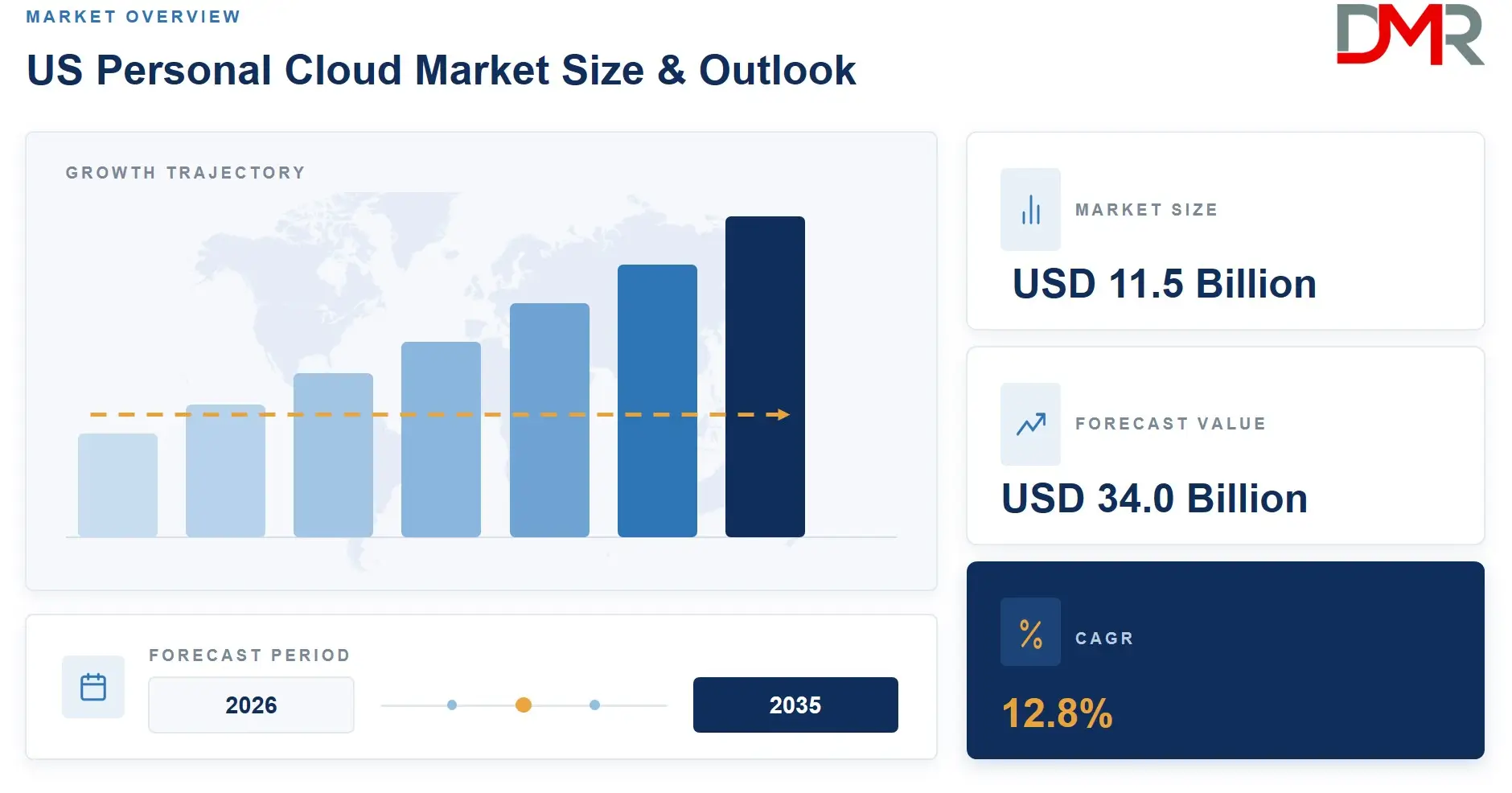
- Market Size (2026): USD 11.5 Bn
- Forecast Value (2035): USD 34.0 Bn
- CAGR (2026-2035): 12.8%
- Leading By Offering (2026): Cloud Storage & File Hosting, around 44%
- Leading By Deployment Mode (2026): Public Cloud, close to 58%
- Key Players: Google LLC, Apple Inc., Microsoft Corporation and others
What is US Personal Cloud Market and its Market Size?
The US Personal Cloud Market size is estimated to reach USD 11.5 Bn in 2026 and is further anticipated to reach USD 34.0 Bn by 2035, at a CAGR of 12.8%.
ℹ
To learn more about this report –
Download Your Free Sample Report Here
The figures set out here cover consumer demand generated inside the United States, meaning the storage capacity, subscriptions and connected hardware that American households and individuals actually purchase and use, not the worldwide revenue booked by vendors headquartered domestically. Personal cloud in this scope spans hosted file storage and synchronization, automated device backup, photo and video libraries, home network attached storage that mimics a private cloud, and the value added layers, such as ransomware recovery and shared family vaults, that sit on top of raw capacity.
The product serves individual consumers, multi-person households and a growing tier of prosumers and home office workers who treat storage as infrastructure rather than an afterthought. Buyers turn to personal cloud because their phones, cameras and smart home devices generate more data than local storage can comfortably hold, and because losing a decade of family photos to a failed hard drive is a risk most households now understand. Purchase decisions increasingly happen at the device level, bundled into a phone, laptop or router purchase, rather than as a standalone subscription search.
What is structurally changing is the blending of storage with on-device intelligence. Camera roll organization, subject search and duplicate cleanup used to be manual chores; they are now automated inside the storage tier itself, which raises the perceived value of a paid plan and slows the churn that once pushed budget conscious users toward free tiers. At the same time, a expanding patchwork of state level data privacy statutes is pushing providers toward clearer disclosures on where and how consumer data is retained, a dynamic that shapes vendor positioning as much as price per terabyte does.
Use Cases
- Family Photo and Video Preservation: Households with young children run automatic camera roll backup across multiple phones into a shared family library, replacing the external hard drive that one parent used to manage manually, so memories survive a lost or damaged device without anyone having to remember to plug anything in.
- Remote and Hybrid Work Document Access: Home office professionals sync working files across a laptop, a tablet and a desktop so the same document is current on every device, cutting the version confusion that came from emailing attachments to themselves between locations.
- Ransomware and Device Failure Recovery: Individual users restore an entire device image after a ransomware incident or drive failure using automated cloud backups, avoiding the data loss and downtime that came from relying on a single local copy.
- Home Network Storage for Cost Conscious Households: Budget aware consumers buy a personal NAS device once instead of paying an indefinite monthly subscription, trading a higher upfront cost for a one time hardware purchase that still delivers remote access and automatic phone backup.
Key Takeaways
- Market Size & Share: The market is projected to more than double between 2026 and 2035, expanding from an estimated USD 11.5 Bn to USD 34.0 Bn.
- Offering Analysis: Cloud Storage & File Hosting is expected to account for approximately 44% of 2026 revenue, the single largest offering category.
- Demand Concentration: Individual consumers and multi person household plans together are set to represent close to 75% of 2026 end user demand, ahead of prosumer and freelancer buyers.
- AI Integration: On-device and cloud hybrid AI features, particularly automated photo organization and ransomware detection, are becoming a primary driver of paid tier upgrades.
- Distribution Shift: Direct to consumer app and web sales are projected to hold around 52% of 2026 distribution, with OEM device bundling gaining ground.
- Regulatory Pressure: A widening set of state level privacy statutes is reshaping how providers disclose data retention and cross border transfer practices.
How AI/Gen AI is Transforming the US Personal Cloud Market?
Artificial intelligence is changing what a personal cloud subscription is expected to include, shifting the product from passive storage toward an active assistant that organizes, protects and interprets a household's data. Computer vision models now scan photo libraries for faces, objects and locations without the user tagging anything, while anomaly detection models watch backup patterns for the sudden mass file encryption that signals a ransomware attack, often halting a sync job before damage spreads across every connected device.
Providers are not forcing a generative angle where none exists. Much of the near term impact is operational: smarter deduplication that trims storage bills, predictive capacity alerts before a plan fills up, and automated categorization that turns an unsorted camera roll into a searchable archive. Where generative techniques do appear, they tend to sit closer to editing than to storage itself.
- Computer Vision Photo Search: natural language queries such as "show me the dog at the beach" now return results without manual tagging.
- Generative Photo and Video Editing: object removal and video summarization tools are increasingly bundled into paid storage tiers rather than sold as separate apps.
- Anomaly Detection for Ransomware Defense: behavioral models flag mass file changes in near real time and can pause a sync before an infected device overwrites clean backups.
- Predictive Storage Management: usage forecasting models nudge users toward a plan upgrade or a cleanup action before a device runs out of space.
Key Drivers in the US Personal Cloud Market
Two forces, distinct in kind, are pushing household and individual spending on personal cloud higher through the forecast period.
- Rising Device Level Data Generation: The average American household now owns several cameras across phones, tablets, doorbells and connected appliances, and each generation of smartphone camera produces larger photo and video files than the last. Local storage on a phone fills within months for many users, which pushes them toward an automatic cloud backup plan rather than manually managing files. This is a volume driven force rather than a price driven one: even users who resist subscriptions eventually run out of free tier space and convert to paid capacity, and family sharing plans multiply that conversion across every household member on a single account.
- Bundling Into Device and Ecosystem Purchases: Smartphone, laptop and router manufacturers increasingly bundle a starter cloud allotment into the purchase price, using it as a retention tool that keeps a household inside one ecosystem across its next several device upgrades. This lowers the friction of first adoption, since the consumer never has to actively choose a storage provider, and it creates a large addressable base of free tier users that providers can later convert to paid plans as their storage needs grow past the bundled allotment.
Restraints in the US Personal Cloud Market
Two genuine brakes temper the pace of expansion, and naming them plainly is what keeps this analysis credible.
- Fragmented State Level Privacy Regulation: With no single federal consumer privacy law, providers must comply with a growing and inconsistent set of state statutes covering data retention, breach notification and consumer deletion rights. Complying separately in each jurisdiction raises legal and engineering overhead, particularly for smaller specialist providers that lack the compliance teams of the largest platforms, and the resulting cost is passed through in pricing or absorbed as margin pressure that slows expansion into lower income household segments.
- Free Tier Cannibalization and Price Sensitivity: Several of the largest providers offer meaningful free storage bundled with an existing account, and many households actively manage multiple free accounts across providers rather than paying for a single consolidated plan. This behavior caps average revenue per user for the market's mass market segment and forces providers to compete on feature depth, such as AI organization or family sharing, rather than on raw storage price alone.
Growth Opportunities in the US Personal Cloud Market
The clearest white space sits where storage intersects with a buyer group or business model that has not yet been fully served.
- Freelancer and Micro-Business Storage Bundles: The rapidly expanding population of independent contractors and single person businesses needs storage that blends personal and light professional use, such as client file sharing and invoice archiving, without paying for a full enterprise cloud seat. Providers that package personal cloud storage with lightweight business features, such as e-signature integration or client portals, can capture a buyer group that current consumer plans underserve and that enterprise platforms overprice for a single user.
- Aging-in-Place and Multi-Generational Household Plans: As more households manage shared responsibility for an aging relative's documents, photos and medical paperwork, demand is opening for family plans explicitly designed around shared caregiving access rather than simple storage pooling. A provider that builds permissioned, easy to navigate shared vaults for this use case can differentiate on trust and simplicity rather than competing purely on price per terabyte.
Trends in the US Personal Cloud Market
Beyond the drivers already discussed, several shifts in how the product is built and sold are reshaping competitive position.
- Convergence of Cloud Subscriptions and Local Hardware: Personal NAS devices increasingly ship with their own cloud relay service bundled in, blurring the line between a hardware purchase and a subscription business, and pushing hardware vendors to compete on software polish rather than drive capacity alone.
- Consolidation of Family Accounts Around a Single Ecosystem: Households are increasingly standardizing on one primary storage ecosystem across every family member's device rather than running separate accounts per person, a shift driven by the convenience of shared photo libraries and unified billing rather than by any single feature.
Research Scope and Analysis
Segment performance is assessed across five axes: offering, deployment mode, end user, subscription model and distribution channel. Each axis identifies the sub-segment carrying the largest share of 2026 revenue and the one expanding fastest through 2035, along with the commercial reason behind each position.
ℹ
To learn more about this report –
Download Your Free Sample Report Here
By Offering
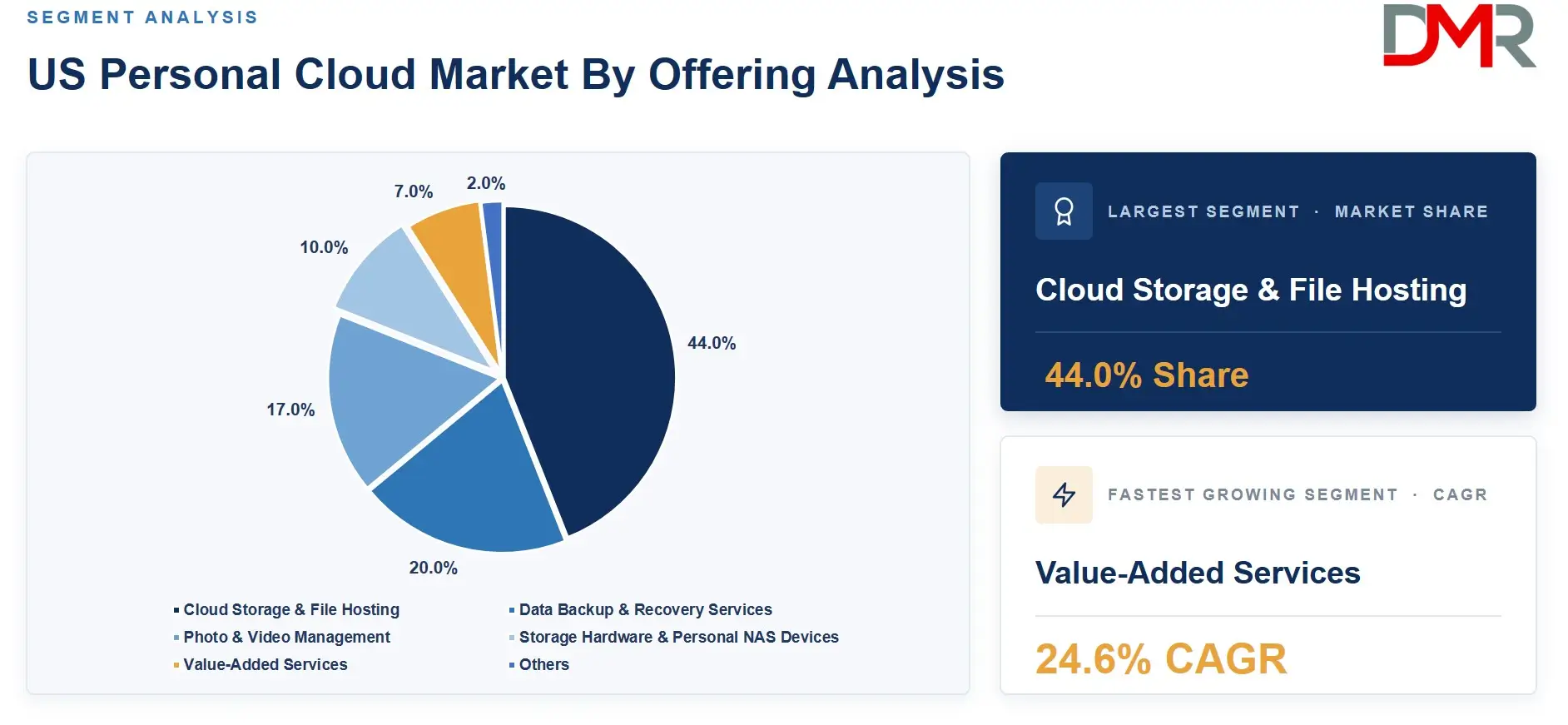
Cloud Storage & File Hosting is projected to hold the largest share by offering in 2026, accounting for approximately 44% of revenue, since it is the base layer every other offering sits on top of and carries the largest installed base of paying subscribers built up over more than a decade. Growth, however, is concentrated in Value-Added Services, expanding at a CAGR of 24.6% between 2026 and 2035 as ransomware recovery guarantees, AI organization tools and shared family vaults shift from optional add-ons to expected features that justify a premium tier upgrade.
By Deployment Mode
Public Cloud is expected to remain the largest deployment mode in 2026, holding close to 58% of revenue, reflecting the convenience of zero maintenance access from any device without a household needing to manage its own hardware. The steeper trajectory sits with Multi-Cloud deployment, projected at a CAGR of 23.9% through 2035, as increasingly tech literate households deliberately split backups across more than one provider to reduce the risk of a single account lockout or service outage costing them their entire archive.
By End User
Individual Consumers are set to account for around 47% of 2026 revenue by end user, the largest single segment, because most personal cloud adoption still begins with a single person protecting their own phone and laptop before any household plan is considered. The fastest growth belongs to Freelancers & Micro-Businesses, forecast at a CAGR of 23.2% between 2026 and 2035, pulled by the rising number of independent workers who need reliable client file storage without the cost of a dedicated business cloud seat.
By Subscription Model
Tiered Monthly Subscription plans are expected to lead by subscription model in 2026 at approximately 46% of revenue, since monthly billing remains the default checkout choice and gives households the flexibility to scale storage up or down as needs change. Annual and Bundled Subscription plans are growing fastest, at a CAGR of 22.9% through 2035, as providers increasingly discount yearly commitments bundled with device purchases to lock in retention over a longer period.
By Distribution Channel
Direct-to-Consumer app and web sales are projected to remain the largest distribution channel in 2026, close to 52% of revenue, since most storage upgrades happen inside the provider's own app at the moment a device notifies a user that it is nearly full. Telecom Carrier Bundled distribution is expanding fastest, at a CAGR of 21.8% through 2035, as mobile carriers increasingly package storage allotments into premium phone plans to differentiate on value beyond network coverage alone.
The US Personal Cloud Market Report is Segmented Based on the Following
By Offering
- Cloud Storage & File Hosting
- Data Backup & Recovery Services
- Photo & Video Management
- Storage Hardware & Personal NAS Devices
- Value-Added Services
- Others
By Deployment Mode
- Public Cloud
- Private/Personal Cloud (NAS-Based)
- Hybrid Cloud
- Multi-Cloud
- Others
By End User
- Individual Consumers
- Household & Family Plans
- Prosumers & Home-Office Users
- Freelancers & Micro-Businesses
- Others
By Subscription Model
- Tiered Monthly Subscription
- Freemium/Ad-Supported
- Annual/Bundled Subscription
- Pay-As-You-Go
- Others
By Distribution Channel
- Direct-to-Consumer (App/Web)
- OEM & Device Bundled
- Telecom Carrier Bundled
- Retail & Electronics Stores
- Others
Regulatory Landscape
The United States still has no single federal consumer data privacy statute, so personal cloud providers operate against a patchwork of state laws led by California's Consumer Privacy Act and its amendments, joined by a growing list of comparable statutes in states such as Virginia, Colorado, Connecticut and Texas. What is shifting now is the pace of new state entrants and the tightening of requirements around data minimization, breach notification timelines and consumer deletion rights, forcing providers to build compliance workflows that flex by user location rather than applying one national policy. The commercial opening sits with providers who turn compliance into a trust signal, publishing clear data residency and retention disclosures as a differentiator rather than a legal obligation buried in fine print. The risk is a further increase in compliance cost that disproportionately burdens smaller specialist providers, potentially accelerating consolidation around the largest platforms that can absorb the overhead, which in turn shapes competitive intensity and pricing power across the market.
Technology Analysis
On-device and cloud hybrid artificial intelligence has moved from an experimental feature to a baseline expectation, with photo organization, object search and ransomware anomaly detection increasingly processed locally before syncing only the necessary metadata to the cloud, which reduces bandwidth cost while preserving the AI experience. What is shifting now is the balance of compute between the device and the data center, as more capable on-device chips let providers keep sensitive processing local for privacy conscious users while still centralizing the heavier generative editing workloads. The commercial opening lies in providers that market this hybrid architecture explicitly as a privacy advantage, appealing to households wary of sending raw photo and document data to third party servers for processing. The constraint is hardware fragmentation. Not every connected device carries the on-device AI silicon needed for local processing, which forces providers to maintain two technology paths simultaneously and slows the uniform rollout of these features across the full installed base, a cost that ultimately affects margin and the pace of feature parity across price tiers.
Competitive Landscape
The US Personal Cloud Market is moderately concentrated at the top, with a handful of device and platform ecosystem owners capturing the majority of paid subscribers through pre-installed defaults on phones, laptops and operating systems, while a long tail of specialist providers competes on privacy, price per terabyte or a specific use case such as ransomware recovery. Competition centers on bundling depth, AI feature parity and cross device convenience rather than storage price alone, since most consumers now expect a baseline of intelligent organization as part of any paid tier. Dominant strategies include folding storage into a broader subscription bundle that also carries productivity or entertainment value, pursuing hardware plus cloud relay combinations that reduce ongoing subscription friction, and courting privacy focused switchers with end to end encryption as a headline differentiator.
Some of the Prominent Players in the US Personal Cloud Market Are
- Google LLC
- Apple Inc.
- Microsoft Corporation
- Amazon.com Inc.
- Dropbox Inc.
- Box Inc.
- IBM Corporation
- Western Digital Corporation
- Seagate Technology Holdings plc
- Samsung Electronics Co. Ltd.
- Backblaze Inc.
- IDrive Inc.
- Carbonite (OpenText)
- Egnyte Inc.
- Wasabi Technologies
- SpiderOak Inc.
- Nasuni Corporation
- Sync.com Inc.
- pCloud AG
- Icedrive Ltd
- Tresorit
- MEGA Limited
- Internxt
- Proton AG
- Synology Inc.
- QNAP Systems Inc.
- NETGEAR Inc.
- Micron Technology Inc.
- Buffalo Americas Inc.
- UGREEN Group Limited
- TerraMaster
- ASUSTOR Inc.
- Toshiba Corporation
- AT&T Inc.
- T-Mobile US Inc.
- Comcast Corporation
- Verizon Communications Inc.
- Lenovo Group Limited
- Best Buy Co. Inc.
- Costco Wholesale Corporation
- Other Key Players
Recent Developments
- In June 2026, Synology unveiled an expanded BeeStation and BeeStation Plus personal cloud hardware lineup at COMPUTEX, positioning the devices as a privacy focused alternative to subscription only storage for American households.
- In May 2026, Google restructured its Google One AI storage tiers around its I/O event, doubling entry level plan capacity and cutting the price of its top storage and AI bundle, intensifying pressure on rivals to bundle AI features rather than compete on raw price per terabyte.
- In April 2026, Backblaze changed its backup client to exclude files synced through other cloud storage folders, a shift the company attributed to platform level restrictions that limit how third party tools can access cloud managed files on consumer devices.
- In April 2026, Synology launched the BeeStation BST151-4T, a single drive personal cloud device aimed at consumers who want centralized photo backup and remote file access without configuring a full network attached storage system.
Report Details
| Report Characteristics |
| Market Size (2026) |
USD 11.5 Bn |
| Forecast Value (2035) |
USD 34.0 Bn |
| CAGR (2026-2035) |
12.8% |
| Historical Data |
2021 - 2025 |
| Forecast Data |
2026 - 2035 |
| Base Year |
2025 |
| Segments Covered |
By Offering, By Deployment Mode, By End User, By Subscription Model, and By Distribution Channel |
| Regional Coverage |
The US |
Frequently Asked Questions
How big is the US Personal Cloud Market?
▾ The US Personal Cloud Market is estimated at USD 11.5 Bn in 2026 and is projected to reach USD 34.0 Bn by 2035, reflecting sustained growth in device level data generation, household backup adoption and AI driven storage features across the United States.
What is the growth rate of the US Personal Cloud Market?
▾ The market is projected to expand at a CAGR of 12.8% between 2026 and 2035. Growth is fastest within Value-Added Services and Multi-Cloud deployment, both pulled by rising demand for AI organization tools, ransomware recovery guarantees and multi provider backup strategies among tech literate households.
What is driving demand in the US Personal Cloud Market?
▾ Demand is driven primarily by rising device level data generation. American households now produce more photo, video and document data across phones, tablets and connected devices than local storage can comfortably hold, pushing a growing share of free tier users toward paid capacity as bundled allotments run out year after year.
Who are the key players in the US Personal Cloud Market?
▾ Prominent players include Google LLC, Apple Inc., Microsoft Corporation, Amazon.com Inc., Dropbox Inc. and Backblaze Inc., alongside specialist providers and personal NAS hardware vendors serving privacy focused and cost conscious household segments.
Which offering leads the US Personal Cloud Market?
▾ Cloud Storage & File Hosting leads the market, accounting for approximately 44% of 2026 revenue, reflecting its role as the foundational layer that backup, photo management and value added services are built on top of across nearly every provider's product line.
Which deployment mode is growing fastest in the US Personal Cloud Market?
▾ Multi-Cloud deployment is the fastest growing mode, forecast at a CAGR of 23.9% through 2035, as increasingly tech literate households deliberately spread backups across more than one provider to reduce the risk of a single account lockout or outage costing them their entire archive.
What role does artificial intelligence play in the US Personal Cloud Market?
▾ Artificial intelligence increasingly organizes photo libraries, detects ransomware through anomaly monitoring and predicts when a household will need a storage upgrade, turning the US Personal Cloud Market product from passive storage into an active assistant that shapes which paid tier a household ultimately chooses.